DigitalRegistrar.com warned me a month ago that my 4dsolutions.net domain name was set to expire.
But when push came to shove I forgot to reregister, resulting in this temporary outage in service.
Maybe my spam filter deflected the urgent warning (like the one I got last year around this time). Given my level of business, that wouldn't have to be my excuse.
Anyway, I've reupped for two years effective immediately. It'll take about 24 hours to repopulate the domain name servers. My apologies for the inconveniece (to me as well).
Wednesday, September 06, 2006
Monday, September 04, 2006
Across from the Blue Nile
Now I'm posting from one of Portland's many coffee shops, using a Personal Telco node. Although it's a holiday, with few cars on the road (for a Monday morning), I'm electing to get work done. Family members are shopping nearby. I'm having a 16 oz. latte + bagel & cream cheese (toasted).
John Brawley on Synergeo has been helping me hammer out an updated way of casting the Synergetics namespace. We've been focusing on the "Nature not waiting to use Pi" thread, using that to pry apart two memes: events unfolding in time, implying "more to come" versus eternal principles, already operating if only dimly understood. We "look forward" to understanding more later ("forward" is a somewhat metaphorical direction), yet Plato assures us that "knowledge is recollection," a kind of remembering + networking (Erhard's "natural knowing"?).
Over on the community college circuit, I'm trying to interest the math profs in Python generators. I think of them as internal combustion engines, with an "infinite loop" piston (while True:...). Each cycle, the generator pauses at yield (a key word) and spits back an interim result. The next method is what fires each cycle (we have several ways of triggering it). My latest example: an engine by Ramanujan that converges to 1/π. Using Python's new Decimal type within a context of 100-digit precision, I was able to match an authoritative Published Pi to like 98 digits.
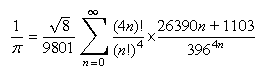 Ramanujan's Generator for 1/πPython is a clean OO implementation and inspires clear thinking about a lot of topics, including namespaces. Our Python Nation is so fortunate to have these talented professionals (Peters, Lundh, Barry, Kuchling, Holden... Guido) attending to the emergence of our core creature over the years. The growth process is somewhat organic, in that it takes surprising turns. Who would have anticipated decorator syntax for example, back in the days of Python 1.5.2? And yet there's plenty of continuity as well, a sense of maturing, of following some plan.
OK, there's my signal. Gotta go...
Later, from Lloyd Center Food Court:
Finding a wall plug was next to impossible (long delay) -- lots of cushy chairs, but no AC. No free wireless. True, $4.00 on my Visa for 2 hours is cheap (from AT&T through Barnes & Noble -- very low signal from up here) but I feel nickle and dimed. Definitely a more money grubbing atmosphere. The American flag is huge, a tip-off that "LAWCAP was here" (a faint whiff of decaying meat). It's still a well-kept facility though, neat and clean. The ice rink has a Zamboni.
So many business class Americans still need their government to tie its own hands, lest it set a shining example of customer service, way better than what the private sector provides at a much higher cost (especially when you factor in all the externalities).
That'd be too threatening to the prevailing ideology, a simplistic "capitalism good versus socialism bad" Dick and Jane mumbo jumbo. The Romano-fascist zombie Corporations tolerate a public sector (especially a bully club military), but they don't want any real competition when it comes to brand loyalty -- unless the flag and eagle shields are really theirs alone to control.
Leave the real governance to United Fruit is the Company's message, and let the USA too be our Banana Republic ["hokey pokey" playing from mall speakers].
This wifi is close to unusable -- I'll finish this later. Time to grab $100 of my own money from the ATM. We're buying up a storm here today.
John Brawley on Synergeo has been helping me hammer out an updated way of casting the Synergetics namespace. We've been focusing on the "Nature not waiting to use Pi" thread, using that to pry apart two memes: events unfolding in time, implying "more to come" versus eternal principles, already operating if only dimly understood. We "look forward" to understanding more later ("forward" is a somewhat metaphorical direction), yet Plato assures us that "knowledge is recollection," a kind of remembering + networking (Erhard's "natural knowing"?).
Over on the community college circuit, I'm trying to interest the math profs in Python generators. I think of them as internal combustion engines, with an "infinite loop" piston (while True:...). Each cycle, the generator pauses at yield (a key word) and spits back an interim result. The next method is what fires each cycle (we have several ways of triggering it). My latest example: an engine by Ramanujan that converges to 1/π. Using Python's new Decimal type within a context of 100-digit precision, I was able to match an authoritative Published Pi to like 98 digits.
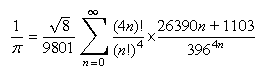 Ramanujan's Generator for 1/π
OK, there's my signal. Gotta go...
Later, from Lloyd Center Food Court:
Finding a wall plug was next to impossible (long delay) -- lots of cushy chairs, but no AC. No free wireless. True, $4.00 on my Visa for 2 hours is cheap (from AT&T through Barnes & Noble -- very low signal from up here) but I feel nickle and dimed. Definitely a more money grubbing atmosphere. The American flag is huge, a tip-off that "LAWCAP was here" (a faint whiff of decaying meat). It's still a well-kept facility though, neat and clean. The ice rink has a Zamboni.
So many business class Americans still need their government to tie its own hands, lest it set a shining example of customer service, way better than what the private sector provides at a much higher cost (especially when you factor in all the externalities).
That'd be too threatening to the prevailing ideology, a simplistic "capitalism good versus socialism bad" Dick and Jane mumbo jumbo. The Romano-fascist zombie Corporations tolerate a public sector (especially a bully club military), but they don't want any real competition when it comes to brand loyalty -- unless the flag and eagle shields are really theirs alone to control.
Leave the real governance to United Fruit is the Company's message, and let the USA too be our Banana Republic ["hokey pokey" playing from mall speakers].
This wifi is close to unusable -- I'll finish this later. Time to grab $100 of my own money from the ATM. We're buying up a storm here today.

Friday, September 01, 2006
Lunch Break
So I'm sitting in my conference room office, waiting for the boss to come by. She wears several hats and our schedules are sometimes hard to synchronize. Anyway, it's lunch time and the cafeterias are bustling. I went through twice: salad bar and Starbucks Iced Coffee Light (in a can), then for a Sierra Mist Free (plastic bottle: no sugar, calories or caffeine).
Given the medical ambience around here, I like to eat virtuously. At home, I'm more likely to dig into the twinkie basket or whatever.
For clothing, I'm wearing tan colored trousers, a fancy dark gray Men's Warehouse blazer (three buttons), with a light blue cross-hatch pattern on the collar shirt. I'm wearing comfortable light-colored sneakers, which is a bit off protocol, but if I call 'em deck shoes, and think how that matches my Princeton University sticker on Razz, it all fits. Very F. Scott (plus I was on a 1947 Chris Craft much of yesterday, more casually attired).
Oh, and let's not forget the tan OSCON bag (a favorite accessory, matches the shoes), I'm pretty sure the same one I took to London on Air Canada and introduced on TV -- although I used to have two, and one's gone missing, so there's a bit of a mystery here (along with what happened to Robin, Razz's predecessor, swiped from the Lloyd Center while I was watching Troy).
I was chatting about Synergetics with Tim Stockton earlier this morning on Yahoo!, hyping my website, which one of my spiders says contains 118 pages (it gave me a list). Given schools are coming back into session, I'm keen to get more focus on the A & B Modules, component building blocks of our concentric hierarchy constituents ("we" being the gnu math teachers I'm always writing about). I must add those to rbf.py one of these days -- or maybe someone else wants to take it in that direction, given it's free and open source and all that.
OK, the boss is on her way over (she was managing some crisis across the way), so lunch break is just about over. More later.
Given the medical ambience around here, I like to eat virtuously. At home, I'm more likely to dig into the twinkie basket or whatever.
For clothing, I'm wearing tan colored trousers, a fancy dark gray Men's Warehouse blazer (three buttons), with a light blue cross-hatch pattern on the collar shirt. I'm wearing comfortable light-colored sneakers, which is a bit off protocol, but if I call 'em deck shoes, and think how that matches my Princeton University sticker on Razz, it all fits. Very F. Scott (plus I was on a 1947 Chris Craft much of yesterday, more casually attired).
Oh, and let's not forget the tan OSCON bag (a favorite accessory, matches the shoes), I'm pretty sure the same one I took to London on Air Canada and introduced on TV -- although I used to have two, and one's gone missing, so there's a bit of a mystery here (along with what happened to Robin, Razz's predecessor, swiped from the Lloyd Center while I was watching Troy).
I was chatting about Synergetics with Tim Stockton earlier this morning on Yahoo!, hyping my website, which one of my spiders says contains 118 pages (it gave me a list). Given schools are coming back into session, I'm keen to get more focus on the A & B Modules, component building blocks of our concentric hierarchy constituents ("we" being the gnu math teachers I'm always writing about). I must add those to rbf.py one of these days -- or maybe someone else wants to take it in that direction, given it's free and open source and all that.
OK, the boss is on her way over (she was managing some crisis across the way), so lunch break is just about over. More later.
Wednesday, August 30, 2006
Delinquent Dog
Like DEQ, Multnomah County Animal Services has this expiring tag system, a TTL stamp after which you're branded "out of compliance." And so we got a Final Notice regarding our Sarah Angel (a postcard via USPO), by this time past due for her license renewal. We'd need to renew immediately, or a Notice of Infraction for Keeping an Unlicensed Animal would be issued, per Multnomah County Code 13:101.
I took this notice pretty seriously (I'm quite loyal to Sarah, as she is to me), plus was happy to discover that parts of this process have already been computerized. I paid my fee over the web, then phoned the vet to request proof of the necessary vaccinations be faxed to HQS. That's a lot what the expiring tag system is really about: seeing to the ongoing provision of healthcare for all the pets in our County -- ditto for motorvehicles and DEQ's tagging system.
All this reminds me of comments at Wanderers this morning, about how Corporations used to get expiring tags (licenses to do business), before being granted these "in perpetuity" privileges. Giant corporations needn't run an obstacle course every few years, to prove continued fitness, because "who does government think it is, to judge us?"
But then ordinary citizens get judged. Sarah Angel might have gone to jail. It's really quite the double standard.
According to Thom Hartmann's research, Corporations jumped on an elevator called "The Fourteenth Amendment" after the USA Civil War. This constitutional amendment was designed to elevate black people, restoring their "fully human" status, after the long "slavery is God's Will" interlude. But the railroads saw a loophole: if we're elevating the not-yet-fully-human to human these days (in terms of legal rights), why not hitch a ride on the bandwagon?
To make a long story short, thanks to some creative rule changes, what had been considered "artificial persons" in earlier days, were now not only "persons" in the eyes of the law, but quasi-immortal beings as well (no TTL stamps -- like vampires, likewise soulless).
I haven't had time to cross-check all of Hartmann's references (Grunch of Giants was one of them), but given how devilishly clever the white man is, at getting around his own laws sometimes, I'm quite willing to believe him. Sounds just like what a clever private railroad would to, if wanting more power against a USA public executive branch: become a giant on paper, a limited liability behemoth, a bully with nothing to lose (because the real human stakeholders stay quietly invisible, jerking the strings).
I took this notice pretty seriously (I'm quite loyal to Sarah, as she is to me), plus was happy to discover that parts of this process have already been computerized. I paid my fee over the web, then phoned the vet to request proof of the necessary vaccinations be faxed to HQS. That's a lot what the expiring tag system is really about: seeing to the ongoing provision of healthcare for all the pets in our County -- ditto for motorvehicles and DEQ's tagging system.
All this reminds me of comments at Wanderers this morning, about how Corporations used to get expiring tags (licenses to do business), before being granted these "in perpetuity" privileges. Giant corporations needn't run an obstacle course every few years, to prove continued fitness, because "who does government think it is, to judge us?"
But then ordinary citizens get judged. Sarah Angel might have gone to jail. It's really quite the double standard.
According to Thom Hartmann's research, Corporations jumped on an elevator called "The Fourteenth Amendment" after the USA Civil War. This constitutional amendment was designed to elevate black people, restoring their "fully human" status, after the long "slavery is God's Will" interlude. But the railroads saw a loophole: if we're elevating the not-yet-fully-human to human these days (in terms of legal rights), why not hitch a ride on the bandwagon?
To make a long story short, thanks to some creative rule changes, what had been considered "artificial persons" in earlier days, were now not only "persons" in the eyes of the law, but quasi-immortal beings as well (no TTL stamps -- like vampires, likewise soulless).
I haven't had time to cross-check all of Hartmann's references (Grunch of Giants was one of them), but given how devilishly clever the white man is, at getting around his own laws sometimes, I'm quite willing to believe him. Sounds just like what a clever private railroad would to, if wanting more power against a USA public executive branch: become a giant on paper, a limited liability behemoth, a bully with nothing to lose (because the real human stakeholders stay quietly invisible, jerking the strings).
Tuesday, August 29, 2006
More Philosophy Talk
Here's a fixed up version of something I posted this morning to a philosophers' sketch pad called Synergeo (a place for Fuller Schoolers to hang out -- gets argumentative sometimes (lots of heated discussions))...
> A perfect sphere example can be seen by viewing the Earth,
> by shaving off the extraneous extra-spherical material, the
> remainder (only slightly smaller in diameter than the minor
> axis) is a perfect sphere. Seen this way, Earth is a perfect
> sphere + dust and water (mud). Most near-spheres can be
> similarly shaved (excluding thin-shelled hollow objects) to
> perfect sphere status. Whether this is mathematically correct,
> I dunno. DD
It's not a perfect sphere the way they teach math in school (aside from the fact that it's oblate alittle). It has pores, holes. It's made of chemicals. Already, a big point against you, if any chemicals are involved (heaven forbid).
There's really no physical material that's perfect enough to make a perfect sphere. That's why they only exist in the mind's eye, where we have all the perfect materials we need.
Actually, that was just me being mean and sarcastic (so what else is new right?). When building for the mind's eye (some kind of mini-god -- like mini-me?), we don't need materials at all. We just do like JB does and zoom in and in and in, and marvel at the lack of imperfections.
"It's just all so perfect in here" the little voice says to itself, "not like imperfect Nature out there" -- arrogant little voice, ain't it? The sound of one more self-righteous little monkey.
OK, that was mean and sarcastic again. Sheesh, what's my problem?
The problem with the mind's eye is it's not all bright and beautiful like a well lit studio. Most people (including me) can't imagine a rhombic triacontahedron in every detail, just rotating perfectly. I actually go to "nature" and build a physical model.
Same with anything really complicated. The imagination ain't good enough. I want to see the cartoons (hungry hungry).
Same with "perfect pi" -- we needed digital computers to get the billions of digits we have today (more if you're willing to pay for 'em).
Those computers are in nature, sucking real juice from real power plants. Lots of chemicals involved.
When push comes to shove, we turn to chemicals, even after dissing them in math class as "too imperfect" to make any of the stuff we believe critical to mathematics (like perfect pi).
So in a way, I think all this celebration of the human imagination and its transcendent powers to envision Perfection is just a lot of overselling. I distance myself from JB when I see him doing it. That's not how I myself would like to be remembered -- as someone who "transcended Nature" (I'd be ashamed to be that big an egotist).
We use the real world for all our really important work. What goes on in the imagination, while critical, is really not the whole story, not in math, and certainly not in physics (although string theorists sometimes seem to think otherwise).
In some theology works, the so-called "real world" is what's in the Eye of God, is that Image in which the Brief History of Man has been unfolding (that's why they say we're created in His image -- not because we look like Him but because we emerged on his Reality Television).
I kind of like this approach because it implies if there's a perfect pi, it'll be in His or Her mind's eye (i.e. in the real world) and not in the musty dusty imperfect imaginations of lowly humans, who can barely do arithmetic in their heads, unless they're celebrated mini-god prodigies like Euler and Ramanujan (and even they needed pencil and paper).
Certainly I'm not into just agreeably supporting people who try to lord it over others, just on the basis of "what's in their heads" -- and yet they have little to no ability to express themselves except by trying to boss people around, trying to make them build a palace so Mr. Big Shot can move in. That's just pathetic.
Stephen Hawking is not like that at all, despite his limited degrees of freedom. He is surrounded by people who love and respect him, plus he communicates intelligently. It's those domineering yet incoherent slave drivers I despise, not the gentle geniuses.
So I'm philosophically on board with your project to find "perfection" (including in circles and spheres) in the natural world. I think that's honorable, and a good counter to all these people who put the human imagination on a pedastal, even though it's a constant source of paranoias for them and leads them to commit atrocities left and right.
Such a dysfunctional species.
I think we should all look for "absolute perfection" somewhere other than in our selfish little selves -- just an exercise mind you (you can go back to being Number One when you're done).
I don't consider myself misanthropic though. I think humans have the capacity to operate intelligently aboard Spaceship Earth and what gives me hope are the trends, as well as all the hard work people commit to doing. They're troopers, these people. I just wish they had less misinformation to contend with, which makes their jobs even harder.
But I'm hopeful there too. More and more people are coming to understand Synergetics for example. I see evidence everywhere, despite the catalog of mutant soccerballs David Koski's been sending me. We're due for another Renaissance here soon.
Kirby
Re: Perfect circles in Nature
> A perfect sphere example can be seen by viewing the Earth,
> by shaving off the extraneous extra-spherical material, the
> remainder (only slightly smaller in diameter than the minor
> axis) is a perfect sphere. Seen this way, Earth is a perfect
> sphere + dust and water (mud). Most near-spheres can be
> similarly shaved (excluding thin-shelled hollow objects) to
> perfect sphere status. Whether this is mathematically correct,
> I dunno. DD
It's not a perfect sphere the way they teach math in school (aside from the fact that it's oblate alittle). It has pores, holes. It's made of chemicals. Already, a big point against you, if any chemicals are involved (heaven forbid).
There's really no physical material that's perfect enough to make a perfect sphere. That's why they only exist in the mind's eye, where we have all the perfect materials we need.
Actually, that was just me being mean and sarcastic (so what else is new right?). When building for the mind's eye (some kind of mini-god -- like mini-me?), we don't need materials at all. We just do like JB does and zoom in and in and in, and marvel at the lack of imperfections.
"It's just all so perfect in here" the little voice says to itself, "not like imperfect Nature out there" -- arrogant little voice, ain't it? The sound of one more self-righteous little monkey.
OK, that was mean and sarcastic again. Sheesh, what's my problem?
The problem with the mind's eye is it's not all bright and beautiful like a well lit studio. Most people (including me) can't imagine a rhombic triacontahedron in every detail, just rotating perfectly. I actually go to "nature" and build a physical model.
Same with anything really complicated. The imagination ain't good enough. I want to see the cartoons (hungry hungry).
Same with "perfect pi" -- we needed digital computers to get the billions of digits we have today (more if you're willing to pay for 'em).
Those computers are in nature, sucking real juice from real power plants. Lots of chemicals involved.
When push comes to shove, we turn to chemicals, even after dissing them in math class as "too imperfect" to make any of the stuff we believe critical to mathematics (like perfect pi).
So in a way, I think all this celebration of the human imagination and its transcendent powers to envision Perfection is just a lot of overselling. I distance myself from JB when I see him doing it. That's not how I myself would like to be remembered -- as someone who "transcended Nature" (I'd be ashamed to be that big an egotist).
We use the real world for all our really important work. What goes on in the imagination, while critical, is really not the whole story, not in math, and certainly not in physics (although string theorists sometimes seem to think otherwise).
In some theology works, the so-called "real world" is what's in the Eye of God, is that Image in which the Brief History of Man has been unfolding (that's why they say we're created in His image -- not because we look like Him but because we emerged on his Reality Television).
I kind of like this approach because it implies if there's a perfect pi, it'll be in His or Her mind's eye (i.e. in the real world) and not in the musty dusty imperfect imaginations of lowly humans, who can barely do arithmetic in their heads, unless they're celebrated mini-god prodigies like Euler and Ramanujan (and even they needed pencil and paper).
Certainly I'm not into just agreeably supporting people who try to lord it over others, just on the basis of "what's in their heads" -- and yet they have little to no ability to express themselves except by trying to boss people around, trying to make them build a palace so Mr. Big Shot can move in. That's just pathetic.
Stephen Hawking is not like that at all, despite his limited degrees of freedom. He is surrounded by people who love and respect him, plus he communicates intelligently. It's those domineering yet incoherent slave drivers I despise, not the gentle geniuses.
So I'm philosophically on board with your project to find "perfection" (including in circles and spheres) in the natural world. I think that's honorable, and a good counter to all these people who put the human imagination on a pedastal, even though it's a constant source of paranoias for them and leads them to commit atrocities left and right.
Such a dysfunctional species.
I think we should all look for "absolute perfection" somewhere other than in our selfish little selves -- just an exercise mind you (you can go back to being Number One when you're done).
I don't consider myself misanthropic though. I think humans have the capacity to operate intelligently aboard Spaceship Earth and what gives me hope are the trends, as well as all the hard work people commit to doing. They're troopers, these people. I just wish they had less misinformation to contend with, which makes their jobs even harder.
But I'm hopeful there too. More and more people are coming to understand Synergetics for example. I see evidence everywhere, despite the catalog of mutant soccerballs David Koski's been sending me. We're due for another Renaissance here soon.
Kirby
Monday, August 28, 2006
Street Corner Tetrahedron
Speaking of The Bagdad, at the corner of NE 37th and Hawthorne, it has two adjacent establishments "by crosswalk" (both edges signal-light protected) : Oasis to the north, and to the west what used to be a cool antique shop (now closer to Mt. Tabor), but currently remodeling to become a Peet's (as in "coffee shop").
That puts Peet's directly across from Starbucks, a competing coffee shop brand (around here, we tend to think of the former as being from California, the latter from Washington State).
Closing the square of this almost-perpendicular intersection (37th jags), Starbucks is across from Oasis. So there are the four vertices: B, P, S and O (Bagdad, Peet's, Starbucks, Oasis).
Ah, but what about the "kitty corner" relationships (so named for the lots of dead kittys who tried crossing that way?): edges SB and OP, don't they matter too?
In a typical tetrahedral model of "four establishments," you'd always expect, and give equal weight to, all six relationships. We wouldn't have this four-square distinction between "signal protected" and "illegal cross traffic."
But of course that's because we're imagining a spatial framework -- like I'm not saying every XY intersection needs two archway kitty-corner bridges (and if one did, you'd probably join 'em at the apex -- already more complicated than a tetrahedron then).
Still, this is a way you could think of spaceships to Mars or something. Giant tetrahedra with lots of coffee and beer going. Of course we'd put whole malls in each vertex, or maybe a school in one, a hospital in another...
Anyway, you catch my drift: once we're in "zero-gravity" (relative to Earth's very positive pull) we can start thinking less like squashed flatlander bugs (XY grid cities), and more like astronauts (cosmonauts, whatever -- like in 2001).
 Oasis, kitty corner from Peet's
That puts Peet's directly across from Starbucks, a competing coffee shop brand (around here, we tend to think of the former as being from California, the latter from Washington State).
Closing the square of this almost-perpendicular intersection (37th jags), Starbucks is across from Oasis. So there are the four vertices: B, P, S and O (Bagdad, Peet's, Starbucks, Oasis).
Ah, but what about the "kitty corner" relationships (so named for the lots of dead kittys who tried crossing that way?): edges SB and OP, don't they matter too?
In a typical tetrahedral model of "four establishments," you'd always expect, and give equal weight to, all six relationships. We wouldn't have this four-square distinction between "signal protected" and "illegal cross traffic."
But of course that's because we're imagining a spatial framework -- like I'm not saying every XY intersection needs two archway kitty-corner bridges (and if one did, you'd probably join 'em at the apex -- already more complicated than a tetrahedron then).
Still, this is a way you could think of spaceships to Mars or something. Giant tetrahedra with lots of coffee and beer going. Of course we'd put whole malls in each vertex, or maybe a school in one, a hospital in another...
Anyway, you catch my drift: once we're in "zero-gravity" (relative to Earth's very positive pull) we can start thinking less like squashed flatlander bugs (XY grid cities), and more like astronauts (cosmonauts, whatever -- like in 2001).
 Oasis, kitty corner from Peet's
Saturday, August 26, 2006
Hood to Coast
Here's a tradition I've not been involved with: teams of 12 gather at Timberline Lodge, mountainside, and begin their long relay race to the Oregon Coast, along a twisted back route. This happens every year around here, and is called Hood to Coast.
This time, the back route included my Hawthorne Boulevard. Derek and I sat in darkness, past midnight, sipping HammerHeads. Runners'd breeze past, to applause and encouragement (one guy streaked through dressed as SpiderMan -- I kinda worried about him). In the meantime, vans, two per team, a veritable parade of Over the Hedge assets (now playing at the Bagdad, so why not throw that in) rolled down the to-Portland lane.
Derek used to participate in this, on one of the faster teams (he was a serious college athelete) and he regaled me with stories (as Dawn likes to say) of his advantures. Dear Dawn: Gayle drove her out to Menucha today, where women are having a theological conference. She found a seven circuit laybrinth and was pleased as punch about walking it at sunset. So little makes Dawn so happy. I love her more than words can say.
Anyway, since Dawn was away, Tara and I saw this as an opening to watch Titanic (Dawn has been vetoing showing it), the Cameron version. Dawn returned in time for the wall-projected sinking and raised no objections to watching it with us. Tara pronounced it "depressing but well done" which is my verdict as well. Not that my judgment is so important -- I don't always care that much about my opinions, if ya know what I mean.
Derek and I also reviewed the Linux distros we might try on his new tower with swap-outable hard drives. We're thinking Ubuntu, Suse and Fedora to start. I helped explain the namespace around KDE and GNOME (Derek is somewhat new to Linux, has eclectic interests).
This time, the back route included my Hawthorne Boulevard. Derek and I sat in darkness, past midnight, sipping HammerHeads. Runners'd breeze past, to applause and encouragement (one guy streaked through dressed as SpiderMan -- I kinda worried about him). In the meantime, vans, two per team, a veritable parade of Over the Hedge assets (now playing at the Bagdad, so why not throw that in) rolled down the to-Portland lane.
Derek used to participate in this, on one of the faster teams (he was a serious college athelete) and he regaled me with stories (as Dawn likes to say) of his advantures. Dear Dawn: Gayle drove her out to Menucha today, where women are having a theological conference. She found a seven circuit laybrinth and was pleased as punch about walking it at sunset. So little makes Dawn so happy. I love her more than words can say.
Anyway, since Dawn was away, Tara and I saw this as an opening to watch Titanic (Dawn has been vetoing showing it), the Cameron version. Dawn returned in time for the wall-projected sinking and raised no objections to watching it with us. Tara pronounced it "depressing but well done" which is my verdict as well. Not that my judgment is so important -- I don't always care that much about my opinions, if ya know what I mean.
Derek and I also reviewed the Linux distros we might try on his new tower with swap-outable hard drives. We're thinking Ubuntu, Suse and Fedora to start. I helped explain the namespace around KDE and GNOME (Derek is somewhat new to Linux, has eclectic interests).
Thursday, August 24, 2006
News & Views
A couple of stories I'm tracking:
Authentication in Banking:
You may recall from my Identity 2.0 (if a non-casual reader), that I'm tracking this whole identity mismanagement thread. I think advanced technology, not more unenforced legalese, is what's called for to address this sorry situation.
So my interest was piqued by the CBS News item yesterday regarding advances in identity safeguards at ATMs and elsewhere. From what one knows, has, or is, pick any two as a cross-check. Thought provoking.
Maybe there's nothing to this, but it seems a lot of people want to keep average USAers clueless, because North America really is a fertile phishing ground at the moment. They bite and bite hard, at the most transparent of schemes.
Real bankers become too easily confused with spam and con artists in the all-American public eye (which the con artists like).
I've seen Hillsboro Police (HPD) try to warn kids of the dangers, but shouldn't the schools be doing a lot more?
The Status of Pluto:
I was somewhat surprised to learn of the Eight Planets solution, but somewhat pleased.
Keeping Pluto on a par with the others would seem too much like giving in to public sentiment (i.e. a politically motivated move). The only consistent path forward would lose sight of the Inner Eight's signature nature, adding all manner of clutter to our once short and memorable List of Planets. Astrology would be ruined.
If some future ninth planet is found that has "cleared its neighborhood" fine, but in the meantime, Pluto becomes the first of a great many dwarves.
Well, I guess there's some fame in being "the first" of anything (go Pluto!).
2003 UB-313 still needs a better name though.
Authentication in Banking:
You may recall from my Identity 2.0 (if a non-casual reader), that I'm tracking this whole identity mismanagement thread. I think advanced technology, not more unenforced legalese, is what's called for to address this sorry situation.
So my interest was piqued by the CBS News item yesterday regarding advances in identity safeguards at ATMs and elsewhere. From what one knows, has, or is, pick any two as a cross-check. Thought provoking.
Maybe there's nothing to this, but it seems a lot of people want to keep average USAers clueless, because North America really is a fertile phishing ground at the moment. They bite and bite hard, at the most transparent of schemes.
Real bankers become too easily confused with spam and con artists in the all-American public eye (which the con artists like).
I've seen Hillsboro Police (HPD) try to warn kids of the dangers, but shouldn't the schools be doing a lot more?
The Status of Pluto:
I was somewhat surprised to learn of the Eight Planets solution, but somewhat pleased.
Keeping Pluto on a par with the others would seem too much like giving in to public sentiment (i.e. a politically motivated move). The only consistent path forward would lose sight of the Inner Eight's signature nature, adding all manner of clutter to our once short and memorable List of Planets. Astrology would be ruined.
If some future ninth planet is found that has "cleared its neighborhood" fine, but in the meantime, Pluto becomes the first of a great many dwarves.
Well, I guess there's some fame in being "the first" of anything (go Pluto!).
2003 UB-313 still needs a better name though.
Wednesday, August 23, 2006
Darwin @ Home
 journal + podcast
(photo by K. Urner)
Here I'm showing off my new (used) 60G iPod, purchased on eBay recently, and now home to Gerald de Jong's first draft of a mathcast about Fluidiom, which is evolving into his Darwin @ Home project.
You'll notice he's using an hexagonal floor pattern for his wobbling creature, which, although flat to the horizon, might nevertheless be imagined as a part of a much larger hexapent. Fluidiom actually uses such spherical planet aesthetics.
Here's a review of this mathcast I circulated, e.g. on Synergeo:
So I'm currently converting Gerald's excellent new mathcast to iPod format, so I can show it off (excerpts anyway -- it runs about 55 minutes) at parties and meetings. Like tonight, I'm listening to a mathematician @ Wanderers (Linus Pauling House, see wwwanderers.org).The journal article in the background has been a hot topic for me, given the hexapent thread.
Gerald uses his time wisely, to explain in succinct and intelligible terms just what he's up to. The "talking head" segments build on each other, so if you miss it the first time, you'll have more chances again later. Plus you'll start building up a "depth dimension" which turns out to be a sophisticated investigation of aesthetic judgment versus machine intelligence, and the positive role for each in Darwin @ Home.
If I find this same video on Google Video or other facility offering easy capture to Myspace, I'll put a link from myspace.com/4dstudios, as I already have for a couple other mathcasts (one by me, one out of Nashville).
Monday, August 21, 2006
More Grid Talk on Synergeo (#28405)
I think we're all ready to see civilian uses be the only uses for nuclear tech, i.e. all other uses will be criminalized and policed against, by agencies with real teeth.
I'm guessing that'll be the kind of symmetry Iran shoots for, in defending a moral high ground. Very old strategy: make hypocrisy expensive (exponentially so). Like, what's up with India?
I accept that we'll continue to have nuke plants for some time to come, but I hope of a better design than Trojan, others with microfracturing problems or whatever.[1] Chernobyl is a planetary disaster, viewable from space. Three Mile Island was probably closer than most realize.
The convection vaults sound a lot better, but I'm not close to the research.[2]
Kirby
[1] [this blog] /trojan-implosion.html
[2] [this blog] /wanderers-200597.html
I'm guessing that'll be the kind of symmetry Iran shoots for, in defending a moral high ground. Very old strategy: make hypocrisy expensive (exponentially so). Like, what's up with India?
I accept that we'll continue to have nuke plants for some time to come, but I hope of a better design than Trojan, others with microfracturing problems or whatever.[1] Chernobyl is a planetary disaster, viewable from space. Three Mile Island was probably closer than most realize.
The convection vaults sound a lot better, but I'm not close to the research.[2]
Kirby
[1] [this blog] /trojan-implosion.html
[2] [this blog] /wanderers-200597.html
Saturday, August 19, 2006
ToonTown Revisited
I've just had a long thread with the M community, looking ahead at the VA, which hosts a gigantic M-based records system. In each special case, one might say "replace it", but really we don't have the luxury of replacing everything on one watch, with the one crew, so of necessity we perpetuate a complement of FORTRAN and COBOL programs, to name just two in a veritable dinotopia of still-necessary languages.
Listening to Glenn ramble about Sumerians on Meliptus this afternoon rekindled my hope that we'll attract humanities types interested on diving deeply into a couple of rarified technologies, sufficiently deeply to take to the bank now and then.
Being good at M would be a sign of erudition on a par with knowing something ancient and Mesopotamian. But maybe you're also literally a deep sea diver, say in Fiji. The Internet lets us permute lifestyles more freely. For example, I'd like to commit source from an on-wheels company office, just like I do from our more geographically rooted Portland Knowledge Lab.
You don't have to peg your whole identity to this M language business, but you still proudly wear the badge. Or maybe it's your fluency in J you're strutting (I'm still a lightweight in J, and don't even register on the M-scale at this point).
To this thread I contributed my vision of Portland as a source of "how to" videos, funneling input from private industry, government and universities regarding their key education needs, and coming back with highly produced, information-dense screencasts, some of them cram-packed with computer science.
Some will be high definition, since they include looking at symbol dances, source code, and we don't want people to have to squint.
We'll need lots of animations around the different paradigms or models, to go with this or that live or dead language. GT.M isn't Zope isn't Oracle, yet all three are implementations of the "database" concept. When it comes to record-keeping, humans have been extremely inventive over the years. Civilization depends on accurate record-keeping, after all. We need to keep getting better at it, not worse.
Speaking of Glenn Stockton, his "global matrix" (akin to Bucky's "geometry of nature") was in the news again today: more naturally occuring chicken wire, showing up on Slashdot within my sparely furnished Google search pane (what I call "home" in Firefox).
Listening to Glenn ramble about Sumerians on Meliptus this afternoon rekindled my hope that we'll attract humanities types interested on diving deeply into a couple of rarified technologies, sufficiently deeply to take to the bank now and then.
Being good at M would be a sign of erudition on a par with knowing something ancient and Mesopotamian. But maybe you're also literally a deep sea diver, say in Fiji. The Internet lets us permute lifestyles more freely. For example, I'd like to commit source from an on-wheels company office, just like I do from our more geographically rooted Portland Knowledge Lab.
You don't have to peg your whole identity to this M language business, but you still proudly wear the badge. Or maybe it's your fluency in J you're strutting (I'm still a lightweight in J, and don't even register on the M-scale at this point).
To this thread I contributed my vision of Portland as a source of "how to" videos, funneling input from private industry, government and universities regarding their key education needs, and coming back with highly produced, information-dense screencasts, some of them cram-packed with computer science.
Some will be high definition, since they include looking at symbol dances, source code, and we don't want people to have to squint.
We'll need lots of animations around the different paradigms or models, to go with this or that live or dead language. GT.M isn't Zope isn't Oracle, yet all three are implementations of the "database" concept. When it comes to record-keeping, humans have been extremely inventive over the years. Civilization depends on accurate record-keeping, after all. We need to keep getting better at it, not worse.
Speaking of Glenn Stockton, his "global matrix" (akin to Bucky's "geometry of nature") was in the news again today: more naturally occuring chicken wire, showing up on Slashdot within my sparely furnished Google search pane (what I call "home" in Firefox).
Friday, August 18, 2006
Drinking Liberally
I arrived at Lucky Lab about 8 PM. Drinking Liberally was in the meeting room this time. The time before, we'd been out in the main hall. I grabbed an end table. Michael was already there.
I tried to catch up on some of the political talk, a big set of horses, with quite a few dark ones (meaning long shots or wild cards). There was no fixed script and I thought the most interesting was Michael's rap about his visit with Native Australians (he's a didj player and went there to bone up on his didj skills). They were mourning the untimely death of a young leader during the 2nd half of his stay.
He followed up with some chatter about factionalism within the CIA, noting the growing rift twixt the White House and Pentagon over how the war is going. I made some crack about the Blair Witch and Google Earth (on mine, entering "CIA HQS" gets you a pointer to the middle of nowhere -- more fun for geocachers no doubt).
My table mate to the right was a cute newly-single from Chicago, tho'd been in Portland for ten years (her ex was an architect). Lots of neighborhood talk (always a topic). We compared winters and springs, with lots of contrast from Boston.
Mostly, I didn't recognize a lot of people. I've been dividing my time evenly with Thirsters, over at the McMenamins near the base of the Fremont (had some lively talk with a jarhead last time, with Lew making peace). But that's only four visits in all.
Michael and I adjourned to the Portland Knowledge Lab for the "scan for free wifi" ritual: no dice. I could see another key holder had been through (no problem, thanks for the screen).
This morning, I'm back in the gnu math pilot seat, a two-monitor desktop (both enslaved to the same video RAM so I can slide stuff between screens, or stop it part way, showing a little on each).
From this workstation, connected to myriad servers, I collaborate with peers around the world on bringing you, dear reader, some interesting opportunities, pretty much the point of relevant curriculum writing in my book. Please feel free to explore.
I tried to catch up on some of the political talk, a big set of horses, with quite a few dark ones (meaning long shots or wild cards). There was no fixed script and I thought the most interesting was Michael's rap about his visit with Native Australians (he's a didj player and went there to bone up on his didj skills). They were mourning the untimely death of a young leader during the 2nd half of his stay.
He followed up with some chatter about factionalism within the CIA, noting the growing rift twixt the White House and Pentagon over how the war is going. I made some crack about the Blair Witch and Google Earth (on mine, entering "CIA HQS" gets you a pointer to the middle of nowhere -- more fun for geocachers no doubt).
My table mate to the right was a cute newly-single from Chicago, tho'd been in Portland for ten years (her ex was an architect). Lots of neighborhood talk (always a topic). We compared winters and springs, with lots of contrast from Boston.
Mostly, I didn't recognize a lot of people. I've been dividing my time evenly with Thirsters, over at the McMenamins near the base of the Fremont (had some lively talk with a jarhead last time, with Lew making peace). But that's only four visits in all.
Michael and I adjourned to the Portland Knowledge Lab for the "scan for free wifi" ritual: no dice. I could see another key holder had been through (no problem, thanks for the screen).
This morning, I'm back in the gnu math pilot seat, a two-monitor desktop (both enslaved to the same video RAM so I can slide stuff between screens, or stop it part way, showing a little on each).
From this workstation, connected to myriad servers, I collaborate with peers around the world on bringing you, dear reader, some interesting opportunities, pretty much the point of relevant curriculum writing in my book. Please feel free to explore.
Wednesday, August 16, 2006
On the PDX 4D R&D Circuit
 latest prototype
Today I got to check up on Sam Lanahan and LaJean Lawson, and the latest version of their brainchild. Sam handles the core geometry while LaJean, a wholesome Virgo, looks in from various angles, capturing the idea in an advantageous light.
LaJean has wide lattitude given Sam's invention is actually prefrequency. The extensible lattices might be time/size realized as rolled-into-place roads, permitting easy takeup when the show was over (or for in-service repairs), or they might be worn, as gossamer gowns or related cladding. The material is inherently porous and permeable, even if not easily torn.
Sam's garage compresses his invention along several axes. He has the different weaves, with their differing properties, and an evolving set of compression members, the latest being a snap-together icosahedron of 12 identical pieces of molded plastic, made in China. As for tension, he's gone through several designs there as well, the latest being these graceful left and right handed arcs, also snap-on.
If you're lucky enough to be a design scientist, you'll maybe be getting a conversation piece soon in the mail. The icosahedron has shape-shifting properties, which adds to the overall squishiness of this strong, and yet elastic product, Flextegrity. These properties are exploited in a clever marketing gimmick designed to give the Flextegrity meme some legs.
The web site should be on-line soon, where you can "read all about it."
 Sam
Samphotos by me using the Olympus Stylus 500
Tuesday, August 15, 2006
4D++
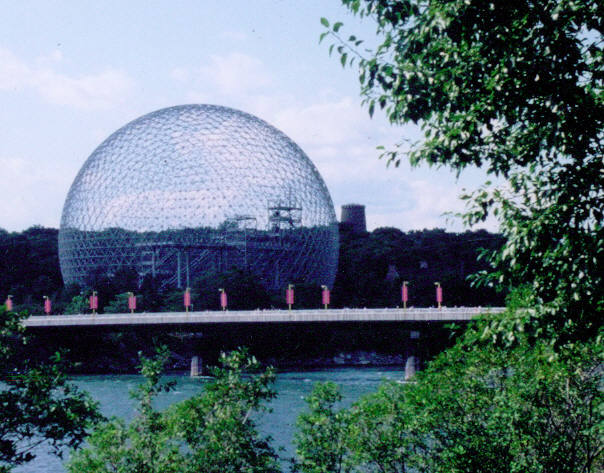 photo by Gerald Gilman
Excerpt from the new myspace/4dstudios website:
So both metaphysical nD-ism, and physio-energetic relativity (special and general), kept the 4D meme operational semi-autonomously from the U = (M)(P) = (4D)(F**3) synergetics meaning and namespace (F**3 signifies 3rd powering, and is canonically signified by a growing/shrinking tetrahedron, not a cube)."nD-ism" refers to Coxeter-type hyper- or n-dimensional polytope geometry and/or multidimensional sphere packing. 4D has a specific meaning in this namespace.
"Physio-energetic relativity" refers to the Einsteinian type stuff. 4D means something different here. In his intro to Regular Polytopes [actually on page 119, KTU], H.S.M. Coxeter is keen to make this distinction.
Fuller designed yet a third namespace for the 4D meme, centered around his angle vs. frequency distinction. U = (M)(P) refers to the metaphysical (prefrequency) and physical makeup of Universe.
A lot of us anticipated a growing secondary literature as academia wrapped its mind around Synergetics and got up to speed on this interesting and alternative namespace by a leading 20th century inventor.
In the 30 years since its publication, that's barely happened (with notable exceptions), and we're now in the process of passing the torch to a next generation of buckaneer.
I like the term 4D++ for 4D-plus-frequency because it rhymes with C++, which added objects to the C language. When we add energy to primitive 4Dness, that's like instancing a type or template, as when making a for-real special case house and/or dwelling machine from a blueprint.
Sunday, August 13, 2006
Friday, August 11, 2006
Portland Knowledge Lab
We're heading down to the PKL just now, a project of 4D Solutions. I wanna see if the new Metro Wifi is on my radar (some PCI card in the HP multimedia box would sense it). My new iPod just showed up, for collection at USPO on Belmont.
Yes, PKL is a very small office, but I'm making Lucky Lab the official meeting ground -- works with my policy of having some Wanderers be nonhuman (dogs permitted in the outside picnic table area).
Time to put iTunes on the HP, if it's not there already, as listening to podcasts from Python Nation is a first order of business (I'm so far behind it's not funny).
However, on the way we discovered USPO pickup was "por domani," so we went to DoubleTree for Bridge Pedal gear, then sauntered to Lloyd Center's Food Court (that's two this week -- was in Washington Square's on fourth day). Chatted with pharmacist in parking lot by cell. Swung by Providence.
Nathan Cogan enroute for his cheques. Quiet summer afternoon. Thinking about Beirut, other places (Cogan and I speculated about a UN force made up entirely of North Koreans, to stabilize the area (might be fun)).
A lot of today is about curriculum writing (one of my day jobs). I'm exploring the concept of Pythonic mathematics rewritten in Squeakland's version of Smalltalk.
How would we do the same progression: from dot notation and data structures to simple figurate and polyhedral sequences to XYZ with vector objects and finally to polyhedra as student-defined classes?
The Smalltalk Community has sent some high-level delegates to edu-sig, and I feel our online/archived meetings have been productive.
However, I'm not really expecting to do this rewrite myself, i.e. it's more a way for me to brush up on Smalltalk, which in at least one model, precedes Python in a curriculum context. So as a Python teacher, I should bone up on what my stuff'd look like were I a Smalltalk teacher instead. Like I said, it's an exercise.
Follow-up (next day): iPod and accoutrements received in timely fashion in good condition, kudos to USPO and I'll assign points to the seller through eBay. I've been catching up on some Python411 podcasts, as well as firing up some Pink Floyd, while strolling along Hawthorne Blvd. Tara is off to a conference with family friends (lawyers and judges), Sam and Judy expected, plus Carol is inbound on Amtrak.
Yes, PKL is a very small office, but I'm making Lucky Lab the official meeting ground -- works with my policy of having some Wanderers be nonhuman (dogs permitted in the outside picnic table area).
Time to put iTunes on the HP, if it's not there already, as listening to podcasts from Python Nation is a first order of business (I'm so far behind it's not funny).
However, on the way we discovered USPO pickup was "por domani," so we went to DoubleTree for Bridge Pedal gear, then sauntered to Lloyd Center's Food Court (that's two this week -- was in Washington Square's on fourth day). Chatted with pharmacist in parking lot by cell. Swung by Providence.
Nathan Cogan enroute for his cheques. Quiet summer afternoon. Thinking about Beirut, other places (Cogan and I speculated about a UN force made up entirely of North Koreans, to stabilize the area (might be fun)).
A lot of today is about curriculum writing (one of my day jobs). I'm exploring the concept of Pythonic mathematics rewritten in Squeakland's version of Smalltalk.
How would we do the same progression: from dot notation and data structures to simple figurate and polyhedral sequences to XYZ with vector objects and finally to polyhedra as student-defined classes?
The Smalltalk Community has sent some high-level delegates to edu-sig, and I feel our online/archived meetings have been productive.

However, I'm not really expecting to do this rewrite myself, i.e. it's more a way for me to brush up on Smalltalk, which in at least one model, precedes Python in a curriculum context. So as a Python teacher, I should bone up on what my stuff'd look like were I a Smalltalk teacher instead. Like I said, it's an exercise.
Follow-up (next day): iPod and accoutrements received in timely fashion in good condition, kudos to USPO and I'll assign points to the seller through eBay. I've been catching up on some Python411 podcasts, as well as firing up some Pink Floyd, while strolling along Hawthorne Blvd. Tara is off to a conference with family friends (lawyers and judges), Sam and Judy expected, plus Carol is inbound on Amtrak.
Thursday, August 10, 2006
Weighing In: On Philo vs. CompSci
Out of allegiance to Russell/Whitehead and other Oxbridge proteges, the Philosophy Department disses practical in-the-field logical languages as impure, too messy, even when the underlying paradigm is pretty darned clear, and even when philosophers such as Leibniz already got it that we were aiming for machine-level implementations.
Basically, I think computer scientists earn a more honest living than most academician philosophers, and use Wittgenstein as a bridge, to try sharing the workload a little more fairly.
Put another way, I'm fighting academic logicians and their undeserved superiority complex, when it comes to what's "pure" (e.g. "math is too pure to sully with actual programming, yech" -- I find such rhetoric dismaying and feel sorry for the students they use it on).
This attitude relates to our disagreements on what's at the foundations of mathematics. They say it's controlled by The Cathedral (some inner circle, secretively chosen few), I say by The Bazaar (by ordinary people, managing as best they can -- open source collaboration is not a new winning strategy).
[ the above reposted to wittgenstein-dialognet, Yahoo eGroup, #6284 ]
Related writing: Some thoughts about testing (aka quality assurance) @ Math Forum (Drexel University).
Basically, I think computer scientists earn a more honest living than most academician philosophers, and use Wittgenstein as a bridge, to try sharing the workload a little more fairly.
Put another way, I'm fighting academic logicians and their undeserved superiority complex, when it comes to what's "pure" (e.g. "math is too pure to sully with actual programming, yech" -- I find such rhetoric dismaying and feel sorry for the students they use it on).
This attitude relates to our disagreements on what's at the foundations of mathematics. They say it's controlled by The Cathedral (some inner circle, secretively chosen few), I say by The Bazaar (by ordinary people, managing as best they can -- open source collaboration is not a new winning strategy).
[ the above reposted to wittgenstein-dialognet, Yahoo eGroup, #6284 ]
Related writing: Some thoughts about testing (aka quality assurance) @ Math Forum (Drexel University).
Tuesday, August 08, 2006
Global Warming
Per the Synergetics Dictionary (Vol 1, pp. 680-681), Fuller cast Euler as a pioneer in topology, thereby reconnecting maths, which had gotten very distant, to everyday experience, albiet superficially (at the level of faces, vertices and edges and their relative number). Next, goes the story, came Gibbs and his Phase Rule, which supplied a more visceral grasp of our freedoms, in terms of temperature and pressure, and the relative proportions of solids, liquids, and gases.
You could think of Synergetics.Euler (namespace notation) as pointing to some colorful computer model of some planet, any planet, like in Sims. Whether that's our planet or not is unimportant (from who's perspective?). Then Synergetics.Gibbs adds another dimension: special case tactile reality, as in "oh, so that's our planet, Gaia" (Earth, Terra, Mothership whatever). Our reconnection with reality, through Euler then Gibbs, is complete.
Now I agree: that's a peculiar story, which you'll likely encounter in no other namespace. People find that disquieting ("if Fuller makes sense, why can't we make more sense of him?").
Hugh Aldersey-Williams, in researching his The Most Beautiful Molecule took a quick glance at Synergetics and dismissed it as lunacy, closer to Alchemy than Chemistry, and therefore not possibly a source of rationality.
I shot back it was meant as a contribution to the Humanities. He took that as a sign I was caving to pressure (giving in to a hostile, rejectionary science), but that wasn't it. I'm a philo guy. I consider the Humanities the superior side of the C.P. Snow chasm. I was beating my chest, doing like a King Kong thing.
Like, just look at the mnemonic economy of Fuller's memory palace: Euler (polyhedra-as- graphs, spin, two kinds of twoness, 3rd person overview); Gibbs (vectorial flows, quality of life in environmental terms, 1st person immediacy (as in "how hot, how much water?")).
Anyway, now that we've bridged the chasm ("what's in your wallet?"), I'm less concerned about which side is which anymore. Let's just call it engineering and/or bioneering and get on with our Spaceship Earth scenario as best as we're able to manage.
You could think of Synergetics.Euler (namespace notation) as pointing to some colorful computer model of some planet, any planet, like in Sims. Whether that's our planet or not is unimportant (from who's perspective?). Then Synergetics.Gibbs adds another dimension: special case tactile reality, as in "oh, so that's our planet, Gaia" (Earth, Terra, Mothership whatever). Our reconnection with reality, through Euler then Gibbs, is complete.
Now I agree: that's a peculiar story, which you'll likely encounter in no other namespace. People find that disquieting ("if Fuller makes sense, why can't we make more sense of him?").
Hugh Aldersey-Williams, in researching his The Most Beautiful Molecule took a quick glance at Synergetics and dismissed it as lunacy, closer to Alchemy than Chemistry, and therefore not possibly a source of rationality.
I shot back it was meant as a contribution to the Humanities. He took that as a sign I was caving to pressure (giving in to a hostile, rejectionary science), but that wasn't it. I'm a philo guy. I consider the Humanities the superior side of the C.P. Snow chasm. I was beating my chest, doing like a King Kong thing.
Like, just look at the mnemonic economy of Fuller's memory palace: Euler (polyhedra-as- graphs, spin, two kinds of twoness, 3rd person overview); Gibbs (vectorial flows, quality of life in environmental terms, 1st person immediacy (as in "how hot, how much water?")).
Anyway, now that we've bridged the chasm ("what's in your wallet?"), I'm less concerned about which side is which anymore. Let's just call it engineering and/or bioneering and get on with our Spaceship Earth scenario as best as we're able to manage.
Sunday, August 06, 2006
At the Base of The Steel
 North Mississippi Avenue
That's where I thought Matt said to meet, The Steel being one of our 10-or-so bridges. But I guess he'd said Broadway. Anyway, we missed each other, but rendezvoused as planned, with Michael, coming our separate ways.
I had the caesar salad with blackened salmon and part way through noticed an iPod and ID sitting very exposed on the sidewalk table next to ours. I harangued the guys when they returned "like you'd never do that in London" but it turned out these were staff and this was more like a trap.
The place was swarming with undercover police (other staff), ready to pounce. I assured him I'd have pounced too, or at least kicked up a ruckus. Anyway, he pitied the hypothetical thief, given his eclectic tastes in music, which'd likely blow the thief's mind. Interesting theory.
We were all on our bicycles. I'd pedaled down from near Mt. Tabor, across the Hawthorne Bridge (mistake), then back across the Hawthorne, then down the east side esplanade to the Rose Quarter (shades of Chattanooga).
Later, in twilight, Matt and I biked through Rose Quarter again, after coffee and dessert with Michael at some Sopranos-style restaurant on Mississippi (comfortable, accordian going, top flight gelato).
By then, the loudspeakers were echoing through the complex, saying something about tickets, no doubt for some event (a many-bulbs sign mentioned Dixie Chicks, but I didn't know if it really meant tonight).
 Michael in rattle snake shirt
Saturday, August 05, 2006
Da Vinci Code (movie review)
Whereas some would consider symbols a doorway to an archetypal space, wherein we perform the necessary alchemy (psychological processing) at a higher rate than mere reality would permit, this movie suggests that its symbols encrypt a literal truth, and so points us back to another ploddingly special case reality.
The mundane cop show reality in this case: the existence of a secret service, aka the Priory of Scion and/or Knights Templar, charged with protecting Jesus of Nazareth's literal descendents. The grail is not a literal cup silly, but Jesus's wife Mary Magdalen, her corpse concealed somewhere, and presumably still a source of testable DNA.
For centuries, talk of "blood lines" occluded the actual genetic science involved, but now, in time for the millenium, we might follow clues to finally solve this very cold case, thereby undermining the standard version of the story, in which Jesus was childless. Opus Dei doesn't want this case solved, and sends out a mentally troubled assassin to keep the myth of "childless Jesus" intact. Tom Hanks, a specialist in religious symbols, is unwittingly caught in the middle of this game.
Theologically speaking, it's unclear why Jesus having children would undermine the Trinitarian model, as his mortal shell was never considered dysfunctional in any way. He just never had the time for fatherhood. In a more civilized part of the world, he might have, but the outskirts of Imperial Rome was very unstable, very unsafe for anyone practicing high level leadership, especially if Jewish.
In other words, there's no scientific evidence that his divinity was genetically based, so the fact of French descendents sharing some DNA would not thereby communicate his special status as a savior. There'd need to be more in the way of skills and core teachings to keep his legacy alive, but shared genes would likely have nothing to do with it, so why should the Church feel so threatened by his literal offspring? Let's just update the story and get on with it.
I think it's a safe bet that if we could trace his descendents by means of DNA, they'd be celebs, given the way geneology buffs like to point to famous ancestors in any given tree. But would we really need a secret service to protect their identities? Why? Is Imperial Rome still that much of a concern?
Of course one might take this whole second literal truth of the Holy Grail (not a cup for wine-into-blood, but a container for genetic material) and repoint it back to the nonliteral archetypal realm. In that case, it's more a story about the central importance of women in the Christian tradition, right back to Jesus himself, who loved his women friends as much as he loved anyone. Is that undermining? I suppose to some.
The movie encourages this symbolic interpretation by framing a lot of art, implying the movie screen is itself a kind of canvas on steroids, a source of psychological and/or theological insights. One could make the same moves to rescue National Treasure, another puzzle-solving challenge leading to a fictitiously literal outcome.
The mundane cop show reality in this case: the existence of a secret service, aka the Priory of Scion and/or Knights Templar, charged with protecting Jesus of Nazareth's literal descendents. The grail is not a literal cup silly, but Jesus's wife Mary Magdalen, her corpse concealed somewhere, and presumably still a source of testable DNA.
For centuries, talk of "blood lines" occluded the actual genetic science involved, but now, in time for the millenium, we might follow clues to finally solve this very cold case, thereby undermining the standard version of the story, in which Jesus was childless. Opus Dei doesn't want this case solved, and sends out a mentally troubled assassin to keep the myth of "childless Jesus" intact. Tom Hanks, a specialist in religious symbols, is unwittingly caught in the middle of this game.
Theologically speaking, it's unclear why Jesus having children would undermine the Trinitarian model, as his mortal shell was never considered dysfunctional in any way. He just never had the time for fatherhood. In a more civilized part of the world, he might have, but the outskirts of Imperial Rome was very unstable, very unsafe for anyone practicing high level leadership, especially if Jewish.
In other words, there's no scientific evidence that his divinity was genetically based, so the fact of French descendents sharing some DNA would not thereby communicate his special status as a savior. There'd need to be more in the way of skills and core teachings to keep his legacy alive, but shared genes would likely have nothing to do with it, so why should the Church feel so threatened by his literal offspring? Let's just update the story and get on with it.
I think it's a safe bet that if we could trace his descendents by means of DNA, they'd be celebs, given the way geneology buffs like to point to famous ancestors in any given tree. But would we really need a secret service to protect their identities? Why? Is Imperial Rome still that much of a concern?
Of course one might take this whole second literal truth of the Holy Grail (not a cup for wine-into-blood, but a container for genetic material) and repoint it back to the nonliteral archetypal realm. In that case, it's more a story about the central importance of women in the Christian tradition, right back to Jesus himself, who loved his women friends as much as he loved anyone. Is that undermining? I suppose to some.
The movie encourages this symbolic interpretation by framing a lot of art, implying the movie screen is itself a kind of canvas on steroids, a source of psychological and/or theological insights. One could make the same moves to rescue National Treasure, another puzzle-solving challenge leading to a fictitiously literal outcome.
Friday, August 04, 2006
ToonTown
This is of course an allusion to Who Framed Roger Rabbit?, wherein cartoon people live in a ghetto of alternative physics, more characteristic of cartoons. Toons rhymes with Sims quite a bit (not literally).
However, in this namespace, ToonTown refers to a region of Portland, Oregon (in the heart of the Silicon Forest), which some speculate might be about to dive head first into the computer animation business.
Of course that's already happening in Portland, thanks to the precedent of Will Vinton Studios (since sold to Nike's Phil Knight and rebranded).
The question is more one of neighborhood: will the city blocks from around Free Geek, Good Will and OMSI, north towards Lucky Lab, and on up along MLK and the train tracks, past Produce Row, provide safe harbor for a goodly number of private studios focusing on the making of "toons" i.e. instructional videos (e.g. screencasts -- see InfoWorld July 31, 2006) laced with computer graphics? Entertaining, not just instructional (gnurotic even).
When 4D Studios purchased Turning the Wheel from DWA (one of my wife's companies), and rebranded it, so far only informally, as our Portland Knowledge Lab, this was the kind of thing I had in mind. This office provides only a small footprint in the neighborhood at this point (close to Lucky Lab), but floorspace is not the point in this business.
What you need is a niche, a look and feel, and the ability to scout for and recruit complementary talent, for purposes of collaboration and mutual benefit. In my case, The Wanderers has been a primary venue for such activities, with excellent results (including my Saturday Academy gigs).
In my case, "a look and feel" means a lot of Fuller School type visual motifs (including hypertoons [PDF]), other trademarks. Yes, others will imitate (flattering), but 4D Solutions (DBA of 4D Studios) already has a strong track record in this domain, albiet on a small scale.
Again, frequency and/or energy involvement is not the critical number; it's the quality of the programming that I'm advertising. A lucky few speculators should have no problem seeing the potential advantages of co-venturing. That's what last night's meeting at The Bagdad was about (we talked a lot about AJAX).
However, in this namespace, ToonTown refers to a region of Portland, Oregon (in the heart of the Silicon Forest), which some speculate might be about to dive head first into the computer animation business.
Of course that's already happening in Portland, thanks to the precedent of Will Vinton Studios (since sold to Nike's Phil Knight and rebranded).
The question is more one of neighborhood: will the city blocks from around Free Geek, Good Will and OMSI, north towards Lucky Lab, and on up along MLK and the train tracks, past Produce Row, provide safe harbor for a goodly number of private studios focusing on the making of "toons" i.e. instructional videos (e.g. screencasts -- see InfoWorld July 31, 2006) laced with computer graphics? Entertaining, not just instructional (gnurotic even).
When 4D Studios purchased Turning the Wheel from DWA (one of my wife's companies), and rebranded it, so far only informally, as our Portland Knowledge Lab, this was the kind of thing I had in mind. This office provides only a small footprint in the neighborhood at this point (close to Lucky Lab), but floorspace is not the point in this business.
What you need is a niche, a look and feel, and the ability to scout for and recruit complementary talent, for purposes of collaboration and mutual benefit. In my case, The Wanderers has been a primary venue for such activities, with excellent results (including my Saturday Academy gigs).
In my case, "a look and feel" means a lot of Fuller School type visual motifs (including hypertoons [PDF]), other trademarks. Yes, others will imitate (flattering), but 4D Solutions (DBA of 4D Studios) already has a strong track record in this domain, albiet on a small scale.
Again, frequency and/or energy involvement is not the critical number; it's the quality of the programming that I'm advertising. A lucky few speculators should have no problem seeing the potential advantages of co-venturing. That's what last night's meeting at The Bagdad was about (we talked a lot about AJAX).
Wednesday, August 02, 2006
Today's Debates
Arthur Siegel again berated me for sticking to my guns as a Fuller Schooler, suggesting I'm marginalizing a lot of perfectly good math by hooking it to a crackpot: "I emphasize the Fuller stuff only because it is an example of you refusing to do your homework, and sticking to your guns at the expense of good sense." [1]
John Zelle attacked what he thought was my brave new world without textbooks [2], but we later dovetailed over the idea of keeping small presses in business (Zelle is the author of a small press Python textbook, a good one).
It's "one size fits all" mass publishing that I'm fighting.
Relating to that theme, over on the Math Forum I kept challenging the wisdom of letting a tiny cabal manage California's K-12 math standards. Wayne Bishop of CalTech was exulting in his group's power to keep "technology" at bay.[3]
I envision small, community-based experiments, including with indigenous curricula, though importing at will. In our Python Nation, we'll teach mathematics and programming in tandem, as somewhat inseparable disciplines. Not everyone needs to choose this combo.[4]
I want schools (even the public ones) free to form multiple voluntary affiliations and alliances, and not be forced into some lockstep, top-down, state-mandated regime. Get parents involved, and students. Make the wheels of democracy turn (they're so rusty these days -- like some forgotten machinery in Uru).
These free and voluntary alliances could be with agencies of the federal government.
Get your GIS/GPS curriculum from the Department of the Interior why not? Government imprimaturs belong on course materials, not exclusively, but as a part of a healthy public/private mix.
The USG should stick its neck out, enter the fray, and deploy those eagle shields on public school materials -- not expect private companies to always provide the branding.
Why can't HUD teach about housing, dwelling machines even? I once publicly harangued Freeman Dyson for doing too little with the Fuller memes when consulting for HUD.[5]
Which reminds me, is there any mention of OMR in the Congressional Record yet, post Katrina?
John Zelle attacked what he thought was my brave new world without textbooks [2], but we later dovetailed over the idea of keeping small presses in business (Zelle is the author of a small press Python textbook, a good one).
It's "one size fits all" mass publishing that I'm fighting.
Relating to that theme, over on the Math Forum I kept challenging the wisdom of letting a tiny cabal manage California's K-12 math standards. Wayne Bishop of CalTech was exulting in his group's power to keep "technology" at bay.[3]
I envision small, community-based experiments, including with indigenous curricula, though importing at will. In our Python Nation, we'll teach mathematics and programming in tandem, as somewhat inseparable disciplines. Not everyone needs to choose this combo.[4]
I want schools (even the public ones) free to form multiple voluntary affiliations and alliances, and not be forced into some lockstep, top-down, state-mandated regime. Get parents involved, and students. Make the wheels of democracy turn (they're so rusty these days -- like some forgotten machinery in Uru).
These free and voluntary alliances could be with agencies of the federal government.
Get your GIS/GPS curriculum from the Department of the Interior why not? Government imprimaturs belong on course materials, not exclusively, but as a part of a healthy public/private mix.
The USG should stick its neck out, enter the fray, and deploy those eagle shields on public school materials -- not expect private companies to always provide the branding.
Why can't HUD teach about housing, dwelling machines even? I once publicly harangued Freeman Dyson for doing too little with the Fuller memes when consulting for HUD.[5]
Which reminds me, is there any mention of OMR in the Congressional Record yet, post Katrina?
Tuesday, August 01, 2006
1-2-3 Testing...
Your message is waiting for approval.
This message must first be approved by the group's moderators. If approved, your message will be emailed to members who have chosen to receive group messages.To: wittgenstein-dialognet@yahoogroups.com
From: Kirby Urner
Date: Tue Aug 1, 2006 4:57 pm
Subject: Steering Mathematicians to Wittgenstein
As I've written about before in this archive, I think LW's later approach, to choose "language games" over "propositions" for atomic examples, dovetails with the computer science idea of "namespaces".
A namespace isn't just a jumble of words in a bag, or needn't be, might be an intricate ordering or mechanism [organism].
Talking about the remoteness of Fuller's "vocabulary" tended to atomize in terms of "words" (a tendency added to by his use of a "dictionary" metaphor). But as LW shows, it's not words-in- isolation that have meaning, but words in machines (grammars, forms of life).
Now that Fuller's geometry is starting to hit the big screens, generating more public awareness, people are looking for on-ramps or access points. I think Wittgenstein's philo could be it for a lot of people. So I point them to discussion groups like here.
Now let's see if this posts.
Kirby
Fixed a typo. I'll report back as to whether this innocent-enough post makes it past the censors. Report: it got through as #6277, and the moderator denies any knowledge of a conspiracy to censor me (why my posts died in queue, while others went through, was not explained -- I remain paranoid).
Monday, July 31, 2006
The Math They Won't Teach You

Or is it History they don't want you to know?
This message is brought to you by: the Oregon Curriculum Network.
Saturday, July 29, 2006
A Happy Day
This was yer basic good day for me. My cousins (quite removed) Mary and Alice drove all the way from Seattle to visit us, and now are on their way back. Mary is the ER doctor, while Alice started a shipping service with her soon to be ex.
Derek scored a gas lawn mower from Weldon, who is moving to Oklahoma. I added Lawnmower Man (stupid but fun movie) to Edward Scissorhands (a more brilliant one), to my small repertoire of impersonations (inside joke: the juniper still looks like a phage).
We shared corn on the cob, salad, hummus and pita, on the back patio. It's a cool day. Then we visited the Rhododendron Garden, where Dawn and I got married. Bhutan has lots of rhodies, or whatever sacred names. I took this picture, knowing it'd fit well in my blog:

But even on a happy day, we don't get to forget about suffering, close to home, around the world. Gaza, out of the limelight, has become a metaphor for Darfur, even further shoved aside and so on. Malign neglect remains the order of the day.
Derek scored a gas lawn mower from Weldon, who is moving to Oklahoma. I added Lawnmower Man (stupid but fun movie) to Edward Scissorhands (a more brilliant one), to my small repertoire of impersonations (inside joke: the juniper still looks like a phage).
We shared corn on the cob, salad, hummus and pita, on the back patio. It's a cool day. Then we visited the Rhododendron Garden, where Dawn and I got married. Bhutan has lots of rhodies, or whatever sacred names. I took this picture, knowing it'd fit well in my blog:

But even on a happy day, we don't get to forget about suffering, close to home, around the world. Gaza, out of the limelight, has become a metaphor for Darfur, even further shoved aside and so on. Malign neglect remains the order of the day.
Thursday, July 27, 2006
Creation Myth
Here's something I posted to a Quaker list recently, just when all are getting comfortable in their Bibles, dusting up on Tyre (an ancient interface twixt overland caravaners and Phoenicia). So I doubt many will have time for such blatant revisionism...
If you've cracked the cover of TetraScroll, you've seen yet another one of our creation myths, this one about how Eve did Adam a favor by goading him out of his nostalgia for a Garden of Eden that never was (something put there by temporal authorities).
The apple (yes, I know, not really an apple) was a symbol for the world being round, a sort of closed, finite Earth message (we're on a planet) that people weren't ready for. The priests jealously guarded their knowledge, and consequent authority. It was derivative authority however, as sea peoples had it as well, and used it effectively.
Demonizing the snake was a way to get these new Middle Eastern landlubbers to forget about the Far East, way more advanced in its civilization, and focused on Naga, a sea dragon. This dragon was also upsetting to local authorities, hence the story in Genesis, still used to frighten children to this day.
If you've cracked the cover of TetraScroll, you've seen yet another one of our creation myths, this one about how Eve did Adam a favor by goading him out of his nostalgia for a Garden of Eden that never was (something put there by temporal authorities).
The apple (yes, I know, not really an apple) was a symbol for the world being round, a sort of closed, finite Earth message (we're on a planet) that people weren't ready for. The priests jealously guarded their knowledge, and consequent authority. It was derivative authority however, as sea peoples had it as well, and used it effectively.
Demonizing the snake was a way to get these new Middle Eastern landlubbers to forget about the Far East, way more advanced in its civilization, and focused on Naga, a sea dragon. This dragon was also upsetting to local authorities, hence the story in Genesis, still used to frighten children to this day.
Tuesday, July 25, 2006
Wanderers 2006.7.25
Patrick Barton is sharing Powersim, modeling software in the lineage of Jay Forrester (ala Urban Dynamics, Club of Rome, The Fifth Discipline etc.). Simulation software lets modelers assemble complex systems from simple components: stocks, flows, linkages.
This event is well attended, by physicists, a banker (semi-retired), mathematicians (including Davids Feinstein and Tver). Terry is manning the camera. I'm in the side office, close to an A/C vent.
Tara uses powerful simulation software too, sometimes hours a day, but for fun not for pay. I'm thinking of Sims 2, Civilization IV, other such games over the years (SimCity, SimAnt...).
Back at OSR, I impressed my social studies teacher Fred Craden (great guy) by doing my independent study on global modeling, including many citations to the Club of Rome studies, which back then (1971-72) had made the cover of The Futurist magazine (my dad a subscriber).
On screen right now: a model of a local dam system, relating to water levels, snow pack, flow rates. Engineers use dynamical models to load balance around electrical demand. Getting Portlanders to back off on the A/C frees more power for Californians, generating income for our state.
I've been thinking about Patricia lately, a motorcycle-riding field engineer for Bonneville Power for years and years. Diane also works for BPA, in a more back office capacity. Both are local Quakers.
Powersim turns out to be quite handy for modelers, with lots of interface widgets of the kind one might study under the heading of wxPython.
Patrick has been working with Glenn and I on this Global Matrix Project, featuring these hexapents I've been writing about (and depicting) of late.
This event is well attended, by physicists, a banker (semi-retired), mathematicians (including Davids Feinstein and Tver). Terry is manning the camera. I'm in the side office, close to an A/C vent.
Tara uses powerful simulation software too, sometimes hours a day, but for fun not for pay. I'm thinking of Sims 2, Civilization IV, other such games over the years (SimCity, SimAnt...).
Back at OSR, I impressed my social studies teacher Fred Craden (great guy) by doing my independent study on global modeling, including many citations to the Club of Rome studies, which back then (1971-72) had made the cover of The Futurist magazine (my dad a subscriber).
On screen right now: a model of a local dam system, relating to water levels, snow pack, flow rates. Engineers use dynamical models to load balance around electrical demand. Getting Portlanders to back off on the A/C frees more power for Californians, generating income for our state.
I've been thinking about Patricia lately, a motorcycle-riding field engineer for Bonneville Power for years and years. Diane also works for BPA, in a more back office capacity. Both are local Quakers.
Powersim turns out to be quite handy for modelers, with lots of interface widgets of the kind one might study under the heading of wxPython.
Patrick has been working with Glenn and I on this Global Matrix Project, featuring these hexapents I've been writing about (and depicting) of late.
Sunday, July 23, 2006
Another Hexapent

In the shell:
geodesic -c 2,3 2 | pol_recip | off_util -O | off2pov > hexapent.pov
My thanks to Adrian Rossiter.
Related reading @ Math Forum by me, plus this web page (also first issued today).
Download the above in OFF format (you may need to "right click" to save).
Note: Packinon also generates Waterman Polyhedra.
Thursday, July 20, 2006
Apollo Chronicles
I subscribe to a number of e-services, including this one from NASA (snglist c/o nasa.gov) that connects me up to program lore. Today, I'm reading about the first Apollo lunar landing (left foot first) and Armstrong's fascination with moon dust (rose petals).
The story, relayed in grade school English, is full of suspense, as the Sea of Tranquility was anything but, from a needing to find a parking space point of view: rocks everywhere. Neil, his heart clocking 156 bpm, saved the day (and NASA's ass) with a last second touch down, fuel meter on empty.
If there's a NASA cable or satellite channel sharing more commemorative fare today, it's not easily accessible from my household (or maybe it is -- let's speak hypothetically). However, the Google video archive is pretty well stocked with lunar lander memorabilia.
There's enough on the Internet for a homeschooler to bliss out on, plus Netflix for movies and documentaries. But does our homeschooler have access to either?
Thanks to TCP/IP, many Portland homes now have at least a well-endowed library's powers, when it comes to archival access. The Oregonian's business page today is about the new metropolitan wireless system (construction begins), intended as a free public service.
Synchronous and even asynchronous archiving of overseas broadcasts was still more a job for embassies and listening posts in 2006, mostly under the control of governments and their contractors, although many expats could tune in their home country's TV via satellite services. In Portland, many expats speak Farsi, others Russian, others Japanese.
Given I'm a curriculum writer, sometimes back office, sometimes in the field, I have a natural interest in knowing a lot of what a librarian knows. I want my lesson plans to match up with actual resources. I'm not just interested in science fiction.
If students have access to Google Earth, that opens up a whole new set of possibilities. If they're patched in through some synchronous feed to a team in the field, say at a marine archeological site ala the Jason Project, then we'd plan the lessons differently.
Our thought is to organize the lesson plans database around tags listing the expected and/or necessary technologies, sometimes with alternatives. A teacher could narrow the search by entering locally available tools and/or topics of interest (Python, SQL...).
In 2006, many of our global university students don't yet have access to the basics (e.g. food, potable water), and so their education remains on hold while we continue debugging a lot of broken "first world" code. Sometimes it's easier to start fresh and just bypass the old stuff. Other times, the old stuff was well designed and proves readily adaptable.
Side light: Tara's sims family didn't pay any bills as it ran overnight. This morning, the repo men have arrived with their ray guns, and are making appliances disappear. Fortunately, her family has enough in the bank to replace some of their stuff. What a hassle though. Which reminds me, I need to get new DEQ tags for Razz.
The story, relayed in grade school English, is full of suspense, as the Sea of Tranquility was anything but, from a needing to find a parking space point of view: rocks everywhere. Neil, his heart clocking 156 bpm, saved the day (and NASA's ass) with a last second touch down, fuel meter on empty.
If there's a NASA cable or satellite channel sharing more commemorative fare today, it's not easily accessible from my household (or maybe it is -- let's speak hypothetically). However, the Google video archive is pretty well stocked with lunar lander memorabilia.
There's enough on the Internet for a homeschooler to bliss out on, plus Netflix for movies and documentaries. But does our homeschooler have access to either?
Thanks to TCP/IP, many Portland homes now have at least a well-endowed library's powers, when it comes to archival access. The Oregonian's business page today is about the new metropolitan wireless system (construction begins), intended as a free public service.
Synchronous and even asynchronous archiving of overseas broadcasts was still more a job for embassies and listening posts in 2006, mostly under the control of governments and their contractors, although many expats could tune in their home country's TV via satellite services. In Portland, many expats speak Farsi, others Russian, others Japanese.
Given I'm a curriculum writer, sometimes back office, sometimes in the field, I have a natural interest in knowing a lot of what a librarian knows. I want my lesson plans to match up with actual resources. I'm not just interested in science fiction.
If students have access to Google Earth, that opens up a whole new set of possibilities. If they're patched in through some synchronous feed to a team in the field, say at a marine archeological site ala the Jason Project, then we'd plan the lessons differently.
Our thought is to organize the lesson plans database around tags listing the expected and/or necessary technologies, sometimes with alternatives. A teacher could narrow the search by entering locally available tools and/or topics of interest (Python, SQL...).
In 2006, many of our global university students don't yet have access to the basics (e.g. food, potable water), and so their education remains on hold while we continue debugging a lot of broken "first world" code. Sometimes it's easier to start fresh and just bypass the old stuff. Other times, the old stuff was well designed and proves readily adaptable.
Side light: Tara's sims family didn't pay any bills as it ran overnight. This morning, the repo men have arrived with their ray guns, and are making appliances disappear. Fortunately, her family has enough in the bank to replace some of their stuff. What a hassle though. Which reminds me, I need to get new DEQ tags for Razz.
Wednesday, July 19, 2006
Rebuilding Indian Country 1933 (movie review)
We earn (6:49-7:00) our place in the sun, and our government is looking after us too.
The film reasonably acknowledges that navams, also originally from around Baghdad (1:00-:18), might also have been called Americans, just as "we" are, had Columbus's reasonable hypothesis (that this was India) been falsified earlier (3:06-:37).
Be that as it may, now that they're Indians, they still deserve the respect and dignity owed every American (including in leadership roles), and their destiny will emerge gradually, through mastery of the civilian white man's tools.
Given the red man already has instinctive appreciation for color (27:34-:41), plus instinctive reckless ability (32:04-:14), learning new skills isn't hard for him.
A key tension in the film revolves around why Indians would necessarily want to change certain aspects about their [dirty hippie] pre-Euro lifestyles (25:08-:25).
Although the erosion going on in Monument Valley (Najavo Nation) is considered weird and ominious (22:41-:49), it's still not clear that the white man's control freaky response to everything is going to fly with these slackers.
However, given their need for revenue, the need for more control over the means of production is simply obvious. American industriousness and increasing mastery over the land is proceeding full speed ahead (Depression? What depression? We're happy to be this driven all the time).
Anyway, the answer is they don't have to change everything (like, we keep with the instinctual storytelling abilities).
Note the "radio voice" of the narrator. As Bucky talks about in Critical Path, the white man was standardizing his tones around then, as an aspect of nation-building. The invention of broadcasting accelerated the adoption of an overviewer's "metropolitan voice" which the narrator here expertly uses.
This film is from a time when many Americans wanted a big brother, and found one in the person of FDR. The upbeat tone and serene synthesis of man and machine, against natural challenges such a trackless waste (21:35-:47) and disease, contains no hint of a darker side subplot: WMDs (aka BLTs) and the AngloEuro's proclivity to use them, against the red man, against himself.
I found the emphasis on conserving civilians (with a whole corps devoted to that purpose) heartening. Governments seem so otherwise preoccupied these days. I can understand why sometimes the white man feels nostalgic for those happier days.
Tuesday, July 18, 2006
Information Harvesting
This morning I'm checking a video blog with Part 1 of Alan Kay's keynote at Europython. The talk was itself streamed in real time from LA to CERN (Alan, recently back from Japan, was advised by his doctor to stay home).
I'm also sampling some Python411 news and teaching podcasts and mp3s (audio, no video -- Ron's talking about Alan's keynote at the moment), although I'm not using an iPod to do this.
Francois Schnell just viewed my Google Video presentation to Wanderers (about some aerospacey prototyping my subculture cares about), and came back with a Flickr photo of the Cornwall facility.
That led me to his Europython pix, including the one above (tagged as public). I'll email Dawn a link to his Tintagel slides.
And all this even before my morning coffee! The web, born at CERN, has come a long way in a few years.
Saturday, July 15, 2006
PR for the PL
 Fuller's folding/unfolding global data display
What I like about our plastic money system (Visa etc.) is it provides a shared currency without making anyone salute another system's presidents, queens or whatever. You can be as pro-queen as the Queen herself, use a Visa card, and still feel like a sovereign.
People may imagine clusters of skyscrapers, when they think of some core management, but as Dee Hock explains, Visa is really chaordic. Like, my gunch.net home page has linked to the Chaordic Commons for years now (check archive.org).
Likewise, my philosophy of education is about increasing our inventory of memetic amplification tools, the stuff of PR firms: multi-track editing machines, cheap and usable computers. You're not buying into a monolithic imperialism here, but a way to make waves while rooting in your own tradition as deeply as you feel led.
Are you a wannabe orthodox something-or-other? Go for it. Be a hard-liner. Strut your stuff. We'll try to tune you in over the incoherent noise some kick up, with their inferior outward weaponry.
And so I think Buckminster Fuller was interested in tossing out (as in sharing) some great toyz, but not in being too control freaky about how we might use them. A nationless map would be a good thing to have in inventory, certainly, especially in light of its high tech hexapent flavor.
But he wasn't imposing that toy on all of us, saying "thou shalt not play the game of nations at war". No, he was leaving it up to some subcultures to so command and control themselves. For these semi-autonomous subcultures, a nationless map might prove eye-opening, a way of clearing away the clutter to really focus on the behind-the-scenes networking.
That game with the flags was always a bit of a shell game anyway, superseded or at least conjoined by games with corporate logos (e.g. Visa). Strategy: use symbols that command loyalty, in ways that get people motivated to fight on your side.
I do it too, gnu math recruiter that I am (somewhat unorthodox). My favorite brands resonate with subliminal messages for an attainable Kingdom, a Promised Land. We compete effectively with many other siren song singers, all prophesying alternative ways ahead.
Yes, the positive futurism we craft is supposed to be tempting. We're good at PR. Now, help yourself to the goodies.
Wednesday, July 12, 2006
Repositioning Think Tanks
So BFI's servers have been glitching, presumably over the heavier loads. This explains my getting an invite to join forums with Michael Ben-Eli, a former student and close collaborator of Buckminster Fuller, a week late. I've been making up for lost time.
Over on the Math Forum, I respun some of the overarching themes of my postings of late:
Into the Cool
Per Sagan-Schneider's Into the Cool, our local situation is one of surfing the solar gradient -- meaning our local system plugs into the Sun (other stars), then reflects back what it cannot really use (the vast majority of the energy goes "to ground" i.e. radiates into space). Human systems are a part of this more encompassing system, which also includes things that'd destroy us if we let them (any good game has "challenges").
Over on the Math Forum, I respun some of the overarching themes of my postings of late:
- a proposed curriculum, still on the drawing boards, being developed in cahoots with some big names in computer science;
- a focus on Portland as a happening center;
- a commitment to conjoin open source community resources with a positive futurism somewhat informed by what I've been calling American Transcendentalism (fed by New England's);
- a commitment to getting the military more involved as a source of constructive, not just destructive, engineering and know-how.
Into the Cool
Submitted by portlandio on Wed, 2006-07-12 14:08.
Per Sagan-Schneider's Into the Cool, our local situation is one of surfing the solar gradient -- meaning our local system plugs into the Sun (other stars), then reflects back what it cannot really use (the vast majority of the energy goes "to ground" i.e. radiates into space). Human systems are a part of this more encompassing system, which also includes things that'd destroy us if we let them (any good game has "challenges").
Anyway, I do not think it necessary that we view the problem as one of optimizing away all extravagant uses of energy, as if we're hoarding a finite supply in the face of certain and increasing Earthian chaos. That's true of some energy supplies, yes. I'm not trying to pitch this or that lifestyle in this context.
But I'm not into sponsoring this economists' "dismal science" meme, which pretends the 2nd law means ever worsening conditions aboard Spaceship Earth. That's not trully physics and is more about artificially lowering expectations as a part of a long-running propaganda campaign.
The biggest entropy increase is in the Sun itself, which overwhelms whatever little locally ordered world games we might play over the next several millenia. I expect we'll play many.
My premise is we can afford to live well and healthily over the long haul, on average.
That we're not already doing so (living well) to a much higher degree is more evidence of our lack of intellectual integrity, more than of any intrinsic energy shortfall.
We're slouches, slum lords, wallowing and warring in intellectual squalor.
But of course we're defensive against that observation -- seems kinda demeaning and we're a prideful crew (and pride in one's work needn't be a sign of decay).
For more thinking along these lines see: GST 2 -- part of what I'm calling Pentagon Math (more @ Math Forum).
Kirby
"Portlandio"
Monday, July 10, 2006
Alternative View
Excerpt:
I'm thinking we should deslave the Pentagon from a broken Congress and let the bases upgrade living standards educationally (in the name of national security, which is no lie -- there's already a mandate).
Model how we might have music, art, science, math, history, civics and prepare 'em for war college and stellar careers in the service, without being too stupid or wasteful with the hard-earned tax dollars.
Bring the TV people in to show off the new digs.
If we're successful, the civilians will sit up and take notice. They'll see technology doesn't have to mean piles of broken equipment surrounding an army of clueless teachers, wondering where it all went so terribly wrong.
For more context, check: this thread @ Math Forum.
Also: [1][2]
I'm thinking we should deslave the Pentagon from a broken Congress and let the bases upgrade living standards educationally (in the name of national security, which is no lie -- there's already a mandate).
Model how we might have music, art, science, math, history, civics and prepare 'em for war college and stellar careers in the service, without being too stupid or wasteful with the hard-earned tax dollars.
Bring the TV people in to show off the new digs.
If we're successful, the civilians will sit up and take notice. They'll see technology doesn't have to mean piles of broken equipment surrounding an army of clueless teachers, wondering where it all went so terribly wrong.
For more context, check: this thread @ Math Forum.
Also: [1][2]
Saturday, July 08, 2006
Taking Refuge in J
Yes, J is a computer language, published by J Software. As I understand it, J is a collaboration between the late Kenneth Iverson of APL fame, and Roger Hui, with Kenneth's son Eric also taking an active developer's role and so on, in wider and wider circles (every novel line of J is in some sense a contribution to the language).
I retreat into J every now and then, sometimes as an antidote when I can think of nothing but Python. Although J supports an object-oriented way of thinking (as does Scheme and/or LISP) that's not the first model one thinks of. Rather, J connects to concepts familiar to English grammarians: word, sentence, noun, verb, adverb and so on.
Instead of learning a computer language through some math-oriented namespace (the usual approach), J pioneers a whole different set of associations, all with the intent to wean you from easy tutorials, and put you right into the J Dictionary (a source you'll use even when you're a pro).
However, unlike English, J is more right-to-left than left-to-right, but with little leap froggy motions, where dyadic and monadic verbs hook and fork in various ways. It's kinda creepy how much dense mathematics cram into a single line, when you start hopping around in this way. Probably something like how DNA gets so much done.
Sometimes I imagine projecting J on a bed sheet somewhere, strung between two trees, camp fire crackling. We've already looked at Stellarium and Celestia, and quite a few of them are already asleep, given the long day of tracking moose or yak or whatever. But for those still wakeful, here's some fun mathematics guaranteed to knock your socks off (if you still have any).
And now, pleasant dreams.
I retreat into J every now and then, sometimes as an antidote when I can think of nothing but Python. Although J supports an object-oriented way of thinking (as does Scheme and/or LISP) that's not the first model one thinks of. Rather, J connects to concepts familiar to English grammarians: word, sentence, noun, verb, adverb and so on.
Instead of learning a computer language through some math-oriented namespace (the usual approach), J pioneers a whole different set of associations, all with the intent to wean you from easy tutorials, and put you right into the J Dictionary (a source you'll use even when you're a pro).
However, unlike English, J is more right-to-left than left-to-right, but with little leap froggy motions, where dyadic and monadic verbs hook and fork in various ways. It's kinda creepy how much dense mathematics cram into a single line, when you start hopping around in this way. Probably something like how DNA gets so much done.
Sometimes I imagine projecting J on a bed sheet somewhere, strung between two trees, camp fire crackling. We've already looked at Stellarium and Celestia, and quite a few of them are already asleep, given the long day of tracking moose or yak or whatever. But for those still wakeful, here's some fun mathematics guaranteed to knock your socks off (if you still have any).
And now, pleasant dreams.
Thursday, July 06, 2006
MI3 (movie review)
I thought Tara might enjoy a Mission Impossible episode, as I did back when it was a TV series. The Bagdad was down to one piece of pizza, with no plans to make more, plus the sound system went bad, with no projectionist in the booth for quite some time (time enough to buy that last piece for Tara, plus a lemonade, plus a Hammerhead for me).
What I liked about the TV show were the subtle interventions. But once we're on the big screen with an action figure like Tom Cruise, and Hollywood driving, there's not much room for subtlety.
The plot line is actually quite lazy, as the most difficult operation is retrieving some stupid bioweapon (aka "rabbit's foot") from a skyscraper in Shanghai. The sleight of hand is versus the audience in this case: get Tom in through the roof (a big leap even for those suspending disbelief), then cut to a van, and a prayer for some cat.
What's going on inside the building? What clever tricks enable spiderman to snag the biobunny, presumably guarded? He crashes through some upper floor window with a parachute (where'd that come from? -- "exotic gear from nowhere" is another persistent theme), interrupting the prayer. Whatever he did to pull off this heist of the century was left on the cutting room floor (if ever shot in the first place).
Another big plot hole: masked gunmen in a helicopter attack a US civilian bridge with high explosives and everyone just sort of looks the other way. No congressional hearings, not even closed door ("who authorized the drone?"), no outrage in the papers. The US civilians have apparently blindly accepted their role as mere extras in vicious shootouts staged by faceless others. Not so unbelievable actually, as US civilians get this message a lot: sit back, relax, and let the pathologically violent handle your security concerns (including your foreign affairs).
Tara thought it dragged quite a bit, but liked the music. I enjoyed some of the backdrops, although I doubt the Vatican was pleased by this faux priest with the fake Bible, stalking prey through its quiet gardens (all simulated of course).
What I liked about the TV show were the subtle interventions. But once we're on the big screen with an action figure like Tom Cruise, and Hollywood driving, there's not much room for subtlety.
The plot line is actually quite lazy, as the most difficult operation is retrieving some stupid bioweapon (aka "rabbit's foot") from a skyscraper in Shanghai. The sleight of hand is versus the audience in this case: get Tom in through the roof (a big leap even for those suspending disbelief), then cut to a van, and a prayer for some cat.
What's going on inside the building? What clever tricks enable spiderman to snag the biobunny, presumably guarded? He crashes through some upper floor window with a parachute (where'd that come from? -- "exotic gear from nowhere" is another persistent theme), interrupting the prayer. Whatever he did to pull off this heist of the century was left on the cutting room floor (if ever shot in the first place).
Another big plot hole: masked gunmen in a helicopter attack a US civilian bridge with high explosives and everyone just sort of looks the other way. No congressional hearings, not even closed door ("who authorized the drone?"), no outrage in the papers. The US civilians have apparently blindly accepted their role as mere extras in vicious shootouts staged by faceless others. Not so unbelievable actually, as US civilians get this message a lot: sit back, relax, and let the pathologically violent handle your security concerns (including your foreign affairs).
Tara thought it dragged quite a bit, but liked the music. I enjoyed some of the backdrops, although I doubt the Vatican was pleased by this faux priest with the fake Bible, stalking prey through its quiet gardens (all simulated of course).
Sunday, July 02, 2006
Movie Sunday
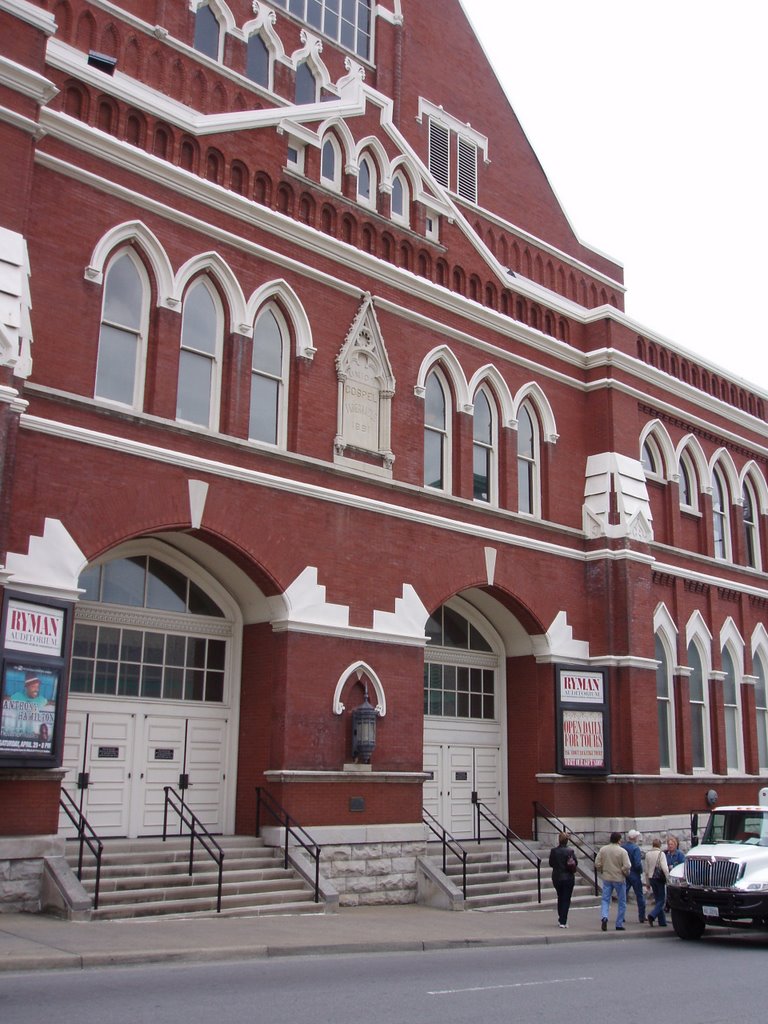 Ryman Auditorium, Nashville, TN
(photo by K. Urner, March 24, 2006)
Today we unzipped the roadshow projector, stored on the "time capsule" (a weird piece of furniture that came with the house, art deco in flavor), and hooked it up to the laptop (blue).
Dawn and I played through Neil Young: Heart of Gold, a concert in the Ryman in Nashville. We both enjoyed it, having both connected with Music City in various dimensions.
After giving the hardware a rest (it gets hot), I dove in to the 3rd in the Qatsi trilogy, which I'd seen before in a real theater.
I really like Philip Glass music set to images in this way. The "Hopi Prophesy" spin makes sense, if you remember Tom Paine's intuition that "to prophesie" means "to sing" (good singing requires attunement).
This Qatsi film (so-called because all three titles end in qatsi: Koyaanisqatsi, Powaqqatsi, Naqoyqatsi), may seem apocalyptic in places. The old Greco-Roman facade is crumbling (opening sequence) and we sort of forget why we fight (military drills).
Then we reconnect with a simple truth: we're operating some very capable, very expressive equipment (our bodies, ourselves). So take heart. We've got what it takes.
Tonight: more Lost.
Saturday, July 01, 2006
Back in the USSA
Yes, an intentional misspelling, yes, an allusion to a song by The Beatles. What I'm on about this morning is an experience many USAers never have, of flying back into their home country.
In the Pacific Northwest, our border with Canada is actually right inside their Vancouver BC airport. Little handheld eyeballs (webcams) snap your mug shot, if you're cute and French, or anything else exotic (lots of interesting passports).
On the intra-airplane TV, as you approach BWI or EWR or whatever, a list starts scrolling, of all those enemy country people that'd better have their paperwork in order, or else. Once off the plane, you might get sniffed by dogs (trained professionals). Hey, it's your choice to be in the USSA. Get over it.
Of course tourists complain that "USA 911-style" is relatively unfriendly (why scare little children?) and so are holding back with their tourist dollars, even if Chattanooga does sound intriguing.
However, the all-American freakout didn't start as recently as 911. Remember back to Y2K? I was in Maseru, Lesotho when the odometer flipped, from 1999 to 2000, watching the telly. The BBC's control room flitted from one time zone to the next, on and on around the world, always with happy campers, celebrating our shared good fortune (you know, like having found us a habitable planet and everything).
Then came the USA time zones (CNN feed mostly). These were not happy campers: "Air Force, still aloft?" "Check"; "Battle Cruisers still afloat?" "Check"... -- and so on through an impressive roster of military assets, all still operational thanks to the "Y2K bug" not having induced the paralysis so many had anticipated.
For the rest of the world, this was kind of a heads up that something was up in the USA. They'd gone all panicy over something rather mind-boggling and abstract, a big digit changeover, a millenium line crossed.
Not every calendar was odometering in this way at the same time, but this Romano-Christian one... well, let's just say a lot of doomsaying has focused on "The Millenium" and Y2K really did sound pretty apocalyptic, something like Nostradamus might have prophesied about.
Then came 911, which also has a 2 in it (what doesn't?). OK, so that must have been what Nostra was on about. He always makes so much sense, given 20-20 hindsight.
And so it goes, an ongoing panic attack, sometimes amplified through television. If more USAers returned to their own airports (having ventured abroad), I think they'd benefit from the reality check. Fearfulness: a two way street in our Wild West.
There's this urban legend of a small previous millenium town with only two car owners so far. No left-lane right-lane conventions had yet been established, no traffic lights implemented (what, for just two cars?).
They had a head on collision.
Freeze frame, captions: Humanity at the Wheel. Think About It. Please Drive Safely.
In the Pacific Northwest, our border with Canada is actually right inside their Vancouver BC airport. Little handheld eyeballs (webcams) snap your mug shot, if you're cute and French, or anything else exotic (lots of interesting passports).
On the intra-airplane TV, as you approach BWI or EWR or whatever, a list starts scrolling, of all those enemy country people that'd better have their paperwork in order, or else. Once off the plane, you might get sniffed by dogs (trained professionals). Hey, it's your choice to be in the USSA. Get over it.
Of course tourists complain that "USA 911-style" is relatively unfriendly (why scare little children?) and so are holding back with their tourist dollars, even if Chattanooga does sound intriguing.
However, the all-American freakout didn't start as recently as 911. Remember back to Y2K? I was in Maseru, Lesotho when the odometer flipped, from 1999 to 2000, watching the telly. The BBC's control room flitted from one time zone to the next, on and on around the world, always with happy campers, celebrating our shared good fortune (you know, like having found us a habitable planet and everything).
Then came the USA time zones (CNN feed mostly). These were not happy campers: "Air Force, still aloft?" "Check"; "Battle Cruisers still afloat?" "Check"... -- and so on through an impressive roster of military assets, all still operational thanks to the "Y2K bug" not having induced the paralysis so many had anticipated.
For the rest of the world, this was kind of a heads up that something was up in the USA. They'd gone all panicy over something rather mind-boggling and abstract, a big digit changeover, a millenium line crossed.
Not every calendar was odometering in this way at the same time, but this Romano-Christian one... well, let's just say a lot of doomsaying has focused on "The Millenium" and Y2K really did sound pretty apocalyptic, something like Nostradamus might have prophesied about.
Then came 911, which also has a 2 in it (what doesn't?). OK, so that must have been what Nostra was on about. He always makes so much sense, given 20-20 hindsight.
And so it goes, an ongoing panic attack, sometimes amplified through television. If more USAers returned to their own airports (having ventured abroad), I think they'd benefit from the reality check. Fearfulness: a two way street in our Wild West.
There's this urban legend of a small previous millenium town with only two car owners so far. No left-lane right-lane conventions had yet been established, no traffic lights implemented (what, for just two cars?).
They had a head on collision.
Freeze frame, captions: Humanity at the Wheel. Think About It. Please Drive Safely.
Subscribe to:
Posts (Atom)

