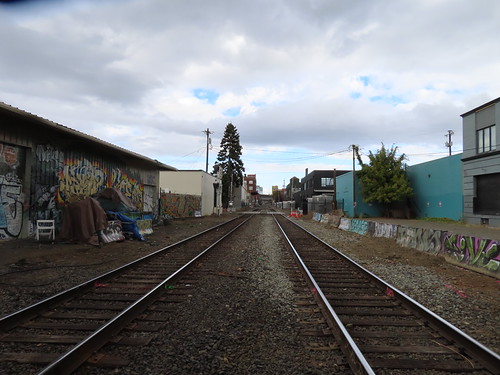
The way it never was…

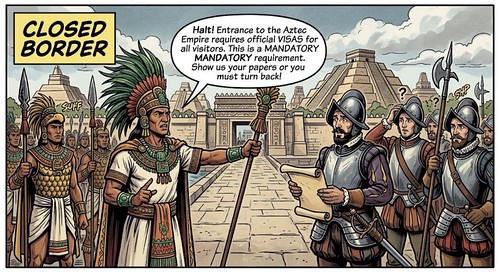

I’m gonna need to get the brakes tightened on this Cannondale. It’s a hand-me-down, a nice one, and I’ve been using it a lot, adding wear and tear. There’s a bike shop quite nearby so rather than go down rabbit holes on YouTube, I’m gonna get some training, and maybe buy a tool or two, directly from the pros.
Before this morning’s bike adventure, was the meetup with raccoons, a family, migrating willy-nilly across property lines, like a band of roaming gypsies that never bought in to the property lines game. I had them staring into my flashlight, half way up the tree. Would I be able to take some flash pictures? No dice.
My route this morning took me north from OMSI, along the Vera Katz Eastbank Esplanade and over the Steel, south along the west side to Tilikum Crossing and the FX2. I didn’t leave my helmet behind this time, even though I took it off to insert my earbuds (I’ve got an off-brand pair with ear hooks and don’t use them when riding). Some of my slowings were taking too long. First Person Physics.
Last night was a last ceremonial outdoor BBQ. It’s still crazy warm in October, in the 70s, or it least that seems above average to me. All in all, it was a mild summer but for the forest fires. That’s speaking as a Portlander.
Now it seems like a mild Fall, but with the winds starting to kick up, blowing the leaves around. The crows’ migration path may have shifted from overhead. We’d see lots of em, directly over the backyard. Maybe that season is still ahead.
Yesterday my multi-modal Wanderers path took me along NE Alberta, from where the 75 dropped me, to where the 6 picked me up, on MLK. I took the Red Line (headed to the airport) back to Hollywood and might’ve gone in Trader Joe’s if the return 75 weren’t arriving so soon. That was all walking activity, no bicycle in the picture. I closed my green Exercise ring per Apple Watch, which is one of my goals.



I did not award myself a smooth operator badge (stored mentally) for the most recent bicycle loop, although I did give myself an honorary E for Effort i.e. Energy (E/acc).
I went for longer than usual: instead of boarding the Orange Line at the Sellwood station (my usual routine), I kept going along Springwater Corridor along Johnson Creek to the Flavel station next to I-205, where I caught the Green Line to Gateway, where I transferred to Blue.
Shades of training for S2P (Seattle to Portland) — that was my old cycling route, or at least half of it (I’d continue north and return home across the base of Mt. Tabor — more recently I stay on Division, newly paved and with a bike lane added).
So why not a smooth operator badge? Because after I caught the Blue Line to downtown (going over the Steel), I switched to the Orange (southbound) at Pioneer Square, and left my bike helmet in the seat next to mine. That’s why.
I could visualize said helmet continuing without me, all the way to Hillsboro. Would it end up in Lost and Found? I’ve had good luck with that at least once before.
This time I had the presence of mind to proactively phone the L&F number, to explain about my helmet, leaving my name (they already had my number, using caller ID). Maybe someone at the end of the line checks all the cars? Probably not routinely.
And now, a day later, I’m even questioning if I left the helmet on the Blue Line or the Green. I only discovered it was missing while awaiting the Orange. Did I take it off after Flavel and leave it at Gateway? Memory fades. Sometimes too fast.
On the brighter side, I have a second, backup helmet just like this one I’ve lost, with a “Bob” Dobbs sticker on the back. The straps may need some adjustment, but I’m confident it’ll work fine. I plan to continue doing loops without investing in a new helmet. I’m trying to save my pennies. Property tax is coming up.
On my way through Sellwood on Linn, I stopped at the substation to take a selfie and show off my new Esoterica T-shirt. I’ve learned quite a bit from Professor Sledge, the channel’s anchor, and still hope to learn more. I’m into esoterica. He’s pretty generous with his scholarship. I’m happy to tag myself his fan.
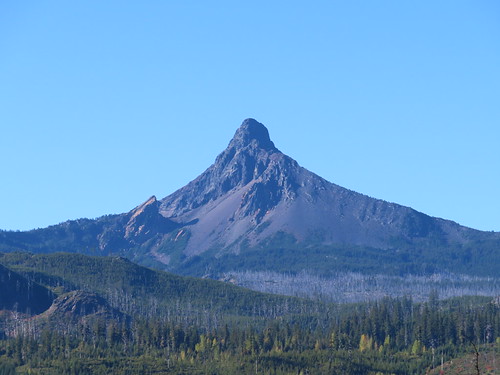
I just completed another circuit, one I've navigated before: Smith Rock area, Santiam Pass, Hwy 126 down the mountains into the Springfield area. This was neither camping nor glamping. I stayed with peeps I know, may even be related to. Sydney, my old dog, came along.
On the curriculum front, I'm following Dr. Rorty's model in bridging to the Eurasian continent, in terms of readings, taking Cascadian Pragmatism back to its sources, through William James to Wittgenstein's critique thereof.
The phenomenology of spirituality aka psychological development, might be mapped in various ways, ala the M4W schemata. I tend to favor an Active Inference informed namespace, which has a thermodynamic flavor.
However, I don't need to exclusively follow the Logical Positivist thread back to the Vienna Circle of the early Wittgenstein (Schopenhauer et al). I've long embedded Mark Fisher in my School of Tomorrow matrix, and through him we get to an important node: the CCRU, a kind of think tank that interpreted developments in philosophy (e.g. Deleuze & Guattari) since Freud and Hegel to an anglophonic BBC-informed audience, around the same time the personal computer was taking off.
We might think of the CCRU as a particle accelerator sending entangled particles every which way. We're not talking about uniformity of thought so much as polarities, counter spins. Mark "liminal spaces" Fisher did not take the same party line as Nick "capitalism is AI" Land (admittedly an anachronistic telling, as AI was but a gleam in Alan Turing's eye back in those days).
As recently as last night I was lolling about taking in comparisons of Mark "weird and eerie" Fisher with David Foster "Infinite Jest" Wallace. I'm still very much in the process of assembling the puzzle pieces, from a curriculum developer's point of view. How might one connect the dots in an efficient synergetic manner?
Speaking of curriculum developers and family relationships, my Springfield stop brought me in proximity to the Fitzgeralds of Great Gatsby fame, leading me to prompt Perplexity this morning regarding some gender studies questions I have.
I was happy to see Perplexity pushing back on what appeared to be my misconceptions:
(a) the Gilded Age (late 1800s) was not the Golden Age (early 1900s), which latter Perplexity prefers to call the Jazz Age and
(b) the Betty Boop stuff is only partially free of copyrights.
Why am I connecting to the CCRU in the first place? Recall Applewhite's tagline for Grunch of Giants: more subversive than anything since Karl Marx. He was clearly calling out the Marxists to check it out.
One might suggest I'm seeking to answer the question: why are the Marxists so slow to pick up on our narratives? But that'd simply be to privilege my own coordinate system versus keeping it all more realistically relativistic.
Subcultures abound (and partially overlap), and we each encounter the puzzle pieces in different orders and assemble different parts of the puzzle in our own good time. Rushed work tends to not hold up, has a shorter half life.
Certainly Infinite Jest is hard to read (I've only sampled it) and yet Hannah Smart said she'd read it nine times, wow. Shades of Finnegans Wake (in the sense of "hard reading" that is).

I have a drive of about three hours planned out, with my dog in the back seat. We’ll be both ascending and descending, with more of the latter than the former, given where we’ll end up, near the Mohawk River at a favorite campsite (well equipped).
Per the worldgame shoptalk, that’s what I’m playing, with my “avatar” or “piece on the board” so to speak, as they say in est, or said, back in the day. If you want more context, think Glass Bead Game from Magister Ludi, a Hermann Hesse novel. I used to bring that up over on math4wisdom (a Freelists listserv) when laying tracks nearer to Lithuania via M4W.
Most Lower48ers (USSAers) won’t have heard of the GBG I’m thinking, unless they’ve heard of Martin Gardner as well, but that’s narrowing it down quite a bit.
Martin Gardner was a polymathic columnist for Scientific American, a role reminiscent of Hugh Kenner’s vs-a-vs Byte. I’d read both. I had free access to the latter when I worked for McGraw-Hill.
Gardner helped with the spread of cellular automata as a topic, per Wolfram et al. By “cell” we mean a partition or particle, like a box but not necessarily hexahedral. Often we just stack em in Tetris fashion and play a game of “trickle down” (i.e. of the “life substance” in terms of what next row — generation — begets).
I’ve been personally invited to a G4G by someone close to Gardner when he was still alive, but I didn’t have any budget for it back then. I still don’t, but remain hopeful. Maybe someday.
I recall something about heptagons one year. I’ll find my blog post about it. Heptagon means seven cornered, deriving from ἑπτάγωνον (that’s Greek).

I got this off the classic actors shelf, under Bogart, but it’d cross-file under noirs easily, were they to file multiple copies. DVDs are expensive, but not metadata, meaning it’s easy to find the same film following multiple routings. I’m speaking in general terms. I’m forgetting which filters MMU uses. I’m thinking in SQL terms (structured query language).
A noir because it starts the way many of them do, with a guy (Bogart) getting out of prison, pardoned from on high, and returning immediately into service as skilled in petty crime (stickups, common heists). As is typical with a Bogart film, his relations with women are of special interest. Although given the vote by this time, women are still groomed as dependents and must think of ways to manipulate men using their desirability.
Bogart is especially attracted to a young woman too innocent to be at all wily yet. She has more power over him for this reason. Her farmer family takes him back to the good old days, before he became a criminal and prisoner.
His willingness to help her with an operation to address a congenital defect, and then take no for an answer when he proposes marriage — he’s expecting a ridiculously paltry payment for his role in a petty heist and plans to retire to a life of travel — shows us he’s a hopeless romantic under it all. That explains why the more worldly woman likes him and wants to be his sidekick (she sees his good side as well as his ruthless toughness, “the right stuff” in her book)).
At first he holds out for Velma (she has attached herself to someone else) but eventually he comes round to caring for sidekick Maria and the dog. The dog (a major character) is treated as a bad omen meaning a lot of thickly applied foreshadowing, starting with Algernon’s story of how the dog’s owners seem to always meet an untimely end. We know Bogart is headed toward a dead end. The high Sierras aren’t featured for no reason.
The film is made for a national audience meaning many states and geographic regions get a plot mention, not unlike in Apple movies today, such as Pluribus, which go for a global audience. The whole globe is now the common backdrop with one weather report for all, on tap at the global weather web sites.
Going forward from this time, women would win some and lose some in the gender wars. Women are still over represented among the exploited classes of course. Movies such as this provide stereotypes and caricatures to some level, one of the chief functions of fiction. That only makes them more interesting from a psychological anthropological point of view.
If you’re new to my blogs, check the index at the right for links to what those blogs are: this one, Control Room, BizMo Diaries, and Coffee Shops Network (CSN). This last is subtitled “Philosophy Talk” and in my most recent post (as of this post) I’m doing some catching up, mentioning some of the names associated with so-called “accelerationism”.
Say what? What’s that?
I’m more an outsider looking in, than insider looking out, so my thoughts might sound naive if you’re a veteran of accelerationist talk. My spellchecker doesn’t even know the word. My thinking drifts back to Future Shock by Alvin Toffler, which I’m surprised is not more cited in the literature, but then I haven’t sicced a lotta chatbots on the issue (yet). He coined “accelerating acceleration” didn’t he?
Put succinctly: if Toffler was right (let’s say he was) then there’s no need to “step on the gas pedal” and no, there’s no brake to speak of. We’ve entered an exponential phase and that’s the new status quo, so how is one to be an “ist” about it? You wanna boost what’s already boosting? You wanna self boost? Why pull yourself up by your own bootstraps when you’re already “up” i.e. already accelerating?
To slow it down we might always get pedantic. I associate the “ped” in “pedantic” with “pedestrian” meaning “the pace of walking” which is slow, relative to some other forms of travel.
To walk it back a bit, acceleration doesn’t just mean speeding up or slowing down; it means changing direction. The laws of inertia suggest that directional changes are proportional to speed and mass in the sense that heavy things don’t turn on a dime.
Sharp turns (a kind of acceleration) require less force at lower speeds. That’s some First Person Physics (or call it rollercoaster physics). You know from driving that taking sharps requires slowing down.
Now, with those Newtonian mechanics out of the way, let’s distill all of the above into a question to myself: am I myself an accelerationist?
At this juncture I’d answer: I accept the premise of a somewhat shocking future in the sense Alvin Toffler anticipated, but I don’t see a need to make it more shocking than it already is. On the contrary, I think less shocking would be fine.
Predictability is not ruled out by the fact of butterfly effects meaning minimizing surprisal in the Active Inference sense is a sensible response in the face of inevitable chaos.
Learn to drive safely, is a good motto to steer by. Practice makes perfect.
But then the perfect is the enemy of the good, meaning don’t expect perfection (or beat yourself up for falling short of it) but nevertheless aim for it in practice.
We’re down to re-minting some old cliches here, some sayings. We get down to maxims.