I'm using wireless from a private residence close to my hotel. Bright blue sky, pool and jacuzzi a stone's throw away -- ah, this is the life (Portland was supposed to be in the 20s today).
The LA Times was fun this morning: there's a long page one article dissecting the Niger yellowcake rumors, saying the FBI investigation into who forged the documents has been "reopened" (why ever closed?); and Bill Maher's editorial is clever, about what I call the Eleanor Rigby Syndrome (we want "them" to listen).
The Budget rental car lady really tried hard to get me to upgrade to the yellow Mustang (hard top).
Richard Metzger's disinfo.com has a new blurb (Feb 15) on Bucky's Montreal dome with links to a couple Google videos. That makes a total of three Google vids (to date) that come up in response to "Buckminster Fuller". I just re-edited the description of my little talk to make it the fourth.
Friday, February 17, 2006
Thursday, February 16, 2006
Octet Truss
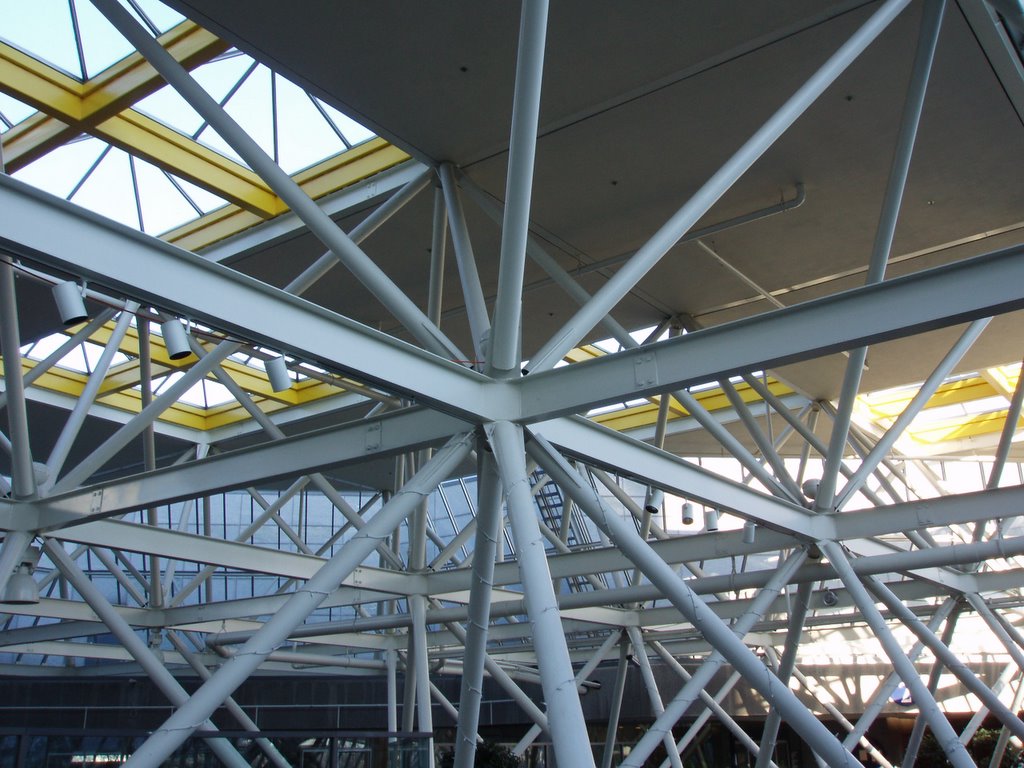 Portland World Trade Center
(photo by K. Urner, Olympus Stylus 500)
I took a series of photos yesterday focusing on an architectural feature of one of our downtown buildings: a spaceframe known as the octet truss. The above photo shows 12 spokes emanating from a common hub, corresponding to 12 balls around a nuclear ball in the face centered cubic packing (FCC).
I incorporated these shots into my slide show for sixth graders at Winterhaven today, along with a slide borrowed from my OSCON 2005 talk featuring Alexander Graham Bell standing next to one of his "kites" -- likewise an octet truss.

The photo below shows the 12-spoke hub in Bell's construction kit.
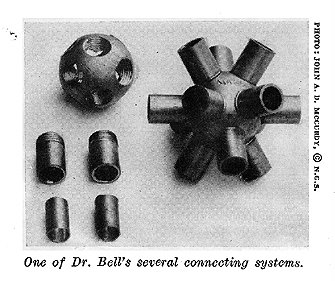 Fuller called this lattice the isotropic vector matrix (all vectors are the same length) and related it to Avogadro's ideal gas model.
Of course gas molecules aren't static, but their average uniformity in a volume might be associated with the isotropic distribution of "spherics" i.e. the rhombic dodecahedral voronoi cells around each ball in the packing.
Related reading:
More Oregon Curriculum stuff, posted from concourse B, PDX airport.

Wednesday, February 15, 2006
Illahee
Illahee is a Native American word meaning this place, our country. Peter Schoonmaker shared with Wanderers this morning about his work with the Illahee Foundation on ecosystem planning, focusing on urban centers, and Portland in particular.
Peter's group produces a lecture series, similar to ISEPP's in some ways, but focusing on these different themes. Last year's theme was How Cities Learn (taking off from Stewart Brand's How Buildings Learn -- Stewart being one of the lecturers). This year it's Water & Oil (watch for the ads on Tri-Met buses).
Fortunately, Wanderers Dick Pugh and Jim Buxton were present, both "long now" types with an understanding of our place on the geological time scale. We joked about the thin stratum of asphalt and other petroleum based products we'd eventually become, as the world goes on turning.
Peter is on Mayor Tom Potter's visioning committee, aimed at coming up with some credible, actionable futurism for Portland. He finds the process rather plodding compared to Jaime Lerner's fast-paced style, but not every city is as lucky as Curtiba (in Brazil), where Jaime served a few terms as mayor.
Wanderers agreed that roping in more creative types, including Portland's illustrious science fiction community, might be a good idea. Jon Bunce cited Ursula LeGuinn's 1971 novel Lathe of Heaven for anticipating Portland's future (the 1980 made-for-TV version was filmed in Dallas, while the 2002 remake features Ursala's home town of Portland, including light rail).
Indeed, according to Peter, Jaime Lerner likes his planning committees to consist of three main types of people: architects for their design sensibilities, journalists because they know how to meet deadlines, and poet-philosopher types, for their powers of precognition.
After Peter's presentation, I hooked up my wireless laptop to my projector, and screened my OMSI Dome and Dignity Village blog entries, about getting FEDs (Fly's Eye Domes) showcased around Portland.
Although designed for service in more rural areas, FED-style infrastructure draws support from urban control rooms, studios, and classrooms, i.e. is the brainchild of our KBE.
I shared my view that corporate media need only shift gears a little and we'd have some dynamite reality TV complete with exciting product placement opportunities. Politicians needn't be in the loop on this one, which is fortunate, as when it comes to brainstorming potentially positive futures, they're apparently otherwise engaged.
Indeed, I'm flying down to LA tomorrow (after my Winterhaven gig), where I hope to stir things up a bit. Why should this science fiction capital, in a state with a movie star governor, lag so far behind Portland when it comes to intelligently brainstorming about our American Dream? Let's get Hollywood up to speed, shall we? We could use its media know-how.
Monday, February 13, 2006
What the Bleep (movie review)
What the Bleep: Down the Rabbit Hole is a remix and second draft of the original What the #$*! Do We Know!? with some added material, most notably the Dr. Quantum cartoons (and did Ramtha smoke a pipe last time?).
The film lays a neurobiology layer atop a quantum mechanics layer in an attempt to boost the observer's quality of life. Thoughts and attitudes matter; reality is maybe more plastic than you'd presumed. In that sense, it's a religious film addressing aspects of the human condition, while piggy-backing on science's credibility to drive its message home. Like, really use those frontal lobes and make your world a better place.
I found the cosmetics too thickly applied, what with the hallmarky backgrounds, music and lighting abetting the already expressive foreground talking heads. Also, I'm philosophically biased against Abbott's Flatland meme, although I found it well-rendered, in the form of a concluding Dr. Quantum cartoon screened within the Bagdad Theater (the observer's very venue in this case).
The film doesn't have anything intelligent to say to parents in the developing world, watching their children die of medically preventable causes such as starvation. It's more aimed at relatively well cared for mid-life urbanites with little excuse to not be over themselves already.
Sunday, February 12, 2006
Turnover
I resigned from all my Yahoo groups today, except the two where I have official responsibilities. Plus I think I've about exhausted what I have to say in the Math Forum, at least for awhile.
My goal is to shake up my reality a bit and look for some new venues, plus my web sites could use some more upkeep and maintenance. Like, I just got an email from Alastair Farrugia about a small group theory error I need to fix on one of my crypto pages (plus he shared some links to fun software).
Dad always warned against getting "stuck in a rut" and had several self-disciplines to keep that from happening (e.g. he liked to keep changing where people sat at the dinner table).
I had breakfast with Dave Fabik this morning, at Cadillac Café on Broadway (very crowded, we sat at the bar).
Dave and I were also lunch mates on Thursday, with Henry Sessions and young Christopher, and Don Wardwell. Henry is in the final stages of becoming a physician's assistant (PA), having come from a career in public radio and public relations (PR), including for the American Red Cross.
Saturday, February 11, 2006
The Kepler Project
Dr. Gibor Basri focused his well-attended lecture on the Kepler Project, designed to answer the question: how many earth-like planets might we reasonably expect to find in our galaxy?
The instrument will be fired into space on a Delta rocket c/o NASA, presumably in 2008 although the schedule has already slipped for bureaucratic reasons.
The space platform, nowhere near as expensive or sophisticated as The Hubble (will Hubble get that last upgrade before it dies?), consists of CCD panels focused on a star field near the Northern Cross and Vega.
The idea is to stare, unblinkingly, at all these stars, for about 4 years. Periodic dips in brightness, caused by planets partially eclipsing their parents, will show up upon filtering the continuously downloaded data. The word "planet" is built in to the etymology of "wanderer" by the way.
The mathematics will tell us how many of these planets are earth-like i.e. in some habitable zone that would in principle allow for liquid water on the surface. Whether there actually is any liquid water, let alone life, on these particular planets is not something Kepler will reveal.
During the Heathman Dinner (I sat next to Glenn Stockton, retired cryptographer, and Jon Bunce, musician, plus David Feinstein, mathematician, Don Wardwell, boat captain, Nirel, web wrangler and Larry, retired chemist, were at our table), I asked whether solar systems ever form directly in the wake of exploding stars.
Dr. Basri said yes, that two of the first earth-sized planets ever discovered beyond our solar system were both in orbit around a pulsar, the remains of a gas giant's exploding and collapsing.
Thanks to the Mentor Graphics Foundation, a lot of high and middle schoolers get to attend these lectures, which would be too expensively inconvenient for them otherwise.
Our regular attenders have built up a lot of appreciation for contemporary science and engineering over the years.
Before the lecture, Glenn and I joined Patrick and Diane Barton for dinner at a McMenamin's brew pub (the one nearest the Art Museum downtown). The Bartons, a Wanderer couple, used to work at Sandia (a national lab) in connection with supercomputer modeling. Glenn used to work for the NSA. And I'm a Fuller Schooler.
Yes, I realize that's two dinners in one night. That's why I just got a hummus plate the first time (plus Hammerhead -- the beer, not the shark). And Glenn had ahi twice (a taste of heaven).
Thursday, February 09, 2006
Restoring Integrity?
Now that we've turned the corner on implementing more design science within K-16, we need to get to work on repairing the damaged integrity of various key players in this picture. The war is over, rehabilitation and rebuilding is now the name of the game.
Sometimes this means working with former enemies, such as the NCTM. Even the MAA is not unscathed, having failed to do anything very sensible with the A & B modules when it could have made a real difference at a critical time. Oh well, that's all water under the bridge by now.
In general, the Ivory Tower has not performed well during this interlude. We've seen too much blaming of others (politicians especially), given how overspecialization leaves its victims feeling powerless and blue.
There've been many stellar exceptions of course, but this doesn't change the fact that reforms are sorely needed. I'm sure "the experts" will be rushing forward with their lists of much-needed changes.
Wednesday, February 08, 2006
Philosophers Gather
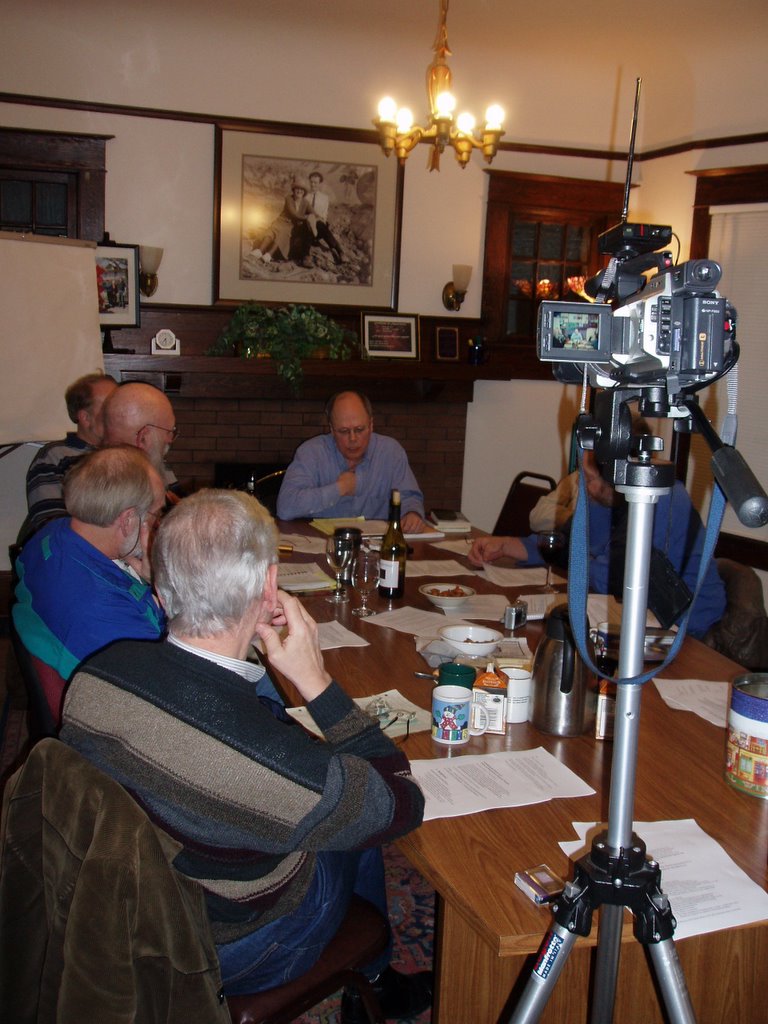 Linus Pauling House, Feb 7, 2006
(photo by K. Urner)
Terry Bristol, president of ISEPP, lectured on American Pragmatism to a packed house of curious Wanderers last night. Karl Popper, Thomas Kuhn, John Dewey, and Joseph Priestley are among those whom Terry cites as influencing his thinking.
Tara (age 11) kicked off the program by demonstrating her two robot dogs, Robopet and I-Cybie (she didn't stay for the lecture though).
That's a picture of a young Linus and Ava over the mantle behind Terry.
Tuesday, February 07, 2006
Broken Flowers (movie review)
I suppose some might read a tone of moral condemnation into this portrayal of an older man's pilgrimmage to past temples, each containing a goddess of some kind: no high moral principles, no glory, no battles for God; secular-materialist (aka "western") civilian life is empty and decadent and yadda yadda.
But that wouldn't be me behind that reading (except I liked the goddess part). I savor that twilight zone of airports and rental cars, soft ring tones, faceless announcements, a little turbulance, dreams. The allusion to Buddhism is apt, amidst ripples of Lost in Translation. Murry's character is overflowing with love in the Void. He's a bodhisattva. America is beautiful.
But that wouldn't be me behind that reading (except I liked the goddess part). I savor that twilight zone of airports and rental cars, soft ring tones, faceless announcements, a little turbulance, dreams. The allusion to Buddhism is apt, amidst ripples of Lost in Translation. Murry's character is overflowing with love in the Void. He's a bodhisattva. America is beautiful.
Sunday, February 05, 2006
Moral Relativism?
I've been chatting with a certain SWM on a Wittgenstein list (a Yahoo! group) -- both of us appear in the acknowledgements in Duncan Richter's new book by the way (Historical Dictionary of Wittgenstein's Philosophy). We've been yakking about moral bedrockism (absolutism) versus relativism, whether Wittgenstein was either, and tangentially, where do we come down?
I know for myself I'm coming to the following elucidation: moral relativism is a first line of defense against the morally inferior; let 'em all duke it out, and the bedrockers among 'em 'll likely percolate to the surface, ready for round 2 etc.
I mean, we're of harder and softer metal, along many different axes or principles. Alchemical mixings of archetypes. I'll budge where you'd never and vice versa. We wonder at one another's weaknesses. I'll grant you all that.
All the more reason to not step in as some Grand Mediator with a handy fix for every problem. I'm not doing that either, believe me. I'm just another guy in the ring, sometimes more than ready for that next bell.
But when they're all still just kids, needing tools of self expression, I'm saying: I won't deny you some dynamite training with these multi-track audio and video sequencer devices. You may grow up an enemy, but you'll know how to express yourself effectively, which means you're less likely to resort to brute force, the strategy of those at the end of some rope already.
You shouldn't run out of editing tricks that fast. Like, I'm not impressed when you go for the guns. OK, so you failed, what more shall we say? But if you know how to edit TV, do a good job in journalism, know how to research, think critically and analytically, then hey, let's watch your programming. Let's see what you think it's all about. I'll help give you those skills, or learn them from others, and make them your own.
It's not like I know in advance if you'll be with me or agin' me. At least you'll be free.
Thursday, February 02, 2006
Conundrum
Our local mayor is working to inject new dollars into a flagging school system. See today's Oregonian, Metro section, page B6 (One step closer to a winnable school plan).
My approach is to talk turkey directly i.e. let's join the school board in looking at curriculum. This Old Library Studio has some right stuff: lots of music-making booths ala EMP, with software for working in multi-track (mostly Apple, though Noah is likewise a Linux devotee).
The multi-track metaphor is likewise what we use in television, however both stem from the older orchestra conductor view: lots of instruments (now called devices) scripted into a whole, with this overview person tasked with waving a wand, making facial grimmaces and so forth (I've watched them work, but have nowhere near the musical knowledge to do much better than mime the performance).
So our curriculum aims to equip kids with mastery of multi-track editing in various contexts. A toy company I used as a base for these ideas has gone out of business (slow link), while my Alien Curriculum (giving academic rigor to these ideas) languishes at my Oregon Curriculum Network website (except not really: I do have a fan base).
Speaking of that article on B6, another conundrum appears right next to it: Calling Inspector Clouseau. This one is about some middle aged guy tripping on his own shoelaces and smashing some Chinese vases at the bottom of a staircase. Playing the clip in reverse: a man back-swims towards heaven's gate, as these Humpty Dumpty type objects reassemble in his wake.
Wednesday, February 01, 2006
Bruce Adams Presents...
 robotic wafer processor from Bruce's slides
The ion-injected dopants disrupt the local lattice. Thermal treatment restores it, but if cooked too long, the dopants diffuse, ruining the junction.
As Moore's Law has continued to push the number of transistors on a wafer, the layering dimension (Z axis) has become critical. Multi-hour lamp-driven baking techniques don't work at these smaller scales, nor is multi-second rapid thermal processing (RTP) fast enough at these smaller scales either.
R&D groups are exploring various solutions, Bruce's being one of them.
Jim Buxton is looking forward to the Libya trip (eclipse viewing). I found it encouraging that Myanmar and Zimbabwe are picking up the slack on the official enemies list these days (referring to last night's State of the Union Address). Libya is a new friend.
Gordon Hoffman joined us today, offering his unique perspective as a long haul Silicon Forester.
Monday, January 30, 2006
Editorial Comment
I disagree with the talking heads in Wired 02/2006 039, who say "cyberspace" is dead (reminds me of an old existentialist movement, popular when Mom was going to college).
Yes, we could be creatures of fashion and rename the thing every few years, setting up a whole new "wired | tired | expired" loop. However, what these experts neglect is the Greek root (a root with root access, I think most will admit, witness greek letters).
Per my Grunch FAQ, "cyber" stems from the Greek "to steer" (as with a rudder), and cyberspace indeed serves that function, owing to its speed, breadth, and sensitivity (in the hands of an expert sand sifter anyway). See my Q: Isn't this just another right-wing, pro-corporate, propaganda site? (hey, the whole FAQ is kinda fun).
So I, for one, plan on keeping "cyberspace" in circulation. Besides, it's backward compatible.
Beyond that editorial comment, I thought this was a fun issue, worth referring back to. Tara is really getting into programmable robot dolls, more affordable than Disney's audioanimatronics.
Saturday, January 28, 2006
CBS Interview
I thought GWB was unassumingly presidential in his remarks last night.
I liked what he said about politics not really being zero-sum, e.g. Washington, DC can afford to welcome the fact of independently powerful metro areas, including within the USA.
Winning in Iraq likewise needn't be at the political expense of those who disagreed with the strategy of invasion and occupation (many Republicans in this category, and military personnel). Too many B Team policies were followed.
I wasn't surprised that Laura was his closest advisor, even though they fight sometimes (the garage door story) -- Dawn and I were fighting just today in fact (something about text messaging and right speech).
Finally, I thought he was wise in his choice of networks.
Friday, January 27, 2006
Noodling in a Moodle
Mark (PPS) gave me an opportunity to simulate a real math/CS course in a moodle. A moodle [link to Moodle] is a webspace, customized to face both teacher (course author) and students (course readers). As a teacher, I'm able to add text objects, quiz objects, link objects and so on (popup driven, point and click). Students watch my course evolve (or remain static once finished). I also collaborate with other teachers, optionally. So yes, it's a nifty system, one of many such, and prototypical of things to come.
The moodle I'm working on is called Python for Algebra Students, meaning I'm taking a "programming to learn" versus a "learning to program" approach. We start with Sequences, which motivate defining functions, which motivates class/object syntax, allowing us to customize our own objects. Once we're able to roll our own, it's on to: rational number type (not native to Python, though decimal is); polynomial type (they form a ring, getting to that); vector type (preview -- more later); then a quick leap into fractals (through complex + trig), group theory (group, ring, field) and number theory (EA, totatives, Euler's Theorem).
Calculus is getting shoved over to Physics (where we might also use Python -- or VPython).
Having a moodle allows me to invite collaborators to look over my shoulder as I develop the above in some detail, and in such a way as to encourage new teachers to explore in this direction. I think younger kids hunger for more crypto for example, and what better way to give it to 'em than to head in the direction of explaining RSA in terms of Fermat's Little and Euler's Theorems? Like in the bestseller In Code.
Thursday, January 26, 2006
Cartoon Physics
I've been flipping through this physics comic book Nancy lent me, along with a companion CD.
Combining with other stuff, I have this image of buckyballs vanishing here and getting tuned in there, with a mediating field described by a kind of ray tracing (a Feynman superposition) of all possible routes in between.
One maybe needn't imagine the energy in transit, since to see it at all is to detect it i.e. is to tune it in. Imagining a little ball going through either slit is unrealistic, is like spending money you don't really have. When some photographic emulsion registers a ping, that's when the energy reappears and a possibility gets actualized (maybe in two places at once -- nonlocality).
You might not think buckyballs (C60 molecules) are small enough to behave like photons, i.e. are too big to constructively / destructively interfere through a double slit apparatus. But they do so behave. This was the subject of Julian's research before he became an artist.
Tuesday, January 24, 2006
Wanderers 2006.1.24

Dick Pugh and Julian Voss-Andreae
Tonight Julian shared about his career as a physicist-turned- sculptor of proteins and other molecules. He's working on some exciting new projects.
Monday, January 23, 2006
More About Geek TV
Your stereotypical geeks love science fiction. Like, we just screened the entire Matrix series again, in our home theater this week (I only watched sporadically, having seen it recently -- to Tara it was mostly new).
The fictive tapestry we create as a background to reality, the stuff of day dreams and amusements, is often identified as "escapist" in nature, and certainly I have nothing against projecting into a completely different solar system (e.g. Serenity) or universe (e.g. Narnia).
However my dad, Dr. Jack Urner, was an urban and regional planner (University of Washington, Johns Hopkins, University of Chicago), subscribed to The Futurist, so as a kid, I absorbed the view that humans could actually dream new stuff into existence.
I watched the whole Apollo thing from Rome (EUR and later Viale Parioli), our base while dad worked with Libyan counterparts on mapping and zoning (he worked with several Islamic countries during his long career, plus the Buddhist Kingdom of Bhutan).
When I started reading Fuller's enlightened futurism in earnest, back in the early 1980s, the Cold War was still in high gear. KAL 007 was shot down. Some nights on the TV news it seemed like the CIA and KGB had a monopoly on world affairs, and were using Central America as their proxy. Russian submarines were parked just off the USA coast, ready to launch if need be.
So how was a geek futurist like me to get any traction in this crazy, cold world? Fuller had a suggestion, embedded throughout his books: focus on the world energy grid concept. He had a lot of other good ideas too. So I wasn't without tools. Perhaps the situation wasn't as hopeless as it seemed.
Now, over 20 years later, I'm looking back on a lot of accomplishments. A lot of leg work has been done. My personal workspace edit/recombine studio (a GST concept) is evident in such products as Intel's viiv. Reality TV as a genre has been established around the game show concept, permitting an easy transition to World Game when the stars feel ready. And the world power grid is coming along nicely, with Iraq slated to get more kilowatts from Iran, once we've brought those power plants on-line (so, where shall we put that SeaWorld?).
What's true is a lot of people have been working on the design science agenda (no need to always call it that). I'm one player among many (a strong one, but powerless in isolation). Nowadays, I'm looking forward to scripting more reality TV (4D Studios work), producing commercials (e.g. for Global Data), and recruiting talented faculty to a bizmo-based lifestyle (cybervans, cram packed with educational programming and equipment).
I'm planning to stay Portland-based. I really don't mind all the rain.
Sunday, January 22, 2006
Visiting OMSI
Tara and I checked out OMSI again yesterday, cruised Turbine Hall, cafeteria (twice), made a fast track through animations [see it looping in the background...] -- didn't make it upstairs at all.
We toured Blueback again (Tara hadn't been in years and specifically requested it). USS Blueback is the latest and greatest to be cast in electric-diesel technology, and she's still in mint condition (admittedly, the Willamette is sort of shallow for a boat of her kind, but our kids love it -- OMSI staff even organizes sleepovers sometimes).
Food was really good on this sub, in compensation for living cooped up like that, fewer beds than personnel (a deliberate design: you don't want everyone asleep at the same time on a sub). Only the captain could actually sit up in bed, without smashing his face into dirty laundry. I say "his" because these early subs were guy things. Women didn't have their own subs yet. Cooks competed ("Think Ney") and the best got bragging rights, and maybe a gig at the White House. The cafeteria (smallish), was also a place for pre-LCD TV amusements, like watching movies 'n stuff.
In officers' quarters, we all squeezed around a table and the lights went low, revealing some scaled silhouettes. Which one of these is the Blueback kids? Having made a fool of myself at SeaWorld, on that huge TV display, I kept my mouth shut this time, but one kid got it right: the smallest one. All of the others were US except the one on the bottom, a Typhoon class Russian, double-wide, and clearly biggest. But there was no sense of an enemy in this revelation.
Subs are these cool underwater boats, not themselves blameworthy for all they've been used for. We should keep them around, invent some new ones, invite more civilians aboard.
Saturday, January 21, 2006
Peanut Butter Bonanza
I was glad to see on KOIN news last night how the Oregon Food Bank is scoring all that peanut butter. Our food situation in Oregon has been somewhat dire of late.
Less excess capacity has been coming our way, leaving us feeling cold and blue -- although we fully realize the victims of Rita and Katrina have needed it more. Still, maybe all this peanut butter heralds a sea change of some kind?
I used to be a programmer for OFB and still know some of the people (hi Steve). My dBase code helped manage OFB's inventory, plus ran the distribution, a complicated formula for computing disbursements to satellite food banks all around the state.
That was some years ago. I doubt many NGOs use Ashton-Tate's original dBase any more. I started with dBase II, which a couple versions later forked into Borland's dBase V and FoxPro.
Microsoft bought the latter, migrating it to Windows, which eventually led to our Visual FoxPro of today, now up to version 9, lo these many years later. I still use VFP sometimes, still mostly in the social service sector, my focus since joining EMO's Center for Urban Education (CUE) in Portland in the mid 1980s.
I'd left my job at McGraw-Hill, Rockefeller Center (there's a story here), and joined my parents to help pack up in Bangladesh. We came back through PDX and I decided to stay behind. The Boltons kindly took me in.
CUE was a management hub for refugee resettlement in the wake of the Vietnam War, plus had a big grant of Apple desktop publishing equipment thanks to Steve Johnson. We trained local area nonprofits how to leverage the latest high tech, like the IBM 386, the target for the first Linux, of which none of us had yet heard (Linus who?).
Nor was Richard Stallman's free software yet available to our kind (soldiers in the social service trenches).
Whereas my recent stint at Free Geek during Ron Braithwaite's tenure was in some ways a deja vu experience -- we networked with similar nonprofit clients, via Penguin Day and so on -- our 21st century tools are so much more powerful (and yet this is still only the beginning).
Thursday, January 19, 2006
Kaa Meets Tiger
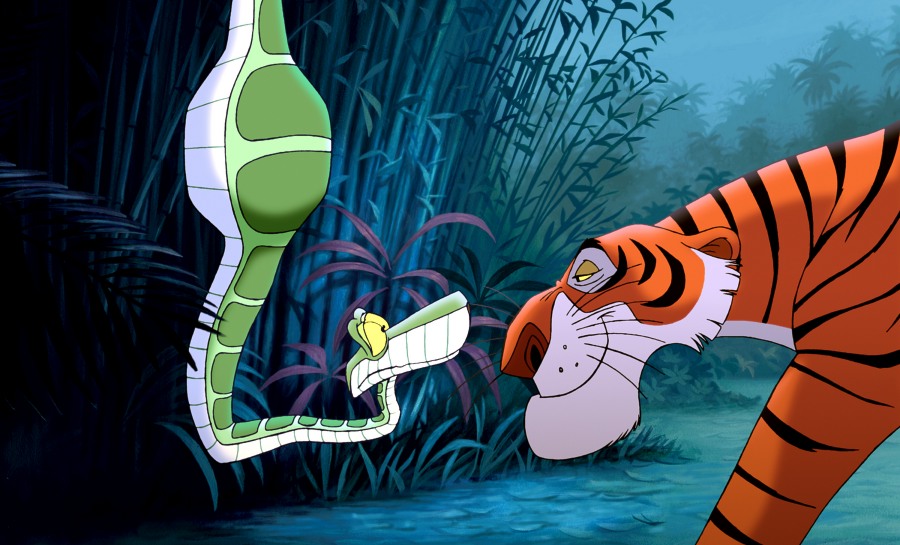 © Disney Company
I understand they'll be wanting me at EuroPython again in 2006. It'll be at CERN this year, the birthplace of the World Wide Web. Maybe there'll be an exhibit.
Relevant posts:
My Kaa impersonation
Re: Europython
Tygerblog link
Wednesday, January 18, 2006
Sequences
I used Don's cell to speak with Koreducators today, from within the hull of Meliptus. Since I regard them as affiliated with PSU, I asked Adam to put in a good word from me for Visual Math @ the Math Learning Center (MLC) should he run across a staffer.
I tried to get to first base with MLC some years ago, using a pre-publication Quadray Coordinates paper as entre. That got me nowhere -- I think he confused me with some math PhD wannabee, who'd have no intrinsic interest in pedagogy aimed at discerning middle schoolers. He was wrong of course, but on the other hand, neither was I as skilled back then as I am today (and I'm still learning).
Anyway, Visual Math uses these interesting tiling patterns to introduce algebraic formalisms, having students deduce an expression for the nth term in the sequence, given an example progression. Tara brings these home most days, and I've enjoyed the creativity. I also see ample opportunities for synching with my own sequence-based approach, which makes Python an implementation language for just such nth term expressions, with figurate and polyhedral numbers the focus.
I also encouraged Adam to keep talking to me about open source, even though I'm not the biggest name in town on that score (at least I know a few Free Geeks).
For its part, Koreducators is interested in recruiting for the new school (obviously). I said I'd try using my AFSC contacts to drum up more interest in northeast Portland (the target demographic this time -- we could bring more of the same on-line in other quadrants, should this experiment prove successful). Portland Impact probably doesn't need any help though, plus I'm no longer clerk of anything in AFSC world; younger talent has assumed the helm.
Tuesday, January 17, 2006
Re: Public Education (Oregon)
So the scheme I'm hearing about for Oregon is like:
e = elementary
m = middle
h = high
c = college
i.e. so-called k16, pre-school through college.
Of course this all looks very cryptic, but I'm just aiming at making it more memorable and compact.
I told some friends in South Africa it was:
in our neck of the woods but my wife says that's just not how it's done here. So I guess I'm not really the authority.
Anyway, my expertise is more in a specific subject area I tout as "a hybrid of CS and math," where CS is short for computer science and math is short for mathematics.
When you blend math with Texas Instruments, you get a calculator-intensive curriculum. But in PDX we've been leaning more and more towards GNU, Linux, open source in general.
So the calculators maybe don't have such a bright future here, except maybe as emulators e.g. kids can write 'em using some event-driven GUI framework, like maybe PyGame.
Addendum re organizational framework @ Math Forum.
k|5e|3m|4h|4c
k = kindergartene = elementary
m = middle
h = high
c = college
i.e. so-called k16, pre-school through college.
Of course this all looks very cryptic, but I'm just aiming at making it more memorable and compact.
I told some friends in South Africa it was:
k|6e|2m|4h|4c
in our neck of the woods but my wife says that's just not how it's done here. So I guess I'm not really the authority.
Anyway, my expertise is more in a specific subject area I tout as "a hybrid of CS and math," where CS is short for computer science and math is short for mathematics.
When you blend math with Texas Instruments, you get a calculator-intensive curriculum. But in PDX we've been leaning more and more towards GNU, Linux, open source in general.
So the calculators maybe don't have such a bright future here, except maybe as emulators e.g. kids can write 'em using some event-driven GUI framework, like maybe PyGame.
Addendum re organizational framework @ Math Forum.
Sunday, January 15, 2006
Dignity Village

Some of you quick draws probably already thought of this -- after all, there's the precedent in LA. What'll be fun is getting across that Santa really does care about poor people.
Of course you cynics see through all that: we're really talking about Grunch in a bunny suit, looking for good will on a planet grown tired of incessant bombing (not to mention outraged by all the collateral damage).
So let's try being at least a tiny bit decent for a change? What a concept! How'd that idea ever get passed the censors?
We've got some spanking new economics spelling out why being good matters, why poverty sucks. Of course we can't make evolution run faster than it'll go. Light speed (186K mph) defines an upper limit (and the normal rate in Synergetics).
I'm confidant that years of watching ecovillages develop will make for better TV (and sell more product) than years of watching bombs go off, per the current dark age in Palestine and Algebra City.
I think we're all tired of Coalition TV by now.
So let's demand something more uplifting for a change! Write to your local programming director -- maybe starting with KOIN?
Saturday, January 14, 2006
Breakfast on Pluto (movie review)
This cute kid from Pluto uses his storytelling powers to keep it together, while working to establish an Earthian identity.
He tries squeezing affection from the male side of the species, which is difficult under the circumstances. There's this fight going on... anyway, the usual guy thing.
Although the police show some kindness, ultimately it's the sisters of the road who keep him safe enough to keep doing his research.
He finally reconnects with a father archetype (the church), plus establishes a long distance relationship with a mother figure.
Individuation achieved. A human is born. Time for breakfast.
Dawn really liked this story. I told her it reminded me of Pinocchio, also about a boy who got creative with the truth while seeking his own humanity.
Friday, January 13, 2006

Thursday, January 12, 2006
More re Public Education
I've had a couple breakthrough insights on the USA OS front lately, regarding how I'm to model public education:
- As a system for educating virtual presidents (internalize this!)
- As a freeway network (Uncle Sam: here ya go kid, explore)
Tuesday, January 10, 2006
Front Page News
Today's front page headline in The Oregonian is "Oregon's bottom line: education" -- this is what most local business and elected leaders believe, whether or not they believe the necessary reforms will actually occur.
Of course I'm thinking my Oregon Curriculum Network might have a role to play in all this. True, I traffic in some rather alien content, but market research proves kids often groove on ET-like viewpoints, such as we provide through Google Earth (a big favorite at Winterhaven) , the space program, and science fiction.
Seeing our planet from the outside is a great starting point for any curriculum; then zoom in on the parts you want to elucidate and articulate, such as the Port of Portland and its role as a switch, between air-, land- and sea-based networks. I often watch the UPS and FedEx planes landing and taking off from PDX, from my viewpoint in the middle of the Columbia; and that daily Lufthansa to/from Frankfurt -- on which I someday hope to catch a lift, perhaps with family (pre-EU Europe was the site of my pre-adulthood).
Those taking the easy route will just think in terms of money and funding, without putting much real thought into actual programming and content. A lot of people seem to think that if the money is there, all that other stuff will just take care of itself -- just minor details. That's an outsider's perspective, shared by many politicians and politician wannabees.
As the television industry well knows, you don't bring viewers to your channel if you don't have any product worth watching. Money compensates talent, but doesn't create it -- otherwise those with money could simply buy their stairway to heaven. But neither God, nor the discerning public, was ever that cheap.
Saturday, January 07, 2006
Location Scouting

So some years back I drop-boxed this JavaDome proposal to OMSI, suggesting a real Fly's Eye or the like, with programmable guts, perhaps on that green patch just outside the main lobby.
Fun idea, but of course a small science museum NGO (with some funding from Spirit Mountain) won't have a budget for such a pricey item. Only Hollywood and the military get those spectator numbers, with private industry standing by to provide the props (livingry or killingry, whatever pays the bills).
Hmmm... how could we script this as reality television? FreeGeek is a great location. No need to spend Hollywood millions to create a trashy, lived-in, gorgeously free-spirited ambience, with geeks galore (the real deal, not acting).
Fly's Eyes will have application in emergency and disaster relief scenarios, as air deployable command and control units, or so we might imagine. We'll use a lot of open source software, so global geeks have opportunities to customize and give back.
Then there's OHSU, including pieces under construction (world class MRI). Doctors Without Borders: helicopters deploy clinics, to places like Pakistan. I see the ingredients of some uplifting TV here.
I'm no screenwriter though (not yet anyway -- and why wait?). We'd need lots and lots of employees to really pull off the pilot (some new exhibits @ OMSI would be concrete proof of mission accomplished).
The key idea here is we don't fake the props. We do it for real, in the spirit of not lying to kids. Not that I'm against good science fiction (Tara and I projected The Matrix in our home theater last night (Tara: "a very unlikely hypothesis") -- I have many positive things to say about it, even though, as a Quaker, I think gunplay lacks sex appeal (I got bored with Mr. & Mrs. Smith, walked away to write this post instead)).
But the design science genre is about going from prototypes, field tested by those with the right stuff, to commercial products (after most of the kinks have been worked out), ala my Project Renaissance model. Burt Rutan knows the score (it's a lot about fun). SpaceShipOne is great reality television.
I'd cast myself as some spooky behind-the-scenes organizer who makes the rare on-camera appearance. That wouldn't be a lie either.
Friday, January 06, 2006
Microsoft Pulls Blog
I woke up to this story on Slashdot: a controversial Chinese journalist has his First Amendment rights trampled by Microsoft, out of deference to offended readers -- in China. OK, so now we know: Microsoft is not really an American company. I'm not especially surprised to learn this. Only a few big companies have the guts to play by the rules, when it comes to upholding freedom and democracy.
Related posts:
My 1/2006 blog entry re Google & censorship
Update in Slashdot Jan 31 2006
Related posts:
My 1/2006 blog entry re Google & censorship
Update in Slashdot Jan 31 2006
Thursday, January 05, 2006
Corruption in Congress
I do enjoy the thought of these comtemptible Congressmen soiling their own pants with emergency charitable donations.
Newt Gingrich seems to think there's time for reform. I think the lack of open source voting pretty much voids their credibility to restore integrity from within.
We definitely want our democracy back, but I don't see that Congress has the power to give it to us. I wish it did.
Of course we have some great public servants in Congress, today as much as ever. But as a body, the institution has denegrated itself to new lows. Until we get a lot more transparency into the system, there's just no trusting these offices to reflect the will of the people.
I vote we erect a temporary Capitol Building in LA, or maybe Anchorage. We could devise a new voting system from scratch, with all current members by definition ineligible to run.
Just kidding.
It'd serve 'em right though.
Update: I shared some prints of this post with folks Drinking Liberally at Lucky Lab this evening. The Nike guy was flipping through slides of his recent trip to Turkey.
Tuesday, January 03, 2006
More Music Millenium Notes
So I taught @ Winterhaven this AM, wandered home up Division, stopping to coffee up, use wireless (more words to math-teach, with lots of English (spin, see 5a)), eat salad.
Now I'm using my surround sound to blast Baker Street by Gerry Rafferty. In my mind's eye, I'm watching polyhedra on 3D IMAX, with the trumpet chorus for soundtrack. This track is also used in Good Will Hunting, so I sense a comingling of beautiful minds here (not just Bucky's).
Note: I couldn't think of the name of this (very popular) song, so started with "most played" songs on the radio, worked my way through candidates, using the iTunes free sampler (you only pay if you want the whole song).
So how's that for computer skills? Helps compensate for my abysmal knowledge of the pop music scene, though thanks to Paul Allen's museum, I now better appreciate the true artistry of Britney Spears ("on the moon baby!" -- my Austin Powers impersonation (um, it was Mars actually)) -- and of the role of the Pacific Northwest in making it all happen. And of hip-hop: tagging, bboying, DJing and MCing.
Monday, January 02, 2006
Addendum
I also watched quite a bit of feed from the space station on New Year's Eve. Some guy took us on a tour, showing us the food stash and trash system. Meals came in two colors of container: red (Russian) and blue (USA). I guess if a cosmonaut eats astronaut food, or vice versa, nothing bad happens, which is good, as color codes have a way of failing. Humans will fare better in space if they're not mutually poisonous. As a species, we're designed to be collaborative, history notwithstanding, is my take.
Sunday, January 01, 2006
Happy New Year
So what did I do for New Year's Eve?
I tuned in asynchronously to watch Cedric the Entertainer do his White House gig (press corps dinner, way back in April -- the same event where Laura gave her funny speech). Cedric sang Folgers In Your Cup to prove his sincerity about winning a spot on American Idol, did his "black Pope" impersonation.
I also taped the part of the Dec 12 PPS school board meeting wherein Koreducators got their charter school approved (I show up as an extra in that one).
A little before 9 PM PST, I flipped through the channels hoping to find Times Square and the New Years ball (a 3-frequency geodesic) but no station seemed to think a synchronous view would be profitable, not even as a short break between regularly scheduled fantasies. I tried the web cams but they were already overloaded.
My wife and I spent some quality time listening to fireworks as the odometer flipped. Tara spent the night at a friend's house nearby.
Earlier in the day I whipped up some new curriculum writing for my students at Winterhaven.
Housekeeping:
If you're new to this blog, be aware that: I sometimes go back and fix typos, maybe toggle the time by a few minutes to leave a trace, plus occassionally I'll even add updates (with a date); also, when I say "big plasma" I probably just mean an ordinary LCD TV (but I think "big plasma" sounds cool, so I take that liberty); sometimes I'll just add links silently.
Also, you'll find links to the two sister blogs, controlroom and mybizmo, both here at Blogspot (check the right margin).
I thought about adding chronofile as a fourth blog, but that domain name was already taken. Oh well, four would probably be too many anyway.
Time to make coffee. And hey, let's take a look at my post of one year ago.
Thursday, December 29, 2005
What's an Urner?
 Insignia of Kanton Uri, Switzerland
(use permitted by GFDL)
* Geneology of the Urner Family by Isaac N. Urner, Clinton, Mississippi, 1893, revised and updated by Barbara Urner Johnson, Bakersfield CA, 1996, pg. 37 (I'm mentioned in a bio of my parents, pg. 242). Library of Congress Catalog Card Number : 96-78942.
Wednesday, December 28, 2005
BuckyWorks Ten Years Later
:: 1996 ::
In
Brainstorming on BuckyWorks
I dreamed of
high tech ecovillages,
relief bases, retreat centers,
alternatives to corporate cube farms.
My initial emphasis was on
high turnover scenarios,
such as we experience in:
timeshares,
hotels,
and
college campuses.
:: 2006 ::
Hypothesis:
instead of designing a bright future,
would-be futurists
are still fighting ghosts
of the last millenium.
In my view,
fighting the nightmares you fear
is far less effective
than dreaming up tomorrows
worth expending some energy to achieve.
The USA didn't get a superhighway system
simply by scaring itself silly.
Work for, not against,
or you risk wasting your opportunity
to make any real difference in this life.
That has the flavor
of a New Year's resolution,
doesn't it?
I plan to take my own advice.
Tuesday, December 27, 2005
In the News
The Dome Village folks need to move on, the rent on their patch (somewhere in LA) having gone sky high. I've been in touch with LEK recently, the company behind some of those domes. I'd think we could use similar high tech in the vicinity of Cape Town.
In addition to the FEMA trailers, several shelter-focused NGOs are working the tent and dome angle, which is all to the good, as more disasters are likely. Expanding the range of response options is what anticipatory design science is all about.
Grunch continues seeding the Math Forum with its preferred curriculum ideas. There's nothing to say private industry can't have a voice in shaping our shared future -- especially when it's a future that'd be of substantial benefit to the average human.
Monday, December 26, 2005

Saturday, December 24, 2005
King Kong (movie review)
King Kong is a venture into the skulletarium, as my friend Gene Fowler might put it. We're warned in advance that science / engineering (the other side of C.P. Snow's chasm) is not in control. Some discontinuities appear deliberate: swept away in the river, then dry?; where'd the natives go?; how'd they get the ape on the boat?
It's a film, see, inheriting from theater before it. So check your literal rational machine world mind at the door. This ain't no Jurassic Park. This is a feast for the unfettered imagination, supported with the best our high tech has to offer. Dino pile!
The injections of vaudeville and burlesque are likewise by design, as is the veneer of faux depth, atop the real depth of strong storytelling. I caught so many intentional Hollywood cliches: scenes of the boiler room; feral boy with mentor turns sharp shooter; pied-piper movie-maker loses his way, improvs a thin cheese, including a final line (no truer than anything else he's said).
So whose dream is this, whose skull are we in? Is our girl undergoing intensive regression therapy? Is our writer rescuing his feminine soul from the collective bug-infested Jungian unconscious? I had to admire Kong as technology, completely adapted to his world, winning a victory for mammal and ape consciousness, with whom we share a bond.
Arrogant city people, impressed with their machinery, their airplanes, don't really have their own economy together. There's this superficial consciousness here, so unsatisfyingly hollow compared to our primal one. Kong is the fitter species, in so many dimensions (no, I'm not jealous; hey, let's do a love triangle).
Our girl moves beyond fear with Kong, because he's so at home in Universe. Even when outside his private enclave, he follows his intuition and soon knows the score. He sets her down gently, knowing he's doomed -- and that he's found his friend again (she's real in both worlds).
Kong is no dummy.
So maybe the dream was his?
Wednesday, December 21, 2005
Solstice Party (Wanderers)
I'm sure I'll have more to say about this gathering, Sol Day, 2005, officially where the sun reaches its southernmost drift vis-a-vis my current private sky coordinates, or where we're at this extreme in orbit around Sol (the sun, one possible proper name for her), and have the northern pole maximally tilted away, creating a sunny, shining climate in places like Cape Town, where I've enjoyed some happy days.
So far, I've invented this rule: a Wanderers solstice party should have nonhumans invited. I was thinking how David, Rick and I all have dogs, plus there're more pets out there. Not that we should turn the place into a menagerie. Just have one or more selected delegates or representatives from the nonhuman kingdom (which kingdom Wanderers forever respect, appreciate, hope to learn from).
In that sense, we'd be proud to be monkeys: as sisters and brothers to the great apes, because they, like we, have to survive here, on a wonderful planet. There's simply no shame in that. And no, I haven't seen King Kong yet, just read about him flipping through Willamette Week, in the East Broadway McMenamins.
We want to save it for them too (the so-called "beasts"); we respect that it's not just for us. This teaching is embedded in the Nativity Scene. Baby Jesus loved animals (including goats, yes), and never changed his mind. He pointed to them as examples to emulate sometimes.
Somehow, sin is for Sons of Adam and Daughters of Eve to worry about (this tendency to blame snakes is symptomatic of the condition (Nietzsche: so resentful, these humans)). Maybe it's some Machine World thing. The denizens of Narnia can't know about it (never having "exited" the Wardrobe). The IQ merely defends against it (humanity might be disloyal to deep magic: let's test).[1]
Only Aslan seems to have been around the block a few times (he wanders on up the beach, maybe to enjoy a transit strike somewhere, make a movie).
God to humans: don't destroy my planet. Humans to God: mixed reaction, but mostly yes, sir! (as if God trained Marines for breakfast).
We're still here at least. That's something.
Must we say "sir!"? Not in my book. Some might salute a female icon. Yes, idolatry comes into it, pretty much inevitably. Idolotry: love of dolls -- a sin that defines us.
Part of our job: to make it safe for dogs to be dogs here (nothing more, nothing less). We lose some, but let's not plan on being too abusive, OK? Same goes for other cast members. No torture allowed.
And so: Sarah (our dog) got to prance around in the party space for a bit, just during setup (Jon Bunce showed up with musical instruments). Then she was gone. Our smiley dog exits, cheerful in disposition, glad to have had a moment on stage with the rest of us.
[1] IQ = Ice Queen, Narnia's counterintelligence chief. See my Narnia analyses of earlier this month for more info.
America Reboots
Well, it's the middle of the night; lots of people in tough service jobs hard at work.
I've realized the codebase is more corrupt than I'd thought. Overinstalling hasn't resolved the deeper problems, so over the next few days I'll be taking more radical measures (but not boring my blog readers with too much nitty gritty).
Of course the analogies with the bigger picture haven't escaped me. Overhauling democracy ain't easy, yet doing so is a necessary investment in our shared future. So it's a good thing we're in the land of the free, home of the brave, no?
Tuesday, December 20, 2005
Big Foot Strikes
I find it somewhat ironic hearing all these Capitol Hill lawyers screaming about the NSA's domestic spying, when they've looked the other way for years as Obnoxico pours spyware and malware into our computers. North Americans are the most spied upon people in the world I'll wager.
Like some 11 year old is going to read all the fine print before downloading a "free" copy of Yeti Bubbles -- gimme a break. Five minutes later, the computer is compromised, reporting back to HQ about pages visited, triggering popups and who knows what all.
How many happy campers, receiving a new PC this Christmas, are going to get bogged down in viral hell within days? Millions of trojan horses are chomping at the bit even now, eager to charge down the throats of those poorly protected, clueless "what's a firewall?" consumers. Merry Christmas, suckers!
We need more serious-minded protection against unscrupulous predators of all kinds in this country. While the politicians scare us with their "terrorist threat" jabber, they're in the meantime letting the sharks have their way with us (hey, whatever it takes to pay the bills, right? -- campaigning is very expensive).
On the other hand, it's a little sad to see the FBI thrust aside so unceremoniously, by some supposedly sexier eagle shield agency. Most of these domestic threats don't require heavy-duty code breaking, unless you count all those license agreements and other tiny print crapola the lawyers legally bury us with, and then offer to help shovel us out from under -- for only $300/hr (cheap).
OK, so I'm writing from a biased state. Against my better judgment, I downloaded Yeti Bubbles last night, wanting to play some games with my daughter (I should have just stuck with addictinggames.com). Now I'm in the throes of reinstalling Winsock on my main machine -- and blaming Congress for not protecting me from my own stupidity.
OK, sorry guys -- you can go back to enriching yourselves now, as this was just another pointless citizen outburst (maybe I should write a letter to the editor (snicker)). Ya'll can go back to whining about the NSA, which apparently cares more about the sorry state of our public education system than you do.
Later that same day:
So I reinstalled XP (twice = two activations), yet still had to hand enter a static IP (DHCP not working, why?) along with Qwest DNS servers.
I phoned Don to vent a bit (thanks guy, Meliptus rocks), posted an education-related comment to a Forum @ BFI, read Joe Clinton's Christmas letter about his intelligent grand kids, and the recent SNEC event in NYC.
We've sent out probably about fifty Xmas letters so far (not really counting) -- my parents used to do hundreds, likewise to a multinational cast.
Dawn and Tara went shopping, bought a lot of owl-related stuff (Dawn's leading a workshop in January, her group to focus on Owl Medicine).
I advocated seeing King Kong this afternoon, but Tara vetoed -- I shouldn't have warned her about the giant bugs.
Anyway, I need to download and install a bunch of patches from Microsoft, now that connectivity has been re-established, plus reinstall the driver for my Santa Cruz sound card, which I've been quite happy with. Done!
Sunday, December 18, 2005

Saturday, December 17, 2005
More TV Talk
As made clear on the DVD (special features), Buffy the Vampire Slayer is now fair game for UCLA and Berkeley type schools, interested in exploring perennial themes via "TV literature" (which'd make sense in California, where high level TV literacy is greatly prized).
So here I am, a wannabee UCer, filing my PhD thesis in American Literature, about why I found the resolution so satisfying. Stop reading if you're anxious to keep the ending hidden (same with Huck Finn or any good yarn -- open source doesn't mean you have to know).
Buffy's chief source of suffering is her "one and only" status as The Slayer, which means it's up to her to show leadership in the face of trully daunting odds (lots of mirror imagery). But she intuits that her own Messiah-hood is a pitfall, a weakness that plays into the hands of her enemy (The First).
Buffy asks herself how this "one slayer at a time" bottleneck ever came about in the first place. With that question, she realizes she and her friends have the freedom and resources to spread the slayer function more widely, per a democratic model. Willow finds this a nifty exercise and deftly executes the maneuver. The charge goes to women, mostly. The First seemed rather deeply misogynistic, so that makes sense too (forewarned is forearmed).
Our little party is still on a magic school bus when it's all over (an eternal return to the beginning, another turn in the spiral); more adventures lie ahead (in Cleveland?). And yes, good people have died: Anya gets to explore her humanity more deeply (a privilege she seems curiously excited about, despite our obvious stupidity) and Spike goes out in a blaze of glory (literally), his soul saved just as surely.
Like I said, a satisfying ending. We watched it as a family on the upstairs Sony, renting from Netflix.
Friday, December 16, 2005
More Accounting
I reupped as grunch.net domain owner, having got it going in synch with Fuller School syllabus materials, i.e. Bucky's Grunch of Giants forecasts a potentially benign world livingry service industry. I added a little more science fact to his science fiction. A lot of us did, in various interesting ways. Dawn just got the confirmation back to her inbox @ Qwest.net.
Dawn is scheduling another bookkeeping appointment, where she goes to the client and operates client bookkeeping systems. I'd like to provide her with better VPN, to take some stress off the Subaru, but mainly to help us get more mobile. So much of our work involves telecommuting already.
Got a snailmail from Associated Oregon Industries (AOI) asking for a W-9 (they likely have it by now). AOI is one of my clients: membership is managed using a client-server VFP program, featuring a tabbed GUI with the member home page showing up in the rightmost tab, courtesy of a canned Microsoft ActiveX object. That's only if the member has supplied AOI with an URL for its database -- having a web presence is certainly not a requirement for membership AFAIK.
We have two memorial services to attend today: I'll be with the Martins, celebrating the life of Roberta, while Dawn will join Elise in celebrating Gordon, Elise's dad.
Wednesday, December 14, 2005
Charter School Approved
Per a story by Paige Parker in today's Metro section of The Oregonian, the board of directors for Portland Public Schools has approved the Koreducators proposal to create the Leadership and Entrepreneurship Charter High School in northeast Portland. Wanderer Don Wardwell and I attended the meeting, as did like a hundred other Koreducator supporters, many with children. The board had earlier denied this proposal, with some board members absent.
Nirel almost came, as she's back to doing her big budget video documentary on the future of public education, but her batteries were low, plus we'd been unable to produce a tripod. So we left her and Jules at Jake's Grill, where we'd enjoyed the crowded happy hour (1/2 lb. cheeseburgers for only $1.95!). But we needn't have rushed. The board had many hours of business to attend to before it got around to taking a second look at the charter school proposals.
Jules, just old enough to legally drink beer, is a big Neal Stephenson fan and is close to finishing the Baroque Cycle. He's also a fan of Ricky Gervais (The Office, Extras) and Ali G (Sacha Baron Cohen). He encouraged us to catch the latter's interview with Pat Buchanan (clip).
I've flagged the new Koreducator school as a potential asset on in-house company maps (as has Coca-Cola). The emphasis on entrepreneurship might dovetail well with Portland's growing reputation as an open source capital. New talent has to come from somewhere. Why not from northeast Portland?
Monday, December 12, 2005
IQ Test

"relative volumes"
(Python + POV-Ray)
(Python + POV-Ray)
- Tetrahedron: fills space with octahedron; inscribes in the cube as face diagonals; self-dual; 24 A mods; same volume as coupler = 8 MITEs (MITE = 2 A mods + 1 B mod).
- Cube: space-filler; inscribes in the rhombic dodecahedron as short face diagonals; dual of octahedron; same volume as six half-couplers (24 MITEs).
- Octahedron: fills space with tetrahedron; inscribes in the rhombic dodecahedron as long face diagonals; dual of cube; 48 A mods + 48 B mods.
- Rhombic Dodecahedron: space-filler; the domain of each ball in the closest-packing arrangement below (CCP); dual of the cuboctahedron; volume of twelve half-couplers (six couplers).

3-frequency cuboctahedral packing
(92 + 42 + 12 + 1 = 147 balls)
(92 + 42 + 12 + 1 = 147 balls)
Followup:
Kirby's address to alumni (Math Forum, Dec 16, 2005)
Sunday, December 11, 2005
More About Narnia
The four Pevensie children, destined to rule Narnia from four thrones, might be construed as a tetrahedron, a minimal system of six two-way relationships (we get dialog along every edge).
Whereas the Ice Queen had many opportunities to kill Edmund, thereby spoiling the prophecy, her job is to test the competence and readiness of the whole system, which is why she's so keen to net the other three and to engage all in battle.
No child vertex is as yet a whole adult, though as a system they're already internalizing parental functions and beginning to assume adult powers. They're in full retreat from a nightmare world, a city under bombardment wherein the grownups have clearly failed at some deep level. The kids are thrown back on their own devices, to cocoon and transmogrify within a fabulously optimized pre-machine scenario. The wardrobe is an alchemist's crucible.
To be frozen is to be paralyzed, stopped in one's tracks along one's inward path. The IQ presides over a world in stasis. However, the minute the children show up, her ruthless / heartless dominion begins melting (shades of Oz). Aslan and Father Christmas befriend humanity, urging him/her to take heart and keep growing.
Meanwhile, the IQ prosecutes the case that humans are unworthy and destined to fail. Edmund provides some evidence the Queen will win, as do the disloyals wielding outward weapons -- bombers etc. -- running amok in Machine World outside, endangering it, betraying the trust of future generations.
Narnia provides enough mythic grist for the mill to enable swift computation, and the children munch through a lifetime of testing in a hurry, emerging in the relative blink of an eye, having trully sampled young adulthood and proved to themselves (the ones most in need of proof) that they're indeed ready for prime time (or will be when the time comes).
Anyway, that's all this particular wardrobe / simulator was designed to provide. This first Narnia fantasy was a dead end eventually, as our foursome had no human otherness to bounce off. Susan is cut out to do more than chase stags for a living. Game over, we've won.
In the process of forging themselves into a true pattern integrity, the humans developed an awareness of synergy (Aslan: wild, surprising, unpredictable), but how this new awareness will unfold is for stories to come.
At any rate, the professor's job is done. The children have been healed.
Chronicles of Narnia, LWW (movie review)
The Narnia books were important to me as a kid. I was hooked on this first one by my teacher at the Junior English School in Rome -- she read it aloud to our class. This movie refreshed (and replaced) a lot of boyhood fantasies. I credit C.S. Lewis for piquing my curiousity about Turkish Delight (not a bad treat as it turns out).
Now that I'm older, it's the Ice Queen herself I went gaga over -- brilliantly cast. Paradoxically, her DNA seemed the closest to human of any in Narnia. I confess I was sorry to see her taken out.
The IQ's general, a bovine, I took as symbolic of the ancient cults of a more Minoan flavor, the ones that worshipped, danced, fought, and traded with bulls (like some still do in Spain). I agree that lions and big predatory cats in general are prettier and probably more worthy as religious idols (although they're less convenient as food).
I was glad to see the forces of good included fauns and centaurs. Lots of Christians want to purge the ranks of any goat-like or even horse-like creatures, given some effective Church propaganda of ages past. Humans have come a long way overcoming their racism, but still harbor beaucoups bigotry against so many in the animal kingdom.
Mr. Tumnus, who looks very Pan-like and plays a mean set of pipes, only flirts with being evil out of fear of the secret police. Edmund is likewise more clueless and mean than outright bad. The IQ gets both amateur disloyals in her dungeon per job description. She didn't write the deep magic, just knows the code really well (Aslan didn't write it either, but is an even deeper reader).
The wolves seemed the most evil, what with their snarly American accents and all (not that the entire dog family was implicated). Maybe the chief wolf was someone the IQ could snuggle with. She had a tough and lonely job and now that I'm older, I can more empathize with that.
Saturday, December 10, 2005
Science Fair

Tara won third place for her popcorn experiment. Her hypothesis proved incorrect, but that's not a bad thing in science. Finding and fixing errors in thinking is the name of the game.
A goal, and a skill, is to propose testable ideas, such that experiment brings one closer to an answer, perhaps by suggesting additional experiments.
Science is also about dreaming up streamlining heuristics which organize what's known into mnemonic devices (e.g. search engines), facilitating faster lookup and application. Or maybe that's more the job of engineering?
In any case, knowledge is more valuable when it's retrievable when and where you need it. A lot of good science gets buried and/or ignored, only to be rediscovered much later. That's wasteful.
Science also gets locked away by those hoping to use it to private advantage -- or maybe just to keep competitors from using it.
One reason Bucky was such a control freak regarding his intellectual property was to frustrate bureaucracies, public or private, that might wish to keep it secret.
By retaining the freedoms and privileges of ownership, Fuller was able to pioneer an open source strategy on behalf of omnihumanity.
Friday, December 09, 2005
Incomprehensible?

A & B modules by Richard Hawkins
(SGI workstation, early 1990s)
(SGI workstation, early 1990s)
Through 2005, Americans were still complaining that USA Medal of Freedom winner R. Buckminster Fuller wrote "indecipherable" poetry and prose.
Academics ridiculed his propensity to invent new shoptalk, even as specialists continued to multiply the number of technical terms within their respective disciplines. For some reason these A and B modules (each 1/24th the volume of the reference tetrahedron) were just too arcane, too esoteric, to merit further mention.
A simple approach to polyhedra, using lots of wholesome whole numbers, embedding them within a lattice well-known to scientists (crystallographers especially), got shelved by the math and science educators, as either too difficult or too trivial, depending on which audience was hearing the excuse.
 This all seemed pretty lame to me. I called for a Math Makeover and suggested students might want to exercise some civil disobedience or employ other non-violent tactics, given their heritage as Americans was being denied them (like many of my generation, I was inspired by the civil rights movement).
On Tuesday, December 6, Oregon Public Broadcasting (OPB) recycled an old video about fractals (a good one, starring Arthur C. Clarke) as a part of its fundraising campaign. I didn't send any money. I felt my patriotic duty was to keep advocating for a more intelligent, less recycled, public discourse.
From my point of view, Americans couldn't really understand their own history (and didn't) minus at least some passing familiarity with the contributions of this great 20th century American philosopher. Our TV-intensive culture hadn't yet devised an effective way of sharing the info, not even on Sesame Street. I used this blog, other venues, to brainstorm possible remedies, investing most of my hopes in a new kind of Reality TV, one in which the stars actually did something useful for a change.
Entering middle age (I'm 47), I was aghast at the level of intellectual squalor my peers seemed to find tolerable. But then, I'd never pretended Bucky was too hard to understand, at least not the easy parts. I didn't go to Princeton for nuthin I guess. At Princeton, we'd read Hegel for breakfast -- and maybe get Kantstipated (Walter Kaufmann's pun, funny).
Related f/u threads:
[1][2] @ math-teach, Math Forum
Postmortem (Bridges submission)
Wednesday, December 07, 2005
Omnitriangulating
I've joined a book group reading Peter Watson's new book Ideas: a history of thought and invention, from fire to freud (assignment: first 200 pages by Friday).
His discussion of the Bronze Age led me back to the Ban Chiang thread: Southeast Asia gets new respect for its early tin-copper metallurgy (starting 3000 BCE?). Fuller brought this up in Critical Path, in connection with the evolution of seafaring and ship building.
That thread took me back to cross-checking his submarine aircraft carrier claims, about which more has surfaced in the last few years: OK, so the Japanese had 'em in WWII. See my Sept 17, 1997 review of Critical Path at Amazon.com for more context.
Woah, a guy just walked off with Ideas! -- said he planned to use it for a mouse pad, thought it was community property, apologized. It's now back in my possession, no harm done. Time for lunch with Don and Nick.
Tuesday, December 06, 2005
New Bucky Book!
I finally got my own copy of Michael John Gorman's Buckminster Fuller: Designing for Mobility from Amazon.com this morning. I'd previewed it at Trevor's (mostly looking at pictures), but today was my first in depth read.
Per opening credits and acknowledgments, I wasn't in the loop on this one, although I know many of the people Gorman interviewed for this work. Maybe I'd have influenced him to focus more on the whole numbered volumes business, the so-called concentric hierarchy, which is how Synergetics fits so many standard polyhedra into the isomatrix or IVM (octet truss), which Gorman does discuss.
Russ Chu's toothpick IVM is depicted on page 92 -- I opened straight too it upon extracting the book from its packaging (Derek is my witness).
But hey, no one book needs to cover every angle, and I think this book has a lot going for it minus whatever complementary material it leaves out. The writing is engaging, the story well told, and I've picked up several tidbits (about the DDUs & DDMs, the radomes, the teardrop car). Lots of great pictures.
Best of all, Gorman proves there's still lots of relevant unrealized potential packed into these Fuller projects. That keeps me hoping we'll get some more interesting Reality TV in the not too distant future, provided our networks show some courage and imagination (they've shown these before, so I'm not too worried about our prospects).
Saturday, December 03, 2005
Toyz!

This marks the first time I've uploaded a picture to my blog directly from my camera's memory card, via the Mozilla FireFox browser and USB (looking foward to WUSB). These are some of the toys in my personal collection:
- The cubocta (lower left) with magnetic edges around a foam sphere is by Kenneth Snelson.
- The plastic hinge-bonded cube (upper right) is from Polymorf.
- The larger glow-in-the-dark buckyball (top center) is from DaMert, based on an earlier design by Roger Gilbertson of Mondo-tronics (with supporting notes by me).
- The wooden puzzles are from Design Science Toys in Tivoli, New York.
- I forget who did the smaller buckyball executive toy in the middle (uses magnets)
- I don't currently own any Zome.
- The coffee coasters are from Lesotho.
Related Reading:
What about puzzles and games? (Math Forum, Dec 2, 2005)
More toyz! (from Summer Memories 2005)
Thursday, December 01, 2005
Radical Evolution (ISEPP lecture)
Joel Garreau is typing as fast as he can to bring possible futures into everyday thinking.
He writes for a lay audience, women mostly, as they're the big readers and book buyers around this holiday season.
He's a layman himself, a reporter with The Washington Post on his resume, not a techie, not some heavily degreed guy.
Joel frames his story in earthy terms he hopes will reach into truck stops and blue collar diners where people of good sense and imagination will ponder his core question: what does it mean to be human, and how will we retain what we value even while altering what it means?
The new human-altering technologies he's looking at comprise his GRIN (Grunch's smile?): Genetics, Robotics, Infotech, Nanotech.
From behind the camera after dinner, I asked if human nature wasn't itself a continuing surprise and revelation, already many times transformed.
And I recommended the science fiction museum in Seattle; we exhibit our fears and longings in distopian and utopian scifi. Neal Stephenson's works (Diamond Age etc.) had already come up in discussion, so I thought this commercial appropriate.
I was pleased my friend Dave Fabik was able to join me. He'll make a great Wanderer (plus he was aboard Meliptus yesterday which makes it official).
I was also pleased by Nancy's continuing enthusiasm for my blog.
Subscribe to:
Posts (Atom)
