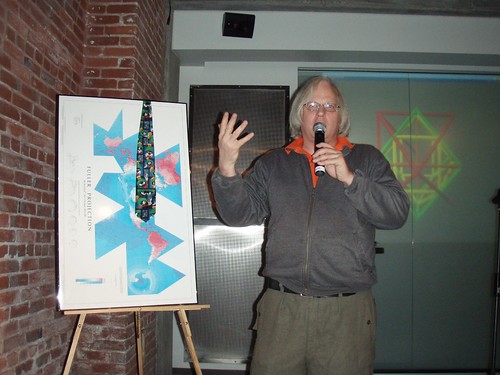
I think most of us know what "abduction" means in a popular (folk) culture context, as in "abducted by aliens". Or rather, we may not know precisely what abduction would entail, but we have a ballpark meaning, and leave it to the science fiction author to spell it out in more detail. What happens to a person when abducted by aliens? The same question arises as with kidnapping: are they ever returned? Were persons sold into slavery "abducted"?
However, what I didn't know, until today, was that the pragmatist philosopher Charles Peirce had introduced "abduction" in concert with the more familiar induction and deduction i.e. in the namespace of logic and its mental processes (algorithms). The process of abduction involves improvisation, coming up with a ready explanation. The question is how does one do that effectively. Another related question is how does one test one's abduction through deduction and/or induction, by way of verification?
A word similar to Peirce's meaning of "abducted" might be "adduced". However, "to be abducted" in the passive sense, as if by aliens, is closer to that sense of intervention by divine grace and/or demonic possession. The impulse comes from outside, inspiring the intuitionist. Ramanujan said as much.
The latter intuitionist, lightning struck by some insight, then needs to perform reality checks, as to whether A really does provide insights regarding some surprising development C (these are the letters Peirce uses).
In the folk religion of the Subgenius (Church of), the aspiration to be abducted on X-Day (one of the dogmas), might be understood as metaphoric, but also as a prayer for ascendancy and revelation, through moments of Genius and/or Gnosis.
One visits (passes through) a genius state ("cosmic zero"), from a default awaiting state of sub-genius-hood.
A "higher power" (a deity, muse or spirit) has to provide the juice, the impetus, the catalyst, in order for the sub-genius to "make the leap" (through that moment of enlightenment) and then return to the default (faulty?) or deficit state.
From the perspective of genius, the sub-genius state may indeed be considered fallen or faulty, which is why the proper attutude of humility is chosen by Subgenius disciples. Bob gets lucky. Bob bumbles. Normalizing the faulty state is the business of the normative bureaucrat, lost in the Matrix, out of touch with how weird that is, to be "normal".
To excerpt from Mapping the Mapper, by Paul Taylor & John Wood in 1997 [1]:
The mathematical concept of mapping
This project attempts to map the ideas and designs of Buckminster Fuller,
who himself developed maps: actual geographical maps and intellectual
maps of fields of study relevant to design. In conjunction with a
mapping of his totalistic conception of design thinking, the notion of
mapping itself underpins the application of Peirce's notion of
abduction, here construed as a mechanism of conceptual development and
problem solving. The facilities afforded by hypertext enable the user to
abductively relate disparate ideas within the field of design and
outside it, in such a way that, in the process of mapping the range of
concerns presented by Fuller, the user becomes aware of the issue of
mapping itself, and thereby increasingly self-aware in respect of the
mappings she herself develops in interaction with this hypertext
environment. Thus, the user is enabled to develop a mental map of the
inter-relationships between various fields and ideas relevant to the
specific issues, which concern her. Beyond this, however, lie questions
of mapping and modeling, which arise in the particular case of the
subject matter of this hypertext. Fuller's geometrical theories can be
conveniently investigated in this form, and can be tested and applied to
other aspects of his work, as well as to other design questions.
Finding closer affinity with Pierce comes as a surprisingly valuable puzzle piece. The gist of Richard Rorty's somewhat autobiographical Achieving Our Country was to put patriotism on a psychologically secure basis within an American context that included Pragmatism, followed backward through certain writers, many of them activists.
Moving forward, we have the Buckminster Fuller lineage, inheriting from Transcendentalism, itself a literary movement. In Synergetics we find the integration of the visually vectorial with the more viscerally incommensurate, a marriage of Eulerian and Gibbsian attributes, in that namespace.
Patriotism might be construed as the free flow of libido (free love, not costly in karmic terms) within a personalized or customized Universe, containing ones folk, people or peeps.
From the outside, a patriot appears as a specimen of some proud ethnicity, a member of some subculture, with patriotism emanating as a sense of "we" i.e. of community and shared subculture. "We the people" suggests a pueblo, or a folk. A spirit of inclusivity and/or diversity need not necessitate surrendering one's sense of taste nor one's powers of discrimination.
Per the James Hillman doctrine and discipline of soul-making or self-making, one might locate a self within an environs, as the complementary semantic space. The two grow and develop together, one's self and one's country (a space of others in relationship), which country may be: a whole planet; some bordered region thereof; and/or a network of affiliated campuses -- all depending on one's sense of selfhood.
The IDEAbase idea of Paul Taylor and John Wood involves consciously thinking about hypertext in connection with the abductive process. Hypertextual approaches to a discipline involve assembling a puzzle, piecing together structures, establishing mnemonic - neuronic highways and byways. These structures are non-linear and their traversal is by default somewhat plodding. However, when the insights kick in, harmonic resonance is achieved, in the form of epiphanies, fits of genius, related to concepts of "possession" and "seizure", or "abduction" in other words [2]:
Work on the IDEAbase system has focused on the abductive aspects of
design thinking, as this provides an identifiably typical thinking
process. This use of the notion of abduction is attributed to C.S.
Peirce : "A surprising fact, C, is observed. But if a proposition, A,
were true, C would be a matter of course. Hence, there is a reason to
suspect that A is true." It has been recognized (Wood & Taylor,
1994) that designers rely heavily on abductive modes of thinking because
it helps them to seek answers to immediate problems that cannot be
found within the problem space itself. In other words, they will
probably have to look beyond the confines of the design problem itself
to find a workable solution.
[1] Taylor, P., & Wood, J., (1997), "Mapping the Mapper", a
chapter in "Computers, Communications, and Mental Models", eds. Donald
Day & Diane Kovacs, Taylor & Francis, London, ISBN
0-7484-0543-7, pp. 37-44, January 1997.
[2] Wood, J., (1994), "Chaos and the Virtual Library - strange
attractors in the design studio", paper given at IDATER "94 conference
(International Design and Technology Education Research) at Loughborough
University, Leicestershire, UK, (August, 1994).
comical nation