Monday, March 27, 2006
Clarksville, TN
At the basement level I found recreations of a one room school house, an early printer shop, an unmarked linotype (my grandfather Reilley was a union linotype operator), plus science exhibits about radar, tornadoes, and designing for people with disabilities.
The Black Horse, a micro-brewery, and Front Page Deli are two of the main downtown eating establishments.
I purchased a local paper (The Leaf-Chronicle) from the corner vending machine next to the Black Horse. One of the front page stories (Chicks 'not ready to make nice,' but return to country, by John Gerome, AP, March 25, 2006) was about the Dixie Chicks making a come back. I agree with their analysis: country music has pretty much lost its moral compass. You can see this in and around Nashville: the genre has forgotten its roots and become a vehicle for glamorizing the excessive lifestyles of its rich and famous.
But is rock and roll any better these days?
Alexia and I joined a small worship group on Sunday, in a beautiful old house on the outskirts of town, built before the Civil War.
I purchased a matted photograph of the Montreal Expo '67 dome from the local art co-op near the deli.
Saturday, March 25, 2006
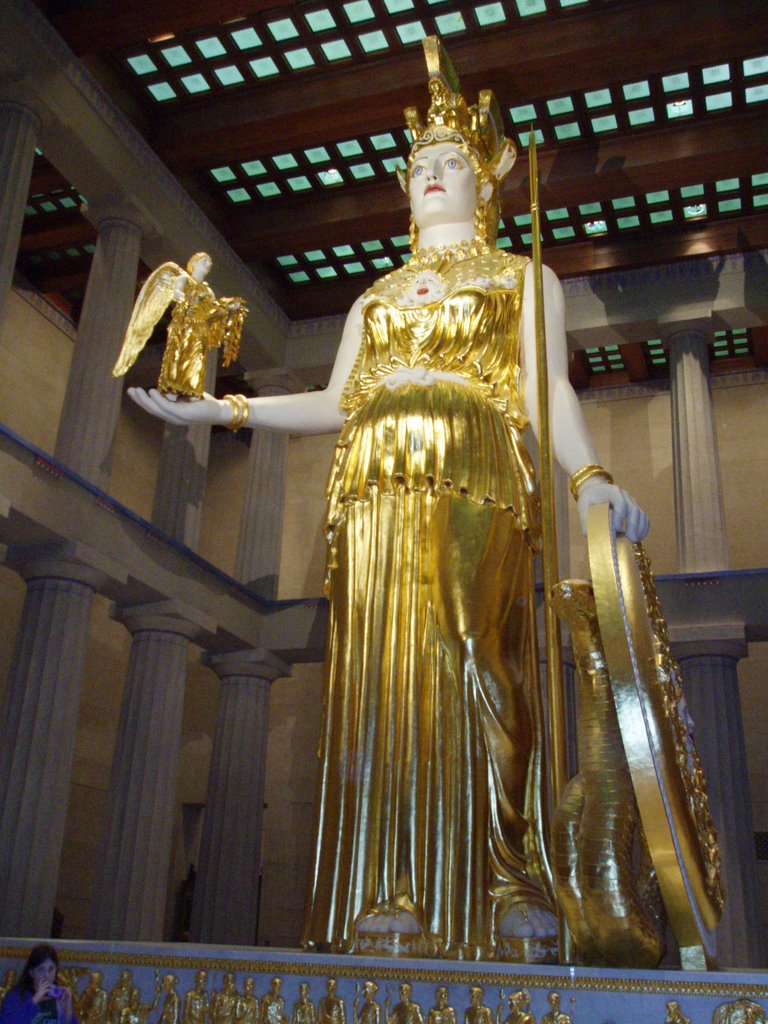
Temple to Athena

(photo by K. Urner)
Whereas neocons have misleadingly indulged in the mythology that Europeans are from Venus, Americans from Mars, in truth American culture is more informed by Athena, the goddess of wisdom and defense.
For example, here in Music City, we have the Parthenon, much loved and well maintained by the natives, with many ties at the museum level to the original Parthenon in Athens, Greece.

(photo by K. Urner)
Wednesday, March 22, 2006
Wanderers 2006.3.21
He had our universe divided into five epochs, of which we were in the second or third. The age of black holes was still to come. The conditions for biological life might not be so favorable then. Perhaps machine life would take our place?
Bob's focus was emergence (synergy) and its centrality in evolutionary scenarios (analogies to fractals). Allen wondered if "emergence" was just another pinhead jargon, while Rick pointed out that at least reductionists still try to anticipate our future (something we need to keep working at), whereas players suckering for "emergence" might give up trying to see into any kind of crystal ball at all -- a kind of defeatism. Bob, to his credit, clearly had his crystal ball out, and was trying to look farther ahead than most of us ever dare.
For my part, I expressed some doubt that the early 21st century would be remembered for its cosmology, given its poor benchmark scores on such simple matters as feeding people and providing them with shelter, instead of blowing them to bits. Why take a dysfunctional civilization's science so seriously? Our thinking is obviously quite warped ("we are devo"). Well, we know a lot about killing I suppose. Some reputation.
Still, if I'm going to enjoy some long haul cosmology, I'm happy to get it from Bob. His dedication to this subject is obvious and admirable. He lives and breathes dark energy. More power to him. Wanderers purchased both of his well-executed cosmology posters for $5 apiece, out of the coffee fund. We hope to display them in the Pauling House somewhere.
And besides, as Laughlin pointed out in his ISEPP lecture, cosmology is good for fund raising, and we do need satellites for lots of stuff. Keeping people interested in their extraterrestrial environment remains a priority, just like we want them to care about undersea life and other wilderness areas.
What humans care about, they're less likely to destroy.
Tuesday, March 21, 2006
More Office Chatter
Mom phoned this morning and requested some albums by mail. I don't know when I'll be seeing some of these pictures again, so this is an ideal time to be testing some new equipment.
Of interest: will Windows be smart enough to recycle the old software drivers, or will I need to reinstall from the CD? Answer: Windows was almost smart enough; maybe I was the problem.
Blogger is having problems accepting photographs this afternoon.
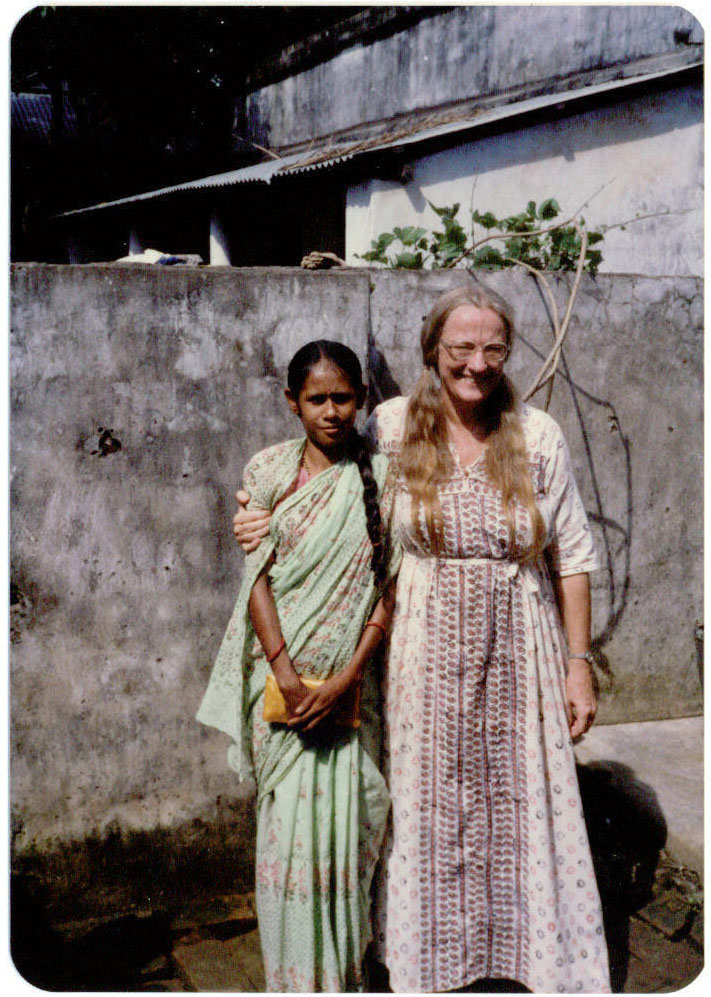
So here're the first scans: Mom doing her Mother Teresa thing in Bangladesh, except her students weren't half dead (just divorced, which can amount to the same thing in that culture); Dad with Thimphu in the background, in front of the family digs with the dog.


Chronologically, the lower picture comes later, as the stint in Dhaka came earlier. The parental trajectory went something this: Seattle, DC, Chicago, Portland, Rome, DC, Manila, Cairo, Dhaka, DC, Thimphu, Lesotho. I peeled off in Manila, and did Princeton, Cairo (twice), Jersey City, DC, New York, Dhaka, Portland, Thimphu (3x), Lesotho (3x). That's a greatly simplified picture (like, my sister has another trajectory yet).
I scanned these to DLW, thence to Tara's laptop by mistake (she must have left it on), thence to TMU2, from whence I grabbed it using KTU2 (the troll-damaged, dual-monitor jobber, where I do a lot of my picture editing). I cropped and rotated using Adobe Photoshop Elements 2.0.
Thursday, March 16, 2006
More Fun Collaborations
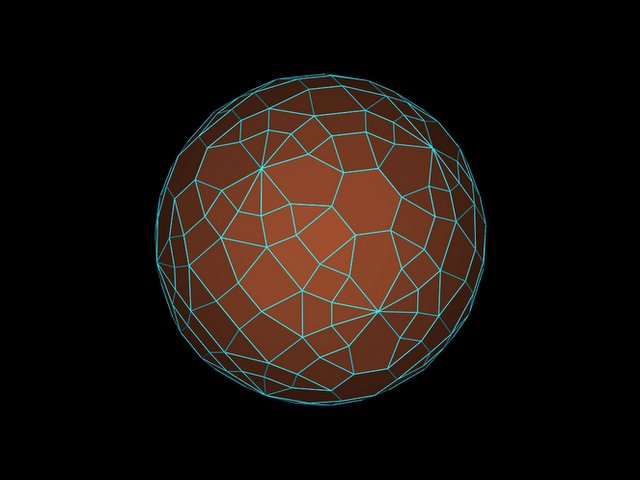
"a Waterman Polyhedron"(by K. Urner using Jython)
A lot of you have heard me lecture about Watermans (my coin, named for Steve): convex hulls with all IVM vertices = CCP centers, and of maximal sphericity per each maximal radial distance.
The above rendering uses Jython (and POV-Ray), an implementation of Python in Java, meaning I was able to import, and use from within Jython, a convex hull finding Java class.
Fun Collaborations
Sam owns the high resolution version of this rendering. Since our collaboration, Sam has enhanced and refined his FlexBlox invention.
Wednesday, March 15, 2006
Global Matrix (Wanderers Meeting)
Glenn Stockton is doing his Global Matrix gig. He uses analogical computation to encrypt/decrypt the generic landscape of information (a metamap). Glenn, see, is a retired cryptography guy (classically trained, pre RSA), at one time in Nam with the NSA (he has a background in linguistics, was pretty good with Vietnamese). Since then, he's been an engineer and craftsman, with a passion for science and philosophy (historical dimensions especially).
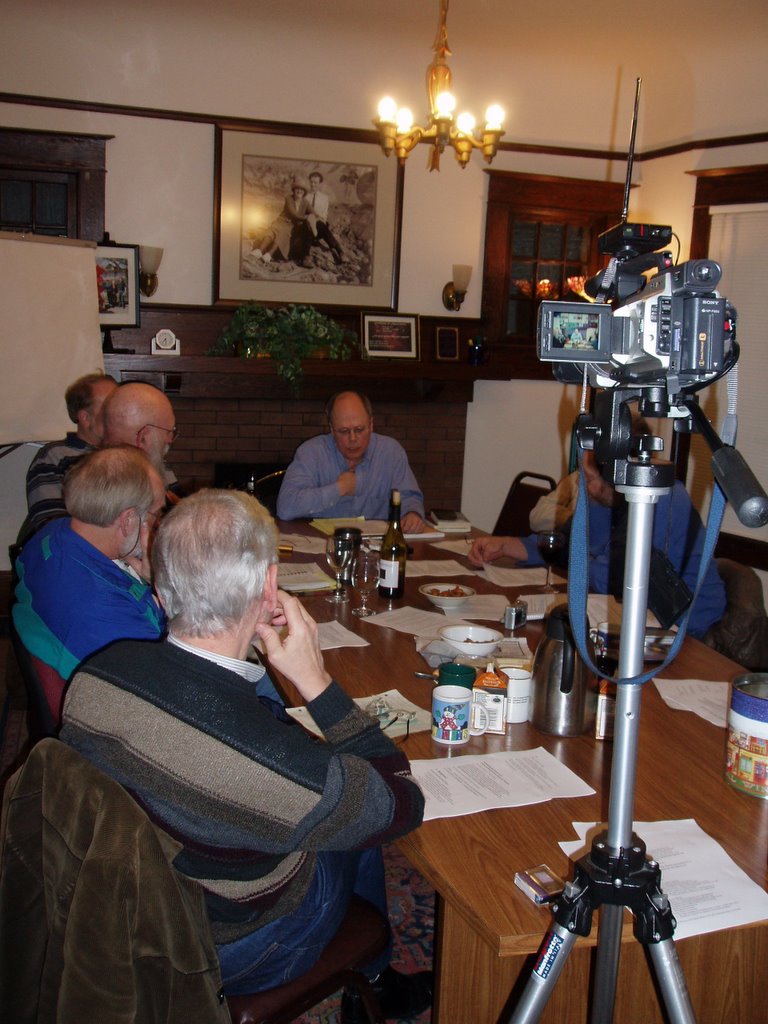
Glenn discovered design science recently. He's plugging The Parsimonious Universe. Obviously, I'm doing this in real time, which is why the present tense. I Ching now. Terry is running camera. Jim Buxton hasn't left for Libya yet, is sitting close to the front of the table, where Glenn is showing an I Ching matrix (octally based). Leibniz, when at the top of his game, got credit for early cryptography using binary methods. This was actually blowback from earlier Jesuit forays into China, which netted them copies of the I Ching, and revelations about arithmetic in other bases (Carl Jung is another channel for Chinese thinking around the I Ching ala his studies in synchronicity and such).
Polarity, less so duality, is characteristic of Leibniz and Heraclitus. A magnet is a perfect representation of polarity. Duality is illusory by comparison [the subtle unity of the two tendencies escapes the notice of Manicheans, as Walter Kaufmann used to call them -- KU].
Glenn was introduced to the pre-MOSAIC Internet by his uber-geek son. Glenn, underwhelmed, committed to defining what the search space and navigation engine might be for this emergent topology. In Bucky language: he committed to studying the geometry of thinking, making full use of his capacities and abilities, as cryptographer, linguist, and electronics engineer (he talks "gate logic" a lot, more below).
In a bifurcative logic, you have a dualistic decision process, an either/or switch. You also have the AND switch. Glenn's emerging computer design also uses inversion (yin into yang, yang into yin) -- in quantum computers, most of the gates are simply inverters.
After years of theorizing, he emerged from small town Arizona to rub shoulders with some big names in the Santa Fe Institute. He phoned Stuart Kaufmann and they had a 2.5 hour meeting. Based on such positive feedback, Glenn continued with his book project. He needed a computer engineer. Phil Walker, a senior software quality engineer (Credence etc.) encouraged Glenn to move to Portland, given the IT culture (Glenn's son lives here too).
Glenn currently has contacts at PSU, where he gets high marks for his system. He was pointed to OGI, where he met with the director, which is how he got pointed to CS @ PSU. This plugged him in to the hexagonal automata studies now happening around magnetologic (reconfigurable hardware; the computer is in the software). He also joined the PSU-based Cascade Systems Society (Wanderer Pat Barton is also a member, as is Milt, sitting here at the table). Milt pointed Glenn to Terry's ISEPP and Wanderers (which explains how Glenn met me, your blogger this morning).
Now we're back to the Civil War, talking about the jailhouse code or playfair square, known to POWs on both sides. Glenn's matrix starts with the 256-character 8-bit byte. Extended ASCII maps to this. 2 ASCII characters index an XY matrix of 256 x 256 addressable cells (= 65356). The XYZ matrix has 65356 x 256 = 16777216 cells addressed with 3 ASCII characters [see addendum].
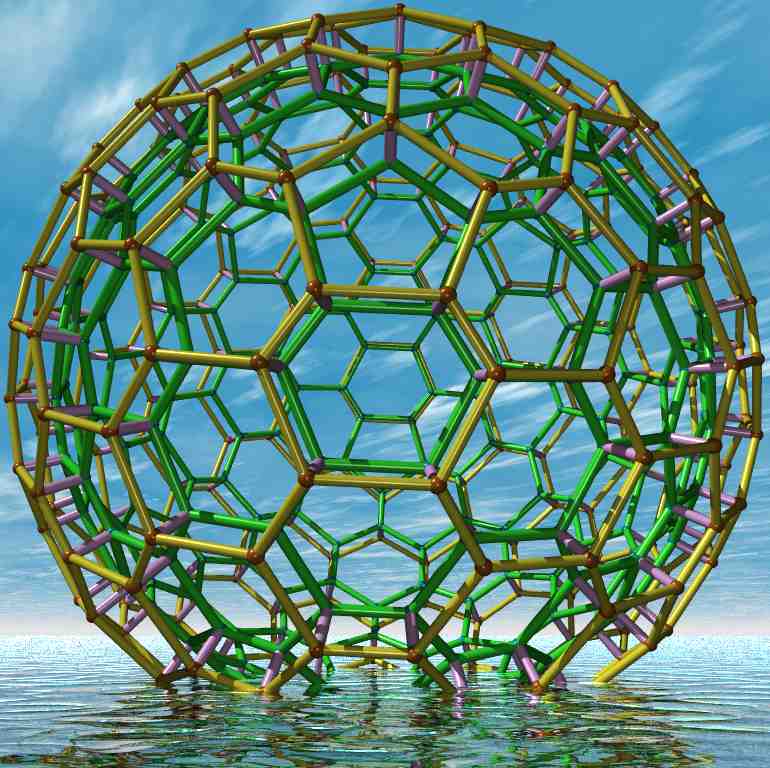
Glenn maps this XYZ cell space to his Global Matrix: concentric, hexagonally tiled spheres, but with 12 pentagons per shell. The Z axis becomes the radius outward from the origin, each Z address corresponding to an XY ball. The same addressing scheme applies in that the remaining 2 ASCII characters cover each ball (floor, or sphere). I need to plug in to AC now, with my DC battery at only 4%. OK, nice save.
We've gotten to the point of Wanderers asking pointed questions. "How is the XYZ \ Global Matrix transformation an inversion?" Terry wants to know. "Good question" I echo. Glenn goes back to his duality versus polarity distinction. The two mappings are complementary, not in opposition (not inimical to one another). One set of file addresses; two modeling domains.
Glenn is supplying a useful bridge for introducing a more spherically adept, omnidirectional, radial modeling style to XYZ-trained thinkers. As a Fuller Schooler, I'm trained to see the IVM bricking within XYZ as rhombic dodecahedra, using Couplers to address the XYZ cube, then generating a concentric hierarchy around some arbitrary origin and spinning the icosa and cubocta, netting 120 LCD triangles from their respective 31 and 25 great circle networks (see below), then applying a frequency parameter to instantiate this template for some literal application (e.g. mapping weather, sun spots or whatever).
Glenn's hexapental approach maps to the variable-frequency icosasphere, the source of the classic geodesic dome.
Glenn was inspired by early Bucky, but hasn't ploughed through Synergetics yet (I noticed this about his library, from when I visited his apartments). That's actually very encouraging. Having someone come up with all this independently is another breakthrough. Putting on my recruiter hat, I'm rubbing my hands ("yum, fresh meat" thinks the smiley dog).
I think Portland is smart enough to support a "think tank" economy, don't you? We've done a lot of homework around how to build and sustain a vibrant KBE. Why should DC's beltway bandits have all the fun? The Pacific Northwest is just as tech-savvy as the Northeast Corridor, if you ask me (not forgetting about bioengineering ala OHSU).
Hexagonal architecture has many advantages, at the level of gate logic, modeling biological growth (including differential equations) and so on. Glenn gets into color coding, cellular automata, other branches of study. Quantum dots.
Terry, on camera, is serving as chief interrogator (devil's advocate) for now, while I keep blogging (need more coffee...). Jon used the word "trifurcation" (heh). Anyway, if you get the tape, you'll see all this. Terry just said "scale invariance." Milt is excusing himself, gave me his biz card earlier, invited me to call. Wanderers in action.
OK, now I'll go back and slightly polish what's turned out to be a quite lengthy post. Mostly, I'll just leave it rough, in keeping with the real time aesthetics.
Later: Per plan, Dawn pulled into the head shop parking lot across the street and whisked me away in the Subaru (Razz). We went to a wireless coffee shop for a late breakfast, to browse web pages about Chattanooga and Nashville, Tennessee.
Now that I've had some more time to digest Glenn's presentation, I'm not seeing how to address all the cells in a hexapent with exactly 2 ASCII characters. 65536 falls between 63482 and 66272, the number of cells in hexapents of frequency 138 and 141 respectively (and there are no frequencies in between). We could go with the 138-frequency and have some addresses left over -- but that breaks any 1-to-1 mapping to the third power of 256 (the borg-like cube).
I still think Glenn is on the right track, in hot pursuit of something useful.
Followup (March 20):
I think this "lesson plan" to the Math Forum captures the essence of much of Glenn's thinking, while shrinking it down to a friendly game-like apparatus pre-college kids might explore.
Tuesday, March 14, 2006
Green Signal?
So my focus these days is whether the war colleges would have any objection to getting behind an initiative to improve the algebra and geometry curriculum for K12ers on USA military bases, as well as in the elite preparative academies, many of them gateways to West Point and so forth.
If not, then we should push ahead with a revitalization plan that nets us more sophisticated fare on the Pentagon Channel. This was the subject of my last two Internet posts, including one to the Math Forum.
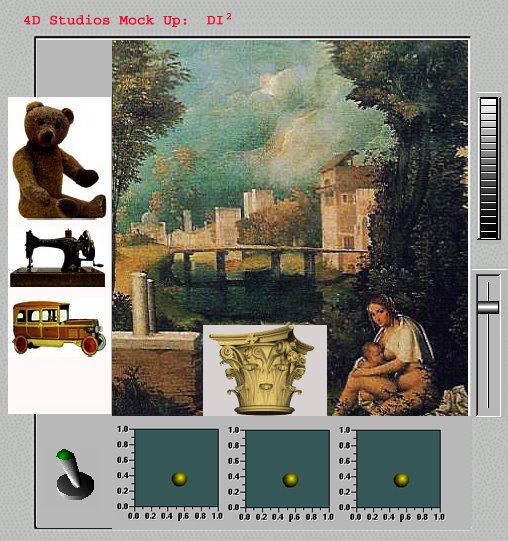
Regarding the above graphic: the student slides a shape onto the pedestal, using a mouse. Holding angles (shape) constant, the student grows or shrinks the shape using the scroll bar. The graphs below plot the resulting changes in the linear, surface and volumetric dimensions (powers of 1, 2 and 3).
Monday, March 13, 2006
Office Chatter
The convenience of just needing a few mouse clicks far outweighed any savings I'd gain doing serious driving, say out to Fry's, or even to Office Depot on MLK. In a few days, it'll be delivered. In the meantime, we'll put up with no paper feeder.
This thing prints double-sided, one of its most endearing features, given the paper pulp this saves.
I'm in limbo on video equipment, as it could be my talent is more in storyboarding. I've got good ideas for commercials. I'm not about to remake myself into an expensive studio overnight. Much easier is the hired gun role -- learn the ropes, while sharing relevant outdoor skills.
Like, at this Men's Group I was just in, we went walking up a trail to a vista point. I volunteered that if we got lost and needed food, I could shoot us a monkey. You had to be there (rural Oregon) to get the joke I guess.
I did phone my wife, out with my daughter in a coffee shop, to have a quick business meeting about the purchase. She was against it, so I volunteered funding from a small budget off to the side, which I control. This amused her, but she also wants to see the retiring printer put to worthy use, as it has some years left in it, even minus a working paper feeder. I agree with her thinking.
Friday, March 10, 2006
ISEPP presents...
Sir Roger Penrose was our in-front-of-the-camera talent, running two partially overlapping overhead projectors, quickly flipping back and forth from diagram to diagram, building a model of an eternally regenerative Universe, of cosmic constant lambda > 0.
In Penrose's latest proposal, the ultra low entropy constraints of the Big Bang are perhaps associated with zero Weyl Curvature (an hypothesis), Ricci Curvature being the other curvature of interest in this namespace.
But this same zero curvature might obtain when all future singularities (black holes) had rattled away their Hawking radiation, like so many kernels of popcorn, turning their last residual bits of mass into pure light energy.
At this point, with everything photons, all sense of time and space is rendered meaningless, and a kind of recalibration or rescaling might take place, such that our now prefrequency, isotropic, limiting special case might once again show up as a low entropy singularity with zero Weyl curvature -- and another Big Bang gives birth to another gravitational economy, ready to take it from the top.
Downhill = our direction of increasing entropy, per the 2nd Law, although on Planet Earth we're locally permitted an uphill ride on the solar gradient, with "clever plants" impounding high energy photons for the local food chain. We rebroadcast away the energy we didn't use.
Back to zero curvature, there might even be some gravitational rippling connecting one universe to a next. Penrose proposes yet another particle, charged, yet massless, to add some weight to his ideas.
Like any good scientist, Sir Roger builds falsifiable conditions into his pet theories. It's better to bow out with integrity, knowingly wrong, than it is to indefinitely linger as a hungry ghost, with some irrefutably baseless theory (i.e. all tautologies or truisms) -- and no fans.
During Q&A afterward, some of the most earnest questions came from children. He'd held them spellbound for like two hours. The two-overheads approach, with mostly hand-crafted content, is quite simple yet effective in a retro kind of way -- all those little light cones become almost iconic (9 parameters describe their shape, their angles, with only the 10th providing a sense of scale, or frequency).
Our dinner was on the 4th floor of the Performing Arts Center, overlooking a wet Broadway, with lots of flashing, reflecting light for atmosphere (big windows). The salmon with potatoes dish was excellent.
I asked no questions of Sir Roger -- although I did get his autograph in my copy of his latest book, at which time I mentioned I'd be his cameraman for the evening.
I wore my Class of 1980 Princeton reunion shirt -- little Nassau Halls in a pattern. If I'd had a Penrose tiles dress shirt, I could've worn that instead. I enjoy clowning around a little, when afforded an opportunity.
Thursday, March 09, 2006
Like Narnia in PDX
We'd been hacking on our Monkey, Dog and Human classes (each student has a Windows 2000 box), each template inheriting from the Mammal class, and Mammal from object (the new-style way to start new Python classes). I wrote it all up on edu-sig. Here's the source code of my zoo module.
Portlanders get skittish in even light snow, as their driving / walking reflexes haven't been conditioned and reprogramming takes time. Winter-hardened mid-westerners'd laugh at how we spin out on our little Hwy 26 for no good reason, just because of a few snow flakes or ice.
I prefer that route along the Columbia Gorge by the way, in front of the old Bolton homestead (happy times there), and turning right and south at Hood River. We did this recently, and I dropped my Samsung in the parking lot. The beginning of the end. Weeks later, it (my cell phone) died on Meliptus but no, I didn't "bury her at sea" (that'd be unecological).
Hood Meadows and Cooper Spur are two of our main ski areas. Hood Meadows is quite big and efficient whereas Cooper Spur is maybe less intimidating, but because lower, more likely to get rain (even when Hood Meadows is still getting snow). Does Condi ski?
So yeah, this being Thursday, I did my usual Python gig at Winterhaven. Before launching into it, the Winterhaven faculty guy I work with showed me where to get a Squeakland plugin for my FireFox browser. This is relevant as I'm still intending to make that Shuttleworth Summit in London in April, where Alan Kay might be struttin' his stuff.
That's not a for sure or anything (we're busy people, so even if I go, maybe nobody else will), but hey, I like checking in on Squeak from time to time. Same with Logo, where I'm a big fan of the "swimming turtles" idea i.e. not just a flat-on-the-floor metaphors, but in a tank or an ocean, swimming freely (not a new idea, not original with me, no way -- like, I saw it in Finding Nemo).
Thinking of news stories that I've seen...
So how about a special olympics or league where you're supposed to take steroids. The players sign a waiver, like they know this stuff can't be good. But there's no game of "discovery and scandal," no attempt to deceive any fans -- just a change in the rules.
Regular non-monster players get to keep their respective gigs, and play squeaky clean, steroid-free baseball or whatever.
The point is to not stack the deck and break records with "advantages" not available to your predecessors. That wouldn't be fair.
However, if people are out in the open about their "advantages" (maybe not steroids though? -- I hear they're pretty dangerous), then maybe it's not really unsportsmanlike to just open a new chapter in the record books for these people?
Like, we won't even try to compare: to a league of their own, those "performance enhancer" athelete-users. Sounds like something Old Sparta would try. Most Athenians would be more Clinton-like, and not inhale.
Hey, it's fun writing about sports. I hardly ever do it.
Tuesday, March 07, 2006
Followup on Funding
The first is a brainstorming and summit, aimed at defining a curriculum pipeline for South Africans (one of several no doubt), featuring Logo | Squeak | Python. Or at least that's the present picture.
As I stated on edu-sig, that's a Turtle, a Mouse, and a Snake. Some say Python refers to a comedy troupe, but I say "it ate Monty" (funny).
The second is to be staged at the home of W3, i.e. at the birthplace of the web. Hypertext is one of those developments I used to rave about, long before it happened, thanks to Ted Nelson's Computer Lib / Dream Machines (now a collectible), plus some brain- storming of my own. Then Tim Berners-Lee came along and simply made it happen.
The fact that I've been on target before about something positive, as a futurist, keeps me thinking I might still be on to something with my brand of positive futurism, even these many years later, even today.
I was even in The Oregonian a couple of times, anticipating hypertext kiosks and more use of the Fuller Projection.
Anyway, productive day. I got some hospital work done, coordinated with employers.
Saturday Academy gave a green light to the London trip, even if that means changes to our schedule. I'll be a more interesting and effective teacher, to the extent I'm able to bring back insights about how things are going in technology and education world.
Quakers seem OK with my missing FGC in Tacoma this year. Although it's a big deal for Friends General Conference to come this far west, I'll plan to rejoin it back east at some point. A memory from 1983: the day I learned Bucky died, I was enroute to this very gathering -- read about it in the car, in The Washington Post, and cried.
And by the way, I sorta lied about being "not [used to] getting much [assistance]." I get and have gotten a lot of assistance, by very expert individuals who're good at what they do. I don't easily forget that. Yet sometimes I need to whine.
Saturday, March 04, 2006
SAO Spring Conference 2006
I was attending the SAO Foundation's annual spring conference, held in conjunction with the Oregon CSTA. Congratulations to Sara Zuckerman on becoming the president elect this year.
As I was thanking WU's Fritz Ruehr for sharing his excellent computer contest challenges with me awhile back (the conference is held in conjunction with a high school programming contest), my shoulder-slung Toshiba swung into a clock made from an old disk drive, knocking out its AA battery, which was hard to put back in. This clock was for timing the contest. Fortunately, Fritz had a backup clock.
Aside from this faux pas, which people were friendly about, I think I did an effective job as a diplomat, both for Python and for the Open Source Community more generally. This year I had the added credential of being a Python teacher in a Portland public school -- plus I use Moodle, which turned out to be another big topic.
Several teachers, without prompting from me, expressed the view that math students are under-served when it comes to technology. Why not mix math with programming? Kids often thrive when this gets tried. Yet the two subjects are strictly segregated, with math made a requirement and computer science an elective.
When the civilian education budget tightens, the technology teachers are among the first to be axed, or switched into math teaching. In the meantime, demand for students well-versed in technology is on the rise, with business and industry begging the schools to be more responsive to their needs.
Universities find incoming freshmen already turned off to technical careers (especially women). Enrollment in CS departments is way down. We learned more about these frustrations during the panel discussion, with representatives from OIT, WOU, PSU, and WU.
The answer seems obvious: require computer use when learning mathematics. And yet when the NCTM talks about "technology in the classroom" it usually means calculators, with a mere nod to a few popular computer applications such as Geometers Sketchpad. Computer programming is rarely if ever mentioned in the NCTM literature. Go to my Oregon Curriculum Network website if you want the real deal.
I made a lot of good contacts. SAO meetings are a valuable networking opportunity.
Addenda:
A conference highlight for me was watching student presenter Steven Bocci (9th grade) whip through GameMaker, building a playable version of Breakout in just five minutes. I now have a better appreciation of why kids flock to Edwin Pillobello's classes at Saturday Academy. GameMaker is cleverly designed and probably does teach some transferrable programming skills, usable in other World Game contexts.
Also, around this same time, Brad Miller was at SIGCSE 2006 in Houston, Texas, giving a formal presentation on the advantages of Python at the college level, which he says was well received.
Friday, March 03, 2006
Cocktail Party
Saturday Academy hosted a "celebrate the instructors" event at Bluehour on Everett, twixt 12th and 13th NW this Thursday night. I finally met Kent Anderson, the veteran C language instructor, and James Zaleski, the Flash instructor.
Plus Noah Kleiman was there from Old Library Studio. Musician Jimmy Lott and I had just been in a training session with him the night before, on open source multi-track (Audicity & plug-ins mostly, although the studio itself uses higher end stuff). Small town.
James, the Flash guy, has been working with the Beaverton police on youth outreach (teaching Flash) and showed some student work. Impressive. Also, Joyce Creswell, SA Executive Director (and Wanderer) screened a little pro-SA piece, which I suggested we get uploaded as a Google Video (if that ever happens, I'll add a link from this post).
This morning, I got an invite to join Shuttleworth Foundation in London in mid-April. Checking airlines, I'm not seeing a way to get back in time for my April 15 SA class. On the other hand, I'd dearly love to meet these people. On the other hand, I have no travel budget for events like this (Catalina and Nashville were family; had to pass on G4G7 in Atlanta, a disappointment). On the other hand, I could ask for assistance. On the other hand, I'm used to not getting much (I made my career helping not-for-profits, mostly, so I'm not rolling in dough). E.J. Applewhite tried to get me a Guggenheim at one point, but was turned away (he was pissed about that).
Note: we're paying like $1100 to have some of Tara's teeth extracted today, plus I'm buying her an iPod for enduring the experience (she's wanted one for a long time). So it's not like we're really impoverished or anything, just typical middle income (per USA standard). Looks like we owe about $8K in taxes this year (mostly for social security). Plus I identify as a capitalist, meaning (in my case anyway) that I've internalized vast assets and manage them, both personally and precessionally.
Thursday, March 02, 2006
More Poopka from Zogby
- Le Moyne College/Zogby Poll shows just one in five troops want to heed Bush call to stay "as long as they are needed"
- While 58% say mission is clear, 42% say U.S. role is hazy
- Plurality believes Iraqi insurgents are mostly homegrown
- Almost 90% think war is retaliation for Saddam's role in 9/11, most don't blame Iraqi public for insurgent attacks
- Majority of troops oppose use of harsh prisoner interrogation
- Plurality of troops pleased with their armor and equipment
Retaliation for Saddam's role? That's not what "the trial" is about (big guys in zoo cages more like -- and where's Tariq Aziz in all this? I hope OK). Cheney says shooting this one guy with his personal gun was a "worst day" for him. Tour some more hospitals guy, they're there because of you. Have some more "bad days" on my personal tab (some black budget line item only you and a few others know about -- sorry, my leak, my bad).
Anyway, I'm glad the mission is clear, for the most part. Any soldier who doesn't get why we fight really shouldn't be in the game. Uncle Sam has every responsibility to make it absolutely clear what the mission is. Any waffling = immediate and severe demotion among the rank and file. Otherwise you get what we got in Vietnam: K-Mart clerks leading the charge, getting shot in the back by "one of the guys" (and good riddance).
Sorry, I have this mean streak.
Tuesday, February 28, 2006
More Polemics
I'm sounding pretty ugly in this thread on the Math Forum. I'm like this whimpering, snarling, monster dog, fangs dripping, just inches away from something I'd like to eat (damn this leash). So I make a cartoon out of it. Flip flip flip.
On an up note, the Gardner people sent me another beautiful invite. I really don't have the budget right now. I blame Congress (snarl, whine, whimper, drool)...
Friday, February 24, 2006
Econ 101
In my view, Earth is this giant spherical motherboard, powered by starlight (the Sun mostly). We insert our waterwheels and what not to get work done (what we consider work, i.e. bread making).
We don't repay the sun (a fusion furnace). We're like a giant not-for-profit depending on grant income i.e. cosmic energy (measured in calories or joules or what have you).
And what's the business of this Earthian economy of ours? I think of it as a giant university system. We're trying to get smarter (and succeeding to some degree), so we get more work done with less of a downside.
Right now, we're still pretty dumb though. How do I know? Humans suffer way more than feels right to me. Higher living standards = less preventable suffering.
Pretty simple huh. Too simple?
Addendum: Hazel Henderson is using a computer metaphor too I see: "Economics is now widely seen as the faulty sourcecode deep in societies’ hard drives." (The Politics of Money) Economics = faulty sourcecode. Heh. Works for me.
Thursday, February 23, 2006
Revisiting Malthusianism
What's lacking I'm thinking is more contextual / alchemical. We need some new myths (means good stories, not untruths).
I'm taking the standard Fuller School line here. The Hunger Project took a similar tack (i.e. tried to "shift the context") but people got cynical hearing talk like that.
My views are more popular in the developing world, which sees lowering birth rates through raising living standards as the only ethical way forward. Global energy grid etc. etc.
Wednesday, February 22, 2006
Dome @ Long Beach

Here's a semi-obligatory picture for a Bucky-related blog like this one. As any middle school student in LAUSD and environs oughta know, this n-frequency (?) dome (see the pentagons?) was a home for the Spruce Goose -- and we all know what that is, yes?
Right, an airplane, brainchild of Howard Hughes, now in McMinnville, Oregon.
The dome is still used, although for exactly what I don't know. I saw cruise ship passengers walking through it. The Queen Mary is permanently parked nearby, another tourist attraction.
Followup: another diamatic dome in the LA area: the Faith Dome.
Saturday, February 18, 2006
Coasters!
Knott's Berry Farm has acquired quite a collection of roller coasters over its lengthy tenure as America's first theme park.
I sampled Silver Bullet (front row!), Ghostrider, Boomerang and Xcelerator. The Farm won the Lisebergsapplåd award (name for Liseberg in Sweden) in 1988.
PS: yes I know this "inflated chipmunk" look isn't my most popular -- maybe too much like Elvis (the dead one). But hey, family members found it endearing. So just call me "a master of many disguises" (that's like a note to old girl friends or something).
Friday, February 17, 2006
Morning in LA
The LA Times was fun this morning: there's a long page one article dissecting the Niger yellowcake rumors, saying the FBI investigation into who forged the documents has been "reopened" (why ever closed?); and Bill Maher's editorial is clever, about what I call the Eleanor Rigby Syndrome (we want "them" to listen).
The Budget rental car lady really tried hard to get me to upgrade to the yellow Mustang (hard top).
Richard Metzger's disinfo.com has a new blurb (Feb 15) on Bucky's Montreal dome with links to a couple Google videos. That makes a total of three Google vids (to date) that come up in response to "Buckminster Fuller". I just re-edited the description of my little talk to make it the fourth.
Thursday, February 16, 2006
Octet Truss
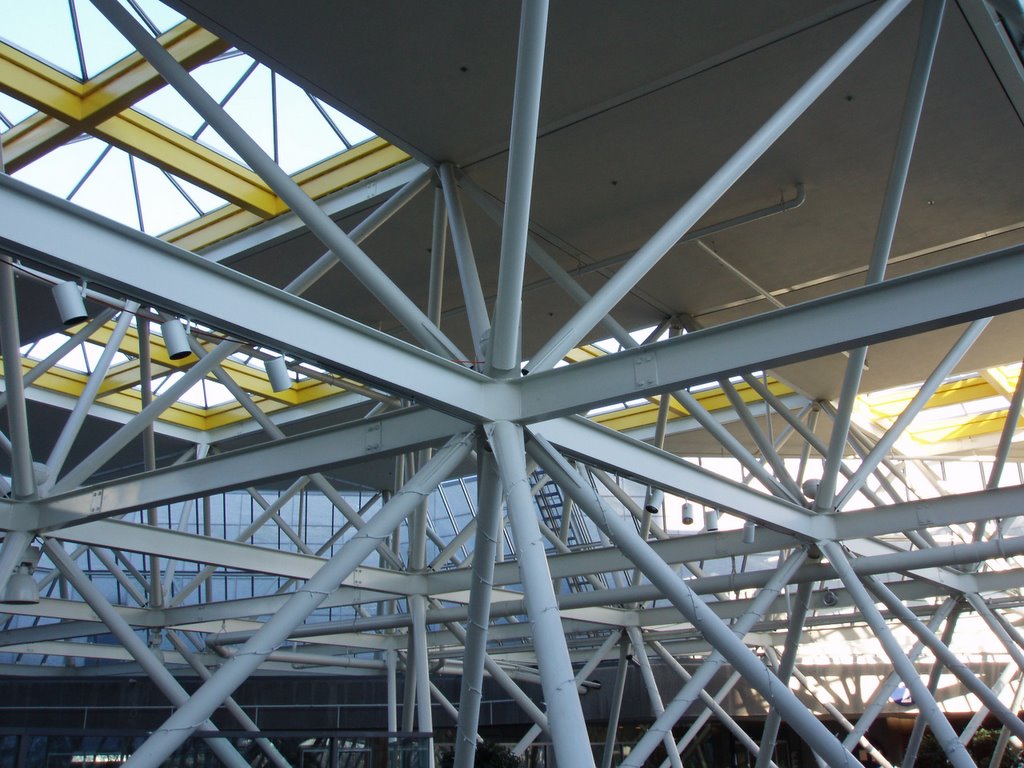
I took a series of photos yesterday focusing on an architectural feature of one of our downtown buildings: a spaceframe known as the octet truss. The above photo shows 12 spokes emanating from a common hub, corresponding to 12 balls around a nuclear ball in the face centered cubic packing (FCC).
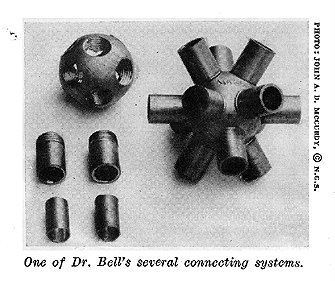
I incorporated these shots into my slide show for sixth graders at Winterhaven today, along with a slide borrowed from my OSCON 2005 talk featuring Alexander Graham Bell standing next to one of his "kites" -- likewise an octet truss.

The photo below shows the 12-spoke hub in Bell's construction kit.
Fuller called this lattice the isotropic vector matrix (all vectors are the same length) and related it to Avogadro's ideal gas model.Of course gas molecules aren't static, but their average uniformity in a volume might be associated with the isotropic distribution of "spherics" i.e. the rhombic dodecahedral voronoi cells around each ball in the packing.
Related reading:
More Oregon Curriculum stuff, posted from concourse B, PDX airport.
Wednesday, February 15, 2006
Illahee
Peter's group produces a lecture series, similar to ISEPP's in some ways, but focusing on these different themes. Last year's theme was How Cities Learn (taking off from Stewart Brand's How Buildings Learn -- Stewart being one of the lecturers). This year it's Water & Oil (watch for the ads on Tri-Met buses).
Fortunately, Wanderers Dick Pugh and Jim Buxton were present, both "long now" types with an understanding of our place on the geological time scale. We joked about the thin stratum of asphalt and other petroleum based products we'd eventually become, as the world goes on turning.
Peter is on Mayor Tom Potter's visioning committee, aimed at coming up with some credible, actionable futurism for Portland. He finds the process rather plodding compared to Jaime Lerner's fast-paced style, but not every city is as lucky as Curtiba (in Brazil), where Jaime served a few terms as mayor.
Wanderers agreed that roping in more creative types, including Portland's illustrious science fiction community, might be a good idea. Jon Bunce cited Ursula LeGuinn's 1971 novel Lathe of Heaven for anticipating Portland's future (the 1980 made-for-TV version was filmed in Dallas, while the 2002 remake features Ursala's home town of Portland, including light rail).
Indeed, according to Peter, Jaime Lerner likes his planning committees to consist of three main types of people: architects for their design sensibilities, journalists because they know how to meet deadlines, and poet-philosopher types, for their powers of precognition.
After Peter's presentation, I hooked up my wireless laptop to my projector, and screened my OMSI Dome and Dignity Village blog entries, about getting FEDs (Fly's Eye Domes) showcased around Portland.
Although designed for service in more rural areas, FED-style infrastructure draws support from urban control rooms, studios, and classrooms, i.e. is the brainchild of our KBE.
I shared my view that corporate media need only shift gears a little and we'd have some dynamite reality TV complete with exciting product placement opportunities. Politicians needn't be in the loop on this one, which is fortunate, as when it comes to brainstorming potentially positive futures, they're apparently otherwise engaged.
Indeed, I'm flying down to LA tomorrow (after my Winterhaven gig), where I hope to stir things up a bit. Why should this science fiction capital, in a state with a movie star governor, lag so far behind Portland when it comes to intelligently brainstorming about our American Dream? Let's get Hollywood up to speed, shall we? We could use its media know-how.
Monday, February 13, 2006
What the Bleep (movie review)
The film lays a neurobiology layer atop a quantum mechanics layer in an attempt to boost the observer's quality of life. Thoughts and attitudes matter; reality is maybe more plastic than you'd presumed. In that sense, it's a religious film addressing aspects of the human condition, while piggy-backing on science's credibility to drive its message home. Like, really use those frontal lobes and make your world a better place.
I found the cosmetics too thickly applied, what with the hallmarky backgrounds, music and lighting abetting the already expressive foreground talking heads. Also, I'm philosophically biased against Abbott's Flatland meme, although I found it well-rendered, in the form of a concluding Dr. Quantum cartoon screened within the Bagdad Theater (the observer's very venue in this case).
The film doesn't have anything intelligent to say to parents in the developing world, watching their children die of medically preventable causes such as starvation. It's more aimed at relatively well cared for mid-life urbanites with little excuse to not be over themselves already.
Sunday, February 12, 2006
Turnover
My goal is to shake up my reality a bit and look for some new venues, plus my web sites could use some more upkeep and maintenance. Like, I just got an email from Alastair Farrugia about a small group theory error I need to fix on one of my crypto pages (plus he shared some links to fun software).
Dad always warned against getting "stuck in a rut" and had several self-disciplines to keep that from happening (e.g. he liked to keep changing where people sat at the dinner table).
I had breakfast with Dave Fabik this morning, at Cadillac Café on Broadway (very crowded, we sat at the bar).
Dave and I were also lunch mates on Thursday, with Henry Sessions and young Christopher, and Don Wardwell. Henry is in the final stages of becoming a physician's assistant (PA), having come from a career in public radio and public relations (PR), including for the American Red Cross.
Saturday, February 11, 2006
The Kepler Project
Dr. Gibor Basri focused his well-attended lecture on the Kepler Project, designed to answer the question: how many earth-like planets might we reasonably expect to find in our galaxy?
The instrument will be fired into space on a Delta rocket c/o NASA, presumably in 2008 although the schedule has already slipped for bureaucratic reasons.
The space platform, nowhere near as expensive or sophisticated as The Hubble (will Hubble get that last upgrade before it dies?), consists of CCD panels focused on a star field near the Northern Cross and Vega.
The idea is to stare, unblinkingly, at all these stars, for about 4 years. Periodic dips in brightness, caused by planets partially eclipsing their parents, will show up upon filtering the continuously downloaded data. The word "planet" is built in to the etymology of "wanderer" by the way.
The mathematics will tell us how many of these planets are earth-like i.e. in some habitable zone that would in principle allow for liquid water on the surface. Whether there actually is any liquid water, let alone life, on these particular planets is not something Kepler will reveal.
During the Heathman Dinner (I sat next to Glenn Stockton, retired cryptographer, and Jon Bunce, musician, plus David Feinstein, mathematician, Don Wardwell, boat captain, Nirel, web wrangler and Larry, retired chemist, were at our table), I asked whether solar systems ever form directly in the wake of exploding stars.
Dr. Basri said yes, that two of the first earth-sized planets ever discovered beyond our solar system were both in orbit around a pulsar, the remains of a gas giant's exploding and collapsing.
Thanks to the Mentor Graphics Foundation, a lot of high and middle schoolers get to attend these lectures, which would be too expensively inconvenient for them otherwise.
Our regular attenders have built up a lot of appreciation for contemporary science and engineering over the years.
Before the lecture, Glenn and I joined Patrick and Diane Barton for dinner at a McMenamin's brew pub (the one nearest the Art Museum downtown). The Bartons, a Wanderer couple, used to work at Sandia (a national lab) in connection with supercomputer modeling. Glenn used to work for the NSA. And I'm a Fuller Schooler.
Yes, I realize that's two dinners in one night. That's why I just got a hummus plate the first time (plus Hammerhead -- the beer, not the shark). And Glenn had ahi twice (a taste of heaven).
Thursday, February 09, 2006
Restoring Integrity?
Sometimes this means working with former enemies, such as the NCTM. Even the MAA is not unscathed, having failed to do anything very sensible with the A & B modules when it could have made a real difference at a critical time. Oh well, that's all water under the bridge by now.
In general, the Ivory Tower has not performed well during this interlude. We've seen too much blaming of others (politicians especially), given how overspecialization leaves its victims feeling powerless and blue.
There've been many stellar exceptions of course, but this doesn't change the fact that reforms are sorely needed. I'm sure "the experts" will be rushing forward with their lists of much-needed changes.
Wednesday, February 08, 2006
Philosophers Gather
Terry Bristol, president of ISEPP, lectured on American Pragmatism to a packed house of curious Wanderers last night. Karl Popper, Thomas Kuhn, John Dewey, and Joseph Priestley are among those whom Terry cites as influencing his thinking.
Tara (age 11) kicked off the program by demonstrating her two robot dogs, Robopet and I-Cybie (she didn't stay for the lecture though).
That's a picture of a young Linus and Ava over the mantle behind Terry.
Tuesday, February 07, 2006
Broken Flowers (movie review)
But that wouldn't be me behind that reading (except I liked the goddess part). I savor that twilight zone of airports and rental cars, soft ring tones, faceless announcements, a little turbulance, dreams. The allusion to Buddhism is apt, amidst ripples of Lost in Translation. Murry's character is overflowing with love in the Void. He's a bodhisattva. America is beautiful.
Sunday, February 05, 2006
Moral Relativism?
I know for myself I'm coming to the following elucidation: moral relativism is a first line of defense against the morally inferior; let 'em all duke it out, and the bedrockers among 'em 'll likely percolate to the surface, ready for round 2 etc.
I mean, we're of harder and softer metal, along many different axes or principles. Alchemical mixings of archetypes. I'll budge where you'd never and vice versa. We wonder at one another's weaknesses. I'll grant you all that.
All the more reason to not step in as some Grand Mediator with a handy fix for every problem. I'm not doing that either, believe me. I'm just another guy in the ring, sometimes more than ready for that next bell.
But when they're all still just kids, needing tools of self expression, I'm saying: I won't deny you some dynamite training with these multi-track audio and video sequencer devices. You may grow up an enemy, but you'll know how to express yourself effectively, which means you're less likely to resort to brute force, the strategy of those at the end of some rope already.
You shouldn't run out of editing tricks that fast. Like, I'm not impressed when you go for the guns. OK, so you failed, what more shall we say? But if you know how to edit TV, do a good job in journalism, know how to research, think critically and analytically, then hey, let's watch your programming. Let's see what you think it's all about. I'll help give you those skills, or learn them from others, and make them your own.
It's not like I know in advance if you'll be with me or agin' me. At least you'll be free.
Thursday, February 02, 2006
Conundrum
My approach is to talk turkey directly i.e. let's join the school board in looking at curriculum. This Old Library Studio has some right stuff: lots of music-making booths ala EMP, with software for working in multi-track (mostly Apple, though Noah is likewise a Linux devotee).
The multi-track metaphor is likewise what we use in television, however both stem from the older orchestra conductor view: lots of instruments (now called devices) scripted into a whole, with this overview person tasked with waving a wand, making facial grimmaces and so forth (I've watched them work, but have nowhere near the musical knowledge to do much better than mime the performance).
So our curriculum aims to equip kids with mastery of multi-track editing in various contexts. A toy company I used as a base for these ideas has gone out of business (slow link), while my Alien Curriculum (giving academic rigor to these ideas) languishes at my Oregon Curriculum Network website (except not really: I do have a fan base).
Speaking of that article on B6, another conundrum appears right next to it: Calling Inspector Clouseau. This one is about some middle aged guy tripping on his own shoelaces and smashing some Chinese vases at the bottom of a staircase. Playing the clip in reverse: a man back-swims towards heaven's gate, as these Humpty Dumpty type objects reassemble in his wake.
Wednesday, February 01, 2006
Bruce Adams Presents...
The ion-injected dopants disrupt the local lattice. Thermal treatment restores it, but if cooked too long, the dopants diffuse, ruining the junction.
As Moore's Law has continued to push the number of transistors on a wafer, the layering dimension (Z axis) has become critical. Multi-hour lamp-driven baking techniques don't work at these smaller scales, nor is multi-second rapid thermal processing (RTP) fast enough at these smaller scales either.
R&D groups are exploring various solutions, Bruce's being one of them.
Jim Buxton is looking forward to the Libya trip (eclipse viewing). I found it encouraging that Myanmar and Zimbabwe are picking up the slack on the official enemies list these days (referring to last night's State of the Union Address). Libya is a new friend.
Gordon Hoffman joined us today, offering his unique perspective as a long haul Silicon Forester.
Monday, January 30, 2006
Editorial Comment
Yes, we could be creatures of fashion and rename the thing every few years, setting up a whole new "wired | tired | expired" loop. However, what these experts neglect is the Greek root (a root with root access, I think most will admit, witness greek letters).
Per my Grunch FAQ, "cyber" stems from the Greek "to steer" (as with a rudder), and cyberspace indeed serves that function, owing to its speed, breadth, and sensitivity (in the hands of an expert sand sifter anyway). See my Q: Isn't this just another right-wing, pro-corporate, propaganda site? (hey, the whole FAQ is kinda fun).
So I, for one, plan on keeping "cyberspace" in circulation. Besides, it's backward compatible.
Beyond that editorial comment, I thought this was a fun issue, worth referring back to. Tara is really getting into programmable robot dolls, more affordable than Disney's audioanimatronics.
Saturday, January 28, 2006
CBS Interview
I liked what he said about politics not really being zero-sum, e.g. Washington, DC can afford to welcome the fact of independently powerful metro areas, including within the USA.
Winning in Iraq likewise needn't be at the political expense of those who disagreed with the strategy of invasion and occupation (many Republicans in this category, and military personnel). Too many B Team policies were followed.
I wasn't surprised that Laura was his closest advisor, even though they fight sometimes (the garage door story) -- Dawn and I were fighting just today in fact (something about text messaging and right speech).
Finally, I thought he was wise in his choice of networks.
Friday, January 27, 2006
Noodling in a Moodle
The moodle I'm working on is called Python for Algebra Students, meaning I'm taking a "programming to learn" versus a "learning to program" approach. We start with Sequences, which motivate defining functions, which motivates class/object syntax, allowing us to customize our own objects. Once we're able to roll our own, it's on to: rational number type (not native to Python, though decimal is); polynomial type (they form a ring, getting to that); vector type (preview -- more later); then a quick leap into fractals (through complex + trig), group theory (group, ring, field) and number theory (EA, totatives, Euler's Theorem).
Calculus is getting shoved over to Physics (where we might also use Python -- or VPython).
Having a moodle allows me to invite collaborators to look over my shoulder as I develop the above in some detail, and in such a way as to encourage new teachers to explore in this direction. I think younger kids hunger for more crypto for example, and what better way to give it to 'em than to head in the direction of explaining RSA in terms of Fermat's Little and Euler's Theorems? Like in the bestseller In Code.
Thursday, January 26, 2006
Cartoon Physics
Combining with other stuff, I have this image of buckyballs vanishing here and getting tuned in there, with a mediating field described by a kind of ray tracing (a Feynman superposition) of all possible routes in between.
One maybe needn't imagine the energy in transit, since to see it at all is to detect it i.e. is to tune it in. Imagining a little ball going through either slit is unrealistic, is like spending money you don't really have. When some photographic emulsion registers a ping, that's when the energy reappears and a possibility gets actualized (maybe in two places at once -- nonlocality).
You might not think buckyballs (C60 molecules) are small enough to behave like photons, i.e. are too big to constructively / destructively interfere through a double slit apparatus. But they do so behave. This was the subject of Julian's research before he became an artist.
Tuesday, January 24, 2006
Wanderers 2006.1.24
Tonight Julian shared about his career as a physicist-turned- sculptor of proteins and other molecules. He's working on some exciting new projects.
Monday, January 23, 2006
More About Geek TV
The fictive tapestry we create as a background to reality, the stuff of day dreams and amusements, is often identified as "escapist" in nature, and certainly I have nothing against projecting into a completely different solar system (e.g. Serenity) or universe (e.g. Narnia).
However my dad, Dr. Jack Urner, was an urban and regional planner (University of Washington, Johns Hopkins, University of Chicago), subscribed to The Futurist, so as a kid, I absorbed the view that humans could actually dream new stuff into existence.
I watched the whole Apollo thing from Rome (EUR and later Viale Parioli), our base while dad worked with Libyan counterparts on mapping and zoning (he worked with several Islamic countries during his long career, plus the Buddhist Kingdom of Bhutan).
When I started reading Fuller's enlightened futurism in earnest, back in the early 1980s, the Cold War was still in high gear. KAL 007 was shot down. Some nights on the TV news it seemed like the CIA and KGB had a monopoly on world affairs, and were using Central America as their proxy. Russian submarines were parked just off the USA coast, ready to launch if need be.
So how was a geek futurist like me to get any traction in this crazy, cold world? Fuller had a suggestion, embedded throughout his books: focus on the world energy grid concept. He had a lot of other good ideas too. So I wasn't without tools. Perhaps the situation wasn't as hopeless as it seemed.
Now, over 20 years later, I'm looking back on a lot of accomplishments. A lot of leg work has been done. My personal workspace edit/recombine studio (a GST concept) is evident in such products as Intel's viiv. Reality TV as a genre has been established around the game show concept, permitting an easy transition to World Game when the stars feel ready. And the world power grid is coming along nicely, with Iraq slated to get more kilowatts from Iran, once we've brought those power plants on-line (so, where shall we put that SeaWorld?).
What's true is a lot of people have been working on the design science agenda (no need to always call it that). I'm one player among many (a strong one, but powerless in isolation). Nowadays, I'm looking forward to scripting more reality TV (4D Studios work), producing commercials (e.g. for Global Data), and recruiting talented faculty to a bizmo-based lifestyle (cybervans, cram packed with educational programming and equipment).
I'm planning to stay Portland-based. I really don't mind all the rain.
Sunday, January 22, 2006
Visiting OMSI
We toured Blueback again (Tara hadn't been in years and specifically requested it). USS Blueback is the latest and greatest to be cast in electric-diesel technology, and she's still in mint condition (admittedly, the Willamette is sort of shallow for a boat of her kind, but our kids love it -- OMSI staff even organizes sleepovers sometimes).
Food was really good on this sub, in compensation for living cooped up like that, fewer beds than personnel (a deliberate design: you don't want everyone asleep at the same time on a sub). Only the captain could actually sit up in bed, without smashing his face into dirty laundry. I say "his" because these early subs were guy things. Women didn't have their own subs yet. Cooks competed ("Think Ney") and the best got bragging rights, and maybe a gig at the White House. The cafeteria (smallish), was also a place for pre-LCD TV amusements, like watching movies 'n stuff.
In officers' quarters, we all squeezed around a table and the lights went low, revealing some scaled silhouettes. Which one of these is the Blueback kids? Having made a fool of myself at SeaWorld, on that huge TV display, I kept my mouth shut this time, but one kid got it right: the smallest one. All of the others were US except the one on the bottom, a Typhoon class Russian, double-wide, and clearly biggest. But there was no sense of an enemy in this revelation.
Subs are these cool underwater boats, not themselves blameworthy for all they've been used for. We should keep them around, invent some new ones, invite more civilians aboard.
Saturday, January 21, 2006
Peanut Butter Bonanza
I was glad to see on KOIN news last night how the Oregon Food Bank is scoring all that peanut butter. Our food situation in Oregon has been somewhat dire of late.
Less excess capacity has been coming our way, leaving us feeling cold and blue -- although we fully realize the victims of Rita and Katrina have needed it more. Still, maybe all this peanut butter heralds a sea change of some kind?
I used to be a programmer for OFB and still know some of the people (hi Steve). My dBase code helped manage OFB's inventory, plus ran the distribution, a complicated formula for computing disbursements to satellite food banks all around the state.
That was some years ago. I doubt many NGOs use Ashton-Tate's original dBase any more. I started with dBase II, which a couple versions later forked into Borland's dBase V and FoxPro.
Microsoft bought the latter, migrating it to Windows, which eventually led to our Visual FoxPro of today, now up to version 9, lo these many years later. I still use VFP sometimes, still mostly in the social service sector, my focus since joining EMO's Center for Urban Education (CUE) in Portland in the mid 1980s.
I'd left my job at McGraw-Hill, Rockefeller Center (there's a story here), and joined my parents to help pack up in Bangladesh. We came back through PDX and I decided to stay behind. The Boltons kindly took me in.
CUE was a management hub for refugee resettlement in the wake of the Vietnam War, plus had a big grant of Apple desktop publishing equipment thanks to Steve Johnson. We trained local area nonprofits how to leverage the latest high tech, like the IBM 386, the target for the first Linux, of which none of us had yet heard (Linus who?).
Nor was Richard Stallman's free software yet available to our kind (soldiers in the social service trenches).
Whereas my recent stint at Free Geek during Ron Braithwaite's tenure was in some ways a deja vu experience -- we networked with similar nonprofit clients, via Penguin Day and so on -- our 21st century tools are so much more powerful (and yet this is still only the beginning).
Thursday, January 19, 2006
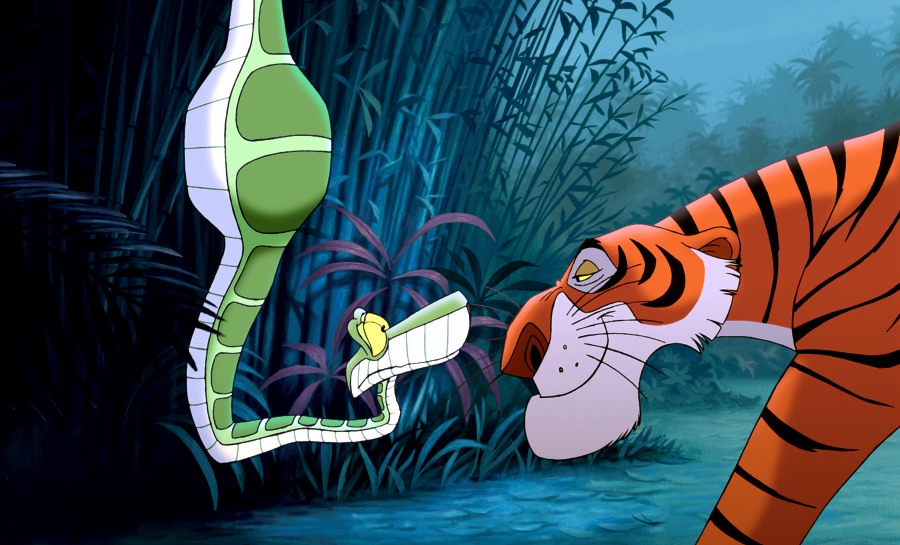
Kaa Meets Tiger
I understand they'll be wanting me at EuroPython again in 2006. It'll be at CERN this year, the birthplace of the World Wide Web. Maybe there'll be an exhibit.
Relevant posts:
My Kaa impersonation
Re: Europython
Tygerblog link
Wednesday, January 18, 2006
Sequences
I tried to get to first base with MLC some years ago, using a pre-publication Quadray Coordinates paper as entre. That got me nowhere -- I think he confused me with some math PhD wannabee, who'd have no intrinsic interest in pedagogy aimed at discerning middle schoolers. He was wrong of course, but on the other hand, neither was I as skilled back then as I am today (and I'm still learning).
Anyway, Visual Math uses these interesting tiling patterns to introduce algebraic formalisms, having students deduce an expression for the nth term in the sequence, given an example progression. Tara brings these home most days, and I've enjoyed the creativity. I also see ample opportunities for synching with my own sequence-based approach, which makes Python an implementation language for just such nth term expressions, with figurate and polyhedral numbers the focus.
I also encouraged Adam to keep talking to me about open source, even though I'm not the biggest name in town on that score (at least I know a few Free Geeks).
For its part, Koreducators is interested in recruiting for the new school (obviously). I said I'd try using my AFSC contacts to drum up more interest in northeast Portland (the target demographic this time -- we could bring more of the same on-line in other quadrants, should this experiment prove successful). Portland Impact probably doesn't need any help though, plus I'm no longer clerk of anything in AFSC world; younger talent has assumed the helm.
Tuesday, January 17, 2006
Re: Public Education (Oregon)
e = elementary
m = middle
h = high
c = college
i.e. so-called k16, pre-school through college.
Of course this all looks very cryptic, but I'm just aiming at making it more memorable and compact.
I told some friends in South Africa it was:
in our neck of the woods but my wife says that's just not how it's done here. So I guess I'm not really the authority.
Anyway, my expertise is more in a specific subject area I tout as "a hybrid of CS and math," where CS is short for computer science and math is short for mathematics.
When you blend math with Texas Instruments, you get a calculator-intensive curriculum. But in PDX we've been leaning more and more towards GNU, Linux, open source in general.
So the calculators maybe don't have such a bright future here, except maybe as emulators e.g. kids can write 'em using some event-driven GUI framework, like maybe PyGame.
Addendum re organizational framework @ Math Forum.
Sunday, January 15, 2006
Dignity Village
Some of you quick draws probably already thought of this -- after all, there's the precedent in LA. What'll be fun is getting across that Santa really does care about poor people.
Of course you cynics see through all that: we're really talking about Grunch in a bunny suit, looking for good will on a planet grown tired of incessant bombing (not to mention outraged by all the collateral damage).
So let's try being at least a tiny bit decent for a change? What a concept! How'd that idea ever get passed the censors?
We've got some spanking new economics spelling out why being good matters, why poverty sucks. Of course we can't make evolution run faster than it'll go. Light speed (186K mph) defines an upper limit (and the normal rate in Synergetics).
I'm confidant that years of watching ecovillages develop will make for better TV (and sell more product) than years of watching bombs go off, per the current dark age in Palestine and Algebra City.
I think we're all tired of Coalition TV by now.
So let's demand something more uplifting for a change! Write to your local programming director -- maybe starting with KOIN?
Saturday, January 14, 2006
Breakfast on Pluto (movie review)
He tries squeezing affection from the male side of the species, which is difficult under the circumstances. There's this fight going on... anyway, the usual guy thing.
Although the police show some kindness, ultimately it's the sisters of the road who keep him safe enough to keep doing his research.
He finally reconnects with a father archetype (the church), plus establishes a long distance relationship with a mother figure.
Individuation achieved. A human is born. Time for breakfast.
Dawn really liked this story. I told her it reminded me of Pinocchio, also about a boy who got creative with the truth while seeking his own humanity.