I enjoyed a satisfying conclusion to Pythonic Mathematics today, that was #7571 - Computer Programming from Chaos to Python. The students had turned raw Python syntax to Vpython gold, including a 3-or-4 frequency tetrahedron, moons around moons, and a mom and her kids did this "look, a real professor" number in the Park Blocks (I had the plastic 4-frequency in tow, attracted attention).
However, these triumphs are somewhat overshadowed by the loss of my OSCON bag and all its contents: iPod, digicam, new Russian geometry book... dried up cashews. Part of the torment is imagining the lucky dude who now has all that, and that's if it really was stolen, which I can't prove (more torment). I recall from some Tibetan Book of the Dead DVD that this is the hardest part: watching your killers play with your stuff. Anyway, maybe it'll turn up, along with Robin, my stolen car.
Back to the classroom: we watched excerpts of a Google Technical Talk, Guido rehearsing before OSCON 2006, talking about Python 3000. Then I shared Store Wars (Cuke versus Darth Tater) and the first few verses of Ramanujan (as many stared into their screens, completing projects). I recommended Python 411 and Dive Into Python (starting with the web version) as possible next sources of information.
As for source code, I looked at Pascal's Triangle (first time through) and Fibonacci generators (second pass -- tie back to triangular and tetrahedral sequences, plus Pascal's). I said something to the effect that these gentlemen needn't have been the first to ever conceive of such language games. So calling 'em is more an honor than a right.
I handed out the closed student evaluation forms, which get sealed and collected at the end of the final class by an SA HQS minion (cute colleague, some new kid on the block), i.e. are pretty much unseen by the instructor. Plus we send home parent forms in case an adult guardian wants to give feedback. Plus I get to fill one out about my students, my experience as the instructor. Plus I handed out signed certificates of completion, properly name embossed, like a credential of some kind.
Several of my students expressed in different ways their wish that ordinary school was more beefy like this, dense-packed with relevant multiplexing, with parents seconding the motion. I always make these "right on" noises, like gee I really empathize. That's why I teach through Saturday Academy, to fight for our Silicon Forest and its values, high standards. I've also been invited onto a curriculum advisory board for Portland Public Schools (PPS).
Saturday, November 18, 2006
Thursday, November 16, 2006
More Hermeneutics
Originally drafted on Synergeo, an eGroup, and therefore populated with references to other discussants -- Editor.
 4D
4D
Cliff is in the vicinity and that always reminds me of our shared interest in outfitting Synergetics with some Mathematica style claptrap (caltrop? -- look it up, Braley-sans-w knows), except in my case it's Pythonic harkening back to APLish (given my personal trajectory), more than Wolframic in its computerized expression [*], but that's not a problem for me if it ain't for Cliffie here.
Other names for the Quadrays namespace might be: Chakovians (after David Chako of Synergetics-L fame); Tetrays (Chako's preferred term); Caltrop Coordinates (vs. Cartesian); Simplicial Coordinates (but minus J.H. Conway's focus on the hypercross and Coxeter.4D) -- and maybe Klingon Coordinates in honor of the other big Conway (Damian).
What we do is shoot four "basis vectors" (pirating from linear algebra) to the corners (1,0,0,0) (0,1,0,0) (0,0,1,0) and (0,0,0,1). To reverse a basis vector is to flip its bits i.e. -(1,0,0,0) = (0,1,1,1) and so on. So we end up not needing negative signs in this canonical representation, though by another convention we might alternatively insist that the sum of the 4-tuples always be zero.
The Cartesians claim having 4 basis vectors is redundant, as they get by with just 3, but then they permit vector reversal to play a role in netting them 7/8ths of their space. Thanks to vector reversal and the three negative "not really" basis vectors, the Cartesians have 3 additional "ghost vectors" doing most of their dirty work i.e. pointing in that 7/8ths negatively tainted space, with only one octant (+++) remaining "positively pure" and therefore directly accessible without all the "bad neighborhood" connotations of a "non-basic" (e.g. +-+) address.
So in point of fact, the Cartesians are using essentially six reference vectors to the corners of a regular octahedron, not just three, whereas in Chakovians we're using just four, and not relying on vector reversal for back-handed access to anything.
 3D
3D
The four positive basis rays positively scale and vector-add to address any point in Positive Universe. Negative Universe is through-the-origin inside-outing of the reference tetrahedron. Your application may have no need for this other space, conjoined through (0,0,0,0), but it's there if you need it. Nor does it matter which you call Positive initially, though once you've invested, conversion may be time-consuming (just like both left and right XYZ coordinate systems have their followings).
My Synergetics on the Web @ grunch.net contains a thorough overview of Chakovians (./synergetics/quadrays.html), plus transforms for converting to-from XYZ, 4x4 rotation matrices courtesy of Tom Ace.
We don't insist on using these in public schools, e.g. won't be targeting any school boards for not, but we do bring kids through on field trips from time to time, just to remind 'em that XYZ thinking ain't all its cracked up to be in some circles.
Alternatives exist, some of them smart cookie.
Kirby
[*] e.g. in some versions of coords.py, imported by rbf.py for doing StrangeAttractors, rendering other concentric hierarchy graphics in the 4D++ IVM.FM (lots at my grunch.net and 4dsolutions.net websites).
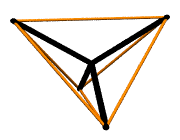 4D
4DOther names for the Quadrays namespace might be: Chakovians (after David Chako of Synergetics-L fame); Tetrays (Chako's preferred term); Caltrop Coordinates (vs. Cartesian); Simplicial Coordinates (but minus J.H. Conway's focus on the hypercross and Coxeter.4D) -- and maybe Klingon Coordinates in honor of the other big Conway (Damian).
What we do is shoot four "basis vectors" (pirating from linear algebra) to the corners (1,0,0,0) (0,1,0,0) (0,0,1,0) and (0,0,0,1). To reverse a basis vector is to flip its bits i.e. -(1,0,0,0) = (0,1,1,1) and so on. So we end up not needing negative signs in this canonical representation, though by another convention we might alternatively insist that the sum of the 4-tuples always be zero.
The Cartesians claim having 4 basis vectors is redundant, as they get by with just 3, but then they permit vector reversal to play a role in netting them 7/8ths of their space. Thanks to vector reversal and the three negative "not really" basis vectors, the Cartesians have 3 additional "ghost vectors" doing most of their dirty work i.e. pointing in that 7/8ths negatively tainted space, with only one octant (+++) remaining "positively pure" and therefore directly accessible without all the "bad neighborhood" connotations of a "non-basic" (e.g. +-+) address.
So in point of fact, the Cartesians are using essentially six reference vectors to the corners of a regular octahedron, not just three, whereas in Chakovians we're using just four, and not relying on vector reversal for back-handed access to anything.
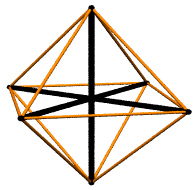 3D
3DMy Synergetics on the Web @ grunch.net contains a thorough overview of Chakovians (./synergetics/quadrays.html), plus transforms for converting to-from XYZ, 4x4 rotation matrices courtesy of Tom Ace.
We don't insist on using these in public schools, e.g. won't be targeting any school boards for not, but we do bring kids through on field trips from time to time, just to remind 'em that XYZ thinking ain't all its cracked up to be in some circles.
Alternatives exist, some of them smart cookie.
Kirby
[*] e.g. in some versions of coords.py, imported by rbf.py for doing StrangeAttractors, rendering other concentric hierarchy graphics in the 4D++ IVM.FM (lots at my grunch.net and 4dsolutions.net websites).

Tuesday, November 14, 2006
Wanderers 2006.11.14
So tonight it was Barry's turn to induct us into the deep metallurgy of small microprocessors, the ones you program once for some permanent job in a car engine or, in Barry's case, a DC light dimmer.
Boats are wired for DC but don't come with a dimmer switch, usually. Barry's gizmo, a coventure, takes DC into a pulse width modulator, written in software, and matched with code to the interface, in this case either one or two switches, and rather complex behaviors.
A feature of this Motorola HC05 series chip is a ripple counter with some flag bits, such as COP. Unless you "kick the dog" every few cycles, COP'll flip and send a reset; useful for when poorly written code enters an infinite loop or whatever. You don't want simple coding errors to devalue the hardware, or maybe the code makes intelligent use of dog kicking internally. Either way, nice to know that COP is there.
So the boat owner chooses to wire either one or two switches, then meters DC power at tiny calibrations, or full on, though even this max brightness setting includes sleeping, i.e. going to low voltage for short intervals.
Given all the interrupts in this picture, 109 cycles a second mas o meno, with 256 intervals within each of those, there's lots of pushing registers to stack, running off someplace, coming back and popping the stack. Nesting subroutines is a source of subtle errors and stack overflows so Barry's code stays pretty flat. He's pretty much self taught, and being a smart guy, he made sure he did a good job of teaching it.
Safe to say, this was pretty unfamiliar stuff for a lot of those present, and Barry didn't get to the graphical (windowed) debugger until close to the end. That actually gave us stepped execution, break points, on a simulated chip, with registers, a next program line pointer (under 500 max lines), other flag indicators, and the very limited 64 bytes of RAM (right Barry?), all conveniently displayed.
I appreciated Barry's willingness to not hold back about the nitty gritty details, even though he knew we weren't tracking in all cases.
Boats are wired for DC but don't come with a dimmer switch, usually. Barry's gizmo, a coventure, takes DC into a pulse width modulator, written in software, and matched with code to the interface, in this case either one or two switches, and rather complex behaviors.
A feature of this Motorola HC05 series chip is a ripple counter with some flag bits, such as COP. Unless you "kick the dog" every few cycles, COP'll flip and send a reset; useful for when poorly written code enters an infinite loop or whatever. You don't want simple coding errors to devalue the hardware, or maybe the code makes intelligent use of dog kicking internally. Either way, nice to know that COP is there.
So the boat owner chooses to wire either one or two switches, then meters DC power at tiny calibrations, or full on, though even this max brightness setting includes sleeping, i.e. going to low voltage for short intervals.
Given all the interrupts in this picture, 109 cycles a second mas o meno, with 256 intervals within each of those, there's lots of pushing registers to stack, running off someplace, coming back and popping the stack. Nesting subroutines is a source of subtle errors and stack overflows so Barry's code stays pretty flat. He's pretty much self taught, and being a smart guy, he made sure he did a good job of teaching it.
Safe to say, this was pretty unfamiliar stuff for a lot of those present, and Barry didn't get to the graphical (windowed) debugger until close to the end. That actually gave us stepped execution, break points, on a simulated chip, with registers, a next program line pointer (under 500 max lines), other flag indicators, and the very limited 64 bytes of RAM (right Barry?), all conveniently displayed.
I appreciated Barry's willingness to not hold back about the nitty gritty details, even though he knew we weren't tracking in all cases.
Sunday, November 12, 2006
Cultural Anthropology
Based on this news that the yellow "support our troops" ribbon motif actually got off the ground during the Indian Wars, when brave horse-mounted Custer types headed off like knights in shining armour, protecting Betty Crocker security moms back home, I'm extrapolating the early emergence of a later counter-culture, in the form of those racoon hatted Daniel Boone types, civilian trackers and company traders, who became friendly with North America's natives, intermarried.
When cultures collide, you always get these Romeo and Juliet stories wherein a younger sister or someone falls head over heels for a pagan, Roman, Jew or whatever rival ethnicity, and it's a big family crisis. One brother encourages his gang members to slay the infidel love object, while another brother, usually played as a pacifist introvert type (i.e. a sissy who better understands women) betrays the rougher bro by leaking news of this plan, resulting in an ambush of the Goody Gang and lots of remorseful suicides, including by Romeo and Juliet. Curtain. Sigh. Such a tragedy.
This pattern gets repeated in our day's Lost to some extent, in the love story between the California Babe and the Elite Republican Guard dude. But in the context of this island, with its strong magnetic fields, the predictable unfolding gets scrambled, and California Babe gets shot by the trigger happy Latina Police Chick by mistake, leaving the Iraqi Dude to mourn and eventually forgive (that's about as far as I've gotten in the series).
More predictable was the CNN banter I heard while in Florida, these Anglo pundits angsting about Iraqis and their tribal loyalties, their lack of sophistication around democracy, USAers having just proved to themselves theirs has yet to be rendered incomprehensible by an insider technocracy in charge of the voting machines (an advancing AI army, like in Terminator).
I haven't studied the history in detail, but I bet if we go back we'll find the brave Custer types were just trying to prevent all those unsophisticated Indians from killing each other, and so would side with one underdog tribe after another, just to balance things out and to prove to all doubters that the Great White Father in Washington knew how to pick a winner every time.
When cultures collide, you always get these Romeo and Juliet stories wherein a younger sister or someone falls head over heels for a pagan, Roman, Jew or whatever rival ethnicity, and it's a big family crisis. One brother encourages his gang members to slay the infidel love object, while another brother, usually played as a pacifist introvert type (i.e. a sissy who better understands women) betrays the rougher bro by leaking news of this plan, resulting in an ambush of the Goody Gang and lots of remorseful suicides, including by Romeo and Juliet. Curtain. Sigh. Such a tragedy.
This pattern gets repeated in our day's Lost to some extent, in the love story between the California Babe and the Elite Republican Guard dude. But in the context of this island, with its strong magnetic fields, the predictable unfolding gets scrambled, and California Babe gets shot by the trigger happy Latina Police Chick by mistake, leaving the Iraqi Dude to mourn and eventually forgive (that's about as far as I've gotten in the series).
More predictable was the CNN banter I heard while in Florida, these Anglo pundits angsting about Iraqis and their tribal loyalties, their lack of sophistication around democracy, USAers having just proved to themselves theirs has yet to be rendered incomprehensible by an insider technocracy in charge of the voting machines (an advancing AI army, like in Terminator).
I haven't studied the history in detail, but I bet if we go back we'll find the brave Custer types were just trying to prevent all those unsophisticated Indians from killing each other, and so would side with one underdog tribe after another, just to balance things out and to prove to all doubters that the Great White Father in Washington knew how to pick a winner every time.
Monday, November 06, 2006
T Module
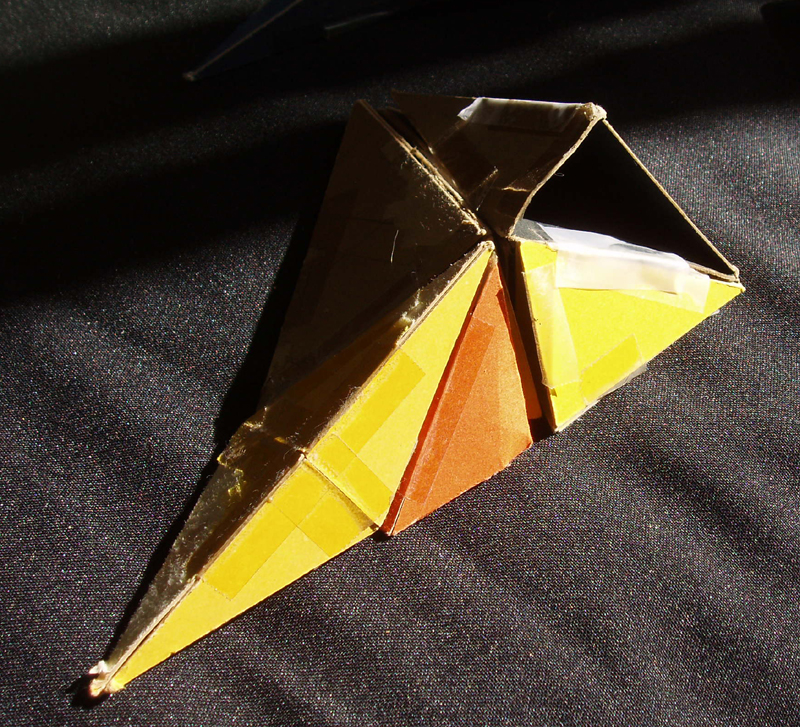 :: an original koski T ::
(Portland Knowledge Lab Collection)
Keep filling the R mod with smaller T mods if you like, but expect smaller terminal R mods.
Phi-scaled Ts and Rs together make a cube, other shapes.
Plus if you regard a golden cuboid (1 x phi x tau (tau = 1/phi)) as defining 7 edge lengths (3 XYZ + 3 face diagonals + 1 body diagonal), and choose those six at a time to get additional phi-scalable tetrahedra, then you've got the gist of David Koski's pioneering explorations.
And remember, two parallel accounting systems: lowest terms in canonical volumes; most economical physical assembly using actual left and right handed modules.
Saturday, November 04, 2006
More Pythonic Mathematics
 :: protocols ::
Gnubees often say "the Internet" meaning just http (hypertext transfer protocol), the one used to serve web pages (through port 80 most likely), but long before Mosaic, Netscape, IE, Opera, Mozilla... FireFox, we had usenet (the newsgroups) and ways to swap files (ftp = file transfer protocol) -- and of course email.
All of these services working together define the Internet, not just http and its webwork of interconnected urls.
After this short intro, we watched Warriors of the Net, a mathcast I've used ever since my first Saturday Academy class at West Precinct.
 :: mosaic ::
This time we had stickworks.py with its Vector and Edge to aid and abet, and a few students had additional shapes in short order.
My Pythonic vectors always have their tail at the origin. If you want a line segment between any two points, feed those two vectors to the Edge class to get back your edge object, which displays in the VPython window when you trigger its draw method.
 :: vector arithmetic ::
I pour these hard white beans from one shape to the other, reminding them of our everyday home base sculpture.
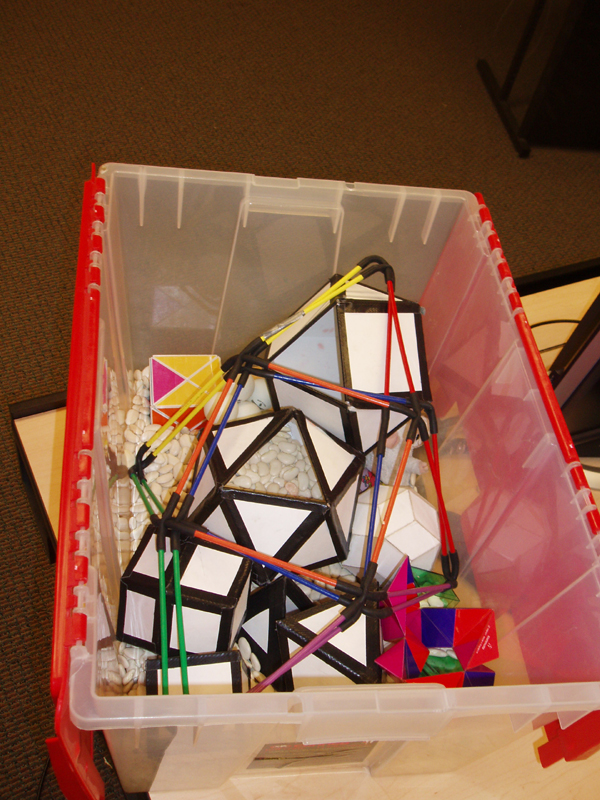 :: cargo cult geometry ::
Next week: we plan to get more into animation, getting beyond static imagery. One of my students is interested in coding a planets-around-the-sun type toon. I turned him on to Celestia.
Wednesday, November 01, 2006
Synergeo 30350
> Marx was not caught up by the idea of not being enough-
> in fact he wrote that in the future will be plenty- though
> he didn't show me the statements of Marx in this matter-
Fuller boils it down to a very simple equation in Critical Path: assuming not enough to go around (Malthusianism), we get LAWCAP (lawyer-capitalism) versus Marxist schools of thought (workers of the world unite), each claiming the competition wasn't pulling its own weight i.e. "our side" has the right to be on the top of the heap (presumably where you find the best access to scarce life support).
Per dumbed down Hegelianism (he never boiled it down to 'thesis - antithesis -> synthesis' the way they teach in grade school) we've since moved on.
Grunch is focused on artifacts and competitive marketing/ branding, but also on open source energy planning and modeling, publicly sharing lots of relevant global data (vs. keeping it classified the way Malthusians had to, cuz the news was so grim, at least for the majority of humans). World Game is still a competitive game, but our top teams don't easily stuff into 20th century pigeon-holes.
Kirby
> in fact he wrote that in the future will be plenty- though
> he didn't show me the statements of Marx in this matter-
Fuller boils it down to a very simple equation in Critical Path: assuming not enough to go around (Malthusianism), we get LAWCAP (lawyer-capitalism) versus Marxist schools of thought (workers of the world unite), each claiming the competition wasn't pulling its own weight i.e. "our side" has the right to be on the top of the heap (presumably where you find the best access to scarce life support).
Per dumbed down Hegelianism (he never boiled it down to 'thesis - antithesis -> synthesis' the way they teach in grade school) we've since moved on.
Grunch is focused on artifacts and competitive marketing/ branding, but also on open source energy planning and modeling, publicly sharing lots of relevant global data (vs. keeping it classified the way Malthusians had to, cuz the news was so grim, at least for the majority of humans). World Game is still a competitive game, but our top teams don't easily stuff into 20th century pigeon-holes.
Kirby
Monday, October 30, 2006
NCLB Polyhedron Memo
"What if we teach about an NCLB Polyhedron, and how the muggles refused to share it, or really much of any Pentagon Math for that matter?" -- Kirby T. Urner, Oct 29, '06 [1]Old timers on math-teach may recall my sudden injection of the NCLB Polynomial, a somewhat surrealist maneuver by the standards of today's joyless political climate, what with all that dreary fearmongering and race baiting that goes on (racist: someone who believes in races).
That went over like a lead balloon. I got only a few reports back of any ripple-effects in the blogosphere, let alone classrooms, although I'm used to having some of my best ideas ripped off without attribution (s'ok, I've got more where those came from).
So now, so close to the election, it's time to up the ante with an NCLB Polyhedron (different type math object from a Polynomial).
Some of you snarkies might've guessed that'd be the Pentagonal Dodecahedron but you'd be wrong. I'm going with the Rhombic Triacontahedron for several reasons:
- it's home base for the T modules (recursive sister of A & B modules)
- it embeds the pentagonal dodeca, one of the Platonic High Five, as short face diagonals (rhombs are diamonds)
- it also embeds the icosahedron (long diagonals), which is more structurally stable, being all triangles 'n all, and also a High Fiver
- [... your reason goes here ...]
- we need more focus on the Rhombic Dodecahedron (one of Kepler's favorites) and rhomb rhymes with rhomb
The NCLB Polynomial, as you recall, was x**2 - x - 1, which, set equal to zero, solves as one plus or minus the second root of five all over two.[2] And that's Phi Country folks, like the land o' Marlborough but without all the cigs ("I miss my lung Bob"[3]), a place for rugged individualism, just like our Python Nation (partially overlapping for sure (did I mention I was its Minister of Education once?)). Welcome to our Wild West.
And Phi is all about Five-Fold Symmetry, rotationally speaking, which is where the NCLB Polyhedron comes in, all part of the same package.
 Rhombic Triacontahedron
 by Ken G. Brown
Now who could deny this'd be wholesome fare for USA kidnicks, stretching to become tomorrow's freedom-loving world game players? It's a no-brainer almost. Figurate and polyhedral numbers, flatscreen computer graphics, hexapent domicile options, horse camps in the high desert. Like of course this is Future America -- who ever doubted it?
Yet the math teachers don't share our NCLB programming, pretending NCLB is no more than a "school rule" of the kind they might easily get away with breaking. They're not really interested in substantive content, which has never been their forte (secret: many math teachers hate math).
So no sharing about Fibonacci Number convergence to Phi (Python generators good for showing this), practically nothing about Pentagon Math (108, in an underground hexapent -- anything clicking?), about Triangular and Tetrahedral number sequences (columns in Pascal's Triangle), and how all this stuff links to our Geometry of the Ages (as embedded in all kinds of USA iconography and architecture [4]).
Or maybe they do bravely share this stuff (that'd be my fond hope at least). If so, they should be loud about it, run campaigns on that basis. NCLB is so important in the fight against terrorism (bumper sticker: only stoopid people bomb (and yes, mean people still suck)).
Thanks to NCLB, our president is winning his war for Iraqi hearts and minds. Why? Because Islam was never so stoopid about geometry as most USA math teachers are, what with their dim-witted XYZ calculus and "duh wuh?" reflexes around nature's well established geometries.[5]
Thanks to NCLB, our children will face life bravely, perhaps unlike their pseudo-adult math teachers, who cower and cringe in the face of their own incompetence, now shining publicly and brightly, as from a lit up billboard -- their collective professional face in our NCLB mirror.
Kirby
Gnu Math Teacher
Portland, Oregon
More context on the Math Forum: Halloween, 2006

Sunday, October 29, 2006
Degrees of Freedom
Over on Geodesic, a listserv out of SUNY Buffalo, Tim Tyler is battling pseudo-scientists over whether Bucky was right about the minimum bicycle wheel having twelve spokes.
Tim claims seven is minimal, echoing claims in a new biography of H.S.M. Coxeter, the late master geometer, to whom Bucky dedicated his two volume magnum opus.
The question is important in part because the bicycle wheel marks a transition from compression-heavy designs to lighter weight tension-based solutions.
The hub in a traditional wooden spoked wheel "pole vaults along" (Bucky's imagery), its spokes pushing downward against the rim, whereas the bicycle wheel's hub hangs from above, reaching out to the sides to prevent the rim from buckling outward.
For Fuller, learning to design around tension was a critical "more with less" strategy that would help humans aboard Spaceship Earth take better care of themselves over the long haul.
I've weighed in on the side of empiricism in this thread, plus hinted at other mistakes we may find in Synergetics, even beyond those already listed, by Robert Gray and others.
Yet how many school kids even know there's a legacy, a "geometry of thinking" to explore? And who was this Coxeter guy and what means "tensegrity"?
No child should be left behind when it comes to accessing their own best heritage, American or otherwise. As I've written on Synergeo recently, a Yahoo! eGroup:
So perhaps our esoteric little arguments will gain wider currency, and even this little bicycle wheel question may help us recruit future scientists.
 bottlenecks r us
Tim claims seven is minimal, echoing claims in a new biography of H.S.M. Coxeter, the late master geometer, to whom Bucky dedicated his two volume magnum opus.
The question is important in part because the bicycle wheel marks a transition from compression-heavy designs to lighter weight tension-based solutions.
The hub in a traditional wooden spoked wheel "pole vaults along" (Bucky's imagery), its spokes pushing downward against the rim, whereas the bicycle wheel's hub hangs from above, reaching out to the sides to prevent the rim from buckling outward.
For Fuller, learning to design around tension was a critical "more with less" strategy that would help humans aboard Spaceship Earth take better care of themselves over the long haul.
I've weighed in on the side of empiricism in this thread, plus hinted at other mistakes we may find in Synergetics, even beyond those already listed, by Robert Gray and others.
My friend Tom Ace shares a lot of Tyler's skepticism regarding Synergetics, plus knows a lot about bicycle wheels. More empirical testing is a good idea. [link]This book, first published by Macmillan and now on the web, should not be considered the last word in the discipline, nor even a last stand, but a promising beginning, a trailblazing exploration.
Yet how many school kids even know there's a legacy, a "geometry of thinking" to explore? And who was this Coxeter guy and what means "tensegrity"?
No child should be left behind when it comes to accessing their own best heritage, American or otherwise. As I've written on Synergeo recently, a Yahoo! eGroup:
For my part, I want to recruit more high powered players who will help me get at least the basics, the concentric hierarchy and its ball packing context, televized and more evenly distributed, so it becomes a part of the background noise of our culture.Fortunately, I'm seeing signs that we're turning this corner and really starting to get the word out to our kids.
Once synergetics is more overtly in the background, I'll make less noise in the foreground and probably come off as less combative and competitive to boot. [link]
So perhaps our esoteric little arguments will gain wider currency, and even this little bicycle wheel question may help us recruit future scientists.
 bottlenecks r us
Thursday, October 26, 2006
Flags of Our Fathers (movie review)
Eastwood and Spielberg exercise state of the art skills to recreate the utter and complete hell that was Iwo Jima. A small set of lucky souls is magically transported to Alien America, to raise money for this terrible hell, and they find this confusing unto death, though they each deal with it differently.
Who are all these people and what are we doing here? Why is hell a real place and not just in the Bible?
What's palpable about these civilians is how they've surrendered so completely to the illusion that there must be some victory in this picture, when it's really all about suffering and dying, with the humanity of one's buddies never in doubt such that somehow on some level it was worth every penny, just to have died there with them. But that doesn't make war OK.
By today's standards, the treatment of those lucky soldiers was inexcusable. We're talking full blown PTSD, in the Indian's case like a flat out psychosis (but then aren't Indians supposed to be crazy? -- look at what happened to them).
Putting nut jobs like these (and I mean that affectionately) in the full glare of packed stadiums, expecting them to perform like pet hamsters or something (look where that got 'em the first time), was out and out animal cruelty. But then, that's what war is.
I salute the makers of this film (actors, logistics...) for reminding us why we want a lot of diplomatic activity, strong friendships across oceans, tourism, deep sharing and listening. The film itself salutes the actual stars, more than I, just some guy, could ever do alone.
We very much want and need to stay sane on this planet, all the more so given our discouraging track record (but King Kong makes us proud).
Our humanity was never in doubt, let's remember that. We were indeed "good people".
But let's face it, Universe is a difficult game and we're far from perfect players (as the angels keep reminding us, when they best us in soccer).
May we always play better together and love a lot more. We are worth every penny.
Who are all these people and what are we doing here? Why is hell a real place and not just in the Bible?
What's palpable about these civilians is how they've surrendered so completely to the illusion that there must be some victory in this picture, when it's really all about suffering and dying, with the humanity of one's buddies never in doubt such that somehow on some level it was worth every penny, just to have died there with them. But that doesn't make war OK.
By today's standards, the treatment of those lucky soldiers was inexcusable. We're talking full blown PTSD, in the Indian's case like a flat out psychosis (but then aren't Indians supposed to be crazy? -- look at what happened to them).
Putting nut jobs like these (and I mean that affectionately) in the full glare of packed stadiums, expecting them to perform like pet hamsters or something (look where that got 'em the first time), was out and out animal cruelty. But then, that's what war is.
I salute the makers of this film (actors, logistics...) for reminding us why we want a lot of diplomatic activity, strong friendships across oceans, tourism, deep sharing and listening. The film itself salutes the actual stars, more than I, just some guy, could ever do alone.
We very much want and need to stay sane on this planet, all the more so given our discouraging track record (but King Kong makes us proud).
Our humanity was never in doubt, let's remember that. We were indeed "good people".
But let's face it, Universe is a difficult game and we're far from perfect players (as the angels keep reminding us, when they best us in soccer).
May we always play better together and love a lot more. We are worth every penny.
Wednesday, October 25, 2006
A Libyan Eclipse
 Buxton (center), Stockman (left) and Tver (right)
Back in the alcove, I absorbed a real time mathcast from David Feinstein, based on his recent middle school teaching in Sacramento. His style of pedagogy is amazingly effective. In this case, he had Shomar in the classroom, his giant dog, which trained kids to reel in their focus (from such a wonderful animal) and refocus on command -- a new skill for them.
David agreed in principle he was available as on-camera talent when doing such gigs, at which point I rubbed my hands together and looked shifty-eyed (seeking my krew?).
At one point in Jim's talk, I jumped in with that picture from off the "time capsule" in our living room (an art deco stack of cylindrical shelves), that one of dad in the 1960s, his team assembled, maps in the background, working on 50 year timelines for Libyan development.
Libya hired a crack team as soon as it became apparent that urban and regional planning were real disciplines, not just pie in the sky distant futurist talk. Portland had already learned that lesson, and has reaped many benefits (as has Libya, over the years).
Other countries my dad worked for in a planning capacity, besides the USA: Philippines, Egypt, Bangladesh, Bhutan, and Lesotho.
In these latter two, I was already doing a gig around polyhedra, and guest presented to school children to rave reviews. I also wrote A Bhutanese Mathematics Curriculum with a hexapent on the cover, gave a copy to Father Mackey SJ. These were my early days as a curriculum writer and I feel I've gotten much better at it since then (but what a lucky beginning eh?).
Jim's and his wife's Libyan experience was quite joyful and they were appreciative of all the hospitality extended to visiting non-nationals. And I'm willing to bet that little patch of desert had never seen such a concentration of high tech cameras and telescopes, for both movies and stills, though at least one lady just sat there, meditating peacefully through the whole event, just taking it all in.
Sunday, October 22, 2006
A Next Generation
 projecting directly to whiteboard
Fortunately, an Academy pro staffer was already on the scene, addressing all of these problems, plus my login and the computer projector both worked flawlessly. Thirty minutes into it, we were cookin' with gas (means hummin' along nicely).
I talked up the importance of PEPs in Python Nation, i.e. our reliance on Guido's design sense for advancing the language, but with responsibility distributed enough to give lots of strong players a role. Like geeks do have the ability to intelligently self-organize and self-manage.
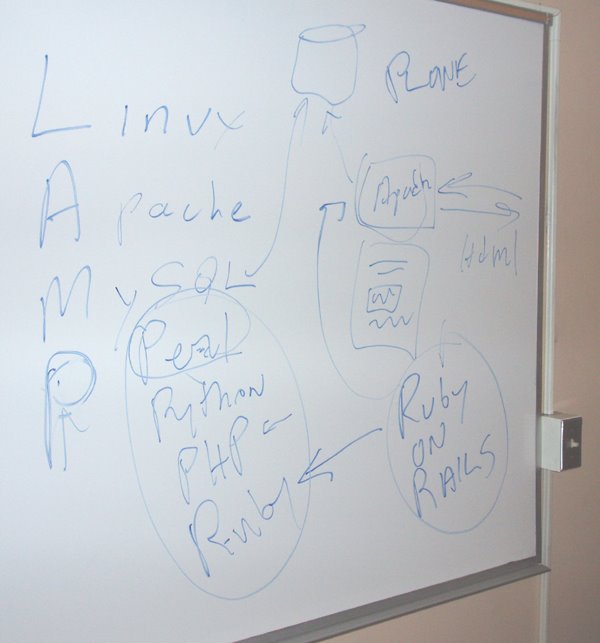
I was very strong on the Monty Python connection, plus hyped adjacent languages such as Ruby and Perl, decoding the LAMP meme towards the end (see below). Of course now that Ruby on Rails has become a primo web framework, that clever idea of a "P-language" (Perl, Python, or PHP) is somewhat obsolescent.
Some of the time we spent in Sloane's Encyclopedia of Integer Sequences. I started with the story of the young Gauss adding 1 + 2 + 3... + 100 in just seconds, based on a couple insights, which led to triangular (1, 3, 6, 10...) then tetrahedral (1, 4, 10, 20...) numbers. That paved the way for the cuboctas (1, 13, 55, 147...) by way of icosa shell counts (1, 12, 42, 92...) and the jitterbug transformation (mentioned only briefly in passing, using my colorful Vector Flexor).
All of these figurate and polyhedral number sequences make for easy Python functions, importable as firstday.py from ./Lib/site-packages (each student is using a local drive, to avoid some frustrating sys.path issues that hampered us last time).
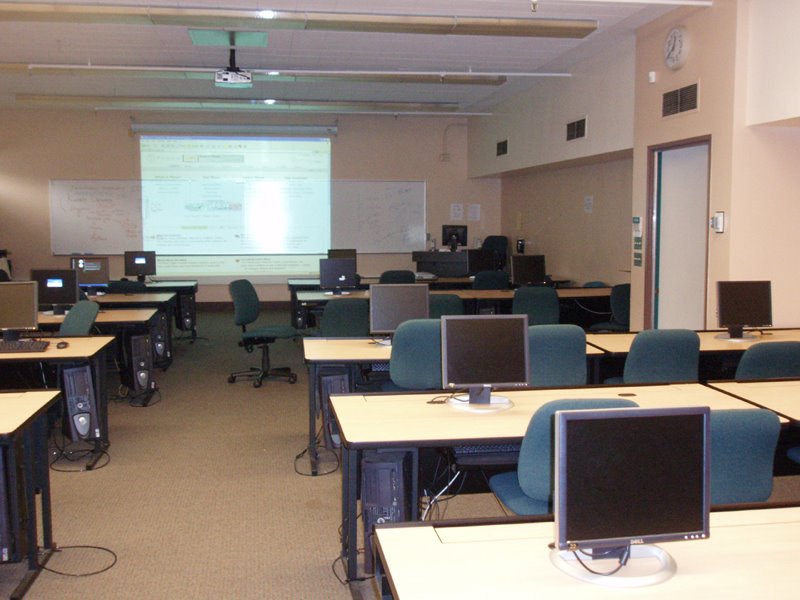
One technique with the white board (shown above) is to retract the projection screen (a switch on the wall), thereby putting code on a markupable surface. I can circle bugs, scribble comments, using projected Python as my target. I used IDLE -- remarking on the pun -- with Courier, Georgia and/or Comic Sans in a 16 pt. bold. I may switch to a wx.PyCrust down the road.
My students were active and engaged, asking questions, providing input.
 decoding LAMP
(click for larger view)
Wednesday, October 18, 2006
Lunch in Oregon City
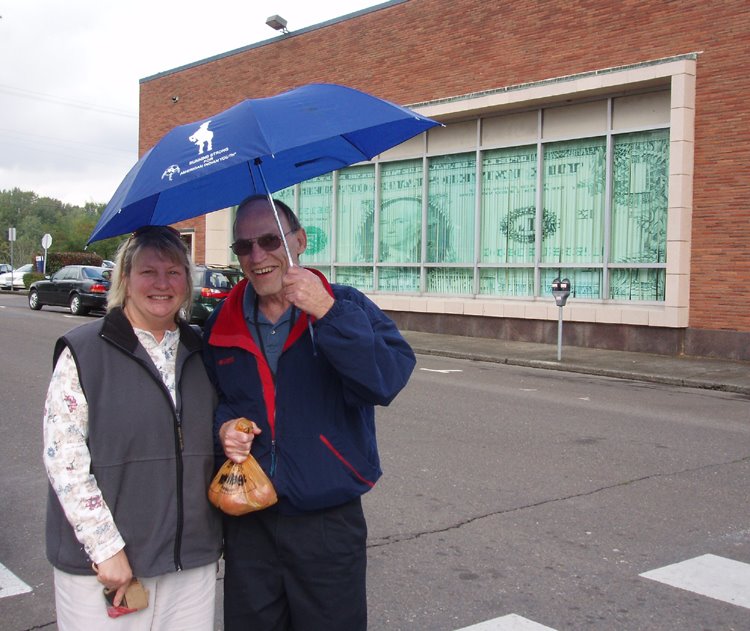 alice & tom (with george in the background)
We had lunch at a "MickeyMens" yesterday (a McMenamins -- a Disney allusion (I overheard a receptionist at Edgefield sighing, not unhappily, about "another day in the Kingdom" so seems befitting)).
Tom (the county employee) and me (the geek computer consultant) used to work in that very downtown building some years before this latest remodel (his new county digs are likewise an improvement).
Today, the hard-working Razz finally got some much-deserved pandering to at the local Jiffy Lube (see Google Earth). I insisted on Quaker State.
Expecting dinner with the Boltons.
Monday, October 16, 2006
Sacred Geometry Talk
         ______________________________
                     [__0__]
                 [__1__][__2__]
              [__3__][__4__][__5__]
           [__6__][__7__][__8__][__9__]
I used the above material to prepare for a talk to Wanderers on Sacred Geometry for Halloween, 2006. That's an "above vs. below the line" apparatus, borrowed from Erhard's est, and a dollar bill allusion (God above, we Novus Ordo Seclorum bricks below, all hyperlinking to stuff and each other).
Saturday, October 14, 2006
Supine Dragon
Actually, I think it's Sleeping Dragon, and this is but a tiny scale model, compared to the real deal, scheduled for Paris.
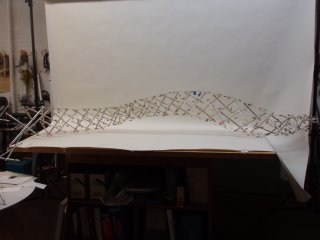 :: scale model ::
And below, the relative giants (standing in front of said sculpture): Kenneth, my daughter Tara, her dad (Kenneth is also a proud father, of Andrea).
 :: kenneth & friends, nyc.soho.studio oct 9, 2006 ::
 :: scale model ::
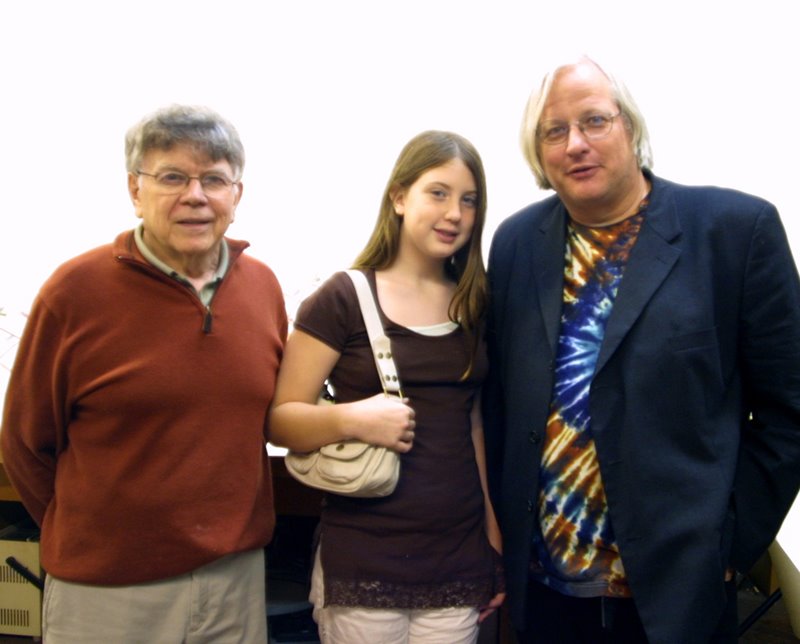 :: kenneth & friends, nyc.soho.studio oct 9, 2006 ::
Friday, October 13, 2006
A Day for Prayer
 :: prayer flags ::
I flew out to be with mom and make arrangements for dad in Bloem and Maseru, receiving much logistical and emotional support from our network. My sister Julie took over and helped mom through her weeks of recovery, flying back with her to America (I met their plane in Atlanta).
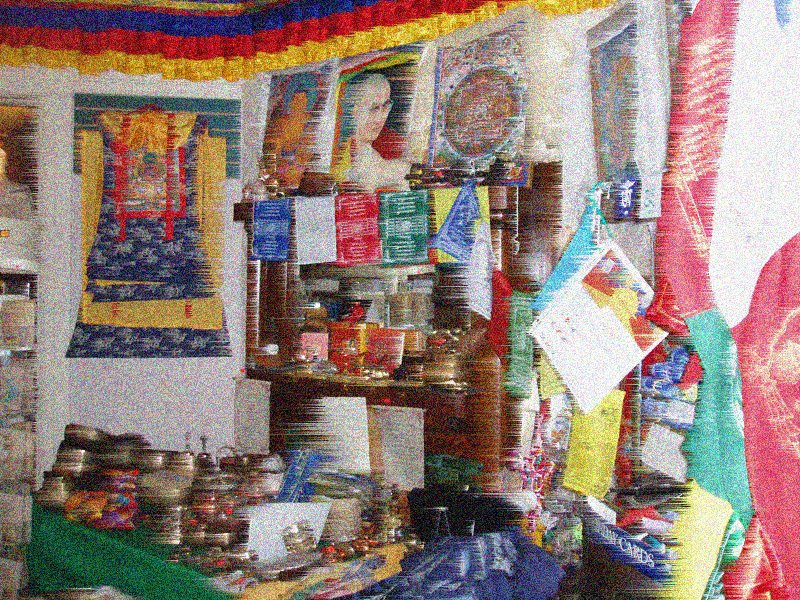 :: prayer flag store ::
I think Dad would have approved of what was on the flatscreens today: some World Paintball Tournament, today featuring the Russian Legion (real Russians!) versus the LA Snakes. I'm pretty sure both teams were coed though it's hard to tell through those fancy uniforms with helmets and everything. Looked like fun, plus they had giant stuffed tetrahedrons to hide behind, among other obstacles.
 :: simple altar ::
I also spent some of my day manning my gnu math workstation. I still don't have a lot of agreement that gnu math exists, but I feel at least some have enrolled in the possibility they might teach it one day. I help them bone up and rehearse, while waiting in the wings, between intervals where I "strut and puff my hour upon the stage" (faux Shakespeare I think (the real McCoy is free in Central Park, but the ticket lines get long)).
Coffee with Derek at Powell's Books on Hawthorne. Shopping at Trader Joe's. Dinner with Gayle (David's ex) and the Braithwaites.
Gayle helped me get a cheap ticket to South Africa in 2000, after we found out about the accident. Plus Eugene, also a Friend, offered to accompany me, which took courage, but I chose to go alone, having been twice before in happier circumstances.
Tuesday, October 10, 2006
Our Big New York Adventure
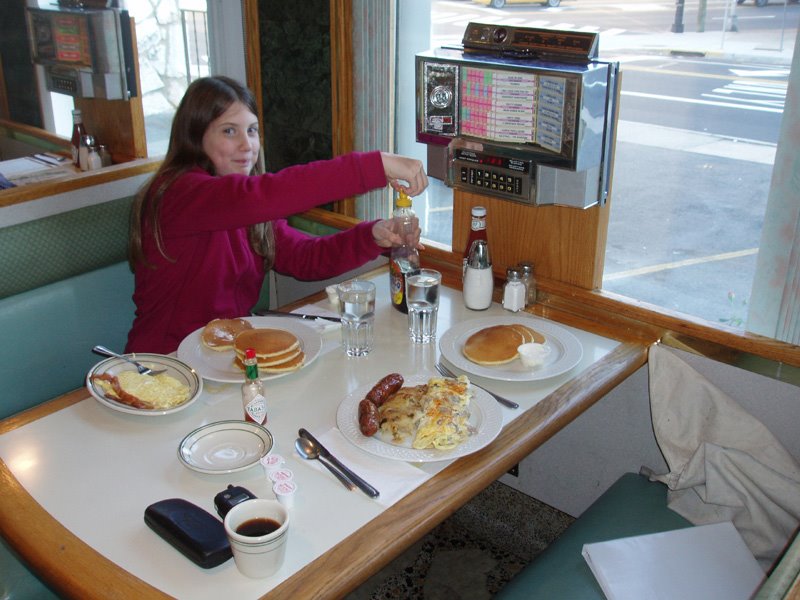
Tara and I boarded Continental's nonstop, a red eye, to EWR on Saturday, connecting by city bus 62 to PATH inside Newark's Penn Station, thence to JSQ for breakfast at VIP Diner (an old haunt). The guy in the next booth was showing off his fancy new camera to the pretty waitress. Bright sunny, but still a bit nippy that early, and almost no traffic.
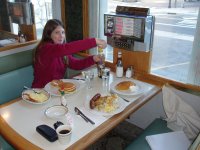 VIP Diner, Jersey City
We reboarded PATH to New York's Penn Station (Penn being a Friend and American icon), then walked to Times Square, gawking with the other tourists. I see Bodies has followed me here, or I it as the case may be (EMP's Dylan exhibit is also enroute). Monty Python's Spamalot is generating guffaws off Broadway -- good to see that brand in action. Monty Python is the comedy troupe for which our Python -- as in "Python Nation" -- is named.
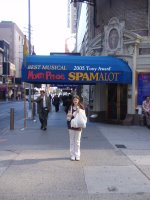 Monty Python off Broadway
Former CUE boss and CORE colleague, David, now of Merkle Foundation, and Patricia with IBM, showed us around, Carl Schurz and Central Parks especially. Particia's bird Bartok was a big hit with Tara, who mentioned Llysa might be getting a bird soon.
 Tara with David Lansky in Central Park
In the interim, before our friendly lunch with Kenneth Snelson, who generously spared the time to meet with us (he's about to open in Paris) we took the tram to Roosevelt Island, stopped at a StarBucks, road the 25 cent electric shuttle bus, and meandered over the colorful bridge next to the very impressive power station. Very Toys R Us (flip that R mentally) -- our big Grand Finale before departing for Newark International Airport from 33rd Street on NJ Transit.
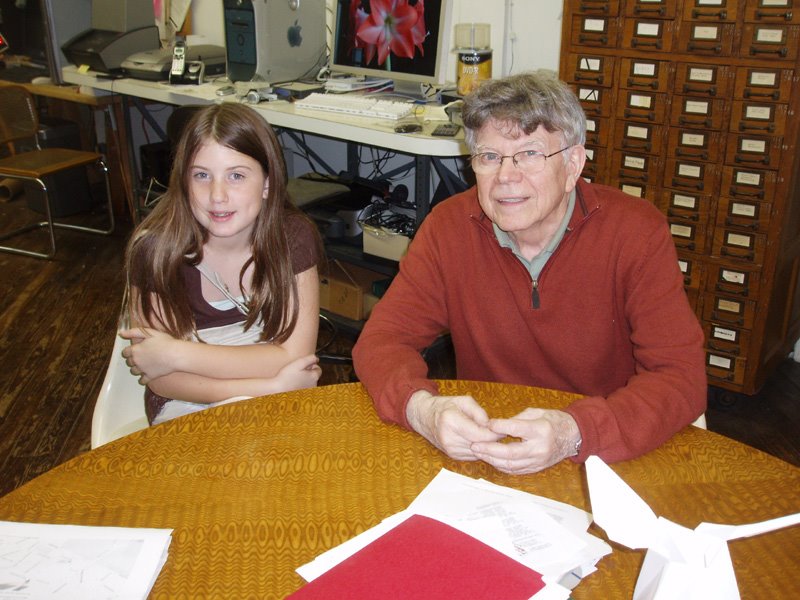
 Tara with Kenneth Snelson in studio
Near that power station, north on Vernon, is the Noguchi Museum, a remodeled gas station parked across the street from Shoji's and Bucky's brick building studio.
John Belt and his design science students from SUNY Oswego, the new BFI Director of Development, Angela Molenaar and associates, Tara and I from Portland, museum staff, other dignitaries, mingled and mixed at a reception for these talented musicians who'd delivered a slice of Fuller's transcendentalist namespace -- in this case, his 1980 commencement address at SUNY Buffalo -- in what I might call a "high conehead" style.
The composer Petr Kotik was intense, and the vocalist Gayla Morgan, whom I interviewed afterward, had been strict with herself in adhering to the score's directives (Bruce Rameker too; they blended well together to give a deresonated flat affect).
The Continental flight back featured Click and X-Men: The Last Stand. Tara didn't like their crushing an Aibo in the first one (the Scrooge story retold), so a thumbs down from her. The second was simply a Marvel Comics heroic opera with lots of special effects (getting sleepy...). Tara is reading Uglies, and trying to stay current with schoolwork @ Winterhaven (formerly Brooklyn) Public School.
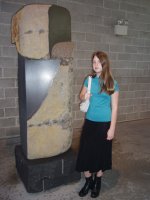 Tara with Noguchi sculpture
While we were away, our house changed color, from battleship gray to a deeper oceanic color (Loyal Blue by Sherwin Williams).
 Chris Cradler & Tara
 VIP Diner, Jersey City
 Monty Python off Broadway
 Tara with David Lansky in Central Park
 Tara with Kenneth Snelson in studio
John Belt and his design science students from SUNY Oswego, the new BFI Director of Development, Angela Molenaar and associates, Tara and I from Portland, museum staff, other dignitaries, mingled and mixed at a reception for these talented musicians who'd delivered a slice of Fuller's transcendentalist namespace -- in this case, his 1980 commencement address at SUNY Buffalo -- in what I might call a "high conehead" style.
The composer Petr Kotik was intense, and the vocalist Gayla Morgan, whom I interviewed afterward, had been strict with herself in adhering to the score's directives (Bruce Rameker too; they blended well together to give a deresonated flat affect).
The Continental flight back featured Click and X-Men: The Last Stand. Tara didn't like their crushing an Aibo in the first one (the Scrooge story retold), so a thumbs down from her. The second was simply a Marvel Comics heroic opera with lots of special effects (getting sleepy...). Tara is reading Uglies, and trying to stay current with schoolwork @ Winterhaven (formerly Brooklyn) Public School.
 Tara with Noguchi sculpture
 Chris Cradler & Tara
Wednesday, October 04, 2006
Surfing in Lower East
I paid rent for Portland Knowledge Lab again, and checked for free Metro Wifi. I'm starting to believe in a conspiracy to keep ActivSpace people inside a for-pay private bubble.
Divesting of the ActivSpace property is starting to look like a good idea. I'll give it one more month.
Just a few blocks away, however, are beer and peanuts, and a free Personal Telco node. Back to civilization. There's even a surfboard hanging from the ceiling, reminding us of the freedom of the open (public) waves.
Yes, I'm at Lucky Lab.
The newest Willamette Week is out (it's a Wednesday), with its stories of local rogues. This week's Rogue of the Week (page 8) pits "the left" against itself, over some computer illiterate political campaign reform measures (46 & 47).
I can't say I much care.
Until we get those Smallville type ecovillages, with open source democracy being honestly and experimentally tried, partially automated in Python or whatever, and shared on Reality TV, we'll be condemned to live in this barely functional pseudo intellectual squalordom, dominated by a pseudo left versus a pseudo right (i.e. phony to the core).
People will keep thinking like politicians, instead of more like engineers.
The cover story, however, is about Roosevelt High...
Although called a "public high school," its curriculum fails to propagate our best American Heritage. No A & B modules, no octet truss by Alexander Graham Bell. Not a grooming ground for virtual presidents in other words.
... So, just another Company slave ship, masquerading as the real deal.
Divesting of the ActivSpace property is starting to look like a good idea. I'll give it one more month.
Just a few blocks away, however, are beer and peanuts, and a free Personal Telco node. Back to civilization. There's even a surfboard hanging from the ceiling, reminding us of the freedom of the open (public) waves.
Yes, I'm at Lucky Lab.
The newest Willamette Week is out (it's a Wednesday), with its stories of local rogues. This week's Rogue of the Week (page 8) pits "the left" against itself, over some computer illiterate political campaign reform measures (46 & 47).
I can't say I much care.
Until we get those Smallville type ecovillages, with open source democracy being honestly and experimentally tried, partially automated in Python or whatever, and shared on Reality TV, we'll be condemned to live in this barely functional pseudo intellectual squalordom, dominated by a pseudo left versus a pseudo right (i.e. phony to the core).
People will keep thinking like politicians, instead of more like engineers.
The cover story, however, is about Roosevelt High...
Although called a "public high school," its curriculum fails to propagate our best American Heritage. No A & B modules, no octet truss by Alexander Graham Bell. Not a grooming ground for virtual presidents in other words.
... So, just another Company slave ship, masquerading as the real deal.
Tuesday, October 03, 2006
Boycott the Schools?
I'm back to my campaign of a decade ago, agitating in favor of a mass walkout.
Why should junior be forced into an insecure prison-like setting, just so mom & dad can go off to their dead end jobs at the local WMD plant or whatever?
The curriculum is hogwash, denies our best heritage, plus once they've been dumbed down, they become prey for adult pervs in Congress, or for lied-to recruiters who think they know the score in Iraq.
Winning the war on terror has to mean fixing the schools and fixing our democracy.
Relevant:
Announcement on math-teach @ Math Forum (Drexel)
More background reading @ GEODESIC from April, 2000
Why should junior be forced into an insecure prison-like setting, just so mom & dad can go off to their dead end jobs at the local WMD plant or whatever?
The curriculum is hogwash, denies our best heritage, plus once they've been dumbed down, they become prey for adult pervs in Congress, or for lied-to recruiters who think they know the score in Iraq.
Winning the war on terror has to mean fixing the schools and fixing our democracy.
Relevant:
Announcement on math-teach @ Math Forum (Drexel)
More background reading @ GEODESIC from April, 2000
Sunday, October 01, 2006
Accessorized Quaker
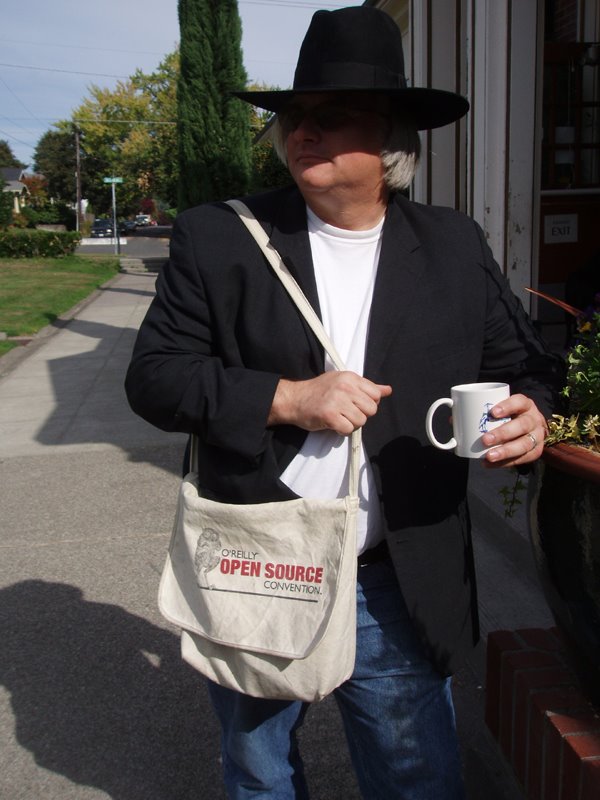 "Quaker model"
 "dog model"
Subscribe to:
Posts (Atom)
