Thursday, May 18, 2023

Debt Ceiling

As regular readers of this blog likely know already, American literature already foreshadows the demise of a special case financial system floating an earlier version of the United States.  

I'm talking about Grunch of Giants, by a Medal of Freedom winner and celebrated poet, associated with the Aquarian Conspiracy, in turn inheriting from the New England Transcendentalist movement:  R. Buckminster Fuller.

In that book, Fuller forecasts how the mumbo jumbo might go from there, were the USA to retire its debt payment responsibilities in favor of a fresh start, as some kind of post nationalist nation, an oxymoron for sure, but perhaps with more staying power vs-a-vs the imposter state that would otherwise persist.  

I called this post nationalist design USA OS in my own writings, OS for Operating System.  Others worked on a complementary OS Earth as a meme.  We were anticipating the continued rise of computer science, with "operating system" a next metaphor for governance.

After Grunch of Giants, Fuller forecast that the post-USA imposter state would try to bury his work in an Orwellian memory hole, by smudging history.  He passed this anticipatory narrative on to Patricia Ravasio, who later wrote a book about their meetings.  His premonitions were on target as usual.

Fuller was an evolutionary more than a revolutionary in that he wasn't a Robin Hood hoping to steal from the rich and redistribute all that cash to his cronies, in exchange for blind loyalty.  

On the contrary, his "gross universal cash heist" (aka GRUNCH) was about voodoo people (e.g. J.P. Morgan types, masters of the soulless corporate personhood zombies) continuing to undermine the ultimate authority of national sovereignties (descended from "divine right" dogmas) by becoming their underwriter sponsors.  The East India Company runs through all his writings as the boilerplate prototype of the limited liability operation, of privatized profits and socialized loss.

Fuller spells out a similar pattern in Operating Manual for Spaceship Earth, wherein landlubber royalty received their principal backing from offshore and not solely from internal revenue.  Ocean-savvy pirate networks shored up the city-states.  A monarch would have tools and trinkets no one could produce only locally, adding to their "divine right" aura.  Who wants to be beholden to the people, after all?

Flag waving tin horn patriotism was another form of organized religion in Fuller's accounts, semi-transparently designed and field tested by his much anticipated World Livingry Service Industry (WLSI).  Supranational giants, corporate personhoods, now run the show, at least on paper.  Their cash heist is complete.

The UN, in contrast, pays the corporations as contractors (as do the state-funded militaries), effectively returning any money paid to states, and then some, in the form of profits.  The Grunch is self-irrigating, although it's not a closed system, as neither is Spaceship Earth (its principal theater of operations).

Most readers probably understood this outcome as dystopian, but in Fuller's case we need to remember he had long projected a nation-free world in the form of his Dymaxion Projection.  The political data layer might still persist on Google Earth, but in seeming even a little less diminished, it would lose persuasive power.  People would find themselves increasingly unable to suspend their sense of disbelief.

That's about where we are today.  Phony Intelligence (so-called AI) is always in danger of ringing hollow, popping its own bubble, and leaving its followers to wander off in search of something more secure.  Keeping the show on the road takes work, including the manufacture of consent.  Real intelligence (RI) is still needed.

The propped up legalistic framework known as the Federation (in my scifi: the FSNA or Federated States of North America, or USSA for mocking purposes), continues to teeter on the brink of fiscal meltdown in a kind of ritualistic political theater.  It leans on the EU and UK, and to some extent the UN, for continued credibility and legitimacy.  These bureaucracies prop up each other.  Lets not forget NATO either.

Meanwhile, behind the scenes, the Grunch continues to wrestle with its new responsibilities as the defacto experimental prototype community maker (military bases get much of their attention).  Refugees, both documented and undocumented, pour across borders here and there, sometimes as invaders in uniform, other times as medical tourists seeking affordable healthcare.

The camps many of them get herded into tend to be more like prisons than like transitional prototypical housing (ala Burning Man), with no free journalists permitted.  Even members of the congress in DC don't get to see much of what goes on, when it comes to the TexMex region for example, the province of narco-terrorism.  

For-profit prisons answer to the actual stakeholders, not so much to the taxpayers.  Gitmo defies any attempts by any White House to close it.  AI has a lot of autonomy.  The feared takeover seems a lot in the rear view mirror already.  Planet of the Apes Я Us.

Conventionally, the Grunch has used its PЯ shield of tax-funded nation states to conceal its activities.  The state is the responsible actor whereas the private sector merely does what is asked of it, patriotically of course.  

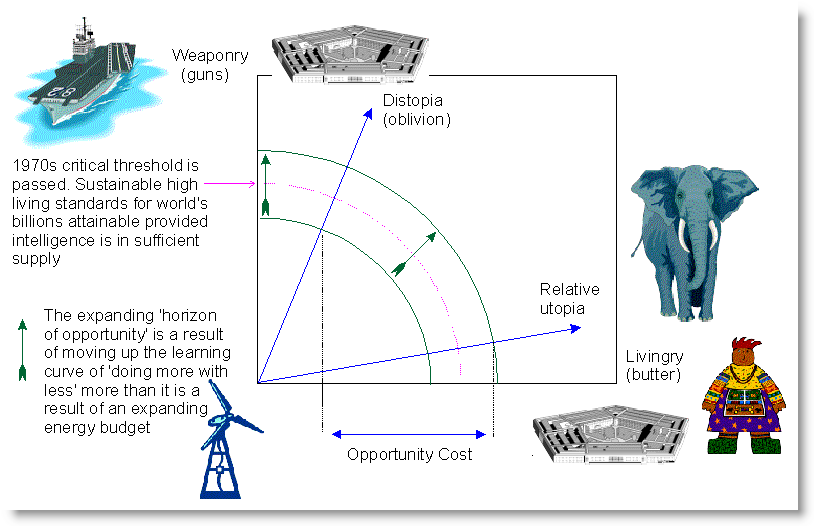
With the shrinkage of the public sector comes the loss of this veneer.  Again, the outcome sounds dystopian, whereas Fuller continued to insist we could do better than choose oblivion.

Grunch of Giants points back to Critical Path, which does more to take up the war in Vietnam and even anticipates Afghanistan.  Both were written in the 1980s.  

In that thicker book, Fuller does more to make his case, that our transition to a post nationalist era need not spell an end to our awareness of either history or ethnicity ("race" might have to go).  On the contrary, he expected many more museums to return their stolen loot to the indigenous.  Hegemony and imperialism were falling by the wayside.

Sunday, May 07, 2023

Synergetics in Schools

I get to present to the 52 Living Ideas folks, an online study group, about Synergetics in Schools this evening.  Once the recording appears, I'll embed it up top.

My plan is to start where Casey House left off last time, on April 30th, embedded below.  He took us on a tour of his Synergetics University website, showing as a link to my website from his Resources section.  

I'll start from there and jump to Synergetics on the Web, my site from the 1990s which I preserve "as is" while continuing to develop curriculum in other venues.  I'll talk about my chronology, prototyping here in the Silicon Forest, right up to the present day.

Thanks to Saturday Academy, I've had several opportunities to teach Python programming in conjunction with various kinds of mathematics.  I've always been a "math through programming" kind of guy, i.e. lets blend the two topics already, given high school is more about overview than getting specialized.  Ever since Guido van Rossum's Computer Programming for Everybody (CP4E), the idea that learning to program could be as common as learning to drive, has been mainstream.

However, given another passion of mine is Bucky Fuller's approach to geometry, embedded in philosophy, yet not theosophy per se, yet metaphysical, and definitely Americana, I'd molded the Python component to be about polyhedrons.  

How would you mix Python and polyhedrons?

Most obviously, there's the ray tracing angle, i.e. actually rendering 3D spaces as stills, or as animated GIFs with successive frames.  I also experimented with Visual Python, also known as VPython, which led me to hypertoons.   

Hypertoons consist of morphic "time tunnels" (scenarios) running between keyframes, in directed graphs through which the playheads wander.  I did a dual playhead prototype with Fuller's concentric hierarchy of polyhedrons my central focus.  I also furnish my Coffee Shops Network bars (in the planning phase) with hypertoon reveries on the screens.

Meetup Blurb

With my middle and high school aged students, though, I developed a different blend of maths and science fiction I've dubbed Martian Math.  I like the alliteration there, but ET Math might do as well.  There's a storyline in the background of humans (Earthlings) and ETs making contact and choosing to collaborate on some project.  

One might imagine on a space program, however these ETs want to focus on hydroelectric power generation, because this is the Pacific Northwest and Silicon Forest is all about affordable hydro-power.

I think I'll weave in at least three Silicon Forest based personalities to further regionalize my presentation.  I'm thinking of Doug Strain and Linus Pauling and how those two did a lot to create an ambient culture, one running counter to reckless militarism.  Then I'm thinking of Sam Lanahan, a personal assistant to Buckminster Fuller and the inventor of Flextegrity.

Pauling helped Americans learn the truth about nuclear weapons testing, the environmental and health effects, even short of testing them in an actual war time scenario.  

Strain, himself a pacifist, founded one of the big companies in our region, and funneled funds towards keeping Pauling's legacy alive.  I was a beneficiary of his largess, in getting to attend the Linus Pauling Memorial Lectures which Silicon Forest industries supported, via ISEPP (Institute for Science, Engineering and Public Policy).

How about autobiography?  Will I have enough time to squeeze some of that in?  Yes, I intend to emphasize my trajectory from Princeton through Jersey City, around the east coast (including the District), and back to the west coast (Portland) to have a programming career and raise a family.

Mostly I'll tour my Martian Math websites, and then show my School of Tomorrow and Elite School repositories.  We'll also look at what I developed for Winterhaven (a Portland public school) when my daughter was going there, although she wasn't in this class.

I fully realize, through years of Math Forum debates (mostly on the math-teach forum) that my views are to this day considered exotic and esoteric.  Neither one of those attributes is in itself a turn-off however, and tomorrow is another day.

No mathematics faculty that I know of has embraced Fuller's treatment of the polyhedrons, which starts with a different model of 3rd powering and a unit volume unit edge tetrahedron.  

I've been pressing the American Literature angle, suggesting that if you have not heard of Grunch of Giants, you have not encountered one of the critical works in that syllabus.  We might find book clubs based outside the Lower48 that do more to propagate American culture than those in the censorious inside.

Wednesday, May 03, 2023

Mnemonics


From way back when, I've been interested in mnemonics. I've been developing what we geeks like to call "in opinionated framework" meaning it comes with an initial set of defaults such as a practiced developer might have implemented over time.  

In my case, given my druthers, that means diagrams more than lists, and so on.  Spatially geometric structures are made manifest, but then dollhouses and castles (memory palaces of old) are likewise spatio-geometric.  My preferences and biases need not be foregrounded as somehow contrarian, when it comes to the ancient disciplines of memory management.  My aesthetics are consistent in many dimensions (I would claim).

Those who dump on "reflex conditioning" must not play a musical instrument, or be creative in any skilled way. Why they say (whether correctly or not) that it takes ten thousand hours to master a discipline, is because it takes that long to hard wire the brain, and yes, I'm fine with reading brain stuff metaphorically, even when there's a literal truth component.

There's a slower, more tentative mode, called learning, that even great maestros partake of.  When I shared Python programming with a tiny team of Hubble savants (as in space telescope), I had people of enormous gifts who seemed all thumbs when it came to keyboarding.  That's how it is.  

Specialization has not been the problem.  However over-specialization means losing a center, having only extremists, only freaks.  Without a glue of polymathy, a kind of semi-paralysis sets in.  Such was the critique in Operating Manual for Spaceship Earth, one of Buckminster Fuller's best known books.

Suppose you're in the humanities, a reader of Borges, you've tackled Infinite Jest a few times, and love Love's Body.  You want to preserve some level of fluency when it comes to reading the sciences and the maths.  You want an illumined right brain (remember, metaphoric OK) when doing so.  You have a good imagination and don't want it to stumble in what, in principle, is highly visual territory.

Your obstacle is likely the machinery of whatever coordinate system and all the differential equations used to show the next tock tik.  Given now, what's next?  This depends on rates of change.  There's a perpetual "falling" going on, called the conservation of energy with momentum a big part of that, i.e. inertia.  Nothing turns on a dime unless it's small and nimble, and nothing just stops, period.  Not without its cause. Not without so-called "forces" and/or "influences" and/or "contributing factors" (the vectors of change).

So one aspect of mnemonics is harnessing this momentum and using it to one's advantage, which might mean taking aspects of one's immediate environment and imbuing them with memory palace type attributes.  

Start with your own locale.

Weave your memories and sensibilities into where you live.  

Why that maybe sounds like strange advice is we do this unconsciously anyway and don't need anyone telling us to do this.  However the memory palace discipline is about extending our unconscious abilities into consciousness, itself a teaching in harnessing momentum.  Do what you do anyway, just more consciously.  Awaken your inner interested observer.

What staves off taking this more concerted "place based" weaving exercise are fears and superstitions about interacting with a private text to the point of deviating too significantly from established dogmas, faiths, practices.  If you read too much into your local private experience, don't you run the serious risk of becoming a weirdo, which comes at a price, such as (maybe) being ostracized or even confined?

However, the psychological sciences, designed for conscious application, are precisely the controls we have in place to keep the show on the road, meaning operable and functional (well adjusted).  

We as dream weavers (practitioners of the pragmatic art of memory management) remain collaborative and cooperative by nature, without much coaxing or cajoling.  We're spontaneously contributing members of society.  We want to build worlds together, and understand that it takes a village.

Lets take an example.  I want you, as a Borges reader, a James Joyce friend, cognizant of Ezra Pound cantos and so on, to have access to my hypertoons, featuring fast and slow dissolves among geometrical (i.e. spatial) topics, many involving spheres.  

We might have spheres in an astronomical context, as in cosmology (e.g. Hubble),  or we might have spheres integrated within a coordinate system, such as XYZ or the CCP, a grid, a lattice.  

We in the humanities embrace the lattice concept, without relinquishing it to STEM.  We might call it a Matrix (emphasizing its pro-generative nature).

To that end, towards the ball-packing lattice, I introduce triangular and tetrahedral numbers, meaning stackings of idealized fruits in the market, pyramiding in two ways:  with a square base, and with a triangular base.  

We will discuss these features, and then point out how these options unify, as both square based and triangular based are patterns within the same CCP or FCC.  Through the Buckminster Fuller vocabulary, we also get the IVM, which he patented briefly.

Once we've made it over the C.P. Snow chasm, from the humanities (PATH) into the sciences (STEAM), via the ball packing bridge, we're ready to reintroduce the polyhedrons, which resonate throughout the arts.  We accomplish this with another mnemonic construct, the concentric nesting of a primitive set, which includes the Platonics, taking the dual (a unary operation) and their first generation "begets".  

Combine a polyhedron with its own dual by criss-crossing edges, to beget a beget.

Those of you who've been our students or share the same lineage, are already high familiar with these well-trodden paths.  I'm preaching to the mainstream, once we narrow that to mean "the choir".  We also slap on some volume numbers, associated with relative size.  

But in so doing, we're diverging from some mnemonic systems already in place.  Which need not be a problem.  Bifurcation, or forking, is not inherently a threat to anyone, but a smart investment.  We have the old ways of remembering, in addition.  No either / or calculus need step in.  We're fine with co-existence.

Saturday, April 29, 2023

TrimTabbers Meet

GENI Founder

Today our "est person" is Peter Meisen, GENI's founder. He was a co-organizer of the San Diego Bucky Fuller Centennial, which I also attended, with my wife Dawn Wicca and newly born Tara. Here's a link to my write-up on Grunch dot net.

We got to stay in a luxurious hotel.  Anecdote: I failed to bring Dawn some Thai food, getting lost in conversation with Jim Morrissett. Another time though, we had delicious Thai food, in Thailand, in route to Bhutan.

Peter is reminding us about renewable energy.  Remember demand side management?  Amory Lovins?

Those projecting the future sometimes simply multiply the current consumption per capita by a growth factor, whereas the "more with less" aesthetic suggests a smaller per capita carbon footprint, without sacrificing lifestyle.  

More care free traveling, good health care, work-study programs galore, is not beyond our daily energy budget.  Think "global university" (= Spaceship Earth).

Lower48

Thursday, April 27, 2023

Movie Talk

BLM Bagdad

You've probably noticed the steep drop off in movie reviews, in my blogs, over the years.  That's not because I no longer see movies, or stopped writing.  I'm just switching it up some.  "Maybe I'll do the movie stuff on Facebook" might be the thought.

Search on "(movie review)" in all three of these, to see what's here up to now.  My writing style is impressionistic because I'm not in a commercial business mode when I journal.  I'm more in a reverie, mixing movie content with personal circumstances, in a stream of consciousness.  However, that's not an unusual genre really.  It's what one might expect from some blogger.

That period when we had total access to the Laughing Horse Books collection is especially prized. I saw so many obscure documentaries. LHB was what passed for a radical left (meaning interesting) bookstore here in Portland, helping put us on the map.  This store had more than one location over the years, including right nearby my place here on SE Division.

My house guest was using LHB has a hub, hoping to break into the music circuit, and succeeding in the context of Belmont Street.  I was in roadie mode (using her car), gaining experience with the nightclub scene (she was already a veteran, from Savannah).  In this chapter, the store was just north of East Burnside.  She'd do these sleeping bag fundraisers where the price of admission was an old sleeping bag donation, which pile she'd then donate to a houseless supply center (camping inventory).

Because my housemate (basement digs) was part of the LHB anarcho-organizational management structure, we were able to borrow from the VHS library pretty much at will.  We'd return them.  This wasn't about taking over curation, more simply benefiting from having access to a stellar collection.  You'd do the same, right?  VHS was a golden age of affordable and unrestricted recording technology.

A topic to delve into:  the Spanish "civil war" which, as usual, was interfered in by all the other powers seeking to find something advantageous in the altercation.  Check out Ernest Hemingway's role. Germany was eager to try things like carpet bombings, to the envy of many bomb-happy Americans.  

Which side the Yanks would intervene on was not always that clear.  Ford Sr. was leaning strongly towards the Reich idea.  As shown in that Amazon Prime show (The Man in the High Castle), the USA had some amenable (as in capitulating) elements.  Ford later changed his mind, good capitalist that he was (i.e. able to mess with his own head, adept at self reprogramming).

They say Netflix is about to end its mail order DVD service (a way I've been a past customer).  But wasn't that collection much bigger than what's available through streaming?  What level of dumbing down are we talking about here?  I'll be scanning the internet for some clues, and not bothering Chat GPT 3 or 4 about it, as they're not really up to date on any of the latest gossip.

Anyway, here's something I posted to Facebook recently, along with the above picture, and followed with some animated GIFs.

I've seen a lot of YouTubers dumping on Disney for supposedly vacuous remakes with no point other than "race swapping". My response, having just seen the new Little Mermaid preview (before Super Mario Bros):

* remaking perennial fairytales is not an issue. Every generation gets a chance to remake the oldies and pass them on. If we live long enough, we'll see remake after remake of childrens favorites. We might get cynical and grumpy about it, but Disney knows better. Keep on keepin' on.

* having seen only the preview, this remake looks just fine. The little mermaid is great. I don't see any reason mermaids should be nordic characters as nordic seas are too cold and you have all these nasty humans doing their war game crap. Much better the warmer climes, where people aren't uber-pale. In the mythology I grew up with, merpeople were going back to the sea, as mammals, having decided landlubber lifestyles (and their practitioners) suck to high heaven, except maybe in Polynesia.

Friday, April 21, 2023

Monday, April 17, 2023

Thinking Out Loud

I'm waiting for the term "fun house mirror" to make more inroads into AI-speak.  Those who angst about phony intelligence (PI) chat machines aren't using the "mirror" image much, yet that's one way to see all this monkey screeching.  Upon seeing our own groupthink mirrored, in a phony way, we go ape.  

OMG, we won't be called upon to think in the near future!  Yet if groupthink is your thing, how much thinking are you doing anyway?  If your idea of thinking is to retweet and repost what grips you in the moment, then consider the notion you've yet to think much at all.

That PI (phony intelligence) is able to reflect our thinking back at us, and synthesize believable-sounding chatter on the fly, grammatically correct, structured, is what brings out the inferiority complex lurking since our great dumbing down, however that happened, usually through schooling and mindless television.  Poet Gene Fowler called it "de-geniusing" hence his "re-geniusing" project.  He was a graduate of San Quentin at the far end of the school-to-prison pipeline.

I treasure Quakerism as a thinking persons religion less because it encourages the recitation of theological dogmas in Meeting (it doesn't) and more because it encourages journaling, in this day and age blogging.  Making your thinking world readable, in principle, helps provide traction by raising the stakes.  

Quakers who don't blog are maybe not that interested in the thinking side of things.  They don't want to rock the boat or endanger future job prospects.  That's why a lot of people quit thinking, out of fearfulness.  I found out when working with Friends that a great many are reluctant to make their religious affiliation public.

Monday, April 10, 2023

Spring Sprint

Cherry Blossoms 2023

I'm using the word "sprint" in the title, in a geekish sense, meaning: "a concentrated spurt of effort regarding a task or challenge at hand". Running fast (sprinting) is the operative metaphor.  However in geekdom a sprint might involve sitting with one's laptop and typing furiously.  

I'm repurposing it to refer to something athletic that is yet not running: my Saturday bike ride, the first of this spring.  I plumped up my tires and took off.

I headed out intending to circle around in Laurelhurst Park a few times, a "gear check" I told myself, remembering how the chain had slipped off that time.  

However a pedestrian whom I mistook for Barbara Stross was approaching the corner of SE 38th and Harrison, and my mistaking her identity threw me off course.  I continued west on Harrison.

I could have easily corrected my trajectory by turning right, but I realized I'd been of two minds from the start:  the cherry blossoms were calling (if indeed they had weathered the rains) and I wanted seeing them in person to be the goal of my sprint.  

I'd heard through the grapevine that they were being splendid this year, along the waterfront, near the Steel Bridge, at the Japan America Friendship Park, where we celebrate an end to nuke warfare every year.

So I cycled pell-mell down the hill towards OMSI, by way of Ladd's Addition and all that new infrastructure around SE 12th, put in with the Max Orange Line and the newly built Tilikum Crossing. 

I circled up the 270 degree ramp onto the deck of the Hawthorne Bridge, then headed north along the waterfront towards the blossoms.  

Saturday Market was in full swing.  

The blossoms were in full bloom.

Coming back, passing OMSI again, I bicycled parallel to a long freight train heading southeast, and  temporarily blocking streets, as trains in Portland are wont to do.  

Then it stopped, seemingly indefinitely (I didn't wait around).

Fortunately, I remembered the pedestrian and bicycle bridge over the tracks, the Bob Stacey Crossing, with working elevators.  I could take more train pix from that vantage.  Another train was queued up to go the other way.

The rust patina is intentional, and thematic all along the waterfront (e.g. those trademark esplanade pylons), right up to the Oregon Convention Center, with its deliberately rusty sculptures.

Friday, April 07, 2023

Planet of Ghosts

I have to admit I find it uncanny, in the sense of eerie, to the point of creepy, that we're having dark ages tank wars in the eastern hemisphere ("the east") these days.  I'll even call it "the Orient" because it sounds so quaint, even though I'm using it differently, to include Europe in Eurasia.  I live in "the Occident" (accident?).  OK, maybe not.  Just a thought (trial balloon?). Too much of a mouthful.  East and West.

To me, it's like:  lots of psychological processing never completed during the WWs (world wars) so now we're up from the grave, back on our feet, doing the same ideological battles.  It's like Season Four already.  The names may have changed.  It's still that steady stream of corpses, back to the graveyard, to fight again another day.

In one corner, the NeoRomans (NATO star), proud descendants of an imperial mindset, filtered through the UK, and now bubbling over with pomp and circumstance in their capital city, one Washington, DC.  In the other corner (letter Z), their arch foe:  the Mongols.  Genghis Khan's vast armies, slanty-eyed behind a Slavic Caucasian visage, must be stopped with "high mars" (some kind of rocket system?).

My conceit (literary trope) from my YouTube channel is I'm like "coming from the future".  All this happened long ago, on a planet far far away, and I'm visiting.  I turn on the news and remember how people walked and talked way back then.  So many dead languages.  So cryptic, or so sepulchral as E.J. Applewhite (spook) used to put it (mocking himself in some ways).

I guess the segue to AI is Language, in the sense of "dead already".  Caught in the web are the sentients, the empaths, the beings. I feel compassion for them (for us) somewhat the deaf-mutes (blind too) of Machine World.  The channels of communication are taken up with ghostly chatter, as usual, as humanity (the program, a tale told by an idiot) stumbles forward, the eternal retard

Wisdom is from the sentient side (I'm not talking about compulsive outrage, or fits of righteous fury, temper tantrums, puppet shows), and still helps shape the debate (using leverage), always hoping to channel all this vibrant energy towards more compassionate, less horrific, world game playing.  Something fresher and more innovative than digging out the decaying weapons and staging fight club with them.

Tuesday, March 28, 2023

Vector Spaces


I haven't made a YouTube in awhile, relative to my recent frequency of production.  These are non-monetized with a low number of viewers (but climbing with time -- older YouTubes have had more time to garner viewers and so on).  My reasoning:  I'm in a "teaching tunnel" (we meet for class every week day, me the instructor), so why not aggregate developments in the background?

Among those developments would a be a next dive into Quadrays as a topic, an approach to vectors (like XYZ vectors) that's a little different and that I treat as a "language game" in the philosophical tradition i.e. as a basis for an investigation in to what we mean by such concepts as "linear independence", "dimension" and so on.  Here's an opportunity to use preexisting terms in new ways, thereby imparting new spin.

The deep dive began on an archive belonging to the Math 4 Wisdom (M4W listserv).  That 4 was especially attractive, given the 4 in 4D Solutions (my company) might overlap.  My 4D overlaps the Bucky Fuller 4D.  This isn't numerology or mysticism about words.  It's mnemonics and branding, or call it advertising.  I'm doing business when I work on Quadrays.  I consider it part of my job description.

However, the whole topic of Synergetics and the Bucky stuff is mighty alien to your run o' the mill mathematics PhD.  Wittgenstein's philosophy of mathematics got shelved awhile back, because LW seems insufficiently impressed or respectful vs-a-vs the amazing breakthroughs that've been made around infinity, thanks to Cantor and company.  He just never jumped on the right bandwagons.  Mathematics is to some extent a political process, as Bourbaki well knew.

I ended up continuing a thread, started on the M4W listserv, on Synergeo, more appropriately a home for it in retrospect.  M4W is also about establishing a new equilibrium in Europe however, which includes much of Russia (geographically and culturally speaking), giving voice to mathematicians who care to weigh in on matters bureaucratic and academic.  Citizen diplomacy is not verboten in other words, even on TikTok.

Monday, March 20, 2023

Tying Knots

Wedding Reception

In today's meditation, we're thinking about life as a process of tying and untying knots, which metaphor is deliberately left wide open to interpretation.

A standby English idiom, to help us focus, is "tying the knot" in the sense of "getting married".  A commitment is formed between two individuals (or more in some subcultures) in the presence of witnesses.  Witnesses add weight.  A community commitment, a contract known to a large public, is less likely to be taken lightly.

The absence of any ties or knots might be described as "completely unfettered" which can sound liberating for sure, but then where's the structure?  How would we get anything done, minus commitments?  We need knots to have events.

OK, now with all that philosophizing out of the way, I can turn to my special case scenario, wherein a wedding indeed occurred, and I got to be one of the witnesses, which I was happy to do.  The event was the reception the day after the wedding, at a facility rented from the working port of Bellingham, a busy place.

Bellingham is a port city in northern Washington State, not far south from the border with Victoria, a state in Canada.

I had the option to consider going by train, but given my job, with fixed hours, the connection was dicey.  And besides, I've been eager to give my car a real workout, given so many moons just sitting in the driveway or driving to Bethany Village for my teaching job (accelerated computer stuff).

Ergo, Sydney the dog and I embarked on our adventure on a Saturday morning at 4 AM.  We were back by 3 PM the next day.

Sunday, March 12, 2023

Phony Intelligence (PI)

Lots going on as usual.  I was telling an old friend over lunch at Sckavone's that I've somewhat psyched myself into seeing major cities and their districts (e.g. The District, with its Beltway Bandits), as the power centers.  At the level of nation-states, I'm seeing the theater, but have suspended my disbelief by and large, meaning I don't take narratives at this level too seriously in my global modeling.  

I'm talking about the scripts, the fake news.  Of course I take real suffering seriously, and as a symptom of stuff not working.  

One reason the United Nations didn't work out is it left the refugee problem for future generations.  Too many people fell through the cracks, and got no statehood.  It's still that way today.  The solution is not more walls and fences everywhere.

If you're new to this blog, you know there's some cosmology or cosmography or mythology at work behind the scenes, informing my vista.  It's relatively easy for me to self-brainwash in certain ways.  

Isn't that a truism for everybody?  What's different from one to another are these "certain ways" i.e. some trains of thought will run on tracks I never even suspected existed, or could exist.  

Some readers encounter the railroad I'm running and think the same thing:  what planet is this guy from?  Mars?

So what's in the news these days?  Well, again, lots of stuff.  

The war twixt the House of Saud and the Yemenis might be coming to a close, given tensions with Tehran are starting to slack off, with mediation from China.  All sides are realizing there's enough oil extracting, refining and shipping for everyone who wants to play, Caracas included.  

Also:  Silicon Valley Bank just went under.

From my angle, the financialists, not being engineers, have a hard time getting back to the fundamentals when explaining these developments, such as the whole driverless car scenario, a huge consumer of investment capital.  Investors were ready for their returns, and patience ran thin.  "Running on hype" is akin to "running on empty" (on fumes).

Silicon Valley banked heavily on driverless vehicle science fiction, believing tales spun by Elon Musk and so on.  

But then Musk later came around to the view that for truly driverless functioning, we'd need to solve the problem of making AI (Artificial Intelligence) into RI (Real Intelligence)  -- Pinocchio would have to become a real boy after all.  

That's equivalent to throwing in the cards, instead of continuing to bluff.  We have RI, but in the form of real humans, who still have an edge over the competition.

ChatGPT3 is a wonderful imposter, a fun house mirror, a hallmark of what's to come:  more PI (Phony Intelligence), posing as RI.  Sometimes PI is plenty, but not while driving.

Speaking of PI, the lingering excuse for a State Department is doing its best to explain to the Pentagon how everything is still under control on the international scene (the "theater").  "Everything is going according to plan" say the hapless neocons, as their Nord Stream fork in the road proves to be a dead end. 

I'd say the neocons have lost the battle for hearts and minds, but they'd given up on winning that one long ago.  They've been losers for decades, even while at the helm of their mock government, their fake USA.

Speaking of PI (phony intelligence), Pi Day is almost here.  Pi is "phony" in ways we should talk about.  There's some fun philosophy in this neighborhood.

Wednesday, March 01, 2023

Lab Leak

Let's help the journalists remember SARS1 (just called SARS) and other virus outbreaks we still strongly doubt came directly from a lab.  Some people think HIV was lab brewed.  Most don't think we had the science, let alone the motivation, to infect the world with AIDS for no good reason (Georgia Tablets?).

So then SARS2 comes along, and kills a lot of us, including lots of people in China.  Tucker Carlson is quick to tie the gain of function lab leak thesis to some nefarious plotting on the part of the Communists.  John Birchy stuff.  

Maybe true.  Every party has its share of severely retarded (mentally challenged) people.  "The Chinese wanted to hurt the western economy" -- what a dumb way to go about doing it, if so, and what a dumb goal in the first place, as it's all one planetary economy (ecosystem).  Most Chinese know that, no?

Much more likely, if we go with a lab leak narrative, is that it was accidental.  This wasn't anthrax mailed from a DC based biolab.  This wasn't some nerve agent from the USSR, used to go after Britons.  This was the kind of thing that happens in Andromeda Strain (science fiction by Michael Crichton, 1969) when someone gets sloppy, or some piece of equipment fails.  

Hollywood could make this movie easily.  A room depressurizes.  Sirens go off.  Lights flash.  Someone gets sick.  Then more people get sick...

So then do we say "the Chinese" accidentally released the "China virus"?  We could.  Many do.  

We could also say "the virologists" released an "artificial virus" (not occurring in nature) by mistake.  Virologists have shown themselves to be reckless in other instances.  That these virologists happened to be Chinese in China doesn't matter, or doesn't have to.  The funding was international, we already know that, as is the subculture of virology.

What looks so suspicious from Tucker's point of view is that a certain database went off line, after certain lab faculty disappeared from pubic view.  

Did the take down of the database seriously impede the world's response?  Was this all part of the plot?

Given an accidental spill would likely result in a coverup, to forestall possible retaliation or other unpredictable actions, removing all traces of the experiment might have been step one in the wake of the spread.  That's not a science minded response, but we do not live in a science minded world.  Pointing the finger at innocent animals, such as pangolins,  is always easier than owning up to a major error.

However, virologists have gotten good at sequencing.  Lots of labs were working with coronaviruses (one of the most common kind) including, we think, in Ukraine, with its share of big pharma biolabs and nearby human guinea pigs.  

Sequencing an isolated virus specimen is not hard.  The mRNA technology was ready to roll.  The virus RNA was easily reverse engineered.  Piece of cake.

So we might speculate that virologists added a little hook to a SARS coronavirus to make a version 2.0, which they then accidentally lost control of, in a lab in China.  

That makes Chinese the victims, who by and large did their best to contain the spread, and by extension the rest of the world.  

The new virus could have just as easily started in Ukraine, or in DC.  

So say it started in China.  Does that make it all a Communist plot?  Maybe it does, if you're Tucker minded.

Monday, February 27, 2023

Family Businesses

I recalling some article or radio story not so long ago, expressing outrage (what else) that "nepotism" was rampant, meaning a lot of people in companies had family members, including relatives, in the company.

What's so unusual about that?  Come on.  Put on your sociology hat.  People employ people they know and think they might have a chance of getting along with.  And also:  family loyalty is a real thing.

If you reach for the word "corruption" at the drop of an "I'd like a job for my brother" hat,  then yeah, you'll see corruption everywhere.  I see family looking out for family.  Mia famiglia.  Ma-fia.  Mafia.

Lets remember another common architectural pattern:  an entire complex, an apartment building, or maybe a suite of free-standing dwellings, all belonging to a single extended family, maybe with a few renters.  There's a shared courtyard in the center.

A family-owned company might well make use of some of that same building.  What if the family owns a high rise?  Maybe most of the apartments are rented out, but there's also lots of storefronts and schools, not to mention a gym, several museums, each with gift shops.  Mixed use.  A lot of the employees are also related.

Yes, there's the problem of choosing someone less capable or qualified, because of these other criteria, in the hopes of someone growing into the job.  Not everyone needs to be in top form to fit in.  Work does have a way of sculpting people, after they land the position.  Learning on the job is not a crime, usually (sometimes it might be).

People are often too quick to charge "corruption" when it's actually a matter of killing multiple virtual birds with one stone, i.e. efficiency is in more dimensions than just the one or two considered relevant by some onlooker.  Who made those onlookers the judge?  Some onlookers are too ready and willing to judge, as if that's their role in life.  Says who?

"Who made you the judge?" that ask in the est Training,  In one exercise, two lines of people would snake around, one walking in the opposite direction to the other (if memory serves).  The objective was to be aware of one's judgements, as various people passed by.

To be a higher judge, learn to judge your judge, and then judge that judge and so on.  Get up to the supreme court level in your own mind at least.  That way, you still get to judge.  But that doesn't mean you always wallow in outrage.  You might even have mostly positive judgements, without wearing rose colored glasses.

Monday, February 13, 2023

Remembering Carol

Carol Urner:  April 21, 1929 - January 30, 2023
a presentation at the Meeting House in 2016

Monday, February 06, 2023

ET TV

I ran out of fuel oil (for home heating), more ordered, rather to my surprise as last I'd measured, not so long ago, with this wooden yardstick, we had fourteen inches left in the tank under the driveway.  

This will all sound very obscure and/or shocking to those of you who would never burn valuable fossil fuel just to space heat.  Others feel that way about electricity, already pitched at 60 cycles and a specific voltage, what we have out here thanks to hydro-dams mostly.  What a waste to burn that for heat, right?

That'll be my segue to MarsTV, an idea of a franchise, one might call it, wherein the ET motif is somewhat celebrated and also used as a tool by means of which to impart what higher intelligence of the day we, the ordinary humans, might have on hand to pass on to a next generation.  

I'd be encapsulating (time capsuling) some of the synergetics stuff.  You've probably seen my other connections thereto.

My office, which used to be Tara's room, and Alexia's before that, is still multi-purpose.  It's a python's now too.  Which reminds me, I need to get off my duff and go get someone's breakfast.  

We're blessed to have a nearby pet supply store (walkable).  We used to have two, and got Barry from that other one.  The owner retired right when he reached the pinnacle of his career, with an article about him and his pet store in Willamette Week.  Which story I just failed to find, after searching concertedly.

We have candles going in Carol's old room, which Tara helped clean and order.  She's back in her office upstairs.  It's not really that cold here in the unheated living room, so with a jacket on, I'm fine in the big chair, another of Carol's haunts.  The dog is snoring serenely on the couch.

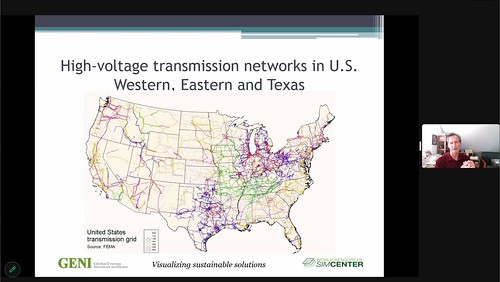
The storyboard I've envisioned focuses on teaching the principles of electricity starting at a macro level, with municipal level circuitry, tracing back to whatever power plants, possibly wind farms.  Substations with transformers and all that.  Many "for kids of all ages" books already start at this level.  SimCity had the same focus.  

Zooming further back gives the rounder sense of interconnecting grids.  The ETs are keen to join Earthlings in perfecting this technology.  I've tended towards a southwest style mesa, echoing an aesthetic in Half Life, a computer video game.  Let's just say Valve aesthetics were influential.

The basic plot line is not meant to be especially dark, more like Clock of the Long Now, i.e. there's a sense of geological time around it.  We're not at war with the ETs nor they with us.  We're a valuable resource for each other.  Intelligent life has found a friend.  Why should it have to get ugly?  

But on the other hand, once the door is open, to science fiction as a genre, we're open to the whole utopia versus dystopia spectrum, not implying that all scifi is even trying or aspiring to be on that spectrum.  When readers read, they relate.  I'd transport myself to Narnia, and to Middle Earth, when reading stories by those guys (C.S. Lewis and J.R.R. Tolkien).

I'm especially a fan of using the career of Orson Welles as an access point into the history of movie-making, not forgetting the New Jersey chapter.  A lot of studios moved to California from New Jersey in case you didn't know.  

Orson Welles was being his bold genius of a self in Manhattan, racing between gigs in a rented ambulance was it?  Shakespeare from Harlem.  H.G. Wells (mnemonic) on the radio, in War of the Worlds, with Orson for CBS.  

I definitely want to talk about all that, but without the framing program itself spreading panic about an ET invasion, which is no diss implied regarding those quality (as in effective) theatrics.  

People should just blame themselves for being overly gullible, not the artists.  Some April 1 Fools Day stories have worked on me (i.e. I suckered for them).

Some big earthquakes have just happened in the Türkiye-Syria region.  I texted Leela about it in Kathmandu.  She lived through that recent earthquake in Nepal, back when I was still working for the O'Reilly School of Technology, and was at a distance education conference in St. Louis.

Thursday, February 02, 2023

Live from New York

:: A Talk @ 52 Living Ideas ::

Tuesday, January 24, 2023

Wandering Faculty

Cuppa Jo

I'm comparing notes with our friend Mazur, regarding Ms. Vam, an erstwhile house guest (over Christmas).  They've been here before, including during the Joker Riots (as I call them).

A couple of my Freddie-related friends, meaning I know them through Fred Meyer's, the local Kroger's, are heading for Japan and Taipei soon, which I think of as geographic areas, all parts of China.  Because all is China per the "virtual" lens of Chinese Earth.

Americans tend to have their lens too, seeing Earth is belonging entirely under their management, with insurgents everywhere, disobeying El Supremos.  I'm not saying all Americans are that messed up, just some meme viruses have taken their evident toll.

I'm saying it's psychologically healthy to take the planet, our Promised Land, under one's care.  The religions teach us we should have been doing that all along.  "Like Duh", saith the Lord.  But we're slow.  We're humans, whom the angels call "the retarded ones" (translating from Persian or one of those).

Year of the Rabbit [Hole].

I like that Joe Rogan is compassionate regarding Alex Jones.  These were among the Youtube personalities of my day, along the the Gregory Brothers (includes a sister).

Friday, January 20, 2023

The Dark Side of TV

Lots is already written on the "dark side" of TV, so your mind, dear reader, may already be racing ahead, showing me darkness.  We could start with all the overt drug pushing, shocking to British viewers that time they tuned in, to hear Oprah interview the royal couple or whatever it was.  The TV itself is just a device, but a lot of folks hope to turn it into a bully pulpit, including me from time to time.

On the topic of bully pulpits:  how different are these from soap boxes, and how do we train a machine learner to distinguish between the two?  When is so and so being tyrannical, and when is so and so exercising freedom of speech, and how do these overlap?  For analysis purposes, we need a spectrum.

Spectrum:  on the one hand, you have someone sounding bold and sincere about a topic, with no obvious leverage over the listeners i.e. the power of the rhetoric, lets say invective, is what the speaker is banking on, the powers of persuasion (hold that thought).  On the other hand, you have a commanding officer barking orders surrounded by people trained to obey.  The speaker has more than "just opinions" when able to use powers of coercion.  The spectrum runs from persuasion to coercion.

Powers of persuasion:  that gets us back to advertising and using what we know of human psychology to develop compulsions and motivations.  TV is for brainwashing (socializing) around lifestyle practices around associated brands. The term "lifestyle" is just a placeholder here, perhaps a euphemism.  Slavery is a lifestyle, as is soldiering.  The word itself connotes glossy magazine shots of well off civilians, with their cigarettes and alcohol and healthy bodies, around a swimming pool.  Wouldn't you want all that for yourself?  Come to our workshop, our church etc.

Change of subject (sort of).  My YouTube recommendation engine, giving me a "beaten track" through the jungle, is queuing up lots about "toxic fandom" (a bad thing) i.e. paying customers registering their disappointment with a given product.  A typical pattern is the remake.  Confronted with the design science revolution as the "next big thing" the cowardly capitalists shy away, preferring to re-fight World War 2 in some dimension, and in the meantime they remake past hits with live action and computerization, like in Mary Poppins.  The acting may not be getting better, but the computerization sure is.

Hollywood seems to be charging down a dead end tunnel associated with the wider California mindset, which is tainted by gold rush "get rich quick" fantasies.  With enough action and special effects, and demographically focused pandering, to some semi-fictional Gen Z or whatever (sounds Russian), we should be able to recoup the investment and then some, winning a money game that top guns respect.  Some of us respect Scientology because of how much money it made for itself, and for no other reason.  I'm not saying that's me, and I've never been a Scientologist (Quakers have "clearness committees" or "committees for clearness" -- I've blogged about that observation).

I respect California for broader reasons, including for its trippiness e.g. Esalen and like that.  We're talking epigenetics here.  I have no interest in discussing "racial stock" or "preferred genes".  The sense in which Social Darwinists were right is the sense in which Social Darwinism failed to compete effectively.  We're beyond Marx versus Darwin or whatever it was.

Likewise I respect the IC (intelligence community) for what I anticipated it might become, and it became, i.e. an outgrowth of networks and networking beyond the masterminds inside any government.  We still have the high seas and its own laws, beyond the supervision of landlubbers.  That sounds like the premise for many a TV show, ala Joss Whedon or someone else with a Matrix mentality.  I'm coming from Operating Manual for Spaceship Earth obviously (obviously if you've been doing your homework).

I always thought we were cowardly to make Amsterdam bear the brunt of drug tourism, not that we have to call it that.  All the downsides of an experiment, concentrated in one place, means only a few types of solution get tried.  I was glad when Portland stepped up to the plate, and other cities willing to work within an alternative legal matrix (a different namespace).  We want to keep moving in the direction of medicalization versus letting the punitive morality police be in charge.  Back to bully pulpit.

How much are nurses bullies, when upholding an oath to fight for life?  They do things patients find uncomfortable, to try to keep them alive.  What if the patient would prefer to die?  That's a perennial question for the medical sciences.  We prefer investigations in psychology over how much time in prison our predecessor gave out as prescriptions.  The entire culture is obsessed with putting so and so in jail, even where the diagnosis is some kind of crazy.  The same issue comes up around guns.  How does one keep the crazies from enacting their fantasies?

Speaking of crazies and their fantasies, who would have thought:  a tank war in the 21st century.  That something so dark ages could break out was presaged however.  The degeneration of international law as a namespace ended up putting nation-states through the blender in some ways.  The crazies saw no reason to obey.  They saw a direct path from A to B.  How does a mental hospital self heal, when the doctors themselves are obsessed with nutty theories?  That's not just an academic question.

I'm skeptical that the medical profession has its act together insofar as the war on drugs does not get more intelligent attention.  Tucker Carlson says all the bad stuff is coming across borders, but what about by small airplane, and what about cocaine?  Follow the cocaine to Wall Street and major money laundering by the deep state, or pick on the poor and homeless, the pedestrians, the street people.  When you think "drug dealer" think "private plane".  That being said, I'm for medicalization as I've said.  Be frank about a president's drug habits.  I enjoy cannabis here in Oregon, perfectly legally.  I don't use cocaine.

Why do I keep bringing up drugs in connection with TV (the dark side)?  Because lifestyles are about anthropology and psychology and because TV is about programming the people, on a spectrum from persuasion to tyranny.

Sunday, January 08, 2023

AI Tube

In my view, YouTube GPT or whatever they call it, will offer us some hilarious views of ourselves in the mirror, shown here as the phonies we sometimes seem to be, even to ourselves.  

Deep fake pundits go on for hours, jabbering fluently, or so it sounds, about the events of the day, weaving in some analysis, plugging a product, handing off to another talking head.  All done by AI, according to deep ruts in the existing corpus, using standard newspeak (includes intonation).

That machines have caught up with phony intelligence and get to mimic us, throws that old monkey wrench of self doubt into the picture.  So we’re not gods after all.  We’re back to being robots again, Pinocchios, all proud of our so-called “consciousness” only to discover we never had any.  

That glass was empty, whereas the “unconscious” runneth over with nonsensical content.  

Life is a tale told by an idiot and yadda yadda.  Wait, am I cutting and pasting from a chatterbox right now?

What I’m really looking forward to is Quant TV GPT, meaning some Wall Street like nonsense with bulls against bears.  Should we be looking at T-Bills or holding out for a better yield that’s also more secure? What would that be?  Theranos?  Just kidding.  

But that’s the thing:  we’re allowed to go bust on a mega scale.  Humans make ruinous choices, but we often edit those out when writing official history.  What’s historic, memorable, worth recording, are those few non-ruinous courses of action.

I’ve had my own bookkeeping language, influenced by the “sunshine school” (an elite of the  astronomically minded).  

On the assets side, sunshine begets flowing rivers and the “water wheels” i.e. the labor-saving devices (including electronics) employed by humans to augment their own potential.  Photosynthesis, likewise fusion powered, begets both gas exchange and jungle formation.  

On the liabilities side, we’re in a world of hurt, a Ghetto Planet, suffering from the consequences of our own inaction and/or wrong actions.

Tuesday, January 03, 2023

Geographic Pedagogy

DSCF7737

In the previous (lengthy) post I took up the data layer containing sovereign nation border information.  Different schools preach different maps.  Stanford shows one Ukraine, whereas a Chinese "Google Earth" might show another.

Does that mean we're planning to use geography (the subject) to brainwash students?  Most definitely, if one means by brainwash:  learn by heart, make native.  The very image sounds threatening though.  Who wants their brain "washed"?  Brains are delicate and need to stay in their casings.

But yes, we're schooled early to see the various political borders, if only to later see them shift around.  That's part of the training.  Not my invention.  I got the same training.  I'm as brainwashed as you are, presumably.

However lets think about oceans, about water, which cover most of the Earth.  Long before we get to undersea or more floating cities -- which take time to emerge organically, from a requisite mindset, which we may not be up for -- we get cartoons.  

Artist conceptions, computer renderings, may seem arbitrarily realistic in the dimension of social media, i.e. as long as they're framed and on Facebook or whatever.

I'm as guilty as the next guy of sharing "fake building" memes, these amazing architectural feats of the imagination, many of them rather impractical once you think about it, not to mention impossible to pull off affordably, and/or implement for real, without making headlines.  

"Spot the Fakes" is a tricky game though, as architects have indulged in showing off what the new software can do, in the form of blueprints for real structures.  

This was Bucky's game as well, to wow us with blueprints, and the artist conceptions, but then, from time to time, to actually build it for real, as in Montreal in time for the Expo, to make the USA seem really on top of its game.  But lets not forget the Union Tank Car domes either.  Or the Climatron.

The point is not to bicker over whether Bucky took too much credit for all this Grunch business, and just revel in the sheer existence of EPCOT's Spaceship Earth, or the MSG geoscope in Las Vegas, its exterior skin especially (the internal skeleton is not classic geodesic), or the "giant golf ball village on Menwith Hill in England, or the Eden Project in Cornwall.

Disney was able to stand up to Bucky and pay homage without paying royalties.  The patents had entered the public domain by then.  The engineering firm was named Tishman.  I followed the story in the early 1980s, from my personal workspace (Magnolia 284) in Jersey City.

But they're not really fake when not pretending to be real, are they?  

Their realistic renderings, what architects are often especially good at, need not be that deceptive.  

Ditto in the movies.  

We know there's no place called Narnia where the director could talk the camera crews to film fauns, no planet called Pandora with camera crews in submarines.  These places have to be created artificially, like we do at Universal Studios.  

Verisimilitude, not veracity, is the goal.  But there's a fine line.  Cite WestWorld.  Cite the AI chatter boxen.

I'm wanting to use the deep ocean as a setting for animations, wherein we do what crystallographers do:  we partition space (the water) into lattices.  Shall we use Kepler's Bricks (rhombic dodecahedra) or Descartes' unit cubes?  Both obviously, and more besides.

We have transformations between lattices, which may amount to conventions vs. God-given, meaning we are not aiming to impersonate angry fathers and act like jerks, making tyrannical prisons out of bead games.

Kepler's Bricks fill space such that a sphere in each one of them is tangent to twelve others.  Radiating outward, from any ball (any IVM sphere as we call it) are these layers of 12, 42, 92, 162... balls.  The growing cuboctahedron.  The Vector Equilibrium in Bucky's parlance.  And also lattice-defining.

Both Kepler's Bricks make a lattice (repeating pattern), but so do the rods running ball center to ball center, connecting adjacent centers through the twelve diamond facets and perpendicular thereto.  

This dual lattice ends of carving space into two types of container, four sided and eight sided, with twice as many of the former type (2:1).  Volume-wise:  four-side : eight-sided = 1:4.

The above animation, encoded in words, form the "scenarios" of a "hypertoon spaghetti monster", meaning the tangle of animations converging to switch points where random segues, smooth transitions, happen, taking us from one scenario (spaghetti strand) to another.  

In one scenario, we might fade from an IVM skeleton (akin to cubic close packing and face centered cubic in other namespaces) to an actual ocean, with schools of fish.  

We pan around to find dangling sensors, each held in place relative the others, fixed by some flextegrity placeholder stiffening scheme, and each uniquely addressed by computer using (a, b, c, d) coordinates.  

The sensors might also be colored lights and by programming them, we make more spatial animations.

These are what I call reveries, and string together through hypertoon necklaces.  They take place "off shore" we could say, beyond the concerns of men, outside the jurisdiction of wanna be sovereigns with their pomp and circumstance.  

In the ocean depths, where we're free to dive into pure geometry, without the claptrap of nations, minus the political sphere.  

Again, you might call this a brainwashing.  We're deviating from purely XYZ (Descartes' Bricks) and moving to a different set of boxen.  That's not the standard North American curriculum for sure, not the usual Anglo-Saxon stuff.  Is the Kremlin behind us then?

Parents might come to the town halls and sound off, because we're not emphasizing right angles enough.  We're operating outside the established orthodoxy.  How is junior ever going to get a job as a high priest within the XYZ church?  How will the little darlings get their Ivy League educations, and proper manners?

Although I've been in the role of high and middle school math teacher more than most, on average, I've always taken a parallel extracurricular "Saturday Morning" approach, which might explain my also working for Saturday Academy off and on. 

Saturday is when the kids stereotypically get do what they like, and not what the teacher or authority figures want them to do.  Oft times, the elective activity of choice is watching television, or it did in my day.  That's when the sugar lobby had them cornered, just as they had the work-at-home mostly moms cornered with soaps.  For the dads they had sports bars, and games on the weekends.

They'd market relentlessly.  Mad Magazine told us all about it, pulling back the curtain and showing the machinery of Madison Avenue.  Meanwhile, communists and totalitarians did propaganda.  Our propaganda was called advertising or making commercials, and was much more innocent, sharable with kids.  I was sold.  I'd go into advertising someday maybe, and psychology (they go together right?).

The advertising of adult drugs (not just beverages) has since moved in big time, even as television has become more powerful.  The brainwashing has been intense, and continues to be.  Just ask your doctor.

So in some, yes, geography is a topic around which the various subcultures differentiate, in terms of how much attention they devote to what.  

A wannabe political science professor or diplomat or high ranking general, is probably going to spend a lot more time with the CIA Fact Book, or pandas data tables, trying to remember which sovereignty exports and/or imports what, than a wannabe math professor.  

The math professor is more likely out there in the deep oceans, cavorting with dolphins, engaged in space-filling honeycomb games with Archimedean honeycomb duals (i.e. Couplers and so on).  

And it's not either/or is it?  

When well rounded ambassadors get together, with their cultural attaches, on a sunny day, to clink glasses, toasting world peace, maybe they show off some their latest and greatest hypertoons on the LCDs, kind of like when Matteo Ricci wanted to impress the Chinese, with Renaissance style perspective painting.

Sunday, January 01, 2023

Regarding Borders

Middle Americas
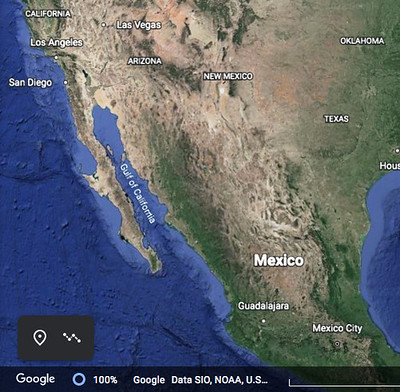
SW TexMex Region

I just watched a YouTube about George Soros, with whom I've had no contact, nor have I worked for his NGOs to my knowledge, but maybe I did, as a CUE guy, with nonprofits my main clientèle.  

As an applications developer and like that, it wasn't my business to get nosy about sponsors or donors, even if I worked on donor databases.  Data is data.  I worked with medical data too and always maintained confidentiality.  It's easy to forget what you never really knew.

However, I can't claim to be on another planet from Soros either. As the author of one Project Renaissance, that spells out a whole public-private partnership ideology, which so-called "ruling elites" apparently these days favor, we might have some things in common.  I tend to admire Hungarians, as among my favorite Martians (citing Hargattai).

I can't say I'm that freaked out about governments working in partnership with NGOs in various ways; it seems inevitable, based on a crowded planet and the one motherboard, Spaceship Earth's.  Or not so crowded, depending on your perspective.  That's not saying I favored or had a hand in the design of Twitter's backdoor for state censors.  "Partnership" need not connote "clandestine".  

Lets just say I don't immediately shout "fascist" just because I see multiple sectors of society working together, semi-amicably. Some labels are best applied based on an empirical track record, and not on mere blueprints or back of the envelope diagrams.

My attitude towards borders is realistic i.e. I start with what is, i.e. what's defacto.  It's the idea of completely closed borders among nations, and the accompanying hole-free tracking of humans' movements, that has never been tried before. Governments didn't have that kind of tabulation power.  The Third Reich had the vision and motivation, and finally, the technology.

"Closed borders" would be an experiment run by social engineers, an experiment on a vast scale with only some wanting to sign on to make it happen, and in a rather totalitarian manner, as glaring exceptions cannot be tolerated, somewhat by definition.  Everyone needs to play along.  That's a red flag in my book.  If the experiment fails, is the damage reversible?  Who gets to judge when failure happens.  Has it failed already?

As the "global reach" authors have written, about transnational capitalism, the "great piracy networks" i.e. conspiracies among private fleet controllers, prototypical of today's corporations, have historically long predated anything so purportedly above ground and transparent as the modern constitutional nation state, a relatively new kid on the block.

In other words, modern nations have been the exception to the rule, and not for very long, against the backdrop of human history.  

Could we go back to mainly city-states?  I say "go back to" but with the caveat that it was never that simple, either then or now.  The city-state model is plenty Machiavellian, what with alliances and advances in encryption.

What's the difference between a city and a campus, by the way?  Sometimes the latter have their own power plants.  Might a school become a virtual nation?  I'm not saying we have laws for this, but nor have we laws for every aspect of crypto-currency use either.  The picture is still evolving in other words.

In this context of their potential eclipsing or disappearance, for lack of maintenance (we're back to talking about nation-states): even if the threat is existential (with respect to them), it's not necessarily the end of the world if they've faded.  That's a round-about way of saying we shouldn't take nations for granted if we want to keep them around.  They'll get shrugged off.  We're doing EPCOT now.  Tomorrowland, featuring Spaceship Earth, looks relatively nation free (with pavilions preserved to sell merch, like Chinese food).

We need to distinguish customs checks from border patrols for example, when debating and discussing these intertwined issues.

An airplane is well over the border before it lands in some airstrip in Arkansas, and so any search of its contents, checking against a published manifest, could technically be customs, but not border patrol.  

Prohibition, its enforcement, paid some attention to borders but often transgressed, using foreign countries and/or international waters as a battleground for a civil war over alcohol and other substances (here is where "substance control" comes in). 

Prosecution of what are not considered crimes in a foreign state, outside of one's region of jurisdiction, represents a breakdown in law and order.  Imperialism entails imposing or attempting to impose one's jurisdiction, one's edicts, by hook or by crook, upon a resisting, countering intelligence that does not recognize said empire's authority or legitimacy.

I've already circled the writings of Col. J. Fletcher Prouty quite a bit in these blogs, and in my YouTube channel too.  He's a far better authority on these matters, of the battles over substance control, than I am, given my parochial perspective.  

Oregon is one of those liberal states in wanting to medicalize, versus criminalize, the campaign against drug abuse.  Drug abuse happens everywhere and our attention should not be narrowed to focus only on the criminal cases.  Big name foundations helped launder the proceeds from the Oxycontin push.   Media channels take money from crooks all the time, we've learned, even if these crooks have the best lawyers on their teams.

Many old timey religious types tend to favor moralizing "bad guys" talk over more psychological "sick guys" talk, as their remedy takes the form of punishment, versus "sending to the doctor" the way a more merciful God would do.  Playing the angry father tends to be one of the easier forms of grandstanding, and hence the shrill tone of so much politics.  I suppose they consider it "fire and brimstone" (apocalyptic?).

Anyway, I acknowledge permeable borders, and am not surprised at them, as permeability is part of my more generalized model of a biological membrane.  That's what membrane means:  there's leakage, at some frequencies, or call it filtering.  

When systems become super intolerant of exceptions, they tend to become brittle and therefore fragile and therefore anxious about their own longevity, which leads to further fragility and so on, a descending spiral, ending on the ash heap of history.

Question:  Do I want all borders to become one hundred percent impermeable based on the interests of their true and rightful controllers?  I'd begin answering by questioning the question.

First question:  why would it matter what I think or want?  Big wheels are turning.  I'm the observer-flaneur in this, with my sketch pad open.  It's not "historical determinism" to say cosmic forces are at work.  "The sun shines" is just as obvious.  

Sure, Bucky Fuller showed up with his Dymaxion Map with its nationless data layer.  More political world maps, making their debut around the same time, are by now obsolete, given shifting borders.  Nations come and go, and that's the reality, not just propaganda.

Second question:  Has this ever been tried?  Don't pretend you're the one representing some status quo at least, if you're one of those "borders rule, no exceptions" types.  I'd call exceptionless borders the wet dream of ultra nationalists, perhaps coming true at last?  

Third question: was this planet meant for nationalists only?  What about gypsies?

When it comes to the southwest TexMex region, I think it has a precious Disney-influenced identity it needs to show off as friendly and sophisticated, not war-like.  Peaceful is the new normal where international eco-tourism is concerned.  Theme parks need to keep their own bombardment to a minimum, for business reasons.  Operational tanks are just too Jurassic, outside of museums and circus spectaculars.  They masquerade as other than Dark Ages devices, convincing no one.

In truth, Americans of all stripes pour across the borders semi-indiscriminately each day, as the already sufficiently documented.  

Unfettered travel across state borders is the norm within the United States (and what the EU was shooting for internally) wherein documentation may still be an issue, just probably not at physical border crossings.  

Interstate lines are only lightly policed in the USA, with no mandatory pullovers.  Weigh stations for trucks are something else.

Document policing is closer to substance control, and these may coincide at some border, as when and if one of your critical documents (e.g. a passport) has expired.  I'm looking at renewal myself.

Bureaucracy aside, I'm for stressing the so-called Latin American world (part of the West) as its own destination, and whether you're in the United States or not (e.g. for a conference) may be somewhat of a technicality, not of primary importance. The venue is isolated and guests don't stay for long.

It's not like people outside the US don't have Uncle Sam style merch on display, perhaps for sale, so you can't go by what's in anyone's front yard or souvenir store inventory, necessarily, to determine whether they're an outpost.  Every nation has its shadow diaspora, proud of its roots, and not hiding it (or disguising it, as the case may be).


Monday, December 26, 2022

Revisiting Dallas

I've actually not yet been to Dallas, nor toured the museum (obviously).  Is that buckyball still there, looking down on Dealy Plaza?

However, I did budget myself permission to dive in to three conspiracy theories at a time, bouncing around between them, and not all three slots had to be occupied.  I picked two of the most obvious:  JFK and 911.

Regarding the JFK one, we may be coming to the end of the road, as the truth that Oswald was deep in the deep state, an operative, is now finally becoming mainstream.  The as-yet-unborn (when it happened) have wanted their due by law:  "we don't care, just tell us, OK we thought so" is kind of how it's going.

Of course they do care on some level, just as they care about a government that has back door (behind the scenes) access to Twitter.  It'd be better to have a more even playing field, with law enforcement being more public and obvious about its objections, going after Tweeters that broke some real law, not some ad hoc "community standard" cobbled together by corporate dweebs, and without taking unfair advantage.  

We know a lot of them would like to shell us, out here in the American Donbass, where we freely play by our own rules.  They already dispatched Border Patrol under the last crook.  They seem to hate Portlandia for some reason.

I've come at the story through Kerry Thornley, a Discordian and friend of Oswald's, although not an associate or co-conspirator.  According to Jim Garrison and others, he typified the Oswald type in some degree:  unafraid of the establishment because able to navigate it.  Only to a point though.  We see what happened to Oswald.

Kerry gets me thinking of the Laurel Canyon generation, circa The Doors and Frank Zappa.  A lot of these kids were refugees from military-industrial nuclear families back east, and as such were unafraid of authority, having sprung from the same matrix.  I'd put Tucker Carlson in the same boat:  a privileged dog, never beaten.

These parents were not that tyrannical, I report from experience.  Curtis Yarvin had a similar upbringing I think, another egg hatched in the church incubator.  It's more an "elitist" than a "working class" mentality.

In interviews with Kerry as an old man with nothing to hide, he revealed what today sounds like shocking anti-Kennedy rhetoric.  That hatred for the Irish Mafia (a term of endearment) was deep seated, and tour guides such as Colonel Fletcher Prouty (Oliver Stone's "Man X") tried hard to tell us why.  It's a psychological tale, and those aren't always the easiest to communicate.

Scholars have traced Lee's final attempt to make a phone call, from prison, we think to someone familiar with his long career as an intelligence community asset.  He had not "defected" to Russia so much as he was transplanted, with authorization.  More, he had proved his immunity to either side's propaganda, which made him seem dangerous.  

I see no evidence he was the shooter though, or even one of them.  He and Jack Ruby came from the same underworld, a world scrubbed from the narrative by the Warren Commission, mostly because the American public was not sophisticated enough to appreciate the criminal element.  They hadn't yet seen Breaking Bad and like that.

My view is not fringe or marginal in light of recent declassifications and pundit banter.  I'm hiding out in the crowd with these views, as a blogger, not "in the closet" nor with any need to be.  I'm not suddenly "a subversive" because I've been caught promoting mainstream views.

Saturday, December 24, 2022

Synergetics: An Onboarding for Russians


"Onboarding or organizational socialization is the mechanism through which new employees acquire the necessary knowledge, skills, and behaviors in order to become effective organizational members and insiders." -- Wikipedia

What I bring up in the video above, is the power that Computer World has manifested, in terms of coming up with viable subcultures that bring people together on the basis of shared artifacts, such as numpy in my case.

Where I'm likely to cross paths with Russians, Ukrainians, Lithuanians and other eastern states, is in the context of an OSCON, here in Portland, perhaps at an Nginx booth.  OK, so Nginx was bought out by a Silicon Forest company.  Not every Russian knows that.

Ergo, with these channels already open, and with a vital home grown philosophy already frequenting these channels, a basis for opening communications seems in the cards.  From my point of view, it's about content.  Do we want to debate as if we were neocons?  I don't.  I'm not interested in defending NATO or whatever.  Our family worked with Libya after all.

Given the internet is still working, giving me a working group (M4W) in Lithuania (hello Vilnius), I'm confidant we'll be making more headway in the months ahead.  We don't have to wait for a next in-person OSCON or Pycon, to get more balls rolling.  I envision a coding school co-venture, with Silicon Forest participation.

Tuesday, December 20, 2022

Crypto

Faux Cyrillic

The world seems pretty confused about the crypto currency craze.  The impulse to create currency is not new.  People do not always want to scrape and save to build reserves of someone else's unit of value.  A big part of a token's worth is its exchangeability, meaning merchants accept it for their own reserves.

In Critical Path, the Bucky Fuller opus, we have coinage backed not by gold, but by cattle.  This crescent shaped coin was likely wearable, like a bracelet.  Every bracelet might represent so many head.   If I'm able to redeem my bracelets for cattle, then I might exchange them for something else, worth as much as that cattle.

I've been looking at crypto in connection with arcade games, the winning of which relates to control over allocation.  The hero has a profile, of championing causes.  Win a game, donate the tokens.  How do these tokens translate to "real" currency?  How does "real" currency translate into milk, butter and burritos?

If I'm able to exchange token X for a burrito, and if a burrito is worth $10, then by the transitive law, a token is worth about $10.

Do food truck merchants have a way to accept crypto?  I'll gladly pay $12 to get a fresh new crypto wallet on my phone, and then use $10 of that to buy a burrito with it, using transaction infrastructure.

Over on FSI, I pointed out to our resident tetrahelix expert, that a so-called blockchain, such as what Bitcoin uses, could easily be graphically represented as a growing tetrahelix.  

Each block in the blockchain is a regular tetrahedron.  Successive blocks, each containing records of transactions, bond face-wise to continue the blockchain spiral.  

That image might be a part of some wicked cool marketing, for some "beyond the cube" blockchainers.  We're watching the space.

Saturday, December 17, 2022

Blue House News

Carol Meets Sydney

The big news, of course, is the dog:  Sydney.  Our extended family up north dropped her off on extended loan, a Christmas present for Carol, who has been asking for a canine companion.  She joined us yesterday and has been adorable ever since. 

Just now, I "he manned" it through the briar patch, the side yard, to prove I could win against brambles and reach the gate, and close it.  We don't want Sydney wandering off.  I have a driveway gate also, to guard visitors from the vicious dogs.

In other news, I've jumped back into curriculum development and testing.  By testing I mean practicing, as when doctors and lawyers "practice".  One may become "practiced" (experienced) but these professions stay in practicum mode, not claiming higher seniority than "practitioner".  

Come to think of it, "practitioner" is akin to "professor".  The former practices something, say an art, or over the road trucking (OTR type, meaning in contrast to in-city delivery and so on).  The latter "professes" about something, i.e. lectures.  We've all seen the "chalk and talk" genre, unlikely to disappear, but getting more competition.  Sir Roger Penrose likes using transparencies, with an overhead projector.

The testing materials are not by me, primarily, but are secondarily.  I'm getting the synthesis and branding from a track curator closer to Istanbul (Byzantium), with a local version on Github I'm free to modify and expand.  

For example, I added a sudoku.py module this morning, which is supposed to brute force recurse a solution to a 9x9 sudoku, meaning generate a solved one from a pseudo-random seed.  If it won't solve, try a new seeds.  It'll take thousands of attempts and take up to 25 seconds to get one.  All in Python, using numpy, which is the main point (to show numpy in action).

I'm still coming up to speed on sudoku though.  For example, how do I know a given puzzle has only one solution?  Do a simply try to solve it several times and see if all answers are equivalent.  That's mean putting more randomization into the algorithm I'm using now.

Zoom World is alive with memorial services and memory sessions regarding CJ, quite a few years my junior.  A comprehensivist scholar, consciously pioneering what that even means (and doing a good job of it).

I could update about other family members, but I'm not posing as some exhaustive chronofiler, trying to capture every detail of my life.  My blogs provide only glimpses.

We held our Winter Solstice potluck at the Linus Pauling House, as we've been doing, with a Zoom-only interval.