I thought Tara might enjoy a Mission Impossible episode, as I did back when it was a TV series. The Bagdad was down to one piece of pizza, with no plans to make more, plus the sound system went bad, with no projectionist in the booth for quite some time (time enough to buy that last piece for Tara, plus a lemonade, plus a Hammerhead for me).
What I liked about the TV show were the subtle interventions. But once we're on the big screen with an action figure like Tom Cruise, and Hollywood driving, there's not much room for subtlety.
The plot line is actually quite lazy, as the most difficult operation is retrieving some stupid bioweapon (aka "rabbit's foot") from a skyscraper in Shanghai. The sleight of hand is versus the audience in this case: get Tom in through the roof (a big leap even for those suspending disbelief), then cut to a van, and a prayer for some cat.
What's going on inside the building? What clever tricks enable spiderman to snag the biobunny, presumably guarded? He crashes through some upper floor window with a parachute (where'd that come from? -- "exotic gear from nowhere" is another persistent theme), interrupting the prayer. Whatever he did to pull off this heist of the century was left on the cutting room floor (if ever shot in the first place).
Another big plot hole: masked gunmen in a helicopter attack a US civilian bridge with high explosives and everyone just sort of looks the other way. No congressional hearings, not even closed door ("who authorized the drone?"), no outrage in the papers. The US civilians have apparently blindly accepted their role as mere extras in vicious shootouts staged by faceless others. Not so unbelievable actually, as US civilians get this message a lot: sit back, relax, and let the pathologically violent handle your security concerns (including your foreign affairs).
Tara thought it dragged quite a bit, but liked the music. I enjoyed some of the backdrops, although I doubt the Vatican was pleased by this faux priest with the fake Bible, stalking prey through its quiet gardens (all simulated of course).
Thursday, July 06, 2006
Sunday, July 02, 2006
Movie Sunday
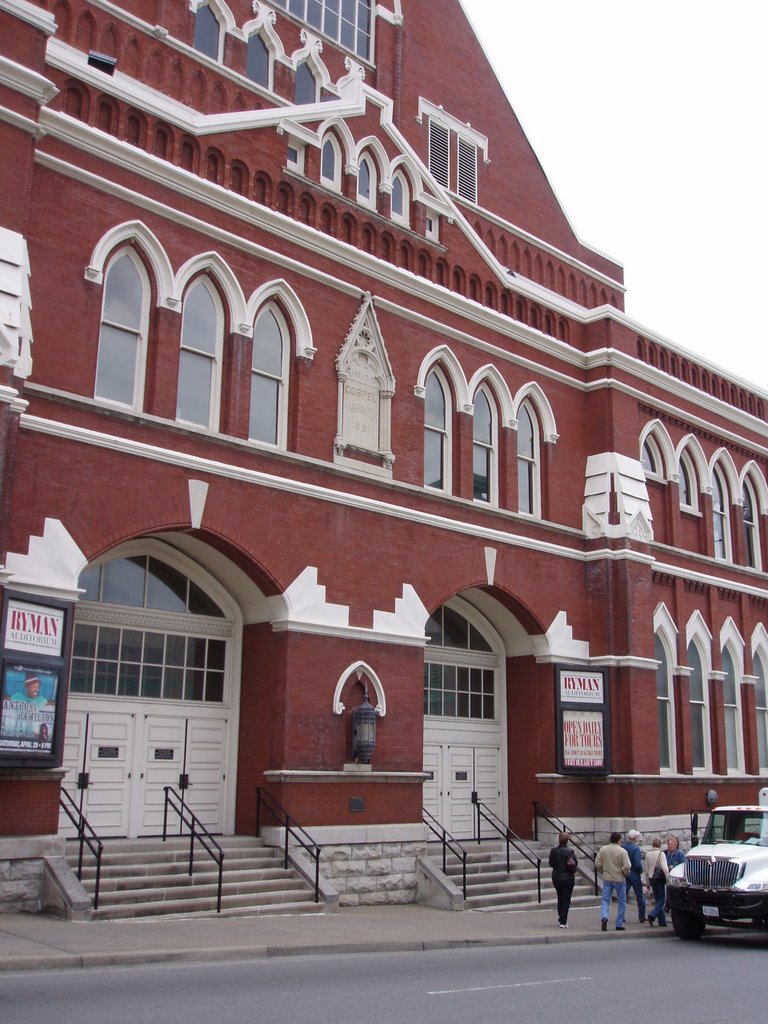 Ryman Auditorium, Nashville, TN
(photo by K. Urner, March 24, 2006)
Today we unzipped the roadshow projector, stored on the "time capsule" (a weird piece of furniture that came with the house, art deco in flavor), and hooked it up to the laptop (blue).
Dawn and I played through Neil Young: Heart of Gold, a concert in the Ryman in Nashville. We both enjoyed it, having both connected with Music City in various dimensions.
After giving the hardware a rest (it gets hot), I dove in to the 3rd in the Qatsi trilogy, which I'd seen before in a real theater.
I really like Philip Glass music set to images in this way. The "Hopi Prophesy" spin makes sense, if you remember Tom Paine's intuition that "to prophesie" means "to sing" (good singing requires attunement).
This Qatsi film (so-called because all three titles end in qatsi: Koyaanisqatsi, Powaqqatsi, Naqoyqatsi), may seem apocalyptic in places. The old Greco-Roman facade is crumbling (opening sequence) and we sort of forget why we fight (military drills).
Then we reconnect with a simple truth: we're operating some very capable, very expressive equipment (our bodies, ourselves). So take heart. We've got what it takes.
Tonight: more Lost.

Saturday, July 01, 2006
Back in the USSA
Yes, an intentional misspelling, yes, an allusion to a song by The Beatles. What I'm on about this morning is an experience many USAers never have, of flying back into their home country.
In the Pacific Northwest, our border with Canada is actually right inside their Vancouver BC airport. Little handheld eyeballs (webcams) snap your mug shot, if you're cute and French, or anything else exotic (lots of interesting passports).
On the intra-airplane TV, as you approach BWI or EWR or whatever, a list starts scrolling, of all those enemy country people that'd better have their paperwork in order, or else. Once off the plane, you might get sniffed by dogs (trained professionals). Hey, it's your choice to be in the USSA. Get over it.
Of course tourists complain that "USA 911-style" is relatively unfriendly (why scare little children?) and so are holding back with their tourist dollars, even if Chattanooga does sound intriguing.
However, the all-American freakout didn't start as recently as 911. Remember back to Y2K? I was in Maseru, Lesotho when the odometer flipped, from 1999 to 2000, watching the telly. The BBC's control room flitted from one time zone to the next, on and on around the world, always with happy campers, celebrating our shared good fortune (you know, like having found us a habitable planet and everything).
Then came the USA time zones (CNN feed mostly). These were not happy campers: "Air Force, still aloft?" "Check"; "Battle Cruisers still afloat?" "Check"... -- and so on through an impressive roster of military assets, all still operational thanks to the "Y2K bug" not having induced the paralysis so many had anticipated.
For the rest of the world, this was kind of a heads up that something was up in the USA. They'd gone all panicy over something rather mind-boggling and abstract, a big digit changeover, a millenium line crossed.
Not every calendar was odometering in this way at the same time, but this Romano-Christian one... well, let's just say a lot of doomsaying has focused on "The Millenium" and Y2K really did sound pretty apocalyptic, something like Nostradamus might have prophesied about.
Then came 911, which also has a 2 in it (what doesn't?). OK, so that must have been what Nostra was on about. He always makes so much sense, given 20-20 hindsight.
And so it goes, an ongoing panic attack, sometimes amplified through television. If more USAers returned to their own airports (having ventured abroad), I think they'd benefit from the reality check. Fearfulness: a two way street in our Wild West.
There's this urban legend of a small previous millenium town with only two car owners so far. No left-lane right-lane conventions had yet been established, no traffic lights implemented (what, for just two cars?).
They had a head on collision.
Freeze frame, captions: Humanity at the Wheel. Think About It. Please Drive Safely.
Friday, June 30, 2006
Estate Planning
Tara is trying to grow her estate, a prize feature of which are the two robot dogs. She has some money saved from babysitting jobs and is eyeing the AiBos on eBay. They start the auction with some token amount, but the market will easily bear over $600 for one of these puppies. They've become collectors' items of a sort, but are also about to be superseded by more advanced models of robopet, some of them likewise by Sony.
I launched into my spiel about long term investing in a field such as robotics. Acquiring a lot of personal property may not be the best strategy, as schools may provide access to well equipped computer labs in exchange for relevant teaching skills (including within middle school aged peer groups).
Instead of staring at out-of-reach toys on eBay, learn some Python. Show girls your age that girls your age do that sort of thing. Use the summer to geek out a bit. Then parley those skills into experiences with robot dogs of the future, maybe through Saturday Academy, some of which robopets will likely have Python bindings.
Like I said, a longer term investment plan than just saving coins and cashing in on a personal copy, to be resold on eBay, over and over.
And I practice what I preach, in that I'm not trying to personally own the bizmos either, even though I'm in the market for some "try before we buy" rental experiences (camper vans == primitive simulators). The school has a fleet. Teachers share them. The robot dogs inside some of them: mostly they're owned by the school as well, but may follow particular students around, more than the motorvehicles.
A bug in FireFox? I'll be typing along, writing a post, then hit an apostrophe, but get a Find box appearing in response. I doubt it's the keyboard's fault. I always Google when I enounter these little hell holes (in the bigger ones, there's likely no way to reach Google, like in Lost). Ah, OK, I see it's an unfixed bug in Mozilla dating back several years. Oh and look, the problem has just gone away (but only for the moment I'll bet).
From my post to Math Forum this morning: "I like this recent Supreme Court joke: 'just one congressional district in Texas must be redrawn' (assuming it's a tiling and neighboring states are off limits)".
Friday, June 23, 2006
Machine World
The scene at the boat house involved two machine-savvy guys lowering some 1000 pound metal engine (an old one, but now rebuilt) down into the hull of a boat. The one man forgot the chain was too short, plus had removed the safety. With about 2 or 3 inches to go, maybe more, the chain slipped from the overhead ratcheted pully device (near the apex of an A frame), and the engine crashed to the floor. But it did not go through the hull.
So many scenarios containing worse consequences branched away from this moment. We immediately counted our blessings, thanked a Loving God (alluding to the title of a book written by a peer mate), and found a longer chain. My role was observer, though my weight on the back of the boat also helped with the placement of the engine, which was eventually rescrewed to the floor.
Having grown up outside the USA for many years (late 60s to mid 70s), opportunities to absorb car culture were limited. I never did constructivist discovery learning around an old beater, although I watched neighborhood older kids get involved in that -- before hopping a jet to Italy in third grade, and immersion within the EUR (or "Mussolini Village" as we Americans sometimes called it), and later Viale Parioli #25 near Piazza Ungheria.
 Piazza Ungheria, Rome
(a Google Earth view)
[One of my best friends in those Parioli days: Kijoon, younger son of the South Korean ambassador to Italy -- our respective homes were within walking distance (years later, I visited him in Seoul, but have since lost track of him)].
I've deconstructed this or that device in my day, plus assembled radios on a breadboard by poking wires into spring terminals, following a wiring diagram, but I never learned internal combustion in any intimate way. I am not fluent in the namespace of flanges and manifolds, although I do know what a crimped pipe looks like, having crimped some myself (not intentionally, under my kitchen sink).
So I got started on driving around age 28. True, dad had me out in the Chevy Nova in Manila a few times. But neither Princeton nor Jersey City had me lusting for a loud smoking thing needing expensive parking privileges, plus insurance, plus other liabilities. A horse would have been as convenient (i.e. not very). I stayed with the bus and Amtrak (Conrail, NJ Transit...), and later the PATH train to and from Journal Square.
 Journal Square, Jersey City
(a Google Earth view)
Some years later (late 1980s), now back in Portland, David Lansky and Carol Slaughter (later Sleigers) gave me opportunities to mangle a transmission and get my first speeding ticket (respectively).
This induction into the world of freeways, with me behind the wheel, was back when I was at CUE, then serving the State of Oregon as a WordPerfect trainer and macro writer, helping Disability Determination Services implement (not architect) its maze of denial and acceptance forms, in the form of macro- generated form letters (a primitive, slow moving protocol and API, conducted through pre Internet snailmail and involving such things as doctor visits and more letters).
CUE had the contract, which also involved developing Spanish language versions of these letters. My need to get to and from Salem in a hurry, in support of this contract, is what got me access to Carol-of-CUE's car -- and the speeding ticket.
Then Matt helped me buy my first motorvehicle, with some money inherited from gandma Margie: a Honda Civic hatchback and my first long term relationship with a member of that machine world species. It was perhaps unkind to nickname her Gutless. She got me to Montana and back that time with Tom-of-TRP. I basically drove her into the ground.
After the above boat engine episode, I drove home by way of a Trader Joe's in Hollywood (a name collision with an LA-based namespace), in part to buy potluck goodies for the Wanderers party. Glenn is all moved back in, Doug Strain having opened a scholarship through ISEPP, which makes him a senior fellow, plus a paid troubleshooter (there's already lots of drama around a broken sewer line betwixt ISEPP properties and the City of Portland).
He talked about the grants application process he'd become involved with during the party, plus showcased some of the fine handmade jewelry he makes. I think Glenn should meet up with Joe Clinton, and am working on making that happen.
At this party we had two male-female couples, two males with off-stage spouses (I am in that category), one currently uncoupled female and one such male. Around Hollywood, you can legally marry and unmarry as many times as you want, although too many times gets to be impractical.
Dawn and I met through CUE. She was living on a horse farm at the time, partnered with Élise, now married to Les and still into horses. We formed Dawn Wicca and Associates (DWA, a partnership) well before getting married, which we did twice (with no unmarried in between).
Dawn had been married before (I had not), and still coparented with her ex around Alexia, with me coparenting as well. Alexia is now grown up and married to her boyfriend of many years. She too had been previously married, to a soldier in the US Army, stationed at Fort Campbell in Tennessee and Kentucky. They'd met in Portland, through Rocky Horror Picture Show and other venues. Alexia quit Willamette University, continuing her college in Clarksville, where they lived off base.
My erstwhile son in law was later reassigned to South Korea where the USA maintained an antediluvean set of bases, presumably as a counter to North Korea, although this political division was more on the minds of Korean War era vets than on the minds of new generation Koreans.
[ On our Fuller Projection, we just saw a lot of biosphere (definitely finite, though of course a steady importer of fresh solar gradient energy), along with the usual monkey-brained shenanigans (e.g. lots of choreographed mud wrestling, with the guys urging the gals to get into it ("girls gone wild" they called it)). ]
My uncles and cousins up north talk machine language really well (internal combustion, but also gravel and rock, even gold mine -- except maybe my Uncle Bill, who talks pre-WWI submarine (not that he's old enough to have served in one, just that's been a focus of his scholarship)).
[Update: Bill talks internal combustion pretty well, but Uncle Bo takes the cake for rebuilding that Dude Car in Denver (non-Ford guts, but with the body of a Ford Model A rescued from a lake bed). Uncle Howard, meantime, has just built his own boring machine from cannibalized parts, for the job of rebuilding some giant front-loader elbow joints, a process that requires round holes to turn square.]
The open source video clips database I'm planning, although currently built around the premise of Geek TV (meaning about a lot of ethereal topics, like tcp/ip) would work well for propagating more traditional machine world memes ala Popular Mechanics and O'Reilly's Make: magazine.
Which isn't to say you can get around doing hands-on.
All of these subcultures require actual practice, not just passive viewing. But getting to watch some favorite role models actually doing the jobs you aspire to do someday, is a promising beginning.
Thursday, June 22, 2006
Social Engineering: Older vs. Newer
Before having my posts blocked @ wittgenstein-dialognet (I've kept my membership) , I was starting to get into how hackers see legal code, in contrast to the stuff lawyers write, which does not self execute on computing machinery.
Legal code is what businesses use to make those check boxes show up in your web browser. Or if you're a visitor to some geek ecovillage, it might be a question about whether you're vegetarian, vegan or whatever.
Illegal code is what crashes the computer, or makes it throw exceptions in some uncontrolled way, assuming this is the fault of the programmers. We guard against it. We train our compilers to barf on it.
So when legislators get together in some big room, with quaint desks, and probably laptops, are their imaginations wrapping around the rule-based interfacing and back end database tables needed to implement their fancy new public policies? No way. Most of them went to law school and don't know how to write any SQL, Python or anything like that. They don't write any code at all, in the sense that we hackers conceive of this art.
I don't chronicle this to be critical, and maybe in your era (when you're reading this), this is no longer true. I merely want to highlight a name collision: legal.code and geek.code (or shall we say it.code, as in "information technology"?). In the geek world, if it doesn't self-execute, it probably isn't legal.
In legalese (an older kind of science fiction, in which pseudo- humans trumped humans when it came to power and responsibility -- a sort of War of the Worlds thing), we have an "executive branch" that handles execution (police and so on), and exceptions are called "crimes" (no matter how buggy the code -- the state's laws don't get much compile time or runtime checking, or would that be the job of the courts?).
Anyway, however it worked, I don't claim to be an expert, it worked very very slowly. Sometimes significant motion was imperceptible, for years at a time. The record filled with speeches (see video archive), resolutions, senses of the Senate and so on, often with no real "bills" attached (a synonym for "bundle of laws" in early 21st Century DC-speak). And when bills did get "passed into law" they often came with no mechanisms for enforcement, nothing for a computer to chew on.
Obviously, as a geek, I'm more interested in snappy performance, and so expect multi-threaded applications, intelligent prioritization, everything we've come to expect from a secure, well-designed GNU operating system.
USA OS is my idealized legal-code-based USA operating system, the stuff of geek science fiction (a newer kind, that takes a lot of stress off those poor police, who have no idea how to "enforce" half the laws a creaky old U.S.A. Congress sees fit to pass, so often as a way of obliging the few people who put them in office (remember about those pseudo-humans (aka "corporations") having more official legal control? (anyway, it was complicated and I don't think anyone really understood it, not even the ones making out like bandits))).
A sad spectacle in my time: an education system that shared quasi-zero geek culture, just Hollywood versions of same, and therefore lots of public debate completely controlled by obsolete namespaces with a proven track record of not doing a good job.
Legislators couldn't read, let alone write, source code, not even freely accessible source code, because they had never needed this skill to become our chief social engineers, both at the state and federal levels.
How could things have been this crazy? Just read the history. Computers were still new back then. Senators such as Robert C. Byrd, Ted Kennedy, Orrin Hatch and Arlen Specter predated the invention of tcp/ip itself. So their notion of "legal code" was understandably antediluvean by the standards of today's more computer literate cultures.
Case in point: a big scandal in the news was the theft of millions of veterans' records when a laptop computer belonging to a VA employee was stolen during a burglary. This was one such dramatic story among many. Fraud and incompetence were rampant, and opportunities for identity abuse were on the rise across the board. Scam artists were having a field day.
Various legislators, executives, and judges made noises about fixing the problem, but few seemed to have a clue about what design sciences might be involved. As any hacker could tell you, if you wanted to address identity theft coherently, you'd need to think about consolidating personal information on secure identity servers. Let potential clients or gatekeeping authorities check your credentials, but also keep a record of who has checked and for what information.
Have your cyber identity serve you, not you your identity -- especially if it's a stolen one (a crime the legalese speakers seemed unable to address coherently, except by making more speeches and writing more illegal -- as in non-executable -- code).
Monitor your online identity, shape it.
It's your record.
Tuesday, June 20, 2006
Reposting from Synergeo
I'm not intensively following this thread but yes, that How to Solve It book has a big following in the math ed community, which I also frequent, via the Math Forum (not sci.math, after that blow up about Wittgenstein some decade back).
In Synergetics, you get all these interconnecting prefrequency hypertoons that look like they must mean something on the one hand, and then a lot of empirical stuff to wade through on the other. Fuller was always tantalized by twilight zone possibilities and sometimes reached into the mirror pond and grabbed a cosmic fish. Or sometimes the fish just lept out at us: buckyballs, nanotubes...
I've always advertised my willingness to just watch the cartoons, and not worry overmuch about what they're about. I'm into the prefrequency pure geometry of it all, kind of as a test pattern (like on early TV -- dunno who still does those anymore, but using a concentric hierarchy with jitterbug would make a fine "screen saver" and I'm surprised no hippie has broadcast one yet). Then you've got the physics crowd, which wants to map whatsons to the A and B particles or combinations thereof. I've never been much of a CERN head myself -- philosophy major, more into memes than mesons. In Synergetics 2, the T->E particle transform is what "popped the balloon" twixt material and radiant energy (a very fine line).
Just getting clear on the cartoons has taken awhile, and there's a lot more to go. But I'm glad to see us swinging back towards visualizations just as movies like Cars prove once and for all that
computer assisted cartooning has a bright future. Greater Portland is getting into that market, with Nike's Phil Knight leading the charge (actually, he's continuing a lineage -- Will Vinton Studios helped get the ball rolling, plus we've always been a mecca for cartoonists). A claymation concentric hierarchy: I can see it now [holding fingers in a frame shape].
Monday, June 19, 2006
Post Summit Followup
Per my pre-summit background essay (5 page PDF), I've been looking for ways to develop a sense of energy cost accounting that's more primordial than say monetary accounting, which invests rather one-dimensionally in a somewhat theoretical fluid or juice, convertible between currencies.
Real joules come to planet Earth from a solar fusion furnace we call our Sun. Real photosynthetic processes help us amass the biomass needed to fuel a bonanza of air, water and land specimens (some multi-medium). Humans partake. All of this ecosystem economics involves joule-measured energy transactions, and could theoretically not involve money in any way (Robinson Crusoe's scenario).
Energy without money is highly conceivable. Money without energy doesn't make any sense.
We've been combining the fruits of such general systems theory insights in the form of rich data structures, suitable for sharing more globally. Ruby and Perl get to play in the Gnu Math playground, just as surely as Python does, so I'm not saying this new Py Dough trademark defines and captures the market, but it makes sense for my team.
Whereas other shops will focus on astronomy, anatomy, minerology, flora and fauna, my shop is hugely into polyhedra for its class definitions. We like 'em round, we like 'em spikey, we like 'em with triangles and without. And in the Fuller School arena, we have this "classical garden" motif (sort of Kyoto in flavor), wherein a stark and austere object world is relatively oriented and sized in a particular way.
This prefrequency "no world" (or "gnu world" -- however special case depicted) also features this sort of jitterbug dynamism (a kind of dance, or heart beat), centered around an inside-outing (akin to an inflection point). The resulting bow-tie shape suggests an hour glass or tornado-like toroid of involuting evolution, a so-called pattern integrity. So let's all put on our 3D glasses and bliss out for a spell. You can maybe appreciate why hippies thought this Bucky guy was fun to tune in.
Anyway, I was documenting this breakthrough (about how to get more joules in the picture) over on edu-sig this morning, over my morning coffee in a black Princeton mug (newly replaced, after I broke the one purchased at my 25th reunion). We'll take this rich data structure idea, and converge it with the idea of a richly inventive class hierarchy, starting with Mammal for example, and feed it out to our schools around the world. Any school might become a source in this way.
Indeed, classes were originally spawned from structs in our C world, were primordially just data themselves, before developing legs and/or fins and accompanying behaviors ("methods" as we say in our namespace, our computer science shop talk).
Differently trained professionals will want to take charge of how to best distill the information. Typically, a simple flat file will prove unsatisfactory, which is where the more involved data structures come in. Spreadsheets keep up the pretense that the data is flat and two-dimensional, but formulae behind the scenes provide for tunneling and hidden connections. Suddenly, a system springs into view, connected around everywhichway.
Open source business strategem: if the work is already done in Perl, or Ruby, we should have no trouble converting it or storing it for Python use or vice versa. As gnubees, we tend to cross-train in any case, so it's not about the one language (we have lots of namespaces, duh). And certainly finding affordable disk space is not the problem.
YAML might help us avoid redundant rekeying. Given Ruby's aversion to using XML (per Ruby on Rails), I could see this as a workable compromise. Dethe on edu-sig suggested checking into JSON, another alternative to XML.
In the meantime, let's press on with our free core liberal arts modules and not worry too much about centralized integration. Consolidation tends to come later in the game, when more players have jumped on the bandwagon, and come to see cooperation as key.
Sunday, June 18, 2006
Father's Day Weekend
I'm seeking a certain Olympus Stylus battery recharger in the garage (a typical hangout for dads on Dad's Day), digging through stuff, some moved from Carol's office in a hurry, when Carol returned for the warm season.
Rescued from boxes this Father's Day:
I'm OK with Guido and Alan anchoring the teaching track in their keynotes at EuroPython this year at CERN near Geneva. We're lucky to have recruited Alan into our highly geekish EuroPython community. I continue networking around Project Kusasa, feeding it with our Gnu Math breakthroughs, and getting back some really good ideas about how to do more more efficiently.
The Edubuntu box is now semi-permanently on wireless in my basement, courtesy of Derek and Dave (both sponsoring with hardware).
My new 1 GB Cosair memory stick easily goes between it (Jennifer) and any other USB-equipped machine, so it's easy to move curriculum writing around from multiple open sources (such "writing" may include executables, with source, so you can at least read 'em to see what they'd do, even if you choose not to run 'em -- an advantage you don't have with binaries-only (or if you can't read the language (gnu math helps make sure that you can))).
Speaking of which, this very memory stick has been steeply discounted for Father's Day and I have the receipt (showing Dave paid a lot more -- I reimbursed him in cash). Fry's is usually quite good about letting customers retroactively take advantage of sales (given the 15 day return policy, that makes sense). I'll plan to get out there again shortly, to spend some more dough (I still have some birthday money left).
In today's Oregonian (Dawn pointed this out): HP is celebrating the 25th anniversary of its 12c calculator. Rogoway boasts how he, and a majority of users, never really "got" RPN (reverse polish notation). I wouldn't be so proud of that if I were him.
Queued for the DVD player: two documentaries from Movie Madness: one of those anti Wal*Mart muckracking pieces, and another about the birth of Air America radio.
Follow-up (June 28, 2006 4:38 PM):
Following prolonged digging, I located that Fry's receipt for the memory stick and was able to redeem $45, on a father-daughter outing to what used to be known as Incredible Universe.
With a full return I could have gotten another $10 (because of the mail in rebate), but I'd ripped open all the packaging, and felt I needed to eat some of the cost (I too have a reputation to protect).
I used the returned in-store credit towards a Uniden 5.8 Ghz base phone plus moon unit. The sound is somewhat garbled on my end (wrong channel?), but works better than what it replaced, which was entirely broken. At some point, when not facing steep medical bills, I'll think about further upgrading.
Rescued from boxes this Father's Day:
- Paul Urone's Physics with Health Science Applications. Dr. Bob Fuller, University of Nebraska emeritus, suggested at our meeting recently that he and I try to revamp this genre, if Dr. Urone's brilliant and pioneering text book failed to stay prominent (like, let's keep his lineage alive).
- Kappa Sudoku Puzzles #2. Time was, I thought these would be important brain teasers in my life, but I eventually decided developing this skill would be a time sink I couldn't afford.
- Historical Dictionary of Wittgenstein's Philosophy by Duncan Richter. I liked his using a dictionary format to help assemble a philosophy in the mind of some reader. You get a handy reference, and an internally connected hypertext document, all in one fell swoop. Good job Duncan!
- The Road to Reality by Roger Penrose. This is my signed autographed copy, from the night I ran camera for the guy, at the Schnitzer (sort of like in the old days).
- My Mapparium bag, from that time I went to Cambridge for a nuclear disarmament conference (I recall Daniel Ellsberg speaking about Manhatten Project II (a big cleanup in the wake of No. 1)), my attendence sponsored by AFSC (I also researched local AFSC youth programs, as this was the start of our Portland AFSC's LAAP/UV, for which I served as clerk for many years).
I'm OK with Guido and Alan anchoring the teaching track in their keynotes at EuroPython this year at CERN near Geneva. We're lucky to have recruited Alan into our highly geekish EuroPython community. I continue networking around Project Kusasa, feeding it with our Gnu Math breakthroughs, and getting back some really good ideas about how to do more more efficiently.
The Edubuntu box is now semi-permanently on wireless in my basement, courtesy of Derek and Dave (both sponsoring with hardware).
My new 1 GB Cosair memory stick easily goes between it (Jennifer) and any other USB-equipped machine, so it's easy to move curriculum writing around from multiple open sources (such "writing" may include executables, with source, so you can at least read 'em to see what they'd do, even if you choose not to run 'em -- an advantage you don't have with binaries-only (or if you can't read the language (gnu math helps make sure that you can))).
Speaking of which, this very memory stick has been steeply discounted for Father's Day and I have the receipt (showing Dave paid a lot more -- I reimbursed him in cash). Fry's is usually quite good about letting customers retroactively take advantage of sales (given the 15 day return policy, that makes sense). I'll plan to get out there again shortly, to spend some more dough (I still have some birthday money left).
In today's Oregonian (Dawn pointed this out): HP is celebrating the 25th anniversary of its 12c calculator. Rogoway boasts how he, and a majority of users, never really "got" RPN (reverse polish notation). I wouldn't be so proud of that if I were him.
Queued for the DVD player: two documentaries from Movie Madness: one of those anti Wal*Mart muckracking pieces, and another about the birth of Air America radio.
Follow-up (June 28, 2006 4:38 PM):
Following prolonged digging, I located that Fry's receipt for the memory stick and was able to redeem $45, on a father-daughter outing to what used to be known as Incredible Universe.
With a full return I could have gotten another $10 (because of the mail in rebate), but I'd ripped open all the packaging, and felt I needed to eat some of the cost (I too have a reputation to protect).
I used the returned in-store credit towards a Uniden 5.8 Ghz base phone plus moon unit. The sound is somewhat garbled on my end (wrong channel?), but works better than what it replaced, which was entirely broken. At some point, when not facing steep medical bills, I'll think about further upgrading.
Saturday, June 17, 2006
On The Job
For Father's Day weekend, I took Tara to work on Friday afternoon, while Liz tended to my wife, in need of transportation (still lugging 02). We visited my boss, also in the hospital, but a different hospital, more Evil looking (in the sense of Mordor -- Tara was going on about Sauron as we approached the parking garage (recently rennovated)).
I tried to show off my knowledge of inner secrets by doing the combination lock on the hallway door in LL, but flubbed it, requiring a knock. Shawnna let us in (she's slender and attractive, in a ring wraithey kinda way). By the way, I may change the names to protect the innocent, like Dewey Clarridge does when writing about Nepal.
In my office, which doubles as a conference room (with multi-way speaker phone) when I'm not there, we look over my scribbles on the white board (John's MIRV is gone -- a name collision with the Pentagon's). This time it's all about Oracle's relational database framework and SQL engine, which I've also lugged a book about in my OSCON bag, purchased recently at Powell's.
Tara and I then adjourned to the cafeteria for a late lunch, me forgetting how soon we were to having the Friends-provided dinner @ home with mom (that later proved to be excellent). We ate salads and self-serve ice cream. Tara took too much, so I had to finish hers (mint). I went with coffee (both as in the ice cream flavor and as in the real deal). We ate outside, between towering ramparts.
Vicki, my coworker (we have the same boss) had answered the datetime question. op_date > {ts 06-05-05 12:00:00} or like that. So I was able to build a fairly fancy new query with that, and have it run on the Oracle engine instead of on FoxPro locally (the objective of this experiment).
We took Hwy 217 to Allen Blvd then on through Multnomah Village (near my boyhood home, and Matt's) to help minimize traffic congestion. Although I was shooting for Barbur, I flubbed again ("screwed myself" as I told Liz on my cell) and routed onto the Terwilliger Curves (scary signs of trucks tipping over, centrifugal force, a kind of "pseudo-force" in physics they tell me (like an inverse of angular momentum)).
Escaped onto Corbett, down Bancroft onto Kelly (drove passed an old CUE building, where I also did Fuller School stuff for EMO), and up over the Ross Island Bridge. We call this Bridge City sometimes, and last year, the Providence Bridge Pedal took in all ten.
All in all, it was a good Father's Day. Dawn had a lot of energy that evening. We also took in the The Truman Show, about some guy's worst paranoia coming true. A lot like The Matrix in some ways, and Anger Management.
Thursday, June 15, 2006
Power Lunch
We converged at Nicholas' on Grand Avenue on Portland's East Side, for a couple mezza plates and some turkish coffee.
We discussed gnu math, bizmos, Google, Saturday Academy, TOPS, and Japanese weddings on Guam. Then we adjourned to Burgerville for seasonal strawberry milkshakes.
I'm glad these executive-level meetings don't have to be in rooms that're "smoke filled" anymore.
I also frequented a few of my cyberspace haunts, putting in my usual two cents on the Math Forum.
Good news about those Hawaiian islands getting increased protection. Fragile undersea environments are not easily replaced, yet are easily destroyed by unthinking land animals.
That's maybe another problem with Operation Vendetta: the possibly negative environmental impact. That subtropical island has suffered enough.
Friday, June 09, 2006
More Philosophy Talk
Some scientists may not want to admit it, but analogy remains a means whereby we continue to anticipate in new fields. When the electromagnetic field was first tuned in, as a physical theory, with Maxwell's Equations and the like, people assumed several analogies (the rippling pond analogy being one of them), but when it came to wires and circuits, the analogy was a piped fluid. And it is a fluid of electron energy isn't it, pushed by repulsion from one cell in a battery, pulled by the other, until the two become equalized (battery dead, perhaps rechargeable from an external source, but with work done in the meantime).
When we see emergence, we recall other times we've seen it. Butterflies from caterpillars -- that's one of the big hand-drawn illustrations that stands out in Synergetics (from a Celtic source).
Synergetics works to set up a lot of stark prefrequency dynamic geometry (hypertoons) that don't really mean anything, except they're smoothly self-consistent and rich in relationships (instructive as pure patterns). But that's not the end of it. They're also suitable raw material for analogies. Doing DNA? Think about using a tetrahelix sometimes. Why? Because if a lot of sciences invest in a common set of dynamic geometry cartoons, we'll have a better superhighway system among disciplines, and that's what Synergetics aims to provide -- except Bucky was more into trains and Grand Centrals than highways per se (I love trains too).
Synergetics explores emergent behaviors in starkly geometric terms, as when those two triangles disclose their spiralness and conspire to breed a four-windowed beast -- an apparent capture of new order, a whole system, a synergetic event. Traditional geometry has had less tolerance for surprise. Euclideanism exults in a sense of having it all mapped out just with the axioms -- the theorems all follow already, even if little humans haven't explored all their ramifications.
It's a comforting image. But that's all it is: an image.
Mathematicians have worked for centuries to make us understand it ain't so simple. Bucky helps in that project. He reminds us our axioms might actually suck, compared to those used by ETs under the Denver airport. We're able to go wrong in our appeal to "self evidence". Infinitely thin planes of infinite extent: a given. Bucky retorts: "oh yeah? Show me one, just one!" We retreat into uncomfortable silence. A disruptor. Disrespectful. Euclid must not be called on the mat! At least not with such naïve challenges (jiggering with the 5th postulate was bad enough).
Euclid meets Sumo-Synergetics in manga I'd like to read.
Tuesday, June 06, 2006
666
I can't resist the snake oil title, given I won't see another 6/6/6 in my life time, plus I want to write about hexagons (six-sided).
I met with Patrick and Glenn today about the omnipresent hexagonal motif (like the Three Bees logo in that Constant Gardener movie). As Glenn points out, it's iconographic for info-, nano- and bio- technologies, a geometry of nature in some way (the bees are innocent of man's crimes).
Patrick had done a lot of Googling and was well aware of my Pythonic approach to geometry. Still, I take no credit for the static clip below. We need a large open source archive of more dynamic clips as well.
So how do Glenn's Global Matrix and my Global Data fit together? In science fiction that's sometimes hard to tell apart from science fact? Global data does look handsome on a hexapent. Somehow it seems a natural fit. Didn't the Klingons know this?
We brainstormed a child's toy or planner's game: hexagonal tiles represent eco-village components; assemble to suit your eco-surroundings, your specific land- and/or sea- and/or air and/or space scape (could be computer graphical, could be cardboard -- could be made to look like cardboard, but on a computer).
I met with Patrick and Glenn today about the omnipresent hexagonal motif (like the Three Bees logo in that Constant Gardener movie). As Glenn points out, it's iconographic for info-, nano- and bio- technologies, a geometry of nature in some way (the bees are innocent of man's crimes).
Patrick had done a lot of Googling and was well aware of my Pythonic approach to geometry. Still, I take no credit for the static clip below. We need a large open source archive of more dynamic clips as well.
So how do Glenn's Global Matrix and my Global Data fit together? In science fiction that's sometimes hard to tell apart from science fact? Global data does look handsome on a hexapent. Somehow it seems a natural fit. Didn't the Klingons know this?
We brainstormed a child's toy or planner's game: hexagonal tiles represent eco-village components; assemble to suit your eco-surroundings, your specific land- and/or sea- and/or air and/or space scape (could be computer graphical, could be cardboard -- could be made to look like cardboard, but on a computer).
Saturday, June 03, 2006
Another Shop Talk
I'll need to bone up on Oracle 8, now that I'm redeveloping SQL against that target, via an ODBC pipeline from Microsoft Visual FoxPro (VFP).
So far, I'm sucking too much content through my remote views, applying all the logic client side, which is fine, given our dire need for data, post system switchover.
However, I should go back and rewrite these as "SQL pass through" (SPT) queries, meaning they go through verbatim in Oracle-compliant SQL via VFP's SQLEXEC. The result cursors should then be finalized data sets, with the various joins and boolean filters already applied by the capable Oracle engine.
I've documented this need for a rewrite in the source code (in pulldata.prg).
We'll see if I get to it.
Probably I should visit Powell's Technical downtown for a good Oracle 8 book. I'm specifically in need of more on the new datetime field type and related functions -- more than I've yet been able to discover while browsing the web.
Friday, June 02, 2006
Philosophy Talk
Blogger's bein' slow today. Dawn's is finally out of the hospital (radiation burns make it impossibly painful for her to swallow much food or drink, but they're healing).
Earlier this morning, I posted the following to Synergeo, which I think is indicative of at least my personal trajectory in semantic space:
Hi Lou --
We've argued about this before.
I've consistently stated I view Synergetics as a work in philosophy, and yes, it's tainted with physics throughout, and with math, but it's best when we shake those loose and can enjoy our pure prefrequency tautologies, which are not "empty nonsense" once you factor in all the cool hypertoons we're getting. Plus (and, in addition), we do get to enter the world of time/size with our various semi-generalizations, regarding banking and accounting and all that good stuff, i.e. we do get to play in the physical world, even to the point of making some changes in physics now and then (but in no sense is that a priority -- physics is free to spin its unified fields forever and there's no reason to get in front of a moving train waving some sign from the resistance).
So I think what you call my "petulance" is rather your complete misunderstanding of the fact that I'm in a different department all together. Yes, Fuller was anti-hyperspecialization of course, but I pride myself (yes, this is vanity talking) that at least philosophers know that's a problem, whereas physicists, for the most part, have fallen into the same literalist trap as many religious fundamentalists. They think ultimate truth is a set of statements about something physical. That's why we we call them physicists (helps to know Greek -- being patronizing, yes -- helps to know Latin).
So anyway, I'm looking forward to a long-running feud with the physics department over how come we in the philosophy department get to teach synergetics so effectively almost without consulting them it sometimes seems. We're off on some tangent, with our own meaning of "spin" in some remote namespace that's nevertheless quite effective. Our students get good jobs. We don't lack funding.
Kirby
PS: Lou was actually finding someone else "petulant" and I misunderstood. No matter. I think it's a valuable post anyway, in the sense that I'm marking some turf.
We watched Oliver Stone's Alexander last night. I didn't think he got JFK right either, but it's his job is to make entertaining movies, right? I suppose I was entertained.
Tuesday, May 30, 2006
Studio How To
So what might be a typical product of the Portland Tech District? Teaching videos for one.
I met my wife Dawn through the Center for Urban Education (CUE), which had several responsibilities, including refugee resettlement in the aftermath of the Vietnam War. When she came to work as our bookkeeper, I was off in Bhutan, doing volunteer dBase work while visiting my parents, both employees of the Kingdom.
Another focus was assisting NGOs (non-profits) with the newly emerging desktop publishing technology. Apple had given CUE a large equipment grant through Steve Johnson, and small activist organizations were only too happy to stop by and use PageMaker and the LaserWriter. I trained older workers in the use of office software, initially on Apple 2es, but eventually IBM PC type technology. Lotus 1-2-3, WordPerfect, dBase and so on.
Yes, I'm showing my age.
Now, two decades later, we're looking back at the open source revolution (still ongoing) and seeing a bewildering array of free, customizable software suitable for NGO use. And indeed, many activist organizations have taken to this new working environment like fish to water. Yet at least as many are still confused and feel left out.
Collaborative Technologies @ FreeGeek, under the leadership of Ron Braithwaite, made an heroic effort to bridge the cultural divide between geeks and social activists, but rather than assume a more generic training function, we dove in deep with a single client, HomeStreet.
Our small network of entrepeneurial affiliates was suddenly up to its ears in SQL Clinic, and setting up a multi-office network with a wireless bridge, and kept at it long after the money ran out to pay for all this.
We had a couple Penguin Days, day-long open house events, thanks to David Pool, but here we are entering the summer of 2006 and is the nonprofit leadership any more comfortable with the new technology? I still see a lot of unmet need.
NGOs need more customized assistance, in the form of orientations and videos.
These videos needn't be boring. They should employ open source techniques, such as recycling clips from a growing database, a commons. Technology companies don't have to synch too tightly with the editors. Somehow, we need to teach about TCP/IP, gateways, DNS, SMTP, Apache, the difference between client and server side programs. Tech companies could start filling the archive with their logo-identified wares.
Splicing together clips from many sources, even while adding fresh material, is how scholars have traditionally kept the curriculum up to date, though in the past more with text than with video and audio.
That's a main difference these days: scholarship and teaching isn't so exclusively text-based any more, thanks to television and the Internet.
So, what's the missing ingredient? For starters, large databases of freely accessible and recyclable audio and video clips. We could start with "anything our taxes have already paid for."
Relevant:
Vid clips recently mentioned on edu-sig: [1][2]
Random Google Videos: [1][2][3]
Saturday, May 27, 2006
TV Commercial
The hypertoon idea is as follows: start with a smattering of nodes, your switch points; connect the dots by various smooth transformations; generate animations from this network, possibly randomizing at the switch points.
Example transformation: a Fuller Projection develops from a globe by flattening into an icosahedron, then unfolds, then refolds but just to the icosahedron frame (a node) i.e. no puffing back into a globe.
Here, the projected global data (whatever it was) might fade, taking us to the more Platonic version of the icosa (fewer secondary features, although for TV you'd probably still want color).
This icosa might then acquire its dual, the pentagonal dodeca (I drop the "hedron" for brevity). They'd combine into the rhombic triaconta and then explode in a rain of T-turned-E modules (end of sequence).
Yes, that's a very esoteric cartoon I just described. Whatever company produced it must really know some design science. Pretty geeky if you ask me. And all that just to sell me some digital camera. Or was it a satellite service?
Anyway, I'm surprised we even have companies that knowledgeable. Certainly most are not. I should remember that logo.
Thursday, May 25, 2006
Coffee Shop Physics
Dr. Bob Fuller was just by, enroute to return the rented van before flying back to his headquarters in Nebraska. Bob's been surveying physics departments about their use of computers, helping lay the groundwork for an upcoming issue of Computing in Science and Engineering.
Survey question: do you have a separate computation course and what languages and/or software packages do you use, if any?
I was somewhat amazed at how many are still teaching FORTRAN. I realize some of the best time-tested libraries persist in this language and I could see wrapping these libraries in a Python namespace, say, but not teaching FORTRAN as a productivity tool.
C++/C and Java rank next.
Then you have applications like Mathematica, MathCAD and Matlab. Bob had Python filed under this heading because VPython is maybe an application more than a bare bones computer language, and that's what some physics departments currently use.
I promised I'd provide Bob with a link to Another Alien Curriculum (2003), as he hadn't followed the action where Dr. R. R. Hake gave it a positive review, as that happened on math-teach @ the Math Forum more than on PHYSLRNR.
If Bernie Gunn's remarks are indicative, the computer science world hasn't done enough to keep other scientists in the loop, such that supposedly "easy" languages like Python instead come across as intimidating, jargon-filled, alien. Bernie is a geochemist with plenty of programming experience from the days of Fortran and Pascal:
One strategy would be to start much earlier with the programming. I've outlined one possible solution in my recent Fuller School memo (5/23/2006) to the Math Forum.
Although I'm focusing on K12 in this memo, new adult education pathways might be pioneered along the same lines, i.e. let's study "math objects" (including colorful/textured polyhedra) in some extensible type system such as Python provides.
Survey question: do you have a separate computation course and what languages and/or software packages do you use, if any?
I was somewhat amazed at how many are still teaching FORTRAN. I realize some of the best time-tested libraries persist in this language and I could see wrapping these libraries in a Python namespace, say, but not teaching FORTRAN as a productivity tool.
C++/C and Java rank next.
Then you have applications like Mathematica, MathCAD and Matlab. Bob had Python filed under this heading because VPython is maybe an application more than a bare bones computer language, and that's what some physics departments currently use.
I promised I'd provide Bob with a link to Another Alien Curriculum (2003), as he hadn't followed the action where Dr. R. R. Hake gave it a positive review, as that happened on math-teach @ the Math Forum more than on PHYSLRNR.
If Bernie Gunn's remarks are indicative, the computer science world hasn't done enough to keep other scientists in the loop, such that supposedly "easy" languages like Python instead come across as intimidating, jargon-filled, alien. Bernie is a geochemist with plenty of programming experience from the days of Fortran and Pascal:
The problem is what with populations out of control, religious wars, desertification, (and 15 million illegal immigrants) etc etc upon us we have a lot of problems to solve. And the average scientist has been shut out of using the best tool going, the good old PC. Talk to as many academics as you like, most can use email and digital camera storage and that is all. (Thu 5/25/2006 11:38 PM)How can we fix this? Is scipy friendly enough for a beginner? As a member of the Python community, I feel motivated to help close this communications gap.
One strategy would be to start much earlier with the programming. I've outlined one possible solution in my recent Fuller School memo (5/23/2006) to the Math Forum.
Although I'm focusing on K12 in this memo, new adult education pathways might be pioneered along the same lines, i.e. let's study "math objects" (including colorful/textured polyhedra) in some extensible type system such as Python provides.
Sunday, May 21, 2006
More Meanderings
I've been criss-crossing paths with fellow dreamweavers of late, segueing threads. For example, here's a trail head near Mt. Hood Community College.
Tara is playing CivIV on TMU behind me. Dawn is in the living room, preparing for a trip to Cannon Beach with her cousin, O2 in tow.
Lynn just called, in her Bridge City Friends Meeting capacity. I appreciate all the help we're getting during this difficult time.
Last night I celebrated my birthday some more with friends Matthew and Michael. We went to the Lucky Lab, then Rimsky-Korsikoffee.
It's a quiet First Day, not too hot.
Thursday, May 18, 2006
Some Autobio
Maybe this'd be more appropriate in BizMo Diaries, given it's autobio, but Grain of Sand was my first blog that I bonded with, so here goes.
Like Woody Allen, I thought Ernest Becker's The Denial of Death was a strong contribution to psychology, which in turn led me to Norman O. Brown's Love's Body, which I really got into.
It was through these readings, and through Wittgenstein's Philosophical Investigations (one of my chief concerns at Princeton) that I felt led to American Transcendentalism and Positive Futurism, in the form of Fuller's and Applewhite's Synergetics. I've always read it as a network of semi-metaphorical verities (1005.52), invisibly and tensively cohered, as did the authors.
I've been alluding to what I call Apocalyptic Christians over on Quaker-P, and feel led to explain a bit. Christianity has the somewhat earned reputation for always expecting a Great Cataclysm within the lifetimes of whomever happens to be controlling the pulpit for the time being.
I think this apocalyptic streak puts an unfair burden on other religions also hoping and helping to steer (and they have every right).
I thank our Loving God that only a small minority of Christians are of an apocalyptic persuasion, but some of them have identified as Friends in the past, i.e. as Quakers, i.e. as so-called "members" of our Religious Society.
So I feel some sense of personal obligation, given I also identify as a Friend, to disassociate myself from those thinking ordinary death in an ordinary age isn't good enough, and that they deserve a front row seat on whatever great destruction awaits.
To these selfish self-chosen, the idea of humanity rolling forward for many more millenia, growing in competence and satisfaction with Creation, is an anathema. They want to see the End Times, and the sooner the better.
Me, I aim to be ordinary. I'm just another guy headed for the grave, and happy to have this time with ya'll (you're wonderful).
And I do sense our persistence in a poetic sort of way. Our 4D++ appearance, as a piece on the board, is like a signature. We may live on to witness the fruits of our handiwork.
My goal, as a man in the rear view mirror waving, is to wish ya'll in the future my very best. Live on, love on, and prosper. Walk cheerfully and tread lightly over the earth.
Now, I must get back to work. Circumstances remain pressing.
Wednesday, May 17, 2006
Wanderers 2006.5.16
Astute readers will note that I've been missing some of these Wanderers meetings lately, or have at least failed to provide write-ups.
Given I now do all the driving in our nuclear family (plus friends have been helping out a lot), I have less leeway to show up in the mornings in particular. I missed by all reports a good one on Christianity, presented by a local author with a fun sail boat -- not much wind that day I was aboard, but it also has a small motor.
We also had a two-part presentation on quantum gravity, both of which I missed (but heard about from Sam Lanahan at a chance encounter during birthday celebrations at Lloyd Center).
I did make last night's presentation though, by Adam Reid (at least in part -- I made a quick trip to Providence at the outset, where Dawn's shy veins had frustrated every attempt to pierce them -- so she's trying again now). Adam spoke about Portland's innovative new public high school, LÊP, which is gearing up to receive its first students on August 1.
Rather than post my write-up here in Grain of Sand though, I posted a few words at in math-teach, an open, unmoderated web-archived Forum I've frequented for many years by now (so don't ever expect me to believe that math teachers lack passion -- I've learned otherwise).
Tuesday, May 16, 2006
OSCON 2006
I doubt I'll be attending the conference proper this year, though I'll likely lurk around the edges, hobnobbing with principals.
I don't have a bizmo yet, which would have merited some show and tell. But Pythonic Mathematics isn't news anymore, at least not among geeks in the know.
Sure, I have the money to rent or buy an RV and outfit it as a business on wheels, but that's not the point. Either it's part of a bigger civilian corporate effort to outreach to schools using cybervans, or it's just a personal hobby. I'm not into it as a personal hobby.
That being said, we may rent an RV this summer. Dawn's health is the wild card. Today she's suffering shortness of breath, a worrisome sign. We may need to change treatment strategies.
Sunday, May 14, 2006
Trojan Implosion

The infamous cooling tower on the Oregon side of that north- flowing segment of Columbia, is these days being stuffed with dynamite in preparation for the big blowup next week.
Per The Oregonian, traffic will be stopped on both sides of the river, plus overhead. People are welcome to stay home and watch everything unfold via TV's carefully controlled control rooms.
Future OPB type documentaries about Trojan might want to follow my trail through Asia Pacific Issues News (APIN), a regional intelligence journal I co-edited (apprenticing under Paulette) and then pretty much soloed for AFSC, way back when Belau was still a nuclear free zone (the USA State Department took care of that defiant lot, re-enjoined 'em to slavery with the usual promises of easy money, and over the objections of the activist voters (since when did we listen to women, anyway?)).
Various prefectures in Japan were all up-in-arms about the microfractures developing in their Trojan lookalikes. The discussion here in Oregon, on the other side of the Pacific Rim, was far less technical in nature, but just as charged politically. And of course this was really a lot about Chernobyl. People now knew it could happen. Three Mile Island had also been close.
The Columbia is famous for its nuclear icons. Putting on my Chamber of Commerce hat, I have to say I'm a little sorry our decommissioned Trojan won't be around to haunt the scene, as a ghostly reminder of Homer Simpson's day in the sun. Hollywood may end up burning millions merely to recreate it, as a great backdrop for more of those "day after" nuclear meltdown type scenarios.
But we still have Hanford, aka the historic site of the Manhatten Project (more links to Japan). No one knows how to shred the memory of that one, especially given it's a very active official superfund disaster, with all the gory details (well, some of them) on display in the public area at OMSI and/or on 60 Minutes.
Then we have the nerve gas stash near Hermiston.
Ecotourism anyone? You too could pay the big bucks to study the folly of man, and, more to the point, our extensive (and expensive) cleanup efforts. How're we doing, in your estimation? Maybe take a few lessons back home? About how not to do things in some instances?
 AP photo, May 21
Friday, May 12, 2006
Dumbing Down for Dummies
So if you're a politician and want to wield power in some lame and inept way, such that ordinary voters come to respect you enough to kiss butt, what should you do?
First: make it all be about money. Real substance doesn't matter, just talk about who will pay for it, which groups will need to dig deep, which might be undeserving and so on.
"Playing politics" is all about enjoying gratuitous power over others, and money is your chief weapon. Any time the discussion veers off into some technical area having to do with science or engineering, find a way to insinuate the money talk.
Budgets, chambers of commerce, lobbying groups, PACs -- you know the lingo. As long as money or the lack thereof is the number one issue, you're king of the hill. Remember that. Avoid substance. Be a king.
Tuesday, May 09, 2006
Panda3D
So I'm just getting my feet wet in this open source animations package, originally pioneered at Disney in support of ToonTown Online. Now it's being hosted at Carnegie Mellon.
At this point, I'm mostly just trying to pick up the basics of the genre: scene graph, models, textures, behaviors.
You'd think I'd already know this stuff, but distance education scholarships were still pretty rare in my middle years.
[I just saw a note from Chris Fearnley about some tensegrity he committed to a time capsule in Philadelphia c/o a business journal -- it's a short haul capsule, going to just 2015]
Most middle class adults couldn't afford to seriously study without losing their livelihoods. This tended to paralyze the economy, with too many would-be students unhappy in their dead-end jobs, piling up debts while a lot of important work went undone.
In the mean time, our on-board intelligence community (IC) had just barely attained critical mass, having suffered years of neglect at the hands of fear-mongering politicians.
For practice, I'm pulling instances of subclasses of my Polyhedron class out of my rbf.py (e.g. cubocta = rbf.Cubocta()) and writing them to disk as .egg files using Panda's API (lots of Egg classes).
My two modules of today ([1][2]) are sort of working, except the resulting shape is too Darth Vadery. I can't get the dang thing to illuminate. I'll blame incomplete documentation how 'bout i.e. not Congress this time?
Panda3D animations I'd like to see: a regular tetrahedron splits apart into 24 A modules; a regular octahedron splits into 48 A mods + 48 B mods. We'd like students to actually pass our basic IQ test before joining our IC.
The export license says I'm not supposed to download this stuff in Libya, which seems obsolete. No mention is made of Baghdad though, so I'm assuming my cowriters in Algebra City could develop scene graphs of their own.
Given Panda3D is runnable on Ubuntu and Fedora, I'm thinking low-cost, money-efficient TuxLab type operations scattered around town, gradually hooking up to the optical fiber infrastructure; the germs of a new think tank economy, much as we're germinating here in Portland.
If/when I get a prettier cubocta, perhaps with a little help from my friends, I'll add a screen shot to this post. I'm also interested in boning up on Soya3D, another open source games and simulations engine, and perhaps even legal in Cuba.
Saturday, May 06, 2006
Blabbing on edu-sig
 using Xgl on SUSE at Novell
From the Python in Education eGroup I'm on; cutting and pasting, adding hyperlinks.
If you've seen one of Miguel's demos of the new Novell desktop, you'll know we're already moving to more 3D motifs at the level of OS GUI, complete with the rotating cube between the six desktops, with a Quicktime movie able to wrap around an edge while still playing (flashing back to an OSCON).
I think we'd like to be able to call up a writing surface, able to take source code, from within a 3D world, such as by unscrolling a canvas-like object plucked from a metallic tube, textures and everything. And as we've seen in Squeak, when every graphical type object has a strong shared set of base methods, then even buttons can be grabbed and tilted (not just depressed).
Per recent Mono or .NET presentations of IronPython: so you want every button on your GUI calculator rotated counter- clockwise by 45 degrees? No problem. That's just the trend in GUIs these days, with GNOME very much a trailblazer (wow, svg screen icons!).
So the engines I'm envisioning at some level might just be the next generation OSs of choice, and their accompanying GUI session managers. If sufficiently integrated and interoperable (we have a ways to go), we might call this Squeaky clean. Think Emacs = eToy.
But I don't think we can stop there. More specialized apps, on top of the OSs, will provide their own vocabulary of 3D components (objects), be they widget type, animal type, or whatever. You'll be able to script their behaviors and interactions, oft times by typing, as the base source continues to be lexical (versus say hieroglyphic, which more characterizes the desktop icons level).
Such applications entail an event model, lots of hooks, and mechanisms for persistence across sessions. The OS offers an API for all of this, yes, but not always at a high enough level. By design. Managing some "higher level" is not really the OS's job.
A layer of "education applications" wrapped around various spatial geometry animation engines is reasonable to anticipate, plus I expect many of them will come with Python bindings, although not necessarily exclusively (any number of languages should be enabled to play, by giving them some shared target language -- precisely the intent of the .NET design, and Parrot's).
Friday, May 05, 2006
Wanderers 2006.5.3
 Michael Bolus shares about ChiGong
(photo by K. Urner)
Tuesday night's guest relayed a fascinating personal journey focusing on the theme of physical health.
Michael, now age 53, was hit by a truck while riding a bicycle in his early 20s, and spent the next 16 years visiting specialist after specialist, as his health and pain just continued to get worse. He had some vertabrae twisted out of alignment, resulting in continual back pain and spasms, plus other problems and symptoms.
Then he read about ChiGong, a Chinese healing art, in some airline magazine and a few days later drove the 300 miles to Chicago (ouch!) for an introductory lecture. Given the low quality of life he was experiencing, he was at this point willing to try anything.
He went in a skeptic, and would have left early in disillusionment if he hadn't already plunked down the money. But after the lunch break, he experienced a breakthrough in his meditation. For the first time in 16 years, he felt bliss and temporary freedom from pain.
The Chinese teacher didn't believe him (beginners aren't supposed to attain such dramatic results in so short a time) and didn't want a continuing relationship, so Michael practiced on his own, overdoing it (a common pitfall among beginners), plunging into fear, anxiety and sleeplessness.
However, he had the gift, and under proper tutelage and after years of study was able to master many elements of this Chinese healing art, resulting in a healed body. He even remedied a congenital heart condition and overcame his crippling allergic reaction to second hand smoke, both of which had played a major role in his childhood.
Now he practices ChiGong for a living and claims some dramatic successes in alleviating the pain of others. He doesn't need to touch his patients. He mostly works over the phone.
Wanderers, those present being Occidentals, were quite properly skeptical and looked for holes in this story. Don offered up a shoulder pain for self-healing and thought it felt better after the demo, but wasn't entirely persuaded he'd been helped. I don't know if anyone was convinced.
Michael emphasized that leaps of faith were not required for ChiGong to be effective. Given the results in his own life, he was clearly confidant in his abilities, plus had an Oriental belief system which explained these abilities to his own personal satisfaction.
Wednesday, May 03, 2006

Tuesday, May 02, 2006
Atmospherics
I see lots of fancy maneuvering in the political sphere. If I were an airplane pilot, I'd use some metaphor about wing flaps.
I'm not experiencing too much turbulance though. We're very used to unpopular and/or crooked politicians and CEOs so this is pretty standard scenery.
True: globalization is messy. But our telecommunications infrastructure is working pretty well, enabling big picture views.
Per What the Bleep and related literature, it's quite possible to become addicted to fear. If the fear level doesn't feel high enough, one worries about "losing touch with reality."
These differences in fear level may be intergenerational as in "those dirty hippies just don't fear the communists enough, or they wouldn't be skipping off to Canada, leaving their country undefended against falling dominos."
But that's not to say those hippies were living without fear. Maybe the difference was less a matter of fear level than of fear focus.
They listened, as wide-eyed children, to Eisenhower's military-industrial complex speech, and took it to heart. Some even joined Canada's clandestine services to fight their own personal dragons and demons.
Sunday, April 30, 2006
The Wild (movie review)
This Disney/Pixar animation shares the Madagascar premise, but is in some ways more all out surreal.
The chameleon secret agents have the dad lion seriously spacing, thinking he's following his sixth sense when he's really just following them, a far more chaotic lot than the Madagascar penguins (also secret agents).
The cameo dung beetles likewise have a trippy look and feel (Yellow Submarine anyone?).
The father/son dynamic centers around whether either is suited for jungle-based living, complete with polytheistic koala worship and carnivore cults (the hooved ones, jealous of their demotion since Narnia, try to stage a come back -- as if they were ever at the top of our food chain).
Of course I loved the giraffe, and the unlikely crush that develops. Thumbs up for the characters, even if the implausability factor was somewhat overwhelming, even for a cartoon.
Friday, April 28, 2006
Working and Playing in River City
My morning was devoted to data base plumbing, nuts and bolts issues having to do with the flow of clinical information, from points of care to back office research and analysis professionals. Our hospital system has been at the forefront of advances in heart treatments for several decades.
The afternoon related more to Math Forum activities, where I'm busy prototyping what I call Pythonic mathematics, in tandem with colleagues around the world, including in Cape Town and Algebra City.
This evening I get to stay in a school building, maybe catch a movie, have a beer or two. Part of our local McMenamins empire. Check very early posts in this blog for more such allusions.
I heard neocon John Bolton (a UN rep) sounding off in panicky mode on NPR this afternoon. He doesn't speak to the issue of an illegal occupation, on the basis of fabrications and prevarications, by a recalcitrant, uncooperative, defiant nuclear superpower, of Iran's neighbor, which to world ears sounds rather one-sided, I think any objective listener would admit.
Besides, we're looking forward to all those new kwhs flowing into the Iranian grid, which will drive down the price of juice regionally, and make our plans for a new SeaWorld more affordable.
Thursday, April 27, 2006
At the Summit
 Helen King, The Shuttleworth Foundation
Alan Kay, Viewpoints Research Institute
(photo by K. Urner in London)
Monday, April 24, 2006
Computer Lab as Playground
The idea of a playground connotes free form, amorphous recess activities, the antithesis of the relatively rigidly managed classroom. But if you think back to actual recess, you're probably aware of cliques, subplots, key personalities, plus the actual equipment (swings, teeter totters...) isn't exactly "free form," as in: there's a right way to swing, or at least a wrong way (getting hurt is no fun).
So a computer lab is like that too: it's possible to get in trouble, mess up, attract peer pressure, make friends, make enemies. The interactions are complex, especially if you factor in broadband and so many relationships with remote others, via IM, elists and the rest of it.
Minimally, we're providing tools of identity. Make yourself a home page, with your picture, let us know you're here. Update your records, synchronizing with the recordkeeping of others. Get your story going. Let the technology give you a boost. A world readable home page, for a few bits of HTML and a fraction of a kilowatt, is hardly a bad deal.
On top of that, it's about problem solving and developing a shared model within which collaborations are possible, and happen often. We share a need for general prosperity, yet differ in our fantasies of what that might look like.
Fortunately, this isn't about monoculture. Computers have the potential to amplify the indigenous, to anchor the key memes, whatever these might be. This is about sharing Eskimo culture, without making everyone Eskimo.
The play space metaphor works best in that it rhymes with workplace on many levels. Students show up at the community TuxLab, queuing for CPU time, we hope not waiting too long (maybe try that Cafe down the street?). But they're not all there for the same sequences. Some want more about cures for diseases, others want to read up on banking.
Alternating with these "open library" times should be the programmed events, the specific scheduled classes offering paced instruction in selected topics. More typical "school" in other words.
But the computer lab itself is used in both modes: lots of free "play time" when you're encouraged to explore your own favorite topics; other time when you've picked from a list, and now stick with it for awhile, learning the discipline (same as in sports, learning judo, kung fu, archery or whatever -- takes practice, teachers, and a dutiful frame of mind).
Sunday, April 23, 2006
More on Namespaces

I'm in Manzanita on the Oregon Coast with family this First Day, having come over the low mountains on Hwy 26 after teaching Pythonic Mathematics for Saturday Academy at Portland State. All seven of my expected students eventually showed (one guy got seriously lost and came in with 30 minutes to go in a 2.5 hour class; a good opportunity to review).
In Python, a namespace is something you import. Complicated machinery lurks beneath the surface, perhaps triggered by common or familiar words, like Dog. If several Python modules define Dog, and you import from them, then watch out for name collisions! Which Dog class are we using? Dot notation to the rescue: ns1.Dog and ns2.Dog remain distinctly identifiable.
For further reading:
More Tech Talk @ Math Forum
Session Two @ Saturday Academy
Friday, April 21, 2006
Another Wittgenstein Essay
Wittgenstein's notion of "language games" compares favorably with the emergent notion of "namespaces" in computer science: in order to disambiguate and avoid gratuitous "name collisions" we must specify the context, using a notation for doing so.
Thusly, what language community A means by 'ego' or 'syndicate' might be distinguished from meanings in community B, much as we distinguish fiction or philosophy titles. A lion in Narnia needn't be the spitting image of Nietzsche's lion in Zarathustra or Wittgenstein's in the PI or whatever, even if there's a family resemblance.
"A failure to recognize context" might be the epitaph carved in the cold stone over the grave of AI, which overpromised and never delivered. But humans netted a lot of useful spin-offs from that push nevertheless, including this "namespaces" business, which may be used to formalize and manage machine world, even if the machines aren't really aware of them on their own.
Wittgenstein's genius was to show that these namespaces aren't just vague fuzzy blobs, as if a context were like an atmosphere or gas (don't just accept such images, question them). Rather, we're talking about intricate machinery, finely tuned clockworks in many cases. So the insight was closer to Einstein's, about the relativity of coordinate systems, even if there's some elemental grammar connecting them all (so-called "constants of nature" and so on).
Per some earlier posts to this list, I think Wittgenstein's later philo is being quite properly appropriated by pragmatic engineer types looking for ways to untangle ostensibly at-odds rule-based cultural practices.
We're able to collaborate at a high level, on such technologies as TCP/IP, so let's take it to the next level. Religious discourse especially might be less violence-prone once informed by this science of namespaces (aka "forms of life"). Religion plus a stronger computer science equals a less rancorous and hostile memepool, or that's the fond hope at least.
As a Friendly delegate to the Parliament of World Religions in Cape Town in 1999, I've long taken an interest in what philosophy might do to diffuse religious tensions, so it's small wonder that I'm seeing ways to deploy Wittgenstein to the front lines in this context. He's quite effective in battle, and not unfriendly to more Asian patterns of thought.
Related reading: "Language Game" as a Philosophical Term (December, 2013)
Queue Ball
A play on words: they're lined up to go in, but it's a cue ball in pool. Stuff I've got lined up: house exterior paint needs replacing; giant waterbed in basement needs assembling and filling; lawn mower needs replacing plus grounds need professional help; and then there're Brian's condors, their proper care and feeding, in some advanced Pacific Rim's industry's Silicon Forest.
I blew through Trader Joe's this morning, aggregating grist. Tomorrow's a road show (aka gig). One more day in the big city.
Tara took the 140 page Aibo manual to the beach this afternoon -- a little light reading for the car.
I blew through Trader Joe's this morning, aggregating grist. Tomorrow's a road show (aka gig). One more day in the big city.
Tara took the 140 page Aibo manual to the beach this afternoon -- a little light reading for the car.
Wednesday, April 19, 2006
Tuesday Night Wanderings
David Tver presented on the number line last night, meaning the so-called real numbers and their breakdown into rationals and irrationals, with the latter forking into algebraic and transcendental numbers. He reviewed Cantor's notion of "countability" as well.
His foray into Ramanujan's "almost integers" such as e**(pi*sqrt(163)) gave me an idea for my upcoming Saturday Academy class.
I was glad to reconnect with Wanderers after my short absence. Jim had some souvenir desert rocks from the Libyan police. Glenn gave me a vintage Spirograph, in good condition, for Tara. Bob McGown recounted some African meteorite adventures. Barry talked about boat hull formation through vacuum-assisted resin injection.
I left a bit early, per plan, in order to get the projector and laptop set up. The rest of the family, including Sam, visiting from over the mountains, had gone out to Old Wives Tales for dinner. When they got back, we watched all the digital slides from our recent Tennessee trip, plus my London trip.
On today's agenda: get a new string of Tibetan prayer flags for the back yard (the old ones are in tatters).
Subscribe to:
Posts (Atom)
