Corporate media tell us the key equation in Iraq is the preparedness of its new domestic security force. But what about the state of its infrastructure? Talk to your average Iraqi and you'll get an earful about that. Politics is expensive, especially democratic politics (so many movers and shakers!). Providing all that champagne and cake to upper deck ballrooms requires a state of the art cruise ship. Beyond a well-appointed kitchen, you need smooth sailing, which entails a well-equipped bridge, 24/7 engineering, GIS/GPS and other sensors, densely informative interfaces. Aircraft pilots will identify, but most police aren't certified on such equipment. And demolition engineers don't build cruise ships, democratic or otherwise. They just send enemies to the bottom (where Iraq already is, so what's their mission again?).
Here in PDX, I have easy access to diagrams of under-street pipelines if I want them, plus satellite imagery of my neighborhood. Our kids need to learn that water from the tap doesn't appear by magic and won't keep flowing without continued planning and maintenance. I've urged OMSI to consider a permanent exhibit regarding our regional water supply, featuring Joe Miller's Bull Run and all the rest of it. An open society educates its children about their heritage, and that includes the infrastructure. Here at the Global Data Corporation, we consider the whole planet, its long term management and care, to be your problem (ours too). And so we want you to have all the data you might need -- and packaged in a form that's usable (by you).
OK, so how are you going to get fuel and power reliably flowing to the Iraqi people? What's your plan? You might need to play with Sims while exploring your options. So, does the Iraqi grid connect to others? If not, why not? Who drew the plans we have today? Are they any good? And if no one asked you, how democratic is that? Oh, so you're not an Iraqi? That never stopped the Americans from making plans for the region. So I guess you don't have to be an Iraqi to think and care about the cradle of civilization -- nor by the same token an American to think about how America might be rewired. Global grids are like that: limiting your thinking to just one patch of Earth, because of some design in your passport, just makes you retarded. Flags, logos, brands, bar codes -- lots of grist for our data base mills.
Here at Global Data we really do care about quality and want our brand to inspire confidence. We don't want you risking big money on the basis of warped or incomplete information. In school they show you a colorful patchwork of countries, all with capital cities -- so what? How usable is that information? National Geographic does a lot of good work to fill in the blanks. But what if their next issue isn't focused on your problem? TV is even more frustrating, compared to what it could be. As if the readiness of the Iraqi police was all you needed to know about. What nonsense. More die from bad water than from car bombs.
Let's show Iraqis some competent management for a change, and with their best interests at heart. If Bechtel and Halliburton won't do it, let's do it without 'em. How about more indigenous consortia? Or maybe invite some Brazilian supranational to the table. The permutations are endless. Whom do Iraqis trust? Run some opinion polls why not? And why shouldn't some of the infrastructure be state run? Because Paul Bremer said so?
We could start with better media: more global data on the screen, and more rational discussion about infrastructure. That means more engineers, fewer politicos. Maybe it's time to get that geek channel showing some control rooms. I know, I know, people are really busy; B2B takes time.
How about we stop abusing the military as a cover story -- as a human shield -- to keep the real deal under wraps? Tell us more about that oil. The global literacy level has gotten too high for those same old bedtime stories, over and over. Our collective IQ won't permit this snail's pace any longer, all this business as usual. We just can't afford to wait for LAWCAP era CEOs to weigh and reweigh the risks -- too risky. Just give us the all data we need, filtered through multiple perspectives, and we'll take it upon ourselves to learn the chatter and start processing, even if we're still just teenagers growing up in Tikrit. The brains are out here in plentiful supply, and real democracy is inclusive, by definition. Let's dive head first into world game.
There's this copout convenience which the prospect of terrorism presents: we can't let you know the real deal about infrastructure, because you might be a terrorist, or, even if you're not, glasnost is simply too dangerous. We can't afford to move ahead with perestroika because of 911. In other words: terrorism has won and you, dear reader, are destined to remain forever in the dark, in some "just trust us" charade wherein this tiny elite decides what's best on your behalf. Sure, there's a facade, a Hollywood set, called "freedom and democracy" but scratch the surface and you'll find it's just a made-for-TV sham.
So, thanks to terrorism, and those using it to their own exclusive advantage, you've been walled out. You're a human being, designed to think and act locally (yeah it's a podunk solar system, but we like it), and yet all those pretentious mickey mouse executives won't let you do your job, won't share any information. OK, so I guess the problem for you right now is to find out how to work around 'em. Perhaps Global Data will be of service (we hope you'll like our commercials).
Obviously my management team considers much of the 911 rhetoric a ploy, used by the selfish to keep what should be common knowledge under lock and key. Sharing the gist of how the water system is set up, in either Portland or Palestine, doesn't mean handing out all the secret access codes. Security is a concern, and unauthorized access is something to protect against -- at least half the time because the incompetent will just get themselves killed for no reason, and maybe win a Darwin award. We don't want that. But nor do we want the crew aboard Spaceship Earth to be kept dangerously clueless about the proper care and feeding of her electrical system, her satellite system, her circulation system, her metals. The CIA World Fact Book was just a beginning in our view.
Nor do we imagine any special "white man's burden" such as Kipling once penned about. The once big secret of the dismal scientists, the inevitability of a Malthusian melt down, is neither secret nor widely accepted dogma any more. Sure, some cults hold to it, but here at Global Data, we're admittedly influenced by Fuller's World Game projections (we plan on using his map a lot, even more than we have been). We tend to think the espousers of apocalyptic prophecies are merely singing their own swan songs, projecting their small-minded myopia on the big screen, and scaring themselves silly. These aren't the kind of people you want on the bridge, right? Haven't you already heard enough phony fear mongering and wolf crying to last a lifetime? Well, if you do miss your doomsayers, feel free to campaign for them. It's a free country after all. But don't expect Global Data to back your guys (our yes men might). Our favorite candidates spit a much cooler fire.
Showing posts sorted by relevance for query “Global Data”. Sort by date Show all posts
Showing posts sorted by relevance for query “Global Data”. Sort by date Show all posts
Friday, January 21, 2005
Tuesday, November 25, 2014
Global Data Revisited
So where's the math in all this?
We clearly need better and more reliable global data.
However I'm skeptical that partitioning the world up into a jigsaw puzzle and collating by "nation" is an at all useful way to be measuring humanity's progress or lack of same.
The UN has to do it that way, for political reasons, but supranationals like Google (or some hypothetical Global Data Corporation) would not need to present and/or visualize global data in those obsolete terms.
More context:
Reply to Israeli Knight (math-teach, Nov 25 2014)
The Mapparium (Feb 09 2005)
FAQ: What is Global Data?
Checking Global Data

Saturday, May 26, 2018
Meanwhile, in the Mapparium...
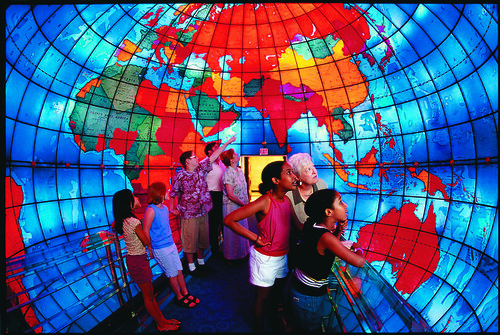
The Mapparium is a Church of Christian Science project started quite awhile back, to nurture greater global awareness within the church. Not just secular governments should be privy to big picture world views. I'm sure the Vatican agrees. Spatial data management systems were an obsession of mine even then, and when AFSC paid my way to Boston, as a part of the Manhattan II project (Daniel Ellsberg and company), I made sure my pilgrimage included a visit to this holy spot.
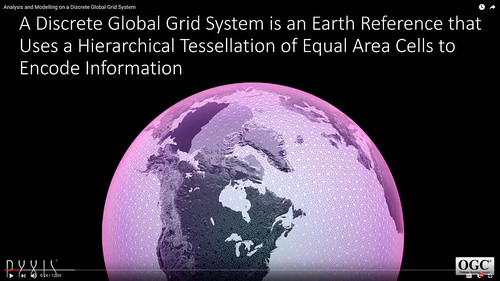
These days I'm looking at DGGS presentations on Youtube, the above picture a screen shot from one of them. Notice the "hexapent" design, a focus of my HP4E campaign. The shoptalk of layers and levels pertains in that one may superimpose several layers at the same level, to tomographic effect, or drop down to show minerals, fossil fuel reserves, coal deposits and so forth.
If you're installing Geopandas using Anaconda, one of the best Python ecosystems, in the sense of convenient, remember to install it in its own conda environment. conda-forge has binary incompatibilities with the default Anaconda installation that are likely to bite you in the butt. Fiona is especially troublesome (that's a package Geopandas requires).
I know what you're thinking: such data layers at the lower levels would be highly prized and mineral exploration companies, oil supranationals and so on, are not about to divulge whatever secrets they've already harvested at great expense. Well, yes and no. The downside of wholly proprietary data sets is if they're not independently auditable, as in verifiable, then confidence in their reliability may suffer, even within a company or government.
Long ago, I wondered if, as a test case, a world class corporation could establish itself outside the US jurisdiction, yet within the boundaries of the United States, per some sovereign tribal, treaty established land. Yes, we know from recent examples that the USG doesn't honor the treaties it signs, but that's beside the point. The question back then is whether this experiment could succeed in principle, and Global Data (not an Inc.) was established with that in mind, as a product in part, of GST (a balancing discipline for Economics the way I cast it back then, and still do to large degree).
Anyway, that's all backstory to today's meeting about DGGS, a global data data management and visualization framework not unlike Google Earth.


Having attended a Process Workshop Institute marathon yesterday (OK, only five hours, with breaks), I had some fresh perspectives to bring to the table, perhaps jarred lose from my internal groupthink matrix.
Glenn and I were able to discuss patterns of information distribution, focusing on such institutions as hair salons (including barbershops) in the archetypal small village. Think of a WestWorld episode if that helps.
The flip side of misinformation-laced "vicious gossip" (or just "gossip") is what we might call "intelligence". The latter often comes with caveats and disclaimers, whereas the former is often "pushed" by people in no mood to be contradicted because they have agendas, which may be time critical. Gossips flock to tabloid journalism, which is sensationalistic by design, intended to stir up outrage in the face of scandal.
I called Uncle Bill from Ringlers along the way. I've cut way back on beer consumption since turning sixty, but haven't gone cold turkey. That was my 16 ounces for Friday. Today, I had my allotted 22 ounces. Having a budget helps. I had taken buses 75 and 15, having returned two overdue library books on statistics to the Belmont Branch, and paid the fine of $3.50.
OSU has more than a big toe invested in DGGS waters. I've been exploring the connections. Having more public macroscope displays is a long time mission for World Game as well, established by the Buckminster Fuller emporium as one of a suite of related 4D enterprises.
Our meet up featured the last lecture in the Complexity series from Great Courses, by professor Scott Page. You can't fix a broken heart with bandaids. What Fullerians call "precession" has everything to do with the maxim: you may control almost nothing, yet influence almost everything.
AFSC flew me to Boston for the Ellsberg summit, but also to meet with AFSC Boston and get ideas for how a youth program might work. As many a mom & pop martial arts studio will attest, having a van really helps if reaching out to minors or non-drivers, yet wanting them at some central site. AFSC Portland actually managed without a van, but then Portland public transit system (Tri-Met) is better than average. Check it out.
Wednesday, May 11, 2005
Global Warming
Doug Strain, age 86, and a principal engineer of the Silicon Forest phenomenon here in Oregon, shared his views on global warming at the Linus Pauling House on Hawthorne yesterday.
Doug's view: it's happening, but likely a rising CO2 level is more an effect than a cause of global warming. The original computer model, out of the Colorado-based National Center for Atmospheric Research (NCAR), wasn't sophisticated enough regarding energy transformations. The sun and oceans are the big players, and neither was sufficiently accounted for at the time CO2 was fingered as a main culprit behind a rise in average global temperature.
Doug describes himself as a life-long metrologist, starting around age 5, when a family photo shows him measuring the snow level. His Scottish grandmother emigrated to the USA and pretty much raised him in early childhood, as both parents worked. She detected his early interest in science and measurement and gave him a copy of some book by Lord Kelvin, which he devoured with gusto.
Early on, Doug invented a way of measuring the fat content in butter using its electrical properties. When the family moved to California, he planned to introduce his invention there, but the demo was a disaster, as in CA, the butter was already salted by the time fat content was tested, which fried his device, spattering butter on his pants. Doug went on to invent many more measuring devices, graduated from Caltech, acquired/named Electro Meaurements Inc., later renamed to Electro Scientific Industries.
Bjorn Lomberg's The Skeptical Environmentalist started Doug down a path of questioning, starting from a strongly green position. He's been a supporter of the Rocky Mountain Institute and renewable energy groups. He still considers himself an environmentalist. But Lomberg spoke to his need to see numbers and diagrams, i.e. to gain access to a lot of relevant global data.
Doug's research led him to start questioning the computer models, and consider a back to basics approach. He hasn't become a pie in the sky optimist. For all we know, the climate changes now underway could be disasterous, but he doesn't think rushing to lower CO2 emissions is necessarily a rational, empirically justifiable response, even if global temperatures are in fact rising with CO2.
The structure of our debate (a Wanderers meeting always turns into a debate) followed along the lines suggested by Jon Bunce: is global warming happening, and if so what are the causes? If global warming is happening, is that a bad thing (maybe it'll forestall a next ice age)? If it is a bad thing, what if anything might humans do to stop, slow or reverse it?
As far as Doug is concerned, it's happening, he's not sure how good or bad it will be, and he doesn't know if there's anything humans can do about it. The global climate has never held steady, with or without humans. Change is the norm, not the exception. Life tries to adapt, plus has an important role to play within the many feedback loops (Gaia Hypothesis). But do we really know enough to take smart corrective action at this point? How might we become smarter faster? Accelerating our rate of knowledge acquisition regarding the planetary ecosystem, not sitting on our hands doing nothing, is the way to go.
I learned from this discussion that Michael Crichton has become embroiled in the global warming controversy, having done three years of research leading up to his latest novel, State of Fear. Here's a quote from Quaker-P last night:
Many at the table agreed that measures people advocate to reverse global warming, such as becoming less dependent on fossil fuels and cleaning up polluted city air, should be undertaken regardless of the impact on global warming i.e. we have other reasons for taking many of these recommended actions.
We went around the table both before and after Doug's presentation, to get a read on where each of us stood on the global warming issue. I was willing to accept that the global models could be improved (no real argument there), and that access to good data remains a priority. A TV camera was running, and I said to the camera we should all drink a lot of coffee -- meaning we need to stay awake, burn the midnight oil pondering these important and perplexing issues.
As for the conventional wisdom, that CO2 is a principal cause of global warming, and human activity a principal cause of CO2, I'm still willing to accept that this may be true. However, I'm also quite willing to give skeptics a hearing. I think Doug did an excellent job presenting an alternative perspective. His goal was to spark debate, and in this he most certainly succeeded.
Doug's view: it's happening, but likely a rising CO2 level is more an effect than a cause of global warming. The original computer model, out of the Colorado-based National Center for Atmospheric Research (NCAR), wasn't sophisticated enough regarding energy transformations. The sun and oceans are the big players, and neither was sufficiently accounted for at the time CO2 was fingered as a main culprit behind a rise in average global temperature.
Doug describes himself as a life-long metrologist, starting around age 5, when a family photo shows him measuring the snow level. His Scottish grandmother emigrated to the USA and pretty much raised him in early childhood, as both parents worked. She detected his early interest in science and measurement and gave him a copy of some book by Lord Kelvin, which he devoured with gusto.
Early on, Doug invented a way of measuring the fat content in butter using its electrical properties. When the family moved to California, he planned to introduce his invention there, but the demo was a disaster, as in CA, the butter was already salted by the time fat content was tested, which fried his device, spattering butter on his pants. Doug went on to invent many more measuring devices, graduated from Caltech, acquired/named Electro Meaurements Inc., later renamed to Electro Scientific Industries.
Bjorn Lomberg's The Skeptical Environmentalist started Doug down a path of questioning, starting from a strongly green position. He's been a supporter of the Rocky Mountain Institute and renewable energy groups. He still considers himself an environmentalist. But Lomberg spoke to his need to see numbers and diagrams, i.e. to gain access to a lot of relevant global data.
Doug's research led him to start questioning the computer models, and consider a back to basics approach. He hasn't become a pie in the sky optimist. For all we know, the climate changes now underway could be disasterous, but he doesn't think rushing to lower CO2 emissions is necessarily a rational, empirically justifiable response, even if global temperatures are in fact rising with CO2.
The structure of our debate (a Wanderers meeting always turns into a debate) followed along the lines suggested by Jon Bunce: is global warming happening, and if so what are the causes? If global warming is happening, is that a bad thing (maybe it'll forestall a next ice age)? If it is a bad thing, what if anything might humans do to stop, slow or reverse it?
As far as Doug is concerned, it's happening, he's not sure how good or bad it will be, and he doesn't know if there's anything humans can do about it. The global climate has never held steady, with or without humans. Change is the norm, not the exception. Life tries to adapt, plus has an important role to play within the many feedback loops (Gaia Hypothesis). But do we really know enough to take smart corrective action at this point? How might we become smarter faster? Accelerating our rate of knowledge acquisition regarding the planetary ecosystem, not sitting on our hands doing nothing, is the way to go.
I learned from this discussion that Michael Crichton has become embroiled in the global warming controversy, having done three years of research leading up to his latest novel, State of Fear. Here's a quote from Quaker-P last night:
[Crichton is] very critical of how science is funded, with continued funding basically contingent upon a certain point of view gaining credence. We could probably progress more quickly with double-blind funding -- in politics too (e.g. you see the money show up in your campaign chest, but it's not altogether tracable, i.e. not really clear who exactly your biggest donors might be -- so keep doing what you're doing, if you're getting support, as you must be doing something right).I hope I'm rendering Michael's views accurately (I haven't read the book yet). Both Doug and Michael are members of the Western Behavioral Sciences Institute (WBSI), and Doug is my source here.
Many at the table agreed that measures people advocate to reverse global warming, such as becoming less dependent on fossil fuels and cleaning up polluted city air, should be undertaken regardless of the impact on global warming i.e. we have other reasons for taking many of these recommended actions.
We went around the table both before and after Doug's presentation, to get a read on where each of us stood on the global warming issue. I was willing to accept that the global models could be improved (no real argument there), and that access to good data remains a priority. A TV camera was running, and I said to the camera we should all drink a lot of coffee -- meaning we need to stay awake, burn the midnight oil pondering these important and perplexing issues.
As for the conventional wisdom, that CO2 is a principal cause of global warming, and human activity a principal cause of CO2, I'm still willing to accept that this may be true. However, I'm also quite willing to give skeptics a hearing. I think Doug did an excellent job presenting an alternative perspective. His goal was to spark debate, and in this he most certainly succeeded.
Thursday, April 10, 2025
Global U vs Planet of the Apes

What the present does is leave records for the future, called the future's past. The present creates the future's past, by making recordings, curating, remembering, memorializing.
These days, humans are engaged in making the collective movie of how they brutalized one another in subhuman fashion, in ways we hope future humans transcend. This was Planet of the Apes. We see it everywhere.
The planet is a mental hospital of sorts, an asylum, and a healing one insofar as we're able to invoke our humanity and create humane conditions. Bucky Fuller's futurism wasn't saying this was our inevitable fate, to act humanely, but that we might choose oblivion instead. Oblivion = Farce. We chose farce.
Closing Time by Norman O. Brown is somewhat required reading for those wanting to trace the transition to the Aquarian Age, as it's all about the coming farce we're now within. We act out, play our roles, dress up, go before the cameras. Politics = Theater.
Fuller's futurism was about how in principle we have the props, the inventory, to stage a "success for humanity" play, and a big part of the challenge is convincing people that was true. China's rise as an economic power, OBOR et cetera, has been encouraging on that front, likewise the growing prosperity of Asia's other little tigers. Portland, a hub city in Cascadia, is a gateway to Asia on the Pacific Rim.
A lot of folks with obsolete educations want to star as heroes but they don't get that it's a farce, because myopic hand wringing about our plight as humans is empty juvenile whining at this point. We have arrived at the point where we see ourselves in the mirror and that it's our choice to keep making this a Planet of the Apes. Our tragic circumstances are self-inflicted at this point, which is what makes them farcical.
The idea behind New Palestine University is the Global University, the university being an older institution than the nation-state. Enrolling refugees into a global system that takes care of them as students and faculty is the name of the game. A benign global company in support of the GU would be Global Data, likewise science fiction (or investment banking once real enough) going back to the 1980s in this author's schemes and dreams.
The refugees of this world should be free to explore the whole planet, without trespassing, because they'll be within their rights on campus facilities, interconnected by airlines. This is really more a model of the status quo than an aspiration, with the caveat that the curriculum is low quality at the moment, by definition. When we see it's Planet of the Apes out there, we look to faculty and ask what they plan to do about it, curriculum-wise.
What I do about it is join with other faculty in finding new shared memes we can build on, such as Global University, Global Data, OBOR, Trucker Exchange, BizMos, Chinese Peace Corps and so on. A big part of what I do is geometric animations, simple GIFs, based in Synergetics, one of our GU disciplines.
Tuesday, June 06, 2006
666
I can't resist the snake oil title, given I won't see another 6/6/6 in my life time, plus I want to write about hexagons (six-sided).
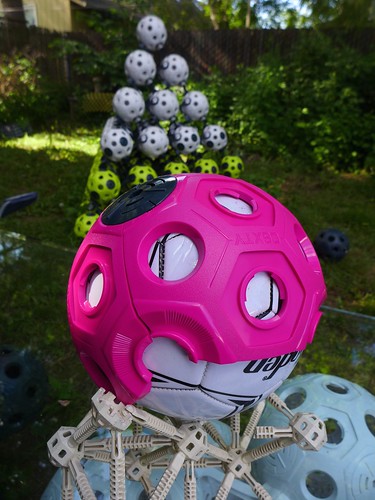
I met with Patrick and Glenn today about the omnipresent hexagonal motif (like the Three Bees logo in that Constant Gardener movie). As Glenn points out, it's iconographic for info-, nano- and bio- technologies, a geometry of nature in some way (the bees are innocent of man's crimes).
Patrick had done a lot of Googling and was well aware of my Pythonic approach to geometry. Still, I take no credit for the static clip below. We need a large open source archive of more dynamic clips as well.
So how do Glenn's Global Matrix and my Global Data fit together? In science fiction that's sometimes hard to tell apart from science fact? Global data does look handsome on a hexapent. Somehow it seems a natural fit. Didn't the Klingons know this?
We brainstormed a child's toy or planner's game: hexagonal tiles represent eco-village components; assemble to suit your eco-surroundings, your specific land- and/or sea- and/or air and/or space scape (could be computer graphical, could be cardboard -- could be made to look like cardboard, but on a computer).
I met with Patrick and Glenn today about the omnipresent hexagonal motif (like the Three Bees logo in that Constant Gardener movie). As Glenn points out, it's iconographic for info-, nano- and bio- technologies, a geometry of nature in some way (the bees are innocent of man's crimes).
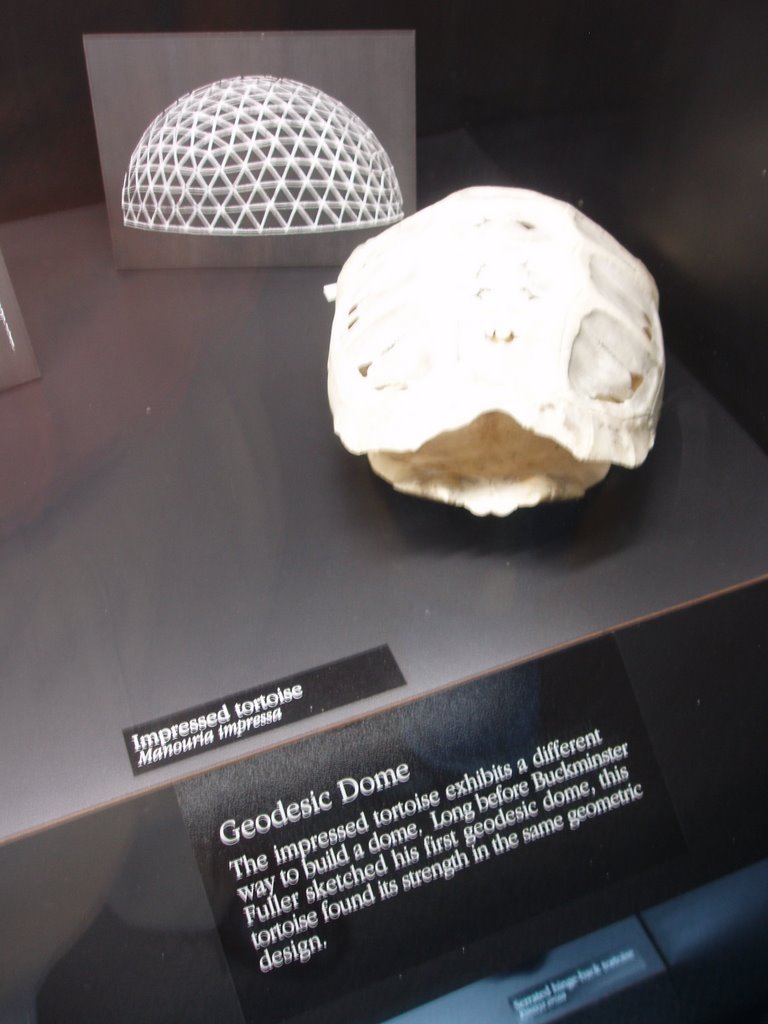
Patrick had done a lot of Googling and was well aware of my Pythonic approach to geometry. Still, I take no credit for the static clip below. We need a large open source archive of more dynamic clips as well.
So how do Glenn's Global Matrix and my Global Data fit together? In science fiction that's sometimes hard to tell apart from science fact? Global data does look handsome on a hexapent. Somehow it seems a natural fit. Didn't the Klingons know this?
We brainstormed a child's toy or planner's game: hexagonal tiles represent eco-village components; assemble to suit your eco-surroundings, your specific land- and/or sea- and/or air and/or space scape (could be computer graphical, could be cardboard -- could be made to look like cardboard, but on a computer).
Monday, April 06, 2009
GIS Meeting
I'm not marketing myself as a GIS expert, not primarily, and so know enough to recruit a current PSU student to fill me in on some of what's cooking.
We met at The Bagdad and went over some stuff, me explaining about the broken pipeline using the e | m | h | c motif, which looks cryptic, but just means elementary then middle then high school then college, or basically K-16. We see a break pre-college, when a lot of students feel heartbroken that they'll never "get math".
Our proposed fix is to use FOSS. GIS / GPS uses FOSS too (per FreeGIS etc.), so that's the bridge.
I learned more about SEEDS and Corpus Linguistics. There's both a physical and a mental geography, in the sense that zip code areas might be filled in with more DemocracyLab data.
I explained about the idea of deliberately spicing your rants with icons, changing the markup behind the scenes, because we want the search algorithms to take these rants into account i.e. we work with the grain of the design, to make the summary representations more cogent.
We're not summarizing in some distant board room, sharing exclusive secrets. The mirroring is right back to the ranting public, providing feedback for steering.
Anyway, the DemocracyLab stuff was more a sidelight. More to the point was the urban gardens, their interplay with the schools, institutional buyers. We want to improve the cafeteria food with Farmer's Market type produce, something Portland is already doing to a limited extent.
Even more to the point, the GIS systems need to show kids where the animals might be, including domesticated farm animals like sheep (a theme for today), and semi-wild animals like muskrats, herons, possums, coyotes, deer and raccoons, all native to Greater Portland.
Make that a Python list, then study some GIS maps, help with the data collection in some case. I saw both a heron and muskrat today, near Dignity Village.
I talked a lot about my visit to Immersive Media with my University of Rochester connection. If you get to practice your skills in some immersive world, like Second Life, then graduate to the real deal in some field trip up the Columbia Gorge, then maybe you'll be less likely to peel off from our math track. You'll think it's exciting and relevant and the GIS objects we give you (an API) will impress you with their power and ease of use.
Maybe you'll get to make mashups? Having mastery over a Controller (often a computer language) in the MVC design, is a key to future happiness in this regard. MIT's Media Lab's work on the Landman Report Card is a case in point.
Close to the surface in my thinking was Glenn's global matrix approach, which uses simple and elegant mnemonics to add more of a time dimension to these global data displays, i.e. he pushes global awareness back to those ancient civilizations we read about in Critical Path as well.
In my "road show" model, I'm able to segue to or from Glenn's segments pretty easily, the idea being to field a rotating cast with swappable members.
I look at Cubespace as a base for some of these trainings, Wanderers for others, e.g. I represented ISEPP at Pycon when doing my three hours, with segues to contributions from both Steve (PSF) and Ian (Tizard / Stanford).
In terms of fantasy worlds, I don't mind asking "where is Python Nation?" as like a question about Middle Earth. Now that Pycon has this Rivendale reputation, that's easy to do, plus the geography is actually quite well developed, thought out.
I alluded to Middle Earth in last year's Chicago talk as well, referring to Moria, a next stage on the journey after an abortive attempt to tackle an over-mountain pass -- metaphorically, Calculus Mountain, a chief obstacle on the older maths track, pre discrete math getting more of a footprint, thanks to FOSS and Portland's innovative math teaching subcultures (MLC a good example).
We met at The Bagdad and went over some stuff, me explaining about the broken pipeline using the e | m | h | c motif, which looks cryptic, but just means elementary then middle then high school then college, or basically K-16. We see a break pre-college, when a lot of students feel heartbroken that they'll never "get math".
Our proposed fix is to use FOSS. GIS / GPS uses FOSS too (per FreeGIS etc.), so that's the bridge.
I learned more about SEEDS and Corpus Linguistics. There's both a physical and a mental geography, in the sense that zip code areas might be filled in with more DemocracyLab data.
I explained about the idea of deliberately spicing your rants with icons, changing the markup behind the scenes, because we want the search algorithms to take these rants into account i.e. we work with the grain of the design, to make the summary representations more cogent.
We're not summarizing in some distant board room, sharing exclusive secrets. The mirroring is right back to the ranting public, providing feedback for steering.
Anyway, the DemocracyLab stuff was more a sidelight. More to the point was the urban gardens, their interplay with the schools, institutional buyers. We want to improve the cafeteria food with Farmer's Market type produce, something Portland is already doing to a limited extent.
Even more to the point, the GIS systems need to show kids where the animals might be, including domesticated farm animals like sheep (a theme for today), and semi-wild animals like muskrats, herons, possums, coyotes, deer and raccoons, all native to Greater Portland.
Make that a Python list, then study some GIS maps, help with the data collection in some case. I saw both a heron and muskrat today, near Dignity Village.
I talked a lot about my visit to Immersive Media with my University of Rochester connection. If you get to practice your skills in some immersive world, like Second Life, then graduate to the real deal in some field trip up the Columbia Gorge, then maybe you'll be less likely to peel off from our math track. You'll think it's exciting and relevant and the GIS objects we give you (an API) will impress you with their power and ease of use.
Maybe you'll get to make mashups? Having mastery over a Controller (often a computer language) in the MVC design, is a key to future happiness in this regard. MIT's Media Lab's work on the Landman Report Card is a case in point.
Close to the surface in my thinking was Glenn's global matrix approach, which uses simple and elegant mnemonics to add more of a time dimension to these global data displays, i.e. he pushes global awareness back to those ancient civilizations we read about in Critical Path as well.
In my "road show" model, I'm able to segue to or from Glenn's segments pretty easily, the idea being to field a rotating cast with swappable members.
I look at Cubespace as a base for some of these trainings, Wanderers for others, e.g. I represented ISEPP at Pycon when doing my three hours, with segues to contributions from both Steve (PSF) and Ian (Tizard / Stanford).
In terms of fantasy worlds, I don't mind asking "where is Python Nation?" as like a question about Middle Earth. Now that Pycon has this Rivendale reputation, that's easy to do, plus the geography is actually quite well developed, thought out.
I alluded to Middle Earth in last year's Chicago talk as well, referring to Moria, a next stage on the journey after an abortive attempt to tackle an over-mountain pass -- metaphorically, Calculus Mountain, a chief obstacle on the older maths track, pre discrete math getting more of a footprint, thanks to FOSS and Portland's innovative math teaching subcultures (MLC a good example).
Monday, April 20, 2020
Test Piloting
My frequency of posting has dropped somewhat, ditto Youtubes, but then for years I didn't do any Youtubes. After a spike in productivity, lasting over a year in that genre, I'm not insisting a uniform distribution here on out.
Carol turns 91 tomorrow and is here in Portland riding out the Covid Storm. Whatever that means. You had to be there, right?
By "test piloting" in the title I mean with respect to various curriculum segments, which I try out. My privilege has been continued access to a range of age levels, from say middle school, occasionally younger, up to adult.
The curriculum segments I test are disproportionately weighted towards communicating a brand of American Transcendentalism I favor, a kind of culturally literate philosophy that takes in fascination with phi and pi, and a lot more besides.
I'm speaking of the "Bucky stuff" of course, which could be used as a broad umbrella, getting out there to circus tent dimensions. In other words, I'm not trying to limit myself unnecessarily. I'm still getting my feet wet in a lot of swimming holes where others have swimmed (swum?) for years.
More recently, I've been revisiting the ubiquitous-on-Twitter (and elsewhere) World of Data Science. What Bayesian World have we accessed, wherein all this kind of stuff is the case? What is the likelihood of the world I inhabit. Be that as it may, it appears that I do, but perhaps my problem is overly fixed beliefs? Am I insensitive to continuing revelations? These are the questions a data science is always posing, to both self and others.
What is the likelihood that the Concentric Hierarchy as I call it, should be dismissed as irrelevant, as noise? I'm not saying that happened. On the contrary, the great thinking of great thinkers has continued to make an impression in our shared civilizational template. I'm in pass the torch mode, working to save (salvage) what I'm able to save.
Given that I have a kind of platform, and take that seriously, I continue doing homework a lot, piecing it together. I'm always looking to other faculty and students for feedback in this cybernetic, global university I sometimes nickname the Global U. Before that, I envisioned myself working for the Global Data Corporation. I wanted some kind of tribal jurisdiction for it.
My Heuristics for Teachers on Wikieducator shows how I'd partitioned a generalist curriculum using the compass directions of future versus past, logistics versus risk assessment, given each of them quirky names: Martian, Neolithic, Supermarket and Casino respectively, with the suffix Math for each one. Casino Math was the math of probability, confidence, assurity and so on, per this particular partitioning of course. I embedded it in the Silicon Forest somewhere, with geocaching (treasure maps).
All of which is to say, I've made something of a career out of testing curricula, and I'm fine sharing that with my latest testees, as we know this is the common process, whereby we all update one another.
Carol turns 91 tomorrow and is here in Portland riding out the Covid Storm. Whatever that means. You had to be there, right?
By "test piloting" in the title I mean with respect to various curriculum segments, which I try out. My privilege has been continued access to a range of age levels, from say middle school, occasionally younger, up to adult.
The curriculum segments I test are disproportionately weighted towards communicating a brand of American Transcendentalism I favor, a kind of culturally literate philosophy that takes in fascination with phi and pi, and a lot more besides.
I'm speaking of the "Bucky stuff" of course, which could be used as a broad umbrella, getting out there to circus tent dimensions. In other words, I'm not trying to limit myself unnecessarily. I'm still getting my feet wet in a lot of swimming holes where others have swimmed (swum?) for years.
More recently, I've been revisiting the ubiquitous-on-Twitter (and elsewhere) World of Data Science. What Bayesian World have we accessed, wherein all this kind of stuff is the case? What is the likelihood of the world I inhabit. Be that as it may, it appears that I do, but perhaps my problem is overly fixed beliefs? Am I insensitive to continuing revelations? These are the questions a data science is always posing, to both self and others.
What is the likelihood that the Concentric Hierarchy as I call it, should be dismissed as irrelevant, as noise? I'm not saying that happened. On the contrary, the great thinking of great thinkers has continued to make an impression in our shared civilizational template. I'm in pass the torch mode, working to save (salvage) what I'm able to save.
Given that I have a kind of platform, and take that seriously, I continue doing homework a lot, piecing it together. I'm always looking to other faculty and students for feedback in this cybernetic, global university I sometimes nickname the Global U. Before that, I envisioned myself working for the Global Data Corporation. I wanted some kind of tribal jurisdiction for it.
My Heuristics for Teachers on Wikieducator shows how I'd partitioned a generalist curriculum using the compass directions of future versus past, logistics versus risk assessment, given each of them quirky names: Martian, Neolithic, Supermarket and Casino respectively, with the suffix Math for each one. Casino Math was the math of probability, confidence, assurity and so on, per this particular partitioning of course. I embedded it in the Silicon Forest somewhere, with geocaching (treasure maps).
All of which is to say, I've made something of a career out of testing curricula, and I'm fine sharing that with my latest testees, as we know this is the common process, whereby we all update one another.
Monday, July 11, 2022
The Geoscope

Fuller's critics may object that he no more invented the idea of a globe than Copernicus discovered the sun, and this is true.
What he invented he named the Geoscope and once you have a word to your name, it's yours to aim and fire, so to speak, meaning it's up to you to impart spin and trajectory.
In Bucky's case, this meant another overture to the United Nations, as his crowning achievement in the geoscope department would have been the one in the East River. In his oeuvre Critical Path, in conjunction with Kiyoshi, Fuller was celebrating the UN even as he claimed to chronicle the twilight of the world's power structures. Erhard's group was celebrating the UN around the same time.
If you wonder about where the Foster Gamble camp inserts a bifurcation, distancing itself from the Fuller School, it's in its choice of conspiracy theories that cast the United Nations as a bad egg. Bucky is less interested in goodies versus baddies, first of all, nor is he against the spread of rights to humans, versus to pseudo-humans (the bots, the corporations).
The Geoscope would not have meant what it did had the same inventor not come up with a certain world map, deemed by analysts to be unique, less for its mathematics (it achieved the same low distortions as the best of them) than for its deployment of the sinuses to echo new Cold War themes, and also the themes of commercial jet travel.
In both cases, the polar route, and in particular the north polar route, had become center stage. As development moves to that arctic circle, the same configuration of the continents is likely to suggest itself.
However, missing from the above analysis is the more obvious distinction: the Dymaxion Map was not about the political anatomy of the world as dreamed up by skilled imagineers (a term from Disney).
The Fuller Projection was not especially friendly to the nation-state jigsaw puzzle in other words, a way of keeping it less dated, more timeless.
Maps go out of date as nations come and go. Not so the Dymaxion.

Those of us who do care about the mathematics are more interested in the tiling algorithms, and how these design and serve hexagons and pentagons from any stash of global data. Or do they serve other polygons, perhaps trapezoids. The latitude-longitude grid lines define a trapezoidal framework. Those could be useful too.
Showing several hexagons around the Texas-Mexico border, when doing weather for example, would help burn in the major towns and roads, mountains and rivers. Weather reporting is a daily geography lesson. As truckers become accustomed to a driving region, they come to know its highways and byways.
This is what truckers come to know: their GPS systems. The first thing any truck simulator should provide is one of those hexagonal tile displays with global data. How do we know it's hexagonal? I'm talking about commercial branding. I'm talking about World Game now.
Sunday, August 25, 2013
Policy Debates and Advisories
In a recent public speech by a native American and treaty rights activist, I learned of some government official saying "someday" the toxic radioactive waste from Hanford might make it into the ground water.
She pointed out how misleading that comment was, as that day is already long in the past. People taught to stay ignorant and take their cues from pastoral cattle prod wielders (aka pastors) are not known for their acuity in debate.
Natives confront vast hordes of average know-nothing Americans who take on faith what "the government" tells them. That leaves them feeling lonely, surrounded by a sea of mindlessness.
Anyway, the ability to discuss radioactivity in the environment in scientific and rational terms begins with simple acceptance. Nuclear meltdowns have occurred and that era of safety we were promised by some (most are too young to remember) was never backed by the engineering.
PR is rice paper thin sometimes. If you choose to fall for a false facade, at some point blame yourself, draw that line. If you're a sucker, suck it up.
However, I'm not into "blame the victim" as a favorite art form. The innocent people around Chernobyl were simply not in the loop. Then as now, sensor readings were hard to come by. I just did a survey of Oregon's public sites and so many of them were saying "we're so sure there's nothing to worry about we're just not taking readings."
That's like students saying, these exercises in our math books have been solved thousands of times by our ancestors (yes, our textbooks are old), the solutions are known and shared in teacher manuals. Why do you make us slog through solving these problems the solutions to which are already known? The answer is obvious: so that you might be ready to put out a fire when it comes to your home.
Just develop the practice of taking readings. The art of placing sensors, and reading them, is a skill in itself (not that it's always that easy as sometimes your "sensors" are dead birds and fish).
Place sensors in "perfectly normal" areas and practice reading them and proving a reliable source of data.
Find parameters it makes sense to measure and develop a model of how theses parameters inter-relate.
Draw on existing research and resist temptation to become overly secretive about your findings, condemning yet another generation to rediscovering what you already knew.
I am pleased that resort casinos understand the museum industry as a worthy interface between a specialized culture and a lay public. The Warm Springs Reservation has an excellent museum, as do the Pueblo in Albuquerque. The interpretive center as an institution makes sense to "Indians" as it would to ETs.
The System of Reservations (aka "jurisdictions" or "zones") which the Federation of States United (FSU) put in place -- I'm getting it slightly wrong, close enough -- is well-positioned within the museum industry to keep educating the public about the ecosystem and its cause and effect networks (its "karmic wheels" as some call 'em, meaning they're super-size big and slow-turning, not human, and/or sometimes they're atomic / subatomic).
Call them science museums if you wish. OMSI is a good representative. Where art meets science is in the science of effective presentation, which includes Tufte but also Crumb, Disney, and Dr. Seuss. We use animation and simulation to impart information.
Not all exhibits need take the same broad path or recruit the same public. Highways and byways remain useful. I've got my eye on the Portland Hilton for some esoteric events.
Changing topics a little, I wonder about how the abortion debate would reshape if deformities per pregnancy were on the rise. I'm not saying that's our world at this moment but imagine the moral debates in such circumstances, wherein viable offspring are a rarity and may have to come from implanted genetic material kept in lead-lined repositories deep within the planet (call it Krypton if that makes you feel any better -- I'm fine with generalizing beyond Earth).
Back to measurement-making and sharing results: sensor networks are not intrinsically about "worrying" and/or "not panicking" the public. They're intrinsically more neutral than that, like thermometers and barometers. Their mere presence is not saying anything about what's expected. When people with measuring devices show up, or fly instruments over you in drones, they're not necessarily foretelling doom. They're about providing reliable global data that might be good news as well as bad. The information may leave you indifferent. But at least the information is being collected. "No change" means you're establishing a baseline.
New scouts need to learn to make a fire. To take a reading is routine. To log a result is your habit. Data gathering is something humans do. If they ask you why you're attending to sensors and sensor data, taking readings, ask them why they're not. When you monitor your environment, you are "minding your own business" -- don't let them tell you otherwise. Tell them you're working for a museum, the one that will treasure your data someday.
If you need to focus on the "half full" aspects of the glass, closet pessimist that you are (an "out there" optimist), then subscribe to RSS feeds about happy camper villages where air quality is going up and people are happier with their lives than ever. I'm not saying you won't find such news if you dig. I'm subscribed to a few of those channels myself.
Summary statements:
Just don't let yourself off the hook if you prove yourself gullible. At some level, you need to set your own standards. Suck it up and move on. Don't use the shock of finding yourself hoodwinked (fooled), lied to, as an excuse to stop probing.
You have a right to keep puzzling away, trying to think it through, whatever "it" is. Admit you've been lied to, and you believed, and make that part of your mental model going forward. That does not mean to never again extend trust. That's a decision to keep making: when to trust, when to not.
People lie, some are paid to, and your ability to discern "the story" will be continually challenged. Accept the challenge. Remember computer games. You get to die many times.
If you watched a lot of cop and detective shows, or read those books, you have that scientists' sense that true stories have this advantage over false ones: they cross-check and omni-triangulate, demonstrate internal consistency, to a much higher standard than cobbled-together postpone-the-day-of-reckoning falsehoods.
The latter (make-believe fabrications) tend to fall apart upon probing, which is why a lot of times it's really up to the prober: how much do I want to believe this story?
Acknowledge your biases, at least to yourself. Is it shameful to wish for better living standards for sentient beings? Was the mistake that you trusted, or that you were let down? It cuts both ways.
She pointed out how misleading that comment was, as that day is already long in the past. People taught to stay ignorant and take their cues from pastoral cattle prod wielders (aka pastors) are not known for their acuity in debate.
Natives confront vast hordes of average know-nothing Americans who take on faith what "the government" tells them. That leaves them feeling lonely, surrounded by a sea of mindlessness.
Anyway, the ability to discuss radioactivity in the environment in scientific and rational terms begins with simple acceptance. Nuclear meltdowns have occurred and that era of safety we were promised by some (most are too young to remember) was never backed by the engineering.
PR is rice paper thin sometimes. If you choose to fall for a false facade, at some point blame yourself, draw that line. If you're a sucker, suck it up.
However, I'm not into "blame the victim" as a favorite art form. The innocent people around Chernobyl were simply not in the loop. Then as now, sensor readings were hard to come by. I just did a survey of Oregon's public sites and so many of them were saying "we're so sure there's nothing to worry about we're just not taking readings."
That's like students saying, these exercises in our math books have been solved thousands of times by our ancestors (yes, our textbooks are old), the solutions are known and shared in teacher manuals. Why do you make us slog through solving these problems the solutions to which are already known? The answer is obvious: so that you might be ready to put out a fire when it comes to your home.
Just develop the practice of taking readings. The art of placing sensors, and reading them, is a skill in itself (not that it's always that easy as sometimes your "sensors" are dead birds and fish).
Place sensors in "perfectly normal" areas and practice reading them and proving a reliable source of data.
Find parameters it makes sense to measure and develop a model of how theses parameters inter-relate.
Draw on existing research and resist temptation to become overly secretive about your findings, condemning yet another generation to rediscovering what you already knew.
I am pleased that resort casinos understand the museum industry as a worthy interface between a specialized culture and a lay public. The Warm Springs Reservation has an excellent museum, as do the Pueblo in Albuquerque. The interpretive center as an institution makes sense to "Indians" as it would to ETs.
The System of Reservations (aka "jurisdictions" or "zones") which the Federation of States United (FSU) put in place -- I'm getting it slightly wrong, close enough -- is well-positioned within the museum industry to keep educating the public about the ecosystem and its cause and effect networks (its "karmic wheels" as some call 'em, meaning they're super-size big and slow-turning, not human, and/or sometimes they're atomic / subatomic).
Call them science museums if you wish. OMSI is a good representative. Where art meets science is in the science of effective presentation, which includes Tufte but also Crumb, Disney, and Dr. Seuss. We use animation and simulation to impart information.
Not all exhibits need take the same broad path or recruit the same public. Highways and byways remain useful. I've got my eye on the Portland Hilton for some esoteric events.
Changing topics a little, I wonder about how the abortion debate would reshape if deformities per pregnancy were on the rise. I'm not saying that's our world at this moment but imagine the moral debates in such circumstances, wherein viable offspring are a rarity and may have to come from implanted genetic material kept in lead-lined repositories deep within the planet (call it Krypton if that makes you feel any better -- I'm fine with generalizing beyond Earth).
Back to measurement-making and sharing results: sensor networks are not intrinsically about "worrying" and/or "not panicking" the public. They're intrinsically more neutral than that, like thermometers and barometers. Their mere presence is not saying anything about what's expected. When people with measuring devices show up, or fly instruments over you in drones, they're not necessarily foretelling doom. They're about providing reliable global data that might be good news as well as bad. The information may leave you indifferent. But at least the information is being collected. "No change" means you're establishing a baseline.
New scouts need to learn to make a fire. To take a reading is routine. To log a result is your habit. Data gathering is something humans do. If they ask you why you're attending to sensors and sensor data, taking readings, ask them why they're not. When you monitor your environment, you are "minding your own business" -- don't let them tell you otherwise. Tell them you're working for a museum, the one that will treasure your data someday.
If you need to focus on the "half full" aspects of the glass, closet pessimist that you are (an "out there" optimist), then subscribe to RSS feeds about happy camper villages where air quality is going up and people are happier with their lives than ever. I'm not saying you won't find such news if you dig. I'm subscribed to a few of those channels myself.
Summary statements:
Just don't let yourself off the hook if you prove yourself gullible. At some level, you need to set your own standards. Suck it up and move on. Don't use the shock of finding yourself hoodwinked (fooled), lied to, as an excuse to stop probing.
You have a right to keep puzzling away, trying to think it through, whatever "it" is. Admit you've been lied to, and you believed, and make that part of your mental model going forward. That does not mean to never again extend trust. That's a decision to keep making: when to trust, when to not.
People lie, some are paid to, and your ability to discern "the story" will be continually challenged. Accept the challenge. Remember computer games. You get to die many times.
If you watched a lot of cop and detective shows, or read those books, you have that scientists' sense that true stories have this advantage over false ones: they cross-check and omni-triangulate, demonstrate internal consistency, to a much higher standard than cobbled-together postpone-the-day-of-reckoning falsehoods.
The latter (make-believe fabrications) tend to fall apart upon probing, which is why a lot of times it's really up to the prober: how much do I want to believe this story?
Acknowledge your biases, at least to yourself. Is it shameful to wish for better living standards for sentient beings? Was the mistake that you trusted, or that you were let down? It cuts both ways.
Sunday, November 28, 2004
Quaker Politics
 One story Quaker parents love to tell their kids is about this time when some native Americans (so-called Indians) barged into a Quaker meeting, tomahawks drawn, looks to kill. The navams were there to rumble, to get rough with the pale faced occupiers who were turning their lives inside out. Well, the story goes, the Quakers just sat there in silent worship, per standard practice, radiating a sense of peace and spiritual depth (OK, some were scared witless, let's be honest). The Injuns "got it" immediately; yeah, Spirit, cool. They sat down amidst the Quakers and together they had a gathered meeting. One imagines a potluck ensued, but the story basically fades out at this point.
Now, the point of this story is not that Quakers were skillfull at converting heathen to Christianity. On the contrary, the point is that Quakers are very clear that humans have this power to attend to the Spirit -- this is part of the generic design. This power is strongly expressed in many traditions, and certainly in pre-colonial North America. What happened, when anglos and natives worshipped together, was mutual recognition of that Inner Light within each individual. Buddhism calls it the Dharma, or Teaching. Personified, one might name it the Christ, or Inner Teacher (cite St. Augustine). In any case, all theology aside, the point of this story is my brand of Quaker considers the Spirit to be essentially innocent of religion and denomination, and all the attending claptrap. Humans (sometimes very gifted) invent these various brands, as much in the religious sphere as in the commercial (and yes, Quaker Oats was our idea: Floyd Schmoe's grandmother gets the credit -- see Lives That Speak, ISBN 2-888305-32-0, pg. 116).
Consequent to all of the above, I'm starting a denomination of Quaker that abandons "membership" as a category and recognizes only the various species of attender, as in "attending to Spirit." The word "Friend" in "Religious Society of Friends" (the more formal name for the Quakers), traces to a Biblical passage (John 15:15) wherein Jesus says he wants friends, not servants, i.e. peers, colleagues, people willing to do hard work without always begging him to boss them around (he's busy enough as it is). But friendship doesn't commensurate with the clubby aesthetics of a membership organization. One may fall out of friendship, stop attending to Spirit.
Yet some Quakers think they're Friends for life, just by virtue of membership in some Society. I say not. Jesus was friendly with all sorts of characters, outside his immediate circle of disciples (they gave him flak for it -- tax collectors? Roman soldiers?). Whether you're a friend of Jesus or not is really up to him, not some clearness committee or business meeting minute. Having served on Oversight for like seven years or something, I'm confidant in saying that Friends spend entirely too much time worrying about membership (who is, who isn't, who might become one, who should no longer be one). It's obsessive-compulsive at this point in history. I'd rather not bother. Attenders only, end of story. And I recognize that my brand of Quaker is taking the minority view here -- a fact which bothers me not one whit.
A side-benefit of tossing out membership is I'm free to export Quaker technology to others without suggesting that I'm seeking their membership in my religion. For example, the Quaker Meeting for Worship for Business is a good invention, has helped many a Quaker company steer its way safely forward through high risk conditions. It's a cybernetic system with Spirit in the loop. Go ahead and study our ways, use the technology, and don't worry that in doing so you'll be trading away Islam for Christianity (for instance). That's not the point. The point is to keep Spirit in the loop, or Allah, or Great Spirit -- use your favorite terminology, and see where it takes you.
Regarding Native Americans, I've suggested we go back to joint venturing, like in the old days. One vehicle I've proposed we evolve together is my Global Data Corporation. I've run this by the US Congress a few times over the years, lobbying for a special loophole that would allow tribal nations to serve in and manage corporate structures not strictly grounded in anglo jurisprudence. Like, we're imitating some of the branding techniques (logo, letterhead, commercials), but we're not an Inc. or LLC in the traditional whiteman sense. Making money for stakeholders is not our primary responsibility (long term sustainability is a goal). Also, we don't buy the doctrine of corporate personhood, a programming error (bug) which lacks realism, seems rooted in superstition.
I don't think my loophole is unreasonable: not everyone should have to master whiteman law before being allowed to do business in this world. Other traditions have their own sense of self-governance, fairness. Furthermore the whiteman model of corporate governance is manifestly broken in so many ways, is so deficient in the role model department.
Bottom line: whiteman legalese is already obsolete in large degree, although the anglos are slow to admit it. The Global Data Corporation is more into using engineering-savvy general systems theory instead. Economists, MBAs, corporate lawyers, may not have the necessary training and background to access our top management positions. That's why we'll need to start a lot of new schools. I'll post more about that some other day (plus there's already a lot on file).
Related reading:
My letter to Friends re becoming an attender (July 24, 2000)

Friday, May 04, 2018
Youtube Content
Glenn has been researching the B Corporation as a background institutional framework. Today, however, was the meeting on personnel. We both think the CSN CTO might be the best at video editing. He and I as talking heads need to be balanced with other content.
Yes, I'm talking about Youtube content. When I first moved to Portland we were looking to Comcast, to which the City had given the keys in exchange for some community television facilities. I was able to get on, do some work in front of the camera. I think I did some editing. Another Glenn I know has done a lot of editing. Award winning. High school friend. Manila.
The B Corporation, Global Matrix lets call it (shades of Global Data), is about giving some of our Pauling House talent an opportunity to get studio air time if wanting it. I'm in studio almost every weeknight, doing closed circuit. That's not the Youtube model though. I did some pilot studies, testing the waters. Those needing more "spy camp" knowledge got their A & B modules, T & E modules. Not forgetting the S.
Yes, I'm tracking the Jupyter Notebook breakthroughs: winner of the ACM award and major feature it Atlantic Monthly this April. I've been yakking with the physics teachers about it, thanking them for Jake VanderPlas tutorials, his Pycon keynote.
Astronomers, including at Space Telescope Institute, have done wonders for Python's street cred.
Stockton knows a lot about white water rafting. He's recovering from an injury at the moment, but I wouldn't put it past him to shoot down the Deschutes. My "math is an outdoor sport" meme is about exercising body as well as brain, but also becoming practiced at noticing patterns. Rivers have their pattern language. A certain type of swerve predicts an eddy, perhaps a beach, another fast current on an opposite shore... Glenn knows all about it.
If you fall overboard and end up in "the Maytag" swim down to get out of it. That's what a lot of people would not try, out of reflex. Scuba has secret knowledge like that too. Which is why it really helps to have a teacher. I had Gill Gilleland in Manila. I'm no white water rafter though. The roller coaster at Oak's Park is closer to my speed.
His Global Matrix is about layered data on a Macroscope, the proverbial illuminated globe of Mapparium fame, hexapent in design. Ultimately the planets don't have to be real. Subject matter, so-called fields, map to planets just fine. Physics Planet and so on.
I'm into timelines myself and keep looking for the best timeline sites. You'll want to know who knew whom, but that's not always information to easily come by. The Economist is dropping its rules against split infinitives by the way (I just read that this morning, coming down from Mt. Tabor).
Monday, October 24, 2016
Revisiting Lambda Calc
Technical readers may consider my version of the "lambda calculus" watered down, much as the Python "little lambda", in being just the one expression, is but a pale shadow of the Great Lambda worshiped further to the north of Python Nation, were such nations to geographically exist.
OK, I've likely lost the rest of you too, so never mind.
But you've heard of "functional programming" yes?
There's this wish to say
-- or something like that. The context may be as mundane as "functional CSS".
The goal is to straightforwardly image some model's state. Take a picture of the world, or some small part of it. Keep the model and its rendering separate, with the rendering pipeline consisting of deterministic components.
My story, in defending my use of "lambda calculus" is I'm keeping memes that belong together, together, so what's the fuss? I'm contrasting it with "delta calculus" as a way to get traction with my would be end users.
What end users?
As you'll recall, where I'm taking my "lambda calculus" is in the Sesame Street direction (some might suggest we call it that) towards any-school's interpretation of some "computer math" pre-college.
Even oldsters as old as me, and older, will feel somewhat duty-bound to keep sharing, with other teachers if not directly with their students, about how to maybe summarize what's happening behind the scenes, succinctly and concisely.
This "computer math" includes the basics of Group and Number Theory, with a practical application in RSA, the public key cryptographic algorithm. That's an outline of your curriculum right there, minus the spatial geometry component, the global data (big data, round data).
No, I've got nothing against Diffie-Hellman (what Ian featured at the Chicago Pycon) and I don't dictate a choice of computer language. Use Ruby if you prefer. Try a bunch. JavaScript is improving.
I just so happen to share about the RSA algorithm using Python, making use of the binascii.hexlify() and unhexlify functions to turn a sample phrase into a number ready to raise to a power, then raise again to get it back. My goal is to keep it simple.
In modulo arithmetic, operations tend to be circular and in RSA we keep secret what pairs with some N to make an encrypted message come back around again. The genius is the secret never needed to leave Alice's computer for Bob to be able to send her encrypted (private) stuff.
I'm not diving into RSA in a spirit of high dudgeon, though I'm plenty aware that governments might have preferred a world wherein "we the people" did not include every little mom & pop shop.
The only reason we have a modicum of transactional security, including to some degree around cyber-monies like bitcoin, is because "computer math" is commercially oriented, not just some military secret, a weapon, as it might have been. I understand the need to protect this civilian heritage.
However I'm coming mainly from a pragmatic impulse to share a "how things work" approach to everyday tech. If our people are to reason about the world they're in, then understanding about Bob and Alice, and "evil Eve" (to whom we owe so much as a penetration expert) is just a part of the package.
We'll also want to keep talking about tcp / ip more generally, and not just DNS (much in the news lately). What's the issue with IPv6? Is there a road block of some kind?
We want the journalism to stay technical, and we want to stay savvy enough to follow it.
Lets start building the necessary reading skills pretty early, using cartoons and puppets if that helps.
In many cases, we simply want to be able to follow our own stories to their logical conclusions, and not get lost in the woods because we've forgotten our lambda calculus. How can we keep playing glass bead games if we're missing too many marbles? Keep the puzzle pieces on the table, so that random individuals have a fighting chance of figuring stuff out.
I'm not saying every high school kid needs to tackle the Y-combinator pattern, but why not get to within striking distance?
You may still opt for the usual "delta calculus" of Newton and Leibniz, of Cauchy and Weierstrass, perhaps exclusively, perhaps in addition. Nowadays we have this other math, this lambda calculus stuff for you too. We offer choices.
OK, I've likely lost the rest of you too, so never mind.
But you've heard of "functional programming" yes?
There's this wish to say
UI = visualization (immutability )
or
subjectivity = interpretation (objectivity)
-- or something like that. The context may be as mundane as "functional CSS".
The goal is to straightforwardly image some model's state. Take a picture of the world, or some small part of it. Keep the model and its rendering separate, with the rendering pipeline consisting of deterministic components.
My story, in defending my use of "lambda calculus" is I'm keeping memes that belong together, together, so what's the fuss? I'm contrasting it with "delta calculus" as a way to get traction with my would be end users.
What end users?
As you'll recall, where I'm taking my "lambda calculus" is in the Sesame Street direction (some might suggest we call it that) towards any-school's interpretation of some "computer math" pre-college.
Even oldsters as old as me, and older, will feel somewhat duty-bound to keep sharing, with other teachers if not directly with their students, about how to maybe summarize what's happening behind the scenes, succinctly and concisely.
This "computer math" includes the basics of Group and Number Theory, with a practical application in RSA, the public key cryptographic algorithm. That's an outline of your curriculum right there, minus the spatial geometry component, the global data (big data, round data).
No, I've got nothing against Diffie-Hellman (what Ian featured at the Chicago Pycon) and I don't dictate a choice of computer language. Use Ruby if you prefer. Try a bunch. JavaScript is improving.
I just so happen to share about the RSA algorithm using Python, making use of the binascii.hexlify() and unhexlify functions to turn a sample phrase into a number ready to raise to a power, then raise again to get it back. My goal is to keep it simple.
In modulo arithmetic, operations tend to be circular and in RSA we keep secret what pairs with some N to make an encrypted message come back around again. The genius is the secret never needed to leave Alice's computer for Bob to be able to send her encrypted (private) stuff.
I'm not diving into RSA in a spirit of high dudgeon, though I'm plenty aware that governments might have preferred a world wherein "we the people" did not include every little mom & pop shop.
The only reason we have a modicum of transactional security, including to some degree around cyber-monies like bitcoin, is because "computer math" is commercially oriented, not just some military secret, a weapon, as it might have been. I understand the need to protect this civilian heritage.
However I'm coming mainly from a pragmatic impulse to share a "how things work" approach to everyday tech. If our people are to reason about the world they're in, then understanding about Bob and Alice, and "evil Eve" (to whom we owe so much as a penetration expert) is just a part of the package.
We'll also want to keep talking about tcp / ip more generally, and not just DNS (much in the news lately). What's the issue with IPv6? Is there a road block of some kind?
We want the journalism to stay technical, and we want to stay savvy enough to follow it.
Lets start building the necessary reading skills pretty early, using cartoons and puppets if that helps.
In many cases, we simply want to be able to follow our own stories to their logical conclusions, and not get lost in the woods because we've forgotten our lambda calculus. How can we keep playing glass bead games if we're missing too many marbles? Keep the puzzle pieces on the table, so that random individuals have a fighting chance of figuring stuff out.
I'm not saying every high school kid needs to tackle the Y-combinator pattern, but why not get to within striking distance?
You may still opt for the usual "delta calculus" of Newton and Leibniz, of Cauchy and Weierstrass, perhaps exclusively, perhaps in addition. Nowadays we have this other math, this lambda calculus stuff for you too. We offer choices.
Wednesday, August 03, 2005
More from OSCON
I spaced the fact that Max now goes to Expo (yellow line), and snapped out of it a stop or two north of the Steel Bridge. I was happy to see this part of town: the Gotham Building (complete with coffee shop); those large grain elevators, one with Amazon.com painted on the side. I joined a last trickle of geeks headed into the great hall on the 2nd floor of the Convention Center, bypassing the OSCON/StarBucks coffee bar, missing part of the first keynote.
Summarizing the keynotes:
Speakers: Nathan Torkington, Tim O'Reilly (both O'Reilly Media), Kim Polese (SpikeSource), Andrew Morton (OSDL), Jeremy Zawodny (Yahoo!), Jonathan Schwartz (Sun Microsystems).
Apparently there's considerable ferment as IT moves to support open source in self interest, meaning geek cultures need to adapt to more corporate hookups, usually around more vertically integrated software stacks with a faster release cycle.
The more slowly evolving backbone of free resources (e.g. LAMP, kernels) provides raw material for more malleable, form-fitting services, with much of that malleability stemming from the fact that the source is supplied to the customer (as customers increasingly demand).
Open source is often safer and/or of higher quality than protected source, because the field is so Darwinian i.e. what survives strict public scrutiny usually has some strong advantages. The code ends up more robust, more vetted.
Enthusiasm for open source is spilling over in the realm of hardware per O'Reilly's Make: magazine (shades of Popular Mechanics).
Atop this growing open source stack, bleeding edge innovation occurs out of necessity, oft times in secrecy. Successful closed projects of today provide the new open resources of tomorrow -- a pattern being followed by Sun's Solaris, now OpenSolaris (there's a big booth about that).
Python stock seems to be on the long term increase, although market share is still small, judging from O'Reilly's statistics. Tim keeps close tabs on technical book sales data, as one might expect of a publishing czar. His talk dovetailed with the Yahoo game demonstrated last night, which uses search engine data to track the buzz on specific technology topics, which is graphed alongside game player trading on these same topics (as if topics were companies) within a virtual stock exchange.
Old timer do-it-yourselfers may be suspicious of this new do-it-together work ethic. They worry about communism or some other failure-prone altruism, per Larry's allusions last night: the People's Republic of Perl slide; his cast of cartoon spies, at least one of whom (cute chick) was no doubt Russian (Larry himself identified with the Chinese guy). I think today's keynotes would prove reassuring to these worry warts: this is unbridled capitalism at work, in the ancient sense of "using your head" (Latin root) as a private individual, as free as your peers to collaborate, to partner, to take risks and reap rewards -- and as willing to make it all work.
Across the speakers' lounge, I spy Jim Hugunin (IronPython) chatting with Miguel de Icaza (Mono) -- bright stars in my private sky. Interesting how few from the conventional press report on these doings. Granted, the storylines are somewhat esoteric, yet history is being made nonetheless. I still think we need one or more geek channels on television, along with an open source archive of downloadable, recyclable clips.
I chatted with Alex earlier. He's quite satisfied with the work environment at Google, where he doesn't feel pressured to always be the smartest guy in the room (lots of smart cookies at Google, which company has a popular booth showing off all the global data it serves -- partly as a result of collaborating with the keyhole people).
My presentation:
I had tech support fiddling with sound during the opening, while I browsed my presentation manager's source code for a minute or two -- didn't get into it as deeply as I'd have liked, but hey, it's on the web. The sound problem was soon solved.
Then I launched into the slides, with an interruption at slide 9 to go out on the web and run both Springie and Fluidiom. My general theme: thanks to open source and design science, our school's ability to collaborate has become vastly easier and more effective over the years.
I covered a lot of material using a sort of frenetic pin-ball/scatter- gun approach, using the slides as a guide: the nationless Fuller Projection, Rick's dome program, Kenneth Snelson, tensegrity, elastic interval geometry, Alexander Graham Bell and the octet truss, sphere packing, quadrays, Grunch of Giants, E.J. Applewhite, intellectual property, education reform, making a difference -- a bit too manic for my taste (45 minutes isn't much time). The people who came to the table afterwards seemed seriously into learning more, especially with regard to providing kids with a better education. One guy asked what planet I was from.
At one point in my talk, I predicted we'd soon have open source repositories of downloadable audio/video clips, which kids'd pull down to their computer desktops, mix with new content, and reupload back to the servers (the same process used with software today, but applied to making video). Schools like ours could harness this economy to foment the production of more relevant educational materials.
Summarizing the keynotes:
Speakers: Nathan Torkington, Tim O'Reilly (both O'Reilly Media), Kim Polese (SpikeSource), Andrew Morton (OSDL), Jeremy Zawodny (Yahoo!), Jonathan Schwartz (Sun Microsystems).
Apparently there's considerable ferment as IT moves to support open source in self interest, meaning geek cultures need to adapt to more corporate hookups, usually around more vertically integrated software stacks with a faster release cycle.
The more slowly evolving backbone of free resources (e.g. LAMP, kernels) provides raw material for more malleable, form-fitting services, with much of that malleability stemming from the fact that the source is supplied to the customer (as customers increasingly demand).
Open source is often safer and/or of higher quality than protected source, because the field is so Darwinian i.e. what survives strict public scrutiny usually has some strong advantages. The code ends up more robust, more vetted.
Enthusiasm for open source is spilling over in the realm of hardware per O'Reilly's Make: magazine (shades of Popular Mechanics).
Atop this growing open source stack, bleeding edge innovation occurs out of necessity, oft times in secrecy. Successful closed projects of today provide the new open resources of tomorrow -- a pattern being followed by Sun's Solaris, now OpenSolaris (there's a big booth about that).
Python stock seems to be on the long term increase, although market share is still small, judging from O'Reilly's statistics. Tim keeps close tabs on technical book sales data, as one might expect of a publishing czar. His talk dovetailed with the Yahoo game demonstrated last night, which uses search engine data to track the buzz on specific technology topics, which is graphed alongside game player trading on these same topics (as if topics were companies) within a virtual stock exchange.
Old timer do-it-yourselfers may be suspicious of this new do-it-together work ethic. They worry about communism or some other failure-prone altruism, per Larry's allusions last night: the People's Republic of Perl slide; his cast of cartoon spies, at least one of whom (cute chick) was no doubt Russian (Larry himself identified with the Chinese guy). I think today's keynotes would prove reassuring to these worry warts: this is unbridled capitalism at work, in the ancient sense of "using your head" (Latin root) as a private individual, as free as your peers to collaborate, to partner, to take risks and reap rewards -- and as willing to make it all work.
Across the speakers' lounge, I spy Jim Hugunin (IronPython) chatting with Miguel de Icaza (Mono) -- bright stars in my private sky. Interesting how few from the conventional press report on these doings. Granted, the storylines are somewhat esoteric, yet history is being made nonetheless. I still think we need one or more geek channels on television, along with an open source archive of downloadable, recyclable clips.
I chatted with Alex earlier. He's quite satisfied with the work environment at Google, where he doesn't feel pressured to always be the smartest guy in the room (lots of smart cookies at Google, which company has a popular booth showing off all the global data it serves -- partly as a result of collaborating with the keyhole people).
My presentation:
I had tech support fiddling with sound during the opening, while I browsed my presentation manager's source code for a minute or two -- didn't get into it as deeply as I'd have liked, but hey, it's on the web. The sound problem was soon solved.
Then I launched into the slides, with an interruption at slide 9 to go out on the web and run both Springie and Fluidiom. My general theme: thanks to open source and design science, our school's ability to collaborate has become vastly easier and more effective over the years.
I covered a lot of material using a sort of frenetic pin-ball/scatter- gun approach, using the slides as a guide: the nationless Fuller Projection, Rick's dome program, Kenneth Snelson, tensegrity, elastic interval geometry, Alexander Graham Bell and the octet truss, sphere packing, quadrays, Grunch of Giants, E.J. Applewhite, intellectual property, education reform, making a difference -- a bit too manic for my taste (45 minutes isn't much time). The people who came to the table afterwards seemed seriously into learning more, especially with regard to providing kids with a better education. One guy asked what planet I was from.
At one point in my talk, I predicted we'd soon have open source repositories of downloadable audio/video clips, which kids'd pull down to their computer desktops, mix with new content, and reupload back to the servers (the same process used with software today, but applied to making video). Schools like ours could harness this economy to foment the production of more relevant educational materials.
Monday, December 14, 2009
Pep Talk to a Math Teacher
A math teacher was concerned that polyhedra might not be relevant, as a mathematical topic, for elementary, middle and/or high school students. Here's an excerpt from my reply, promoting the Bucky stuff in particular (a focus of the Synergeo e-list this comes from):
Maybe don't start with the Greek idea of polyhedra.
Recognize that we're talking about space in general, i.e. the right brain, i.e. the visual imagination, as well as one's spatial abilities with tools, such as airplanes. Any four non-coplanar points define a tetrahedron or more generally, any four events. In this sense, they're inescapable.
Thinking coherently about volume, space, the relationships therein, involves thinking about the planet, stars, great circles. It also includes thinking about micro structures unseen by the naked eye. Not just crystal lattices but molecules of all kinds, viruses etc.
In building up spatial fluency, we have this backbone construct called the concentric hierarchy that's like a Swiss army knife of geometric relationships. You can anchor discussions about duals, relative volume, power law, space-filling, left and right handed, honeycombs, angle vs. frequency, and so forth. In other words, if a science teacher can simply take for granted that all these students have already internalized the concentric hierarchy, jitterbug included, then said teacher knows she or he doesn't have to start from scratch when explaining some architecture or chemistry.
This blog post might help as well:
http://mybizmo.blogspot.com/2009/05/show-me-polyhedra.html
Remember, it's not just any approach to polyhedra that you're promoting, but one that's supremely memorable, dense with information, and centered around the volume tables here:
http://mybizmo.blogspot.com/2009/12/another-rant.html
In today's environment, I think a selling feature would be that these students would join a tiny elite receiving information in this form. The link to Bucky could be explicit. They'd know about the map too, and about how they're privileged in knowing one of our great minds wanted us to focus on the electrical grids, how they're joining together and spanning the globe. A really cogent curriculum would be generous with such global data, but of course such data isn't that easy to come by, even on the Web. We're not in the habit of doing serious place-based education to begin with. You'd think Google would be into it. I should apply as their electric grid specialist and chief curriculum writer eh? They do hire curriculum writers I've noticed.

Maybe don't start with the Greek idea of polyhedra.
Recognize that we're talking about space in general, i.e. the right brain, i.e. the visual imagination, as well as one's spatial abilities with tools, such as airplanes. Any four non-coplanar points define a tetrahedron or more generally, any four events. In this sense, they're inescapable.
Thinking coherently about volume, space, the relationships therein, involves thinking about the planet, stars, great circles. It also includes thinking about micro structures unseen by the naked eye. Not just crystal lattices but molecules of all kinds, viruses etc.
In building up spatial fluency, we have this backbone construct called the concentric hierarchy that's like a Swiss army knife of geometric relationships. You can anchor discussions about duals, relative volume, power law, space-filling, left and right handed, honeycombs, angle vs. frequency, and so forth. In other words, if a science teacher can simply take for granted that all these students have already internalized the concentric hierarchy, jitterbug included, then said teacher knows she or he doesn't have to start from scratch when explaining some architecture or chemistry.
This blog post might help as well:
http://mybizmo.blogspot.com/2009/05/show-me-polyhedra.html
Remember, it's not just any approach to polyhedra that you're promoting, but one that's supremely memorable, dense with information, and centered around the volume tables here:
http://mybizmo.blogspot.com/2009/12/another-rant.html
In today's environment, I think a selling feature would be that these students would join a tiny elite receiving information in this form. The link to Bucky could be explicit. They'd know about the map too, and about how they're privileged in knowing one of our great minds wanted us to focus on the electrical grids, how they're joining together and spanning the globe. A really cogent curriculum would be generous with such global data, but of course such data isn't that easy to come by, even on the Web. We're not in the habit of doing serious place-based education to begin with. You'd think Google would be into it. I should apply as their electric grid specialist and chief curriculum writer eh? They do hire curriculum writers I've noticed.
:: global studies class, Portland ::
Sunday, June 17, 2007
Our Global U (advertisement)
Served by state of the art geographic informations systems, our classrooms are bringing a higher awareness to our students at Global U...
 ...of our planet, of our role in sustaining it.
Please join our other sponsors in giving generously to our school.

 ...of our planet, of our role in sustaining it.
Please join our other sponsors in giving generously to our school.

A message from the Global Data Corporation
Tuesday, November 16, 2004
Weather Reports
A quiet purpose of weather reporting is to remind people what their country looks like, and to provide a sense of community. In this jet age, the concerns are likewise practical: a portion of those viewing will actually encounter weather on the opposite coast later that same day.
An interesting aspect of international travel are weather shows which encompass more of the globe. Sitting there in your waiting lounge, you see what's up in Dubai, Dhaka, Jakarta, as well as Paris, New York, Rio De Janeiro. CNN specializes in these kinds of weather reporting, and has a lot of market share in airports.
What's interesting about USA TV is how immersed one gets just in some meticulously devised parochial consensus reality. There's not much global data. USAers have to go to the movies (e.g. Bourne Supremacy) to see much in the way of major capitals. The isolationism and inward-focus of the USA psyche is extremely evident on the evening news. If you've just flown in from the UK, where the BBC is far more aggressively global in its coverage, the contrast is enlightening, and some would say frightening.
The promise of multi-channel cable and satellite was more exposure to the "big world out there." Ted Turner experimented with this, in the early days. But these experiments seem to have dried up of late, as more channels turn to home shopping, reruns of syndicated sitcoms or cop shows, and sports. And then, of course, there's the weather channel -- and the food channel.
Another venue through which USAers get some whiff of the outside world (beyond camera shots from embedded journalists, looking over the shoulders of US Marines), is so-called 'reality TV.' These are game shows, typically competitions, played out against the background of the world stage. The site scouts do a good job coming up with romantic or engaging backdrops.
A question I have is how long we'll be able to perpetuate the cognitive dissonance that comes from these two forms of 'reality programming': through the lens of the game player, and through the lens of the demolition engineer (aka soldier). The spectacle of USAers playing with fast cars, cavorting in luxurious resorts, doing "fun stuff," goofing off, "surviving" in a completely phony, made-for-TV set of circumstances, contrasts very sharply with the War on Terrorism programming (lots of swoopy graphics, battle maps, retired generals, sanitized death). These seem like two different planets: the inviting one we goof off in, and the one we demolish, because it scares us.
The rest of the world wonders: how do these USAers manage to play in the sun, cavort in phony realities, while at the same time they enjoy bloody rampages through Fallujah. Between these two extremes, they seem to consume very little programming about the rough politics and complex economics that might bring some realism to either genre. Are we looking at two sides of the same coin? Neither reality TV nor the War on Terrorism seem very grounded in rational thought. We see two basic currencies at work: longing for the good life, and fear.
I guess a question for TV executives right now is whether this kind of programming is going to have much of an aftermarket outside the USA. How tolerant of USA-style entertainment will the world be? Do they really care who "survives" in some romantic faux-Thailand, even as Fallujah burns? Perhaps executives in the UK might like to brainstorm a more grounded and intelligent hybrid that mixes heaven and hell using a different alchemy.
I propose more of a futuristic and hope-inspiring approach (I go with longing over fear, any day), wherein high tech industries show off their ability to enhance civilian life, including in difficult circumstances (shall we stage episode one in Southern Africa, near Cape Town perhaps?). This proposal might be something to meet about on my next trip to the UK.
If the USA is hell-bent on remaining parochial, and wants to push its schizoid mix of "fun in the sun" and "bloodbath in the sand," let it. I bet the UK television market could use this poor planning as an opportunity to signal its greater sense of realism -- an important signal to send, given the proximity of other European markets nowadays finding USA TV increasingly alien, bizarre, a horror show from another planet.
Followup:
Notable improvements in CBS News by mid-December, e.g. check Dec 14, 2004: note the more global perspective; the far healthier groove.
An interesting aspect of international travel are weather shows which encompass more of the globe. Sitting there in your waiting lounge, you see what's up in Dubai, Dhaka, Jakarta, as well as Paris, New York, Rio De Janeiro. CNN specializes in these kinds of weather reporting, and has a lot of market share in airports.
What's interesting about USA TV is how immersed one gets just in some meticulously devised parochial consensus reality. There's not much global data. USAers have to go to the movies (e.g. Bourne Supremacy) to see much in the way of major capitals. The isolationism and inward-focus of the USA psyche is extremely evident on the evening news. If you've just flown in from the UK, where the BBC is far more aggressively global in its coverage, the contrast is enlightening, and some would say frightening.
The promise of multi-channel cable and satellite was more exposure to the "big world out there." Ted Turner experimented with this, in the early days. But these experiments seem to have dried up of late, as more channels turn to home shopping, reruns of syndicated sitcoms or cop shows, and sports. And then, of course, there's the weather channel -- and the food channel.
Another venue through which USAers get some whiff of the outside world (beyond camera shots from embedded journalists, looking over the shoulders of US Marines), is so-called 'reality TV.' These are game shows, typically competitions, played out against the background of the world stage. The site scouts do a good job coming up with romantic or engaging backdrops.
A question I have is how long we'll be able to perpetuate the cognitive dissonance that comes from these two forms of 'reality programming': through the lens of the game player, and through the lens of the demolition engineer (aka soldier). The spectacle of USAers playing with fast cars, cavorting in luxurious resorts, doing "fun stuff," goofing off, "surviving" in a completely phony, made-for-TV set of circumstances, contrasts very sharply with the War on Terrorism programming (lots of swoopy graphics, battle maps, retired generals, sanitized death). These seem like two different planets: the inviting one we goof off in, and the one we demolish, because it scares us.
The rest of the world wonders: how do these USAers manage to play in the sun, cavort in phony realities, while at the same time they enjoy bloody rampages through Fallujah. Between these two extremes, they seem to consume very little programming about the rough politics and complex economics that might bring some realism to either genre. Are we looking at two sides of the same coin? Neither reality TV nor the War on Terrorism seem very grounded in rational thought. We see two basic currencies at work: longing for the good life, and fear.
I guess a question for TV executives right now is whether this kind of programming is going to have much of an aftermarket outside the USA. How tolerant of USA-style entertainment will the world be? Do they really care who "survives" in some romantic faux-Thailand, even as Fallujah burns? Perhaps executives in the UK might like to brainstorm a more grounded and intelligent hybrid that mixes heaven and hell using a different alchemy.
I propose more of a futuristic and hope-inspiring approach (I go with longing over fear, any day), wherein high tech industries show off their ability to enhance civilian life, including in difficult circumstances (shall we stage episode one in Southern Africa, near Cape Town perhaps?). This proposal might be something to meet about on my next trip to the UK.
If the USA is hell-bent on remaining parochial, and wants to push its schizoid mix of "fun in the sun" and "bloodbath in the sand," let it. I bet the UK television market could use this poor planning as an opportunity to signal its greater sense of realism -- an important signal to send, given the proximity of other European markets nowadays finding USA TV increasingly alien, bizarre, a horror show from another planet.
Followup:
Notable improvements in CBS News by mid-December, e.g. check Dec 14, 2004: note the more global perspective; the far healthier groove.
Friday, April 03, 2009
Model UN?
 Given our predilection to use an apolitical world map, to speak of "supranational institutions", there's maybe some confusion as to whether Fuller Schoolers are "anti UN" in some way. Isn't the United Nations itself a supranational institution?
Desovereignization is not a result of legislating something away, but of acknowledging limitations. The ecosystem didn't suddenly split asunder just because a small minority instituted a system of jurisdictions, with many falling between the cracks, either unable to get a passport, or simply not caring about these "invisible lines" through their deserts.
In like fashion, Native Americans never felt compelled to memorize the "50 states", as their points of reference were much older and no more arbitrary. How we choose to mentally subdivide the planet is to some extent a matter of ethnicity and personal choice.
If your company administers a sprawling network in many cities, it stands to reason the CEO might put her "nationality" on the back burner, as something to quietly take pride in, but without being too vocal about. Whereas refugees and non-humans may have no citizenship, some others have two or three.
As a maverick individualist, Fuller tended to see himself as a "me ball", with his environment as "otherness", their interplay an "awareness" (a relationship). Each one of us has a similar individualized relationship to the planet, one which transcends accidents of birth, conventions around citizenship or membership.
In exercising more personal responsibility towards our fellow beings, regardless of which passport they're carrying, we come to think more supranationally, more like airline cabin crews, or like one of those doctors without borders.
Self-seeking brings a potential loss that engenders first caution, then fear: fear of change; change being inexorable, fear increases and freezes. Self-seeking always eventuates in self-destruction through inability to adapt. (411.23)Fuller was eager to give us a more worldly outlook, one well informed by global data. He designed something along these lines for Montreal '67, but the USIS decided against it. Nor was the East River version of the geoscope ever much more than a sketch.
And yet, psychologically speaking, these projects still made a real difference. Ephemeralization, doing more with less, sometimes means doing practically nothing, and yet exerting a steering function. Our "A team" players know what I'm talking about (i.e. "precession").
My standard line is that even if the Fuller Projection is somewhat copy protected against unseemly displays of nationalism, we still have all those other more traditional maps for showing those national boundaries.
I favor using those highly distorted Mercators, as they usually give just the right retro flavor, provide that edgy, mocking tone. I chuckle whenever I see them, especially on "sophisticated" news shows, so cosmopolitan yet not.
At some point, misinformation becomes ironically self referential and people use it as kitsch. We've seen this with the Sino-Soviet propaganda, which is somewhat appropriate given the "withering of the state" was the projected outcome, not the same as "world government" exactly, more noospheric and cyberspatial.
We still need a United Nations though, to protect against human rights abuses, to gather data, to monitor agreements. A lot of professional engineers get a career boost from that corner, plus Quakers have their own QUNO.
Our family had UN passports for awhile, back in the day. We felt pretty cool about that I remember, liked flashing 'em in airports.
Saturday, May 28, 2005
Princeton 25th Reunion

2D
So I'm visiting my alma mater, which is bursting at the seams with funds, alumni voting with their dollars to float this UFO, which does some good work in the world.
Professors praised my astute remarks at an event in McCormick (Art Museum), where we discussed the role of religion in campus life. I offered that when it comes to ethics and morality, we shouldn't leave it to the religion department (nor to campus ministries); every walk of life has a code of ethics to offer (potentially). Let's compete and not make religion carry the whole burden. Like, I represent philosophy as a way to go. Psychology contributes as well.
Cindy Lazaroff showed up at the class dinner and regaled me with stories of the Heraclitus, an ocean-going masted vessel, which lost its foremast in a daring crossing of the northern Pacific, registering the most days alone at sea of any vessel. She's devoted to saving coral reefs, and feels betrayed by Crichton's State of Fear, my airplane reading. Cindy and I agreed that better access to global data is what's needed. To that end, her organization is trying to raise money for a satellite, the main mission of which will be to monitor the state of coral reefs around the globe.
Cindy and I were co-residents at 2 Dickinson Street (2D), in our day a new alternative to Princeton's traditional eating club regime. We cooked for each other, and purchased our own food on a university-allotted budget.
I also attended lectures by leading physicists. I learned about how the particulate properties of photons mess with plans to optimally transmit bits per phase-modulated pulse over optical fiber. But clever algorithms let the receiver rectify by anticipation, shifting the subtractive reference pulse to glean maximal data. Dr. Gott discussed esoteric models of early Universe e.g. a time-loop, molded in glass, and begetting forked expansions. I partook of strawberrys and cheese at the reception.
A number of our 2 Dickinson crowd are in evidence this year: Cindy, Kirk, John, Sally, Sarah, Nancy, Kate... and I just encountered dear Selma. The band is too loud to permit talking at the moment. I decided to post to my blog instead. I'm purchasing souvenirs for the family and taking lots of pictures with the Olympus.
Follow-up: Today I crossed paths with Adam Bellow, an old chum with whom I've lost contact over the years. He was on a panel discussing the future of publishing (the university offers a rich program of presentations during reunions). Our class led the P-rade given this is our 25th. I walked and watched it with my ol' buddy Gary Nackenson.
Click here for slides from this reunion, and from my time in the tree house.
Addendum: Ralph Nader '55, a member of our parent class, showed up in church with Patti Smith. I missed it, but some of my friends went.
Wednesday, April 27, 2016
Wanderers 2016.4.27
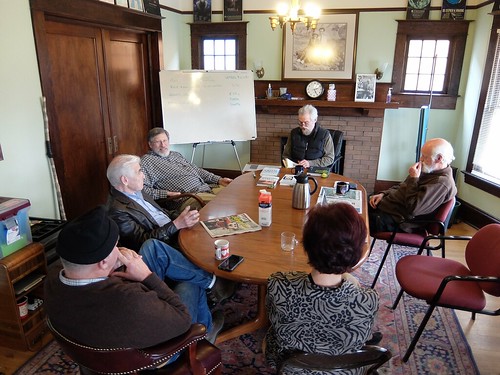
I expressed my frustration with Culture and Value to Jon Bunce. Wittgenstein, a Vienna Circle vet, alludes in knowing tones to all these musical passages, yes by well-known composers.
It's only my ignorance that's showing through. Nevertheless, I could use a podcast version (anyone? Princeton?).
The podcast guides, the voices, would not need to share all of Wittgenstein's opinions, about Mahler's stuff for example. They'd not be disciples necessarily, but would play some of these missing puzzle piece passages while trying to get at the nuances Wittgenstein was hoping to get across in referencing them.
For Wittgenstein, music had the capability, especially in the hands of some composers, to approach language in its attributes and abilities. He used language and music as quasi-mirrors of each other, to gain deeper insights into both.
Glenn is talking about his Global Matrix as a useful summarizing tool. Geoscope. Macroscope. The Christian Science folks had their Mapparium. Yes, we're talking about a globe, which in projections gets flattened out, into a Mercator or whatever. Glenn's matrix is a data structure.
What distinguishes the Global Matrix from the Mapparium is Glenn is really into the "hexapent" (a word he doesn't like). Hexagonal tiling is more characteristic of certain game boards, including virtual boards like in Civilization.
We had two newcomers this morning, who've never heard Glenn present, so he had a good opportunity to summarize. We had some interesting discussion, focusing a lot on the Internet, but ranging to other topics.
Glenn derives a lot of his stuff from scratch, like a cook who invents many great dishes that other restaurants immediately recognize but have other names for. He builds on his own experience, as a crypt-analyst and project manager. The flavors he comes up with are subtly different, or even surprisingly different in some cases. Glenn has his own cuisine. Maybe he'll succeed where few others have dared to tread.
That reminds me, last night at the dinner party, Alice named my dessert drink, Soylent + Jack Daniels, a "kirbster". I doubt that'll stick. We geeks already have "headless chicken" for the Bloody Mary, an allusion to the etymology of "geek".
I expressed to Jon my concern that Wanderers might seem too intimidating from the outside. Would-be attenders might be concerned they'd be grilled, interrogated, by judgemental know-it-alls. But that's quite far from our ideal.
I recalled my suggested logo: that Monopoly guy wandering on a chess board, a "random walk", with a lamp post marking its beginning, a dotted line showing his path. Is he holding a bottle? Is that a triple-x on the label? He must be drunk right? And therefore wandering.
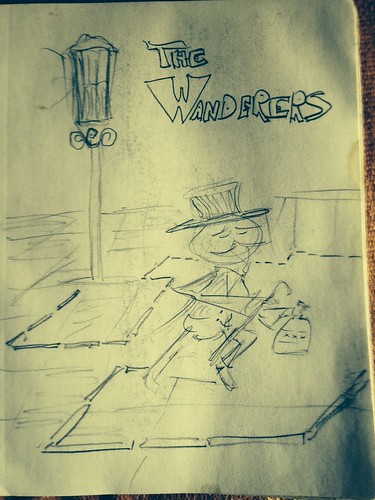
We're called Wanderers for a reason. We don't have alcohol at our weekly meetings (we do at our Equinox and Solstice celebrations). The wandering is more Ouija Board like at its best, recalling a Quaker meeting. We let the spirit move the conversation.
Jon and I got to talking about David Prideaux's No Big Bang in the kitchen, reviewing some of the main memes (elevators, acceleration, gravity...). Jon agreed that gravity affects wavelength. Light escaping from a massive body gets redshifted.
We also agreed the Monopoly guy had a much better chance of coming back to the lamp post in a 2D matrix, rather than in a 3D matrix of XYZ cubes, or perhaps rhombic dodecahedra, if using the IVM.
Before that I was out on the porch, phoning Carol Urner (mom), presumably in transit somewhere between Cape Cod and WDC, and Patrick Barton, asking for advice.
"What's a good entry point into what we're calling 'machine learning' these days?" was the gist of my question to Patrick, and "do we have to learn R?". I'd started reading on the topic in Safari On-Line earlier that morning.
Patrick suggested starting with a large publicly available database. Although we talked about baseball statistics, I actually don't know if those databases are open. I completely agree that a hallmark of that sport is its fascination with statistics.
When still with O'Reilly School, I'd suggested writing SQL-related curriculum against just such a stash, but again I have no idea to what extent this stash is available, and/or at what price.
How about a database of faces against which to run facial recognition algorithms? We could play a game like Memory, wherein every face is twice repeated and the machine's job, after a training period, is to recognize as many pairs as at can. Patrick suggested using mug shots of the very same baseball players (called "trading cards").
My angle on Machine Learning against Big Data is from the point of view of a code school curriculum writer / instructor, and wanting to lower a ladder to keep the topics accessible.
Where would we start with 8th graders? I think with success stories. Voice recognition, and OCR (optical character recognition) have come a long way in my day.
"Voice recognition" does not necessarily mean recognizing "who is talking" although that could be an application (biometrics), and would be more like fingerprint or retinal pattern matching (used to authenticate and/or determine identity). This is more Buzz's area.
The customary meaning of "voice recognition" in 2016 is that the computer correctly transcribe into writing what the speaker has said. Given advances in this area (didn't Tim Peters do work here?), people are talking into their devices a lot more, asking questions, and getting answers.
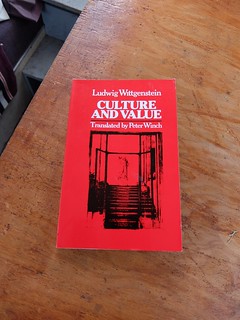
It's only my ignorance that's showing through. Nevertheless, I could use a podcast version (anyone? Princeton?).
The podcast guides, the voices, would not need to share all of Wittgenstein's opinions, about Mahler's stuff for example. They'd not be disciples necessarily, but would play some of these missing puzzle piece passages while trying to get at the nuances Wittgenstein was hoping to get across in referencing them.
For Wittgenstein, music had the capability, especially in the hands of some composers, to approach language in its attributes and abilities. He used language and music as quasi-mirrors of each other, to gain deeper insights into both.
Glenn is talking about his Global Matrix as a useful summarizing tool. Geoscope. Macroscope. The Christian Science folks had their Mapparium. Yes, we're talking about a globe, which in projections gets flattened out, into a Mercator or whatever. Glenn's matrix is a data structure.
What distinguishes the Global Matrix from the Mapparium is Glenn is really into the "hexapent" (a word he doesn't like). Hexagonal tiling is more characteristic of certain game boards, including virtual boards like in Civilization.
We had two newcomers this morning, who've never heard Glenn present, so he had a good opportunity to summarize. We had some interesting discussion, focusing a lot on the Internet, but ranging to other topics.
Glenn derives a lot of his stuff from scratch, like a cook who invents many great dishes that other restaurants immediately recognize but have other names for. He builds on his own experience, as a crypt-analyst and project manager. The flavors he comes up with are subtly different, or even surprisingly different in some cases. Glenn has his own cuisine. Maybe he'll succeed where few others have dared to tread.
That reminds me, last night at the dinner party, Alice named my dessert drink, Soylent + Jack Daniels, a "kirbster". I doubt that'll stick. We geeks already have "headless chicken" for the Bloody Mary, an allusion to the etymology of "geek".
I expressed to Jon my concern that Wanderers might seem too intimidating from the outside. Would-be attenders might be concerned they'd be grilled, interrogated, by judgemental know-it-alls. But that's quite far from our ideal.
I recalled my suggested logo: that Monopoly guy wandering on a chess board, a "random walk", with a lamp post marking its beginning, a dotted line showing his path. Is he holding a bottle? Is that a triple-x on the label? He must be drunk right? And therefore wandering.
We're called Wanderers for a reason. We don't have alcohol at our weekly meetings (we do at our Equinox and Solstice celebrations). The wandering is more Ouija Board like at its best, recalling a Quaker meeting. We let the spirit move the conversation.
Jon and I got to talking about David Prideaux's No Big Bang in the kitchen, reviewing some of the main memes (elevators, acceleration, gravity...). Jon agreed that gravity affects wavelength. Light escaping from a massive body gets redshifted.
We also agreed the Monopoly guy had a much better chance of coming back to the lamp post in a 2D matrix, rather than in a 3D matrix of XYZ cubes, or perhaps rhombic dodecahedra, if using the IVM.
Before that I was out on the porch, phoning Carol Urner (mom), presumably in transit somewhere between Cape Cod and WDC, and Patrick Barton, asking for advice.
"What's a good entry point into what we're calling 'machine learning' these days?" was the gist of my question to Patrick, and "do we have to learn R?". I'd started reading on the topic in Safari On-Line earlier that morning.
Patrick suggested starting with a large publicly available database. Although we talked about baseball statistics, I actually don't know if those databases are open. I completely agree that a hallmark of that sport is its fascination with statistics.
When still with O'Reilly School, I'd suggested writing SQL-related curriculum against just such a stash, but again I have no idea to what extent this stash is available, and/or at what price.
How about a database of faces against which to run facial recognition algorithms? We could play a game like Memory, wherein every face is twice repeated and the machine's job, after a training period, is to recognize as many pairs as at can. Patrick suggested using mug shots of the very same baseball players (called "trading cards").
My angle on Machine Learning against Big Data is from the point of view of a code school curriculum writer / instructor, and wanting to lower a ladder to keep the topics accessible.
Where would we start with 8th graders? I think with success stories. Voice recognition, and OCR (optical character recognition) have come a long way in my day.
"Voice recognition" does not necessarily mean recognizing "who is talking" although that could be an application (biometrics), and would be more like fingerprint or retinal pattern matching (used to authenticate and/or determine identity). This is more Buzz's area.
The customary meaning of "voice recognition" in 2016 is that the computer correctly transcribe into writing what the speaker has said. Given advances in this area (didn't Tim Peters do work here?), people are talking into their devices a lot more, asking questions, and getting answers.
Subscribe to:
Posts (Atom)

