Monday, August 14, 2023

Touring in the Silicon Forest

Ancestral Roots

The exact boundaries of the Silicon Forest are nowhere specified to my knowledge. Although one may make the case it all started in Asylum District, my neighborhood, on Hawthorne Boulevard, with Tektronix and Electro-Scientific Industries, there's no need to get that specific about its origins, either.

In my own thinking, since we're talking often about Casino Math, and the many tribes intrinsic to the region, and given casinos are likewise vast data centers, Silicon Forest is to some degree a N8V American enterprise. From that platform, we embrace the Pacific Rim economies. If the Pacific is an American Lake (a nickname in this region), it's also a N8V American lake (that's just descriptive).

Although we drove by many casinos on this tour, we didn't go in. Instead we talked about the binomial theorem and probability from the standpoint of Pascal's Triangle, a grand central station, a focal point, on Maths Planet (with lots of train tracks coming and going), and the theme of the M4W movie currently under development, Andrius Kulikauskas directing. He's shortly to fly off to visit his brother, likewise an artist.

This was also a family visit for both of us. After leaving Andrius with his sis, I visited my haunts further north and this time managed to visit the grave of my great great grandmother, Lena Bjorklund. Her daughter Helena married Swan Person (Beth was able to find their marriage certificate in a heartbeat) and the rest is history, with Mercer Island a focus.

We pulled over in an all-electric Mustang (cooler than a Tesla if you ask me) and were thinking "the Jetsons" i.e. here we are in that 21st Century far future people wondered about. We're the colonists of that time. We're colonizing the future, that is, a space we create together.

SciFi Ville

Andrius asked me how Oregon Curriculum Network connects to Silicon Forest high schools. "By abduction" mostly, to steal a meme from Peirce the Pragmatist. I work backwards from the future, leveraging hindsight (mine to concoct), assuming folks wake up to the potential of the IVM and 4D in complement to the XYZ and 3D (the normie stuff).

In be-knighting Andrius "the ErdÅ‘s of Wierdos" I wasn't meaning to be offensive or insulting. Rather, I'm extending the Esozone language, Subgenius tinged (overlap: "slack"), wherein "weirdos" form a peripheral network surrounding centralized normies (the normal mainstream programmed). 

You could call us "unprogrammed" (as some Friends do) but I'd prefer "auto-programmed" as in highly customized (by God, by prayer, by Bob, by whatever).  Andrius, like me, is sometimes itinerant, plus he recognizes and chronicles some really talented individuals, most of them likewise into esoterica.

Esoteric knowledge is not the same as Occult: the latter working overtime to deliberately obscure itself. Esoterica is often in full throttle outreach mode, yet nevertheless has limited appeal, because the content is difficult and challenging, like mountain climbing, or like endocrinology. 

The Silicon Forest is deeply into the esoterica of metallurgy and electronic bit manipulation (software development). That doesn't make us occult in the sense of secretive (unless you mean patent protective). We invite visitors. We invite tourists. We also tour.

Great Great Grandmother

Sunday, August 06, 2023

Alternatives to Violence

I'm hosting an alternatives to violence guy -- spelled out in lower case because he's never heard of Alternatives to Violence (AVP), a formalized training workshop often held in prisons. 

He's worked in a prison, in a program designed to recruit and/or cultivate Independent Thinkers. 

Andrius Kulikauskas is Lithuanian, though born and raised in California. His main interest these days is his Math 4 Wisdom network / community, of which I am also a member.

I met his plane on Friday night. He was coming from a Category Theory conference at the University of Maryland. He is aware of my project and agenda: to track the progress we're making, with some of the ideas from Synergetics in higher ed.

Today I plan to introduce him to Quaker meeting at the meetinghouse nearby.

Some of his past work focused on tensions in Africa. Without visiting in person, but with strategically targeted $100 wire transfers, he was able to network with folks on the ground who were able to help diffuse situations in which armed youth gangs had taken over roads, to/from Nairobi for example.

Andrius is rather well versed in Lithuanian history, unlike myself, and so I'm using this opportunity to get more of the story. By filling in more of the gaps in my knowledge base, I'm better able to appreciate unfolding events in Ukraine and so on.

Sunday, July 30, 2023

Trending

Colorado River's End:  An Unmarked Grave

Some suppose the great Colorado River passes into the Gulf of California through some delta or wadi.

A little research using Google Earth helps wake us up from such romantic fantasies. 

The Colorado River ends at an unmarked site just shy of the US-Mexico border, on the California side.

Check it out!

Friday, July 28, 2023

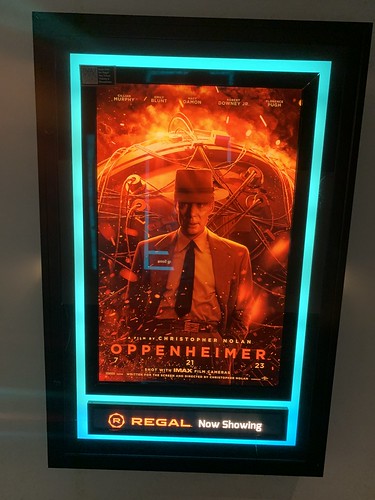
Oppenheimer (movie review)

Summer Movies / Oppenheimer

Since so much is and will be written on this movie, I'm gonna make it all about me (just kidding). Like I can vouch for the Institute for Advanced Study scenes, with Einstein and Godel in the forest, and faculty housing in idyllic proximity. 

All true. I was there. Not as connected with said institute but as an undergrad at nearby Princeton Inn, once a country club with adjoining golf course, and by my time (arriving 1976) already converted to a mostly freshman dorm, or residential college. I'd jog in the forest with my fellow mutant ninja tigers.

We didn't meet Einstein, by then passed, but at least one guy I know met the Beautiful Mind guy, John Nash.

I'm circling the whole aesthetics of that time frame, coming in through the lens of Wes Anderson and Asteroid City. That place of atmospheric testing, confidant futurism, science fiction, comic books, UFOs. Oppenheimer takes us to that same place. 

"Give it back to the Indians" said Oppie, of Los Alamos. That grated on the ears of the Manifest Destiny types (e.g. Truman), who now saw a chance to "go Frodo" with the nuclear weapons thing (or should we call it "going Gollum"?). Bagdad Cafe is nearby in this space. The Atomic Cafe is ground zero.  Dr. Strangelove.

Speaking of Asteroid City, there's that scene in the gym or whatever, with the writer, where he wants them (the actors in his play) to all fall asleep at once, act it out. That seems where Oppenheimer goes when he gets to take the podium at his chief apex of popularity. 

The stomping of feet and delirious shouts of hysterical joy was semi-deafening (haunting in retrospect) and my new Apple Watch logged a sustained 90 decibels period, I found out later. These were Walt Whitman's sleepers, giddy with their own sense of spacetime (history). Not especially sober or grounded.  

Were such people ready for real WMDs? Would they survive them?

I'm an "all out of order" guy like Nolan, the director, meaning I like getting the story as an asynchronous non-chronological bag of events I then get to assemble, like life itself. Because chronology is not always so important. 

We're still adding pieces today. 

We have other action connectors besides calendar chronologies.

In vouching for the authenticity of the Princeton impressions, I'm mostly saying they match my own, as one who lived there. I'm suggesting that by extension we might trust the storytelling. The medium of film is akin to that of the imagination, such that a Narnia movie reminds readers of where they went in their own minds' eyes. "Yep, this is the place" is a hoped for reaction.

As a resident of Portland, Oregon, I'm also not far from Hanford, Washington, the campus, mentioned briefly in the film, where the Nagasaki bomb was made, or so I'm told. They did that same insta-village thing with the layer of secrecy and paranoia. It's not like Los Alamos delivered all of those bombs on its own. 

I got close to Los Alamos once on a trip to New Mexico with Dawn and Tara, got some feel for the place.

Yes, egghead intellectuals like Einstein oft tend to be on the left. Why is that? Because they tend to be idealists and think lifting living standards for all makes life better even for those at the top. Why settle for Ghetto Planet?

They're impatient with the status quo, these idealizers. "Left" seems to mean "boat rocker". Intellectuals, visionaries, see the positive possibilities, one could say that's their job. Quakernomics.

Oppenheimer is a valuable contribution to the literature, reminiscent of some Oliver Stone films in that sense.

Sunday, July 23, 2023

Study Hall

I'm moving up and down (out and in as Buckynauts say), between rooms and screens, with an interesting talk on amphetamine and other drug-induced psychoses in the kitchen, the BBC Proms, and the Dalai Lama preaching on Facebook, upstairs (outstairs) in the office.

The point Bucky was making with "instairs versus outstairs" is you want to school your intuitions (gut feelings) with what's intuitively important knowledge, or watch them become obsolete reflexes leading you astray.  

If you're not thinking of your planet as a spheroid, quite commonly, meaning quite frequently during the day, then try some of these mental exercises he recommends.

Sydney the dog also follows me between floors.  I do kitchen work in the kitchen, or other tasks, as I take in the pharmacology.

The pharmacology talk is critical of the spread of epidemics, which often have to do with companies working backwards from new patents they've gotten.  Now that we own this intellectual property, lets find out what it cures.  In the case of psychotropics, ADHD has been a target, enlarging, according to our narrator, because many more patented amphetamine-like drugs now crowd the shelves.

Lets definitely accept the hypothesis, offered in the talk as well-proved, that drug abuse correlates with a mental illness pattern.  One slide links Cannabis, assigning a likelihood of a long term diagnosis of some 34%.  What about the remaining 57%, what happens with them?  Might some have special gifts? Why do we always only look at the downside, right? Sure drugs are dangerous, lets not kid ourselves.

Also, what is the background likelihood of a long term diagnosis in the general population absent drug use / abuse?  I'll need to go back to see what's given, or do some more digging.  

There's also the chicken-egg question of aren't those prone to mental instability the same demographic more likely to experiment with controlled substances?  Why not see Cannabis use as part of the descending / ascending spiral, not the cause but the symptom?  Like I said: chicken-egg.

Any skepticism aside, however, my hypothesis is the Roaring Twenties maybe had more to do with the later outbreak of amphetamine abuse than we normally let on.  I'll be reading more on these topics as I enlarge my echo chamber in American Studies.  

I haven't had enough time in the heartland, both figuratively and literally. More blues and more jazz would be welcome.

For sure Benzedrine abuse was a side-effect of World War 2, when it was widely introduced to the military. Was it also a contributing cause? War is a groupthink psychosis and/or the search for a cure, depending on one's mindset.

The upstairs screen also has had my Jupyter going, the notebook environment available for several computer languages, Python most famously, but also Julia and R (hence the name: JuPyteR).  I've been doodling with the Mandelbrot Set again, producing another one of those low resolution ASCII art renderings characteristic of my Just Use It ad campaign (pro Python).

The occasion this time is M4W and an upcoming meetup on complex numbers.

Tuesday, July 18, 2023

Central Oregon Revisited

Smith Rock

Readers, searchers, of these journals, may have already encountered various sojourns through Central Oregon, high desert country.  My in-laws, my wife’s brother and his partner Judy, came to Oregon well before I returned in the mid 1980s. They eventually settled in the Sisters area and Dawn and I, Alexia, and later Tara, would go visit them, through various chapters. Alexia would live with them in one chapter.

Without going back myself, and consulting everything I’ve said, I’m recalling Extremely Remote Livingry (XRL), an acronym that probably won’t catch on, but tries to capture the mix of high and low tech that might make remote, so-called off-grid living an enjoyable experience. Not that humans don’t already enjoy such environments. Per GST, we spiral through periodic improvements, as to what’s in inventory.  Do we always remember though? What we already have?

As an older guy with a lifetime of writing, I’m trying to train myself away from the “two spaces after a period” rule, which by social agreement, is falling by the wayside (has fallen). Lately I’ve been editing some of these blog posts with an eye toward removing the offending spaces, as more offending typos. I’m doing this without the benefit of my office device, having been sent on the road by my company.

A health goal for me is to not turn into a Homer Simpson donut eating machine around foods I adore.  I’m at an age where the management function is not meant to stay back burner.  I ate way too many BBQ flavored potato chips yesterday. We watched History channel tell us stories about North American brands, such as Jiff versus Peter Pan versus Skippy. Pepsi versus Coca-Cola. The subtitle might be “business heroes” i.e. we’re celebrating innovation, including in tricky ways to get moms choosing the right stuff.  We don’t spend a lot of time on Lucky Strikes for women story from a health industry angle. We stay focused on the parade stunt (strident stylish women appeared to protest, while smoking).

This morning I’m touching base with a few in my far-flung network, tangentially talking “design science revolution” in the sense of what memes caused us to find one another in the first place. Networks are content-driven meaning one’s tribe’s identity is knit together with interweaving stories, with overlapping casts. If you don’t have a tribal lore up close, civilization offers fall-backs, including the worldly mega-religions, such as Mormonism. I’m thinking about Las Vegas these days for various reasons, which brings of memories of documentaries and books.

Although in the high desert, I’m hardly roughing it. I’m not camping or doing anything that remote. We drove over to Smith Rock (dog Sy, and I) just to make sure it’s still there. I’m using what I call the ISEPP iPad to get my work done (company business).

Saturday, July 15, 2023

Generational Reprogramming?

I often wonder why the “battle of the sexes” (however many) seems to get all the headlines, alongside the battle of the so-called “races” (as with “sexes” their number keeps changing) whereas the inter-generational battle seems to me more front and center, yet not as much in the news.  

The elderly are committing the young to fight each other over obsolete ideologies, and are refusing treatment, in the form of more up to date thinking (better ideologies). Is that because the old don’t want to feel lonely in their beliefs? If the younger folk revolt over their debtor status, how will the older folks pay the bills?

For example, most Boomers watching USATV, absorbed the view that the world was conflicted over two leading ideologies, capitalism versus communism. The more educated learned of a “third world” that was opting out of this conflict, with the freedom to stay friends with both sides.

The terms of debate were not always crystal clear however.  The Pentagon always seemed plenty socialist in its ways, with LAWCAP (the so-called military industrial complex or MIC, as studied by our AFSC) needing military socialism to stay on top.  

Then communism seemed to whither away, becoming socialism also, in the form of central government spending and a growing public sector.  

China invested big time on commuter rail and high rise apartments, and in taking over manufacturing from the so-called “west” (as if Europe were not in Eurasia) with its spanking new facilities.  

Meanwhile, Russia went back to being more of an oligarchy, much like the USATV system, now run through six or so controllers.  

Telling the defunct USSR and emergent USSA apart has become increasingly Orwellian, with words like “authoritarian” bandied about i.e. each side calls the other an oppressor of its own people, while appealing to the neutrals and non-aligned, to finally align. Sweden succumbed. Switzerland and Austria remain proud.  

Except what are these “sides” anymore? Don’t we just have unfree peoples everywhere you look, and isn’t that “double plus ungood“ (Orwellian utopia-talk)?

By unfree I mean, in part: “programmed to hate the baddies” from a young age, then trained in weaponry, then sent, in kill mode to, if required, die on command against the other side.  That’s called “being a hero”. The elderly applaud and make cemeteries, as that’s what many of them had to go through too. They’re just passing the torch. Who needs an upgrade?

As a Friend (NPYM’s Annual Session goes on without me — I’m visiting family this year) I see older generations, more comfortable in power roles, sending younger generations into Great Tragedy scenarios, to act as extras (and stars), as a part of the backdrop, as the obsolete ideologies duke it out in the foreground, trying out various new forms of rhetoric, looking to see what sticks.

In the meantime, our campaign to push an updated ideology meets with roadblocks at every turn. The investment in keeping any newer technology out of the schools is highly selective. Machine Learning is allowed to flood in, taking over a lot of responsibilities. Human Learning is put on the back burner.  

However, Human Learning (yes, a form of reprogramming, lets face it) is what it takes to give a younger generation a sense of better prospects and new possibilities.  

“Why are we being sacrificed?” is a good question.  I encourage them to keep asking it.  

Don’t let them tell you it’s “for God and country”. That line has worn thin.

Monday, July 10, 2023

Immune Response

I'm speaking metaphorically, but then so does polite society, sociologists, when describing how a next generation may have antibodies against X, where X is not a literal virus, but a vector that spreads like one, and may be correspondingly countered.  If you hear Category Theory between the lines, you're growing new ears maybe.

Take propaganda, in the broadest sense, which includes PR and advertising, rhetoric more expansively.  In American English (Amerish -- a MER ish, Fowler), "propaganda" is almost always used in a derogatory sense, to impart a negative spin.  Perhaps we're hearing remnants of Protestantism decrying the continued propagation of a more Catholic catechism.  There's always "high church versus high church".  

We also call these rhetorically polemical clashes "wars" (e.g. the Math Wars) as in "culture wars" but we hope to manage and contain them around an ideal of non-violence.  The martial arts usually circle a sense of peace and equanimity as core to the warrior mentality.  A true warrior is not "looking to start a fight" but lets not forget about sparring i.e. helping others get better.

Today I watched a lot of reels, Facebook's answer to TikTok, and become more aware of this Auditor movement, wherein civil rights activists engage in some "suspicious" activity that's nevertheless within their rights, or defensibly so.  There mere act of recording is often the triggering "offense".  

If an authority figure tries to challenge them, they turn into expert lawyers, some more successfully than others.  They remind police personnel to recall their own training, and make professionalism the value at stake.  A professional activist inspires professional responses.

Against a backdrop of police brutality and movements such as Occupy (in the civil rights lineage), it's not surprising that new antibodies might form, giving rise to new breeds or professions.  This is what evolution goads us into.

What's made a big difference is the smartphone and live streaming, in combination or isolation.  Cops are increasingly wearing body cams, but then so are ordinary civilians.  Citizens march around in fashionable uniforms, or dressed casually, with Go Pro helmets and/or other recording gear.  

They look and act a lot like cops, disciplined to not use unnecessary violence.  Except a lot of police escalate and lean towards violence rather quickly, which is where that police brutality may kick in.  Mind over brain, brain over brawn, is how they teach us in school.

Friday, July 07, 2023

Pacific Rim Radar

I find it curious, not to mention ironic, that NATO is out of its pond, contemplating the growth of militarism in the Pacific.  Really?  And NATO is here to protect us right?  Nothing interesting in the Atlantic hemisphere happening?  You need more business?

I'm a professor Jeffrey Sachs fan though.  He's not another knee-jerk Russophobe, dime-a-dozen type.  So hey, I'll keep an open mind.  That a Quaker magazine would bring this event to our attention is quite appropriate.  No endorsement of NATO is expressed nor implied.  I'd say that's obvious, but bears repeating.

Monday, July 03, 2023

Doctors Organize

I thought of this ridiculous ad campaign:  "I'm healthier than my doctor!"  I jump on stage all sprightly fat, like a Tinkerbell on steroids (which no, I'm not on), and then they wheel my doctor out, all pale with an IV.  The implication is somehow snake oil X is best for you.

Hey, before I go on, thanks to Ms. Vam I got to see the Crystal Skull episode of Indiana Jones last night (thanks to Movie Madness having it in stock, yes a DVD for rent, how quaint right?).  It makes a crater (and I mean that as praise) in the same territory as Asteroid City.  Maybe that's the actual crater it made, with the ETs in question returning to see if they needed the exhibited meteor (nah, scan it and put it back).

And now, my more serious topic, mentioning doctors.  The "systems analyst" role in society is still pertinent, especially the ability to graph workflows, say those of a working ER doc.  Track her movements through the day, in a Tayloresque exercise in collecting big data, but not in a way that quantum perturbs.

That's the issue these days:  the geniuses at the genius bar keep wanting to probe the ER with more forms to fill out, more direct doc reporting, a little more here, a little more there, fattening the living system (trying to live) with clerical bloat-work.  BS jobs are on the rise because too many script kiddies learned React and now want to run society, thinking kiddy knows best.

I exaggerate though, in blaming my geek peers for the flood of forms.  They're less the culprit than those with the magic to serve their overlords.  The bureaucracy hampers working doctors with clerical tasks because that's what the bureaucracy knows how to do.  Clerical Tasks R Us.  The promise of computers, of automation, was to actually streamline workflows and relieve doctors of paperwork.

Example:  ER doc to nurse:  "OK to remove from special diet, standard tray check".  Nurse: "check".

Same thing today:  ER doc to terminal, boot app, navigate menu, pick this pick that, order meal, is or is not Jehovah's Witness, please enter emergency contact...  you get the picture.  Meanwhile, someone dies on the table.

Systems Analysts where are you.  Please openly discuss these problems in ways the doctor lobbies never do, because there are no doctor lobbies (i.e. unions).  Unions, labor organizers, are coming for your family physicians with great bargaining chips, given the slave ship many a clinic has become.

Sunday, July 02, 2023

Modeling Language

The idea of a "word-meaning trajectory" resonates with some of the memes bouncing around in this Tai-Danae Bradley lecture.

I used to write about the word "Pepsi", atypical (i.e. an outlier) in the philosophy of language, generically averse to commercial brands.  

Highlighting Pepsi is shorthand for linking in Edward Bernays style "invisible persuader" propaganda budgets aimed at establishing a "market position" i.e. a place for some brand or meme in the collective mind of a stakeholder public.  That's where "rubber meets road" in terms of "revectoring".

Stakeholders include the potentially and/or actually negatively effected.  These are stakeholders nonetheless.  One may have a stake in opposing one advertising campaign with another. 

Expecting propagandists to just sit idly by while they see an underdog needing their help, is unrealistic.  Onlookers self selectively surrender their innocence (as bystanders) and join some ongoing fray.  They take a side, become partisans.  Pertinent figures of speech:  "getting sucked in"; "falling into a gravity well".

So where does a Pepsi or a Tylenol live in an LLM (large language model) and how do we machine learn to fully automate or at least cue finely-tuned repositioning maneuvers?  Grossly-tuned if needed.  Infants have similar needs for motor skills (and nutrition!) when learning to walk and/or to continue walking.

Keep a brand burnished and polished.  How?  Answer: keep introducing new usage patterns (permute the namespace).  That may be easier said than done of course.  Inertia levels may be high.  Weights pertain.  It's a balancing act, one of maintaining a qualitative as well as quantitative equilibrium, sometimes punctuated.

Other times, the wiser strategy is to just coast.  Why fix what ain't broke?  Why advertise what's taken for granted?  Why make billboards to advertise blue sky?

What are the mechanics of gaining traction and getting work done?  How does a media campaign leverage energy expenditure?

For example, how did Synergetics (Fuller) first inject and the revector the "Jitterbug" meme?  It came in as a dance,  somewhat in the Twist family, and Fuller capitalized on this existing trajectory to signify a geometric transformation.

Picture two tetrahedra on each side of a pinch point, like a bow-tie, left and right.  Then picture a stella octangula or merkaba wherein left and right tetrahedrons are centered and interpenetrating. Packed spheres anchor the context, much as cubes do in XYZ.  The icosahedron to cuboctahedron inter-twisting relationship rounds out this so-called Jitterbug Transformation.

From Tai-Danae Bradley I get a boost in seeing an ad campaign as a statistical challenge, i.e. to revector through "brute force" for example, whatever that means.  Say by means of "blanket coverage".  Omnipresence.  More like a Pfizer or LEGO might roll out.  

That's high budget advertising and one hopes a way of financially supporting a not-hostile relationship i.e. "at least you won't attack me if I'm sponsoring your program".  Funding buys non-negative coverage, is the press, although it's not that simple.  Sometimes a business or politician suffers because of disclosures about who the donors are.

Another strategy is to stay small and hard to find, such that the "surface area" or "perimeter" one needs to defend, is relatively minuscule.  Not every luxury is mass-market, by definition.  Instead of playing the most popular girl in school everybody knows, play at being mostly invisible and within some opaque clique.

Some companies are actually satisfied with their size and discourage sudden burgeoning, which could only mean uncontrolled.  Metamorphosis is sometimes in the cards, but if so that's likely presaged in the company's DNA e.g. some of its antecedents were gigantic, and/or a tycoon-minded heir has come along.  Many a small business deliberately stays small, with no desire to establish remote branches.  The same stakeholder may be involved with companies in different phases of their lifecycle.

Wednesday, June 28, 2023

Regeniusing

In my cliques or social circles, one hears fairly often that children are born geniuses, but that one way or another, the adult world shapes them into dolts.  The American poet Gene Fowler comes to mind, with his Regeniusing Project and Waking the Poet.  Is there a way to reverse the dumbing down?

Picking up on this thread, I'm trying to think of ways I might've had specific powers I had to water down or ignore.  Without claiming to have any kind of photographic memory, I feel I listen pretty closely to what people tell me, and file their remarks away in my memory bank, such that when we meet again, I'm feeling pretty well-versed on what they've said already.

What struck me as a growing child, then, was how adults didn't seem to bother to keep track of who they'd told what, such that they'd be perfectly OK with repeating themselves endlessly, as if we'd never met.  I'd say things like "yes, you told me" or "yes, I know that" but these remarks came off as rude.  The social practice was to repeat oneself with wild disregard for the audience.  Adults had no responsibility to keep track of prior utterances and rely on shared memory banks.

Now that I'm an adult, I'm better positioned to make their case.  Firstly, talking something out is therapeutic sometimes, so if you have a willing ear, a productive way to take advantage of the opportunity is to retell one of those signature stories.  Just hearing oneself retelling may lead to new insights.  

As a guy who narrates the same slide deck over and over on my YouTube channel, I know the value of this kind of exercise.  It's the same with music.  No one takes the attitude:  we've sung that song already, and we all know how it goes, so why sing it again?

Also, there's the obvious rejoinder that adults get to know exponentially more people and trying to keep track of "who they've told what" becomes empty overhead after awhile.  That's great if you have a great memory. A lot of people do not.  

So that someone in your presence starts down the same road for the umpteenth time is intelligent behavior on their part.  They're not presuming you're a genius in other words.  None of us should presume that of  another -- and so the great dumbing down begins.

The metaphor I'm coming to is not original.  A diamond in the rough.  Shine on you crazy diamond (Pink Floyd).  I'd say the productive path in adulthood is to recognize and not adulterate your specific superpowers, whatever they are, and I'm deliberately weaving in all the superhero comic book images in calling them that.  

I don't need to stump for the supernatural in making some space for the extra-sensory.  We experience the limitations of our senses constantly, and through instrumentation we know about workarounds.

I'm siding with Nietzsche in thinking having a chip on one's shoulder, holding it against some invisible unspecified "society" or "the adults" that one is dumber now, slows one down.  Recall your native / natural abilities and cultivate them as you see fit, but with an eye to being constructive and helpful to your fellow humans and to yourself. 

I'm thinking this was Bucky's secret in large degree:  when you couple your gifts to "helping all humans" versus gaining advantage over them, in a zero sum game, you have less of an upper lid on how you might apply them.  

The evil genius is by definition a tad less of a genius, simply because "being evil" comes with more overhead, a greater cognitive load.  Superpowers become more burdensome when it's all about gaining triumphal vengeance over one's foes, although I don't deny the latter impulse may be temporarily motivating.  

In the Work, ala Maurice Nicoll, one's true foes are internal states and perennial complexes, well known to psychology as potentially ruinous (e.g. hubris and so on).  To the extent you want superpowers, cultivate their virtuous use in some internal jihad, which doesn't equate to becoming self hating.  

Any martial arts guru will teach you that much.  And being virtuous need not equate with simply being a good doobie.

Sunday, June 18, 2023

Word Weights

Words have weights in a context or category.  Change the context to change the weights.  Heavy may become light, and lightweight heavy.  Weight and momentum go together.  A heavyweight word has more inertia meaning impacting its trajectory takes more work.

Category Theory has penetrated higher mathematics by osmosis, as a shared glue language.  The objects (nouns) and morphisms (verbs) that make up a category do not require much infrastructure beyond transitivity and associativity.  The vocabulary from sets and functions flows in to provide bulk (grist for the mill) right from the get go.

How will Synergetics, over time, affect the weights in CT (or in LLMs more generally)?  Polyhedrons are the obvious 4D objects, but we need not include "all" the polyhedrons.  We're happy with a subset and Occam's Razor, and the adage:  don't add what you don't yet need (or "only add on demand" in other words).  Necessity is the mother of invention.  Superfluous invention is a mother of clutter and excess.

In the Synergetics namespace, we may start with the Platonics and their duals, the tetrahedron being self-dual.  By "dual" we mean vertices exchanged with faces, the number of edges holding constant. 

Then we "marry" (Platonic, Dual) pairs to "beget" the rhombics:

  • (Tetrahedron, Tetrahedron) begets a Cube (a Rhombic Hexahedron)
  • (Cube, Octahedron) begets a Rhombic Dodecahedron
  • (Icosahedron, Pentagonal Dodecahedron) begets a Rhombic Triacontahedron

Euler's V+F == E+2 gets introduced, along with Descartes' Deficit and concavity/convexity.  We're interested in polar pairs, associated spin axes, and great circle networks (especially juxtaposed and reduced to LCD triangles).  

We're also interested in dissections, of polyhedrons into component polyhedrons, and a relative volumes hierarchy.  

The Jitterbug Transformation has to qualify as one of the hallmark morphisms, or as a sequence, or poset, of morphisms.

An associative sequence of morphisms might be called a "train" with transitivity implying "express trains" that skip stops.  The cuboctahedron to icosahedron "local" then continues to the octahedron, whereas an "express" might go from the octahedron back to the cuboctahedron without click-stopping at the icosahedron.  

The connected volumes of 20, 18.51..., 4 count as properties of the polyhedrons in question.  Objects have properties.

The cuboctahedron of 2.5 grows to an icosahedron of 2.91796... with two applications of the S:E scale factor (S-factor) where S, E are specific polyhedra (see BEAST modules).  

One application of the S-factor would take us to a local station stop of intermediate volume 2.5 < v < ~2.918 tetravolumes.  We locate the 12 vertices along the "rails" of a contextualizing octahedron of volume 4.

from Synergetics: an volume 4 Octahedron containing 
the ~2.92 Icosahedron and 2.5 Cuboctahedron

A question arises as to whether IVM-space and XYZ-space should be considered two different categories, given they contain identical objects and morphisms.  

We're saying they could be. 

Their isomorphism is clearly apparent, but for the difference in the volume property, which we can iron out.  The polyhedron volumes differ by a multiplicative constant.

This Synergetics Constant (S3) suggests itself as a functor in case we do want to separate these 4D and 3D spaces.  A cube of edges √2 has volume 3 in IVM world, given its R-edged cube of 1.06066... where R is the radius of any IVM ball (IVM = isotropic vector matrix = the CCP lattice when it comes to balls).

The modules themselves morph into one another, as when the A module morphs into a B module of equivalent volume.  Then of course we have φ scaling e.g ...s3, S, S3... and so on, where the S volume is (1/2)(1/φ)5.  See my Replit on the S&E modules.

Tuesday, June 13, 2023

Freedom Fighters Revisited

All this bellyaching on whether Elon Musk is being hypocritical or falling short of defending freedom of speech, because buckling to demands from the EU, Turkey and/or India, is misplaced in my view.  

The assumption is "we the USAers" are somehow not under the oppressive rule of an authoritarian self-entitled class, and our "freedom of speech" is therefore our leading export, to freedom-hungry peoples around the world.

Closer to the truth is authoritarians admire the sleight of hand tricks the USAers are likely to sucker for.  

Twitter has barely been rescued from being a tool of The District, and could easily fall back to its old ways, whereas Facebook and YouTube are still seriously in the thrall of the dictator agencies (aka NATO or whatever we call it).  

We're under the rule of authoritarians in the USA, with the ghost of democracy still haunting us.  So what's all this about Elon succumbing to pressure in foreign countries?  The battle has yet to be won here.  

It's too early to assume we have any freedoms to export.

Friday, June 09, 2023

A Memorial Day Meander (School of Tomorrow)


Related journal entries: 

Wednesday, May 31, 2023

The District

Although my friend who prompted me to give Marianne Williamson another look, has since moved on, to the newest Kennedy, I'm not making any public noise about any switch in loyalty, since I'm not empowered to vote in the DNC primary anyway, and I don't want DNC on my political resume enough to want to surrender my Pirate Party status.  Yes, I'm seeing it as either/or these days, and yet at the same time as statistically insignificant.

I'm reminded of my support for Tulsi for prez.  My line the whole time is she's too straight an arrow for a crooked office, we need a crime boss, and that we got.  I should know better than to look a gift horse in the mouth.  I voted for the guy.  I wanted to try a different Mafia, other than say Kushner and Ivanka's.

But what did I know, right?  We all should have realized from the first Trump impeachment, that standing in the way of NATO was going to be a treasonous offense.  A lot of citizens had never given NATO much thought, but now it was going to make sure Raytheon-Halliburton stayed prosperous, so we'd better get used to it or else.  

Once Trump was out of the way, and the old crew back at the helm, we could get on with the showdown, in some "us versus the world" (a tired play).

I like Marianne because she's into psychology and matters of public mental health.  Clearly the schools are in trouble.  I'm watching the YouTubes from teachers on why they had to quit.  

As a geek heading into teaching, I was always aware of the steady stream coming the other way.  I was like that lone vehicle driving into the city where the oncoming lanes are packed with fleeing refugees.  Was I some kind of hero?

Actually, I don't think it's wrong for some jobs to be primarily taken by young people, who then move on. From the point of view of a prep school middle schooler, somebody who just went through college, and therefore knows what it's like from recent experience, is going to be implicitly more up to date on many wavelengths.  More than a geezer would be.

When I taught at St. Dom's in the 1980s, I was fresh from the university and not that different in age.  I don't begrudge those willing to stay and be Gandalf or Sister Joan.  I'm just saying it's not an automatic diss to say a job is skew-bulge-occupied by a younger crowd.  

Besides, I've gone back to teaching gigs with younger cohorts off and on into my sixties.  Coding with Kids for example.  Many times before that, and on many campuses.  Meaning I've had the best of both worlds:  full time immersion in my youth, as faculty, then pilot programs, field testing some new ideas, in my wizard years.

Speaking of wizard years, yes, I think I'm saying I support Marianne because she's a witch, and not a wicked one.  My wife took the name Wicca as a reminder to seek wisdom, not to tie herself to any subculture.  Marianne has a kind of aristocratic flare that actually comes off as presidential.  I find it easy to imagine her relishing ceremony.

The present could use more of Williamson's piping up on the Wurlitzer.  Ditto Andrew "UBI" Yang.  Ditto many of those who've obtruded into public discourse for having run for top office.  Or held one in the past.  These are not voices to gleefully block simply because the press (and/or cable) has the power to do so (or once had).

So does that mean I'm watching Williamson on TikTok and/or Zoom?  Not currently.  

I'll pig out on TikToks only rarely and pretty much leave it to the algorithm versus seeking out specific content.  

That's all raw intel in my book, whereas I'm relying on several layers of sifter-editor to come up with some choice pieces.  I only have so much time for The District (one of the popular soap operas) after all.

Saturday, May 27, 2023

Wild Wild Country (movie review)

This six episode documentary (not "docu-drama") revisits the culture clash, the story of worlds in collision, that was the Rajneeshpuram experiment in Oregon.  The filmmakers find a sweet spot between a lot of rear view mirror distance, from events in the 1980s, yet with many of the principals still able to be forthcoming about their personal experiences.  

We get it from the mouths of the horses involved.  Except not from Osho directly (the Baghwan himself).

Teachers will advise you to look within for your teacher and follow that still, small voice (or whatever shoptalk blah blah), however the truth of the matter is if a lot of us agree on a teacher, other than ourselves, and if we all plunge into service mode, great accomplishments of collaboration might be achieved.  

Rajneeshpuram was in that sense a monument to what humans of like mind and sufficient skill are able to achieve in short order.  They built a dam, shaped the lakes, provided both power and pumps, and turned a desolate ranch into fertile farmland.  They built structures and instituted a form of self governance, based on the model of Master and top drawer Secretary.

However, the rate of change was too bewildering for the slow-moving, deliberately backwater surroundings of rural Oregon.  Making Wasco County the site for an annual festival (like a Burning Man) for a global network of centers, was not making Wasco correspondingly wealthy.  On the contrary, the locals were being bought out and/or were fleeing, as the aliens invaded.  Some decided to stay and fight, only to be called out as ignorant bigots (i.e. "deplorables").  

The chemistry wasn't clicking.  Curiosity turned to dread and mutual demonization.

Given time, making Rajneeshpuram a tourist experience, and a gateway to Oregon travels more generally (Crater Lake, High Desert Museum...) would have benefited a broader base.  A whole boomer generation has already embraced so-called Eastern Religions.  The cultural DNA is all there.  However, embedding more seamlessly with the surroundings would have required a longer period of mutual adaptation and gestation, more diplomacy, better PR.  

Naming it Rajneesh University from the get go, and encouraging outsider tuition paying visitors to sample the lifestyle, saying "campus" instead of "puram" might've been one way to go.  Osho could have been the prez, a more recognized title, or CSO (chief spiritual officer).

I should be clear that although I am currently a resident in Portland, I didn't return to this city of my early boyhood until around 1985, when the Rajneeshpuram experiment was unwinding.  I was aware this melodrama was unfolding around me, but not until now, in 2023, do I feel like I have a handle on what all went on, thanks to this documentary.

Arming themselves with assault rifles after the bombing of the Portland hotel was a missed opportunity to get Oregon's existing law enforcement agencies more on their side.  

Their willingness to reinvent every wheel (including chemical warfare) was actually a barrier to better intercultural understanding and integration.

I'm not saying it ever could have worked out well.  Some experiments teach a lot more because they failed.  We all have much to learn from this chapter.  I have a lot more to think about.  The experiment contained so many potentially volatile ingredients we still juggle, such as homeless disenfranchised veterans with no existing governments able to realistically address their situation.  At least this group gave it their best college try.

I thank everyone who agreed to be interviewed for this film and for the thoughtful job of splicing it together the editors did.  Top notch.

Thursday, May 18, 2023

Debt Ceiling

As regular readers of this blog likely know already, American literature already foreshadows the demise of a special case financial system floating an earlier version of the United States.  

I'm talking about Grunch of Giants, by a Medal of Freedom winner and celebrated poet, associated with the Aquarian Conspiracy, in turn inheriting from the New England Transcendentalist movement:  R. Buckminster Fuller.

In that book, Fuller forecasts how the mumbo jumbo might go from there, were the USA to retire its debt payment responsibilities in favor of a fresh start, as some kind of post nationalist nation, an oxymoron for sure, but perhaps with more staying power vs-a-vs the imposter state that would otherwise persist.  

I called this post nationalist design USA OS in my own writings, OS for Operating System.  Others worked on a complementary OS Earth as a meme.  We were anticipating the continued rise of computer science, with "operating system" a next metaphor for governance.

After Grunch of Giants, Fuller forecast that the post-USA imposter state would try to bury his work in an Orwellian memory hole, by smudging history.  He passed this anticipatory narrative on to Patricia Ravasio, who later wrote a book about their meetings.  His premonitions were on target as usual.

Fuller was an evolutionary more than a revolutionary in that he wasn't a Robin Hood hoping to steal from the rich and redistribute all that cash to his cronies, in exchange for blind loyalty.  

On the contrary, his "gross universal cash heist" (aka GRUNCH) was about voodoo people (e.g. J.P. Morgan types, masters of the soulless corporate personhood zombies) continuing to undermine the ultimate authority of national sovereignties (descended from "divine right" dogmas) by becoming their underwriter sponsors.  The East India Company runs through all his writings as the boilerplate prototype of the limited liability operation, of privatized profits and socialized loss.

Fuller spells out a similar pattern in Operating Manual for Spaceship Earth, wherein landlubber royalty received their principal backing from offshore and not solely from internal revenue.  Ocean-savvy pirate networks shored up the city-states.  A monarch would have tools and trinkets no one could produce only locally, adding to their "divine right" aura.  Who wants to be beholden to the people, after all?

Flag waving tin horn patriotism was another form of organized religion in Fuller's accounts, semi-transparently designed and field tested by his much anticipated World Livingry Service Industry (WLSI).  Supranational giants, corporate personhoods, now run the show, at least on paper.  Their cash heist is complete.

The UN, in contrast, pays the corporations as contractors (as do the state-funded militaries), effectively returning any money paid to states, and then some, in the form of profits.  The Grunch is self-irrigating, although it's not a closed system, as neither is Spaceship Earth (its principal theater of operations).

Most readers probably understood this outcome as dystopian, but in Fuller's case we need to remember he had long projected a nation-free world in the form of his Dymaxion Projection.  The political data layer might still persist on Google Earth, but in seeming even a little less diminished, it would lose persuasive power.  People would find themselves increasingly unable to suspend their sense of disbelief.

That's about where we are today.  Phony Intelligence (so-called AI) is always in danger of ringing hollow, popping its own bubble, and leaving its followers to wander off in search of something more secure.  Keeping the show on the road takes work, including the manufacture of consent.  Real intelligence (RI) is still needed.

The propped up legalistic framework known as the Federation (in my scifi: the FSNA or Federated States of North America, or USSA for mocking purposes), continues to teeter on the brink of fiscal meltdown in a kind of ritualistic political theater.  It leans on the EU and UK, and to some extent the UN, for continued credibility and legitimacy.  These bureaucracies prop up each other.  Lets not forget NATO either.

Meanwhile, behind the scenes, the Grunch continues to wrestle with its new responsibilities as the defacto experimental prototype community maker (military bases get much of their attention).  Refugees, both documented and undocumented, pour across borders here and there, sometimes as invaders in uniform, other times as medical tourists seeking affordable healthcare.

The camps many of them get herded into tend to be more like prisons than like transitional prototypical housing (ala Burning Man), with no free journalists permitted.  Even members of the congress in DC don't get to see much of what goes on, when it comes to the TexMex region for example, the province of narco-terrorism.  

For-profit prisons answer to the actual stakeholders, not so much to the taxpayers.  Gitmo defies any attempts by any White House to close it.  AI has a lot of autonomy.  The feared takeover seems a lot in the rear view mirror already.  Planet of the Apes Я Us.

Conventionally, the Grunch has used its PЯ shield of tax-funded nation states to conceal its activities.  The state is the responsible actor whereas the private sector merely does what is asked of it, patriotically of course.  

With the shrinkage of the public sector comes the loss of this veneer.  Again, the outcome sounds dystopian, whereas Fuller continued to insist we could do better than choose oblivion.

Grunch of Giants points back to Critical Path, which does more to take up the war in Vietnam and even anticipates Afghanistan.  Both were written in the 1980s.  

In that thicker book, Fuller does more to make his case, that our transition to a post nationalist era need not spell an end to our awareness of either history or ethnicity ("race" might have to go).  On the contrary, he expected many more museums to return their stolen loot to the indigenous.  Hegemony and imperialism were falling by the wayside.

Sunday, May 07, 2023

Synergetics in Schools

I get to present to the 52 Living Ideas folks, an online study group, about Synergetics in Schools this evening.  Once the recording appears, I'll embed it up top.

My plan is to start where Casey House left off last time, on April 30th, embedded below.  He took us on a tour of his Synergetics University website, showing as a link to my website from his Resources section.  

I'll start from there and jump to Synergetics on the Web, my site from the 1990s which I preserve "as is" while continuing to develop curriculum in other venues.  I'll talk about my chronology, prototyping here in the Silicon Forest, right up to the present day.

Thanks to Saturday Academy, I've had several opportunities to teach Python programming in conjunction with various kinds of mathematics.  I've always been a "math through programming" kind of guy, i.e. lets blend the two topics already, given high school is more about overview than getting specialized.  Ever since Guido van Rossum's Computer Programming for Everybody (CP4E), the idea that learning to program could be as common as learning to drive, has been mainstream.

However, given another passion of mine is Bucky Fuller's approach to geometry, embedded in philosophy, yet not theosophy per se, yet metaphysical, and definitely Americana, I'd molded the Python component to be about polyhedrons.  

How would you mix Python and polyhedrons?

Most obviously, there's the ray tracing angle, i.e. actually rendering 3D spaces as stills, or as animated GIFs with successive frames.  I also experimented with Visual Python, also known as VPython, which led me to hypertoons.   

Hypertoons consist of morphic "time tunnels" (scenarios) running between keyframes, in directed graphs through which the playheads wander.  I did a dual playhead prototype with Fuller's concentric hierarchy of polyhedrons my central focus.  I also furnish my Coffee Shops Network bars (in the planning phase) with hypertoon reveries on the screens.

Meetup Blurb

With my middle and high school aged students, though, I developed a different blend of maths and science fiction I've dubbed Martian Math.  I like the alliteration there, but ET Math might do as well.  There's a storyline in the background of humans (Earthlings) and ETs making contact and choosing to collaborate on some project.  

One might imagine on a space program, however these ETs want to focus on hydroelectric power generation, because this is the Pacific Northwest and Silicon Forest is all about affordable hydro-power.

I think I'll weave in at least three Silicon Forest based personalities to further regionalize my presentation.  I'm thinking of Doug Strain and Linus Pauling and how those two did a lot to create an ambient culture, one running counter to reckless militarism.  Then I'm thinking of Sam Lanahan, a personal assistant to Buckminster Fuller and the inventor of Flextegrity.

Pauling helped Americans learn the truth about nuclear weapons testing, the environmental and health effects, even short of testing them in an actual war time scenario.  

Strain, himself a pacifist, founded one of the big companies in our region, and funneled funds towards keeping Pauling's legacy alive.  I was a beneficiary of his largess, in getting to attend the Linus Pauling Memorial Lectures which Silicon Forest industries supported, via ISEPP (Institute for Science, Engineering and Public Policy).

How about autobiography?  Will I have enough time to squeeze some of that in?  Yes, I intend to emphasize my trajectory from Princeton through Jersey City, around the east coast (including the District), and back to the west coast (Portland) to have a programming career and raise a family.

Mostly I'll tour my Martian Math websites, and then show my School of Tomorrow and Elite School repositories.  We'll also look at what I developed for Winterhaven (a Portland public school) when my daughter was going there, although she wasn't in this class.

I fully realize, through years of Math Forum debates (mostly on the math-teach forum) that my views are to this day considered exotic and esoteric.  Neither one of those attributes is in itself a turn-off however, and tomorrow is another day.

No mathematics faculty that I know of has embraced Fuller's treatment of the polyhedrons, which starts with a different model of 3rd powering and a unit volume unit edge tetrahedron.  

I've been pressing the American Literature angle, suggesting that if you have not heard of Grunch of Giants, you have not encountered one of the critical works in that syllabus.  We might find book clubs based outside the Lower48 that do more to propagate American culture than those in the censorious inside.

Wednesday, May 03, 2023

Mnemonics


From way back when, I've been interested in mnemonics. I've been developing what we geeks like to call "in opinionated framework" meaning it comes with an initial set of defaults such as a practiced developer might have implemented over time.  

In my case, given my druthers, that means diagrams more than lists, and so on.  Spatially geometric structures are made manifest, but then dollhouses and castles (memory palaces of old) are likewise spatio-geometric.  My preferences and biases need not be foregrounded as somehow contrarian, when it comes to the ancient disciplines of memory management.  My aesthetics are consistent in many dimensions (I would claim).

Those who dump on "reflex conditioning" must not play a musical instrument, or be creative in any skilled way. Why they say (whether correctly or not) that it takes ten thousand hours to master a discipline, is because it takes that long to hard wire the brain, and yes, I'm fine with reading brain stuff metaphorically, even when there's a literal truth component.

There's a slower, more tentative mode, called learning, that even great maestros partake of.  When I shared Python programming with a tiny team of Hubble savants (as in space telescope), I had people of enormous gifts who seemed all thumbs when it came to keyboarding.  That's how it is.  

Specialization has not been the problem.  However over-specialization means losing a center, having only extremists, only freaks.  Without a glue of polymathy, a kind of semi-paralysis sets in.  Such was the critique in Operating Manual for Spaceship Earth, one of Buckminster Fuller's best known books.

Suppose you're in the humanities, a reader of Borges, you've tackled Infinite Jest a few times, and love Love's Body.  You want to preserve some level of fluency when it comes to reading the sciences and the maths.  You want an illumined right brain (remember, metaphoric OK) when doing so.  You have a good imagination and don't want it to stumble in what, in principle, is highly visual territory.

Your obstacle is likely the machinery of whatever coordinate system and all the differential equations used to show the next tock tik.  Given now, what's next?  This depends on rates of change.  There's a perpetual "falling" going on, called the conservation of energy with momentum a big part of that, i.e. inertia.  Nothing turns on a dime unless it's small and nimble, and nothing just stops, period.  Not without its cause. Not without so-called "forces" and/or "influences" and/or "contributing factors" (the vectors of change).

So one aspect of mnemonics is harnessing this momentum and using it to one's advantage, which might mean taking aspects of one's immediate environment and imbuing them with memory palace type attributes.  

Start with your own locale.

Weave your memories and sensibilities into where you live.  

Why that maybe sounds like strange advice is we do this unconsciously anyway and don't need anyone telling us to do this.  However the memory palace discipline is about extending our unconscious abilities into consciousness, itself a teaching in harnessing momentum.  Do what you do anyway, just more consciously.  Awaken your inner interested observer.

What staves off taking this more concerted "place based" weaving exercise are fears and superstitions about interacting with a private text to the point of deviating too significantly from established dogmas, faiths, practices.  If you read too much into your local private experience, don't you run the serious risk of becoming a weirdo, which comes at a price, such as (maybe) being ostracized or even confined?

However, the psychological sciences, designed for conscious application, are precisely the controls we have in place to keep the show on the road, meaning operable and functional (well adjusted).  

We as dream weavers (practitioners of the pragmatic art of memory management) remain collaborative and cooperative by nature, without much coaxing or cajoling.  We're spontaneously contributing members of society.  We want to build worlds together, and understand that it takes a village.

Lets take an example.  I want you, as a Borges reader, a James Joyce friend, cognizant of Ezra Pound cantos and so on, to have access to my hypertoons, featuring fast and slow dissolves among geometrical (i.e. spatial) topics, many involving spheres.  

We might have spheres in an astronomical context, as in cosmology (e.g. Hubble),  or we might have spheres integrated within a coordinate system, such as XYZ or the CCP, a grid, a lattice.  

We in the humanities embrace the lattice concept, without relinquishing it to STEM.  We might call it a Matrix (emphasizing its pro-generative nature).

To that end, towards the ball-packing lattice, I introduce triangular and tetrahedral numbers, meaning stackings of idealized fruits in the market, pyramiding in two ways:  with a square base, and with a triangular base.  

We will discuss these features, and then point out how these options unify, as both square based and triangular based are patterns within the same CCP or FCC.  Through the Buckminster Fuller vocabulary, we also get the IVM, which he patented briefly.

Once we've made it over the C.P. Snow chasm, from the humanities (PATH) into the sciences (STEAM), via the ball packing bridge, we're ready to reintroduce the polyhedrons, which resonate throughout the arts.  We accomplish this with another mnemonic construct, the concentric nesting of a primitive set, which includes the Platonics, taking the dual (a unary operation) and their first generation "begets".  

Combine a polyhedron with its own dual by criss-crossing edges, to beget a beget.

Those of you who've been our students or share the same lineage, are already high familiar with these well-trodden paths.  I'm preaching to the mainstream, once we narrow that to mean "the choir".  We also slap on some volume numbers, associated with relative size.  

But in so doing, we're diverging from some mnemonic systems already in place.  Which need not be a problem.  Bifurcation, or forking, is not inherently a threat to anyone, but a smart investment.  We have the old ways of remembering, in addition.  No either / or calculus need step in.  We're fine with co-existence.