[ Synergeo 59679, hyperlinks added, typos fixed. Note use of "tetrits" and "cubits" is quirky i.e. peculiar to this namespace; idea is alternative models of parsing volume ]
What seems clear from Steve's work on that chart is the coolness of some Great Stella or one of those (is that what he called it?), an application for viewing the various cube sizes (in his case).
You could just flip a switch and get everything in tetrits instead of cubits, with volumes computed on the fly. Of course having a "volume" requires some definite convex hull (with relative concavities) to be defined as an "having an inside" group. The notion of "facet" and/or "window" has to be there.
These conventions have been well established by now, so most of us just take for granted what a "system" is, to the point of not needing a name for one.
Synergetics makes use of this pre-existing infrastructure to swap in a unit tetrahedron on some channels, doing spatial geometry a different way. Having the spatial viewer accommodate both approaches, with a toggle or switch, is what we've been doing implicitly for years, but without much help from the software.
My rbf.py was coded in Qrays (quadrays, tetrays) at the Python level, yet in scene description language (POV-Ray's) or VRML, the convention is of course xyz. The conversion constants were worked out enough for that namespace to work. Many images were rendered.
I'm not saying toggling to Qrays and IVM volume are synonymous features. One could imagine various applications for which no vectorial features were required.
The Qrays were from David Chako, our team on Synergetics-L. I've used the term Chakovian Coordinates sometimes. The static web pages I developed during those years were about Quadrays. FoxPro Advisor published an article on my use of those in the FoxPro language. The move to Python came later.
Anyway, just getting some notes down. Our collaboration with Waterman was most intensive around there, with work in Qhull and so on, lots of insights from Gerald de Jong who did some work in Pascal. Getting some cool renderings was a breakthrough.
Friday, May 28, 2010
Tuesday, May 18, 2010
The Architect
We're meeting with John Driscoll today, thanks to Dr. Nick. Chance of Rain, now Magnolia, was our venue (just off 32nd & Hawthorne). John has bicycled across North America, from Boston to Astoria (as Sam Lanahan has, going the other direction). More recently, he rode from Bolinas CA to Vancouver BC. He pulls a bike trailer. I need to introduce him to resident faculty (see below).
John has been living at the doorstep of a GMO HQS in the Netherlands, in a former fishing village north of Amsterdam. We discussed world food policies and the pervasive corruption of science.
John's idea for hexagonal parking lots is interesting. We discussed the commercial, for some electric car company that shall go nameless in this context. Glenn spelled out some connected ideas, which he's been kicking around with the Bonnie Slope people (Buzz et al). Glenn also explained the Flextegrity product.
Global U rad math teacher LinZ showed up between assignments before our meeting was over and asked John questions about cross-country biking, including through Central and South America. She was hit by a car yesterday, sustained contusions, plus the bike itself (Dawn's favorite) was rendered unridable (bent frame).
LinZ resourcefully scrounged a loaner from the bike collective in order to perform assigned duties this morning, which involved pulling a trailer. She is now patching holes in her clothing from the crash, plans on building another bike from scratch this afternoon with help from the resident mechanic.
She's starting with a quality frame rescued from a garden (freely offered via the Internet) some ten months ago; is also hoping to maybe learn some new horticultural skills from the herbalist who hit her, in trade.
All members of this household have by now been in serious accidents with motor vehicles. I'm grateful we're going by train on our next trip out of town. I'm developing a healthy hatred for car driving, given the lifestyles it spawns.
The new campus facilities we'd like to build will not be premised on such a heavy use of fuel oil.
Wasting energy connotes a low subcultural IQ, a substandard curriculum.
Intelligently designed communities provide students with opportunities to walk their talk, promote internal consistency, do not instill hypocrisy as an academic virtue.
Some trucking companies are moving to better optimization algorithms (I was just viewing a demo last week, written in FoxPro), even as people think twice about mindlessly rewarding Obnoxico's "less with more" behaviors.
An economic "system" that rewards squandering is not really a "system" to begin with.

Monday, May 10, 2010
Tomorrow's Food
In addition to Susan Greenfield's debate about how to best cultivate our brains (a kind of farming, one might say), is the debate around how to best cultivate our primary and secondary food crops (the latter being fed to animals which in turn serve as food).
Genetically engineered seed crops are not simply cross-bred varieties. They are new, largely untested biological phenomena with the potential to wreak havoc, as they cannot easily be recalled. Most soy, corn and cotton planted in the USA is genetically engineered.
Some analysts contend that USA agriculture is already in a meltdown as a result of buying in to these strategies.
India has endured a terrible experience with Monsanto's cotton product, Bollgard, and has wisely banned further introduction of mutant crops pending independent study.
The identification of foods and medicines in ayruvedic culture suggests that the FDA has been too cavalier in distinguishing foods from drugs.
The barriers to entry have been low, while the "science" has become increasingly suspect, given the conflicts of interest bedeviling the industry.
The corruptibility of science is a theme of Michael Chrichton's book State of Fear as well as War Against the Weak by Edwin Black (quoted in Chrichton's appendix). Phony science was also a focus of Dr. Susan Haack's ISEPP lecture. Civilizations may back slide and decay, as they surrender to moral decadence.
Experience with tobacco companies sets the pattern: they'll tell you their product is good for you until forced to admit that it's actually killing you (and even then, it's your fault if you believed their claims in the first place).
Demonstrating cause and effect is more difficult with transgenic materials.
Farmers and consumers are starting to see they have a common interest in moving away from mutant mono-cultures in favor of more diversified organic methods.
Because Congress is slavishly obedient to retro agribusinesses, labeling laws have kept consumers in the dark about whether their food is contaminated with these unwelcome and uninvited "guest" breeds.
This was by design, to prevent boycotts and/or "voting with one's dollars."
I'm providing a "neg" position for debating purposes. Those taking the "aff" (affirmative) position have a right to be heard as well.
Public schools are an appropriate forum for these debates. There's mathematics involved, so here's another chance to "get relevant" by encouraging informed discussion about what goes into those school lunches.
We owe it to tomorrow's people to not shut down all the important conversations in favor of computer games with no purpose. Purposeful gaming (ala world game) and simulations are another matter. Where's the game about crop cycles (vs. circles)?
Friday, May 07, 2010
Tomorrow's People

Dr. Susan Greenfield hit the ground running when she got to Portland, addressing a Mensa group, then hopping on Don's boat with her entourage for a visit to Island Cafe.
Despite differences in time zones, she was ready for Sunset High School the next afternoon, then her big appearance at the Schnitzer, to deliver the final ISEPP Linus Pauling Memorial Lecture of the 2009-2010 season.
This is where I first joined the action, providing the laptop for the podium. This Win7 Toshiba, a sponsor contribution, also served admirably in Baltimore at the Space Telescope Science Institute in service to Holden Web.
Susan's message is well crafted and she presents it in a humorous idiosyncratic style. Phrases like "lets give this a think" and "just to be brutal about it" pepper her discourse. Dr. Greenfield's Powerpoint skills are polished and her content is creative. Our mostly Anglophone audience had no trouble following her arguments and concerns.
Her message: we owe it to our progeny to question and debate the upsides and downsides of so much time spent with screens. The dangers she sees in them reflect parental worries across the board: too much living through cyberspace results in a deterioration of attention span, inter-personal skills, cognitive ability, individuality, empathy (those drone pilots come to mind).
We run the risk of producing zombie robots, easily manipulated by media and therefore easy prey for fascist, totalitarian or mindlessly materialistic ideologies (she talked about "affluenza" quite a bit).
Combine this loss of identity with drug use, and you have a recipe for infantilizing the brain, reducing its capacity for judgment perhaps by impairing the brain's frontal lobes.
Brain-centric mythos runs deep in Anglophone cultures and listening to Susan is like finding a missing puzzle piece or a decoder ring. Here's a world view English speakers will recognize.
She's at the opposite end of the spectrum from Aldous Huxley (Doors to Perception) in a lot of ways, in seeing psychotropics (e.g. psychedelics) as detracting from human potential. The brain is already plenty plastic and adaptable and doesn't need artificial enhancers for optimum performance, is her thesis. Walking with Nobby would be another candidate opposite, though with a shared focus on dementias associated with aging.
Access to a nutritious diet with exercise, combined with ample opportunities for gross and fine motor skills training, is what will provide society with the people it needs to move forward in a positive direction.
Drugs represent a desperate escape and their widespread / uninhibited use is symptomatic of a broken curriculum combined with incompetent leadership. Once you factor in legally prescribed psychotropics, you get a clear picture of a dysfunctional civilization.
This aspect of her message was a tad on the conservative side for a youthful Portland audience, which is looking forward to legalized cannibus (as she calls it). During the Q&A, one young woman took the bull by the horns, saying she actively encouraged the use of psychotropics and what did Susan think about this?
Susan claimed to be non-judgmental and scientific in her answer, but of course she continued to share her own ethical code, which is to mentor against elective (optional, recreational) drug use, mainly because of unintended side effects and the dependencies which develop.
I would agree with Susan that providing more ample opportunities to people in dire straits is a civilizational responsibility. I wish I'd had time to talk over my Coffee Shops Network (CSN) business model, which uses cyberspace to raise funds for activist NGOs, social service providers, worthy causes around the world.
Students still get to play those challenging computer games, but then so many are instructive, informative, topical -- as well as identity-building, as committed winnings may be added to one's profile. The social atmosphere provides free schooling opportunities with peers right there in the same venue, counter-balancing the isolating / solipsistic environment of the study carrel or private dorm.
Whether said coffee shop serves alcohol or other controlled substances to cardholders would vary by zip code and commercial license. The CSN blueprint (class template) allows for plenty of individuality at the instantiated object or establishment level. Dress codes are likewise a variable.
Around our table at the Heathman (ISEPP dinner, Susan, a Baroness, our guest of honor), we discussed the Wanderers session on telekinesis quite a bit (four of us had attended) and wondered to what extent brain science still has any ties whatsoever to what used to be called the study of "paranormal" phenomena. Back in the 1960s or 1970s, one might imagine the audience asking more questions about "ESP" but that way of talking didn't come up at all here in 2010.
I'm not especially surprised that the tenor of the questions has changed over the decades, as the invention of cyberspace has filled pretty much the same explanatory niche, suggesting how we might partake of a shared noospheric un/consciousness i.e. how we creatively reshape our identities within various partially overlapping threads within the Zeitgeist -- like on Facebook.
The suspension of disbelief required to accept TCP/IP as a service provided to and by the world game playing agencies is easier to pull off than a belief in magical notions (although this varies by subculture). Yakawow about some "second world" is therefore a path of lower resistance, more omni-economical to pursue, at least among Anglos and Gringos.
Wednesday, May 05, 2010
Fresh Fruit
 Fig 1: 14 Rhombic Triacontahedra around One
Depicted above is a 2-Frequency rhombic dodecahedron (shaded), of tetravolume 48, anchoring a bevy of rhombic triacontahedra of tetravolume 7.5 at its 14 vertexes.
In terms of our home base ball packing, the IVM, the uniradius spheres would be smaller than these rhombic triacontahedra. This distance across the rhombic dodecahedron, from face center to opposite face center, would be two sphere diameters (hence 2-Frequency).
Because rhombic dodecahedra fill space, what we see here is the nucleus of a repeating pattern or lattice. The rhombic triacontahedra occupy positions in a body cubic centric packing or BCC, with eight around 1 at the corners of a cube. Note that the triacontahedra touch one another at vertices only, do not have shared edges or faces.
 Fig 2: Nuclear Rhombic Triacontahedron
Here is a nuclear rhombic triacontahedron (shaded) surrounded by its eight neighbors at the corners of a cube (shown in outline). The edges of the cube define the short face diagonals of the 2F rhombic dodecahedron depicted in Figure 1.
Recall that the volume 6 rhombic dodecahedron and volume 3 cube both decompose into constituent Mites of volume 1/8. The volume of two Mites is equal to the volume of four K-mods, which are the T-mod shaped tetrahedral wedges dividing the 7.5 RT into 120 constituent members.
The Mite itself dissects into two A-mods and one B-mod, each of volume 1/24 and each equal to the volume of the T-mod, that which divides the RT of tetravolume 5 into 120 wedges.
The volume of the K-mod is 3/2 larger than 1/24, i.e. is 1/16 or half that of a Mite. Four K-mods have the volume of a Syte (two Mites).
David Koski supplied these pictures, developed using Scott Vorthmann's vZome. He has a long-standing interest in rhombic triacontahedra and their dissection into phi-scalable modules.
The Mite itself dissects into two A-mods and one B-mod, each of volume 1/24 and each equal to the volume of the T-mod, that which divides the RT of tetravolume 5 into 120 wedges.
The volume of the K-mod is 3/2 larger than 1/24, i.e. is 1/16 or half that of a Mite. Four K-mods have the volume of a Syte (two Mites).
David Koski supplied these pictures, developed using Scott Vorthmann's vZome. He has a long-standing interest in rhombic triacontahedra and their dissection into phi-scalable modules.
 Fig 3: Duotet Cube of volume 24 (eight touching one)
Monday, May 03, 2010
United Nations / WILPF
Carol (my mom) is in New York City these days, attending United Nations events.
The UN Secretary General addressed her group yesterday, on a topic he cares about deeply: reducing the world's total complement of nuclear weapons. If all goes as planned, she'll get to have dinner with Amy Goodman.
Stay tuned.
The UN Secretary General addressed her group yesterday, on a topic he cares about deeply: reducing the world's total complement of nuclear weapons. If all goes as planned, she'll get to have dinner with Amy Goodman.
Stay tuned.
Sunday, May 02, 2010
Civil Action
We're checking in at the start of our Oversight Committee meeting. I declared my plan to get Tara to St. Francis dining hall, for First Day community service.

Peter offered to drive us, meaning I won't need to use the "torture taxi" (Nissan Maxima).
Lindsey and I compete to not burn peak oil unnecessarily. Transporting heavy equipment (e.g. the Bose Tower) and trips to the ER are the two exceptions she makes for herself.
My client for private lessons tomorrow (in the piano room) is willing to bicycle to my side of the river, which I appreciate -- way better than either of us driving. We're studying scientific computing with Python.
The oil spill is taking up bandwidth at Meeting this morning. Sonya wanted more details. Our Sunday Morning Adult Discussion (SMAD) was on the topic of fear, though Mendel was mostly mocking the fear-mongers, many of them TV personalities.
While Tara works at St. Francis, my hope is to interview some of the principals engaged in civil disobedience at Washington School. I need to grab my camera.
I've already met some of these people through Radical Women and Vegans not Pigs.
As it turned out, Vasu Dev aka Dru Jones was at the site. He didn't know me and my bona fides only went so far, but he let me take his picture while he spoke of the inspiring meetings at the camp the night before. Although the police had patrolled quite a bit, no force had been applied.
Dru sees Washington School as a future part of ToonTown, meaning he thinks in terms of storyboards and animations, had been to school in these subjects (also mask making). His bicycle with trailer was clearly labeled Food Not Bombs, and he knew Darren was leaving.
Perhaps I'll catch up with Ibrahim later. Dru says he was a strong presence in the meeting.
Dru Jones
Saturday, May 01, 2010


Wednesday, April 28, 2010
Wheeling & Dealing
I was gratified to learn that the Laughing Horse collective would accept a collection like mine as a sponsored shelf.
The principled management would rather close shop than sell out to ideologically undermining material, so an endorsement at this level is not just a trivial formality.
I explored this option with other book collectors today. Some of us may have duplicate volumes, if not willing to part with only copies. Grunch of Giants might soon be available in multiple copies, along with Cosmic Fishing and maybe Tetrascroll.
This change in direction might be perceived as outreach to a more geeky readership. Mike D. is already at the hub of One Laptop per Child in Portland. I've connected him with Ed Cherlin and others, Ed having some core responsibilities re Pycon 2012 in the Bay Area.
Portland bills itself as a capital of open source, is hosting both OS Bridge and OSCON this summer (I'm lurking on the planning list for the former, know O'Reilly has control of the latter). We're glad to get OSCON back from San Jose.
So does that mean it's easy for your average Portland-based high school math teacher to get an in-service credit for some Introduction to Python course? Not easy enough I'd hazard. I was up front with STScI about our uphill battles in this regard. Scientific calculators still monopolize the vista, with spatial geometry languishing in the lurch (except in a few elite venues?).
Will all this spirited initiative translate into new Free School classes at Laughing Horse, in Apache, in Django, in Pippy on the XO? Quite possibly. Or is Free Geek still doing those? Perhaps more cross-pollination is in order? I'd be a willing attender of these classes, as well as a presenter, which activities would from my perspective involve extending an already-thriving Pauling Campus subculture. We also both have video collections.
I'd be happy to sit in on some free and/or donation requested Django classes, given I'm currently hacking on /projects/ktraks, plus looking over Patrick's shoulder on his operational buzzbot with a Django front end. We could reach out to more children with Turtle Art as well. Maybe Ed himself would send us a video, or we could stream something live, ala Alan Kay addressing EuroPython.
The upcoming Flextegrity book is going to focus more on the graphical content than the lexical. I'd written something experimentally lyrical as possibly suggestive however this isn't like a recap of Tetrascroll (a poetic work); the nuts and bolts come across in the load-bearing prototypes themselves, more than in just the verbal descriptions thereof. The tactile / kinesthetic experience is likewise illuminating, hence our outreach to schools of design.
Jim reminded me in our meeting this morning (at Lyrik) that Edgar Allen Poe is one of Baltimore's celebrated favorite sons. I hadn't realized or remembered that. Now I'm thinking "Eureka!" (good to know). Baltimore has a kind of Gothic Gotham flavor that deserves explicit celebration.
Monday, April 26, 2010
Back in 97214
I connected with Patrick and Glenn today.
Glenn and I started our morning with Acme Coffee Shop (its real name) as I wanted to introduce myself to the owner. This shop is around the corner from the Pauling Campus with a back end facing the same parking lot.
Lindsey was in there recently talking up getting them a free piano. She's turned herself into a mini-Hubble, tracking heavy pianos people want to get rid of, in some cases still good, easily tunable and/or fixable. Of course moving them is an art in itself.
She'd like to intern at Immortal Piano or one of those.
The upright at our house likewise needs student-intern attention, might still serve to give music theory lessons (like the Yamaha gave when I was away in Baltimore).
Then Glenn and I went to Barebones (by way of Red Square, also on Belmont) which has replaced Muddy's (same server slot). We had simple fare (fresh bagels and bottled beer, some hand made apple pie), enjoyed the sparse ambiance.
We then went around the corner to where Flipside had once been, the site of our first radical math class for Portland Free School.
Glenn remarked on the professional nature of the new dry wall that'd gone in (we were looking through the window).
Glenn has recently acquired a new kite, one of those Oregon beach soaring models. He got it at a rummage sale for $1.
Patrick and I stared at Django code and managed to make some headway on a more user-friendly front end for his buzz bot. He's already using the BB's back end, harnessing its services to help with some Hollywood "what if" business. He's amazed how much money rides on decisions backed by practically no analytics or psychometrics e.g. a "sample size" of "five similar films" -- what does that even mean?
Lindsey has been in Portland for about a year, as of today. We're marking the anniversary of her arrival from Georgia, at the end of a long drive across country. In addition to pianos, she shares Mike D's focus on XOs, has other geeky plans for Laughing Horse -- which may be on the verge of closing after all these years, given the paucity of volunteers. When it's open, it tends to do some brisk business in books, T-shirts, other merchandise which in turn helps to pay bills.
I've parked a Dymaxion Projection in there a couple times, more as a symbolic gesture than as a real for-sale item -- same as I did for the Burning Man crew. Maybe contact BFI if you want copies.
In Other Words, which used to be in our neighborhood (as did Laughing Horse -- on Division) now serves fresh coffee. So could Acme could benefit from some science magazines? Inquiring minds want to know.
Glenn and I should do our next Flextegrity workshop at one of those tables. That might net 'em some new customers, plus Ken is one great portrait painter, with some example works already displayed.
I'm cooking Together Friends lentils this evening, back to the brown ones. I tried this dish with red lentils recently and effed it up, though the hodge podge tasted pretty good, especially with soy sauce. This time I think I pulled it off, as I'm more experienced with lentils of this variety.
Last night we went out with Sam Lanahan on Flextegrity business. Tara doesn't appreciate fish, got the chicken strips instead. The cheesecake was just out of the freezer but still tasted OK (I don't eat it much, though did encounter some top-of-the-line example of that edible material in Fairfax, Virginia recently).
Although I'm scheduled to teach Martian Math this summer, it's not like I'm eager to abandon Project Earthala. A focus on Mars does not entail a loss of focus on Earth.
On the contrary, our geography-aware curriculum is about upgrading our diverse domestic civilizations to a point where we might one day realistically contemplate achieving such an esoteric goal as installing some human-habitable research facility on some other planet or moon.
We have a lot of homework to do, and studying doesn't happen when our students have so little security in so many necks of the wood. We retard the Zeitgeist by letting the Global U stay so far from "ship shape". What curriculum deficiencies might we address? What "more with less" learning strategies might we adopt?
Astronauts train in giant swimming pools. Undersea cities will likely presage true space colonies. Your geodesic domes had better not leak too dramatically under water. What math might we teach to keep these submarine dome-dwellers dry?
Might we need Old Man River City and others like it, to sustain our skilled work groups of ground-based personnel? "We need to address depleted infrastructure and move on to the next thing" hardly seems that controversial an hypothesis.
The Eisenhower Administration got the freeway network going (the I-net). Today's "freeway system" is more about fiber optics perhaps, with Google the new General Motors.
Speaking of ship-related skills, Glenn taught me some more tricks with string and rope during our circuit today. He also had his handsome handmade sling along for show and tell purposes. He's been making these things since boyhood, gradually improving on his designs. Boys Life was an influence, a popular magazine, not unlike Make: in some ways, disregarding the gender bias.
The math curriculum we're imagining has a lot in common with scouting programs, with a mix of stereotypically "boy" and "girl" type skills. Home economics, gardening, self defense and weaponry, navigation and mapping, diet and health... there's a math angle to each of these, as well as multiple timelines to simulate and contemplate.
Games like Civilization help students integrate the variables into sometimes non-linear relationships, with comic books and cartoons helping to fill in and flesh out what might otherwise come across as dry-as-bones statistics and demographics.
Of course anything so practical and outdoorsy must seem like a radical departure from the more commonplace and mostly sedentary approaches to matters mathematical -- because it is. These would be your more experimental pilot programs, not just run of the mill and not necessarily widely available in 2010. Geocaching R Us.
Getting our curriculum off the ground will be remain difficult minus an influx of trained personnel with an ability to impart some of these skills. Trainers are in short supply around the world, as is logistics capability. Afghanistan is absorbing much of this talent.
As we saw with Katrina and will see again if / when a disaster next strikes, if the guard for that state is mostly deployed in some remote, poorly-directed overseas misadventure, then it's unlikely the citizenry will accept some nebulous "war on terror" as a legitimate excuse.
Since when was it OK to rob the domestic front of its trained protectors? Many governors have asked themselves this same question.
I joined a thread at the Math Forum regarding other aspects of the curriculum. Having recently observed first hand how programming skills remain in demand in the aerospace sector, I was again nudging the math teachers to maybe pick up some of that slack even pre-college.
This is not some new party line I just invented for the mid-term elections of 2010. This is a tune people have been singing since computer programming became somewhat affordable to many schools in the mid-to-late 1970s, with the advent of the personal computer with languages like BASIC and LOGO.
Later, a more Unix-like environment would migrate to the personal desktop, in the form of Linux and FreeBSD, and some additional computer languages would percolate through the popular mindset.
Languages such as LISP, Scheme, APL, Smalltalk, ISETL, ABC and so forth, would migrate from their mainframe settings onto home computer hard drives.
Of course no rule says high schools must confine themselves to running what home computers might run, but as a rule of thumb one wishes to have some continuity in that regard, if only to keep parents somewhat in the loop.
Tomorrow I'm to meet with Dr. Bob Fuller, my mentor on the First Person Physics project. This isn't the same gig as the Nebraska-based initiative (as in Lincoln), but it sounds like there may be some commonalities, e.g. a focus on delivering the information in ways health care professionals might find especially useful.
The focus on biomedicine was a characteristic of some of Dr. Urone's books as well.
Dr. Fuller is a student of Dr. Robert Karplus when it comes educational theory and techniques. A Love of Discovery sits in my living room on the "time capsule" (semi-cylindrical shelves) between a book by Linus Pauling and Wolfram's thick tome.
Dr. Tag has been bouncing around the Middle East for the last few weeks. We connected by Google chat yesterday, me just back from Baltimore, Maryland, and she in Damascus at some outdoor cafe.
Perhaps an Islamic bank might want to work with Acme? The one in Whittier seems to be doing OK (mom went to one of their meetings).
I'm not sure what financial services Portland even offers of that genre. Some branches are little more than a few cubes in some "cube space" I would imagine (we used to have an official CubeSpace in one of our banks, where I used to show up for work sometimes, or for user group meetings).
Tara is home sick. Our $500/mo health insurance policy covers 0% of her $80+ antibiotics and 0% of the $200+ doctor visit. As MoF winner RBF put it in Grunch of Giants: the "system" has been gamed (contrived) to serve only those making $100K/yr or more. That's not an American design, hence his call to arms (including cyber-spatial) against this alien GRUNCH (his books tended to be acronym cities -- search these blogs for decoder rings).
Like I'm guessing the interest on the debt for Star Wars alone is probably sufficient to restore education budgets to their higher 1970s levels (relative to GNP).
Eco-tourism could easily pick up the slack when it comes to needing skilled engineers, including those in an aerospace pay grade. The insolvency of the "ray gun" school is hardly a state secret at this point. Investors aren't buying what can't be sold (an economic truism I realize).
Speaking of economics, buzz in the financial press suggest the SEC plans to use Python more. I wonder if this might be owing to its new decimal type (just speculating again, though not without evidence).
Basically any silo is free to suck down a copy of Python and use it for whatever work / study programming. The license is liberal in that way.
In sci-tech circles, it's the NumPy module that gets a lot of appreciation, plus other stuff on top of it.
The Panda3D project started out under Disney and was published with a Pythonic API following its further development as an open source project under Carnegie Mellon Entertainment Technology Center. What kinds of course-ware might we develop around this asset?
Glenn and I started our morning with Acme Coffee Shop (its real name) as I wanted to introduce myself to the owner. This shop is around the corner from the Pauling Campus with a back end facing the same parking lot.
Lindsey was in there recently talking up getting them a free piano. She's turned herself into a mini-Hubble, tracking heavy pianos people want to get rid of, in some cases still good, easily tunable and/or fixable. Of course moving them is an art in itself.
She'd like to intern at Immortal Piano or one of those.
The upright at our house likewise needs student-intern attention, might still serve to give music theory lessons (like the Yamaha gave when I was away in Baltimore).
Then Glenn and I went to Barebones (by way of Red Square, also on Belmont) which has replaced Muddy's (same server slot). We had simple fare (fresh bagels and bottled beer, some hand made apple pie), enjoyed the sparse ambiance.
We then went around the corner to where Flipside had once been, the site of our first radical math class for Portland Free School.
Glenn remarked on the professional nature of the new dry wall that'd gone in (we were looking through the window).
Glenn has recently acquired a new kite, one of those Oregon beach soaring models. He got it at a rummage sale for $1.
Patrick and I stared at Django code and managed to make some headway on a more user-friendly front end for his buzz bot. He's already using the BB's back end, harnessing its services to help with some Hollywood "what if" business. He's amazed how much money rides on decisions backed by practically no analytics or psychometrics e.g. a "sample size" of "five similar films" -- what does that even mean?
Lindsey has been in Portland for about a year, as of today. We're marking the anniversary of her arrival from Georgia, at the end of a long drive across country. In addition to pianos, she shares Mike D's focus on XOs, has other geeky plans for Laughing Horse -- which may be on the verge of closing after all these years, given the paucity of volunteers. When it's open, it tends to do some brisk business in books, T-shirts, other merchandise which in turn helps to pay bills.
I've parked a Dymaxion Projection in there a couple times, more as a symbolic gesture than as a real for-sale item -- same as I did for the Burning Man crew. Maybe contact BFI if you want copies.
In Other Words, which used to be in our neighborhood (as did Laughing Horse -- on Division) now serves fresh coffee. So could Acme could benefit from some science magazines? Inquiring minds want to know.
Glenn and I should do our next Flextegrity workshop at one of those tables. That might net 'em some new customers, plus Ken is one great portrait painter, with some example works already displayed.
I'm cooking Together Friends lentils this evening, back to the brown ones. I tried this dish with red lentils recently and effed it up, though the hodge podge tasted pretty good, especially with soy sauce. This time I think I pulled it off, as I'm more experienced with lentils of this variety.
Last night we went out with Sam Lanahan on Flextegrity business. Tara doesn't appreciate fish, got the chicken strips instead. The cheesecake was just out of the freezer but still tasted OK (I don't eat it much, though did encounter some top-of-the-line example of that edible material in Fairfax, Virginia recently).
Although I'm scheduled to teach Martian Math this summer, it's not like I'm eager to abandon Project Earthala. A focus on Mars does not entail a loss of focus on Earth.
On the contrary, our geography-aware curriculum is about upgrading our diverse domestic civilizations to a point where we might one day realistically contemplate achieving such an esoteric goal as installing some human-habitable research facility on some other planet or moon.
We have a lot of homework to do, and studying doesn't happen when our students have so little security in so many necks of the wood. We retard the Zeitgeist by letting the Global U stay so far from "ship shape". What curriculum deficiencies might we address? What "more with less" learning strategies might we adopt?
Astronauts train in giant swimming pools. Undersea cities will likely presage true space colonies. Your geodesic domes had better not leak too dramatically under water. What math might we teach to keep these submarine dome-dwellers dry?
Might we need Old Man River City and others like it, to sustain our skilled work groups of ground-based personnel? "We need to address depleted infrastructure and move on to the next thing" hardly seems that controversial an hypothesis.
The Eisenhower Administration got the freeway network going (the I-net). Today's "freeway system" is more about fiber optics perhaps, with Google the new General Motors.
Speaking of ship-related skills, Glenn taught me some more tricks with string and rope during our circuit today. He also had his handsome handmade sling along for show and tell purposes. He's been making these things since boyhood, gradually improving on his designs. Boys Life was an influence, a popular magazine, not unlike Make: in some ways, disregarding the gender bias.
The math curriculum we're imagining has a lot in common with scouting programs, with a mix of stereotypically "boy" and "girl" type skills. Home economics, gardening, self defense and weaponry, navigation and mapping, diet and health... there's a math angle to each of these, as well as multiple timelines to simulate and contemplate.
Games like Civilization help students integrate the variables into sometimes non-linear relationships, with comic books and cartoons helping to fill in and flesh out what might otherwise come across as dry-as-bones statistics and demographics.
Of course anything so practical and outdoorsy must seem like a radical departure from the more commonplace and mostly sedentary approaches to matters mathematical -- because it is. These would be your more experimental pilot programs, not just run of the mill and not necessarily widely available in 2010. Geocaching R Us.
Getting our curriculum off the ground will be remain difficult minus an influx of trained personnel with an ability to impart some of these skills. Trainers are in short supply around the world, as is logistics capability. Afghanistan is absorbing much of this talent.
As we saw with Katrina and will see again if / when a disaster next strikes, if the guard for that state is mostly deployed in some remote, poorly-directed overseas misadventure, then it's unlikely the citizenry will accept some nebulous "war on terror" as a legitimate excuse.
Since when was it OK to rob the domestic front of its trained protectors? Many governors have asked themselves this same question.
I joined a thread at the Math Forum regarding other aspects of the curriculum. Having recently observed first hand how programming skills remain in demand in the aerospace sector, I was again nudging the math teachers to maybe pick up some of that slack even pre-college.
This is not some new party line I just invented for the mid-term elections of 2010. This is a tune people have been singing since computer programming became somewhat affordable to many schools in the mid-to-late 1970s, with the advent of the personal computer with languages like BASIC and LOGO.
Later, a more Unix-like environment would migrate to the personal desktop, in the form of Linux and FreeBSD, and some additional computer languages would percolate through the popular mindset.
Languages such as LISP, Scheme, APL, Smalltalk, ISETL, ABC and so forth, would migrate from their mainframe settings onto home computer hard drives.
Of course no rule says high schools must confine themselves to running what home computers might run, but as a rule of thumb one wishes to have some continuity in that regard, if only to keep parents somewhat in the loop.
Tomorrow I'm to meet with Dr. Bob Fuller, my mentor on the First Person Physics project. This isn't the same gig as the Nebraska-based initiative (as in Lincoln), but it sounds like there may be some commonalities, e.g. a focus on delivering the information in ways health care professionals might find especially useful.
The focus on biomedicine was a characteristic of some of Dr. Urone's books as well.
Dr. Fuller is a student of Dr. Robert Karplus when it comes educational theory and techniques. A Love of Discovery sits in my living room on the "time capsule" (semi-cylindrical shelves) between a book by Linus Pauling and Wolfram's thick tome.
Dr. Tag has been bouncing around the Middle East for the last few weeks. We connected by Google chat yesterday, me just back from Baltimore, Maryland, and she in Damascus at some outdoor cafe.
Perhaps an Islamic bank might want to work with Acme? The one in Whittier seems to be doing OK (mom went to one of their meetings).
I'm not sure what financial services Portland even offers of that genre. Some branches are little more than a few cubes in some "cube space" I would imagine (we used to have an official CubeSpace in one of our banks, where I used to show up for work sometimes, or for user group meetings).
Tara is home sick. Our $500/mo health insurance policy covers 0% of her $80+ antibiotics and 0% of the $200+ doctor visit. As MoF winner RBF put it in Grunch of Giants: the "system" has been gamed (contrived) to serve only those making $100K/yr or more. That's not an American design, hence his call to arms (including cyber-spatial) against this alien GRUNCH (his books tended to be acronym cities -- search these blogs for decoder rings).
Like I'm guessing the interest on the debt for Star Wars alone is probably sufficient to restore education budgets to their higher 1970s levels (relative to GNP).
Eco-tourism could easily pick up the slack when it comes to needing skilled engineers, including those in an aerospace pay grade. The insolvency of the "ray gun" school is hardly a state secret at this point. Investors aren't buying what can't be sold (an economic truism I realize).
Speaking of economics, buzz in the financial press suggest the SEC plans to use Python more. I wonder if this might be owing to its new decimal type (just speculating again, though not without evidence).
Basically any silo is free to suck down a copy of Python and use it for whatever work / study programming. The license is liberal in that way.
In sci-tech circles, it's the NumPy module that gets a lot of appreciation, plus other stuff on top of it.
The Panda3D project started out under Disney and was published with a Pythonic API following its further development as an open source project under Carnegie Mellon Entertainment Technology Center. What kinds of course-ware might we develop around this asset?
Tuesday, April 20, 2010
Python Gig
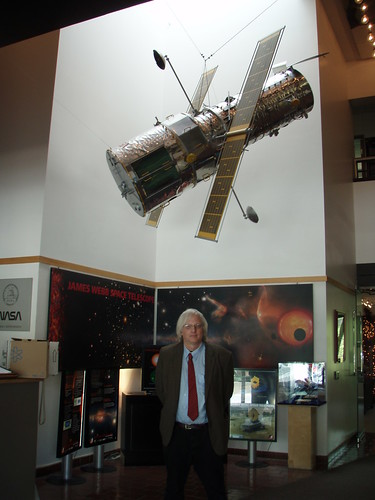
Thanks to Holdenweb, I was given an opportunity to visit the Johns Hopkins campus in Baltimore, to present a three day Python training to people working with the Space Telescope Science Institute (STScI).
STScI is a management and data analysis hub for the Hubble space telescope, and will also provide ground support for the James Webb Space Telescope (JWST).
I arrived at Dulles (WDC) on Sunday and stayed a night in Fairfax, Virginia. I am grateful to my kind host for making so many of the arrangements.
Saturday, April 17, 2010
Design Science

Given all the jitters in space program circles, these EPCOT-like proposals to "colonize Earth" by using aerospace level technology are gaining new appeal.
The PR around such terms as "dwelling machines" (a variant of "smart house") is worth monitoring.
Perhaps people are finally ready to stand back and take a new look at their energy ecology. Futuristic artifacts make more sense when changes appear inevitable, with or without said artifacts.
I've been surveying the "peak oil" literature again, finding lots of awareness of the "design science revolution". Apocalyptic scenarists, if tempered at all in their doom saying, tend to steer towards these "more with less" aesthetics of aerospace and high efficiency.
Squandering fuel on commutes is seeming increasingly crazy.
Fuller cites "planners" as among those most empowered to think in big picture terms. Planning around lifestyles that don't require a daily commute might require some rezoning.
More communal kitchens are feasible, including in suburban settings. The metaphor of a campus might become less of a metaphor in that case, especially in light of all the student exchange going on (a lead counter to xenophobia around the world).
Our hopes to showcase some of these alternative future lifestyles clearly manifest in Portland, not least in connection with the Pauling Campus in zip code 97214. Sponsors looking for product placement opportunities have been stepping forward.
Having humans rewarded for not commuting while getting important work done nevertheless, will likely involve greater use of optical fiber.
Dreams around urban agriculture, less tied to fossil fuels for transport, and of eco-villages designed from the ground up to do more with less, seem semi-mainstream by this point.
Tuesday, April 13, 2010
Wanderers 2010.4.3
Tonight was about eco-tourism, which means developing budgets to keep environments pristine, in a state people would gladly pay to experience, and/or save for others to experience.
Lynne Taylor gave the presentation, showing lots of pictures from her eco-tour in Australia, mixed with other maps, screen shots from Google Earth (or so I recall). Jeff Goddard produced the projected slide show, which Lynne reviewed quickly afterwards, for my benefit.
I got here late, having caught the 14 back from downtown. This wasn't the first time PPUG and Wanderers had met on the same night.
Barry was attuned to the trimaran Groupama 3 that'd recently broken an around the world sailing record.
PPUG 2010.4.13
I made a quick visit to Portland Python User Group on the 16th floor of a downtown sky tower this evening, at the WebTrends office.
We're having sponsor-provided pizza but did not manage to secure permission from management to consume beer.
Our first presentation is on the "baker" module. This provides a customizable decorator that lets you export a bunch of functions to your external command line environment.
Jason has a proposal in the EuroPython. The GIS in Action conference, where I spoke last year, is about to get started, at PSU this year. The wheels keep turning.
Jason is quickly covering some 2.7 features, mainly new dict methods. He's noting that 3.x features have been back ported, but isn't sure what all these new features are. Dictionary and set comprehensions" are a neat. Adam is showing us those.
Kyle is showing us execnet. This lets you send Python code through an ssh connection for execution on remote Pythons, Jythons or whatever. The "channel" created by makegateway() uses its own serializing protocol, although you can specify a different one.
I'm busy cramming for a gig, supposedly an introduction to Python. I should probably get back to that. We must have like 40 people here, only one of us female. Lindsey (FOSS witch) is sending some grammatical remarks (corrections) through the ether, so is here in spirit.
Discogs & Python by Kevin Leweandowski (founder and CEO of Discogs) is about the Discogs database, which is wiki-like. The database has about 2 million entries, 4 million unique users a month, runs on about 30 servers. His latest architecture uses some Python ports of Ruby stuff: Routes, and WebHelpers (is that through Pylons?).
Kyle really appreciates the Python interactive console, one of its most unappreciated features (saves time in development, maintenance etc.).
If I leave now, I'll have a short time with Wanderers.
Saturday, April 10, 2010
Radical Math and Python

Figure 1: Inscribing a Cube in a Rhombic Triacontahedron
by D. Koski
Loyal readers of these non-fiction blogs will have discovered a Russian novel's number of characters, along with numerous "mug shots" of polyhedra, repeated in many contexts.
For example, I phoned David Koski this morning to double-check on the face diagonals of the Rhombic Triacontahedron of volume 7.5 which shape, you may recall, intersects the volume 6.0 Rhombic Dodecahedron of radius 1 (or of diameter 1/2 if accounting in diameters). The 7.5 volumed Rhombic Triacontahedron has a radius of Φ/√2 compared to that of a sphere of radius 1.0.
These polyhedra are both members of our august Concentric Hierarchy of Polyhedra, a famed inner circle of polys, including the Platonic Five, that comprise our Zen Garden.

Note that a Rhombic Triacontahedron of volume 5 would contain an inscribed cube (per Figure 1) of volume 2, i.e. 5 * 2/5 = 2. This is a good candidate for a 2-volume in the concentric hierarchy, which already has volumes 1, 3, 4, 5, 6, (Φ2 + 1) 3√2, 5 Φ2√2, 20 and 24.
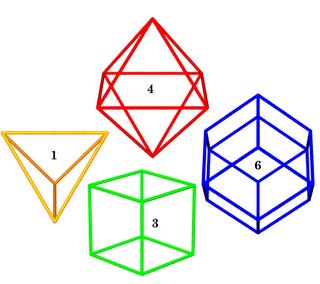
David had a ready answer: given a Cube inscribed as above has 2/5ths the Triacontahedron's volume, the 7.5 volumed RT would contain a Cube of volume 3. This is convenient, as it's the Cube volume we had already, based on two unit volume Tetrahedra intersecting each other to form its corners.
What's cool is that every time you intersect a Platonic with its dual, you get a polyhedron with rhombic faces (squares count as rhombs, and so the Cube is one of them).
When you criss-cross those rhombic faces, you divide them into four right triangles (the face diagonals of rhombs intersect at 90 degrees -- something to prove in a Euclidean geometry class). The point at the body center forms the fourth vertex of these four tri-rectangular tetrahedra per rhombic face.
In the case of the Cube and the Rhombic Dodecahedron, the fall-out from so carving the faces are Mites, or minimum tetrahedra. One gets 24 and 48 of them respectively, each weighing in with volume of 1/8. Cube: 1/8 * 24 = 3. Rhombic dodecahedron: 1/8 * 48 = 6.
In the case of the Rhombic Triacontahedron, the fall-out is the T-module shape. To be an actual T-module, you'll want your Triacontahedron to weigh in at precisely 5. This gives each of the corresponding 120 T-modules a volume of 1/24, i.e. 1/3rd that of the Mite and the same volume as the A and B modules (the Mite is comprised of 2As and 1B).
Below is David's instructive vZome as to how the Cube and Rhombic Dodecahedron are both comprised of Mites.

Figure 2: sharing a MITE
by D. Koski
Note that a Rhombic Triacontahedron of volume 5 would contain an inscribed cube (per Figure 1) of volume 2, i.e. 5 * 2/5 = 2. This is a good candidate for a 2-volume in the concentric hierarchy, which already has volumes 1, 3, 4, 5, 6, (Φ2 + 1) 3√2, 5 Φ2√2, 20 and 24.

"relative volumes"
(Python + POV-Ray)
(Python + POV-Ray)
Note: the above information is premised on using Tetrahedral Accounting, not widely practiced or known about as late as 2010, Dr. Arthur Loeb's brilliant essays notwithstanding.
A wily underground of Radical Math teachers, some with friends in high places, willingly circumvented the Bucky Boycott (an anti-USA PR campaign) and taught this "verboten math" on the sly -- a risky-yet-necessary business given the high stakes involved.
Python, Athena's archetypal protector (she's our goddess of wisdom, intelligence and defense) is also literally a computer language. Python proved useful for encoding such radical math as the above, keeping it alive and kicking through a dark age of rampant ignorance and tyrannical subjugation.
Thursday, April 08, 2010
My First Critic
Some of my fiercest critics hide out. This guy, Frank Zubek, is at least up front with his counter-points. If he succeeds in confusing you, maybe check Color Plate 3? Don't forget to order his Elusive Cube. Be the first on your block to share one. CubeIt! by Huntar is also worth having, if the mighty MITE is your game.
 close encounter with Martian Math

:: MITEs Cube with
pg. 71 of Regular Polytopes ::
Tuesday, April 06, 2010
Globalization
The term "globalization" has many negative connotations, such as loss of ethnic identity, change at too fast a pace, disruptive economics. I'm not on some mission to dismiss what's really difficult as somehow easy. Along with Jungians, others with a psychological focus, I'm aware of an inward process as well as an outward one. Humanity is giving birth to its next collective self in some dimension. People look to their religious traditions, other wisdom literature, for guidance in these unprecedented times. We have each other.
I wandered into Tibet Spirit today, after working all morning on a Python-related project. I read some of the meditations, wished the proprietor well. This was after driving Tara's community service project report to her school (3.4 miles round trip). She was home fighting a cough. I spoke with my mother by cell phone (the only phone we have anymore).
My thanks to Glenn Stockton for his help today with the office.
I thought about Mecca today as well, the pilgrimages people make. One may reason against these practices, yet from another standpoint, here is how people have made a way together, created community. Precession. Side effects. Gravity. Tension. I do not disrespect or sit in judgment. I join the prayerful in their eagerness to find a way forward that has integrity. My contributions should be a help, not a hindrance. We pray to serve and to find alternatives to violence, out of compassion for ourselves in our own suffering. Let us work together. May Allah have mercy when we stray or delay, and write new teachings in our hearts.
I wandered into Tibet Spirit today, after working all morning on a Python-related project. I read some of the meditations, wished the proprietor well. This was after driving Tara's community service project report to her school (3.4 miles round trip). She was home fighting a cough. I spoke with my mother by cell phone (the only phone we have anymore).
My thanks to Glenn Stockton for his help today with the office.
I thought about Mecca today as well, the pilgrimages people make. One may reason against these practices, yet from another standpoint, here is how people have made a way together, created community. Precession. Side effects. Gravity. Tension. I do not disrespect or sit in judgment. I join the prayerful in their eagerness to find a way forward that has integrity. My contributions should be a help, not a hindrance. We pray to serve and to find alternatives to violence, out of compassion for ourselves in our own suffering. Let us work together. May Allah have mercy when we stray or delay, and write new teachings in our hearts.
Sunday, April 04, 2010
Easter Sunday 2010
In celebration of Easter, Tara and I joined the Boltons' extended family, plus a nuclear family from China that has lived in North America for some twenty years.
The Chinese family had recently traveled across America by train, from Portland to Boston, with a change in Chicago. They had a sleeper compartment and took in a lot of country they had never seen from an airplane: eagles on the frozen Mississippi, owls on the leg to Seattle.
I had some Flextegrity along, for conversation purposes, a product of Glenn Stockton's workshop with supplies from the company, the four-frequency tetrahedron of 35 plastic injection molded hubs, each of 6 identical components, made somewhere on the Chinese mainland.
Tara joined the other young girls, and an older guy, in hunting for eggs and chocolate. Tara has a special liking for Cadbury eggs. That used to be a Friendly company (as in "Quaker"). I wore my Friendly hat, a professorial jacket, black and blue jeans and shirt. Tara was more stylish.
Later, I visited with Glenn, returning said tetrahedron. We discussed Hinton's work. Charles Hinton was a contemporary of Edward Abbott's of Flatland fame. Geometry was entering a new chapter back then, with talk of hyper-dimensions, starting with four.
In the Greek view, height, width and depth constituted three independent dimensions, which took care of conventional space. The "unconventional dimensions" per Hinton and others, might have to do with "higher consciousness" -- not an unusual view and one which continues to permeate the literature, although one perhaps more commonly thinks of mundane "time" as a fourth dimension, complete with world lines and so forth.
Linda Darlrymple Henderson's The Fourth Dimension and Non-Euclidean Geometry in Modern Art provides a useful account of fourth dimension talk at the start of the 1900s. Fuller was a player by then, as was P.D. Ouspensky. When Fuller finished writing 4D Timelock, he rushed a copy to the latter, per Dr. Henderson's chronicle.
I replied to Alan about the Coupler on Synergeo, fitting in mention of Descartes' secret notebook. I was going over Descartes' angular deficit in the context of Fuller's critique of the calculus with Glenn, jumping from Bishop Berkeley's excoriations.
Tara took public transportation to Clackamas to see a movie with her friend. I wrote our trip to Hillsdale on the mileage sheet, then walked around the neighborhood with LW who was seeking candles. Cooking and cleaning ensued (also blogging).
Non-humans played an important role in this year's Easter, starting with Suzanne's possum on Facebook, through the squirrels in our attic, to the new pug puppy at our lunch. The pug ate a carrot off the Flextegrity tetrahedron (see Fig. 1). From the Amtrak train, many animal tracks had been visible, though no actual bears had been seen.
Last night, Tara educated me about the steampunk aesthetic, one of several styles that have traction at her school. She sent me a detailed email, including pictures, spelling out more of the lifestyle taxonomy. Steampunk has a neo-Victorian flavor, which got me thinking about Neal Stephenson's writings.
Tara is reading about Clarence Darrow and studying the issue of jury nullification for district debates. We had a discussion about corporate personhood over dinner last night, with me citing Thom Hartmann's research into the bogus beginnings of this idea, and with LW linking to Europe's social democrats. Regarding these social democrats, Tara worried about any tyranny of the majority that might give outlet to rampant xenophobia. Should ethnic costumes be banned just because Preppies don't like them? What would the Goths think?
Treating corporations as programmable machines does not negate the value potentially added by the people who control them. Some Quaker corporation (e.g. Global Data Corporation) might deliberately drop the corporate personhood dogma and revert to becoming such a machine. The new business rules would be expressed in the software, and with the government's blessing. We're designing new institutions from scratch, borrowing from cultural templates, but not mindlessly imitating them. Academia could help with the blueprints (class definitions), as could some national labs. Plus let's work with Native Americans to pioneer these new ethics. This proposal might make for some interesting steampunk science fiction if nothing more.
 Fig 1: flextegrity dog
The Chinese family had recently traveled across America by train, from Portland to Boston, with a change in Chicago. They had a sleeper compartment and took in a lot of country they had never seen from an airplane: eagles on the frozen Mississippi, owls on the leg to Seattle.
I had some Flextegrity along, for conversation purposes, a product of Glenn Stockton's workshop with supplies from the company, the four-frequency tetrahedron of 35 plastic injection molded hubs, each of 6 identical components, made somewhere on the Chinese mainland.
Tara joined the other young girls, and an older guy, in hunting for eggs and chocolate. Tara has a special liking for Cadbury eggs. That used to be a Friendly company (as in "Quaker"). I wore my Friendly hat, a professorial jacket, black and blue jeans and shirt. Tara was more stylish.
Later, I visited with Glenn, returning said tetrahedron. We discussed Hinton's work. Charles Hinton was a contemporary of Edward Abbott's of Flatland fame. Geometry was entering a new chapter back then, with talk of hyper-dimensions, starting with four.
In the Greek view, height, width and depth constituted three independent dimensions, which took care of conventional space. The "unconventional dimensions" per Hinton and others, might have to do with "higher consciousness" -- not an unusual view and one which continues to permeate the literature, although one perhaps more commonly thinks of mundane "time" as a fourth dimension, complete with world lines and so forth.
Linda Darlrymple Henderson's The Fourth Dimension and Non-Euclidean Geometry in Modern Art provides a useful account of fourth dimension talk at the start of the 1900s. Fuller was a player by then, as was P.D. Ouspensky. When Fuller finished writing 4D Timelock, he rushed a copy to the latter, per Dr. Henderson's chronicle.
I replied to Alan about the Coupler on Synergeo, fitting in mention of Descartes' secret notebook. I was going over Descartes' angular deficit in the context of Fuller's critique of the calculus with Glenn, jumping from Bishop Berkeley's excoriations.
Tara took public transportation to Clackamas to see a movie with her friend. I wrote our trip to Hillsdale on the mileage sheet, then walked around the neighborhood with LW who was seeking candles. Cooking and cleaning ensued (also blogging).
Non-humans played an important role in this year's Easter, starting with Suzanne's possum on Facebook, through the squirrels in our attic, to the new pug puppy at our lunch. The pug ate a carrot off the Flextegrity tetrahedron (see Fig. 1). From the Amtrak train, many animal tracks had been visible, though no actual bears had been seen.
Last night, Tara educated me about the steampunk aesthetic, one of several styles that have traction at her school. She sent me a detailed email, including pictures, spelling out more of the lifestyle taxonomy. Steampunk has a neo-Victorian flavor, which got me thinking about Neal Stephenson's writings.
Tara is reading about Clarence Darrow and studying the issue of jury nullification for district debates. We had a discussion about corporate personhood over dinner last night, with me citing Thom Hartmann's research into the bogus beginnings of this idea, and with LW linking to Europe's social democrats. Regarding these social democrats, Tara worried about any tyranny of the majority that might give outlet to rampant xenophobia. Should ethnic costumes be banned just because Preppies don't like them? What would the Goths think?
Treating corporations as programmable machines does not negate the value potentially added by the people who control them. Some Quaker corporation (e.g. Global Data Corporation) might deliberately drop the corporate personhood dogma and revert to becoming such a machine. The new business rules would be expressed in the software, and with the government's blessing. We're designing new institutions from scratch, borrowing from cultural templates, but not mindlessly imitating them. Academia could help with the blueprints (class definitions), as could some national labs. Plus let's work with Native Americans to pioneer these new ethics. This proposal might make for some interesting steampunk science fiction if nothing more.
 Fig 1: flextegrity dog
Wednesday, March 31, 2010
A View from Abroad
 to Poly list, by DK
Dave Koski and I were on the cell again tonight.
I ranted a bit.
Two points:
(a) Not including much if any Bucky in K-12, where some of his contributions clearly belong, in geometry, history, literature, is a clear signal to the world that some ulterior motive trumps obvious relevance. Study what America teaches its young. What diplomats or politicians put out, is far less of an indicator than what goes down in K-12. We're talking about a positive, hopeful futurist whom many a world leader embraced. To actively exclude this information is a forceful declaration of a commitment to go in a different direction, a commitment renewed daily in schools across the country. Just mentioning geodesic domes in a geometry textbook sidebar is hardly saying much. Where are the whole number volume ratios?
(b) Not making more hay around the minimum space-filler, so-called because it's a tetrahedron without left or right handedness, seems bizarre. Math World doesn't mention it on its page on space-filling, with or without Fuller's terminology (he called it a Mite). True, spatial geometry is somewhat esoteric to begin with, but a minimum space-filler... even K-12 should have room for such a thing.
Here's from Math World. Notice how tetrahedra are not mentioned at all in the paragraph below, even amidst an attempt to be exhaustive:
In the period 1974-1980, Michael Goldberg attempted to exhaustively catalog space-filling polyhedra. According to Goldberg, there are 27 distinct space-filling hexahedra, covering all of the 7 hexahedra except the pentagonal pyramid. Of the 34 heptahedra, 16 are space-fillers, which can fill space in at least 56 distinct ways. Octahedra can fill space in at least 49 different ways. In pre-1980 papers, there are forty 11-hedra, sixteen dodecahedra, four 13-hedra, eight 14-hedra, no 15-hedra, one 16-hedron originally discovered by Föppl (Grünbaum and Shephard 1980; Wells 1991, p. 234), two 17-hedra, one 18-hedron, six icosahedra, two 21-hedra, five 22-hedra, two 23-hedra, one 24-hedron, and a believed maximal 26-hedron. In 1980, P. Engel (Wells 1991, pp. 234-235) then found a total of 172 more space-fillers of 17 to 38 faces, and more space-fillers have been found subsequently.What you find instead is that Aristotle was wrong: tetrahedra do not fill space. "Although even Aristotle himself proclaimed in his work On the Heavens that the tetrahedron fills space, it in fact does not."
The more nuanced dismissals remember to say he said "regular tetrahedra," however this oft repeated factoid just goes to obscure the fact identical non-regular tetrahedra do fill space.
Mites face-bond to make two more space-filling tetrahedra (called Sytes by Fuller), though these are not as primitive, given their decomposition into component identical space-fillers.
Dave is looking at some Catalans these days, duals to the Archimedeans. The cuboctahedron and icosidodecahedron have the rhombic dodecahedron and rhombic triacontahedron as their respective duals. He's studying the dual concept more generally, going off some of the data in the Robert Williams compendium.
These latter are combinations of duals themselves: the rhombic dodecahedron is a combination of the cube and octahedron; the rhombic triacontahedron is a combination of the icosahedron and pentagonal dodecahedron.
I doubt many people will read a lot of Synergetics with gusto. That's a hard text. Glenn routinely expresses his frustration with it, as do I. Not everyone reads philosophy, period.
Related post to Math Forum: Recap: Letter to Arne Duncan etc. (March 31, 2010)
Sunday, March 28, 2010
Work / Study Programs
Global U student LW has been traveling along with Paul Treanor through the highways and byways of Amsterdam, looking at Google Street Views.
I took a little workshop with Glenn this morning, in his GlobalMatrix Studio on the Pauling Campus. I got to snap some more acrylic icosahedra together (a fun skill), then paid with a lunch at Oasis.
His prototype Flextegrity kit is looking good but I won't say much about it yet. Glenn and Sam did some inventory recently, meaning Glenn got to see the energy-efficient two wheeler Sam let me ride. The three of us plan to meet again tomorrow.
During our lunch at Oasis, Leslie Hickcox put me in touch with a Sky Trams guy who used to be with Boeing. He's into high speed rail and like that. I was amused by the little cartoon about the year 2000, made in some Other America; "very sexist" I told him, smiling broadly.
That got me thinking about the for-academic-credit work / study approach to some of these railroad jobs.
These are programs helping companies recruit their future engineers (of many varieties) and so are not about taking away jobs. We're presuming friendly town-gown relations.
This is about internships, apprenticeships. Students sample jobs, learn lore.
Some of those enrolled may have no strong leading to commit to railroad building as a career focus, are up front with this thinking, and yet are willing trainees for the semester, bring relevant skills.
The resulting mix in the temporary communities will prove more diverse as a result, and this is a net positive. Biologists and ecologists in training, a few nurses, out with the surveyors and track layers, doing some cross-training and coming to understand one another better: something to write home about.
Temporary campus communities would need to set up along the way, sometimes in picturesque circumstances. Core staff would include those working full time in a more dedicated capacity, perhaps with Siemens or Bombardier.
When you get back to your dome village, you have classes in other subjects, like computer programming or TV editing. There's a cafeteria, private living spaces. We don't presume the typical construction site trailers. Perhaps Princeton is supplying some of the programming.
Some temporary campus facilities may grow into small towns, provided this marks a return to passenger railway days, with some trains making lots of local stops (perhaps on a siding).
The trend has been in the other direction, so there'd have been a cultural shift twixt then and now, maybe thanks to peak oil, frustration with suburban living, nostalgia for saner lifestyles.
Given this whole work / study approach is from Another Tomorrow, lets be imaginative and simply assume North Americans have returned to the notion that trains are good, and lots of remote living along the railroads is once again a preferred lifestyle. Or maybe this is somewhere closer to Mongolia?
You've got optical fiber, lots of bandwidth, local clinics with skilled health care personnel.
Yes, there might be a runway within a couple hundred miles, but no regular commercial service. Sometimes an executive team will visit by small jet, especially if the rail line is still under construction. These bases come and go though, just as the villages do. They're built with dis-assembly and removal already a part of the plan -- a new kind of architecture.
Back at the campus, lets tour around: more horses than motor vehicles? Electric ATVs? No supermarket for hundreds of miles? How many children? How many elderly?
A given campus might host facilities for alumni, company veterans. Even though you don't visit the construction site every day, don't operate heavy equipment, you're still able to teach, work on memoirs, collate experiences, play with young children. The Global U is for life-long learners.
The trains sometimes leave box cars with stuff off the ships, ordered on-line. The new "smart homes" fit in one container.
This isn't about "commuting to work" necessarily, so much as being where the school is located, and both working and studying.
Is this school a religious institution? The more permanent towns will have their cemeteries, their sacred spaces. If the school starts a vineyard, then the trains may have orders to pick up, as well as drop. The idea of a civilian-friendly rail-based economy will have reasserted itself.
Smart curricula will combine experiences, integrating the new knowledge and skills, encouraging positive synergies. For example, the dodecacam you used at the job site (while working on the railroad) will feature in your learning to program, as you upload to the company server.
As a materials engineer, you will analyze data from the work site. As a field biologist, you will have your specimens to study. As a geologist, you might have collected a few gems. Apprentices will mingle with more experienced personnel, learning the ropes.
A railroad is a stand-in for many a project requiring off-the-duff tool use.
A semester in North America, or Russia, or wherever, working on an interesting mega-project, would be a feature of several university majors.
Consider Old Man River City (OMR). Where would the workers come from?
If they're also students in some cases, then the build site would have more of an Arcosanti flavor.
I took a little workshop with Glenn this morning, in his GlobalMatrix Studio on the Pauling Campus. I got to snap some more acrylic icosahedra together (a fun skill), then paid with a lunch at Oasis.
His prototype Flextegrity kit is looking good but I won't say much about it yet. Glenn and Sam did some inventory recently, meaning Glenn got to see the energy-efficient two wheeler Sam let me ride. The three of us plan to meet again tomorrow.
During our lunch at Oasis, Leslie Hickcox put me in touch with a Sky Trams guy who used to be with Boeing. He's into high speed rail and like that. I was amused by the little cartoon about the year 2000, made in some Other America; "very sexist" I told him, smiling broadly.
That got me thinking about the for-academic-credit work / study approach to some of these railroad jobs.
These are programs helping companies recruit their future engineers (of many varieties) and so are not about taking away jobs. We're presuming friendly town-gown relations.
This is about internships, apprenticeships. Students sample jobs, learn lore.
Some of those enrolled may have no strong leading to commit to railroad building as a career focus, are up front with this thinking, and yet are willing trainees for the semester, bring relevant skills.
The resulting mix in the temporary communities will prove more diverse as a result, and this is a net positive. Biologists and ecologists in training, a few nurses, out with the surveyors and track layers, doing some cross-training and coming to understand one another better: something to write home about.
Temporary campus communities would need to set up along the way, sometimes in picturesque circumstances. Core staff would include those working full time in a more dedicated capacity, perhaps with Siemens or Bombardier.
When you get back to your dome village, you have classes in other subjects, like computer programming or TV editing. There's a cafeteria, private living spaces. We don't presume the typical construction site trailers. Perhaps Princeton is supplying some of the programming.
Some temporary campus facilities may grow into small towns, provided this marks a return to passenger railway days, with some trains making lots of local stops (perhaps on a siding).
The trend has been in the other direction, so there'd have been a cultural shift twixt then and now, maybe thanks to peak oil, frustration with suburban living, nostalgia for saner lifestyles.
Given this whole work / study approach is from Another Tomorrow, lets be imaginative and simply assume North Americans have returned to the notion that trains are good, and lots of remote living along the railroads is once again a preferred lifestyle. Or maybe this is somewhere closer to Mongolia?
You've got optical fiber, lots of bandwidth, local clinics with skilled health care personnel.
Yes, there might be a runway within a couple hundred miles, but no regular commercial service. Sometimes an executive team will visit by small jet, especially if the rail line is still under construction. These bases come and go though, just as the villages do. They're built with dis-assembly and removal already a part of the plan -- a new kind of architecture.
Back at the campus, lets tour around: more horses than motor vehicles? Electric ATVs? No supermarket for hundreds of miles? How many children? How many elderly?
A given campus might host facilities for alumni, company veterans. Even though you don't visit the construction site every day, don't operate heavy equipment, you're still able to teach, work on memoirs, collate experiences, play with young children. The Global U is for life-long learners.
The trains sometimes leave box cars with stuff off the ships, ordered on-line. The new "smart homes" fit in one container.
This isn't about "commuting to work" necessarily, so much as being where the school is located, and both working and studying.
Is this school a religious institution? The more permanent towns will have their cemeteries, their sacred spaces. If the school starts a vineyard, then the trains may have orders to pick up, as well as drop. The idea of a civilian-friendly rail-based economy will have reasserted itself.
Smart curricula will combine experiences, integrating the new knowledge and skills, encouraging positive synergies. For example, the dodecacam you used at the job site (while working on the railroad) will feature in your learning to program, as you upload to the company server.
As a materials engineer, you will analyze data from the work site. As a field biologist, you will have your specimens to study. As a geologist, you might have collected a few gems. Apprentices will mingle with more experienced personnel, learning the ropes.
A railroad is a stand-in for many a project requiring off-the-duff tool use.
A semester in North America, or Russia, or wherever, working on an interesting mega-project, would be a feature of several university majors.
Consider Old Man River City (OMR). Where would the workers come from?
If they're also students in some cases, then the build site would have more of an Arcosanti flavor.
Subscribe to:
Posts (Atom)

