So today was another Wanderers meeting, at Linus Pauling's boyhood home on Hawthorne. Eve Menger and George Hammond, both accomplished chemists, presented their ideas for a new introductory science text book aimed at non-science majors, prompting a lively discussion among the many scientists present.
I took a plastic bag with some favorite writing examples, including one purchased yesterday for 20% off at Barnes and Noble, where I became a member for $25 (netting another 10% discount, plus no sales tax, because I live in Oregon -- and thank you Subaru, for picking up the tab on that drive train job): Head First Design Patterns (ISBN: 0-596-00712-4). This book is the latest in the Head First series, which O'Reilly is justifiably excited about. I know Guido'd like to see a Head First approach to Python, but the market is more Java-centric these days. Fortunately, if you know Python, a reading knowledge of Java is not hard to come by. I also bought Ruby In a Nutshell, Ruby being, like Python and Perl, another scripting language, with a big following in Japan.
What's special about this book (pre-figured in Who is Fourier?, another title in my bag), is the attention given to the proper care and feeding of the human brain. Without pretending to any advanced neurological theory, the authors (with background at Disney) intersperse clever graphics, scrawled handwriting, jokes, stories, puzzles. Why they do this is spelled out in the Intro, and raves on the back (hi Ward) are testament to the effectiveness of their approach. I'd say the "for dummies" series (with wanderer Allen Taylor one of its authors) has also pioneered in this direction, but with O'Reilly there's not even the pretense that the readership is dumb. One of my favorite graphics is on page 12: this arms-folded, somewhat defiant-looking young woman has this thought bubble: "I don't see why you have to use an interface for FlyBehavior. You can do the same thing with an abstract superclass. Isn't the whole point to use polymorphism?" Hah, I love it.
Anyway, George and Eve were very open to this kind of informalizing, yet purposeful innovation. Allen pointed out that Head First is a trade book, not a text book -- a distinction publishers sometimes worry about. I also had Concrete Mathematics in my bag (a true text book), which I thought prototypical in its use of marginalia to make things friendlier. Beyond that, it's more typical of math texts: austere, intimidating, a monument to the authors' intellect.
The Hammond-Menger approach to energy as a unifying theme is also refreshing: the sun powers earthly operations, and we take in a lot of that energy as calorie-laden foods. Relating physics to personal human experience is also our approach in First Person Physics, which will have a precessional impact with or without NSF funding.
The geek channel I've been brainstorming (including in this blog), takes these kinds of pedagogical advances to the next level. We won't be abandoning book learning, but high bandwidth audio-video will tap into even more brain power. As David Feinstein pointed out, 60% of our brain circuitry is about visualization, and 20% of that is about sensing motion. So if you supplement your pedagogy with moving pictures (e.g. animations), you're ipso facto making your audience more intelligent, and your content more illuminating. Bill Nye the Science Guy always stands out in my mind as a great pioneer in this direction.
George and Eve also circulated copies of A Dangerous Signal to Science, an editorial by Alan Leshner of the AAAS (Science, Vol 306, 24 December 2004, page 2163). Many wanderers expressed their concern that fear parasites are draining the budget for civilian science education, leading to a dumbing down of ordinary Americans. That's all by design of course. If Americans were more science-savvy, they wouldn't be such easy prey for those capitalizing off Pentagon waste (e.g. unnecessary soldier deaths), thereby undermining our long term social security, which is not their concern (yet it is our president's, who, like Reagan, is no dummy -- something the Russians could tell you).
Followup 2005.1.20: per email from Eve and George, I fixed their surnames. Plus I watched the USA's presidential inaugural this morning. Although cameras picked up protestors being escorted away by police, the corporate media I heard was too busy manufacturing consent to comment -- an interesting novent given the content of the speech itself (which was right on the money in a lot of ways). My family is honoring various boycotts today, our way of helping Cheney defend the Constitution against foot-dragging domestics -- LAWCAP slowpokes that're hardly moving compared to an up-to-speed USA. Last night, I watched Inside Iraq again, using the external Sony DVD drive on KTU2.
Tuesday, January 18, 2005
National Treasure (movie review)
So I was back at Dick Hannah's getting Razz a new viscous coupler (we name the cars in our family), and decided to see National Treasure at the neighboring mall, with my friend Dave Fabik, a Quaker vietvet.
Like Polar Express, you need to see this as a film for kids -- which makes me suspicious there'll be some theme park ride deriving from it (in the case of the train movie, I'd vote for a real roller coaster over a simulator). In the guise of this somewhat formulaic vehicle, Disney clues newbies that there really is such a thing as intellectual history, that it glues monuments and documents together (by making sense of them), and that it includes such things as secret societies and their cryptic teachings. Indeed, our shared treasure is the historical record itself and what it tells us about ourselves as human beings -- and portends for our future (the booby prize is the big house and fancy car).
On a more adult plane, Multnomah Friends are looking at buying a Masonic Lodge across the street, or risk losing the parking lot (Masons use it Saturdays, which works well, but what if they sell to a competing Sunday user?). The deal hasn't closed -- still processing. Last night I passed on to the clerk my two cents that it'd be worth it to have the deepest pipes snaked to make sure all the under-street plumbing is in working order. In our century-old neighborhoods, that's really not a given, a fact houses on either side of ours have recently had to deal with. When I shared this Friendly concern with Dave he joked that instead of "eye in the sky" my viewpoint was more "camera in the sewer."
And speaking of real national treasure, I phoned Ed Applewhite from the Barnes and Noble (a segue to my next post). He's feeling upbeat that Fuller's legacy is, now more than ever, irrevocable (and I concur). However, Ed himself is starting to say his good byes. We've enjoyed a strong friendship, and I look forward to staying in touch with his kids.

Sunday, January 16, 2005
Text Drives Graphics
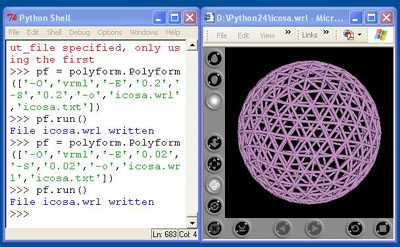
Python + VRML
An important point to emphasize with a new generation of computer-savvy student, wowed by eye candy, is that even if the graphics are glitzy, the source code behind them is still text-based. In other words, the programmer's world still looks more like free verse poetry than Saturday morning cartoons.One way to show this is to start with a VRML graphic, such as the 5-frequency icosasphere in the right window above, let students interact with it, using interface controls (Cortona's in this shot), then switch to the left window, where a scrolled session demonstrates a corresponding text-based API. What bridges left and right is a lot of scripting language, in this case Python. These scripts take user parameters and generate the underlying .wrl file (world file), which the VRML browser then processes and displays.
Likewise, even where the effective use of such scripts is to valve electrons on a motherboard, in order to make state changes to a hard drive, the engineers who designed this mutiple layering of hardware and software used a lot of human-readable text in the process. We're still firmly anchored to what we most need: comprehensible readings (even if highly technical sometimes).
The moral of the story is, contrary to outward appearances, the culture is not moving away from reading, i.e. the process of eye-balling text to extract meaning. The right brain is getting more of a workout, what with all the visual cortex stimulation, but so is the left. So the old balance between left and right is still recognizable.
Fuller's goal in writing Synergetics was to make a more geometrically sophisticated right brain process accessible to strong readers in the humanities. Per Applewhite, Fuller was even contemplating a free verse format. The idea here was that artists and designers of our future artifacts would need to have a strong background in the humanities and the sciences. In developing a more mathematically informed poetics that would excite the liberal arts reader, while at the same time driving a set of precise geometric visualizations, Fuller hoped to bridge what C.P. Snow considered a chasm between the two cultures.
Most scientists and mathematicians who've taken a look at Synergetics, thinking it might be a work in their discipline somehow, have come away frustrated because it doesn't yield the kind of strictly literal "bottom line" interpretation favored by fundamentalists.
Readers in the humanities, however, although more tolerant by training of multi-dimensional readings, typically disconnect early-on, because this really doesn't look like anything they're used to in American literature. Too crazy-making. They'd rather take the easy path and try to write Fuller off as a naïve technophile who couldn't really master the language. But his strong track record in terms of real world physical artifacts made that difficult. Plus he'd held the Charles Eliot Norton chair at Harvard for awhile (see Critical Path, Chronology of Prominent World Events: 1962), and coined the term Spaceship Earth. Not so forgettable, huh guys?
As a liberal arts student at Princeton with a strong background in Wittgenstein's philo, I wasn't so hooked on the need for a literal meaning, plus I was willing to let Fuller develop his own meanings operationally, i.e. through use. Erhard's est Training also helped provide focus in that the Centers Network was clearly taking Bucky very seriously, thereby reinforcing the idea that American philosophy ultimately wasn't going to bleep over a powerful contribution to American literature, regardless of what the rank and file in academia might be about. Plus I noticed another sector of American society that was taking Fuller very seriously: the CIA. My CIA Report on the Centers Network (1985?) was an attempt to better unify these two threads (I think Stanford has a copy -- can't find mine right now).
All of which brings me to American history: if you haven't been paying attention to either the literature, or the philosophy, then how much about it do you really know? Something to think about (especially if you consider yourself an American): some Russians know it better than you do.
Saturday, January 15, 2005
Freezing Rain
We have freezing rain in PDX today with traffic conditionings worsening. Saturday Academy is canceling across the board. In more normal conditions I'd be driving out to Oregon Graduate Institute this morning. I phoned all my students. Qwest.net is having email problems in multiple states per a recording on their support line.
Dawn has this tenderness in her armpit, and that's keeping me on edge. Probably nothing, but once you've had IBC, you're always sensitive to any signs. If it doesn't abate, we'll phone a doctor next week.
When Bucky lost his first daughter, his despair was at first self-directed and he strongly considered suicide. Then he realized that, despite not making a lot of money, he'd been a productive human being (he'd served admirably in the navy, had some civilian structures to his credit -- the domes were still in his future) and he came to another place: human society was backward and behind schedule, i.e. if only we'd advanced further along our destined path, medical sophistication would've been greater, and his daughter might have lived (and yes, in 2005 she likely would have).
So Bucky committed to becoming an engine designed to propel us forward -- as a whole species, not just as one specific family, tribe, or nation. He felt his effectiveness in the world actually derived from his commitment to the whole. And the objective record is testament to his effectiveness. Lots of Chinese read his books with interest, and not because they thought he was brainstorming about ways to kill them (refreshing).
I share Bucky's sense that we're dangerously slow, especially in light of the fact that, even after giving it his all, we tend to dismiss his life's work. Academia has moved on, in a way that mostly just bleeps over, never comes to grips with, his contribution. Like at least he bequeathed some good American literature, right up there with Edgar Allan Poe's (I'm thinking of Applewhite's speech at the Bucky symposium last March, a day or two before I learned of Dawn's cancer diagnosis).
So why don't we read his poetry at least -- for credit, in university? And the concentric hierarchy, his way of organizing simple shapes: I've taught it to 2nd and 3rd graders with no problems, and yet mostly I meet with blank stares when I mention it to adult educators, and we're talking thirty years after the publication of Synergetics.
Yes, there's a lot going on in our little network. We're not at all moribund. In my class today, I was going to show off Braley's VRML interpretation of the pillow dome skeletons, used in Cornwall for the Eden Project. We have a Win2000 lab, so the Cortona plug-in would be the way to go. Then I was going to show how I'm able to generate VRML files on the fly using a set of Python utilities written by Adrian. Because they're open source (BSD license), I'm able to modify them. Likewise, I've contributed a lot of code, a lot of curriculum materials, aimed at making the Bucky stuff more contemporary and accessible.
No one has paid me to do this. Getting this paying gig with Saturday Academy is new, and I think a good sign. But I can't shake this feeling that we're running behind schedule. No matter how effective I am, I can't completely compensate for all that waste in the Pentagon for example. It's just not an even fight. Like, they're losing big time, true, but why do they fight against their own USA? Don't they realize: resistance is futile, we are borg?
A message from the Fuller School: you won't beat us, so how about joining us? Make those geometry cartoons show up in the dot mil domain how 'bout? And what about those BizMos? I should already have one by now. I blame the United States Navy for not being on the ball. Like, aren't those admirals supposed to have great overview or something?
Followup: Dawn's new theory is the pain is actually joint pain owing to the Arimidex -- definitely a more positive spin. Tara and a friend are planning to stay indoors and watch Spiderman. Nick is a guest in our basement, but I think he's out on the coffee shop circuit, per usual. Mom phoned from DC in high spirits -- she's been working with Congress and making significant headway in her own estimation, and I have no reason to doubt her.
Friday, January 14, 2005
Inside Iraq: The Untold Stories (movie review)
Few of you will have had an opportunity to view this one yet. Mike Shiley, a guy from my neighborhood, armed with a still camera and video equipment, ventures alone into Iraq with hastily arranged press credentials. Later, he gets certified to operate a tank's machine gun -- whatever it takes to get the best camera angles. With beginner's luck (or perhaps Allah's protection), he out performs most seasoned pro journalists to bring us this story.
Mike's premise is that spreading democracy is indeed the mission, and in that light, he shares his qualms and misgivings, but without delivering "a left wing rant" -- I use the quotes because he told us this directly; the guy was right there in the theater, and selling the DVD when it ended (I bought one, picked up a biz card).
The Iraqi lady in the car says it well: we're suffering too much, and democracy will never happen amidst this ongoing chaos and destruction. The level of incompetence that delivered us into this mess is extreme. I won't get too personal on that score, but many histories will be less restrained. My policy is more to forget than forgive.
I did come away thinking there must be a special place in hell for people who make and deploy land mines. The compassionate response would be to arrest them now, and save them from certain oblivion. Or maybe not. Let others judge. Maybe ABC News, for which Mike was on assignment, will air this nationally and uncensored. That'd help orient a bigger audience in a shorter time than will the art theater circuit.
Thursday, January 13, 2005
More About BizMos
So why would the US Navy want bizmos, which are here conceived as dry land mobile units equipped with telecom and various sensors? Well, aside from being like little subs on wheels, serving as simulators for more pressurized (i.e. under water) team-based living, there's always the recruitment angle. Most USA schools are still on dry land. In other words, if the Army already has them on the drawing boards, then the Navy won't settle for less.
Obviously Mercy Corps needs bizmos. Yes, in major disaster situations we must resort to helicopters and other airlift technologies, both for resupply and emergency evacuation, but not all situations are major disasters. Sometimes you just need the average reconnaissance vehicle looking for mosquito breeding grounds or other precursors to epidemics, having to do with sanitation, irrigation, water management in general.
The teams need technical expertise, GIS/GPS, access to data bases, and ways to alert follow-up teams better equipped to actually deal with the biohazards. These teams may well be entirely indigenous, thanks to the comm tent and DVD library left behind, combined with folk wisdom, which is often intact and just needs a chance to operate minus interference from myopic absentee landlords who only care about resource extraction, ecosystem be damned.
In my case, it's more just this middle class family, like you find at camp grounds, tucked away with some fire in the grate, glowing in the moonlight. Kids and their parents mosey over to see what this tricked out little RV is about, not realizing that it's really a BizMo in disguise. There's this InFocus projector, DVD juke box, GIS/GPS, and stuff you might think would make more sense in a submarine. It all feels vaguely science fiction, like some Hollywood prop that escaped the lot, but everything works and is for real, and that's cool and reassuring. Apparently, there's this futuristic lifestyle available, and some Americans are already living in their dream machines.
"So where do we get training and access to BizMos?" the average camper wants to know. Well, there's the military, as I was saying, and Mercy Corps type operations. UNICEF has a fleet. Really, you have lots of options, so think about your philosophical commitment and figure out what you want to say. Maybe you're like Charles Kuralt, out to see America, and chronicle your findings for viewers tuning into your network. You've got a CBS logo on your BizMo. That'd make sense, even in an overseas context.
The bigger picture, as I see it, is Project Renaissance. Private R&D is collaborating with the public sector to prototype what may not yet be ready for prime time, in terms of safety or eventual utility, but is on the way to commercial viability thanks to test pilots, pioneers, Navy Seals or whatever (thinking of Jay Baldwin's kid). I see retreat centers sprouting up which give average Americans exciting opportunities to train on the new equipment, which includes more stationary radome-like living quarters, some sponsored by corporations (CEOs will want first dibs, per their usual greediness), or by tribal casinos for their young people.
Faith-based organizations will want a piece of the action of course (Church of the Brethren has a cool camp near Remote, Oregon). I'll probably set up a few such high tech faith-based encampments myself. Maybe we'll draw a giant pentacle on the ground to show the helicopters where to land. Like, we liberal Quakers at least have already forged some strong alliances with Wicca, a fact which, as a reader of this blog, you probably already know.
Related Readings:
Brainstorming on BuckyWorks
What's a BizMo?
Project Renaissance
(some other classified stuff)
Wednesday, January 12, 2005
Dark Side
Some of you who've heard my polemics (or technoinvective as Applewhite called it -- more out of dismay than admiration sometimes) may suspect I had something to do with that school strafing back in December, 2004. I assure you that I had nothing whatsoever to do with that.
Yes, I think our students get terrible service and I'll likely spend the rest of my life tearing into the fabric of an obsolete and incalculably damaging curriculum with gusto, like a pack of wolves devouring its prey, blood spattering everywhere, beastly screaming noises -- but that's just a videogame, just figurative language.
I'm a Quaker and I don't condone the use of outward weapons, especially not F-16s versus undefended school buildings. I mean, that's just sick.
OK, that out of the way, I'm buckling down to do more data submissions, and later on, I'm interviewing a candidate for the class of 2009 for my alma mater (more paperwork). There's a Python meetup tonight with some RSVPs already returned. On the whole, I expect this to be a fun day.
I do have my blue meanie moments however -- a mark of weakness I'm sure. But hey, this is my blog, and I have a right to come clean about my darker nature (apologies for the Pink Floyd links again -- gets tiresome I realize).
Tuesday, January 11, 2005
The Morning Mail
Today's morning mail (electronic) continues recent threads regarding the tetrahelix and the Richter Transformation. On synergeo, we've been discussing Bob Gray's colorful notes on these subjects, plus I brought up Gerald's finding that tetrahelix vertices, if they start rational, stay rational, but with no tetrahedron precisely juxtaposing (by translation) with any previous one.
I wrote a little Python program to generate tetrahelix coordinates in rational number format, using a tip from Adrian.
John Braley pointed out that the 3-tet boat (a short helix) is already an octahedron, just not a convex one. John Brawley complained that Bob's description of the transformation (to a regular one) is confusing. I think having Braley and Brawley, both Johns, on the same list is confusing, but I don't blame Bob.
I forwarded some of this material (electronically) to Julian, a Wanderer, an artist, and a physics student who did graduate work with buckyballs in Austria. Bob is a physics guy too.
Monday, January 10, 2005
A Tale of Two Toymen
So I just had a beer at the Bagdad with Rick Engel, CEO of Polymorf. He's done his homework and has his ducks in a row. I sort of discouraged him from paying for a booth at the upcoming NCTM conference in Anaheim, as I can scarcely imagine wanting to give that group any money, after all these years of its not doing its homework worth beans (a Pythagorean reference, but no doubt based on a misunderstanding).
We talked about hypertoons, space-fillers on cable TV -- one could fill a whole channel or just the odd time slots between regularly scheduled content (Eve's concept). Basically, I'm talking about an iTunes visualizer on steroids. We go spatial, and we go 4D: a network of animations connecting key frame nodes, with a randomizer for passive viewing, or choice-points if interactive. Key frame: Icosahedron. Key frame: Fuller Projection. Both are like grand central stations (like Pascal's Triangle), with a gazillion scenarios branching off, but with some connecting the two, by way of smooth (?) transformations. Sound track optional. Ambient Music for Airports (hello Brian Eno).
The above is in contradistinction to a more didactic approach, wherein we actually delve into some hard math pedagogy. That's more classroomer or homeschooler content. What I'm doing, with my 4D Studios, is front-loading a tough-going curriculum with eye candy enticements. But not out of any desire to deceive. I trully get sustenance from this product, or, as we say in geek circles, I eat my own dog food.
I shared with Rick about my friend Stu Quimby, CEO of Design Science Toys. Last I knew, Stu was throwing in the towel, looking for a buyer. The big box retailers have walled out the esoteric boutique shops in large degree, hurting Stu's customers (mostly retail chains, but not the big box ones). He could cut costs, by moving ops overseas, but he wants to support his community in Tivoli, New York and environs. Is that a crime?
His strategy, with strong business school backing, was to try direct-to-customer sales over the web (B2C instead of B2B). He invested in a state of the art Plone site, complete with community access portal (note .org and .com: same basic site, different skins), and a catchy domain name. But home shoppers hardly beat a path to his door (except when Stu got on QVC a few times). Why? Because American consumers have been educated by a mass culture with no clue. How many CEOs know what an icosahedron is? How many NCTMers actually know that rhombic dodecahedra fill space (like duh!). 'Nuff said. This is the Dark Ages, pure and simple.
What happened to end the last Dark Ages? Well, the Greek stuff went into hibernation in Europe (movie & book: Name of the Rose), but was kept alive in Islamic circuits, where it was amplified and improved upon, until when it finally got back into European cultures, it sparked a revolution, called the Renaissance in retrospect. In other words, to make a long story short, the cradle of civilization (Persia and company) saved our collective butts. So maybe something similar will happen again? Geodesic mosques. Could be big. Which reminds me: Rick used to be a tilapia farmer in Jordan, near the Gulf of Aqaba someplace. Over lunch (curry chicken pita) I shared stories about my experiences in Ramallah, helping to build that swimming pool (then ice cream at Rukab's).

Chatter
Hah, this title makes me think of Randi Rhodes on KPOJ (620 AM, Air America in PDX): she's always making fun of Homeland Security types talking about "chatter," and playing that Rolling Stones cut in reply. Also thinking of monkeys (they chatter), and therefore of monkey mind -- lots of chatter about that too, in pop psych & spirituality circles (you go, google).
So, turning to this morning's Oregonion: ah, I see Dr. Albert Starr's name on the front page, in an article about Providence, a nonprofit I work with.
And on the next page: Sunnis say they won't boycott if the US military spells out its redeployment timeline. Well, last week the US military was saying it's consolidating to bases, slimming to an advisory presence among police, with an eye towards pulling out big time if voter turnout is big.
Sounds like Sunnis and CENTCOM are on the same page: we'll vote if you leave; we'll leave if you vote. Basically, to vote at all is to vote for an end to the occupation. That's a fine exit strategy, if you ask me. I hope the car bomb people are smart enough to stop blowing themselves up and start working for a free Iraq.
Ah, and I read Palestinians also got to vote. So will the occupation end there too? High time, don't you think?
A true story:
Some time ago, I went to a local mosque at the invitation of some local Muslims (many at Intel), post 911, pre invasion of Iraq. Their agenda was to touch base with a lot of local Christians, to share views and perspectives, so we'd better understand where they were coming from. I went with Friends (i.e. Quakers).
OK, so it was a good and informative talk, going over the basics of Mecca (who, what, when, where, how), and then turning to the Palestinian issue. Here, the speaker was a bit heavy-handed, sort of laying it at our doorstep about all the Palestinians the Israeli soldiers have killed, and how he, the speaker, an official Muslim, was officially aggrieved.
My problem with this analysis, when speaking to Friends in particular, is that we're not strangers to the plight of Palestinians. Many of us, including me, have spent time in Palestine and know first hand what it's like. Some Friends have spent their entire careers trying to bring some sense to that region.
Our speaker, however, was from Bangladesh I'm pretty sure. Now he's at Intel, enjoying the good life (which I applaud). Had he ever spent much time in Palestine? Not clear. So was he really any more clued in than his audience?
I don't think which brand of religion you buy is the heart of the issue. The issue is freedom and equal rights, regardless of religion.
Friday, January 07, 2005
Happy B'Day Sarah
Between brainstorming about geodesic mosques (could be big), setting up for a new class (starts tomorrow), and doing some data submissions before deadline, it's another busy day in River City -- but never too busy to celebrate Sarah's birthday.
Sarah is mostly a yellow lab, but we think maybe part pit bull or dingo. Strangers stop to pet the "pretty dog" (she's lean, has good lines), but then maybe back away, because of her "smiles" (we sometimes call her Smiley). The young nightshift staffer at Howl-a-day Inn was so freaked by this behavior that we've had to overnight her elsewhere ever since (she's still welcome for daytime play). So yeah, Sarah's a little weird, but very affectionate with the people she trusts.
Speaking of our nonhuman friends, and continuing yesterday's theme (rebuilding Iraq), I'm always interested in reports about zoo conditions (thanks Lindsay). I'm hopeful that the Baghdad Zoo gets more of an Internet presence, complete with web cams for remote viewers like me. And how about a Sea World with a clone of Shamu? Maybe that'd be more practical in Umm Qasr. There'll have to be security, like at Disney World.
The lowest life form of them all, the adult perp who intentionly hurts innocent children (maybe by killing their parents or pets) , may try to frustrate these GRUNCH projects, but we know that ordinary Americans love children as deeply as anyone, and will join us in prayers for an end to the violence (maybe in a geodesic mosque), so that we're able to start rebuilding in earnest.
Thursday, January 06, 2005
Rebuilding Iraq
As the US military moves towards redeployment, many generous-minded Americans are wondering if they'll be able to participate in Iraq's post war economy. The devastation there is just as real as in the wake of the tsunami. Just look at Fallujah.
But how welcome will Americans be, given these last gasp retro attempts of a dying LAWCAP to assert its imperial ambitions? Obviously the new government isn't going to be following the Bremer Edicts to the letter, now that the US military is shrugging them off (the Pentagon was never the private dream machine of sad sack neocons, after all).
When dad first went to Bhutan, and we were provided with that extremely luxurious two-story home, near RICB apartments, overlooking downtown Thimpu, his salary came out of a loan from the World Bank. However, dad didn't want the Bhutanese thinking of his income as some kind of accruing debt, and arranged to credit his salary to Helvetas, the Swiss technical assistance agency (also right near our house).
I share this story as a reminder that GRUNCH is sophisticated. Americans who genuinely care about Iraqis will find ways to join the rebuilding effort even if some of the flagship corporations aren't big familiar names like Halliburton or Bechtel. Maybe Russian or Japanese companies will play a bigger role -- it's really up to the Iraqis to decide at this point. However, my expectation is that proud Americans, especially those who know something about supporting democracy, will have multiple ways of sharing expertise and securing incomes, given the sophistication of our shiny new post LAWCAP global capitalism.
Followup: Dick Hannah's Subaru dealership fixed the passenger-side mirror this morning (that's in Washington State) -- see recent Xmas Eve blog entry for details. While waiting for repairs at the adjacent Barnes & Noble, I stumbled on Lindsay Moran's new book (ISBN 0-399-15239-3). I started reading it over a latte at the in-store Starbucks; looks like fun, purchased.
Wednesday, January 05, 2005
And now this...

A cosmic fish
(from clipart archive)
(from clipart archive)
Grain of Sand is sponsored by:
the Global Data Corporation
the Global Data Corporation
Tuesday, January 04, 2005
Shanghai City
Today it was Allen Taylor's turn to regale the Wanderers with real life stories of adventures around the world; Shanghai this time. Dr. Taylor, as he is known at Fudan University, is part of an accredited degree program offered through Portland State University. Graduates of this state of the art curriculum get a PSU diploma. Much of the instruction is by video, so this was a unique opportunity for students to finally meet the on camera talent live. Jovi and others invited Allen out for a meal -- one of many such invitations, which kept the happy couple busy and joyous the whole time (sounds like not much was lost in translation).
PDX has a long history with China, as does Oregon State. One of the first Chinese apothecaries the westward drifting European pioneers had ever met settled in John Day awhile back. Plus the verb "to shanghai" developed real meaning here in Old Town. An underground railroad rescued alcoholics from a dead end lifestyle, and took them out to sea. They'd wake up shipboard, and not necessarily in a mood to express gratitude. I don't know how many ever managed to talk their way back to shore, but no doubt some got to see China.
These days, Portland is proud of its state of the art Classical Chinese Garden (the Japanese one is likewise faithfully rendered), and an approach via West Burnside will take you through our Ceremonial Chinese Gate, a gift from Kaohsiung, Taiwan. For years, my wife and I have done programming and bookkeeping for the Northwest Regional China Council, which helps broker cultural exchanges and relationships.
Allen is an entrepeneur, not just an academic, and so had some business proposals for his Chinese hosts. Plus his wife is into stuffed toy penguins, as well as the real thing (she and Allen visited penguins in Antarctica recently). Did you know GenToo was a subspecies, hence the name of that well-regarded Linux distro?
One proposal was to distribute Evil Cult, which Allen produced, and his family stars in (in the movie, his son Rob, alias Neil Stryker, keeps wanting to go back for his stuff). This proposal was shot down however, as digital media just get copied willy nilly in that neck of the woods. Traditional copyrights don't get much respect. But that doesn't mean you can't secure an income in the software biz, where it's often more a matter of who gets it first, even if the code is later made more widely available (yes, the open source model is big in China too -- makes sense).
Sunday, January 02, 2005
Napoleon Dynamite (movie review)
Hah, at first I wrote Bonaparte in the title (guffaw). Yes, it was at the Bagdad. An anthropology film, investigating the generally positive influence of African American memes on middle American dorkiness -- of course through a modest filter of caricature.
There's this one guy (Napolean's uncle right?) with a not-cool orange BizMo, mainly not cool because of the guy in it (like, my grandparents had a bright orange VW bus like that, and they were pretty cool with it). This uncle is stuck in a 1982 idealized vision of himself, to the point of wanting to time travel. The gizmo he gets off the Internet for this doesn't work as advertised however.
This 1982 guy seemed like a caricature of some Burt Reynolds characters, plus reminded me of Anchorman, which is also about invoking, and poking fun at, a recent time frame in American culture (in that film, biz culture sexism gets a send up).
Napoleon has some redeeming qualities himself. He's not especially cowardly towards life, even if he's bullied a lot, and he thinks about the welfare of others. The African American piece gives him some missing moves, and his prospects have brightened by the end, although his audience might need some therapy.
Saturday, January 01, 2005
Happy New Year
So it's the start of 2005 according to this very widely accepted calendar -- though Brenna did ask about changing to a new animal last night, and we had to clarify that it's the Chinese who do animals, and it flips a bit later -- plus they started (or reset?) their stopwatch earlier.
Thinking back to Election Night 2004, I was impressed by that slick data display the anchor was using to slide stuff around on CBS. Very Minority Report, but also not over the top, not too science fiction (some past election years were too gussied up with faux futurism for my taste). This display of data savvy was far more interesting to watch than those stupid ribbons at Rockefeller Center (NBC's focus as I recall). I never checked Fox (I rarely care to be fair and balanced, when I think about that sorry operation).
I've been colluding with Quakers to dig up a lot bigger time frame around the anatomy of political elections, my point being that it never has really worked as advertised. Tampering with the vote is not a recently discovered invention. The USA's history is sordid and yet it's still a great democracy, worthy of celebration -- like I'm happy to put out for pyrotechnics for mutual entertainment and enjoyment on July 4, even if I sometimes use products Made in China on or off the rez (good with gunpowder ya know, one of their inventions, and wisely, a controlled substance under the Khans).
If the American people want, a really secure voting infrastructure could probably be implemented, using public key encryption, one-time-use, identity-keyed polling devices, highly secure data bases with multiple cross-checks and integrity checks, and so on. Geeks know a lot about securing computers. Punch cards aren't necessarily the problem, or the solution (that was a red herring). However, what we had in 2004 was nothing, repeat nothing, like this pie in the sky voting system of tomorrow. We're talking toy software, baby computers, and incompetent coders (or highly paid crooked coders, depending how you want to spin it). Which isn't to say all the private companies are equally culpable or pushing the same agenda. But think about it: if you could sell election results, and keep secret how you do it... goldmine! Don't think this thought hasn't crossed a twisted mind or two (sheesh).
That's my take anyway. I'm not claiming to have the inside scoop on a lot of juicey details here (talk to some of my colleagues about it). That's why I was suggesting the longer view, some historical perspective. It's not all about criminals either. Sometimes it's more about wrongdoing, and with legal authority. Slavery was legal here for a long time, wasn't it? Not a big secret. Not a big surprise if, like right after the Civil War, former slaves didn't immediately have equal rights. Wouldn't be that simple, would it? OK, so let's start the story there and roll forward. We could even squeeze in the part about how corporations get the same rights as humans, artificial zombie-wombats that many of them are, and even before blacks do. Better paid lawyers I guess. And so science fiction becomes law. Welcome to Wild America (and was she ever tame? really?).
Again, I'm not the big historian here. Don't come running at me with those silly cameras, expecting a raw dump of American History. I can't do it. I majored in philosophy at Princeton. But hey, I'm interested. I'm looking foward to watching some pro DVDs, kind of like that documentary on PBS about the Civil War. Really thorough, somewhat painstaking. It'll take time. It's not an easy story to cover. I'm not expecting Netflix will have these listings immediately. However, we should keep taking those oral histories -- including the ones we're collecting about 2004 (lots of great raw footage, already safely archived).
Wednesday, December 29, 2004
School Business
Eating pizza here at my desk; not the rule, but if I'm going to get used to living in a BizMo, well, multi-tasking is the name of the game. Checked in with Russ by cell from the hospital. He's just back from DC. He pinged me yesterday during my tech session with Wanderers in KOIN tower (what some PDX families call "the candle building"). I fired off an email to Ed, using the new gmail account. He's been in my blog of late too.
I've lost track of how the theater company is doing. The play was great in Seattle, plus a kind of reunion (GENI was there), including with Canadian talent. It felt like our powwow at Russ'n Deb's, and at Karl's that time. However I regret to this day not getting to meet with Ron, the star of the show, and not for any lack of accessibility on his part. We got too engrossed around that table -- I saw some pictures from then and I looked even fatter than usual.
When do computer geeks get the time to stay buff, I'd like to know. All the pizza isn't really the problem IMO, it's like not hiking in Utah, high on my list for its geological attractions, and for when I get my BizMo. In the meantime, maybe I should just jet about in the repainted Gulfstream. That'd mean more time at the gym -- which'd be good for me.
Consoletti must be glad to finally know his two Synergetics in the Classroom, SUNY Oswego, Summer 2004, Department of Technology CDs have arrived. I gmailed him a sample picture, of himself looking workshopish. Sunanda took off for Hawai'i some weeks ago, leaving a bicycle.
I hope BFI remembers to keep reregistering that domain name (bfi.org). Kiyoshi and I snagged that for them at the start of its cyber-existence -- tough to get those 3-letter dot orgs any more guys. If found, please return.
Trevor is looking into some ideology questions for me. Some of you don't know him. He's a student of Walford's (gwiep.net). His dome page is still popular.
I discovered a cool new cafe in the neighborhood with no patrons, just a lonely barista. I'm heading back there for another coffee (late night planned), maybe a game of chess with myself. Of course I have my cell. Hey Koski, thanks for the Xmas card; I've got it on the fridge.
Followup:
OK, so I did manage to squeeze in my short loop around the Steel, not the longer 17 miler I use when training for the STP (looking forward to doing it again). I haven't risked a Segway yet. George made it look hard (BBC). How'd Saddam do? Now it's off to return The Essence of Genius (Bucky VHS) to a bookstore in the Pearl, by way of Union Station (Fabik is heading out). I think my friend Larry should get to license on the jet.
Ended up with C-SPAN tonight (missed KOIN): caught Kofi Annan telling that Fox journalist where to get off, like duh he can manage the UN from Wyoming, doesn't need to sit behind a desk in New York -- plus unlike some politicians he's not about to further strain resources with an ill-timed photo op in the disaster zone; and I snarfed up much of Howard Hart's spirited if enigmatic performance in Virginia (a replay from Dec 3, 2004). Fixed some links for Christina.
Tuesday, December 28, 2004
The Life Aquatic (movie review)
The Life Aquatic with Steve Zissou is a surprisingly whimsical but also melancholy film, which is trademark Bill Murry, who also stars in Lost in Translation and Ground Hog Day (and many others, but those are the ones I most think of here). I fell in love with many of the characters, including Bill's. And I was reminded, by the film's tribute to Cousteau, just who the real pioneers of Reality TV really are.
The film plays with being fake, by being very deliberately fake, not just in the aquatic segments, but in the slice shot of the ship, for example, where the father and son fight over who gets the girl (worth fighting for BTW). By such devices, the storytellers invoke a frame within a frame, as was Shakespeare's wont. This device is about prompting self awareness.
This film is also prototypically geek channel, in that the quest, though driven by spirited emotion (including revenge in some degree), is rather apolitical. The dialog is blandly pointed -- you don't need to be a diplomat to sail with this crew, just honestly yourself. The challenges, beyond the soap operatic, are mainly technical. Operating a ship is hard. The helicopter crash drives that point home. Maintenance matters.
As we give increasing showtime bandwidth to the myriad BizMo crews, ER teams and so on, as they fan out around the globe, their loves and heartbreaks will be real enough, as will be their many joys. The ancient rivalries will be there. But at a level we didn't enjoy before, there'll be a sense that we're all on the same team: the human crew of Spaceship Earth, with nonhuman friends in tandem (dogs and such -- and let's not forget jaguar sharks).
Matt pointed out that was Bud Cort playing the bond company stooge (a kind of saint it turns out). That was good casting, given this guy, of Harold and Maude fame, is another master of whimsy and good fun.
More Geometry of Thinking
John Mac Cosham (aka dharmraj) is continuing in the tradition of Richard Hawkins and Russell Chu, exploring the rich set of relationships set up by the IVM (aka the isomatrix) and the quanta modules. These mods assemble various polyhedra in a variety of permutations. How many ways to fill a Coupler? If the Coupler is set at volume one, per usual, then the A and B mods have volume 1/24.
Of course all this terminology is likely completely unfamiliar to you if you grew up in the United States in the late 20th century. Your teachers likely never let you in on our fancy new geometry-based philosophy. Sure, our chief architect and philosopher, Bucky Fuller, put it on the map, in part through thousands of lecture-hours at hundreds of colleges and universities. But getting established academics to actually mouth this stuff -- well, let's just say it took us many years and lots of skill to defend our beloved Ivory Tower against the raging hoardes of Sauron.
However, we did win in the end, and prospects for Middle Earth look a lot brighter as a result.
Related blog posts:
Canadian Tech: SpringDance
Blast from the Past
Sunday, December 26, 2004
Tsunami
For the record, I just went around the channels twice, using my basic PDX Comcast account, and found nothing live and updating about the situation in Southeast Asia. That's the problem with our TV over here: it's a stupid tape loop.
They've got us walled in. At least we've got the Internet. And people with premium channels get a little more; but mostly more tape loops. Everything pre-programmed so you can have your TV Guide all cut and dried.
How about we have a TV studio called the Situation Room that just keeps a cool computer map updated, but then does periodic zoom-in cutaways to on location reporting? The map could be Fuller's, why not? See previous post. This'd be more geek channel fare.
One of my favorite underground hits: the music video for Electronic Behavior Control System by EBN (a music group). Part of what makes it funny is that it's just so true. There's a lot of delay in TV because slow-moving ideologues want time to preprocess and spin the news, so it's meaningful to its discerning audience and not just a raw data dump. I understand and appreciate that (I'm an ideologue too, I admit it -- like who isn't one?). As humans, we're somewhat slow. A goal is to not be too slow for our own good. Nature keeps us on our toes, always.
Questions that interest me about this earthquake and tsunami: how much advance warning did scientists feel they had? Was this completely out of the blue? How much advance notice could we have given the people in Sri Lanka and environs, given tidal waves have a finite top speed? What telecommunications setup will provide such warnings in future? Are we getting warning signs that more such disasters are immanent? What signs? What services are being provided to the victims?
I'm sure I'll find all that on the Internet, but it'd be nice to use high bandwidth television more effectively, since it's already sitting right there in most homes, just waiting to be used more intelligently.
Given the hand nature deals us, it's already a tough enough game without our making it so much worse with all the flame wars. We're trying to save lives here. All that logistics savvy and deployment capability the military has: yes, we need it. A lot of the weapons we don't have any planned need for. Is that really so bad?
Followup:
Democracy Now! has some good reportage -- this crew consistently produces a quality product, thanks Amy et al.
Subscribe to:
Posts (Atom)