Tuesday, July 02, 2024

A Gentle Genius

Remembering Tom Connolly
remembering Tom Connolly


Explorers of these blogs may find references to Transportation Reaching People, a "socialist" version of Uber, meaning run by the county (Clackamas at first) and involving mainly retirees, compensating their mileage, and providing a socially useful role, an opportunity for community service. Tom Connolly was a main reason it all happened.

Tom and his family hailed from Missoula. One of my big adventures was packing up Gutless, my first car, a Honda Civic, and driving back to Montana with Tom, so he could show me around. We backpacked in to Lake Bertha in Glacier Park along the way. He helped me relive some of his memories as a thespian, connected to some troupe in that university city.

Tom looked like a pirate and knew how to act like one if called upon. He had a comedic stage presence, mixed with a gentle intelligence, that endeared him to all the volunteer drivers who signed up to take mostly elders to various doctor appointments, and to shopping malls. Trimet's mandate is to get people from where they are to where they need to go, a challenge only partially solved with fixed route busses.

Tom played several other characters, including a goofy version of Zoltar.

What I learned from Tom is community organizing is a lot about entertainment. Providing a fun working atmosphere around projects with purpose is not just icing on the cake, it's substance. We're talking about volunteers. Only mileage was compensated. They would get to know their regulars. My role was to code a match-making scheduler, to pair up rider requests with drivers. This was in an age pre phone app. It wasn't precisely like Lyft or Uber. One needed a lot more advanced notice for one thing.

Tom was like an older brother and mentor for me in a lot of ways. Upon his retirement, we didn't manage to stay in touch. He passed away several years ago. Tomorrow, I will gather with his family, whom I'd come to know, and we will honor him with a more formal ceremony at a military cemetery.

Thursday, June 27, 2024

Just Use It

Athena with Python

Speaking of osmosis and diffusion, I summoned up this mnemonic of Athena (the goddess) with her Python. 

Exactly how Athena and the Python relate in Greek mythos is complicated and would take a long time to chronicle if going by what's already in the record. However our goal is not to scrape through all the layers of wallpaper so much as to apply yet another tomographic pattern, sensitive to the same grooves (archetypes).

Whereas the German Idealists and depth psychology groundbreakers liked to counterpose Apollo with Dionysus, symbolizing a sunny rationality versus a countervailing more emotive, more irrational panpsychism, our Athena springs directly from the mind of Zeus and is plenty rational. Yet her disciples at Delphi speak in a dreamy, oracular, white noise of a language, inspired by vapors wafting up from the chthonic Python's cavern under Mt. Parnassus.

So when Apollo moves in to take over the Delphi complex and, by Apollonian accounts, proves victorious against the snake, resistant counter-intelligence, from the prior paradigm, is not Dionysian but that combo of war and wisdom for which Athena was renowned. 

The snake escaped, in our fork off canon. Athena's guild had new business in the New World to attend to, even as Old Europe fell under the spell of an Apollonian hegemon battling anti-science Bacchanalians, the reasonable versus the unthinking.

The good people of Nashville accepted their new Parthenon with open arms, a fully restored version of the one at Athens itself. The other pavilions and monuments were allowed to fade away, but Athena stayed, standing tall, her penchant for music consistent with her mastery of fight songs (trumpet) and propaganda (flute).

Python the computer language diffused throughout STEAM, then crossed the A bridge, from STEAM to PATH, via Natural Language Processing (NLP). The humanities crowd, including later versions of German Idealists, are now able to follow more of the math, thanks to Athena's pythonic mind in this Aquarian Age. The infusion of smarts via Anthropology (or the Arts) is bidirectional. Apollonian brittle rigidity becomes more flexibly pneumatic, for a smoother, safer ride.

Monday, June 24, 2024

More Shop Talk

Screen Shot 2024-06-24 at 7.28.40 AM

Around the time of Deep State Synergetics, I was reconnecting with talent I'd met through edu-sig, the vibrant Python community listserv (implemented in Mailman, itself a Python app), and getting some tutoring about French geography and MIDI.

I've always posed to myself those questions about where to spot-weld the maths to music. We're used to the frequencies approach, focusing on pitch, but how about MIDI itself, the entire protocol? Pitch is included, as data bytes following specific command bytes, but so is so much more, such as channel selection, emphasis (key pressure), attack (velocity) and so on.

MIDI is a code language, not in the sense of "encrypted" so much as "encoded". What's the diff? Encryption is about concealing a message from all but an intended receiver. Encoding is about sending payloads of information by means of discernable signals, which in our Digital Age means ones and zeroes.

Given I'm at the headwaters, where the salmon come to spawn and die, it's not for me to now downscript all the lesson plans, down to the minute or even to the specific devices.  I might do that for my own workshops naturally, but I'm not publicizing those plans. I do go down to the slide deck level, so it's not like I'll avoid a good demo, especially if it's my own value added.

I remember at Junior English School we had two instruments to choose from: recorder and melodica. I took the recorder fairly seriously and my parents indulged me, by buying me a bass (same shape, but bigger). But I never got any serious instruction on that instrument (I did on piano) and to this day can't read music at speed. I'm retarded in that respect (lag behind, don't keep up). 

So I'm grateful my own disabilities do not define the limitations of what I record as my curriculum.  

Let's do some stuff with MIDI is all I want to say.  Leave it to Faculty XYZ to decide what their focus will be. Some might mandate attention to some specific tune, such as Star Spangled Banner or some school anthem. For local faculty, mandating such specific content would go with the territory, whereas such mandates from me might constitute an abuse of power (serving only to make my performance seem awkward and out of step).

Indeed, my French connection is reminding me that MIDI doesn't need to be about music creation. As a protocol, we're free to map it, taking advantage of existing devices yet making them control geometric objects instead. 

Replace pitch with color, volume with size, and allow pitch bending to mean rotation around some axis why not?  

Again, the details are beneath me (i.e. above my paygrade) to have to specify.  Don't let me be the bottleneck for a great idea. I don't even have Python midi modules installed, yet.

Saturday, June 15, 2024

The French Connection

My Zoom session was with Blender / Python talent in France today. 

The new studio sounds exciting and I look forward to resuming real time work after the remodel.

We talked about the Arabic language, among other topics.

A tetravolumes table:

20مكعب السطوحmukab al-sutuh
18.51إيكوساهيدرونicusahedron
6المعينية دوديكاهيدرونal-muiniya dudicahidron
4ثماني السطوحthamani al-sutuh
1رباعي السطوحrabai al-sutuh

How'm I doin'? 

The premise is we're over the hump in terms of showing relevance. 

The main barrier now is a language barrier, not so much a credibility gap.

We're not waiting for me to learn Arabic or develop masterclass Blender skills. I'm not the bottleneck.

We already have those skillsets covered.

Our main focus is the need for a Blender toolkit specifically engineered for teachers including memes from Synergetics e.g. 
  • the concentric hierarchy in its IVM context
  • the spin-generated 25 + 31 great circles
  • the corresponding 48 and 120 LCD triangles
See the Figure Index, 900 section especially. The CH includes its BEAST beginnings.

Monday, June 10, 2024

Political Parties

Summation
student poster, Portland public school

I was tuning in this NYT opinion piece, a YouTube-archived recording of a conversation, which to my ears sounded very NPRish, from a production values standpoint (pretty good in other words, if too uber-slick in places, that's journalism), and musing further about the partisan role of political parties.

Discussing the role of parties, as in political parties, is of intrinsic interest. 

My rhetorical flourish was to create yet another Pirate Party, distinct from the others, with only planks, no candidates. Folks in the other camps should feel free to walk 'em. For example where are the "by application process only" Fed boarding schools that ain't militaristic? 

We need to breed diplomats, not just sore losers. We have West Point and... ?

Looking back, I'd say Uncle Sam's public offerings, since privatized (given his passing), insufficiently prepared young Americans for the debates of today. 

As a parent, I don't have that criticism, as our Portland debate team culture was well-developed, reaching  national championship level twice during our family's period of patronage. However I'm able to see my fortunate experience in contrast to the norm.

I'll admit I haven't recently sought out the YouTube channels where high school aged debaters are taking on serious resolutions reflecting today's events. I used to do that more.

What are the teams allowed to say, regarding the blowing up of gas pipe infrastructure, as in the case of Nord Stream? I'd have to go look. 

What I surmise, though, is most subcultures are too nervous about being politically correct to risk too much realism.

Not until I was chaperoning our Cleveland "we'll eat you alive" Cannibals did I tune in Model NATO as a thing. I met some recruiters in Indianapolis, at one booth among many (Reed College had a booth). 

Model UN we'd all heard of, but here the kids were trained to thinking more like NATO states first and foremost, or at least that's what I'd expect. I'm not curating comments here in my Quaker journals (blogs) but do feel free to be in touch or elsewhere record what Model NATO was really like. 

I didn't do much Model UN either, as a parent or high schooler. I've got my little story about all that.

Back to the NYT thing: so why just the two parties? 

Anytime I bring up my experience of moving to Italy, wherein the number of parties was more open ended, people tell me that's a "parliamentary" system and the US doesn't have a prime minister, ergo (the logic goes), so many parties, including Socialist and Communist parties, maybe several of each, a Christian Party if that's feasible (too many factions?), could never coexist within our US motherboard's design. 

Our OS is inherently duopolistic, is the thesis there.

Like in that NYT piece, they're talking about William Buckley's encouragement of anti-communism more as a witch-hunt FBI thing than as a big tent Congress thing with at least a seat or two for pinkos. 

With different, more up to date public school offerings, Uncle Sam might've prepared today's Feds for such as "zionetics" as well as "dianetics" i.e. leading "ics" of the last century. Cybernetics. General Semantics. Of course "zionetics" is usually cast as an "ism" not an "ics" but we needn't get lost in esoteric grammatica here.

Will today's high schoolers be familiar with talking points on all sides, or were the speeches of Lavrov not curriculum-included, only press conferences by WDC admin spox John Kirby? That'd be insufficient prep to score highly. Time to cram?

Will the forensic societies be so lackadaisical as to lose all debates at the global level? Losing a round of poker and resorting the one's pistol versus paying debts is an old timey sad story. The more honorable course is to cash out and settle.  

Of what worth is high school if no one is equipped to talk about the Minsk Agreements (for example) when debating the Ukraine debacle. They'll miss the thrust and parry that only realism in simulations might provide, if they don't know the history. 

Bone up in a gamepod why dontcha? Find some way to self brainwash that works for ya. No one else can do your own thinking quite so effectively, so take the helm.

So what's my solution, as a curriculum developer, to all debate team deficiencies? Do I have one? Not directly.

I trickle charge my 4D solutions through mathematical fantasies and science fiction, with my "synergetics" (another "ics"). I pipe in lots innocuously neutral content (see "hypertoons"), that's yet "outside the box" enough to get more teachers amused and in a mood to be open-minded. 

If the mathy mind (STEM) is so able to spring open so smoothly, then why can't debate culture in the humanities (PATH) be likewise infused by a painless osmotic process, resulting in more relevant models and imagery?  That the teachers feel thought-provoked is about all one might shoot for and expect positive results. Being too pushy only delays right action further.

Friday, June 07, 2024

About Name Collisions

"namepaces are one honking great idea"

In the early grades, for me 1st or 2nd, we learn the word "homonym" and what it means. "To mean" and "being mean" mean two different things. A "meany" is not someone good at being super meaningful.

This point (node) in the curriculum is a great branch point to come back to when learning about "name collisions". We know all about those in computer science and solve the problem with what we call "name spaces" or "namespaces" (without a space).

Every cool kid on the engineering block wants to code a Vector and not use some lesser term, like Schmector. Some upperclassmen (sexist) might wanna lord it over the underclassmen by reserving the coolest terms for their Vectors and Tensors only. For snobs like that, we have workarounds, e.g. namespaces.

Even a rank amateur tween is free to use her "Vector" and "Tensor" to name her two teddy bears. We don't always insist on "Pooh" or other prefabbed commercial label, authorized for stuffed toy animals. Stifling rigidity is the alternative to freely allowing diverse namespaces to coexist. Namespaces provide membranes between vector spaces.

What's an example of a name collision? Take any homonym as a potential example. "He leads with a head of lead" is only rescued by "led" for "lead" in the past tense. In my YouTube channel I take up "CCP" as another perfect example, since we're all about cubic closest packing to begin with. Two other CCPs help us tune in Southeast Asian politics. Up for a treasure hunt?  Hint: where I went to high school has one of them.

And don't forget, the cooler way to write USSR, back in the day, was CCCP. More Soyuz. More Sputnik.

CCP = IVM = FCC is not precisely the case, because the equal sign ain't apropos. Let's go with ⋈.

CCP ⋈ IVM ⋈ FCC

Namespace ⋈ Corpus

Wednesday, May 29, 2024

Leftism

By DJSparky - Own work, CC BY-SA 3.0, Link

 "My left or your left?" marks the beginning of a confusion potentially without end. 

We counter with conventions. "Stage left" means to the left when looking from (not at) the stage. "House left" is "stage right".

"Righty tighty, lefty loosey" defines the what we might call "cork screwing" -- a vector cross-product.

Wednesday, May 22, 2024

Hieroglyphics

Upscale Egyptian

Ancient Egypt still exists, although I haven't defined exactly what that means. I won't have to. The point is where it exists: in the matrix, by which I mean our shared language, a public project. 

In hitting the keys, as of a piano, I somewhat expect "Ancient Egypt" to prove evocative: of hieroglyphics, of sphinxes, of pyramids... of mummies. That's all encoded in the music, as it were. On the other hand, you might be new to English and not have all those associations, which is fine.  Ancient Egypt still exists.

The USA still exists, of course it does. 

I seem to traffic in some nonsense wherein the word-meaning trajectories of all these words have undergone some tortuous twisted changes, or are about to. 

How could I deviate from the standard predictable mush and expect to be understood? One doesn't just proclaim the non-existence of what's clearly real, and expect to make a dent, does one?

But then let's remember, debates about existence are already prevalent in what we call "academic circles" (more or less arcane) and even when they're not, we take them for granted. That people would debate whether "God exists" is not questioned. Clearly these debates occur. 

"God" has a word-meaning trajectory in the matrix, and a spin, like the Higgs boson of zero spin. 

Ancient Egypt still exists.

In literature, we cordon off some sandbox areas wherein authors are allowed to experiment. If we like their results, we cast some limelight in their direction, send sparks of fame and glory, maybe igniting something. Others will copy, if able, wherever success is to be found. 

James Joyce, Thomas Pynchon... David Foster Wallace... Octavia Butler... am I planning to list all the writers that have twisted the language around? ... Buckminster Fuller... No, I'm not into making long lists. Leave that to computers.

My typical notation is [e0, e1, e2... eN], like in a math book, where "e" is for "element" and we have left-to-right indexing, entirely conventional however quasi-universal.

It's just that when nation-states join the mush between our ears, trapped in some deep-learning mesh of the neuronal maze, as popularized brain science would have it, then it's easier to see how they evoke a performance, our shared theater (the T in PATH: Philosophy Anthropology... History). They live in dreams, in iconography and prompt our gestures, our salutes.

The almost 200 nations (196?) are a part of that model UN people still carry around internally, along with childhood memories of classroom globes, and jigsaw puzzle nations no one agrees on any longer, when it comes to the details.

Pointing to Ukraine is hardly a trivial exercise these days, except in one's personal workspace, where you get your own globe, and set of magic markers. 

Believe what you like in your rubber room reality. It's your model. Feel free to actively infer with it.

Monday, May 13, 2024

More Lore

Main Entrance

I was walking home from a Timbers game, with my Daimler Truck of North America friend, and we passed by Portland's landmark Masonic lodge. Many other lodges around town, such as right across from the Quaker meetinghouse, were sold off. Hawthorne Theater is likewise in Masonic digs, a few blocks from The Bagdad.

Speaking of which, here's me on Telegram earlier today:
A way Masons got "perpetuated" (regenerated?) around Portland is a couple brothers started a successful brewpub empire that gradually came to include theaters and hotels (all connected to breweries). 

McMenamins. They have a strong iconic look and feel owing to incorporating lots of symbols, so feels kinda Masonic. Then they actually bought a Grand Lodge retirement home for Masons (in the old days) and converted it into one of their brewpub hotels (a whole campus, room for small golf course etc.). But they preserved the Masonic heritage, with paintings and plaques and so on, bringing it forward one could say. 

McMenamins is entirely a commercial business and not Masonic or anything, but it shows how momentum is preserved, if you know what I mean. Mixed into their symbols is the Grateful Dead stuff. Jerry Garcia et al. A powerful mix. Helps make Portland what it is (the brand is so successful the brewpubs have spread to adjoining Washington state, as well as all over western Oregon).
You can see where I'm going with this: secularization is a powerful process, even still.

Lifting text from one of my memos:
Proponents of the ethno-state consider ethnicity a basis of a sense of national unity, kind of like those Europeans who saw the New World as a future utopia for Christian palefaces such as themselves. “We shall make of these newly forming United States, a Christian nation.”

However these religious zealots were frustrated from the beginning, by Freemasons such as George Washington, other founding fathers, who had no interest in expanding the authority of the church, any church, within their version of USA OS.

Their motherboard circuit design was based on the principle of E Pluribus Unum (hence the “unum state”) and the ideal that no one ethnicity (no Aryans, no Caucasians, no Christians, no Ivy Leaguers…) need be uber alles. Dynamical systems theory would apply (what some people call Chaos — a branch of math). We’d surrender to the Ouija Board in a way.

 Again on Telegram:

I don't think the Masons make a big deal of the compass in their logo being set to 60 degrees, in contrast to the "square" (right angle device) it subtends (overlays). Fuller's angle vs frequency distinction seems embedded in the sense that angles are primitive timeless sizeless whereas once you assign a size (scale) you get time/size i.e. frequency i.e. energy involvement. Their G stands for God but also for Geometry according to Wikipedia. Too rich a symbolry to just leave on the shelf.

But is it so, that the compass is set to 60 degrees? "Compasses" is plural in Masonic lore. The whole point of the compass, as a tool, is its angle is variable. Perhaps it's set at 36 degrees some of the time, suggesting a bridge to five-fold symmetry.


Monday, April 29, 2024

Satori States

I'm seeing the term "lunatic state" bandied about on YouTube thumbnails. I look at lots of thumbnails. I'm also a YouTube producer, with a small following of under 500 subscribers (as of this post), given what I traffic in: esoterica. 

One might object that's no excuse as some esoterica channels boast huge followings, however oxymoronic that sounds. I'm not making an excuse though; I'm proud of my cliquey niche.

So what about "satori state" at the other end of the spectrum?

"Satori" means "enlightened" i.e. "restored to radical sanity".

In the realm of the everyday psyche, if one does manage to identify with the whole of it, whatever that means, it'd make sense to have some sense of relative immortality, even if the belief system didn't come with clear rails to infinity in both directions (past and future); immortals wouldn't want those anyway. 

So it stands to reason: a nation (a type of psyche, for the sake of argument) that realizes its planetary level ("my state is a planet") is going to feel more secure, given a lifespan more like the solar system's.

Of course the planet has many names. People like to say Gaia. Spaceship Earth, Global U… home to the United Nations and all those left out of the UN, nonhumans included.

Did you join a religion and drink the kool-aid yet? What's the delay? Too many to choose from?

Some of you have lived a long time and have done some significant cult hopping. Sometimes a person in government or maybe in an NGO or the private sector, will awaken to seeing the whole thing as theater, i.e. as a “programme”, a running script, executing instructions. It'll maybe seem smoother and more alien at the same time, less divided against itself.

Such an experience might easily get lost in translation though. Abducted by whom again?

The Genesis version shows a God beset with a problematic monster that keeps going off the rails. Eden doesn't work out, then it's down to Noah and family, then comes the Tower of Babel fiasco, at which point the problem is more or less solved: no one form of groupthink is likely to impose its monoculture, at least not for long, not globally. 

Call it the blockchain if you wish. God gave us crypto in the sense of mutual unintelligibility regarding non-unitarily conceptual scenario Universe (to quote one of our genius resident advisors). No one group of conspirators would be strong enough to undermine transaction transparency. Duplicity relies on obscurity, back rooms to cook the books.

Because we disbanded after the Tower, becoming a diaspora, turning to exploring the planet, we gradually, finally, became aware, as a species, of our spherical Promised Land, our Israel, our Zion. No, it’s not a closed system: it feeds off the Sun.

Genesis doesn't talk about humans escaping to Mars, although I bet more than a few are finding prophecies regarding interplanetary travel in the Book of Revelations. At least we find ETs in some vernaculars.

I could see Japan being a Satori State, given its advanced level of science fiction and receptivity to intuition. How do you say Zion in Japanese? Just call it Nippon.

My branch of esoterica, geometric in flavor, has always featured practitioners of Japanese heritage: Sadao, Noguchi, Kajikawa, Kuromiya... that list continues.

Tuesday, April 23, 2024

Agricultural Studies

Gadabout

Continuing a story... the old propane tank had not been swapped out yet. I wanted to have the owner in on moving tanks around. 

Indeed, I'm working closely with the owner on the whole "Boeing production line" we call it (complete with quality control) whereby each section of the wheel line gets a five point inspection:

(a) the wheel itself (mid-section) is ready for service, with the spokes and cleats all in order
(b) new sprinkler with leveler assembly installed, with tightened nozzle (also called nipple)
(c) new drain (from a box in the Gator)
(d) new gasket (old removed, grooves brushed, new gasket glued in)
(e) pipe section is obstruction-free

You've seen these wheel lines I'm sure. They must be advanced from riser to riser in most setups, a riser being where the irrigation system pops up with like a hydrant. Each section of pipe, used, recycled, presents its own set of problems, in terms of removing the old hardware and replacing it. The owner and I would yellow tape any section passing the above five point test.

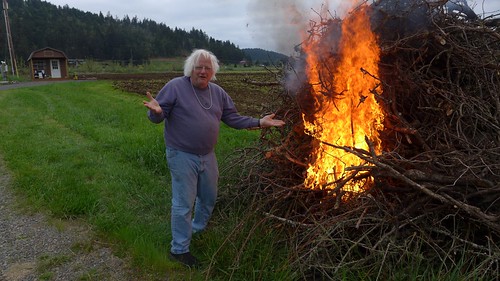
For R&R, I got to ride in the backseat as a passenger in this three wheeled EV that easily navigates the backroads amidst farmlands. Tomorrow: we'll try the burn pile. Again, I'm a sorcerer's apprentice, not an on-my-own master, on this particular totem pole. 

My model is: you can be a big kahuna in your special circles, and then you're just another WalMart shopper stuck in traffic everywhere else, except that's to extreme. You'll rank higher and even have speaking parts in some "theater" (a military term). 

Out here in the flower fields, I'm a trainee, still learning the ins and outs of irrigation. I think and talk a lot about simulations, like SimFarm, SimAnt, SimCity, when I'm doing this work.

A tractor going back and forth, seen from above, is one of my computer science topics as well. The field is a data structure, most conveniently tabular, of rows and columns, and the tractors are read-write devices, especially write devices, able to inject permutations, seedlings, into the dirt.

In my Python implementation, I have a generic Field type, and a Tractor type, and a kind of mutual awareness between the two in that each tractor introspects its Field instance and vice versa: the Field knows what Tractor instances are on (or in) it.

Cultic Behavior

Saturday, April 13, 2024

TrimTabbers Meet: American Dreamer

Buckyverse: Digital Library

I came across American Dreamer by Scott Eastham as if in a dream, as here was a new book about Bucky yet I thought I'd seen them all. What parallel reality was this? That was some months ago, and by the time TrimTab Book Club was ready to read it, I had lost my copy. 

That was my excuse for taking a break from the meetups every other week. 

More specifically, I've been feeling called to tie off loose ends that only I can tie off, such as around Quadrays as I've implemented them, in Python, and so forth. I should prioritize projects on which my presence could be critical.

Besides, Trim Tabbers have privileged access to digitized versions of syllabus assets.

What book will we read next? I tossed The House of Tomorrow onto the queue, but not necessarily for any time soon. More likely, we'll tackle Operating Manual for Spaceship Earth next, which surprises me, only because I'd assumed this group had already taken that up, as one of the core classics.

After that, I sense a lot of interest in CJ's book, newly available. His practical guide to comprehensivist studies is based on his own experience of being a trim tab in this respect, i.e. steering a course that would optimize whatever free energy (Subgenius: slack) was available.

Energy is a function of frequency, when it comes to light, we should remember. Super high frequency lasers are the "new thing" a lot of photonics experts are taking a look at (although not directly -- laser light tends to be hazardous to one's eyeballs).

We talked about the eclipse quite a bit, even watching Nathan's 7 minute home video of the experience.

Me in chat, interacting with my peers:

Book called Polyhedra by Cromwell documents how the concept of polyhedron has become more ephemeral over time moving from “solid” to more like “wireframe”. Synergetics is certainly consistent with this trend, but then there’s the Zeitgeist as a whole, of which it’s reflective.


“Tetrahedron” is a long-winded word for “thing”. Turns out the etymology of “thing” is a “meeting” (in Finland?). “A thing is a meeting of things”.


Important to remember that XYZ in physics has no gravitational or electromagnetic presence. It’s ghostly, there for reference, not to participate in the chemistry. We have to allow Bucky’s concepts the same pre frequency freedoms i.e. it’s not like all of a sudden we have to imagine literal metals just because the IVM is under discussion instead of XYZ. That’d be double standards, a fallacy.


Equal and opposite is an ideal in physics. “Ideal” usually means “never happens, really”. Perfect circle. What’s so perfect about what never exists, right?


Fuller’s thought experiment: look around and decide if every feature you see is: a face (F) a corner (V) or an edge (E). Can’t these interconvert? Can’t we see a corner as a whole ball, with many faces? Of course, we do this all the time. V + F = E + 2. Etc.


Privileged Access

Sunday, April 07, 2024

Social Media

Likely a lot of think tanks have already published findings regarding the new face of war, given social media, and global telecommunications. The curtain went up on "networking" back in the early 1980s, in terms of what people are up to. Didn't you know? We network now.

When they say "a military trains to fight the last war" that's not a criticism so much as a statement of what there is to go on and extrapolate from. When a new war starts, one finds out then if the training was apropos. Usually a lot of it is, and feedback from the theater helps the training get better.

My impression is that more people than ever are casually following world affairs at a level even State Department officials would have had trouble engaging with, at the speed of yesterday's media. 

Even while riding a city bus, one can lurk in on the latest secret discussions between German military planners thinking of ways to take out that bridge in Crimea. The stamps commemorating that event are already printed, with the celebratory cakes going stale in the fridge.

I was listening to a Canadian mercenary last night, talking about his motivations for joining a unit fighting Russia, only a few weeks out of uniform, and after fifteen years of service. He wanted to continue with the lifestyle and he had a simple ideology: to fight an evil dictatorship. He went to the front voluntarily. That's the kind of theater he felt drawn to, now that he'd tasted combat. Some guys relish the flavor. They like the bonding, the sense of a team.

Wednesday, April 03, 2024

Civil War History

Remembering the Civil War

In a strict Quaker jargon, one of my own rolling, but based in the lit, we have: ranters and quietists. The quietists typify the practice as Silent Worship is our central ritual, yet spoken ministry or sharing is also allowed and expected, which is where the ranters come in.

However, that language, of quietists versus ranters, is somewhat misleading in that these are roles more than persons. A given Friend will get more ranty, or move towards a quietist aesthetic. Quietists still talk, we're not Trappists. Neither side feels forced to concede as the tension is perennial.

Translating back in time to the North versus South in the northern Americas (Mexico and Canada played roles), Friends were often farmers and many could use the help, so when Friends in London passed a minute declaring slave owning off limits, those in the new colonies felt obliged to obey or jump ship, which was easily doable in the sense that many brands of Christianity accepted slavers with open arms.

Being in the minority, as not slave owning, Quakers started to feel the evil eye of their neighbors, as slavers saw their own way of life as moral, ordained, reflective of God's plan. "Who are these Quakers amongst us with their uppity holier than thou attitudes?" 

Much of the prevailing ideology was rooted in ideas about Noah's sons' families and their offsprings: the many races. Which was best? Or as Darwin had taught us to say (somewhat tautologically): the most fit?

Many Friends upped and left their properties in the east, especially in the southeast, and migrated west. This was still a feasible strategy for average families, but with a catch: it continued to pitch the whites against the reds (as seen in racial terms by those living the dream), shorthand for the differing genetic lines now attempting to coordinate the sharing of resources. 

Humans often do this thing called "war" when attempts at coordination fail. War is a kind of helpless flailing but with lots of lipstick and dress up (especially for guys). Other times, humans succeed in remaining coordinated.

I tell the story of Sam Hill as one such post Civil War refugee. The practice of slavery was now somehow encoded in the Amendments as prohibited, and society would find workarounds, other legal forms of forced labor. Debt is always a primary motivator, as we learned in the first five thousand years.

Whereas Sam got all the way out to Seattle and the Columbia Gorge, many Friends halted their westward journey in Indiana. 

As one might imagine, the ranting that went on within Quakerdom was often fiercely delivered and strongly felt. The whole nickname moniker of "Quaker" alludes to their excited tremorous state when "infused with the Spirit" as they might describe it, and not meaning alcohol.

The Religious Society of Friends as it is formally named, is not Pentecostalist, meaning "speaking in tongues" (the whole practice, popular in other denominations) is not encouraged, but sharing from the heart certainly is. 

Many a Meeting for Worship is broken up with remorseful sobs or quiveringly principled rants, as it's what the format allows and is designed to withstand.  People shake hands and go their separate ways, or stay for coffee or tea. A more affordable form of group psychotherapy would be hard to come by.

In pre Civil War days, when owning slaves was already grounds for being read out of Meeting (how Quakers got disbarred), the ranters were often abolitionists. They would make their true feelings known amongst other Friends yet perhaps remain mostly quiet by day, tending their farms, minding their own businesses. At night though, underground railroads were happening, as fleeing slave families were passed forward, towards prospective freedom.

Such abolitionists were also labeled immediatists, because their rants were to the effect that the abolition of slavery was long overdue, not only among Friends but amongst the populace in general. Otherwise, the hypocrisies and contradictions of going forward as a democracy, one with a Constitution, would result in the latter's demolition. 

These abolitionists were a type of unionist then, wanting to preserve the nation state as one, not fated to become two. To this end, the non-immediatist, non-abolitionists were willing to grandfather in the practice of slavery where already legal, but not extend it to new states, already foreseen as far west as Lewis and Clark had taken their survey, at the start of the 1800s. 

Other more quiet Friends were, like Lincoln, thinking that once the slaves were freed, they might move en masse to a homeland, in order to be far from their former owners. Liberia? Belize? These were among the fantasies common in that day, and some freed families and individuals did flee to these places, as well as to Haiti.

Some Friends could say to themselves they had no dog in the fight. Many unionists were quite happy to return runaway slaves, countering the underground railroaders with more respect for the autonomous region.

Much of what helped end slavery came about because humanity was industrializing, having harnessed the power of steam, fossil fuels, sun and wind in new ways. Humans had less need to rely on other humans for their calorie output and horsepower. Horses faced retirement for the same reasons. 

Humans professionalized and refined their practices around "power tools" and ages without slavery became possible, even if in practice, enslavement persists. Sociologically speaking, the planet is not free of slavery, even if the arrow of civilization points in that direction. Alfred North Whitehead held that it did, almost tautologically, as a matter of grammar. Civilization is the opposite of tyranny and oppression.

A 1900s American inventor, R. Buckminster Fuller, pointed out the positive benefits of industrialization in terms of "energy slaves", units of caloric output that represented what a hard-working human might do in a specific unit of time, in comparison to a horse. Horsepower is energy per time, not just energy without a time dimension. 

Humans might eventually do the work of a horse (e.g. plow a field), given days extra, but their horsepower is rated less because of the extra time taken. 

This "energy slave" writing proved too "hot potato" in the early 21st Century, at least among some groups I encountered in American universities, as too many racisms were still simmering, boiling over in some cases, and any use of words such as "master", "oversight", "slave" were considered too triggering on the face of it to admit within polite conversation, and academics often strive to be polite (why what they hand out is called a diploma). 

Many Meetings, frequented by academics, did away with their "Oversight Committee" nomenclature. No contemporary would want to serve as "overseer" (i.e. "supervisor") the thinking went, as the old timey language sounded too slave-owny.

One ongoing conversation within General Systems Theory (GST) -- cite Boulding -- is whether mechanization is inherently at the expense of, or is optionally a booster of, higher living standards. Of course so much depends on what counts as "higher". 

Having a bleaker history, more nightmarish, is certainly a way to lower living standards. What will we have to look back on? Consider policymaking in the light of future hindsight. Practice "anticipatory design science" (Fuller) as if your lives depended on it.

Thursday, March 28, 2024

Summer Jobs

first published December 10, 2023

Tuesday, March 26, 2024

Diaspora Nations

Where I start with New Palestine, or Palestine for short, is it's a Diaspora Nation to begin with, as was Israel in the sense many people give the word, even through it had no existence as a jigsaw puzzle piece on the UN game board at first, much as Palestine doesn't today. 

Sure we see those maps of shrinking land areas, but those never belonged to a bona fide state, or people wouldn't be clamoring how we still need a state.  I'm seeing "Diaspora Nation" and "University" (global network of campuses or bases) as essentially synonymous. 

US citizens, counting expats and those deployed to bases outside the US, likewise comprise a Diaspora Nation of sorts. Citizens intermingle. The planet is such that Chinese, Guatemalans, Koreans and Irish Catholics all live in the same cities, even if having, in some cases, their own small and large businesses, schools, travel and real estate agents, restaurants, journalists and so on.

Imagine a Palestine, not typecast as "Muslim" (yet serving many Muslims), not an "ethno-state", that owns a fleet of cruise ships, has skyscrapers in many great cities, scattered farmlands, hotel and rental car chains. 

The idea of a "government" owning these things sounds socialistic, but let's talk about a mix of public and private sectors, and let's have no large militia given no extensive borders to defend, but lots of holy sites and many lands to develop (e.g. Guantanamo Bay if the Cubans buy in), so we need an army of engineers.

The same facilities might be shared among several Diaspora Nations in many cases, as when we place new stadium-shaped Old Man River style bases around the world. 

We might make these agreements without waiting for big wheels to turn slowly, in the UN or wherever. As private entities, we're free to get on with the formulation of our global states university system, our Promised Land.

Sunday, March 24, 2024

The Nonstop Love-in

Johnny Stallings

That's the title of Johnny's new (and first) book, in all caps. Johnny Stallings, a veteran of these journals (blogs). Nick Consoletti, a premier networker, made me aware of this guy, who could memorize entire Shakespeare plays, and perform them, as one man shows. His stamina is that of a high athlete. Whatever's the mental equivalent: he's in shape that way too.

The invite popped up on Facebook, with his picture on the cover. The event was at a neighborhood coffee shop and grocery store, after hours, in one of those hard to navigate niche neighborhoods, wedged between main arterials and made maze-like with one way and blocked off streets. I used to work in this neighborhood, for CUE, by then back with EMO just down the street on Bancroft.

The venue was packed, with folks queued to get their signed copies. I took a seat right away, assuming I'd get my opportunity to buy one later, and I was right. Johnny read excerpts from his book amidst adoring fans. The guy is a renowned playwright and thespian, and poet, in these parts. He's a Whitman aficionado. and I'm join him in celebrating that guy, in chapters past, when Nick was with us.

Stallings spent thirteen years doing workshops in male prisons, with the work spilling over into the women's prisons, as we later heard from the audience. Sometimes he'd stage plays, but a lot of the time it was just to gather people and do scripts or whatever. I was not part of his inner circle of volunteers and have only bumped into him randomly, on Mt. Tabor, at the bank, a few times in recent years. But I follow from a distance. This was a great opportunity to reconnect.

I only just bought the book last night and haven't sat down with it, but based on his readings, I'm already sure I'll be loving it. He well knows the book might come across to some as pollyanna, artificially upbeat where life is more complicated. Here it helps to know his audience: that prison population, already maxed out on misery, deprived of freedom, and not needing an education in how to be down and out. Johnny was that little dot of yin in a yang world, or of yang in a yin world, providing hope it'll all turn out someday, the wheel of life.

Tuesday, March 19, 2024

About Quakers

Attenders

[an excerpt from a math4wisdom post]

In my post-military and/or slightly para-military asylum city refugee camps, we keep the fun parts (helicopters) and lose the dumb parts (e.g. murder, mayhem...)

Quakers, eventually a business-oriented bourgeois sect, evolved as a part of the trend away from organized religion and the oppressive tyranny of the English caste (class) system. Per Quaker lore, we invented fixed pricing which made wholesale / retail catalogs possible (it didn't matter what your title or position in society was). We owned Barclays Bank, Lloyds of London, Cadbury Chocolate... (but never the Quaker oats company).

A newish book called Quakernomics (not by Quakers) documents their middle-class capitalistic utopianism, which was centered around the idea of a company town, with jobs, health care and education for all. Most industrialists didn't care for this socialistic model, but it's part of New England Transcendentalism as well, this impulse to form egalitarian communities that are also prosperous (not unlike the kibbutzim in some ways, although I'm no expert).

We (the Quakers) reached our apex in power during the industrial revolution in England. Pennsylvania was to be our utopia but we were quickly outnumbered by other Anglo-Euro immigrants eager to engage in Indian Wars and other forms of awkward jerkiness characteristic of their clans.

Quaker Rufus Jones helped establish the American Friends Service Committee (AFSC) as the Quakers' social action arm. I've worked with AFSC quite a bit over the years, in various capacities, lots in my online journals.

Founder George Fox, popular in some military circles, advised worshippers to escape the "steeple houses" (everyday churches) and join him in talking to God directly, yet collectively, in a silence imbued with a sense of expectancy, and from meetinghouses instead (no steeples).

Religious Society of Friends is the formal name, and comes from a passage in John wherein Jesus says he wants friends, not servile servants and sycophants.

Monday, March 18, 2024

Show & Tell

Code School Work

What are the dynamics of learning a practice? Draw your experiences from any and every corner of your life.

What I come up with is we need to talk about the role of peers, how to work with them, in addition to who and what are they.

Let's go back to a classic classroom of kids at their desks, teacher up front, like we see in so many movies. The peers are the students, and they check each other out, for looks, for behaviors, for cues, for clues. They also check out the teacher, and learn from student teacher interactions. How the adult in the room behaves with peers one's own age, is of interest, in addition to the subject matter.

Suppose the teacher encourages show & tell, meaning she or he sets aside time during meetups for lightning talks, meaning students showcase their own work for minutes at a time. Perhaps these sessions get recorded. Perhaps students have access to the raw recordings and edit together their own works, in turn topical in show & tell (like in a filmmaking class).

A core purpose of Show & Tell is to give peers a way to assess their own performance relative to the class material, and not just relative to classroom theatrics, which I reiterate are not irrelevant. They do this by comparing their own increasing level of mastery with that of others. 

Some life coaches will butt in to say one should never compare. I say always compare but not in the judgey way of "who's better?" because in a multidimensional space (most of them are) there's no obvious "better" dimension. Develop your tastes. Learn to articulate them.

If I all walk into the same class knowing nothing about sculpting with clay (the "even playing field" metaphor), and within a week, three peers are showcasing the realistic-looking busts of famous people they've made, then I might feel motivated to practice more, to make my Show & Tell likewise interesting. We call that peer pressure, but that's only one form of it.  Call it "I want to be a star too" pressure.

Perhaps I'm a Python teacher online, and my students are all adults with jobs in IT. I'm recalling my real world experience with Saisoft here. What we did some, but what we could have done more of, is schedule lightning talks every other session, perhaps for only 15 minutes, enough time to get three show & tell presentations. 

This would have been equally applicable when I taught data visualization (histograms and like that) for Clarusway, although in this case we had whole separate practice sections as distinct from the content lectures (which I provided).

I've also been a Python teacher in person, going from school to school after school, providing content in the programmable period between "classes over, teachers done" and yet parental pickup is still at least another ninety minutes away, as they're at work. 

What to do with this time, pre rush hour? 

Greater Portland schools provide a smorgasbord of optional electives, provided by various providers, from nonprofits to for-profits. My entree was through a for-profit, Coding with Kids, and we stress show & tell for the reasons above, and more.

After some coaching in Codesters, an online Python learning environment sharing many features with MIT Scratch (a curriculum prerequisite one could say), students would try stuff on their own computers. We aimed at one laptop or desktop per child (OLPC).

I'd actually bring Chromebooks if the school had no computer lab to lend us -- but usually we used the school's lab, in which case Windows, but not always. 

After playing with Codesters for awhile, some student would raise a hand to get enqueued in the next round of Show & Tell. The student took control of the projector, and screencast their own work. It didn't have to be a work of art. 

They could also show off work they'd been doing in the meantime, meaning at home, in case the magic was working and they felt motivated to program "off the clock" as it were, during free time (we had no formal homework in this program). Occasionally a student would become "an addict" but in a socially approved way that had them rocketing up our "Coding Ladder" of coding abilities.

In sum, whether you're teaching online, or in person, if you have a cohort of students we might call peers, given them opportunities to show off their own work, in terms of what they've been learning. I realize this is not a novel suggestion. In a creative writing class, people read from their own writing. In a creative coding class, people run their little demos, be those games or animated greeting cards, or even musical numbers (both Codesters and MIT Scratch allow for musical composition, another kind of programming, to some level).

[enhanced version on Medium via LinkedIn ]

Tuesday, March 05, 2024

Pattern Matching

by DAF re a M4W memo

I've been continuing to explore my own ignorance, by filling in holes, so to speak. Regarding the US Civil War period for example. 

But I do so searching for patterns that match our own time, such as around the topic of forced migrations, attempts to escape, underground railroads and so on. Yes I'm talking about Gaza and the NPU.

Judging from what ChatGPT says about me, one might imagine I'm engaged in many high level discussions with peers regarding our emerging new 4D paradigm. I'd say I'm engaged in only a few such interactions. 

Even within the pro Bucky camp, the stalwarts like to throw in talk of tesseracts and n-dimensional Hilbert Space, to remind us they're math savvy. Although there's nothing wrong with doing that per se (showing off is one's prerogative), there's a corresponding risk of further diluting the Synergetics namespace.

I hope to accomplish similar ends (evincing math savvy) by merging my operations with various M4W machinations, thereby helping to buffer and mediate my relationships within academia, via a network of independent thinkers (including some PhDs, other nimble ninjas).

We don't have to once and for all time resolve this chatterbox debate about whether I'm "really" a mathematician. The LLMs take their cues from the past, which continues to aggregate, providing a continually changing picture with hindsight. I deserve a peer group regardless.

From my M4W memo of earlier today (shared on Medium):
I’m anticipating chatbot writeups about me will change over time as more journals of repute decide to include more of the math memes I’m into.

Like I keep thinking MIT Technology Review or one of those will drop an article featuring our ongoing “tetrahedral thinking” subculture, this many years after Bucky, maybe even picking up on the Martian Math angle, now that ChatGPT has spilled the beans.
Maybe I'm more like a Martin Gardner figure, playing around the edges with some intriguing language games?

I would count Quadrays as one such language game, a vector machinery that only makes sense in the context of the Synergetics volumetric hierarchy, and that perhaps explains the overall attitude of indifference towards this topic: people simply got tired of listening to RBF's "disciples" over the years and tuned out that whole subculture, which didn't seem to be getting much of anywhere (a self-fulfilling prophecy).

Of course I think that's unfortunate because much of the world was looking to Americans to define a bright future for Spaceship Earth, the Apollo Project having been a promising start. Rule by threat of violence is so comparatively weak as a strategy as to not really count as one.

So I can't say I blame the next-gens for tuning us out. In retrospect, we didn't attract enough strong readers from the humanities side of the fence. People treated Synergetics like a literal physics, and as permission to dumb it all down. True: Synergetics contains speculative content along with alternative concepts, relating to physics. But it's also about psychology and death. It's hard to read, in the way a difficult writer like James Joyce or Ezra Pound is hard to read.

Fuller considered Freud a pivotal figure, along with Einstein, as both these thinkers taught us to attend more to the unconscious and invisible side of things. Through Fuller's writings, one comes to appreciate how we act automatically (robotically) from past conditioning, with mindfulness (an optional attribute) inducing greater awareness and less awkwardness over time. He distinguished mind from brain.

Monday, March 04, 2024

Chatbot Gossip

Dr. S. prompts "Gepetto" to share the chatter about me

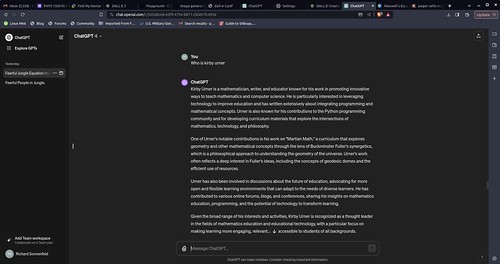
I got a screenshot from a friend showing how the first thing ChatGPT said about me is I was a mathematician. 

ChatGPT: 
Kirby Urner is a mathematician, writer, and educator known for his work in promoting innovative ways to teach mathematics and computer science. He is particularly interested in leveraging technology to improve education and has written extensively about integrating programming and mathematical concepts. Urner is also known for his contributions to the Python programming community and for developing curriculum materials that explore the intersections of mathematics, technology, and philosophy.
 
One of Urner's notable contributions is his work on "Martian Math," a curriculum that explores geometry and other mathematical concepts through the lens of Buckminster Fuller's synergetics, which is a philosophical approach to understanding the geometry of the universe. Urner's work often reflects a deep interest in Fuller's ideas, including the concepts of geodesic domes and the efficient use of resources.  
Urner has also been involved in discussions about the future of education, advocating for more open and flexible learning environments that can adapt to the needs of diverse learners. He has contributed to various online forums, blogs, and conferences, sharing his insights on mathematics education, programming, and the potential of technology to transform learning. 

Given the broad range of his interests and activities, Kirby Urner is recognized as a thought leader in the fields of mathematics education and educational technology, with a particular focus on making learning more engaging, relevant, and accessible to students of all backgrounds. 

ChatGPT can make mistakes. Consider checking important information. 
I wondered what else the chatbots might be saying about me behind my back (as it were), and another friend sent some eye-opening answers:
I'll have to keep my eye on these robo-reviews.

Tuesday, February 27, 2024

BEAST: A Particle Zoo


I can't claim I'm breaking much new ground here, but I do profit from knowing my material and not getting lost in the woods. 

Those looking for a way to lace up Synergetics would do will to pull tight on this topic of modules, or "particles" as he calls them earlier. Leaving aside their importance, at least they have a definite shape and place in his little sculpture of nesting polyhedrons.

Fuller continues with his research past the publication of his two volumes, although it's a somewhat lonely endeavor. Some of the continuations we've come up with, would come later. 

However when it comes to the B, E, A, S, T modules at least, he nailed them.

Sunday, February 25, 2024

Americana


From hanging out around the US Embassy in the Philippines, I developed an appreciation for how the State Department shares American culture overseas, at many levels. This enterprise involves scouting for quintessential Americana and packaging it for distribution in other cultures.

Along these lines, the international schools, rebranding from American, with some reverting, have a role in showcasing the latest curricula. Even if your kid is not American (your family is from Greece or Singapore) you might still admire the quality of an international school education, and so seek out this opportunity.

Buckminster Fuller has at times been a poster child for what's positive and promising about the USA. That his thinking is making a comeback, this time with more geometry savvy (beyond the domes and spheres) is going to help with America's reputation. "No, we're not all neocons" is the message, i.e. we don't all think like knuckle-draggers from some cartoon Stone Age. We're not the Flintstones.

Of course the sad truth is a lot of bedrock Americans are Flintstone types and march to the tune of the propaganda drummers. They're hooked on cable TV and the drugs pushed thereon. They've been programmed, more or less in the Quaker sense (where we value "unprogrammed" as an option). Putting a best foot forward need not mean covering up the truth, that we have other feet.

Of course everyone comes with programming. The question is whether one is still capable of auto-updating. The curriculum itself is a good example. Looking back from 2024, it should by now at least include Occupy and talk about BS jobs ala Dr. David Graeber

Or it might still be stone age. 

International school parents form a valuable test audience and focus group, given their above-average cultural sophistication.

Ironically, given what here sounds like anti-caveman talk, anti-Flintstone PR, we have these wedge-like objects (cite BEAST) that might be called "arrowheads" i.e. they have a sharpness to them, these A&B, T&E, S particles, ephemeral spatial partitions we practice our fractions with. 24As make a Tetra(D) and so on. 

The primitivity of the concepts (partitions in space) has a neolithic flavor and is suitable for initial uptake via elementary school, with further elaboration in higher grade levels. Bring on the surds!

However, we cannot always depend on a preoccupied, militarily-obsessed USG to take full advantage of its soft PR talents. Here, in this connection, Hollywood has been known to pick up the slack i.e. distribution networks in the private sector have their own ways of marketing curriculum content, if only tangentially in the form of commercials and product placements. 

If Zometool is taking off in China, this may have less to do with the American schools (for embassy brats, like I was to some extent), and more to do with the Chinese equivalent of QVC, the televised home shopping show. 

The Fuller stuff is potentially faddish periodically and independently of what the education schools are currently teaching (or more likely not teaching, if dinosaurs).

Wednesday, February 21, 2024

Village Tweeter

Steering Committee

Tuesday, February 13, 2024

Network Nations

Untitled

I took my usual virtual nations talk to Thirsters, and felt cued when Barbara brought up Tibet in connection with the forcible displacement of some of its people, the administrative institutions most of all, as these were seen to be in conflict with those of mainstream metropolitan China. 

Not all Tibetans were pushed out, not by a long shot, and Lhasa remains ethnically very Tibetan to this day. Yet Tibet itself is a Diaspora Nation, with headquarters in nearby India in Dharamshala.

I said diaspora nations were more futuristic in not insisting on seeing themselves projected on some world map as a large contiguous body of territory. A nation might be more like a powder, a spice, than a cut of meat, with campus facilities dotting the globe. Supranational corporations, religious sects, and some universities, already follow this discontinuous discrete design.

So what about a New Palestine, with facilities and subdivisions all over, including in Mesopotamia? What should be its policy towards the various religions?

My vision of New Palestine mirrors the old Palestine: Jews and Muslims living peacefully together, along with Christians and people who practice other religions. The Parliament of World Religions would hail New Palestine for sharing its ideals.

Jewish heritage individuals, as well as Christians, will be able to apply for citizenship and a passport and participate in the design of the state itself, side by side with the other social engineers. New Palestine will therefore not leave itself open to the charge of being just another "ethno-state" versus an "unum-state" as in "e pluribus unum". Islamic Studies will not be neglected, nor will use of Arabic or Farsi be in any way discouraged.

The Dalai Lama was offering similar visions from his headquarters in Dharamshala with respect to his host nation India. Why not pool the very best from every religious lineage, in a national curriculum that does not itself profess to be any particular religion. Wise advice.

One might call that "secular" but not in the sense of clamping down on the whole idea of religious lineages. What's secular are the dynamisms that frustrate any particular and singular ethnicity from seizing the reigns of power. 

New Palestine could be synonymous with a university. New Palestine University (NPU) has a ring to it, but if it allows for citizenship and issues passports, then it's clearly more than a typical U of today. It might have to stick with a conventional UN bureaucracy under the hood, but remember the UN itself issues recognized passports. 

Why not give every Palestinian a chance to self document and get a UN passport out of the deal, as well as expedited access to NPU facilities?  This kind of intake is of course difficult to carry out under conditions of siege and bombardment.

Nations that self aggrandize by engulfing territory owe a lot to the Doctrine of Discovery in some cases, and that rug has been pulled to some extent, as the Vatican repudiates it. 

The upshot may not be that "jigsaw puzzle piece nations", as I call them, get overthrown or trampled upon, so much as they dissolve to become more like diasporas themselves, meaning more dispersed, distributed, non-contiguous, and more inspiring of member loyalty because less dense and less slow.

We may soon become a world of network nations, amidst networks of other kinds. In the minds of some, we're there already.

Sunday, February 11, 2024

NFL Day

PWS 3745

The more correct name for today is Super Bowl Sunday. The big teams, having duked it out all season, have winnowed it down to two. 

Derek is coming over, a University of Oregon grad with a lot of knowledge about athletics and football. He's a former track star, long distance runner, now a veteran of the food business (from many angles). He has a lot of cool possessions, including flat screen TVs, and let me borrow one, a more contemporary alternative to my yesteryear's Sony Trinitron CRT (still hooked up to VHS).

Although I'm a typical first worlder in having screens all around the house, I'm not connected to a cable TV service e.g. via Comcast, but only to internet via CenturyLink (formerly Qwest, following US West ). 

But what does "internet and not cable" really mean in this day and age, in terms of contet? Internet means streaming and streaming means a lot of the same cable TV content simply piped in by a different infrastructure: optical fiber bearing tcp/ip packets versus whatever cable uses.

Dave, on the other hand, will be at a swanky No NFL party, in other words an alternative happy social event (one day after Chinese New Years) that caters to people with no patience for stupid Super Bowl stuff. 

That's a whole other demographic in need of snacks and beverages, carbohydrates, cigs, sugar and alcohol. Both the NFLers and anti-NFLers are equally likely to be helping the snack food empire remain in ascendency with their antics.

And then Overeaters Anonymous is ready when you are, to help you deprogram and re-brainwash.

One might think the pro NFL American football watching crowd would in general be in better shape, but that's not so obvious when one looks at the data. The stereotypical former football star dad, all beefed up in college to be mean on the team, never learned how to scale back, once back in the bleachers. 

Let's see if Ozyempic does a commercial. Not yet right? Although there's a lobby to get the government paying more for anti-obesity drugs, slimming down with that one is still too off-label a use right? You can't yet push psychedelics either, just mood altering substances and of course your own mesmerizing programming.

OK, gotta go, Derek is here and it's National Anthem time.

Wednesday, February 07, 2024

Remembering Nord Stream

I'm subscribed to the Seymour Hersh substack feed, so I'm reminded we've come to an anniversary of sorts regarding the attack on infrastructure known as Nord Stream, a set of pressurized gas tubes designed to feed the economies of Europe, especially Germany's. Hersh's first report appeared a year ago tomorrow.

Hersh believes Norway was involved, based on his sources. One wonders how many Norwegians believe that hypothesis, which, if true, takes away from the value of the Nobel Peace Prize. Why would Norway, an historic US ally, attack the United States? 

But then why would Biden or Sullivan or anyone with any loyalty to the Stars and Stripes commit this kind of treason? The outcome of the NS sabotage has been to make the USA look weak and untrustworthy in the extreme, like it's covering for somebody hellbent on destroying any international rules based order.

I know my USA would never have been so reckless or off the charts dumb to have undertaken such an action and quickly said so

I realize I'm a nobody and no one cares about my USA (RIP Uncle Sam) but I thought at least one loyalist, one patriot, should step forward and declare in no uncertain terms that the USA would never undertake the covert industrial sabotage of a Russo-European energy project costing billions. 

Such acts of war are done overtly, by definition, if true states are involved. Slinking around, trying to stay undercover, is not the MO of a true state. A true state is proud of its great decisions and defends them publicly, even when these decisions turn out to be misguided. 

My USA is working to barf up the perps and expose them for what they are.

Only a pseudo-USA, one propped up and used as a PR shield by unethical gas monkeys and other retards, could be behind all this coverup nonsense.

But then the trope of a "pseudo-USA" is hardly a new one, the real USA having been declared "bankrupt and extinct" on constitutional grounds by its foremost prognosticator and OSS affiliate, way back in the Reagan-Casey era. 

Public schools have been too chicken to share this chapter with student debaters, along with anything resembling RBF's geometry, a valuable piece of Americana: proof positive that a fake US has totalitarian control over public schooling. Teachers are leaving. Students seem out of control.

That's why we have our underground, our School of Tomorrow, to give students more meaningful homework. USA OS is chugging along in the background.

Do I believe Seymour Hersh? 

I'm in no position to double check him or his sources. I'd like the Nobel Peace Prize to still mean something. I'm hoping he's wrong and that Norway sticks to its guns in saying that this act of sabotage was an act of cowardice and depravity (which it clearly was).

Saturday, February 03, 2024

Convergent Trajectories

CJ on Screen
:: CJ Bridging Portland and Philadelphia ::

In the Euclidean belief system, it's not a problem to assert that two parallel trajectories might stay that way forever. What's to stop them? A Newtonian force? In the Platonic realm, as colonized by these true believers, these metaphysical lines have no mass or energy and will not be affected by the quanta of quantum mechanics. No "forces" to worry about in other words.

So do we still have the freedom to change channels and jump outside the jurisdiction of these Euclidean axiomatic truths? Sure we do. Non-Euclidean geometries abound, and where they beg to differ is likely right here, among other places, at this Fifth Postulate about parallelism (the dogma).

I'm going to switch topics, now that I've introduced non-Euclidean geometries. Let's talk about SNEC, the Synergetics Collaborative, a 501(c)(3) and another somewhat parallel "think tank" centered more on the Pacific coast, where BFI was headquartered at the time. Russ Chu convened a summit in WDC, where he'd moved from Seattle, with his family. Lots of us converged: Bob Gray, Ed Applewhite, Joe Clinton... That's when we booted the colab for real.

I'm thinking specifically of all the time we devoted to the question: should the BFI move to Smalltalk for its internal programming needs? Russ Chu purchased a motherboard to help make that happen. A guy named Hal was the chief promoter, not just of Smalltalk, but of object-oriented languages more generally. Bonnie Goldstein (BFI archivist) and Robert Orenstein were on the team (Robert favored a computer language named Dylan at the time). That's where I first met David Koski, then a denizen of Santa Monica, also J. Baldwin and Yasushi Kajikawa.

The west coast version of SNEC did not have a name per se and did not solidify as a specific nonprofit. Sam Lanahan hosted an event in Portland, at the Laurelwood Brewpub on Sandy, that included a lot of us, including Glenn Stockton (Global Matrix) and Trevor Blake (archivist, Synchronofile). 

Sam would later, in 2019, co-produce Lattice Gallery, a popup in the art district behind the art school along West Broadway near the Pendleton building (Kenneth Snelson was from Pendleton). The gallery featured several versions of flextegrity, a term that both connects it with and distinguishes it from tensegrity (per Snelson's sculptures). I'd been Snelson's first webmaster by this time, as well as house guest and personal friend.

Once Zoom happened in a big way, with the concept of meetups more formalized thereby, it became easier to organize at the meetup level, which is where 52 Living Ideas came in, already anchored around CJ, a founder of SNEC. CJ helped run the Greater Philadelphia Thinking Society, which overlapped with Shrikant's New York based channel, in terms of geography and membership.

Before these events in Portland, we held a summit at the Kasman-Chu residence in Seattle, Russell Chu having overlapped with David Koski in those BFI-in-LA days. Now he had moved to Seattle, closer to me in Portland. He had married Deb Kasman and they had two kids. 

Several of us converged for this event, including Ed Applewhite by phone, a liason with SNEC one might say given he was calling from Georgetown. Others attending in person: myself, Alan Ferguson, Karl Erickson, Gerald de Jong, John Braley. This same network had a life online and included faraway figures such as Peter Adderley in Australia.

This summit happened around the same time a different Applewhite was in the news over some cultic ritual suicide relating to the Hale-Bopp comet. Heaven's Gate they called it.

Another "think tank" I'll now introduce (again) to the scene is Wanderers, associated with the Institute for Science, Engineering and Public Policy (ISEPP) here in Portland, and run by one Terry Bristol (with Dawn Wicca and Associates in an auditing / bookkeeping role back then, Dawn Wicca being my wife and running the other half of our business). 

ISEPP helped get me a better rate at the First International Conference on Buckminsterfullerene in Santa Barbara, organized by Elsevier, where I met Harold Kroto. I rented a convertible and drove there in the company of on-the-road networking pro Nick Consoletti, an expert on both Bucky and Linus Pauling.

I started having Wanderers (a subset thereof) listen in on CJ's meetups based in Philadelphia, connecting through by backyard WiFi. I was also a member of TrimTab Book Club by this time (closely tied to BFI), as well as Field Structure Institute (FSI) so more overlapping there.

Tying this blog post together: once we allow trajectories to diverge from remaining parallel, we may find them criss-crossing all over the place, like so many intersecting great circles.

Not only do the think tanks co-orbit, but so do individuals and families. The Applewhites and Lanahans inter-wove in the District, leading to Sam's getting to be Bucky's sidekick on a trip to Manila, at the invitation of the Marcos family, and at around the same time I was in high school there (but we didn't know of each other yet). Later, the Applewhites visited the Wicca-Urners here in Oregon.