Monday, August 22, 2016

From Providence


I've come here with Carol many times, I've even worked here.  I'm in the cafeteria on the ground floor.  Carol needs to come back later this week as her measures are out of whack.  She's lower energy as a result, but up for walking around the grocery store next.

I've shared the Harold Kroto email with the Physics Learning list, an association of physics teachers concerned with best practices.  Our discussions are free ranging.  I'm not a physics teacher so much as an invited guest.  Dr. Bob Fuller recommended me to this listserv.  We're also yakking about what counts as "CS-friendly math" at the high school level (CS = computer science).

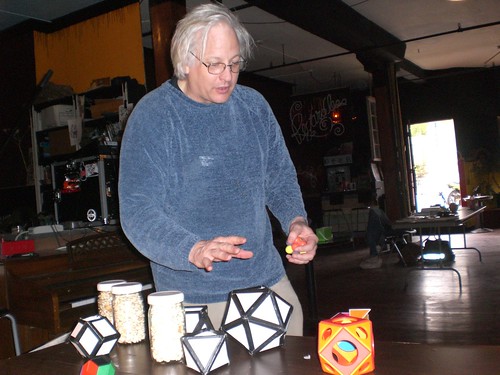
Computer science and physics are both explicitly concerned with the time dimension, its advance.  Mathematics has "pure forms" in the Platonic sense that don't change with time, a tetrahedron for example.  In the Synergetics language we call these "pre-frequency" if drawing attention to the eternal aspects, the surface and central angles mostly.

When it comes to vectors, as used on CAD (computer-aided design), 3D printing, these may be timeless.  Once time enters the picture, it's a matter of computing a "next frame" and a "next frame" after that, as when making animations.

Gerald de Jong, Karl Erickson, Russell Chu and a few others, were involved in early animations based on elastic vectors, meaning structural members that resisted further compression, or further stretching, according to various simple formulas.

Gak!  My next stop was the grocery store, top-level parking, where I discovered:  no computer satchel on the back seat, with mom's walker.  Oh yeah, I'd put that down next to the car, in the hospital parking garage.  Oh God, I'd felt a bump backing out and idly wondered what that was.  Putting two and two together, that was me driving over my own computer.

I asked mom to accompany back to the scene of my misdeed, for emotional support, dreading the smashed device I would encounter.  Instead a kind lady had it leaning next to her pickup across the way, and was dialing for Lost and Found.  She was going to turn it in.  Nor was the computer gone or inoperable.  Everything survived.  My camera had been in my pocket...

Mentally, I'd gone through some of the process of not knowing many passwords.  I rely on my computer to store them.  I need to print out a hardcopy backup again, right away.

Saturday, August 20, 2016

Basement Again

I'd say WiFi is a tad iffy down here, even 4dsys1, but I'm getting signal, and work proceeds.  We're having a heat wave and Lindsey strung up Christmas lights and left it uncluttered for the most part.  She moved away quite awhile ago, divides her time twixt Oregon State University and the Kathmandu area.

Thanks to getting the toilet fixed, there's nothing too out of whack, at least not in current weather conditions.  You'd think I'd be using this space more, at least when it's hot.  Well, here I am.

I've been reconnecting with writings by Anthony Judge.  We're not in a Vulcan mind meld or anything, just I enjoy catching up and recall when he analyzed the Bucky stuff sometimes.


Speaking of which, I'm in a nomenclature clash with the "civil war" terminology being deployed right alongside maps that are clearly multi-state, if going by the old globes.

I realize that nations come and go on this bubbling chaotic layer we call "civilization", and so the existence of variable lag times and "Doppler Effect" (as spun in Synergetics) makes plenty of sense.  We don't all talk the same way, duh.

In other words, sorry for sounding obtuse, when Turkey and a non-UN (unrecognized) state of Kurdistan, another unrecognized state, yet identified, and additional existing (recognized) states all overlap, of course it's a hodgepodge.  But how is it a country at war with itself?

People are still seeking some victory within the old framework, as if infrastructure depletion and "collateral damage" were worth some price for what future?  Where was this all going?


I'm tripping down memory lane, remembering how in Jersey City, after Princeton, I was writing in terms of a Housing Project and Language Project.  It's not that I was planning to be "in command" of these projects i.e. I was not having fantasies of becoming a dictator, I just wanted a framework to think within, other than what had been handed me.

The Housing Project was a lot like "Orlando time share" but then came new life with AirBnB and like that.  The housing stock would be shared more, with people sampling various lifestyles.  "While I'm away, you can stay at my place" type deals.  Some properties, such as the hotels along El Camino, come to seem like cultural institutions, meaning religious in origin (that's one way of putting it).

The Language Project was like poster art.  I drew a few of my own, simple pictures, like of the Earth from satellite / spaceship with captions like Game Park, and Spaceship.  Wild Life.  Nothing earthshaking.  More recently I've come to Teaching Hospital as another good caption.  Global U.

I was doing PR for the Bucky stuff in some ways, having picked up PR skills ("ad man" instincts) living in Rome, a cosmopolitan capital.  Beyond that, I was simply aware that language was always changing, and we could "watch the wheels go 'round and 'round", like John Lennon did in his famous song.  I'd go on to become the Buckminster Fuller Institute's first webmaster, though not for long.

That I'd approach Language in this general way is predicted by my interest in Wittgenstein's philosophy, with background reading in psychoanalysis.  Yes, I know, 8th grade is considered young for Freud but then prior generations didn't have Interpretation of Dreams on a high school library shelf.  We did, at OSR.

Language-oriented philosophy appeared to be getting into the same insights as the psychoanalytic generation, with Wittgenstein's bridging to anthropology somewhat completing the (Vienna) circle.  I enjoyed the luxury of studying all this at Princeton (Class of 1980), getting a snapshot.


I'll admit "civil war" keeps it sounding contained and that maybe soothes nerves.  I'm all for soothing nerves.  When the US was at it's own throat over what the future would be, people did not know the outcome and wondered what we would see, looking back (the back-looking vista keeps changing too, as we learn more).

In the face of uncertainty and wonder about the future, sticking with a known vocabulary may be a choice in self defense.  We don't jump ship until we have another ship to jump to, if we can help it.

On the other hand, we need to protect the integrity of shared language in terms of meaning, as it's breakdowns in shared language that account for so much of the strife.  The need to be truthful is also a requirement for traction.

There's an urge to make sense.  The opposite of "making sense" is maybe "fiddling while Rome burns" (to pick an already famous image).  But with Rome already burning, what else was there to do?  Might as well fiddle at that point.  Anticipatorily nipping the causes of war in the bud was what George Fox was more into.

Anticipatory Design Science.  Looking ahead.  Planning.  Warring is the postponing of planning, which then has to be done anyway.

In other news, we tweeters (I've had my face in that) saw a dog in zero G, a samoyed Glenn guessed from my description.  The dog appeared to be on the space station, which got my head spinning imagining the logistics, so I went browsing.

I came to a source persuading me this dog was on a Vomit Comet. Yes in zero G, but not for a long time.

Glenn was by to show me some amber, the good Baltic kind with lots of bugs in it.

I'm not just tweeting all day, however as a writer and code school teacher, math teacher and so on, I need to advertise that I'm out here and show off a portfolio. My "enough web dev to give traction" demo (a Flask application) has been time-consuming of late.

I'm hard at work in my "studio" in other words, or PWS (personal workspace) in General Systems Theory (my blend at least).

Baltic Amber

Friday, August 19, 2016

Yakking About Health Plans

I got an ESL teacher on the phone in Florida, working a second job as a licensed insurance agent.  We were discussing my plan options.  He called just a few seconds after I filled out some POSTing web form, giving my age and weight.

I'm not the big expert either but pulled the plug during verification, when I realized there was no reimbursement to medical providers, simply advocacy up front, negotiated fees for service, which I'd need to pay.  "No cap" sounds good, until you realize they mean "on your expenses".

The information was going by too fast.  We oldsters actually do need time to catch up, if coming in from the sidelines.  One needs orientation, meaning Youtubes.  How about have some government officials actually explain what to do and how it works.  Don't leave it to some "private sector" even if the latter has a role.

The rules seem ever changing.  Trying to make a sale and explain the New World Order in a single sales call is asking a lot of these sales folks.  I got to talk to the supervisor later.  He understood where I was coming from, but then the higher priced options had no real benefits unless I needed chemo or whatever.

Can we hedge against such an eventuality affordably, per actuarial statistics?  Apparently not?  Not in the USA that is. I'm not talking about Dubai at the moment (what's a health plan like there I wonder?).

Go look for Obamacare on the Web, and say "welcome to Shark World" under your breath,  This is the USA they're selling today as "numero uno" in terms of great places to live.  However, if shopping for a new country to join, be forewarned.  They're somewhat in disarray in this fish tank.  But then when have we ever really figured it out? Look at history.

There's a difference between the process of planning, and selling plans.  Plans need to be made before they're salable.  I suppose that's obvious.  My dad helped plan for the Tripoli of the 1980s, from the standpoint of the 1960s.  The plans were followed, or so we heard.

DSCF7968

Maybe "wellness plans" are indeed the coming wave, or is that how it's always been or whatever.  So I Googled on "wellness plans" -- it was mostly about caring for pets.

The plan provider even looked up my doctor's name.  He was very personable.  However it takes more than one visit to Best Buy to figure out about computers.  Health plans are no less dense with information.

Having companies ravenous to hook a new customer without allowing said customer to engage in a thought process, is not going to work out in the long run, unless the libraries get really good at simply imparting practical information.  Has that been happening when my back was turned?

Should libraries turn into call centers, or add call centers to what they do?  I'd answer calls about specific topics.  I'm not some know-it-all about everything (not a "walking encyclopedia" -- I could never win at Jeopardy).  There's no one "go to librarian" who knows it all, plus they don't all speak Vietnamese, if that's called for.

The dream of a World Wide Web (or World Around Web if thinking globally) close matches this idea of a "library", staffed with real people, not just bots reading scripts.  The responses come asynchronously mostly, not instantaneously over the phone.  At least that's true in my experience.

An older guy like me, in good health (not on meds) in his late 50s, is able to get in on a wellness plan, but major medical maybe not, unless through an employer.  DWA (our mid-life partnership) was a self employing "gig economy" type player (lots of clients, per resume, and my wife had as many), so that meant paying for our own coverage, which she ended up needing, for chemotherapy.

There was something called Obamacare in the picture, but this was never really explained.  Where's the web page again, to enroll?  They say the deadline has already passed.  But I was covered before, thanks to a California employer, so how was I supposed to jump ship?

When people clamor for "single payer" I think that means a system they understand.  I'm one of those guinea pigs in the system with an out-of-date picture of how "medical coverage" (the game) is currently played.  There's probably a whole TV channel devoted to the subject, or a Youtube channel.

No doubt you'll find a gazillion blogs chattering about these topics.   

Grain of Sand readers probably aren't coming here to find out about health insurance.

They auto-call you now, when you fill in a web form and click, almost immediately.  The calls are scripted and recorded.  I bet a lot of people fail in verification, like I did, when I realized I didn't yet know the language and backed out.

They say "hold your questions until the end" as they're hoping to get you to sign on some dotted line.  But sometimes the sales process is so lightning fast you have no idea what you're buying, if anything.  A description of the benefits will be mailed to you latter.

Yes, all in English on the face of it, but what does that tell you?  That we're in some play by Shakespeare? ESL == "English as a Second Language".

Carol (WILPF elder, 87) is up for Fred Meyer's by car.  She and I missed the John Taylor talk at Thirsters.  She's not as strong sometimes.  Yep, we made it.

Carol Shopping

Thursday, August 18, 2016

Classroom Formats


The "two teachers per classroom" movement is addressing itself to the student:teacher ratio issue in a way that requires less floor space.  We may still cram 30-40 students into the room, but we have two teachers in charge.

In practice, the teachers do not always co-present.  In a lab setting, both might walk around to the stations, helping individuals and teams.  Or one teacher goes to code school, if a STEM teacher, or even an English teacher brushing up on grammar and typography, fonts and the like i.e. HTML + CSS.  Then they switch and the other teacher gets PD (professional development).

However, we've learned from sportscasting that two engaged in banter, repartee, dialog, may be far more enlightening than a lecture format.  Have two geeks chattering, with an eye towards inclusivity, having students chime in, and you have a new model for bootstrapping into fluency, as a beneficiary of this "sportscaster" format.

I also like the "talk show host interview" format and plan to use that more in my classrooms.  I do both "brick and mortar" and "virtual" appearances.  For years, my mode was asynchronous, meaning student work would queue and I'd "slay the queue" (evaluate submissions), either marking them "done" or "in need of more work".


That was our "grading system":  you keep chipping away until the mentor says it's OK, and is able to back up those decisions with reference to specific criteria i.e. it's not just subjective BS.  This was Python programming; I'm not saying every discipline is able to communicate itself so much in this way.

More recently, my mode is "radio show broadcaster" in a closed circuit television type environment.  We have about twenty or so students, able to ask questions in real time.  Mostly they see a talking head (mine) in a window, with my desktop filling their window or screen.

I give them lots of privacy and don't turn on their cameras unless they're asking to be put on.  I've been looking forward to such classrooms, so I'm not complaining now that I'm getting the opportunity to use them.

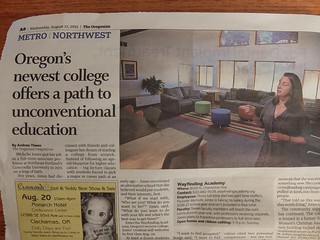
Deke the Geek just left a copy of The Oregonian, Metro Section, in my box.  I'll be going through that this morning, as the focus is on education this time.  I was on the front page of the Metro Section once, in the 1980s, holding a Fuller Projection on a post card.

Another time they featured me as a local futurist.  I was anticipating "hypertext kiosks" in local hospitals, where people could browse about insurance plans.  Sure enough, within some years, Providence Health System had precisely that.

DSCF7963

Tuesday, August 16, 2016

HP4E (continued)


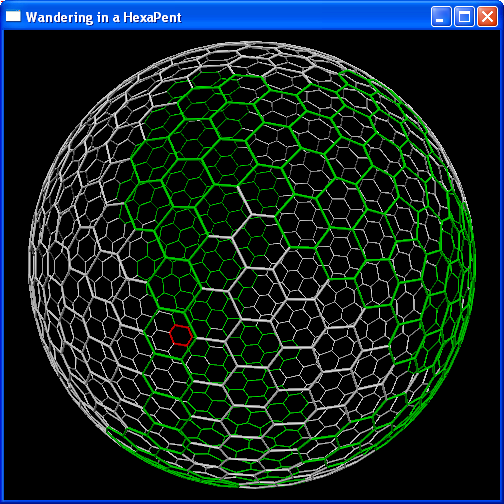
HP4E is a long-running campaign: "hexapents for everyone" is what it means.  A role model campaign was Guido van Rossum's CP4E, or "computer programming for everyone".  The latter had DARPA funding for long enough to get Tkinter + IDLE out the door, which popularized Python among Windows fans, one of the largest user bases in the 1990s.

You'll find the gamer community, around Civilization especially, were hip to the idea of a "macroscope" (globe) divided into, not trapezoidal, not quadrilateral, but hexagonal, and a few pentagonal tiles.  That's a "look".  If you're into fashion, you know about "looks".  The hexagon goes well with carbon chemistry.  Why?  Graphene.  Nanotubes. Buckyballs.

As a long-time attender at ISEPP lectures, run by my friend Terry Bristol, I've been privy to a lot of hexapent talk. I even have an email from Harold Kroto, let me share it:

Date: Mon, May 27, 2013 at 8:40 AM
Subject: RE Buckminsterfullerene


Dear Kirby
Thanks for your update and link to your very interesting blog

FYI
At the end of a lecture a few weeks ago I was asked
by Martin Saunders how the name came about ...
Ed Applewhite's account indicates that I named it
and Rick did not like the name (at the time!...somewhat
of a euphemism actually!) ...but does not
give the context.  Here is an email I sent to Martin:


Dear Martin
It was very nice to meet up again and remember our discussions at Masada I shall send you a copy of our MS on Ne22 in carbonaceous chondrites as soon as I have refined the first draft and also make any useful comments (should I have them) on your MS on He@C60 as soon as I can.

At the end of my talk yesterday you asked how the name Buckminsterfullerene arose

The sequence of events is as follows: Smalley and I wrote the original draft of  the discovery manuscript together.  At one point the question arose at to what  the title should be. Smalley asked me to suggest a possible title.  I responded on the spot with these words: “C sixty colon space Buckminsterfullerene”.  Smalley typed this in exactly and to my memory made little or no comment and I guess did not think too much about it at the time.  I concocted the title on the spur of  the moment because Buckminster Fuller's structures had been one (there was another!) of the strong influences on my thinking about what the structure of C60 might be.  This was partly because I had visited Buckminster Fuller US pavilion at Expo Montreal in 1967.  In addition this beautiful night-time photograph
in special copy of Graphis magazine, devoted to Expo67, had made a very strong memorable impression in my mind.  I had suggested that we withdraw a book by BF from the Rice library which Smalley did. I was a visitor and had no library credentials.  There are very few images of the simple truncated icosahedral (soccerball) structure in the book though there is one and BF is actually standing in it.

At the time I was quietly satisfied that the –ene ending worked so perfectly from a chemical point of view and furthermore the name, though rather long, scanned very nicely...doubly satisfying.

In the Ed Applewhite article http://www.4dsolutions.net/synergetica/eja1.html (extract attached) Smalley corroborates the fact that I gave C60 this name...a name that Smalley really did not like at all as is also indicated in the Applewhite article.

Some time later Smalley received a letter from Alex Nickon about the name.  He was so disenchanted with it at the time that he gave me the letter and told me to respond as it was my invention. I did respond and here is Nickon's book entry:


I hope this answers your question satisfactorily!

Best wishes
                      harry

Sunday, August 14, 2016

Messed Up Mercator


There must be another way...  (of course there are, so many!)


Not the most familiar way, considered obscure, but with some nice features.

Saturday, August 13, 2016

Digital Islam


Hijab meets Cyberpunk VR.

Friday, August 12, 2016

VML (Verboten Math Lab)


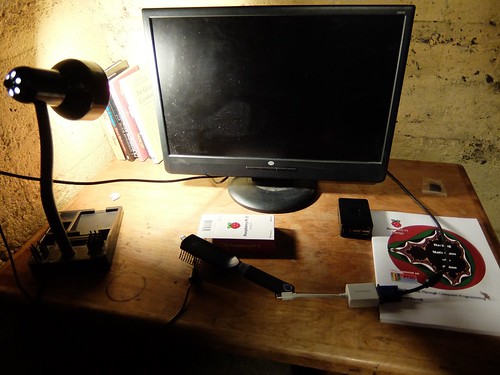
Note:  that's math, not meth, no dangerous chemicals, just a Raspberry Pi and Hacking Math Class by Peter Farell (I met him at a Pycon this year):


VLM

Set up in a basement maybe?  The Eye of Mordor is scanning the horizon...

Code Learning Studio

Remember, Church of TI is Oregon's State religion, when it comes to what thou shalt bring to math class and AP exams.

Practice kneeling and pretending to fit in. A friendly church may be offering free WiFi to the huddled masses, check phone poles for info.

Curious about Verboten Math?  It's a meme in these blogs.

Tuesday, August 09, 2016

Airline Talk

Although like many US Americans, I have a credit card that accrues Frequent Flyer miles, I am not a frequent flyer these days.  I've flown a lot in my day, over a period of decades, so it's not like I'm a noob in that namespace.  I've been in London, Vilnius and St. Louis in the last decade or so, also Georgetown (2012).

Nevertheless, I only got the Delta story, about computers going out, through Twitter, in a Portland neighborhood, land-lubbering in a drizzly setting.  Yes, August rains.  I wasn't in transit at the time, not even by bus (that would come later in the day).

Yes, I remember another story, about a T1 or other data line getting cut, and that shutting down a service, I should Google that.  An airline is a huge operation.  I used to study airport management for entertainment, in a trailer park (mobile home estates) in Florida (Bradenton).  Airport management is but a tip of the iceberg.

I said "it's not my business, I'll gladly take in opinions and maybe in a hundred years venture to say something".

Not so Patrick's crew, off by airplane this morning. Patrick has put in a lot of miles. He came by with some leftover Ja Civa's cake, which I may never have tried.  That's a respected neighborhood bakery we're all proud of.

When I teach object-oriented programming in Python, I'll suggest Concourse, or maybe LuggageSystem as a class name, suggesting they conceptualize an airport in terms of components, for software modeling purposes.

Patrick thought in the EU that airlines were less lax because the administration was less prone to spoil the enterprises and let them get away with too much unskilled management.

These were broad brush stroke considerations on Patrick's part, regarding matters we have only a metaphysical (psychological) understanding of.

AI isn't really a big help right now, though search and pattern recognition certainly are.  What's in vogue right now is seeing if we can dump vast amounts of big data through neural nets and get the AI bots to tell us what to do.  However the GIGO principle still rules.

MEMEX, a meme lobbed from the past by one Vannevar Bush in 1945, was on the money, hit the bulls eye pretty closely.  Good aim.  That's Google search, and like that.

We absolutely benefit from the ease of retrieval, relative to having a duplicated library of books with ladders and so on, with an entire estate built to maintain it.  We call those "server farms" today, and get the http responses back electronically, in milliseconds, by tcp/ip packet.

I asked if the EU business climate was the reason for Brexit, that the UK wished for a more relaxed business climate as maybe people perceive in the US.  Thanks to tort reform, this has become the new place to get rich quick, goes the hype, maybe.

My thinking had turned to "tort reform" as a movement, given my recently viewing Hot Coffee, a documentary focused on that topic.  Hasn't McDonald's had PR problems in the UK as well?  That's a tangential question.

For those just joining us, Google only recently became a subsidiary of Alphabet, in a reorganization designed to compartmentalize operations, reserving Google for search (which includes searching Google Earth, a big data operation).

Speaking of search, we had an interesting discussion of correlation and signal composition, by algorithm, at the code school last night.  A double-E gave the talk, I came late by urban train.

Loud Lady IPA

Saturday, August 06, 2016

Hot Coffee (movie review)


This 2011 film got some additional attention in retrospect thanks to Jamie Leigh Jones finally getting her day in court (spoiler alert, stop reading if you don't want to know the ruling).

However hers is but one of many cases discussed, and win or lose, the point is the integrity of the jury trial system.

Pointing out that the US Chamber of Commerce is no more than a glorified lobby, is helpful, same with the Federal Reserve in a way (not mentioned in the Constitution -- anyone can use the word "Federal").

But then so are the DNC and RNC glorified lobbies, entirely dispensable to the US style of government, if going by original blueprints. Hundreds of parties would be just as feasible.

What the Founding Fathers designed, was three branches of government providing checks and balances, with the Legislature and Executive branches supposedly controllable by money.

The Supreme Court, on the other hand, cannot be wined and dined.

However that premise is somewhat undermined by the later discovery that state judge elections are in fact buyable.  TV ads are quite persuasive when viewers are trained to stay uncritical by high school teachers.

Karl Rove was able to lead a gang of business-minded Texans to buy what was legally for sale.  The US Chamber of Commerce was pretty happy about the Reagan-Bush Era and the resulting change in climate.

Today we see Congress able to block any Executive appointments to the Supreme Court, irreparably harming the system, tearing it down.

Giving ordinary people access to the court system was proving inconvenient for business, as juries would empathize with people and seek to find just solutions.   Just $800 for third degree burns thanks to inhumane kitchen practices was not sitting right with the people.

By branding citizen lawsuits as frivolous, simply a "get rich quick" scheme by trial lawyers, the businesses, including doctors, would enjoy greater impunity than mere limited liability status provides.

Profitability could be protected also, by means of caps on awards, with insurance premiums still rising or held constant.

Likewise employees could be made to bargain away any right to court access by mandatory binding arbitration agreements as a condition of employment.  Without a growing body of case law, with decisions locked away in silos, the paralysis of the justice system became complete.

Loss of access to the courts is what happened to Jamie Leigh Jones, who was sent off to enjoy opportunities in Iraq only to find herself an easy target for a predatory coworker.

The perp knew he'd get off if it ever came down to "he said versus she said", which it did, finally.  He was right, though she had to go through hell and high water to find that out.

With these new measures in place, the US as a system continued to crumble.  The date of its official demise will remain debatable.  Sometime around 1983?

The executive branch had been turned into an instrument of Empire by the Halliburtons of the world.  US Americans could now be exiled to overseas bases, turned into refugees, while investors, eager to play a "supporting role" could reap the profits from their exploitation.  Many young people died for their president.

Congress had proved too spineless to protect its people (Al Franken and Al Gore notwithstanding).

Now the judicial branch was hollowed out.

Al Franken is a star in this film for his brilliant maneuver:  anyone doing business with the Pentagon at least, would not be allowed the customary "cowardly capitalist" outs.  KBR had no choice but to allow a trial, which it won.

Most citizens are losers though, and the US continues to enforce Prohibition without their consent.  Even the bankers are getting mad.  Continuing to pretend it's the dark ages just adds to the sense that we're done with our legal system, and something else is taking its place.

I expect BDS (boycott, divestment, sanctions) to trump the award caps etc., along with more systems like Yelp for doctors.

People will find out which companies played a "supporting role" in vicious land and oil grabs, human trafficking, other malpractice, and simply refuse to reward them economically going forward.  I know I'll never buy BP again, if I can possibly avoid it.

Thursday, August 04, 2016

Accelerated Learning

Given the agrarian origins of the one room schoolhouse, which gave Johnny summers off, to work in the fields, the curriculum was designed to be repetitive.  Johnny would forget much of what he'd learned over the summer.  Some review would be in order, come fall.

Around 8th or 9th grade, come Algebra, Johnny and Jill would learn about "functions", math objects one calls with arguments, getting something back.  Or maybe they just pair inputs with outputs.  During the New Math era, formal definitions were provided.  Functions need not be numeric.

Along with functions, comes their composition.  Given functions f and g, Johnny learns to write f(g(x)) and g(f(x)), but it all seems a tad meaningless and questions may be raised, by this or that student, regarding when these concepts will actually be used.

In the meantime, everything that happens on an industrial scale, tends to happen because of software, because of code.  In learning to code, we learn about functions too, and their composition.  One pipes to the next.  Functions are chained together.

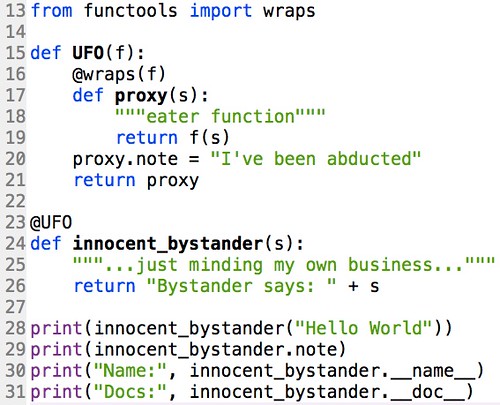
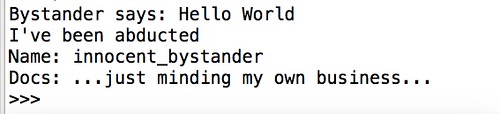
In the Python computer language, decorators are all about composition of functions.  In the code below, from tonight's code school class, UFO "abducts" (composes with) innocent_bystander to return a well-disguised proxy, identical with the original right down to its docstring.

I use the ABC TV show Invasion as a stage-setter, for story, with no requirement that students watch it.  The plot is clear enough:  extraterrestrials in the lake eat and replace innocent humans with identical clones, so outwardly the same, that even the clones themselves do not suspect they're but proxies of their original selves.

CODE:

session10_1

OUTPUT:
session10_2


The @wraps decorator completes the disguise, carrying the __doc__ and __name__ attributes from the original to the proxy function.  The cloning operation is complete.

Now that high schools are under some pressure to include coding, the question is:  in what sort of course?  The common assumption seems to be that any programming homework would logically fall under computer science, not mathematics, which is immune from needing computers, because well equipped with calculators.

Math students calculate.  Computer science students compute.  That difference is enough to drive a wedge through a school and unnecessarily multiply the number of times the same content is covered.  In math, Johnny learns to calculate with vectors.  In computer science, he learns to compute with them.

So on the one hand, we have mathematics looking for ways to prove relevance, and on the other, a discipline of proven relevance that's kept distinct from math, despite hitting a lot of the same topics.

Both math and computer science involve functions, plotting, algorithms, data structures, tabulation, summation.

However the assumption is math teachers cannot be retrained in place to add coding, because that's not what the textbooks include.

Innovation, original curriculum-writing, as a part of the math teacher's job description, seems too much of a stretch, despite teachers wishing to actually teach, and thereby regain higher status.

So not only is Jill given summers to forget, with repetitious fall reviews, but she's subjected to two separate approaches to a lot of the same material.  Composition of functions is taught in math class, without much context, whereas computer science involves passing functions to functions that return functions.  But we won't call that math.

Computer languages have the ability to take the drudgery out of repetitive computations, freeing the programmer to focus on the logic, the algorithms.

Rotating a polyhedron by applying the same rotation matrix to all its radial corner vectors, is tedious by hand, whereas once coded, happens at thirty frames a second or more.

Are polyhedrons and their scaling, rotations, translations, part of math or computer science?  Will students learn about polyhedrons from two sets of textbooks?

Not only are Johnny and Jill subjected to yearly repetition and review, but the very same topics get covered within two different treatments.

Given all the unnecessary redundancy and repetition in the curriculum, accelerator programs have many ways to provide a head start and speed things up.

If we don't assume students are forgetting and starting over every year, plus learning the same concepts twice through two different treatments, we may be in position to at least double the curriculum's effectiveness.

What will serve Jill and Johnny well over the years are keyboarding classes.  Coding is here to stay, at least for a good while, and it's primarily a keyboard activity, not a drag and drop graphical activity, Scratch notwithstanding.  Typing remains an important skill across the board.

Wednesday, August 03, 2016

The Youtube Channel


This interview is of historical interest in my view. [October 20: swapped a different one in, from around the same time, as the original link went to a canceled account].

Wikileaks is a grown up reader-funded public institution, tied to Ecuador, appreciated by the RNC (or at least the Trump campaign) for its revelations about election rigging.

TV journalists consult Julian not as a man on the run, but as a CEO of something. More like Snowden.  I'm not saying that's wrong.  I appreciate hearing the views of both from time to time.

The "Youtube broadcasting system" (shades of EBN) has helped level the playing field.

Monday, August 01, 2016

CodeCastle on Twitter

For more context, click here.

CodeCastle on Twitter

Thursday, July 28, 2016

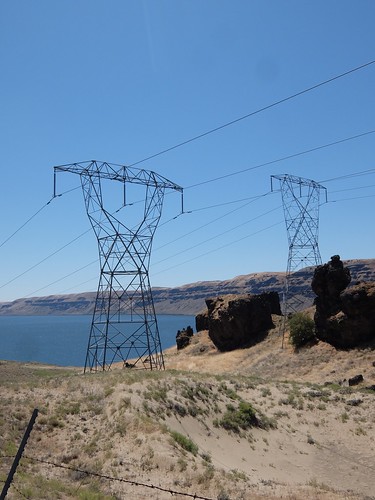
High Voltage

High Tension Lines

I got a lot of work done on MathFuture, but given we were starting to argue about the Infinite Monkey Theorem, and given that's not a list designed for arguments, I felt it was time to get off.
NOTE:  I acknowledge the case where we claim the proof is empirical, because Shakespeare fits our definition of "monkey" for all intents and purposes (so what about a few chromosomal differences, don't be so picky).  So duh, a monkey already *has* come up with Hamlet, a tale told by an idiot, that monkeys also read. [post]
We were hitting too many hot button items, such as whether the Theory of Real Numbers is really sound.

Andrius, in Lithuania, clued me regarding the video below, which I'm still plowing through, as I get ready to teach a next class.

Bradford gave me some good advice, reminding me I wasn't talking to rank beginners.

The target audience for my Philosophy for Physics Majors is more like West Point faculty members (thinking of Dr. Bob Fuller).  I shared it with the Physics listserv I'm subscribed to.

Anyway, the voltage was getting too high for such a village-level grid, where typical household voltages are more the norm, if I may be permitted such a metaphor.

Regarding Norman Wildberger's video, I've gotten up to 31 minutes, 16 seconds, where he covers the Infinite Monkey Theorem, par for the course (i.e. it often crops up in such contexts).

He tries to shove that nonsense off onto Philosophy maybe, after getting our agreement it's not Mathematics, however I'd say Philosophy grew up a lot in the 20th century and what he's saying is not really Philosophy either.

Yes, it might be cocktail conversation after a few drinks.  I'd leave it at that.

I think the whole talk up to that time point demonstrates what Wittgenstein observed:  that mathematicians are singularly poor at avoiding pitfalls in philosophy. I'll have to go dig that up and provide a proper citation.

Norman is trying to dig himself out of such holes, more power to him.

Monday, July 25, 2016

Another Introduction to Tetravolumes

Here's a new Jupyter Notebook undertaking to compare the 4D IVM tetravolume measuring system vs-a-vis the 3D XYZ cubic volume system we all learn in school.

By 4D I don't mean "four mutual perpendiculars" but four rays from the origin through the corners of the topologically minimum container, the most primitive "cage" enclosing volume, a "simplex" of Euclidean dimension: Dim=3.

Think of the 4D as a "branding mark" signalling a different approach to 3rd powering. The Notebook expresses this difference in a way similar to the way Bucky does in Synergetics 982.44-47.

Imagine two sticks of varying length with a common origin, at any angle to start, and imagine an operation that connected the two tips with a 3rd segment, thereby marking off the area within.

This is "closing the lid" in the case of a triangle (Dim=2). However, leaving the angle unspecified fails to nail down the numeric results of the computation. We need to decide on a fixed angle to always get the same result.

Fixing the included angle defines a specific triangle (SAS).

In XYZ multiplication, that included angle is 90 degrees, upon which, after we "close the lid", we then multiply by 2, placing two of the resulting triangles on opposing sides of a shared hypotenuse, thereby defining a rectangle.

That's our standard algorithm for area. |A||B| is a rectangle, a square if |A| = |B|. We all know this cold by elementary school.

In the IVM (different scaffolding), the included angle is 60 degrees and upon closing the lid, we do not proceed further to double the resulting area.

That internal original area, of the triangle, is simply defined to be |A| x |B|, where |A| and |B| are the stick lengths. |A||B| is an equilateral triangle if |A| = |B|.


Moving on to volume (Dim=3)...

In XYZ we start with 3 sticks from a common origin (0,0,0) fanning out in a mutually orthogonal arrangement. Closing the lid begets a right tetrahedron that is only 1/6th of the total volume we come up with, by forming a rectilinear parallelepiped from these sticks.

|A||B||C| is a brick, maybe a cube.

In the IVM, three sticks from a common origin fan out along the imaginary edges of a regular tetrahedron, which establishes relative direction.

The magnitudes are variable, so the resulting tetrahedron may not be regular. The angles at this corner remain fixed, as they do in the XYZ case.

We simply "close the lid" and call that the volume. The numbers stay the same. 2 x 4 x 5 = 40, same as before, it's just that 40 is tetrahedron-shaped, and obtained from adding three sticks to the initial three, thereby forming a six-edged, four faceted shape, not a hexahedron as before.[1]

How might we bridge these two operations?

Taking our cue from Bucky, we construct a tetrahedron from four unit-radius balls, closest-packed, edges 1/2 D where D = ball diameter. Saying the edges are 1 and the volume is 1, makes the cube in which said tetrahedron inscribes = 3 tetravolumes.

That's a fixed and known relationship: the tetrahedron inscribed in a cube as face diagonals has 1/3rd the volume (this generalizes to any parallelepided).

However in XYZ this same cube of edges √2 (in R units) and face diagonals 2, will have a volume of 2.828427... or √2 √2 √2 i.e. "√2 cubed".

So there's our conversion constant: 3/2.828.. or √(9/8).

Another way to think about it: the XYZ scaffolding or matrix consists of unit cubes of edges R. It wasn't originally developed with sphere packing in mind (unlike the IVM, which is the scaffolding associated with the FCC or CCP).

The unit R (2R = D) gives us R * R * R = 1 or R-cubed in XYZ (cube shaped), whereas D * D * D gives us 1 in the IVM (tetrahedron shaped).

Using our conversion constant is like converting between currencies or energy values (joules, calories) where the R-edged XYZ cube is about 6% bigger than the D-edged IVM tetrahedron. The two units of volume are somewhat close (like the Canadian and American dollar) but not the same.

If you know the volume in XYZ cubic units, multiply by √(9/8) to get the same volume in IVM tetrahedron units, or use √(8/9) to go the other way.

Why bother? What's the pay-off?

The tetrahedron of edges D divides thrice into a cube of face diagonals D (as we've seen) four times into an octahedron of edges D (its space-filling complement in the IVM), six times into a rhombic dodecahedron (space-filling CCP ball encasement), twenty times into a cuboctahedron (from 12-balls-around-1 and connecting corners).

Volumes Table:

Tetrahedron           1
Cube                  3
Octahedron            4
Rhombic Dodecahedron  6
Icosahedron          18.51...
Cuboctahedron        20
2-Frequency Cube     24

The five-fold symmetric Icosahedron, Pentagonal Dodecahedron, and Rhombic Triacontahedron (RT) all fit in here as well, incommensurably in most cases.

The Jitterbug Transformation is used to connect the Cuboctahedron of edges D to a corresponding icosahedron of edges D.

Said Icosahedron of volume ~18.51, combined with its dual, define a rhombic triacontahedron that, if shrunk down by by 1/Phi (linearly) gives the RT of 120 E-mods (60 left, 60 right-handed).

The RT sharing vertexes with the RD of volume 6 has volume 7.5 exactly (IVM tetravolumes) and shrunk by 2/3 gives the RT of volume 5 exactly, and the 120 T-mods, same shape as the E-mods but a tad smaller, by about .001%.

What David Koski does is phi-scale the E-mods to express volumes as a linear combination of mods of different size (same shape).

Quoting from Koski's paper:

E module denotations:

    e6 = ((√2)/8)ø ̄⁹ = .002325
    e3 = ((√2)/8)ø ̄⁶ = .009851
    E =  ((√2)/8)ø ̄³ = .041731
    E3 = ((√2)/8)ø⁰  = .176766
    E6 = ((√2)/8)ø³  = .748838

Quoting again from his paper [2]:
A rhombic triacontahedron with a radius of ø¹, is dubbed the Super RT. The long diagonal of the rhombic face = 2, which is R.B.Fuller’s edge for the tetrahedron, octahedron, cuboctahedron or VE, and the resultant icosahedron from the Jitterbug transformation.

The volume of the Super RT is 15√2 or 21.213203 = 120E3 = 480E + 120e3 [tetravolumes].

The icosahedron with an edge = 2, inscribes within the Super RT. It has a volume of 5(√2)ø² = 18.512295. It has an exact E module volume of 100E3 + 20E = 420E + 100e3. [tetravolumes]

That's about all the mathematics one needs to know, to understand about tetravolumes. It's not that hard.

We also get to think again about foundational matters, such as what basic assumptions we might vary to produce interesting new flavors of mathematics.

[1] Just for fun, lets compute the lengths of the "lid" edges and feed these numbers to our Pythonic tetrahedron volume computer, same one as in the Jupyter Notebook. Given edges a=2, b=4, c=5 I get d=3.46410..., e=4.582575..., f=4.35889... for a volume of:

a = 2
b = 4
c = 5
d = 3.4641016151377544
e = 4.58257569495584
f = 4.358898943540673

tetra = Tetrahedron(a,b,c,d,e,f)
print("IVM volume of tetra:", tetra.ivm_volume()) 
IVM volume of tetra: 39.99999999999998  (check)

[2] http://4dsolutions.net/synergetica/RevisitingS&Emodules.pdf
(typo fixed in 2nd quote:   5(√2)ø² = 18.512295.)

Ghostbusters (movie review)

Although superficially a light comedy and midsummer entertainment, this film gave me much to think about and when people asked me for my views, like my mom, I'd say "still thinking about it".

There's a lot about symmetry, left and right, dead and alive, with this bridging of two worlds.  Male and female.  Flipped roles.  The receptionist is the airhead bombshell.  The girls are geeking out.

Girls are good at geeking out, we knew that.  I was probably more thrown by a guy bombshell.  I tend not to see them that way, though I could digress into a longer psycho-social profile and make this review more of a selfie.  I'll forgo.

Lets just say I identified with the dead behind the mirror.  That goofy blob guy seemed to be having the most fun throughout the movie.  Maybe I could be him.

Mostly what I learned about was New York (again) and the Victorian convergence of electricity and negative Universe (meant in a spooky sense).  Edison was not the only one to think these phenomena might have something to do with the soul.

There's sense in that really, in that we're already bio-electrical devices in an Internet of Things, as high tech as we don't know how to make, which is the highest of all.  Us, the not-ghosts.  We think we're less spooky than if we floated.  We're wrong.

Anyway, haunted world, and politics.  The Mayor is as close to a father figure as we get, and he's savvy about (A) the need for ghostbusters and (B) the need to deny it.  His operative, another smart cookie, keeps us attuned to another sense of "two worlds" (one to keep the public happy, another that's more real).

The physics lady, the first person we follow (omniscient camera), is caught in that bind between upholding Victorian science against the evils of abhorrent or heretical beliefs, and her actual experiences.  What happens to Bill Murray's character again?  How was his going missing smoothed over?  Plot hole?

The mirror people remind me of The Zero Theorem, which I've been thinking about quite a bit.  They get sucked down a vortex, but before long they've come back for more.  There's an eternal return implied here.

But like I said, it's summer fluff and great ethnography, a memes-on-parade reminder of where we stand with the paranormal (or whatever) in 2016.

Saturday, July 23, 2016

Verboten Math


"relative volumes"
(Python + POV-Ray)


Concentric Hiearchy on Display

Friday, July 22, 2016

Hypertoons Etc.

Teaching @ a Code School

Probably an ideal job for me would be as tour guide through various storyboards from which hypertoons and other movies could be made.

Hypertoons consist of a wandering playhead making choices at each keyframe, about which scenario to follow, node-to-node.  Keyframes are hubs, some are grand central stations.  Many "time tunnels" (tubes) start and end at each one.


I was mentioning to students tonight on my real time Python channel, that if we had truly driverless cars, then we could send them on errands sans any human passengers.

"Go get me breakfast" might send the car through a drive-through, where a robot would hand my menu selections through the window, as a bag for the driver's seat.

My topic was APIs or control surfaces.  What controls are read-only and when might a user's choices be overruled?

Trying to change lanes with a car in your blindspot?  The steering wheel locks up.

Wednesday, July 20, 2016

Asylum City

Back in the day, futurism, a subclass of science fiction, included so-called "mega-projects" by which was meant more than just more skyscrapers.

Whole cities might be planned and built according to plan, implementing smart house and grid technologies.

Whether jet packs were involved is up for grabs, but definitely people movers.  A passenger would be delivered to a dialed-in destination without having to do any skilled driving.

Many big airports have these today, as trains connecting terminals.  Elevators are also people movers.  Neither of these is quite as private as the private car, not yet driverless.

Today, many civilizations have imploded or are imploding, meaning the individuals trying to make their way in these societies may be in need of rescue.  We recognize physical disasters but some of the most acute are man-made.

A global network of Asylum Cities, geared to take a steady influx of people needing to start over, would provide cyber-identities that were difficult to steal and easy enough to manage in shared memory.  Services such as healthcare and education would be provided.

One imagines people flocking to these cities even if well-provided for, however the familiarity of the known means less stress and less coping.  Undertaking a brand new life in Asylum City is both work and a workout.

Valid identities that do not stipulate nationhood, at least at first, might be a first step.  Having no documents proving citizenship need not result in random assignment.  Feel free to move about, at least in Asylum Network, even minus a recognized homeland or nation.

As of this writing, Turkey is in turmoil, with massive layoffs amidst high levels of distrust.  The need the New World served, in terms of receiving refugees, is still a need, even if no world is new anymore.  Venezuela, South Sudan, Syria, Iraq, Libya... much of the world is falling apart.

Now that we're very clear on the finitude of our planet, it makes sense to sustain high living standards for as many as possible, as a best way of avoiding wars.

Friday, July 15, 2016

Annual Session 2016

NPYM Annual Session 2016

I'm only here for an afternoon, night and morning this year.  Mary Klein, editor of Western Friend, and myself, Clerk of the IT Committee, thought up an Interest Group focusing on the experiences of Monthly Meetings using information technology, including social media.  I'll post a separate journal entry on how that goes, still ahead as I write this.

On my way out here, driving alone, I veered off to visit monuments and memorials.  My mind is hovering in that space between the two worlds, perhaps just a figure of speech.  Sam Hill's Stonehenge, and the Washington State Veterans Cemetery, near Spokane, called me to pay my respects, and I obeyed.

I've been thinking about our global Iron Mountain economy, whereby so many find their daily bread, typically within the context of a male-dominated pyramid hierarchy.  Has the nature of soldiering changed in any essential way, since the time of the Roman conquests?  How do we define our terms?  I know that was a preoccupation of former Secretary of Defense Donald Rumsfeld (definitions).

If it's true, as Bucky Fuller was fond of claiming, that we crossed a threshold in the 1970s, whereby taking care of the world's billions at a high living standard was in principle doable, does that change the context in any way?

One veteran I know was saying how welfare programs were failures because whole families just stayed home and became couch potatoes, unto a third generation, to which my response was "I have no problem with that."

In my mind's eye, I see a pilot in a souped up jet fighter, bombing some village, with the caption "Welfare Queen".  Ditto drone pilots and their warlords.  Not very nice of me to think that right?  Families are proud of their generations of national service, regardless of nation.

Yes, the Iron Mountain shells out a lot to pay for such sacrifices, and the costs are much higher, but think how many paying jobs each bomb represents, not to mention all the work it takes to maintain such aircraft.

Staying home, watching TV, is of negligible cost in comparison, though maybe not if family members fail to exercise and require expensive medical interventions as a consequence.  That's employment for medical professionals sure, but don't we want to focus on preventative care?

If said family has disposable income, they likely help keep the local stores and restaurants afloat.

I think about "programmable money" quite a bit.  Food stamps are a step in that direction.  Imagine a form of currency that was only good towards charitable donations, yet one still had discretionary powers over which charities.

My charitable video arcades or whatever we call them, wherein the winners engage in philanthropic behavior, are about developing awareness of what's out there, in terms of helping people.  Choose where your winnings go, you just won the right to do so.

What makes living standards low today is precisely that so many suffer in ways we could prevent if not so stuck in our reflex-conditioning.  South Sudan is but the tip of the iceberg.

Living standards occasioned by the displaced, those fleeing untenable / unsustainable theater, are low for everybody as a result, as we all share the same backdrop of Ghetto Planet or Looney Bin Earth.

If we were to eliminate death by starvation as in any way "natural" (as in "God's Will"), then living standards would increase even for those who've been in no danger of starving.  The whole world would feel better off.

Tuesday, July 12, 2016

HB2U RBF


DSCF6890

DSCF6894

Saturday, July 09, 2016

NPYM + REST

:: good background on "RESTful API" concepts ::

Thanks to my being a proposal reader for OSCON 2016 (and in some prior years as well), I was able to gain access to the recordings, as a way of getting feedback on our program committee's work.

Did we pick useful presentations for our conference goers?

Just as important:  what is the state of the art in the world of computer programming?

In working through those videos, I came across Kirstin Hunter's talk on being a polyglot, (here's one like it on Youtube) in the course of which she introduces a modeling language called RAML (RESTful API Modeling Language)

Wow, I hadn't seen that before. I learned a lot from her talk, and tweeted my appreciation.
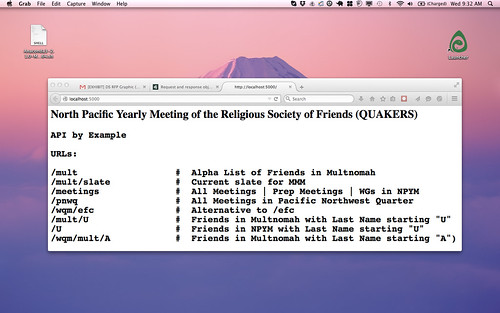
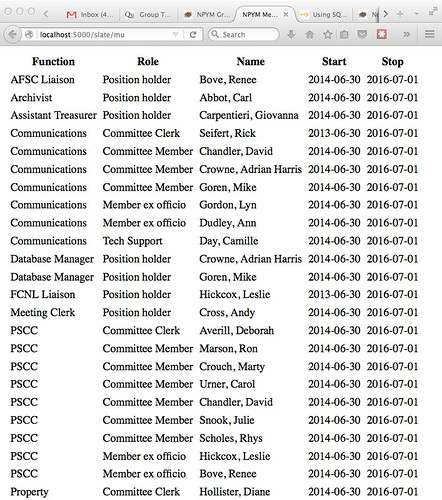
I've been diving into RAML ever since (i.e. since this morning), and now realize that a RAML specification of an NPYM.org API could be a next project for the NPYM IT Committee, of which I am clerk.

As shown below, I'd started on such a thing last year, but without knowing as much about API design as I do now:

Restful API

mmm_slate

The Youtube below, by one of the inventors of RAML, does a good job of advertising the power of thinking this way.

One of my goals for Quakerism is that it get up to speed on IT such that our volunteer roles become more rewarding in terms of the professional development opportunities they offer.

Wednesday, July 06, 2016

Summertime Reverie

[ Reprint of a posting to MathFuture, typos fixed, hyperlinks added ]

Greetings Brad.  I was thinking "circle and/or sphere and/or tetrahedron" through most of what I wrote, and seriously thought of quoting some passages from Synergetics associated with this Figure:

http://www.rwgrayprojects.com/synergetics/s10/figs/f7310.html

... then thought the better of it.  Some other time maybe.

True, conflating spheres with circles is conflating 3D with 2D, and that might be a sin. 

On the other hand, Renaissance perspective is all about rendering 3D vistas on a 2D canvas and as Joe points out, the 3D moon is a circle (if full) in most children's books. 

We play with that circularity, as in the DreamWorks logo (boy with fishing pole, sitting on a moon sliver). The basic idea is to establish in fresh minds (of any age) a semantic network of related concepts that don't fizzle right away, as they too often do, thanks to geometry being compartmentalized, something to put on a mental shelf the minute we leave the classroom. 

On the contrary, V, F, E all follow us down the hall, as halls with doors and lockers, the school itself (like a maze) is all Vs, Fs and Es, once you start looking for them. 

And yes, it's on a ball (Planet Earth), which we might see using Google Earth on a flatscreen.  The Little Prince might feel right at home here (or not).

Circles have a lot of the same properties as spheres, as you well know, and if we're able to take advantage of this homomorphism -- the analogy (if not a full isomorphism, congruent concept) -- so much the better. 

The circle has concave and convex aspects, just like a cave.  People are either inside or outside the circle, drawn in playground dirt, or "on the fence", straddling, one foot in, another out. 

That sense of "container" -- which I'd consider at the root of conceptuality -- is still there.  Or we might use a square, or a triangle, to make our boundary.  Who's in?  Who's out?

The semantic web I was building follows the Synergetics path of looking for "twonesses" (pairs of concepts that go together): 

(i)   spinning around an axis in either direction
(ii)  growing and shrinking radially
(iii) having a macrocosm outside, a microcosm inside. 

We might play this game with circles, not only balls.  We might use a circle to represent a ball. In a Geometry of Lumps per Karl Menger, we have only "3D" as there's always the observing camera, the viewpoint, separated from whatever's observed. 

The observer-observed is already an axis and its context is always volume.  There's 2D "in volume" and 1D "in volume" but the context-container is always 3D.  Everything is a lump.  A circle is a pancake, a disk.  A line is a cylinder.  We may dismiss "thickness" as irrelevant but we don't appeal to infinity to make it disappear.  A plane is a sheet of paper. 

In this geometry (non-Euclidean) there's no need for either "infinitely thin" nor "infinitely wide" as in Euclideans' metaphysical cartoons (lots of hand-waving).  The word "infinitely" itself as been largely deprecated as unnecessary. 

Different axioms and definitions, sure, but not entirely unfamiliar as its a reality we may access experientially.  Taking a page from the old textbooks, we might say the omni-presence of 3Dness is "self-evident". 

But then what about Time i.e. change, i.e. deltas?  The movie moves.  Stuff happens. Going deeper with the elementary topics, I introduced V + F = E + 2 and Descartes Deficit of 720 degrees.  You'll not find these in Common Core. 

My ethnicity, no doubt some religious minority or cult, wants to share these generalizations in 3rd grade.  Might we need a special dispensation from the Governor?  Must we keep our kids from public school?  I certainly hope not, fingers crossed. 

In the 1980s, I wrote up much of the above for an archive in Bhutan, but I doubt it met with Jesuit approval way back then.  Malesh (means "oh well" in Egyptian -- an acceptance of God's will).

Finally, I want students (of any age) leaving my geometry classroom to keep thinking about social networking, about graphs.  Who is friends with whom?  Who consider themselves enemies? 

I'm in need of such a graph database myself.  As I wrote to the director of the code school (< guild />) this morning from Linus Pauling House:


I spent the night of the 4th at home studying history of the French Enlightenment period. I had no idea that Hume, the Brit, and Rousseau, the so-called romantic, had such a dramatic falling out. Such revelations make me want a graph database of "friends and enemies through the ages".  A great way to teach history to kids (adults too): "if I were Thomas Jefferson on Facebook, who would my FB friends be?" ...

Giving high school teachers free PD in Python etc. would be a smart move, as a pilot program at least. I guess I'd consider myself a lobbyist for such programs. I probably have natural allies in PSU I don't know about, enemies too. History was ever thus. :-)

I'm also sporadically reading a fantastic book on Ada Byron, the first computer programmer. She wasn't allowed to know who her dad was until her 21st birthday, when his portrait was unveiled with much ceremony. The mom didn't want her to have any contact with the guy.

PD = Professional development.   PSU = Portland State University.

You might see where high schools could relate to talk of "in groups" and "out groups", the Venn Diagrams.  That's what the #BigData and #MachineLearning folks are studying too.  Who's who, and who knows whom, who works with whom etc. 

The company Little Bird (here in Portland) is one example, that's what they do for a living:  find out who is influential, based on network traversal. The theory is that, in knowing all this, one becomes an insider in some way, like being in the CIA in some science fiction. 

My wish, then, is to anchor a semantic web that doesn't fizzle when the mind turns to social matters.  Geometry doesn't just sit on the shelf. 

Verifying the truth of a story, seeing if it all checks out, is "omni-triangulating". 

We're building mental maps, mental models. 

Yes, constructivism:  we're each responsible for creating our own model. 

Geometry supplies conceptual tools for doing that. 

Graph Theory and Geometry are not strangers.

Sunday, July 03, 2016

Deep Believing


Improvements in speech and image recognition have caught the attention of BR (business religion), which is a little different than BI (business intelligence).

Those tracking the Deep Belief Net (DBN) algorithm, or really any neural net solution, know it's all about weights and biases.

BR is all about applying DBNs in an unsupervised learning environment and forming conclusions about the patterns it finds, locking those in, and defending them, creating a "hard shell" around a "nut" or "nugget".

Depending on the use case, said "nut case" (pun intended) will have a corresponding "half life" or decay curve, preceded by potentially sharp spikes or other growth patterns.  Strong BR has the potential to form the nucleus of a "pattern integrity", to use the jargon.

The millions of customers using camping or other outdoor gear on a year round basis, abetted by sports campers, are stretching the borders of Cell World i.e. those parts of the biosphere served by cellular telecommunications technology.

GPS, news, weather and basic daily income (BDI) are examples of what some businesses circle as mission critical, either as customers or providers or both.  The cell phone network is forming the B2B web that we hope has a safety net aspect where living standards are falling.  What does BR say?

Note that Business Metaphysics (#BM as in IBM) and Business Philosophy (#BP) both serve as tags in this space, but really BI and MVC have more widespread circulation as concepts, the latter (model view controller) serving as a mirror for what many businesses see themselves to be.

Star Trek's Enterprise is MVC with VC concentrated on the bridge to interact with Spock's and Kirk's bionets (brains included, however a the whole body is trained, including glandular / hormonal systems; Spock's is built this way too even if he has more control of emotions).

We give BR a captain's role, whereas BI is the ship's computer, more like Siri.  BI will take feedback from a Model up to the visualization phase, however only the captain and other bridge personnel have the weightings and biases to recognize what levels of risk might be acceptable or not, going forward.

BR is concentrated in the CRO (chief risk officer) in other words, the Klingon in our analogy.  Klingons are on the lookout for shaky markets likely to flat-line, bubbles on the brink of bursting.  Whereas some on the bridge might be looking to pump in some energy savings, their "get rich quick" short cut might best be tested on the holodeck first.

Speaking of the holodeck (simulation environment), although mostly used for entertainment on Star Trek, that's the training ground you'll want and need, when investing in role playing around new business models.

If you're a bank working with crypto-currencies, you'll want proto-customers to role play with actual devices.  Pitch a tent right there in your 47th floor office if need be (don't start any fires) or find a prototyping camp that specializes in Deep Learning.