Saturday, September 12, 2015

Compare and Contrast

I would agree that the language of mathematics is about making generalizations, but also making them precisely enough so that they hold universally thanks to some clear stipulations.  Minus the clear stipulations, one just gets dogmas (poopy belief piles).

In some of the Google Groups, such as mathfuture, I suggest abetting ordinary XYZ vector mathematics, an arithmetic of sorts, with what I put forward as a sidebar "IVM vector mathematics", with an apparatus some might claim is a parody of XYZ but which I'm happy to take quite seriously.


In comparing and contrasting the two approaches, we come to see what commonalities apply.  The two arithmetical games have the same operations.

"We use a Caltrop in place of a Jack" is one of the ground rules, differentiating respective language games.

The XYZ "jack" divvies space into eight octants whereas in Quadrays, the "caltrop" divides it into four.

XYZ (jack): (+ + +)(+ + -)(+ - +)(- + +)(- - +)(- + -)(+ - -)(- - -)

IVM (caltrop): (+ + + 0)(+  + 0 +)(+ 0 + +)(0 + + +)

Per any point, one direction stays passive in Caltrop arithmetic, with positivity (or zero) in the other three, sufficient to reach all points in a quadrant, with four quadrants spanning space.

Cartesian coordinates (also invented by Fermat) employ a "jack shape" of six spokes whereby space is subdivided into eight regions, designated by permutations in sign, positive or negative.

Tip-to-tail addition, 180 flip for negation, scalar multiplication (if allowed) works the same way as with "Jack vectors" such that all points have 4-tuples instead of 3-tuples, and negatives are not needed.  We have an isomorphism between them.

The Americans have apparently said "no" to any such curriculum for now, if we're to judge by Common Core, but then who says that's what to judge by?  Common Core actually forbids nothing, being an affirmative document in a "what to include" format, so lets not assume "verboten" where "not mentioned" is more the expected norm.

Common Core is like a cake with no frosting, or staircase with no carpet.  The frills are missing, leaving bare bones.  In adding spice with the IVM, in addition to XYZ, we're going beyond what's required.

In other words, if you're the teacher and you find introducing Quadrays to your classrooms catalyzes more productive thinking about "vectors" in general, then you have the right, as a freedom-loving American (or whatever) to say "yes" to the sharing of these ideas, if only for experimental purposes.

However, you may feel you need permission from your "church" or from whatever various designated religious authority sub-geniuses, however intriguing you find these ideas personally. It's not necessarily your call, where the education of innocents is concerned, whether to venture outside the lines or not.  Not every teacher is a wannabe rebel.  I encourage you then:  follow your conscience.

Besides, I've had a free hand to teach this stuff for some decades now, so I'm not about to complain about censorship.  I maybe don't always reach the most receptive age group, as vectors are usually saved until college and my Saturday Academy classes were more middle school on average.  That's a different issue.  The past does not dictate the future in any case.

No, I think the reason IVM mathematics makes so few inroads in America has more to do with complacency than with censorship, with the XYZ people thinking "why should I share the road with some johnny-come-lately, and what's a 'caltrop' anyway?"  The NIH ('not invented here') syndrome is prevalent.

caltrops

Nobody recognizes "Quadrays" as a brand of anything (correction:  there's a flashlight by Nitecore), let alone as a geometric something, which means the whole language game might as well be from Mars.

In an age that rewards people for being "mainstream", anything out of the ordinary (i.e. "extraordinary") is left to "circus freaks" or whatever "out cast" of underdogs.

We're more likely to learn of Quadrays from wandering egoists "sirfessing" in Hobo Colleges [tm], than from Pearson or Springer-Verlag.

Speaking of Mars, that's a segue to Wittgenstein, the movie, wherein the young LW's alter ego and / or imaginary friend, is likewise a Martian -- played by Nabil Shaban, a Facebook friend (introduced to me by Trevor).

Wednesday, September 09, 2015

Another Study Period

A Private Sky

I've been studying history as well as working in IT waters.  IT has a timeline (a history) too.

Studying what you ask?  You want to know?

I won't be able to cover all of it in one blog post, but let me review.  Even if no one were to read this, Evelyn Wood Reading Dynamics says "doing a recall" is a good idea.

To review circumstances:  I'm care-taking for a family pet who needs a fit assistant.  Instead of hiring someone, I'm doing the job myself, as sitting kicked back in an easy chair with a relaxed mutt is in many stereotypical scenarios one of the best places to be.  People want this, especially with the gigabit fiber optics and BBQ out back.

Why should I act aloof (haughtily above it all) when I enjoy such privilege in Scenario Universe (non-simultaneous and eternally aconceptual)?  In addition to these physical comforts, I have the benefit of friends and family, pets.

So what am I complaining about?  Nothing, not for me, lets go take care of those refugees.  "First world problems" means "well taken care of" by world standards.  Now lets raise those standards for everyone, which means a global safety net, like the UN has been working on providing (FAO, WHO... UNICEF).

When people feel safe enough to change jobs, then those miserable in their current service might find where they better fit, and a happier population makes for a better experience for all of us aboard our shared Spaceship Earth.  A safety net means having time to learn, to study, to catch up.  People need that.  We're reprogrammable, but not in an instant.  Retraining takes work.

Then of course there's that eternal insecurity of not knowing tomorrow (as big as today, which is huge), as if omniscience were ever an option (or would help).  We all have our existential issues with mortality, even when a next meal looks like a pretty sure thing.  Alan Watts wrote about this stuff, as did Paul Tillich and many others.

Lets admit that in boosting physical well being, we're not pretending to resolve all metaphysical conundrums.  That's not to ignore metaphysical issues, just to stay humble and admit a smartphone or even smartcar may not supply the meaning of life, although these phones get pestered with that stuff daily.  Even bankers and financial advisers are smart enough to know they don't have all the answers, most of 'em.

I understand about data hog smartcars being attractive, even if not in auto-drive.  I should have posted this in BizMo DiariesLots of e-stuff, on the road.

However smart places to stay put in, shelter, need not have wheels, let alone wings.  Having swipe screens in the kitchen with apps and videos, however mounted or built in, makes as much sense as on the dashboard of a smartcar.  But what does the village look like?  Hillary said it takes one.

I think of the Blue House as a big wooden tent, complete with furnace and furnishings.  City blocks are like RV hookups, where you connect to services, including data, sewer, electricity and whatever.  RV camping and living parked in a non-mobile home, is more a matter of degree.

I'm camping, just with a heavier rig that's not designed for the open road, let alone the rolling waves.

I speculate that we're still waiting for something more to come out of Camping / Scouting that preserves a lot of the DIY ethic, but takes more advantage of bandwidth and other space program developments.

Science / research teams that show up (they have before in these blogs), live in and sample an environment (might need to have airlocks if mosquitoes are a serious threat), then leave with a plan to remove their equipment, including dwelling units, once the studies are complete.  What did these units look like?  Biosphere 2?  Lost in Space?

Since the units are designed to be moved, cleanup is not perceived as an onerous duty but as a logical completion of a project.  We get into weight (as in tonnage) as an issue, and the "more with less" phenomenon, which is what camping is all about, even if other types of architecture are more about being super heavy (bunkers, banks... fortresses).  Helicopters play a role.  An oil rig is a village.

Of course some of these pioneering villages will "stick" and grow over time, perhaps reaching a constant size rather quickly, then extending through time for quite awhile.  The map of how villages may shrink or grow is already a long one and that's not what I studied.

I was looking at the US stock market and all the scary news, and no it wouldn't surprise me if risk markets were skittish in the face of an uncertain future.   Where there's a dip in August you often see another one in September, I get that.  Nothing I can do about it either, like the weather.  Flap my butterfly wings?

Many Americans live in fear of exotic attacks, the like of which TV and Hollywood have already graphically depicted.  In a world in which humans were just not so crazy, didn't deliberately drive the bus off the cliff, we could relax more.  It'd be more like DisneyLand, where yes, accidents happen. But then Americans have made lots of enemies, they're told that too.  The world doesn't love them any more.  What happened?  No time to reflect given fantasy rules the roost.

Sketching more than just a smartcar but something like a lifestyle behind it, would please many investors, unsure what they're buying when robot cars are unveiled.

What's the future gonna be like?  Some giant crazy war?  Should we be saving to retire to a resort casino lifestyle or what?  Will the golf cart drive itself?  Or are we talking "virtual golf"?

People don't wanna be fooled (blindsided) by a future they didn't see coming.  I get that.

Like, sure, sure, we'll drink Pepsi and Coke, but then what?  Like in WALL-E maybe, the movie? That didn't look so bad, on that space ship, right?  A lot of us would be happy with that, no?  Those were self driving cars / chairs were they not, complete with Big Gulps.  Why did they go back to Earth again?  Something about not enough vegetables?

I think that's the easy chair talking.  The lullaby of the recliner.  This is how many Americans sit, watching TV.  I need to hike Mt. Tabor after this (just a small hill, but I've cut back since the heel problems).  Update:  maybe tomorrow.  I'll have a beer.

So much screen programming is just the engine running idle, turning over in fantasies, faux versions of professions invented for the big screen.   The not-real doctors treat not-real patients.  Not-real mathematicians help not-real police.  The answer:  "reality TV".  A bunch of games.

And they all have such superpowers compared to us, those fictional characters, or a lot of 'em do.  We can't hold a candle to fiction.

The "reality component" in people's fantasy lives is tough to gauge but even so, is an important variable through time.  Are they scared?  What do they see as inevitable?  Prophesies can be self-fulfilling you know.  Thomas Paine was at pains to remind us of that fact, reminding us that to prophecy was to songify, to auto-tune the news.

Televangelists of all stripes create some amazing illusions don't they, with that smoke and those mirrors.  Illusions jump start realities, just like The Turk (chess playing automaton, supposedly, in Napoleon's day) "proved" the possibility of chess-playing automatons, and now we have them.

I've also been studying demented cartoons, on advice from a lawyer I know (still practicing).  Thanks to my immersion in another season of Squidbillies (easy to find on-line) I found myself late to a lunch I'd been looking forward to.  I popped out of the Matrix just long enough to remember I have a life.

That being stupidly late pushed me to run which proved I still could, and brought me back to my days as a jogger, exiting my dorm window, golf course level, and running through the woods around Princeton's Institute for Advanced Studies.  Cue fall colors.  Make me look handsome.

Hyuk.  Squidbillies is pretty funny.  They're squid hillbillies see, and they have hatred for "Chalkies" (white people), at least in some episodes.

I saw where Putin of Russia was extending more of a hand to Greece, Orthodox Christianity being a bond between them.  This was old news by now i.e. I was going back to a different debt crisis.  Now we're looking at the US's again, another thing I studied.

People who don't read a lot of history probably don't appreciate what a house of cards it's always been.  Humans, like chimps on a chimp island, have a glimmer of what intelligent institutions might be like, but follow-through is somewhat difficult for this species and besides, the puzzles are really tough to work out.  We only came up with arithmetic fairly recently, in geological terms.

In Gnostic and some Christian lore, the Angels are downright mocking of Man for being such a ditz-brain, can't get it together, always flat on his face, saying to God (in some Gnostic gospels a She - I'd advise we let It pick It's own pronoun) that God ought not waste too much time with these backwater hick squidbillie humans of Planet Earth.

In today's terms, these "Angels" are some ET race that's just jealous for some reason.  At however many billion we should take a moment to pat ourselves on the back.  Malthus never imagined we'd make it to such numbers, which show signs of leveling off.

Monday, September 07, 2015

Labor Day 2015

Labor Day 2015

The day got off to a bumpy start in that Carol, my mom, world class activist, was supposed to join a national call.  Instead she was confronted with a disaster of sorts:  our arthritic dog, unable to exit the house without assistance, had done her best to give warning.

Carol can't lift a forty pound dog down the front steps.  If the dog tries it herself, she tumbles, though she will come in on her own steam OK.

I put the picture together in the rear view mirror.  I'd been there the whole time, but upstairs snoozing.  I finished the cleanup but Carol was unable to join her call, a system notorious for not being friendly to cell phones.  Frustrating.

The second occurrence, less intense, reminded me I should work from the Chair of Computer Science (where I am now), not from the red office upstairs (it had been aquamarine).  When I'm a floor away, I'm not alert to the dog's cues.  She's not happy alone anyway.

The better solution was to have the dog join me outside on the patio.

"The patio" is a primary Place in the Pattern Language of middle class lifestyles.  One engages in ritual BBQ, especially on Labor Day, and that's exactly what I did, buying some choice meats from the supermarket, open on this flag flying Monday.

Glenn came by, bringing potato salad.  Life seemed less grim by late afternoon.

The radio and TV are full of stories of refugees and their battle with the prison-state system.  Nations have the right to bomb, or assume they do, or civil wars break out and nations bomb themselves.

People leave their nations, their homelands, and become part of a diaspora.

How friendly is the rest of the world, to wanderers?

This continual re-shifting of populations is not about to "settle down".

People on the move is the norm.  We're not livestock in feed lots.  I'm not saying humans bombing themselves is normal (I see it as pathological), however fleeing from disasters not Made By Man [tm] will remain a priority and human right.  If your place to live floods or burns, gets hit by a hurricane, you get to move somewhere else, perhaps to an "Old Man River" city (ala OMR).

There's some chatter on the Thirsters list.  I'm looking into New York City's recent history from the point of view of a Village Voice journalist, digging into it.  This was some time ago, before the 2015 electoral vista in the US.

The meeting room was quite packed at our Thirsters last meeting, with the facilitator kindly making more room at the table for me.  I'd arrived rather late, coming from a Python User Group organizers' meeting at Rentrak on Alder.

NPR is previewing a large number of upcoming films.  Some perked my interest.  All of this before Thanksgiving.  Then another Star Wars.

Sunday, September 06, 2015

Orgazmo (movie review)

Thanks to my film instructor, I was immediately clued to the historical links twixt this film and South Park Studios.  Writer-directors Trey Parker and Matt Stone (uncredited as a writer -- both play characters as well) sketch a comical clash, twixt Utah Mormon and LA Filmmaker subcultures (porn filmmaking more particularly), that in many dimensions mirrors the culture wars covered in the movie reviewed below, Best of Enemies, about the Vidal-Buckley TV debates of 1968.

Those of us with fancy educations are more likely than most to associate the sometimes demonized "Liberals" of US political vista fame, with the so-called Vienna Circle that grew up simultaneously with Nazism.  Given I have a fancy Princeton education, that's not surprisingly my spiel as well.

The folklore or "volk-lore" of Wagner's melodramas rode the wave of anti-Semitic German nationalism, based in faux mythologies, including Social Darwinism popular in the US, to somewhat eclipse the whistleblowers who prophesied what was coming (not pretty).

Nietzsche in particular was driven to insanity by what was to become Nazi culture, his descent into madness roughly coinciding with the date of Hitler's birth.  His legacy was then twisted to fit the Nazi mold, which must have occasioned some intense grave spinning.

Liberals, such as Freud and Jung, thought repression of bawdy topics, banning open investigation of human sexuality and so on, only came back to bite one in the butt big time in the form of guilt and other pathologies, mostly dealt with by norms-enforcing religious orders and their secular / sponsored states.

The price of censorship, at both the individual and societal level, would be sick and twisted mob psychologies, an abhorrence of diversity (xenophobia), and increasingly fragile / defensive egos, feeling besieged by temptations (guilty pleasures, pornography) on all sides, plus a propensity to project fears on scapegoats, supposed puppets of dark and sinister forces.  Good against Evil in other words, Saints against Vices.

Those power-nesters seeking to cultivate a morally wholesome G-to-PG spectrum for their children feel threatened by uncensored R, NC-17 and MA materials available through adjacent magazines, TV channels, URLs.  Even TV-14 scares the G crowd sometimes.

Freud was saying unless humans gave vent their fantasies, their unconscious anti-egos would pretty much take over, which leads to outward wars and mob psychologies.  Better to let people explore the inner vista, as consenting adults, than pen them in and pay the piper.  Allowing Dante to tour Hell, in the Italian vernacular no less, made him, and his readers, more adept in the skills of enjoying life without getting trapped in its anti-patterns.

With the invention of broadcast television, the Liberals were especially feared in light of there only being three major networks in the USA at that time.  What if they put orgies on right after the news? With so few channels to choose from, the stakes were high.

How about gun violence fantasies right after the news?  Those are less of a problem for most cowboys, though to a tractor-driving Quaker like me, equally pornographic (pulling out a gun in public is considered immodestly forward in Quaker circles, not really for polite company, whereas actually using one as a weapon is beyond the pale crude).

The still nascent EU was far behind in terms of channels back in 1968.  UHF and cable were still in the future.  The real explosion in LA porn filmmaking would await the invention of VHS and asynchronous (non-broadcast, not real time) television, and later the Internet.

I was a fan of Freud's as early as 8th grade, plus was at the time living in Rome, Italy where sexuality is less inhibited (La Dolce Vita and all that).  Rome is frankly cosmopolitan and young ears and eyes hear and see plenty, even if I wasn't engaged in much risky behavior myself.

Cultivating judgement is a part of growing up, and one loses one's sense of what to watch out for if penned in by only PG.  Not a new insight, I realize.  Eat dirt if you want antibodies (but not in huge amounts).

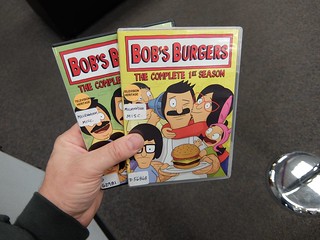
Rocky Horror Picture Show covers a lot of the same territory.  I'm also going through some episodes of Bob's Burgers having delved into Archer (lead male actor the same in both).

These latter qualify as "naughty cartoons" but are not considered "pornographic" by Media Mogul standards.  They're typically guarded as Free Speech protected under the US Constitution, just like Vidal's books.

Animation (anime) as a technology covers the full spectrum from G to MA (what used to be called X-rated).

When it comes to teaching important lessons, the literary device of analogy, akin to the mathematical concept of iso- and homomorphism (mappings), allows fairy tales and dream sequences, other fantasy genres, to allude more than rub in.

Given teachings are about generalized principles sometimes, there's no real satisfaction in the special cases anyway.  The sense of completion (getting the teaching) is in connecting the dots, not in the dots themselves.

Some of the most effective andragogy involves "leaving things to the imagination" sometimes with the added layer of needing to crack the code in the first place.  Freud was saying something similar in that how the unconscious works is to encode or layer (cite Interpretation of Dreams, an 8th grade favorite).

Norman O. Brown had more to say on all this in Love's Body.

DSCF0144

Thursday, September 03, 2015

Best of Enemies (movie review)


I was but ten years old at the time.  Now, at fifty seven, don't picture me as having the puzzle all put together, everything figured out.  On the contrary, they keep dumping more puzzle pieces into my vista, this documentary a case in point.

ABC is behind in the ratings, the low budget wannabe, so with less to lose, risks a new scorpions in a jar format, arch conservative, William F. Buckley, versus a likely nemesis, Gore Vidal.  They hate each other and that makes for interesting television.  The format paid off, boosting ABC's ratings and the other networks followed suit.  Punditry pitting opposing viewpoints, along with the hosted talk shows, the host sometimes highly opinionated, would carry us forward as standard fare.

I'm not quite on board with the thesis that having just the three networks was a Golden Age.  More bandwidth, not less, keeps diverse memeplexes alive, some we may not appreciate, but need as surely as elemental protein.  That we're all more on our own and alone in our stitching it together (piecing it together) from a variety of sources, is more like detective work, less off the cuff, more reflective, less mob-like.  I'm not nostalgic for the older economy, however I do appreciate the vitality of the debate format and appreciate what ABC attempted, as an experiment.

Lets be fair, the ABC anchor was the first to say "Nazi" in comparing flying an emblem associated with Ho Chi Minh's army, against which soon-to-be Nixon's forces were arrayed.  Wasn't that deliberately provocative, like flying a Nazi swastika, the newsman asked?  He'd let that meme out of the bag, and Vidal made it land in Buckley's lap with the spin of "crypto".

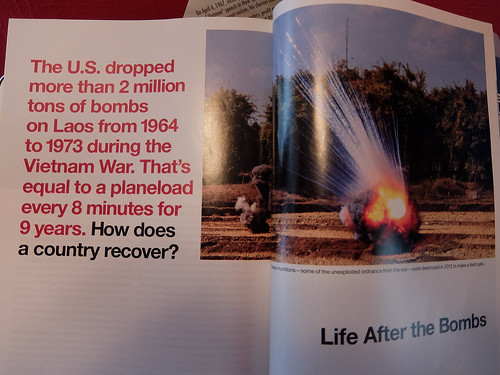
What never happened was any rational discussion of how like or unlike the WW2 example, was the flying of said banner in a Chicago park, amidst acts of police brutality.  Nixon-Kissinger would be carpet bombing Laos soon.  Even Twain had mocked the Republic for becoming an Empire.  Been there done that.  We'd all studied Roman History, so the US was to be another cliche then?  Vidal mocked the Manifest Destiny crowd.  Seeing the former US ally against Japan, a Jeffersonian democrat, as a Hitler, did indeed seem far-fetched.  Carpet bombers with B-52s seem more Fourth Reich to me (shades of Spain), with the benefit of hindsight.  What a bizarre analogy, I'd suggest to ABC.

However instead of delving into history, educating his audience per usual, Buckley lost his cool.  Gore got his goat, in front of millions.  This documentary rubs it in.  That Buckley was so bothered by this episode helps define his character as usually taking some high road, at least in his own mind.  He'd gone below his own moral standards, in a blow to his own ego.  The threatened physical violence maybe seemed idiomatic, but calling Vidal a queer just reeked of feeling out-gunned.

I think his taking it hard that he lost his temper helps establish the guy's having a moral compass, which Vidal would have us doubt.  In any case, conservatism would become fashionable in the wake of Buckley's pioneering example, so whereas Vidal may have scored, the culture at large was ready to surge to the right.

Vidal predicted this during the 1968 convention, saying he smelled jingoism in the air.  Having become an atomic superpower, the need to show the world who its new boss was, was becoming an overwhelming need for some, especially in light of a perceived best time to act being short lived, and already over by the end of the Kennedy administration.  By 1968, the Cuban missile crisis has proved there's no winner-take-all strategy, and the Cold War is well under way.

Speaking of ABC and TV ratings, I coincidentally have a meetup at Rentrak tonight.  That's a company that performs a lot of the same services Nielson used to, but with newer technology.  Just a Python organizers meeting, followed by Thirsters.

After the movie I stopped by Yard House, getting soup, salad and ESB from the gracious Shannon behind the counter.   Then I walked across the Hawthorne Bridge, stopping here and there as I made may way back up the hill to my neighborhood, a good test of the healing ankle.

Uber-Cowards Attack!
:: national geographic ::

Wednesday, September 02, 2015

Opting Out

:: behind an Iron Curtain ::

KOIN TV (CBS affiliate) has been reporting that Oregon State is getting nervous about how few students are electing to take the new Common Core Standards test, administered by the Feds.

If not enough students in a district take the test, loss of federal funds could be a result.

I'm one of those who goes around telling parents that, even if we do need a Common Core, the one they've come up with is probably not the one we want to go with, if at all interested in maintaining the quality of our Silicon Forest economy, largely nano-tech based.

The mathematics purveyed by Pearson, a British company, discriminates against Americans, an inventive people who came up with some twists on EU-style geometry, which the latter suppresses as "verboten" math.

We feel behind some Iron Curtain in that respect, with our designer memes nixed by powers that be, powers out of touch with We the People.

For example, we have a way of valuing volume that anchors to a shape other than the cube (a tetrahedron) and its all 90 degree angles.

No, our memes do not shove the cube off stage or commend it to the ash heap of history, but you'd never know that given the hostility and defensiveness with which Cubists meet what they perceive as defiance.  We merely wish to share the road.

Any questioning of the authority of these awkwardly insecure partisans, and the barriers go up, like a wall across New Mexico.  The "not invented here" syndrome is very strong among the road hogs.  We get forced off the road every time, unless we refuse in some way.

The State of Oregon is not directly a member of NATO, is only dragged along, unwittingly, by an incurious and incompetent Washington DC, which commits us to one disastrous policy after another.

That our core is neglected, theirs always hyped, is a disparity and double standard we (a lot of us) will no longer accept in Cascadia.  Taxation without representation has never been our cup of tea.

The loss of federal funding is a relief actually, given all the strings attached.  Detaching from the brain dead is a good investment if our purpose is to serve the welfare of Oregonians.

Monday, August 31, 2015

A Refresher Course

I'm reviewing a shop talk here, one used in IT.  You'll remember .NET (pronounced "dot net") which pioneers the idea of a common low level language to which higher level ones compile.  C# ("C-sharp") and Visual Basic would both compile to the same CLR (Common Language Runtime), which is like assembler language but not right on the chip.

The "chip" here is virtual i.e. there is no actual hardware that talks this language -- but could there be?  To run .NET on different physical chips means getting under the hardware abstraction layer.  .NET is well-established and does business every day.  The Open Source version is known as Mono (or "monkey") with support from Novell.

Anyway, picture .NET as a Great Pyramid (Mono in its shadow) and then add another one nearby:  the JVM or Java Virtual Machine.

Same idea:  multiple languages target the same pile of code, thereby availing of the million hours of labor going into them, we can debate whether to call it "slave" given wages were in the picture.  The JVM was pioneered by another giant of the Silicon Age:  Sun Microsystems.  The Sun ecosystem, including Java and Jython, was not so long ago acquired by Oracle.

So you might compare Microsoft and Oracle as chief sponsors of the two Great Pyramids out there on today's cyber-desert.

Lets look at the JVM more closely and talk about what it means to share a common lower level language.  Java, the main driver of the JVM project, is the computer language most native to this platform, but then consider Clojure, or Scala, or Jython.

These general purpose languages target the same JVM which brings with it the possibility of interoperability, a buzzword that tends to get all manner of coder geek excited, PyLadies included.  Something running in Jython might have applicability in some Clojure namespace.  I've been tracking developments along those lines.

Lets back up and talk about Jython again.  That's a version of the Python language that targets the JVM.

In contrast, Iron Python is a project targeting the .NET pyramid.

Two more VMs define Python:
  • it's home base in a C-language version, and 
  • PyPy, a Python written in a slimmed down version of itself.  
That's a lot going on and not every language enjoys such a complicated evolution.

Python's story is worth weaving in here though, as it helps us refine our understanding of the relationship between a high level language, such as Python, and the engines on which it might run, which are numerous, each pregnant with different if overlapping possibilities.

Where does Clojure fit in, mentioned earlier?
  • One, it targets the JVM (think of Oracle) and 
  • Two, it's in the LISP family ...
... a proud (and rightly so) branch in the family tree, which likewise includes Scheme, and Racket, and even the more obscure Hy, a recasting of Python into a LISPish syntax.

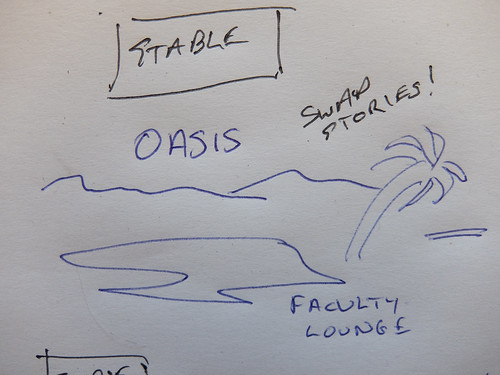
Think of caravans converging from faraway places, on some Oasis near some Pyramids.  That will give you a placid vista in which to think about how all these lineages and traditions come together and trade memes.

Even without turning into a Clojure programmer, a Pythonista may learn from the LISPers.

The stories told in the shadows of these Great Pyramids are informing today's IT.  Lets hope you feel somewhat refreshed about these concepts, relevant to computing today.

Faculty Lounge

Saturday, August 29, 2015

Trendy Talks

Two versions of an excellent talk by Joi Ito:

TED Talk

@ solidcon

Thursday, August 27, 2015

Meat Therapy

I'm calling it that because the butcher behind the counter at the local market called out to me, helpfully, asking if I'd found everything all right.  Personnel at this market are encouraged to ask that, and if the customer strikes up a conversation, they're allowed to follow it, at least a little ways.

My response was to say I knew the market like the back of my hand (which I've barely explored in any detail, but idiomatically it means "know quite well") but thanks to a gift from my moved-away neighbors, I was now developing more BBQ savvy.  "You'd think an old guy like me would know everything there is to know about BBQ" I intoned, using my louder Bartonius voice, "not true, I'm just a beginner."  The butcher perceptively remarked that we forget and grow rusty as well.

"Yes, and the technology is always changing" I agreed, "like I've got this chimney thing..., anyway, expect to see more of me."  I thanked him for his early morning "meat therapy".

As I wandered away from the meats section, I was thinking about my concerns about meat eating, a behavior I indulge in, which quickly led to thoughts on the role of morality.  To make a long story short, some of the best and most interesting work involves a delicate hand and a lot of empathy, and those habituated to bull in a china shop behavior e.g. lacking empathy, just won't have a prayer of landing such assignments.

However I do feel empathy for all of us who are meat, me one of them.  Being meat has amazing properties and many novel ways to suffer.  I'm watching my dog suffer loss of mobility day by day as I blog about it, as this form of degeneration has no cure but to start again with new meat, if one believes in "reincarnation" where "carne" is literally "meat" in Latin i.e. "to incarnate" is "to become meat".

There's a pun in English a lot of geeks use, rhyming "meet space" (the space of meetups) with "meat space".  Per the meaning @ Meetup.com, a meetup is indeed a meat space event, and I would argue even cyber events involve lots of meat, not just silicon and plastic, as the meeters still need to incarnate in order to pilot their avatars.  As long as one has a meat avatar, all events involving one have a meaty flavor.

That's just a fancy way of calling attention to some of the substantive consequences of enjoying ones presence as a mammal, in turn a member of the Meat Kingdom (many of the meats for sale and good for BBQ are not mammal meats, the set of animals being a superset of the mammal set).

Sunday, August 23, 2015

BBQ on a T-Day


Right after witnessing Sky Writing and duly buying the advertised brand, to show my support for such stellar acrobatics (and to have ice cream), there appeared in my vista, in New Seasons, a slab of salmon on sale.  Ever since the neighbors sold their house and left, gifting me with two items, BBQ and lawn mower, I've wanted to try them both.

I've tried the mower, it works great, and today is T-day (try-day) for the BBQ, me having purchased a part of that slab at $8.99 a pound.  Carol and I sampled it last night using ordinary cookware, indoors.  Now I'm ready to fire up this Webber and find out what I'm able to do.

I've invited a guest for the occasion.  As I am not an accomplished BBQer in this chapter, or at least rusty from times gone by (our family used to live in Braai Country, Southern Africa), I'm leaving a wider margin of error and not subjecting too many guinea pigs to my culinary experiment.

The atmosphere has been much a topic these last few days, Metro Portland just getting a whiff of what truly is driving many crazy as these fires are so vast.  No relief in sight for the Bend area right now, where a lot of people have put a lot of nest eggs, in the form of expansive homes.

The Metolius Fire was another tragedy the locals still speak of.  That part of Oregon is a tinder box, relative to say Willamette Valley, a lowland under intensive cultivation.

So Portland is not getting huge sympathy and indeed its citizens are resigned to just toughing it out, as driving to clean air would mean going all the way to Nevada, and that's just not that practical.

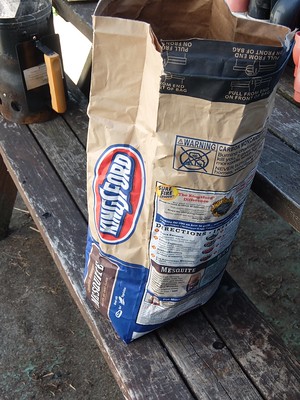
Adding a plume from mesquite chips will not significantly impact PPM (parts per million).  We're doing our best to make efficient use of fresh fish, with skills-building exercise.  Like in scouting.  The dad is supposed to know how to grill in this culture.  I'm ready to give it a try, today is T-day.  I'll be the dad in this scene.

Of course I made some mistakes:  not enough charcoal and the fish slabs should have been in foil, though this way I at least got those stripes, like in the pictures, with the foil to follow.  Deke showed up and we did the chimney part again, using that special cylindrical device to get things going.

This time I turned the cylinder over on top of the lower grill instead of letting everything just sit on the bottom of the grill.  Live and learn.

The salmon turned out great.  Mom got some too, along with coleslaw and potato salad from Freddies.

We did a taste test comparing Dr. Pepper made with sugar, versus diet.

Summer fun.

Wednesday, August 19, 2015

Wanderers 2015.8.19

Jeff on Guitar
:: jeff goddard, 2009 ::

Jeff Goddard found time to join us, and it turns out his career and mine have brought us closer together:  we're both into Clojure.  He's using the Reagent based approach to working with React, the Facebook-supported JavaScript library.  My needs are more primitive so far as I'm doing curriculum writing in early STEM, looking at the concept of Vectors.

The discussion wandered all over, as is our wont.  I wrote on the white board with a colored marker clearly labeled as "not suitable for white boards" and had to put some work into getting everything back to pristine, which I did.  Lesson learned I hope.

Those other pens are for butcher paper presentations, not white board presentations.  I had a new domain to share, sounding vaguely shadowy in a DC Comics kind of way (4Dsyndicate.net -- just a placeholder right now, complements Grunch.net and 4Dsolutions.net, used for curriculum writing and DHL shipments (just shipped an art book to Nepal)).

Having access to Safari Books On-line as a perk of my employment means I might find a lot more on React and Reagent if I go poking around.  I'll plan on doing that soon, also wearing my IT Committee hat with NPYM (NGO community service role).

My schedule opened up during Wanderers owing to a rescheduling by the party interested in visiting Costco with me, a sometime Wanderer herself.  We can do that another time.

We talked about Uber, with me reminiscing about our Clackamas County experiment, funded by cigarette tax money through TriMet, who's mandate was to get people from here to there regardless of by what means.

Transportation Reaching People (TRP) showed how a non-profit -- a GO in this case, not an NGO -- could participate in the same space as Uber, tapping mostly retired folks with their own cars and dispatching them to help various parties keep doctor appointments, go shopping etc.

I also mentioned Ron Braithwaite's presentation years ago, about "urberizing" eldercare with a system of passive sensors and human monitors, some of them clients of health care in other ways, perhaps wheelchair bound.

Doing this work in public-private space was Ron's vision for Canada at first, but whether that idea ever went anywhere I know not.  My impression is we're still in the dark ages, Canada too.

My rant this morning was humans were very much an unfinished work, and were aliens to visit they'd likely say:  "not fully matured yet, we'll check back in a couple millennia, good luck."

That attitude derives from my latent case of misanthropy I'm sure.  Likely there's a pill for that in some catalog or other.  Mostly I've got it under control and have a lot of empathy for people.

In fact later today I for some reason (no reason?) took time off from teaching Python to plunge into some Youtubes looking back on the Tsunami in Indonesia, Thailand and Sri Lanka.

I also studied the sinking and refloating of the Costa Concordia, before meeting Carol's flight from Boston (JetBlue).

Sunday, August 16, 2015

HSF 2015

Hawthorne Street Fair 2015

(def HSF-2015 "Hawthorne Street Fair") in Clojure.  Symbols may have that hyphen, whereas in many computer languages the parser would see that as a subtraction operator.

Anyway, you'll see I focus on merchants and merchandize a lot, which is what a Fair is all about in some respects.  And showing off interesting canines.  I really enjoyed the dogs this year, missed the art cars, not saying they weren't there.

I did two passes through the festival.

The first time, with camera, starting at Fred Meyer's and working west all the way to the Cuban restaurant and the pink Voodoo Donuts food cart in the middle of the street.  Then I cut over to a quiet back street and ambled home, to upload my catch.  Great fun.

The second time I left the camera at home and joined Deke the Geek at StarBucks, already in good company.  I then headed west as before, but zigzagging almost to Belmont, winding up at said Cuban place, by way of the Growler Store, permitted to have beer in its parking lot.

I listened to folk music over a pint of IPA (just one), then ate Cuban food (rejoined by Deke at that point) then headed to the gym for my workout.  Pork mojo, tostones (fried plantaines) on the side, with brown rice and black beans.  Excellent.  My first time there.  Used to be a Taco Del Mar, which I also liked.  Deke took some pictures too (to be included in the above album when I get them).

At the gym I switched from Elliptical A (the model I'm used to) to Elliptical B (why not?), forgetting I'd already dumped my Android in a cylinder attached to A.  I was almost home again before realizing my mistake and hopped in the Nissan to get back as quickly as I could.  Still there.  Lucky me.

I saw several of my friends, including a Quaker or more, milling about, from my various vantage points.  I texted two of them, but did not interrupt their sojourns.  I also met up with a Hanukkah party regular and we talked about an upcoming photography exhibit at Newspace.

I'd planned yet a third circuit, with camera again, before closing time at 7 PM, and a re-opening to motor vehicles.  That was not to be, as I got involved in cyber-projects and let the time fly by.

Saturday, August 15, 2015

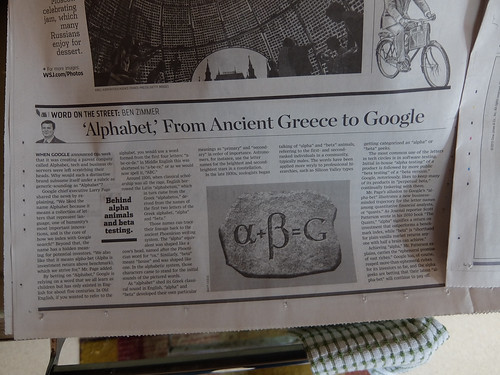
Alphabet Soup

Alphabet Soup

I read the Wall Street Journal (WSJ) this morning (page C4), seeing spin applied:  Alpha has market meaning, similar to the one in Geekdom.

An "alpha geek" -- not to be confused with anything only male -- tends to be Bullish in the sense of upbeat (Bears tend to be more bullying), and Bet is like betting i.e. taking risks.  "Bet on us to stay Alpha" is therefore the "secret" message.  Fine, that's clever.

I think another spin would be along the lines of how people admit to a veritable "alphabet soup" in some namespaces, meaning the number of abbreviations is going to seem daunting to an outsider, may seem out of control to even an insider. 

Quakers play that game, with their FWCC, FGC, FCNL, AFSC, NPYM and so on and on, a veritable "alphabet soup" of Friendly entities.  When introducing Quakerism to newcomers, that bewildering array of abbreviations is referred to as "alphabet soup" (no, not Quaker oats).

The US.gov plays similar games and actually Indra's Net is infinite for all intents and purposes, but thankfully not all at once.  One tunes in as necessary, to get the work done.

The inevitable cartoon, if Google itself kept buying and owning, would be to call it Gobble, which only dilutes its Search Engine sharpness with the image of some creature with a big appetite.

"Alphabet soup" in contrast, contains the possibility of staying undiluted and dense with nutritious sense (or at least islands thereof).

So making the parent sound soupy, while keeping the successful flagship meaning what it means, is all good planning, at least at first glance.  Seems apropos.

Back to Wall Street, investors like to know what they're buying and don't like it when hidden losses get covered by what's really the driving core.  Using profits to cover losses, all internally, makes it hard for investors to see what's happening (that's sometimes intentional).

The call for transparency is not just from voters but shareholders as well and new activists are demanding nominating powers over the board of directors (also in the WSJ today).

Corporate bylaws are not some ultimate shield against democratization and many of the more successful companies are that way because of their decentralized "everyone responsible" sense of self-governance.

That's another reason it's good to split up.  I think Deke was telling me that, my neighbor, one of the top Tweeters in Portland, in terms of followers.  True, our City of Roses is no nation's capital, but it does have that cosmopolitan gateway status accorded cities of world class.  So hats off to Deke.

An "alphabet soup" is otherwise known as a namespace.  Whereas Google (a childhood word for huge number) connotes a kind of brute force infinitude, a search engine plowing through giant mounds to get at what's critical, Alphabet connotes permutations starting with only a small set, like DNA.

Infinitude stems from a few core rules, an alphabet, creating the chaos, the welter, the many words, which Google then explores.  Such is the Alpha and Omega of at least one company's business model, no doubt more than one.

Speaking of Omega, the Unicode tables are sensitive to differences in meaning (but maybe not to a great enough degree in some cases?).  The Ohms Omega and the Greek letter Omega have two separate code points.

In principle, the distinction provides a freedom for these two to get further apart, even in appearance, although I'm not saying that's a prediction, simply what "different code points" allows.

That dive into Unicode may seem a non sequitur but think again:  when it comes to permutations and abbreviations, nothing's to stop us from intermixing more alphabets than just one.

Plus Unicode extends to cover beyond what most people call "alphabets" i.e. this is ideogram country, but mathematical symbols as well.

So lets expect our alphabet soups to get more interesting and experimental.  That doesn't mean they'll all be tasty or catch on.  Some people prefer specialty soups, which may be just as wholesome if not more so.

Speaking of Wall Street Journal, here's another example of it's applying spin this past April in: 
A Test Drive of the Death-Trap Car Designed by Buckminster Fuller by Dan Neil.

Here's some counter-spin from an Archdaily some years earlier:   Video: Norman Foster Recreates Buckminster Fuller's Dymaxion Car by Kelly Minner.

For more on the topic of Fuller's weird car and its misadventures, see Trevor Blake's recent narrative account.  Also see Poor Slob Bucky for more analysis of LAWCAP's anti-Fuller PR.  To say these squares feel threatened by an advancing Grunch is somewhat a truism in this namespace.

Thursday, August 13, 2015

Health Talk

body_house

I'll mix body and home, anatomy and domicile, in this one.  Indeed, for say... termites and ants, and also humans -- especially the city-dwellers -- distinguishing where "organism" leaves off and "not organism" begins is a tricky prospect, best avoided.

I like what Glenn reminded me to think:  habits and habitat go together.  They inform each other, two way street.  If possible, being humans, we'll typically attempt to transform an environment to match our habits as a first strategy.  If that doesn't work, there's always adapting, developing new habits.

But that's not always the first option you choose.  "If you can't beat 'em, join 'em" is a pattern you've sometimes followed with Nature, not just with your fellow humans.  In other words, you try to beat 'em first.  Maybe think about joining first?  You can always beat 'em later. :-D

On the home front, given the neighbors, here for thirty five years, have sold the place and moved away -- kindly gifting me with both BBQ and lawn mower (gas powered) -- I had a smallish timedelta (Python object) to tackle the east side of my garage, with ladder, gutter scoop, broom, hose, bucket, before the new neighbors moved in.

Wow, talk about ant farms!  That gutter, never cleaned in N years, was a super ant habitat and I came along and messed it all up for them.  I was covered with ants in no time, as was the ladder, which is where the hose came in handy, slung over the fence, so using only my water.

I also raked up afterward to make it all spic and span, buying a new Black & Decker rake at Fred Meyer's just this morning.

On the body front:  got a six month physical today, monitoring various parameters.  The Achilles tendon has become chronically tender (a previously blogged complaint).  Almost poetically, this condition has become the Achilles Heel of  my weight loss and maintenance program.  I'm up to 279 lbs, still holding the waistline at 40 inches.  I'm drawing the line.

I've discovered recently that using the Elliptical, at the gym, does not inflame the tendon further and that that has become my newest form of regular exercise.  I bench press about 70 lbs while I'm at it, as a way of cooling down (it's a smooth machine, no free weight aspect).

Aside from that and "swimmer's ear", other minor issues, I was good to go until next January.  I am not taking any medications beyond the usual non-prescription supplements.

In between home and body:  my Internet connection.  Once, when a truck yanked my DSL line from the house -- it was hung too low -- I felt I was witnessing an umbilical cord being severed.  Home or body?

I've been seeing the CenturyLink vans around the neighborhood leading me to think gigabyte optical fiber speeds are now attainable.  Deke thought they might be.  They are.  I've been waiting.

That's going to cost me a lot more in phone bills which means I need to cut the fat elsewhere, literally.

A good way to accomplish that is to take the Alaska Airlines Visa off line for awhile and go back to habits I picked up in Food Not Bombs days.

Expect FNB to feature more prominently, as I get back into that lifestyle, not necessarily a step down in any way.  More bicycle use predicted.  Blogs are good for declarations like that as one never knows when the Pope is reading it. :-D

I should mention the dog's health:  she lost most of her mobility but still has an appetite for life.  I'm keeping her company, the Chair of Computer Science (inherited from Steve Holden) being in the coolest room in the house, not counting the basement.

Knock on the door:  a realtor representing a possible buyer on the other side is scoping the sewer.  That's right, title is changing on both sides of me.  Hmmm, sewer talk:  that's for a future blog post as well. I did have my first colonoscopy last season.

Gravity's Effects

Monday, August 10, 2015

Concurrency Again

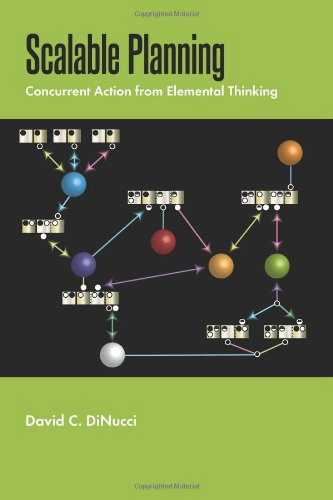
Scalable Planning
:: by Dr. David DiNucci ::

Hot languages such as Clojure and Python are building concurrency structures into their basic grammar.

Sure, you might want to talk to the operating system about threads, but maybe your language uses different concepts, such as "start this now and get back to me" or "do this later".

Let the translator talk to the OS, while you the coder stay blissfully in your native language sphere.

As I was planning with Glenn, we need to converge computer science with theater a lot more, if folks are to understand at a deeper level what operations research and general systems theory are all about.  Business executives need these concepts as much as coders, if wishing to avail of economies of scale.

It's not just that a website is like a backstage, with JavaScript puppets keeping a user amused, it's like when you direct films, or plays, with casts of thousands, the extras cannot all wait on each other for cues.

They have their instructions, some of which may involve waiting for other processes to finish.  Once you get the ball, run with it.  Many relay races, many Olympic events, are all going at the same time, perhaps with some kind of scheduler (the OS itself?) with a sense of priorities (changing?).

The mirror of a multi-process or multi-threaded back end is an event driven front end.

If a process dispatches a whole lot of worker bee processes to tackle some task, with a "report back when done" instruction, how will the program know when to check back?  Waiting for the teapot to boil is just another form of blocking.

How is work accomplished in the meantime?

That question is often more intuitively answerable when we use a control panel indicator, on some dashboard or in a cockpit, to show "percent complete" and leave it to the human controller, the driver, the pilot, to initiate some next action.

The human controller is likewise a multi-tasker, as is that human's own anatomical infrastructure.  The human body is about as parallel (concurrent) as it gets.

"This work is now done, so you have the option to do this other thing".  Just an option.

Just because a gun is loaded, doesn't mean you have to fire it.

Yes, military planners confront these same concepts.  A lot of these concepts were initially hammered out in some war-fighting context.

Dr. David DiNucci has done extensive research into concurrency as a topic and has come up with what amounts to a graphical language even choreographers or theater directors might use, to organized dances or plays with lots of non-blocking calls, lots of not waiting amidst waiting.

Many patterns pertain in concurrency diagrams.  A cast of threaded workers, awaiting tasks, is a well-known pattern.  Workers pick tasks off a queue and go off on their own, reporting back when complete.  These workers are also known as "listeners" or "subscribers" or "agents" in the design pattern literature.

From the description of Dr. DiNucci's Scalable Planning @ Amazon:
A new graphical representation called ScalPL (Scalable Planning Language) is then introduced for building even complex concurrent activities of all kinds from those elemental activities, one mind-sized bite at a time. For programmers, structured and object-oriented programming are extended into the concurrent realm, and performance techniques are explored. For the more serious student, axiomatic semantics and proof techniques are covered.
In today's world of Containers and Micro-services in the Cloud, the emphasis is on freeing up components to get work done regardless of the various critical paths through the network.

A given job may get hung up somewhere, waiting for Y to finish, but X and Z have already moved on, free to take on other work.  A well designed ecosystem does not freeze up or get paralyzed when a particular process seizes.  Just make a frozen process back burner and move on.

Sunday, August 09, 2015

Disarm Day 2015

Disarm Day 2015
:: Portland's Disarm Day Ceremonies ::

Disarm Day was fantastic this year.

I had a plan going in, which was to make forays into contemporary surrounding Portland, to celebrate its vibrant interpretation of the "city" concept, complete with Right to Dream Too, a north campus that's evolving quickly.

I was heartened to hear on the radio that some cities are close to "functional zero" where homeless vets are concerned, which doesn't mean vets won't fall out of housing and wind up on the streets from time to time.

New Orleans of all places was talking about this level of service.  This was on NPR.

The public NPR radio stations and the BBC have a close relationship, weaving in and out of some of the same stories, but hours apart on the same 91.5 frequency band in this neck of the woods (KOPB).

"Who'd be crazy enough to nuke a city?" is my implicit question, in compiling this Album.

Carol (mom) delivered a keynote.  She practice it in the living room and I gave her some feedback, but we both agreed she's the extemporaneous sort, a product of years of training to keep it spontaneous (Quakers are not supposed to rehearse their messages to the meeting).

Voodoo Donut got some air time in my shoot.  Mostly I focused on the entrance of Veterans for Peace, abetting by NPYM Quakers with their Peace Dove Puppets, across the Steel Bridge, with colorful large origami cranes hanging therefrom.

The drumming was spectacular and the turnout just as anticipated.  Thumbs up to Physicians for Social Responsibility (PSR) for a well-organized event.

Wednesday, August 05, 2015

Player Test


Not very player support the start and duration tags offered by the iframe format.  Here I'm testing those parameters by starting at start = 157 seconds (2 mins, 37 secs) and playing for 4.4 minutes (end = 419), a way of quoting or citing a part of a video.

My thanks to John Denker for calling these parameters to my attention.

Tuesday, August 04, 2015

Ecovillage Storyboard (continued)


Glenn and I have been brainstorming about the made-for-TV campus in rural Oregon, the EcoVillage, a long running theme in these blogs.

Picture lots of Climatrons, like in St. Louis, just to keep it Lost in Space futuristic, then add lots of retro touches, allusions to our own times.

I'm influenced by The Funny Company, an old TV series with lots of cutaways to black and white documentaries.  Animations were the hook, in an attempt to interest young kids in the documentary format.  I gradually became a fan of the genre and enjoy documentaries (including in color) to this day.

There's a kind of science fiction that's so present day, the viewer is left guessing if these are Hollywood movie props, the real deal, or what.

Some technologies we just know don't exist, but others do exist and we just don't know it yet.  That's partly what this campus is about:  showcasing some of the newer stuff, which is also product placement.  We might place product in lieu of advertising rather than in addition to it, but a combination of both is possible too.

My garage has long been the target of some vine-like parasite that, left unchecked, would likely pull down the whole structure.  In any case it was unsightly and finally I purchased a real ladder, one of those twenty position step and straight ladder Werners.

That got me up on the garage easy and with Glenn's help I was 70% done.  Just need to tackle those gutters again.  When the neighbors move out (leaving me mower and BBQ), I'll maybe have a window to tackle the east side.

Then we checked out a new recycling store where I bought some off beat T-shirts (long sleeve turtleneck like, not suitable for summer, but under a jacket maybe OK), and a couple kitchen things.  Large Mona Lisas adorned the wall.  I took some pictures.

The Ecovillage would be like a Breitenbush mix of long haulers hosting tourists, apprentices, friends in residence...  there'd be turnover at different rates.  What goes to Youtube or whatever is not necessarily something in real time.  Editing with segues to documentaries, animations, is more what I envision.

Then we had lunch in Hollywood (our Hollywood) and Columbia River Brewing, one of my favorites.  I promised the waitress, doing a schools supplies drive, that I'd bring around a whole lot of 3-ring binders (left over from Synchronfile's large archiving project).  I bought two bottles of War Elephant IPA.


DSCF9501

Friday, July 31, 2015

PWS: Personal Workspace


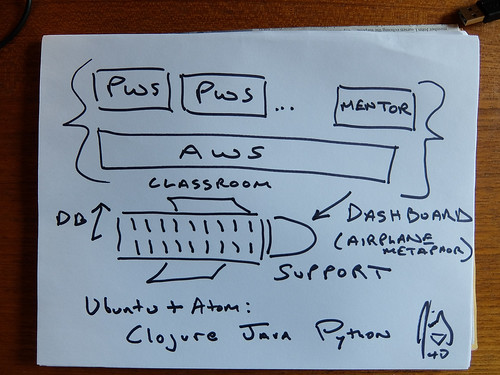
Setting up a PWS in the form of a remote desktop on AWS is not that crazy-making, per this Youtube demo.

Your school may want to provision these setups to students automatically, with lots of stuff pre-installed besides bare Ubuntu. I-Python Notebooks + VPython, for example, for 2D and 3D computer graphics, lots of user activity.

Core to any school is the workflow around sending work round trip to / from a mentor:  your school, like ours, may already have solutions for how to accomplish that.

Typically, a mentor would expect a task queue for notifications of submitted student work (in order received or in some other mentor-selected order).  The mentor opens a copy of a student project and runs it, then provides feedback.  Quizzes may be dealt with much the same way.

Our school uses iterative feedback and multiple attempts in lieu of grades. Why settle for a B- when, with more practice, your work could be perfect?

Some students take more time to get through the obstacle course than others.  With a self paced learning model, that's perfectly OK.

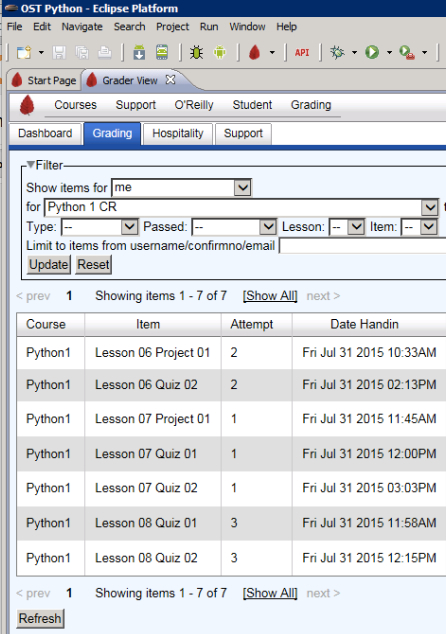
mentor_queue
:: mentor dashboard (ost) ::

Tasks per course are marked not started, complete or still in progress, with "percent complete" (tasks per course) part of the student dashboard as well.

Our school has not used AWS to host student remote desktops.  The cloud was not that sophisticated when our blueprints were drawn up in Traction Station, Champaign-Urbana many years ago.

We went with Windows servers back ended into a Linux file store and a bash shell accessible through Terminal in Eclipse (our choice of IDE), but the idea is similar.  Java, Python, C++, Android... all learned in the same development environment.

Choice of IDE is sometimes critical.  Emacs?  IntelliJ?  Atom?

A Clojure plug-in for Atom is under active development.  However feedback from the Clojure list suggests Eclipse or Emacs might be better.


The way one might work it is when a class fills (a certain minimum is required) then a begin date is set and the meter starts running.

Some students will finish quickly, however the course as a whole is of finite duration. Some students may not complete the course in time. That's their prerogative (a refund is not implied, YMMV).

The diagram below shows a seating diagram such as people see on Expedia when booking airplane tickets.

A class is metaphorically a flight of finite duration, with a cockpit dashboard for the mentor and other support staff, and a per student dashboard (GUI) as well.  Some models of airplane may offer more videos or whatever.  The metaphor extends.

DSCF9344

For further reading:
Asynchronous Learning Engine (ALE)
PWS on MathFuture list (April 2016)
More PWS on Mathfuture (after Portland Pycon 2016)

Tuesday, July 28, 2015

Wanderers 2015.7.28

Dr. Peter Bechtold is speaking to a packed Linus Pauling House (Gordon Hoffman is here) about his career and world view.  This is Part Two of Two whereas I missed Part One, two weeks ago.  I'm doing my best to put together a picture.  The topic is ostensibly "the Middle East" -- what "Orientalists" study.

Dr. Bechtold thinks the greatest threat to US security is not terrorism but the foolishness of voters.  They have a poor track record of electing fools, which begets silliness in government.  The quality of debate in Canada is simply much higher.  The clowns here would not have such currency in a smarter country.

Today's speech by Congressman Ed Royce (Senate Foreign Relations Committee) was typical of the laundry list of misinforming BS that everyone in Washington DC is supposed to recite, according to Bechtold.  I didn't have much quarrel with his reading.

So what the US has some of the top universities in the world; we're talking about averages.  Keith:  Americans get one PhD dumber every seven years, thanks to television.  Voter turnout is abysmal. Lots of veterans sucker for expensive on-line degree programs, running up student debt.  Oregon as a state has been plummeting in the caliber of its educational programming, per various measures.

"Why are we talking about education levels, isn't this about the Middle East?" asked Steve.

Bechtold:  the connection is ignorance and misinformation.

Carol (mom) is here.  She wanted to compare notes on ISIL, a Sunni group inheriting from old Ottoman networks, and not the only group into beheadings (with or without guillotines), whereas bombs, such as dropped on Laos, render bodies into parts more randomly.
 
Because the US is uber-dumb, politicians are able take advantage of that fact.  The thesis here reminds me a lot of the Power of Nightmares.  The fear-mongers are the cheapest sort of politician and get a free ride when the voters are idiots.

The bar is very low and the kind of people attracted to Washington are the same people we'd normally want to lock away in Asylums of various kinds.  Instead, we indulge them in their fantasies of "running the world" -- they're armed and dangerous, so that's about the best we could do I guess?

Hey, kudos to politicians for at least voting, right?  Assuming voting rights still pertain (prisons are a lot about stealing away that right).

Military bases are a jobs program.  Bechtold painted a rather sanitized picture of how bases contribute to the economy based on his experience at Fort Campbell. I'm not entirely a stranger to bases either.

So what about the Congo?  Do we care about oppression there?  Saddam was maybe only the 18th worst dictator at the time he was deemed intolerable.

Only misinformation could get "us" to attack Iraq (I was against doing that myself, so don't revert to "we" that easily).  The monkey-brains got their way because of GIGO (garbage in garbage out).

Misinformation results in misbegotten adventures that should have been aborted, nipped in the bud early.  Instead, these crazy fantasies get out of the bottle to become self-fulfilling prophecies.

For lack of sufficient containment of powerful nightmares, humanity has paid dearly, in lives, in treasure, in prestige and in friendships.  Why did all that stupid stuff happen (e.g. Bremer Edicts and so on)?  Because of public enemy number one:  willful stupidity.  I think we get the point.

But is that news?  Aren't we just talking about the human predicament?  We're in over our heads, collectively, and it shows.  Philosophers know this already.  Policy analysts are finally coming to the same conclusion?  Welcome to Spaceship Earth, right?

But there's more to think about here, mainly how Affluenza spoils one's capacity to think.  Given we're a species that values cogitation over conspicuous consumption (?), raising education levels while reducing the ugly blight of consumer waste may well go hand in hand.

Friday, July 24, 2015

On Super and Uber

Not that many of us got to listen to Dr. Walter Kaufmann talk about his workflows when translating Nietzsche.  Translating is not simply transcribing.  With Nietzsche's uber-mensch:  to what should he map that?  Many scholars went with super, creating "superman", in name collision with the comics and superhero complexes.  Kaufmann went with over, as in oversight, with "overseer" so similar to "supervisor" in English, with the former sounding more antiquarian, though we often speak of providing oversight (supervision).

Switching gears a little, we teach children about synonyms and homonyms.  Synonyms "mean" alike whereas homonyms "sound" alike and may (usually do) "mean" quite different things, as with "vain" and "vane" (and "vein").  However, more confusing if not sufficiently discussed, are different meanings of the very same word, often with bridging connotations.

Probably the biggest difference experience makes is it potentially deepens one's appreciation for context and the limited scope (or radius) of any specific meaning.   For example, the technical word "vector" tends to mean "some permutation of dialed in values" such as (apple, pear, pear), but then takes on more distinctly geometrical properties in some language games.  In Clojure, a LISP-like computer language targeting the JVM (Java Virtual Machine), Vector is one of the core data structures, along with Lists.


Change channels to Python and Vectors drop away as a core data structure with Python's Lists taking their place, then having tuples as an immutable type whereas in Clojure all collections are immutable.

Readers of Computer Science have more context i.e. more space, for words to wander, yet within constraints.  The meaning disease monitoring and control experts have for "vector" is another one yet.  An influenza might travel by bird, malaria by mosquito, such that infected or host species become "vectors" (enabling media) for some pathogen.

And yet all of these meanings of Vector convey the notion of momentum / inertia in some direction, against a backdrop, and therefore deltas (differences).  Even the lowly permutation, like a one armed bandit readout in a casino, may be seen to converge or diverge from specific (as in "winning") patterns, thereby defining a notion of movement through distance, perhaps purposeful movement, within some "vector field".

Ironically, I managed to miss the themed intra-OSCON party event, the night tutorials end.  This year that theme was superheros.

Tim O'Reilly talked about augmentation; Amber about the fears that come with new tech, concerns about differences and disparities.  If we're all privileged, that's different.  We're each super in different ways.  Lets not forget "extreme" as in "radical" which is rooted in "root".  We're each "root" in our own system, would by a geeky thing to say.

Uber has been considered a disruptive technology in the Greater Portland sphere, but then in geekdom, "disruptive", like "hacker" and "lazy" tend to have positive spin.  Geekdom, a subculture, has its own lingo -- so again, back to namespaces and their vectors (of propagation).

nginx

Wednesday, July 22, 2015

Snapshots from OSCON

DSCF9211


Our opening session, with tone-setting keynotes, began with a representative of the UK government explaining her enterprise's commitment to serving the UK.  Digital Services is leveraging open source by insisting on open standards.  These two drive each other.  How to best share street address information, geographic location and so on?

Now I'm in a talk on what every programmer should know about floating-point arithmetic, by Java Floating-Point Czar Emeritus, Joseph D. Darcy, currently with Oracle.  From here, I'll be heading to the HP sponsored lunch.

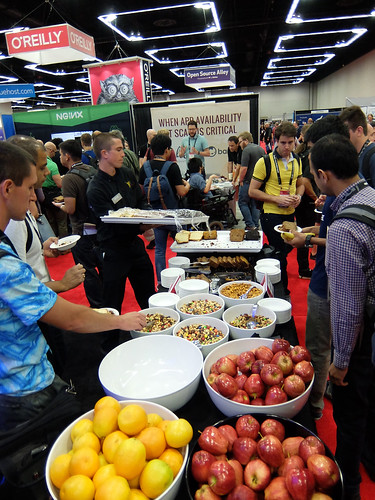
Before this talk, I enjoyed a first visit to the Expo Hall, heading straight for the O'Reilly booth on Debra's instructions to make sure our school's new catalog / brochure was displayed.  Yes it was, with Natalia on the cover.  Bravo.

The HP booth speaker wanted us to all know about HP's huge commitment to "keeping it open" (we got a free mug for listening).  The Facebook keynote was along the same lines, as was Allison Randal's talk:  it's not just out of altruism or some bleary-eyed thinking that companies embrace open source; they do so out of economic necessity.

Allison would like to see reluctant joiners becoming more effective users.  Holding on for dear life is less enjoyable and rewarding than contributing as a full participant.  Facebook:  the discipline required to make projects suitable for public consumption is likewise what makes them robust enough for in-house re-use.

At one point in the early days it looked like F/OSS might always be the hobbyist version playing catch up to the grown up stuff.  Whereas many proprietary solutions are best of breed, in some domains the free tools are also the only tools or simply the best tools available.

The Linux Foundation guy was super excited about containers, the next big thing in data center development.  Again, open standards is the name of the game, as the skeleton key unlocking our perennial dreams of total interoperability.

They call floating point numbers an "approximation" of the reals (ℝ), but since when did anyone multiply π times itself in pure real numbers?  The reals have always seemed pretty unreal to me.  To what precision do the real number people multiply π?  Real reals have no upper limit on precision right?

N ⊆ Z ⊆ Q.  That's a field.  Then came the leap to Algebraic Numbers as a subset of .  "They threw the guy over the boat who discovered Q was insufficient" (paraphrase).

The Lindesmann-Weierstrass theorem 1882 proved π was transcendental, not algebraic, so Real Numbers include both.  Another field.  ⊆  C ⊆ Quaternions (⊆ Octonians).  Surreal Numbers, invented by Conway ("the other Conway" some say, given OSCON began as the Perl Conference and ours is first-named Damian).  Donald Knuth wrote a novel entitled Surreal Numbers.

Floating point numbers need to be deterministic, reproducible etc., i.e. the rules need to be clear.  The significand is multiplied by 2 to some exponent.  All floating-point numbers are rational. CPU specifications often defer to IEEE 754.

Most of the talk was on the non-field properties of floating point numbers.  They're not associative for example.  Like in the 3-bit signficand "toy floating point" system introduced in the slides:  2.0 + (0.1 + 0.1) != (2.0 + 0.1) + 0.1.  Best to not use floats for money given a true Decimal type is more likely to obey established rules for rounding, that predate electronic computing.  Java and Python both offer extended precision Decimals, as do many other computer languages.

After lunch:  the future of mobile payments, by Jonathan LeBlanc from PayPal.  The payment industry is shifting to serving the mobile environment in a big way.  Location and habit awareness, browser uniqueness, device fingerprinting, all help with user authentication.  When a user deviates from patterns and falls outside the trust zone as a result, additional challenges may be provided to provide additional checks.

The key term this year seems to be "at scale" which means "not diminished" as in "using the full data set".  For example, graph analysis "at scale" implies doing something computationally intensive. Kenny Bastani showed us how to use Docker to get Neo4j talking to Apache Spark to run PageRank and Centrality algorithms against toy amounts of graph data -- but he assured us the same techniques would work against all of Wikipedia (i.e. "at scale").

Item lost:  Neoprene case for the Mac Air.  Lets hope that's the extent of my losing stuff this year.  I dashed downtown to grab a replacement at the Apple Store then grabbed a couple pints at Yardhouse, adjacent, before reboarding Max to return to the Expo Hall.  I ended up talking to a satellite guy with UCAR in the process of developing his Python chops, coming from Perl.

Steve, Cynthia, Patrick and I took the Max back to my car and ended up on my back deck, talking over events of the day.  Patrick gives a talk tomorrow.

DSCF9264