Saturday, November 26, 2005

Half Coupler


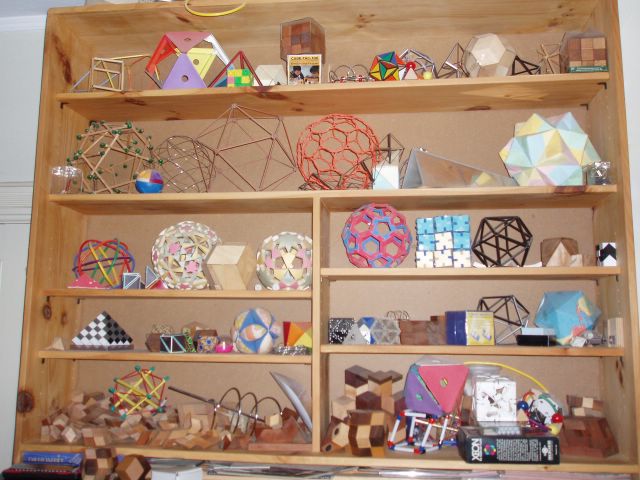
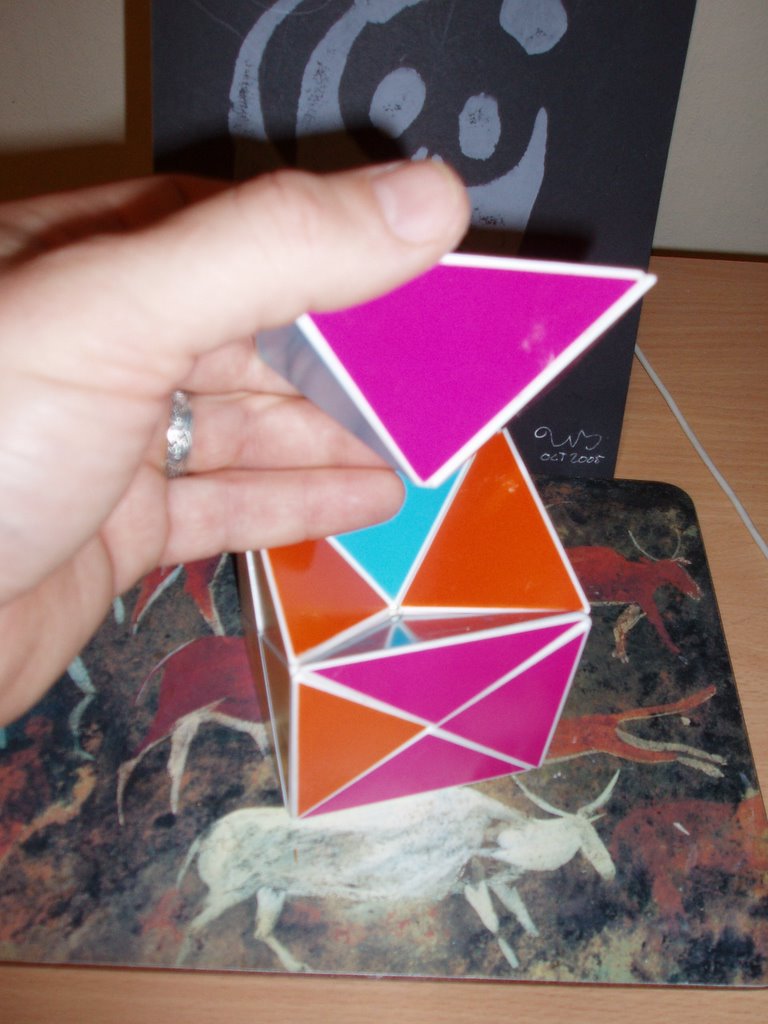
The dissection of the cube into 6 half-couplers is easy to show with Cube-It! from the Huntar Company. I purchased my copy years ago at Math 'n Stuff in Seattle. The half-couplers further disintegrate into 4 MITEs (MInimum TEtrahedra) in Fuller's concentric hierarchy.

Most middle schoolers received no instruction in these concepts for over 30 years after their publication, despite their obvious relevance and simplicity.

For further reading: [1][2][3][4]

Sunday, November 20, 2005

Chicken Little (movie review)

This one makes me think, maybe because I'm in it (Kirby that is, three eyes) -- but then so is Mickey (on a watch), so at least I'm in good company.

We had lots of little kids in my audience (Lloyd Cinemas annex), and some were clearly troubled by an over the top War of the Worlds scene. Like the kiddie roller coaster at Oak's Park, before you ride the big one with Tom Cruise. Why do we scare kids silly with that ET stuff again?

My take on ETs: shooting for here in a spaceship would be a huge gamble, given relativity, since even if the subjective lag is reasonable (time for a couple of inflight movies, some drinks), by the time you get here the Earth has aged like a million years, and has probably had time to discover new defenses you didn't see on I Love Lucy.

You can't bank on overcoming an alien auto immune system. The odds are strongly against any would-be attacker. Be thankful for the vast wastelands of insular space.

For life forms to be successful over the long haul, they have to have really gotten to know a place. We've evolved as many eyes as we need, thank you very much.

Anyway, as you can see, it got me thinking. The characters were funny. The small town had a very peculiar homeland security system. As we all know, chickens make mistakes rather often. Putting the whole place on a trip wire, while giving chickens easy access to the panic button (or bell), would seem a poor design. I wouldn't blame the little kids for that.

Hey I'm really liking the new Google portal. I use Yahoo's too of course.

Saturday, November 19, 2005

Science Project

So Tara's school science project this weekend, an experiment of her own design (with input from family members), is to pop 50 kernels of Orville Redenbacher's Gourmet Popping Corn one-by-one in the microwave, record the 50 popping times, and bar graph the results. For example, X kernels will pop between 2' 30" and 2' 35".

What we've found so far is that the individual kernels in this batch aren't inclined to pop. After several four minute trials, with single kernels center stage, the Magic Chef decided it'd had enough, and gave up the ghost -- temporarily or permanently we're not sure. Obviously I'm not anxious to run out and buy a replacement appliance, only to blow it again. New strategy needed.

Current experiment: bring oil to high temperature in a saucepan on the electric stove. Add a single kernel, start stop watch. Wait for results. Results so far: I hear the smoke alarm in the living room. Gotta go.

Follow-up:

The Magic Chef came back to life, but we stayed with the shallow stovetop bath of Canola Harvest, with a transparent Pyrex cover. Kernels were added to the simmering oil one by one and their TTPs (times to pop) recorded. A few never popped.

Addendum:

We celebrated the success of our experiment by seeing Chicken Little at the mall (stop signs are not hexagonal by the way). Then Derek came by and we watched some of the 109th Civil War (UofO Ducks vs. OSU Beavers -- USA-style football). Oh, and Don says with emphasis that it's Mt. Hood Community College (never "Mount").

Tara offered to make spaghetti but turned on the wrong burner. Heat accumulated in the aforementioned Pyrex (Kim's) and exploded, covering the stove and floor with glass. Our kitchen linoleum acquired permanent sear marks from the super hot shards. Fortunately no one was standing nearby. The Ducks won. I finished making the spaghetti and put duct tape over the blemish.

We're rough and tumble in this family. Buddhism in a nutshell: Suffering R Us (now you figure out how to turn that R around and invite a lawsuit). Tara is following her plan for the evening, happy I'm not too burned up over the Pyrex misadventure. I wonder how Alexia is doing, and Julie. Sam. Carla.

So here I am, typing in my blog, and feeling pretty zen about the whole day -- maybe because I went to sleep listening to Alan Watts on CDs (a present from Jim Buxton around the time of George Hammond's memorial, McMenamins after). I read lots of Alan's files (published books mostly) in my high school years.

Now, back to USC vs. Fresno.

Friday, November 18, 2005

More from the Urner Soap

We had breakfast out before school, then I was summoned to the hospital for a sudden meeting, which turned into a kind of promotion, which likely means more time on the VPN (encrypted because of HIPAA). I explained about my dreams of a bizmo. Apparently I wouldn't be the first to get work done in this way (I suspected as much). Some bizmos contain roving doctors using a lot of skills I don't have, yet sometimes need or could use.

Then I came back to the 'hood for coffee with Derek. We were about to cross Hawthorne under the marquee of the Bagdad, when we were accosted by a charity organization trying to help children in developing countries, the kind of thing Jack Nicholson got involved with when he played that guy in an RV.

I challenged the charity rep to think more in terms of village wireless, so power nesters, protective of their adopted families overseas, could see for themselves how the donations were invested, thanks to web cams, Google Talk or whatever. A prodigy 'deshi kid might chat with salon guests in Chicago on 2-way big plasma, about the meaning of pi, or the prospects for unicode in South Asia.

The charity guy shot back, asking if I'd ever been outside the country and did I have any idea of the realities his charity had to face every day in the field. I put some credentials on the table, but concealed the fact I'd as yet never been to South or Central America.

"Don't you think they should learn to read and write before we give them computers?" he asked. "Learn it all at the same time" I replied.

I talked about that computer scientist in India, who embedded a computer in some wall, no explanations (see Frontline). Street kids played with it and gradually taught themselves tricks (including a few the scientist hadn't learned). Imagine how far they'd go with a little more instruction. Some kids take to high tech like fish to water. The circumstances you're born into shouldn't matter that much.

I didn't give him any money, although I probably should have (more leverage for me). Instead I offered to share a competing vision through an independent operation, to demonstrate the effectiveness of "high tech first" (right up there with safe drinking water in importance).

"High tech" is not synonymous with "inappropriate tech". Villages need access to weather reports (visual data displays) and ecommerce. Guatemalans good at handicrafts could sell them directly on eBay -- or through a mall-based intermediary (movie allusion).

The vision: help these villages turn themselves into cybervillages if that's what they'd like, with village elders (but not just elders) empowered to steer, accelerate, apply brakes. Nextgen youth, born into the new environments, will then lead off in various directions. The village as a whole could use democracy and/or a sense of the meeting (Quaker talk) to find a good way forward. Absentee landlords needn't have overbearing influence.

"So, what will you call your new organization?" the clip board guy asked. What indeed.

Shall we call it CyberCare?

Whatever it's called, we'll work closely with other NGOs, UNICEF, UNESCO and like that, but we'll specialize in wireless access, distance education, high tech solutions (shelters included). We'll give our donors a lot of customized insight into what their donations are doing. We'll also give them opportunities to visit, to join us on Reality TV.

Tuesday, November 15, 2005

As The World Turns

I kept stumbling into soaps on TV just now, while struggling to get S-Video plus audio from my Sony Hi-8/DV cam to my Sony TV (even my new 20" Dell monitor is a Trinitron) -- I'm trying to audit the newly minted Doug Strain DVD (test only), to see if the various glitches we're seeing were because of the tape or the player. I'm pleased to report that the physical recording is on the whole fairly good, and Doug's quality narrative excellent.

Thinking back to those soaps: these people can certainly act, but what're their computer skills like? Willow certainly had the right stuff in Buffy, right up there with Chloe of Smallville fame -- both demonstrated a well-developed ability to investigate, to dig. Judging from the level of savvy I encountered at HPD, I bet even a kindergarten cop would know a thing or two about searching arcane computer data bases.

I had the Earth turning for the 8th graders today, in three different applications: Google Earth, Celestia, and Stellarium. I call this curriculum segment "Hello World".

So we're cycling around to Thanksgiving again. Last year at this time, I was exploring various Native American threads. There're hints of that again this year, as in this recent thread at the Math Forum. Exercise: think more about pronouns, as in "what we whiteman?" or "my Marines!" (per Applewhite's index see: Complex it, Ego, I, Me, Self, They, You & I).

Tonight's another Wanderers' gathering -- I'm typing from the Pauling House right now. I'll likely stop chronicling these gatherings, or do so more sporadically. Our focus is shifting to synchronous/asynchronous video connections, plus maybe more realtime chat and IM channels. Check the website for developments. I relay fond greetings to my bizmos in the desert.

Monday, November 14, 2005

Acting Locally (continued)

I got Mom's shipment out the door (nine boxes), with tracking URLs emailed from the UPS Store (a handy service). Then, after coffee with Derek at Powell's on Hawthorne, I walked the Doug Strain tapes over to Bullseyedisc. I look foward to delivering him his copy.

Then Sunanda and I joined Don on Meliptus where some interesting phone calls came in (hey Russ, I'm glad you'll be making the upcoming SNEC confab in NYC, sounds like great fun).

This evening I took the Max over to the Dixon Building to see if the Koreducators charter school proposal would be approved. It was voted down 3 to 3, after a couple firebrands took the floor and raised a lot of straw man issues (including ad hominem remarks lambasting a plan to locate the new public school inside Marshall itself -- not really the plan at all (hence a straw man argument)).

Board member David Wynde did nothing to shush the cheering and applause in the wake of these unseemly polemics, but when I booed loudly, suddenly we weren't to indulge in "public spectacle" and he threatened ejection (so would the applauders be ejected too? -- I think not (get the tape, see what you think)).

All in all, it was disappointing to watch so much hard work derailed by fearfully protective impulses emanating from within our older model schools.

Whereas the board has a mandate to give grassroots organizers exactly this kind of opportunity to experiment with new approaches, career educators think it's somehow their special right to monopolize reform from within. Obviously our charter school initiative is being subverted and undermined by the selfishly entrenched.

So maybe it's time to explore other options?

Saturday, November 12, 2005

Jarhead (movie review)

There's a long and twisted history behind Marines being the way they are, and this film chronicles some additional twists that will feed into the lore going forward.

Instead of studying existentialism in college under the tutelage of hot professors (yes, Camus is a fine place to start), Swofford elects to take it straight from the horse's mouth. He works all the way up to nausea (ala Sartre) and really deserves some kind of degree in the end (he's a good writer). These guys should be making films, not just watching them.

The sense of wasted talent, watching one's youth go by in a desert (a teenage wasteland on steroids), understandably makes 'em psycho. The dead end job once they get home doesn't really make up for the sense of loss (dread, despair etc.).

The price of oil is really very high. We don't just pay at the pump.

Related post: A Catholic Economy (Nov 10, 2004)

Thursday, November 10, 2005

Google Gets Video

So I've been uploading since like 4 AM, even while sleeping, this 712MB vidclip of me presenting to Wanderers @ Linus Pauling House some years back, on the subject of Geodesic Domes.

At this point in history, open source video is still somewhat new. However, my general systems theory papers suggest this model: humans in scenario Universe = PWSs = personal workspaces = edit/recombine studios.

Of course "recombine" evokes "recombinant DNA" and all the nightmare possibilities early 21st century humans needed to grapple with (right up there with extraterrestrials and dolphin intel).

But it also has more benign meanings, e.g. individual humans becoming very adept at mixing multimedia, expressing themselves and their worlds, making use of studio quality equipment 24/7 (with breaks), and in the freedom of their own homes.

This is in addition to performing in popular day jobs: baggage handler at megajet and microjet airports (including UPS, DHL and FedEx), outdoor security and park ranger (including at zoos), web wrangler (e.g. like for Wanderers), computer technology trainer, health care pro, architect & construction engineer, heavy equipment operator (some airline pilots), and those doing Hilton-Sheraton-Marriott type services (includes a multi-ethnicity cast of career diplomats and spies).

All these lines of work harness many energy slaves, in the sense of robotic time on the CPUs and SQL engines -- a true mass labor force even in 2005 -- with software and circuits etched in silicon (the possibility of machine intel another one of those "must grapple withs" -- and well played by the then Governor of California).

Followup: I'll link to said vidclip lecture here when the uploading process is complete.

Followup: Google kicked us all off Google Video in 2011, so I moved the clip to Youtube (which is also Google's).

Tuesday, November 08, 2005

Math Forum

I posted more futuristic mathematics today, invoking a lot of VBNs in the math teacher community (Gibbs, Heaviside, Hamilton). The general topic is Math/CS, this hybridized numeracy curriculum my colleagues and I think makes a lot of sense in this age of Google Earth and XML. We want formal operations applied in business and commerce, like before, but with more attention to the global Internet, how it works, who administers it.

Washed Razz (the Subaru) in a local U-Wash (insert coins, operate a cycle waving giant wands, Harry Potter style, with stuff spurting out all over your car, sometimes under high pressure -- worth a couple bucks, plus you get this shiny waxy vehicle to drive off in (a happier camper for sure)). Swapped a couple items at Trader Joe's. Having better luck with DVD-Rs for some reason, the DVD+Rs keep wiping out. Burned a complete set of Don's Guatemala pix to a JVC yesterday afternoon. Loved the final Extras with Patrick Stewart on HBO!

More open source curriculum writing from 4D Solutions: [1][2]

Thursday, November 03, 2005

Acting Locally

Some days ago I used the wget tool at my Cygwin command line, a *nix in a *doze, on Joe Moore's site. He's spent half a lifetime compiling bibliography & connecting ideas around Bucky (Bucky being a veritable switchboard of the 20th century), all in rough and ready wild west HTML (no rules, or almost none -- however consistently tabular, a big help).

So this morning I subclassed HTMLParser in Python and wrote a quick hack, aiming at filtering HTML noise and republishing in a strict XML. From there, it'd be easier to head for mature formatting, via XSLT. We wouldn't lose touch with Joe's primary audience, either: souls on the web (so-called "eyeballs" in market research parlance). My Python code globbed through "books By"*.htm and spit back some reasonable XML for a minority of pages (those in a strict 3-column id, chapter title, page number format). I pasted one success story to GEODESIC c/o SUNY at Buffalo. Here, lemme link to my code.

That was this morning.

This afternoon, I left Dawn with some veteran/alumni of some enlightenment training (Portland has a lot of good schools), while I picked up Tara, who needs something faxed to her teacher (due homework, completed per spec, but left in the printer this morning), and then drove out to Marine Drive to welcome Don back from Guatemala. He spoke with great awe and respect of the Guatemalen experience/people (pueblo). I'll be rejoining him later for the kickoff of the 2005-2006 ISEPP lecture series, our latest in a series of presentations delivered by some Very Big Names (VBNs) -- sometimes with repeat visits (e.g. Roger Penrose is returning in March).

Portland has felt very privileged to be on the receiving end of Terry's circus. I've enjoyed so many of these lectures so very very much. You VBN people are simply amazing and wonderful creatures. Love!

But some of that hasn't finished happening yet. Gotta get back to work.

PS: Lotsa VBN-hoods out there, and you're welcome to be a Big Name in several of them. The Universe is not stingy about letting us be celebrities in cool circles we respect, if that's our goal (which doesn't mean individual humans can't be miserly). Join the club, beat your drum (metaphor), and sometimes hold it down (Quaker voice: ssshhh, keep it quiet), and you'll dimly hear many more drum beats, from far far away (something drums are good for).

Followup (Nov 4): my write-up of last night's lecture (link).

Tuesday, November 01, 2005

Wanderers Meeting 2005.11.1

The Gaia Hypothesis holds that complex chemistries known as "the living" may play a homeostatic role on a planetary scale, maintaining atmospheric conditions far from an "equilibrium of the dead." Our oxygen-rich Earthian cocktail could never have arisen, nor would be sustained, minus cell-based metabolism.

We humans play a role in the local cybernetics and have evolved new powers to anticipate and counter death threats the dinos never had (e.g. Apophis).

Gus Frederick of Silverton, Oregon shared his hopeful hypothesis that our self-destructive tendencies were symptomatic of species adolescence, a passing phase we'd survive and outgrow. Our long term destiny, thinks Gus, is to spread life extraterrestrially, starting with our moon and Mars.

Only time will tell.

Followup: link to Gus's slides

Saturday, October 29, 2005

Capote (movie review)

Truman helps prolong the lives of two murderers, giving them false hope of reprieve within a barren prison existence, in order to better understand their crime, and turn his understanding into a non-fiction novel.

He makes good on his promise to portray Perry as more human than monster. The other killer gets far less empathetic treatment. The victims of the crime appear only in horrific flashbacks and crime scene photographs.

Truman is aware of the exploitative aspect of his work. First he needs to keep the prisoners alive, so he can get their story, then he needs them dead, so he can conclude and sell it (his friend Nell sees this dynamic even more clearly). He also sees a lot of himself reflected in Perry. His empathy is real, if tainted. And besides, it's not just Truman who stands to gain by exploiting suffering and violence, but his community of literati, generations of English professors, the makers of this film.

Coincidentally, just a few hours before seeing this film with Dave, I read Lawrence Weshler's essay Valkyries Over Iraq (Harper's, Nov 2005), which looks at how violence and art sometimes feed off one another within the war movie genre. Obviously art is part of life, not outside it, just as language is within the world -- it's not really a matter of one imitating the other. As a Buddhist might put it: parts reflect other parts but the whole is unreflected, because it has no mirror.

Sunday, October 23, 2005

Legal Affairs

Some news and views regarding legal matters:
  1. President G.W. Bush's defense of Harriet Miers reminds me of my own defense of Ada Byron: "It's a casting decision, and in my judgement this Ada Byron character has done a creditable job, and should keep developing in this role. It's her niche and she's earned it. Others may (and do) disagree, but I'm unmoved to alter my aesthetic judgement at this time."

  2. The big crime tangential to special prosecutor Fitzgerald's investigation would be the forging of documents aimed at implicating Niger, a sovereign nation, in secretly circumventing the IAEA by supplying a nuclear weapons program with uranium. Ambassador Wilson's trip to Niger was a part of that larger CIA and FBI investigation. I hope the dangerous criminals behind this ruse eventually get caught, so we can all feel safer.

  3. This morning, I wrote an essay discussing my views regarding the practice of law, which is partly what got me onto this topic. Software engineering is inevitably replacing a lot of legal boilerplate with self-executing code -- the only way to keep up with the increasing volume and speed of global commerce. Philosophy helps communicate our ethics and aesthetics to these engineers, as their soulless machines are intrinsically ignorant of our human values (note: PI = Philosophical Investigations, a book by Ludwig Wittgenstein).
Addendum: link to news item re #2, by Martin Walker, UPI Editor.

Wednesday, October 19, 2005

Wanderers 2005.10.18

Rick Grote took us through an overview of classical thermodynamics and statistical mechanics, in preparation for his review of Into the Cool, a new book by Eric D. Schneider and Dorion Sagan (and which mentions some Wanderers in the acknowledgments).

A core thesis of the book is that life capitalizes on thermal gradients, gets work out of them, is itself work (or organized play, as the case may be). Of course the 2nd law prevents 100% efficiency i.e. there's always leakage in the form of heat such that no standalone machine ever wins immortality for itself.

Another thesis: just noting our Earth is an open system, and therefore not currently bogging down under the 2nd law, doesn't "explain" life's amazingly inventive gradient- exploiting ways, any more than the brute fact of ocean waves "explains" the phenomenon of surf boarding in California.

Grote, a chemist and engineer, found Into The Cool persuasively written and full of interesting info, such as the graph relating successive generations of ground cover to thermal efficiency: small, short-lived, energy-inefficient ecosystems give way to slower, bigger, more thermally efficient ones (e.g Oregon's old growth forests).

He also found insightful the focus on metabolism (eating) over sexual activity, as a signature of primitive life. However when it comes to sheer complexity and pattern formation out of chaotic conditions, non-life is pretty good at that too (the book is pregnant with examples). Life seems destined to explore at the edge of chaos, is always taking risks, flirting with disaster, in terms of becoming overly-complex and experiencing a break down.

On the down side, Rick doesn't much like the aphorism "nature abhors a gradient" as she seems to create and depend on them just as surely as she erodes them away. He also didn't find the tie-ins to preferred social policies scientifically persuasive, even though he shares many of the same policy goals.

Temperature differentials are what separate living ecosystems from an entropic desert, and life seems intent on keeping it that way (an uphill battle), by creating new gradients, new possibilities for interesting work, even as she/we/it burns through existing ones. Even if we're all headed for an ultimately entropic state, as many writers suppose, life has a way of drawing things out, postponing the inevitable for as long as physically possible.

Addendum:

After the end of Rick's talk (2 Hi-8 tapes, recorded using my Sony TRV240), I projected Gerald de Jong's Fluidiom project (Java app). Apparently the digital life people come in for some withering criticism in Into the Cool (which I haven't myself read yet), especially in connection with Stephen Wolfram style cellular automaton studies. Gerald's approach is more like Roger Gilbertson's (muscle-wire robotics), and uses tensegrity-inspired elastic interval geometry (Kenneth Snelson, R.B. Fuller, Cary Kittner, Sam Lanahan, Karl Erickson, Russ Chu, John Braley et al).

Thursday, October 13, 2005

A Candle for Dad

Today we remember the October 13, 2000 car accident, and the wonderful life of Jack Urner. My uncle Lightfoot came by for some coffee. We talked about his adventures in publishing, now that his new book is available. Dad and Bill both worked in Alaska for a spell, had similar adventures. Dad's side of the family really digs Alaska.

Carol, my mom, born in Chico, California, grew up in the midwest and Seattle, her dad a union linotype operator for newspapers. She met my dad at the University of Washington. Dad's lineage traces to Swedish settlers on Mercer Island on his mom's side, and to Urners emigrating to North America in the 1700s on his dad's side. He studied urban/regional planning with Dr. Richard Meier at the University of Chicago, after a stint at Johns Hopkins in international affairs. He then moved his family to Portland, where he joined the Planning Bureau.

Dad's dream all along was to see the world and do planning abroad (a civilian lifestyle -- he'd become a convinced Quaker by this time) and his first overseas client was Libya. He always worked closely with counterparts in the client country, which were then the Philippines, Egypt, Bangladesh, Bhutan and Lesotho.

The car crash happened between Maseru, Lesotho and Bloemfontaine, South Africa, on a dangerous section of road. I flew out to tend to mom in the hospital, arrange the memorial service, settle accounts, and sell or ship our family possessions. My sister Julie spelled me after about a month, and got mom back to the States once she could be moved.

The US Embassy in Maseru, and the one in Johannesburg, were helpful in our time of grief, as were many engineer and diplomat families of many nationalities, the funeral director in Bloem, the police, many Southern African Friends, the Bleekes of Multnomah Meeting. My profound thanks also to the professional staff at the hospital, including the rescue team, who saved mom's life. Thank you to my parents' friends in Lesotho for making their years there so enjoyable, and to Emily for all her good work.

I am also lighting a candle for the driver of the other vehicle, who also died as a result of the crash.

Wednesday, October 12, 2005

Saturday Academy

Terry is chattering about "E equals emcee-squared" (apparently the topic of last night's Nova on OPB). In synergetics, we don't think "squared" so automatically -- "triangled" could be cooler i.e. the important thing is just to imagine some/any surface area (a topology). "Cubed" is volume, and closely associates with "tetrahedron" in synergetics (i.e. the minimal sharp-edged volume). Volume is related to energy, frequency, information and experience (see Synergetics Dictionary).

A few minutes ago, we were exploring Caitlin's (Terry's daughter's) blog. She's enroute around the world.

Joyce Cresswell (SA CEO) kindly appeared to deliver her presentation. Also present: Allen Taylor, Terry Bristol (ISEPP CEO), Jon Bunce, Jim Buxton, Rick Grote and myself. Don (Wanderers CEO) is enroute to Guatemala today, hurricane Stan (now past) notwithstanding. The earthquake in Pakistan was a focus of CBS News last night.

SA was founded around 1982 by 2 PPS TAG teachers. Computers were invading the business world but not yet the home. HP, Tektronix, bright kids = dynamite combo. The companies said yes, let's do it @ Oregon Graduate Institute (OGI). Taught 185 kids the first year, enrollment now up to around 4K+, including Corvallis.

Transitioning to a knowledge-based economy (KBE), is what SA is all about, because that's where creativity is heading in this state: design, invention, not so much manufacturing (although we do some of that). Average income for Oregonians is pretty low by USA standards (75% < $40K). KBEs center around engineers. Degree stats: US 5%, Oregon 9% and China 46% graduate in engineering (source credited on slide: Institute for Engineering Education). Employers have little choice but to import leadership talent. Problem-solving, critical thinking, work ethic -- all in short supply, on top of missing engineering savvy. Allen, citing a recent meeting of IEEE, chatted about the lack of training in cross- disciplinary teamwork.

SA offers courses in: robotics, programming, forensics, web design, genetics etc. It offers apprenticeships in industry, research labs, agencies. Community-based professionals comprise the faculty (I, Kirby, am one of them -- e.g. Joyce placed me with the Hillsboro Police Department that time, teaching open source). A benefit to engineers: SA provides participating firms with a sneak peak at native talent, relationships form, which may lead to later recruitment.

Bottom line: Oregon is moving to address its obvious weaknesses. The elements of a new pipeline are in place, but it's still relatively low volume. The older pipeline, which loses most would-be scientists and engineers through the cracks, still handles most of the load. Too much native talent is needlessly squandered.

SA is working to double enrollment, triple scholarships, and consistently reflect the locally complex demographics (in both students and faculty). Oregonians of whatever hue tend to be multi-ethnic, yet have a common interest in continuing to build a dynamic, world class, Pacific Rim KBE.

We finished with lengthy discussions and Q&A. Wanderers and Saturday Academy have a lot to talk about. Terry sampled a lot of his pro-design, pro-engineering soap box rhetoric. I mentioned Trevor Blake as a possible future Wanderer/presenter regarding such topics as the Technocracy movement and systematic ideology.

Saturday, October 08, 2005

Flightplan (movie review)

Took some fancy footwork (Trimet assissting) but I got there in time, with a preview to spare. This was at the end of the hall in the multiplex out in the infamous parking lot (across from the LC mall), where those crooks stole my Dawn's Suburu during Troy that one time.

She's in top form, dear Jodie as Kyle, sprinting the length of a very long jet, a few times, adrenalin pumping, every emotion in gear, single minded, to find and rescue her missing child.

Hints of Red Eye, sure, but also, for me, a strong hit of Sigourney Weaver as Ellen Ripley, what with her nakedly aggressive bias (pro-human), which audiences know and recognize. We love our children. We fight for them.

The difference being: in this film, the heroine is not up against space aliens, but immigration aliens, i.e. us, the human types. And we're scary enough. We're all those other people on that plane, with our own private losses and dramas. We secretly admire Jodie's character, because she's strong, willful, even right, i.e. a goddess protectress, an incredible.

My insider take is that the movie blatantly lied about aircraft architecture outside the double- deck cabin, territory Jodie's character supposedly knows well. Like that Cray- like supercomputer beneath the cockpit? A pure archetype. Or hey, maybe she really was crazy and wakes up later in bed in some Arnold Schwarzenegger scifi -- or in eXistenZ (caught David Cronenberg's interview with Terry Gross the other day, wherein parent-child separation anxiety was also a theme).

Wednesday, October 05, 2005

Market Research

Pat Barton shared about his science with Wanderers last night, camcorder on, lapel mic on. He works in linear equations describing covariances discovered in focus group data, tying customer attitudes to brand loyalty. This is an expensive high end service for Fortune 100 corporate clients.

An example would be Whirlpool: the company was already heavily involved in Habitat for Humanity, because of its specific history, but the public didn't know that. In the mean time, Pat's company's analysis showed that power nesters, mostly boomer women with bucks and a desire to have the best appliances in all dimensions, cared deeply about corporate social responsibility, and if it turned out Whirlpool actually cared, then more people would replace older Whirlpools with newer Whirlpools. So obviously the answer was to publicize this pre-existing commitment and track record. Everybody wins.

Sunday, October 02, 2005

WQM (Fall, 2005)

WQM may not actually meet quarterly, but the Q does refer to a four period cycle. Quakers apex into local Yearly Meetings, which conduct business during their Annual Sessions. Minutes from the Monthly Meetings for Business, such as MMM or BCFM (both in Portland), filter up through the quarterly level (e.g. WQM) enroute to the Yearly level, in our case NPYM (North Pacific Yearly Meeting). The Willamette Valley stretches from Portland south through Salem, Corvallis, and Eugene.

I talked a good bit with Anthony Manousos of Friends Bulletin. He authored the short pamphlet Islam, which documents some kodak moments that characterize the relationship between Islam and Friends (generally good).

Manousos observes Ramadan, which begins this Tuesday. This signature month-long period of fasting at the core of Islam is in part about strengthening and celebrating God's gift of an intuitive mind, attuned to eternal principles, and so frequently our ticket out of these hells of our own making, hells brought on by inappropriate automatism, obsolete and unexamined habits of thought.

Another motivation for the Ramadan fast is to commiserate with the starving. We pray this form of compassion will be of fading relevance, as our global university campus Food Services starts to kick in.

Ibrahim, one of the featured panel members this time, also catered the main meals. He's a pro in the local food biz. His excellent dishes got rave reviews. WQM has been turning to catering more and more (a topic in Business Meeting, along with EMO). Helen's son John catered Thai food a few cycles ago, and that seems to have gotten the ball rolling.

Thanks to my friend Pan, I spent some time thumbing through The Fourth Turning, a cycling-through-archetypes panorama. I got slaughtered at ping pong by a Junior Friend, also a talented piano player (good game). Friend Michener related some of her experiences in leadership with Landmark Education.

The weather wasn't all that bad Saturday night, so star gazing was an option. Mars was very bright overhead around 6 AM the next morning, when I joined the breakfast crew (Pam Avila of MMM directing, fellow BCFMers at work stations).

I shared Stellarium with several Friends in the main lodge while charging up on AC. Later I ran solo on DC in an open field, comparing screen pixels to patterns of starlight. Then I transferred to my tent for the night, where I used up the rest of the battery.

Other abbreviations decoded: MMM = Multnomah Monthly Meeting; BCFM = Bridge City Friends Meeting; AM = Ante Meridiem (i.e. before noon); AC = alternating current; DC = direct current.

Friday, September 30, 2005

Another Day in the Rainforest

Jim Buxton gifted our group with some of the best chanterelles ever, and for two days in a row we've been having them on the side next to mushroom & Tillamook cheese omelets. My FitDay food log is having a cow about it, but hey, I'm still under my daily calorie budget, steadily shedding pounds (a British imperial unit).

Quarterly Meeting starts today @ Sky Camp. Given the dismal weather, this'll be largely an indoor affair, more about fellowship and less about banana slugs. I'm packing a tent and may cocoon with a Buffy DVD vs. Stellarium.

I wrote a cool essay on the Urner/Wittgenstein relationship today @ Math Forum.

Great job Nirel! -- she's our new Wanderers Web Wrangler. Whomever holds the Portfolio of Scheduling should report directly to her (we're thinking to rotate the job of booking presentations, so we each get a chance to share some of our favorite people, like I did with Ron i.e. as we've already been doing from the get go).

Wednesday, September 28, 2005

Public Licensing

Obviously a lot of the thinking that's gone on around how to keep software designs public, per the intent of its authors, is starting to inform licensing more generally. Some types of inventor have always wanted their work to benefit humankind. Toys, pharmaceuticals, manufacturing processes -- I expect to see more and more open source licensing protecting these assets from overexploitation by a greedy and undeserving few.

The corporation, having sneakily insinuated itself into our codes as a pseudo-human (see Unequal Protection by Thom Hartmann), has tended to suppress our very human desire to benefit one another. However, the power of this particular institution, in its LAWCAP form at least, is on the wane, in part because much of its core infrastructure is in the hands of philanthropic engineers with an appreciation for general systems theory (i.e. of what it will take for us to succeed macroeconomically).

What does nature herself provide, in terms of common heritage? Should we consider DNA sequences found in nature to be under some kind of BSD type license, or is she more GPL? Such questions will frame the ethical debates of tomorrow, thanks to people like Richard Stallman, one of the great moral philosophers of our day. Unbridled human selfishness, on the other hand, will be seen in retrospect for what it was: a pathology and design flaw that nearly got us wiped out as a species.

Sunday, September 25, 2005

More World Game Data

Page A10 of today's Oregonian talks about the rally in Washington, DC on Saturday, next to an ad for Terry's lecture series. My friend Matt was at the rally along with others in his family. He flew all the way from PDX just to be there. I'm looking forward to hearing his personal account.

Wednesday, September 21, 2005

GST Revisited


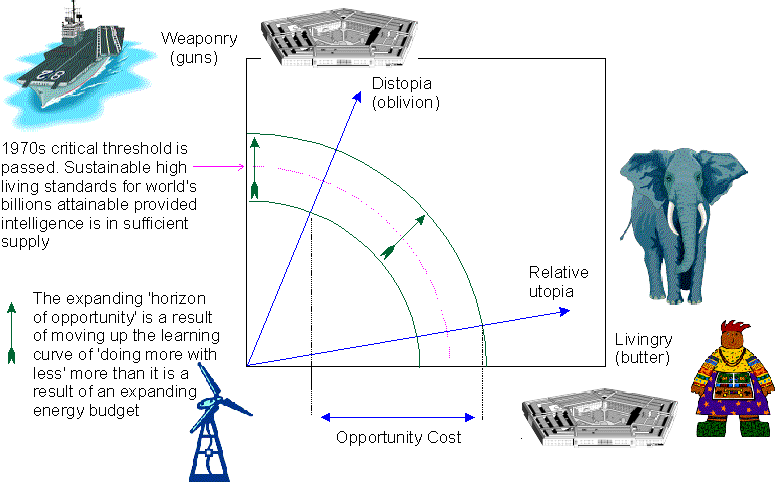
Last night I decided to alter this ancient graphic at my Synergetics on the Web, by sliding a copy of the Pentagon to the lower right (if looking from this side). And I added the paragraph: "The Pentagon is shown in both directions because some in the military have largely freed themselves from LAWCAP's obsolete reflex conditioning and have a more GST-informed outlook."

I think it's important that we acknowledge the progress we've made to date.

And speaking of progress, kudos to Blogger for making picture uploads a snap through the standard interface.

Monday, September 19, 2005

Talk Like a Pirate


Jolly Roger

September 19 is Talk Like a Pirate Day -- another excuse to get in touch with this part of our heritage. According to the algorithm in today's Living section in The Oregonian, my pirate name could be: Squinty Rumpot Broadside (I think I'll pass).

Related Post: Adventures in Radio Land (Part 2), 10 Feb of this year.

Saturday, September 17, 2005

Build It Green

Today we joined other Portlanders on a self-organizing tour of G/Rated homes, featuring various intelligent, energy efficient designs. We visited the tiny one-person house on wheels (visiting from Olympia), the sunlight and rain harvesting "net-zero" Victorian, and the little clay studio with a living roof.

We also left voicemail expressing some interest in a refurbished '84 Ford Econoline camper, a possible bizmo, though hardly G/Rated. The Victorians had a pickup they run on B100 (vegetable oil recycled from restaurants).

We had coffee in one of Dawn's former work places on Foster (she quit shortly after the bomb incident -- the site used to be an abortion clinic, Dawn their bookkeeper). Then we went to a nearby Vietnamese bakery to buy moon cakes.

Across my desk: Bruce LeBel's temporary shelters proposal to Oxfam (forwarded by Dick Fischbeck); a poorly sourced story about US soldiers raping Iraqi infants in Tellaffar; email from Nancy, a would-be Wanderer (I invited her to the 9/20 meeting); a request for a CV update from Nick (changes made); a heads up from Gerald de Jong about N J Wildberger's innovations in trigonometry; other stuff.

Thursday, September 15, 2005

Powell's on Hawthorne


Tricycle Magazine cover
Vol. XV No. 1 Fall, 2005


I snagged a copy of this issue of Tricycle at Powell's this morning, along with Make: (vol. 03) and a copy of The Onion (a satirical newspaper). Coffee with Derek.

Before going out, I worked on some new reports for one of my clients (a coding project, Visual FoxPro). Later today, I finished a first edition of a new web page, in preparation for a course I'm slated to teach.

This afternoon, I watched some Smallville with the family on a borrowed Braithwaite DVD (though not the episode mentioned in the aforementioned web page).

Yesterday was our biweekly Wednesday morning Wanderers meeting. KOREducators Adam Reid and Reese Lord went over their hopes and dreams regarding a new charter school they'd like to start under the umbrella of Portland Public Schools.

Charter schools are public schools, but follow a slightly different rule book, allowing them to experiment with different types of teacher (only 50% must be state certified).

Joyce Cresswell of Saturday Academy joined us as well. Her institution likewise gives students access to teachers from a variety of backgrounds.

Sunday, September 11, 2005

Summer Memories (2005)


Geometry Toys

Part of the Quimby-Kittner collection in upstate New York. I took this photo during my stay in the tree house this summer, enroute to my 25th Princeton reunion (Class of 1980). For more summer memories, check BizMo Diaries, September 2005.

Thursday, September 08, 2005

Red Eye (movie review)

A salute to lonely pro service workers who take their jobs seriously and fight back when cornered. Modern commercial flight is faithfully rendered (especially coach), but the off shore Russians seem implausibly employed.

The screenwriters provide no backstory about the kingpin with the private jet, who holes up in Miami with his henchmen -- into money laundering perhaps (that'd explain the high caliber enemies).

Saw it with Dave Fabik in the Regal @ Lloyd Center (VP Nixon: "America's answer to communism") . We previewed the new Jodie Foster movie, also airplane-based. She's effective in those suspenseful paranoid films -- I'm looking forward to it (perhaps as inflight entertainment).

Wednesday, September 07, 2005

Wanderers 2005.9.7

Doug Strain kicked off our evening series, alternating Tuesdays. We had the camcorder going, fingers crossed the lapel mike was doing its job (audio is critical for hearing Doug's many excellent stories).

We learned more about how Doug got transitioned from war time nutrition experiments to fighting fires started by Japanese fire balloons.

In the experiments, Doug and other conscientious objector friends were fed various diets to see what'd keep them alive in shivering cold conditions (they spent 8 hrs a day in especially refrigerated rooms -- like on some reality TV show). The high protein diet proved the best, which was disappointing to the experimenters, as it was also the most expensive.

Doug's talents were better used working with the U.S. Forestry radio lab. Maybe 5000 fire balloons were set adrift over the Pacific, timed to crash and burn stateside. Fortunately, the best wind patterns coincided with the wettest forest conditions, so although the fire fighters were kept on their toes, actual fire damage was not that great. Perhaps four lives were lost.

I quizzed Doug most intently on ESI's relationship to its neighbors on the Stark Street property, which was subsequently gifted to Quakers and the AFSC, after the city zoned that neighorhood out of bounds to even light industry (Jantzen had constructed the factory originally, installed lead lined die vats upstairs). Turns out ESI didn't get along with its neighbors that well either. Some long-running karma just goes with that territory I guess.

After ESI moved, over to the Macadam area, the new place burned to the ground the night of some firemen's ball (no one to answer the distress call -- probably couldn't have saved it anyway, given the high temperatures involved). Fortunately, the insurance came through. And later, State Farm (also insurance) helped grow the Silicon Forest with a lot of investments, as did Hewlett-Packard. HP loved Doug's ability to measure resistence in micro-ohms -- about 350 micro-ohms for a house key -- and added Doug's inventions to its product line.

Doug started the meeting with what he called good news: British Petroleum's outlook on remaining proven reserves (40 years worth?), then shared about some promising new city power R&D that Westinghouse is helping fund at Oregon State. Four of these vault-contained helium cooled convection units could sustain Portland. Yeah, we're talking nuclear fission again (means toxic byproducts), but minus any weaponization pathway. Iran might do something similar. Our two Davids discussed the average 24 kW-h per diem energy requirements of the average USAer (takes about a kW to power "the good life"™ they say).

Rick Grote brought a box of golf balls, inviting us to help ourselves. I took seven (six around one). Great seeing Allen Taylor, Dick Pugh, Julian, Steve.

Jim, Don, Barry and I, joined by Derek, celebrated afterwards with beers at the Bagdad. This was after Jim drove Doug home but forgot his thermos bottle, and so came back for it. I'm borrowing Jim's copy of The Astronomical Companion, which I'm cross-checking against Celestia, thanks to Trevor.

Addendum:

I almost forgot to relate Doug's much earlier interesting story about his participation on some panel proposing the switch to cesium-based atomic clock time, and how the Navy was all bellyachy that only astronomical cycles mattered, nothing so measly as an atom should give us the time of day.

Congress got caught up in the soap opera. So the cesium clock people just set it up in Colorado. It's not like they wanted to take anything away from the Navy, just add this new layer. And to this day, atomic clocks take the cake for enabling us to synchronize within tiny slivers of a second -- a kind of synching needed for GPS for example (so ironically, the Navy is now as interested in cesium time as everyone else).

Moral of the story: if you want to get anything done, don't get it bottled up in Congress. Which is too bad really, Doug went on. If only those lawyers understood the science even a little bit better, the whole enterprise might run more smoothly (which is where I think USA OS comes in). The job of educating powerful politicians is enormous, but with modern media, I think it's doable.

Tuesday, August 30, 2005

Wanderers 2005.8.30

Bob McGown is giving a thorough overview of our search for ET tech (might not involve any communications). Lots of impromptu discussion. We've found quite a few planets outside our solar system by this time.

We're taping to Hi-8 and I'm hoping a streaming video site will enable us to asynchronously serve excerpts (synchronously too). We could do audio with podcasts (the new iTunes makes it easy).

Given our line up, a growing on-line archive makes some sense. OPB has its eye on doing a Doug Strain interview with broadcast-quality equipment. But given the relatively lower bandwidth of most Internet circuits, consumer camcorder feed is sufficient for our purposes (at least we use a tripod). We've booked Doug for September 6.

Terry thinks the Institute of Noetic Sciences is on a good trajectory. Allen Taylor likes what the Acceleration Studies Foundation is up to. My wwwanderers.org web site is expected to keep morphing c/o wandering web wranglers.

Monday, August 29, 2005

Bridge Pedal in Rear View Mirror


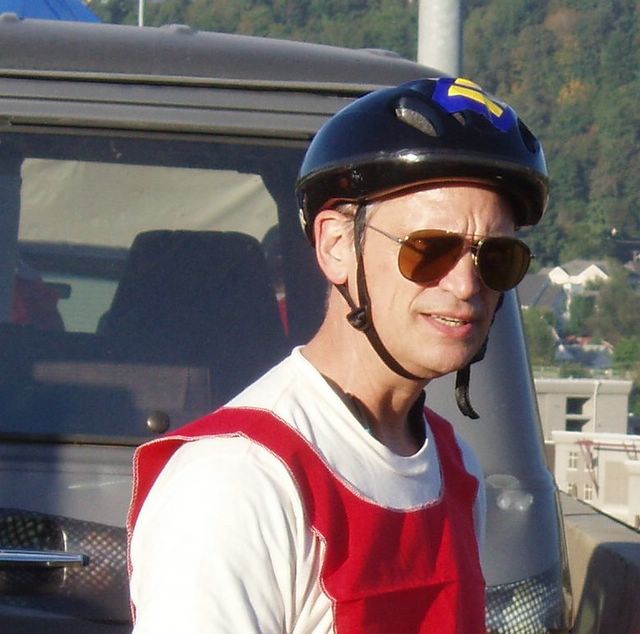
"top of the Marquam"
Congressman Earl Blumenauer
(photo by K. Urner, Olympus Stylus 500)


First year in a long time the Bridge Pedal taversed all 10 bridges -- maybe the first time ever. I was through the chute by 6:30 AM.

This isn't a race, it's a ride. No prize for being first.

Shorter more family-friendly alternatives are provided. It's a city-wide event, on a Sunday, when traffic is minimal anyway.

Sisters of Providence a major sponsor.

Friday, August 26, 2005

Outdoor Project


Repurposed Loft

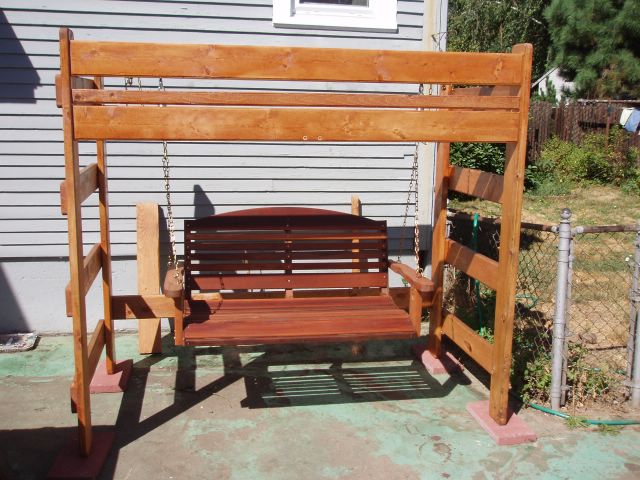
This has been one of my projects over the last few days.

The loft was disassembled and moved to the garage some weeks ago. I prepped and stained it, added a purchased 4' swing and chain Made in Ohio, plus other hardware. I bought the custom cut 82" beam it hangs from at Home Depot on Mall 205 (it fit in the Subaru). My solution to fixing the beam in place: three brass braces at each end, two atop, one under, these purchased from Divison Hardware.

The finished swing now sits in the back yard, facing the Mother Mary statue.

Thursday, August 18, 2005

Flextegrity


Flextegrity
(photo by K. Urner with D. Wardwell's Canon PowerShot A510)

Tuesday, August 16, 2005

Wanderers 2005.8.16

Today's presenters, Sam Lanahan and LaJean, unveiled Sam's so far unnamed invention, a building system based on a meshwork of tensile and compressive elements. The several Made in China plastic prototypes (plus the welded metal one) provided interesting visuals, plus LaJean's slides were distributed as bound color hand-outs. We failed to solve the projector puzzle (the mouse cursor froze every time we connected it to the PowerBook).

We used the occasion to stream video (with audio) to/from Terry, vacationing with family on the Oregon coast. Both ends used Apple laptops running iChat, with vidcams connected by firewire. Down the road we plan to host multiple real time clients, funds permitting. Don and I agree our setup was too obtrusive; we'll try a different arrangement at our next opportunity (maybe shoot from the side office, putting the computer on Terry's desk?).

Does Sam's invention have commercial (.com) or military (.mil) applications? Might NGOs use it in emergency relief situations (.org)? Possibly. David Feinstein's earlier remark, that it's a solution in search of a problem, seems on target. However David Ulmer felt it'd be of immediate relevance as a teaching tool and encouraged Sam to make it available to universities (.edu).

I enjoyed catching up with Julian after so long -- he's been very busy with his hemoglobin sculpture, nearly finished. He's hoping to meet up with Kenneth Snelson this fall. Sam, a long time student of tensegrity, would like to meet Ken as well.

Other threads:

I watched Cinderella Man at the Bagdad last night; Russell Crowe goes back to playing a gladiator, after playing a mathematician in between (link: a spoof with no Netflix listing -- sigh). What's more hypocritical than an adult who decries violent video games and then pays to watch this barbaric sport, wherein the injuries are real? Million Dollar Baby was just as depressing. NBC's The Contender: pure exploitation.

I'm enjoying Agile Web Development with Rails, purchased at OSCON. Powell's sold a ton of 'em, thanks to Ruby's high profile at this conference. Unfortunately, none of my ISPs currently support the Ruby on Rails option.

Monday, August 15, 2005

March of the Penguins (movie review)

Conceptually speaking, this movie branches off the earlier Winged Migration, and might have been named Ambulatory Migration. The storyline is more complicated this time, so there's more work for a narrator. Morgan Freeman supplies the voice-over for the USA version and does an excellent job.

The life-cycle:

Small bands of would-be parents waddle and slide about 70 miles to the camp. Like other migratory birds, emperor penguins have built-in GPS, so only a few get lost, though some perish from exhaustion.

Upon arrival at camp, the moms- and dads-to-be pair off. The gals outnumber the guys and sometimes fight for a date -- the guys seem to enjoy this part. There's no rule about finding the same spouse as last year, and some don't find significant others -- better luck next year.

There's not much to do in Antarctica, and relationships are very important. The penguins bond strongly (to call it a marriage would not be out of place), which is fortunate, as the coming ordeal will test both parents severely.

After the egg is laid, mom keeps it safely pinched between her feet and her belly for a little while, but she's starving and so the pair rehearses kicking the egg over to dad. Getting it right is essential: if the egg is exposed to brutal cold for more than a minute or two, it'll freeze solid. Inexperienced teams sometimes flub the hand-off. Either way, mom heads for the ocean, 70 miles distant.

While the mom's are off to fill up (eating for two), the also-hungry dads keep themselves warm against the bitter polar winds by huddling. After some weeks of shuddering cold, junior hatches. Dad and junior bond, but dad is hungry -- he coughs up one meal for junior, but mom better be back soon (she'll be able to cough up a lot more).

When the moms finally get back, the dads turn over custody and head for the ocean, as now it's their turn to feed. The moms do child care for awhile, but take off a little before the dads return, because the chicks need a preview of life on their own -- a sobering experience. Dad gets back shortly before junior totally freaks (unless junior has been eaten by a predator).

This process of parents switching off, with some family time in between, goes on for several months, but with increasing frequency as the ice is melting and the ocean is getting closer. By the time the young penguins are ready for reorientation, the ocean is pretty much adjacent to camp.

Finally, having done some initial training, the parents disperse, having discharged themselves responsibly. The young adult penguins hang out in high school a little longer, then dive in for five years of college in the deep blue sea, only to emerge as full-fledged adults, ready to start their own trek to the camp ground. And so it goes. There's a lot of conformity here, few lifestyle options.

I was glad for the outtakes during the credits, showing the human camera teams at work. I dislike documentaries which pretend camera teams don't exist -- my main beef with that IMAX film Everest, which never shows the camera team at critical moments (even a few stills would have been an improvement).

Saturday, August 13, 2005

Kirby @ Free Geek

On invitation through a FreeGeek email list, I attended a presentation by Ying Ki Kowg, PhD, PMP from the Department of Human Services within the State of Oregon. His office is overseeing a large contract between Oregon and various vendors who are adapting a solution already developed for the State of Oklahoma.

My take: Oregon will end up with the resulting source code on its list of assets, and so might in theory open source what it's buying. Another state could start out that much further along. Any federal or state project involving the procurement of source code is logically a contributor to our growing pool of assets, given who ultimately picks up the tab (we the people) -- unless, that is, there's something inherently not open about the process being coded (e.g. it's a weapon, not a voting machine).

If government buys software, and doesn't release the source, the public is entitled to know why (national security improves when many eyes see in, and fewer bugs go undetected -- an important function of journalism if/when the press is really free). Naturally, if contributing source back to the community is built in as a business requirement, then the project will be run a little differently, e.g. state-approved licensing requirements may change.

Speaking of FreeGeek, Ron Braithwaite and family are back in PDX, having failed to gain entry to Canada for the purpose of starting a new life, new school, and work on CareWheels of Canada (Ron's pet project). Their paperwork was not in order. New quarters have been secured, and the 25' U-Haul has been unloaded, the mission aborted.

Tomorrow: 38 miles on my bicycle, over all 10 bridges in Bridge City (aka Portland). Read more on that later in Bizmo Diaries (captain's log).

Related threads: [1][2][3][4]

Thursday, August 11, 2005

Wwwanderers

Terry gave me the green light at our meeting this afternoon to launch Wwwanderers.org. I wasted no time registering the domain with Godaddy. Propagation through the DNS system seemed to happen pretty quickly.

I notice Bob Parsons, the CEO of Godaddy, links to his personal blog from the top of the Godaddy home page.

His posting of today is about overcoming the Universal Human Phobia against committing violence against other humans. He's glad firefighters, police, and emergency workers train to overcome this phobia to protect his way of life. Without such warriors, trained in the latest violent techniques, his lifestyle wouldn't last more than a year.

He ends with a link to a music video celebrating the attack on the Iraqi city of Fallujah. "During combat, there is no music" he writes, which isn't always true. Many soldiers wear mini-headphones and/or pipe their tunes through the speaker systems which modern weaponry provides.

Wednesday, August 10, 2005

El-Fish

Tara has been eyeing this El-Fish box on my book shelf for some time, thinking it might be fun to install and run. This software was developed by Russians retired from the Cold War and wanting to wrap their heads around something more genetic. They started with wildflowers and butterflies, but the final commercial version, a game, features an electronic aquarium full of genetically rich electronic fish (hence "El-Fish"). The product was created by Animatek (a Russian company) and published by Maxis.

Unfortunately this product dates back to 1993 and the floppies had gotten corrupted after all these years. Even after finding it archived on an abandonware site, I was unable to run it (so far) on WinXP. Maybe I'll set up an old box to run DOS in a partition, like Simon did. Simon is a 3rd grader I know (4th grader by now); he also got his Thinkpad to work as a Linux-based telnet server, to which he'd connect from his school's Win2000 boxes (he'd install Putty for this purpose).

And speaking of kids I've mentored (through Saturday Academy or Portland Public), Ki Master George accidently wiped out his IM prototype and blog for Father Bob (the latter was a school project). Fortunately, Father Bob wasn't adding new content, and Ki'd already received full credit and glory for his efforts (he'd customized Pybloxsom to run with mod_python on Apache, with algorithms to re-skin the interface based on important dates on the Catholic and US calendars, e.g. the interface'd change color around Easter, plus flag election day). KMG was in 8th grade back then, is now heading into high school.

Related blog post: Twenty Wall Posters

Thursday, August 04, 2005

OSCON continued

Additional OSCON coverage is available in the August 2005 section of my neighboring blog, My Bizmo Diaries.

Wednesday, August 03, 2005

More from OSCON

I spaced the fact that Max now goes to Expo (yellow line), and snapped out of it a stop or two north of the Steel Bridge. I was happy to see this part of town: the Gotham Building (complete with coffee shop); those large grain elevators, one with Amazon.com painted on the side. I joined a last trickle of geeks headed into the great hall on the 2nd floor of the Convention Center, bypassing the OSCON/StarBucks coffee bar, missing part of the first keynote.

Summarizing the keynotes:

Speakers: Nathan Torkington, Tim O'Reilly (both O'Reilly Media), Kim Polese (SpikeSource), Andrew Morton (OSDL), Jeremy Zawodny (Yahoo!), Jonathan Schwartz (Sun Microsystems).

Apparently there's considerable ferment as IT moves to support open source in self interest, meaning geek cultures need to adapt to more corporate hookups, usually around more vertically integrated software stacks with a faster release cycle.

The more slowly evolving backbone of free resources (e.g. LAMP, kernels) provides raw material for more malleable, form-fitting services, with much of that malleability stemming from the fact that the source is supplied to the customer (as customers increasingly demand).

Open source is often safer and/or of higher quality than protected source, because the field is so Darwinian i.e. what survives strict public scrutiny usually has some strong advantages. The code ends up more robust, more vetted.

Enthusiasm for open source is spilling over in the realm of hardware per O'Reilly's Make: magazine (shades of Popular Mechanics).

Atop this growing open source stack, bleeding edge innovation occurs out of necessity, oft times in secrecy. Successful closed projects of today provide the new open resources of tomorrow -- a pattern being followed by Sun's Solaris, now OpenSolaris (there's a big booth about that).

Python stock seems to be on the long term increase, although market share is still small, judging from O'Reilly's statistics. Tim keeps close tabs on technical book sales data, as one might expect of a publishing czar. His talk dovetailed with the Yahoo game demonstrated last night, which uses search engine data to track the buzz on specific technology topics, which is graphed alongside game player trading on these same topics (as if topics were companies) within a virtual stock exchange.

Old timer do-it-yourselfers may be suspicious of this new do-it-together work ethic. They worry about communism or some other failure-prone altruism, per Larry's allusions last night: the People's Republic of Perl slide; his cast of cartoon spies, at least one of whom (cute chick) was no doubt Russian (Larry himself identified with the Chinese guy). I think today's keynotes would prove reassuring to these worry warts: this is unbridled capitalism at work, in the ancient sense of "using your head" (Latin root) as a private individual, as free as your peers to collaborate, to partner, to take risks and reap rewards -- and as willing to make it all work.

Across the speakers' lounge, I spy Jim Hugunin (IronPython) chatting with Miguel de Icaza (Mono) -- bright stars in my private sky. Interesting how few from the conventional press report on these doings. Granted, the storylines are somewhat esoteric, yet history is being made nonetheless. I still think we need one or more geek channels on television, along with an open source archive of downloadable, recyclable clips.

I chatted with Alex earlier. He's quite satisfied with the work environment at Google, where he doesn't feel pressured to always be the smartest guy in the room (lots of smart cookies at Google, which company has a popular booth showing off all the global data it serves -- partly as a result of collaborating with the keyhole people).

My presentation:


I had tech support fiddling with sound during the opening, while I browsed my presentation manager's source code for a minute or two -- didn't get into it as deeply as I'd have liked, but hey, it's on the web. The sound problem was soon solved.

Then I launched into the slides, with an interruption at slide 9 to go out on the web and run both Springie and Fluidiom. My general theme: thanks to open source and design science, our school's ability to collaborate has become vastly easier and more effective over the years.

I covered a lot of material using a sort of frenetic pin-ball/scatter- gun approach, using the slides as a guide: the nationless Fuller Projection, Rick's dome program, Kenneth Snelson, tensegrity, elastic interval geometry, Alexander Graham Bell and the octet truss, sphere packing, quadrays, Grunch of Giants, E.J. Applewhite, intellectual property, education reform, making a difference -- a bit too manic for my taste (45 minutes isn't much time). The people who came to the table afterwards seemed seriously into learning more, especially with regard to providing kids with a better education. One guy asked what planet I was from.

At one point in my talk, I predicted we'd soon have open source repositories of downloadable audio/video clips, which kids'd pull down to their computer desktops, mix with new content, and reupload back to the servers (the same process used with software today, but applied to making video). Schools like ours could harness this economy to foment the production of more relevant educational materials.
Tuesday, August 02, 2005

OSCON (Day 2) + Wanderers

I'm listening to Dick Pugh tell the story of our Willamette Meteorite. Dick feels sure this multi-ton lump of metal was pushed by a glacier, then a big flood, from a great distance. The metal itself (a mix of several, some gold even) dates back about 4.5 billion years (mas o meno) and likely came from the asteroid belt.

People have fought over its possession ever since it was discovered. These days, it's in some museum in New York. Dick has a couple little pieces of it. The museum itself broke off some to trade for Martian rock. Native Americans have some ceremonial control.

Now I'm back at the Convention Center, in my Mono Bootcamp venue (room E141). While still at the Pauling House, I downloaded the 40+ meg installer for Windows. Upon rejoining OSCON, I ran the installer and tested the demo of gtk# widgets off the Start menu, which worked well. Mono implements .NET on various operating systems. Of course I'm interested in Mono/.NET mainly because of IronPython.

I had a choice of buses, coming from Hawthorne District: the 75 to Hollywood, transferring to the Max, or the 14 to downtown, transferring likewise to the Max, but going the other direction. I positioned myself strategically to take whichever bus came first. Not surprisingly, it was the 14 (it runs more frequently). Enroute, the middle exit door got stuck, meaning a rider had to make his way to the front. The driver literally rebooted the bus, twice. The second time, he had to get out and do something at the rear. Rebooting the bus solved the door problem.

I handed off a copy of my open source OSCON talk to some guy with a USB stick, after we talked for a few minutes (it's on the web too). This guy turned out to be D. Richard Hipp, creator of SQLite, as I found out later, when he received a $5K Integrator Award from Google.

I'm connected by wireless, which is why I'm able to do real time blogging, check email, news and so on. Yes, I'm concerned about the shuttle, have been at least since reading about NASA seeking replacement parts -- CPUs -- on Ebay. I'm in substantial agreement with the LA Times opinion (The Wrong Stuff, July 28) that "no shuttle should ever fly again" (new technology is needed).

Highly technical talks may be sampled on many levels. I appreciate the freedom to not give my undivided attention to the C# code being discussed on the big screen right now, even though it's really cool.

Larry Wall gave a whimsical State of the Onion based on Spy (a fictional computer language). Damian Conway delivered fun with dead languages (e.g. Latin, Lisp, PostScript, C++...), featuring Lara Croft and Conway's Game of Life which latter was also important in last year's talk, about programming in Klingon. In between, Paul Graham discussed what businesses might learn from open source and blogging (or die).

Monday, August 01, 2005

OSCON 2005 (Tutorial Day One)

So I'm sitting in the Oregon Convention Center listening to Stefan Neufeind from Germany introduce us to XUL. Earlier, at the Starbucks breakfast coffee bar, two geeks discussed the relative merits of Python and Perl (especially Perl 6). I couldn't have scripted it any better; OSCON is off to a great start. I will now give my undivided attention to Stefan...

XUL references Ghostbusters (the movie). The ghost Zuul possesses a certain character (Dana Barrett) and says "There is no Dana, only Zuul," giving rise to a slogan: "there is no data, only XUL." This slogan serves as an engineering guideline: don't incorporate actual data in your XUL documents -- just link to it, and make XUL all about the layout (interface).

Documents of the xul-type (application/vnd.mozilla.xul+xml) talk to the Gecko rendering engine in Mozilla-based browsers (e.g. FireFox) or in whatever clients (other engines may speak xul too). XUL is a DOM-extending XML namespace providing a <window></window> framework within which to lay out widget-containing boxes (variously oriented, directed, packed, flexed and aligned -- bottom-to-top, right-to-left OK too), in order to make a cross-platform front end to back end data sources and runtime objects (e.g. XPCOM gives you hooks to C/C++ library resources). You'll gain control over menus and toolbars as well.

CSS usually plays a role. JavaScript listens for and handles events (Python is a batter up).

Note that mozilla -chrome on the command line will let you substitute your own top window, independently of the default browser, with all its menus, tabs and so on. Chrome is the look-and-feel repository (consulted by Gecko) providing window trim.

A lot of this stuff is similar to my bread and butter Visual FoxPro, in that widgets trigger specific events (oncommand, onmouseover), as does the <window> itself (onload, onunload, onclose). Plus you've got the tabindex attribute with which to control the focus ring.

Try this in FireFox.

I first learned of XUL from Claude Goodman of CareWheels, who mentioned at a Free Geek meeting that he envisioned his interface as XUL-defined. I made a mental note then to find out more about XUL (this meeting was over a year ago by now I believe). I met up with Claude again at Ron Braithwaite's presentation to Wanderers.

Don and I attended Ron's 'Off to Canada' picnic at Creston Park yesterday, before heading over to the Brewer's Festival on the waterfront (stopping enroute to register for OSCON). Lots of motorcycles showed up for the Braithwaite party (plus Jasper's battery- powered bicycle from Taiwan), some ridden by Bavarian Illuminati (Ron is one).

I had lunch with Randal Schwartz and friends, Randal being a heavy lifter in the Perl community (I've studied his Perls of Wisdom in the library). His group of four graciously accepted Kevin Altis and I, both Python people, as table mates at Red Robin. Perlmongers filled us in on some of the community- bending soap operatics surrounding the DBI class, plus offered friendly advice about how we snakecharmers might do something like CPAN, the global Perl repository.

The distinguished Alex Martelli, now with Google, has a new mustache, and joked how European males, upon moving to the US, tend to sprout facial hair to better signify their European origins (Alex is Italian). Guido, you may recall, recently grew a beard.

My afternoon tutorial: Ruby on Rails (a convention-driven framework for website development, based on the Ruby programming language).

Monday, July 25, 2005

More on Gothenberg


My day in Liseberg, Gothenberg

A thing I did in Gothenburg: buy an all-day rider's pass at Korsvagen, use it even on the ferry boats, and go to Vrango to read Quicksilver and take pictures. At the terminus of tram 11, I found myself in a Thai food kiosk. Guido and family were also present, having previously ordered and waiting to collect the merchandise. Guido had it on good authority that the food here was indeed good. And it was. I got in trouble for eating it in the upstairs cafe enroute to Vrango -- the whole upstairs belongs to the coffee counter (I'd surmised only the closest tier, misjudging the scope of the counter's authority). I was flattered that she lectured me in Swedish. Scandanavians are cool.

Gothenberg has a "Lip Stick Building" similar to our "Candle Building" (KOIN Tower), only theirs is more over the top.

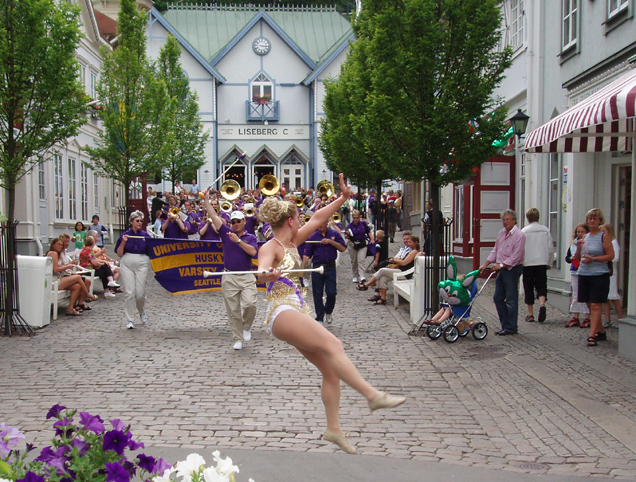
Liseberg was great fun. There I was, all by myself, a 47 year old guy kicking around an amusement park, and who should show up but the University of Washington Varsity and Alumni band! Great baton twirler, enthusiastic musicians. My fellow amusement park goers stood around and clapped, trully impressed in some cases.

I bought an "as many rides as you can stand" pass in Liseberg. I went twice on the roller coaster that parallels the escalators to the tower, once on the others. And that swing thing towards the middle, next to Kannen's 360, wow. I hadn't watched a session before boarding (was just doing my random walk) and wished I'd pocketed my glasses. 47 year old man goes round and round and upside down. In Gothenberg. Fun.

Wednesday, July 20, 2005

Wanderers 2005.7.19

Yesterday's Wanderers was one of the best ever, and yet was unplanned, for the most part, a "do whatever we feel like" kind of event. The result was a kind of round robin, although moving at variable speed, with lots of back and forth between turn-taking.

Big news was more about Lew and his Educational Leave of Absence to dive into the Urban Studies department at PSU -- one of the best in the nation (Carl Abbott is a Friend).

Dick Pugh revealed more mysteries of the meteorites. Brian indulged us with more Condor-talk. Don offered to assist everybody (at the last meeting, Don introduced himself as "Terry's Igor," which brought the house down).

I wedged in a complete OSCON presentation off the laptop (no projector), complete with "Fog of War" battlemap (drawn in green felt on the spot). Jim talked more about the watershed and his plan to view next year's eclipse from a Libyan standpoint, insha Allah.

David left before the round robin got to him (and before I drew my battlemap), but I enjoyed re-explaining Quadrays to him (one slide in my OSCON presentation) -- David being an applied mathematician, with an emphasis on spectral analysis.

Sunday, July 10, 2005

Bewitched (movie review)

Here Hollywood makes a film about Hollywood remaking a Hollywood TV series. The outermost frame is unspoken (this isn't a documentary about "the making of") but that just heightens the irony of actors making fun of, and celebrating, acting (including bad acting) and its made-for-the-camera cultural milieu.

For Nicole Kidman to frame herself as an actress playing an actress, she almost has to come from another dimension -- which she somewhat manages to do, as a witch who knows her own nothing-to-sneeze-at charms. Ferrell is charming too, and of course more obnoxious as Kidman's male foil.

Shirley Maclaine and Michael Caine play the older parallel couple (as Endora and Nigel), and covertly bewitch one another, likewise to foment romance. So is love authentic if it's so artificially begotten? The movie industry is forever asking itself this question, given the impersonal machinery of love-making is so in-your-face all the time (smile for the camera now).

I don't remember the TV show well enough to recall Uncle Arthur, originally played by Paul Lynde. His appearance in the person of Steve Carrell smashes the illusion: he starts in Wyatt's dream sequence, but is still there when he wakes up -- the layered realities collapse into one (hi Steve). Nor did I recall that Darrin got recast some distance into the original series, a fact Farrell's Wyatt alludes to, when feeling nervous about his career.

The film stays light-hearted throughout, faithful to the spirit of 1960s USA sitcoms and their suburban Pleasantville fluffiness -- is a traditional mid-summer comedy in other words.

Wednesday, July 06, 2005

Wanderers Meeting 2005.7.5

DigitalHomeTechConvergence

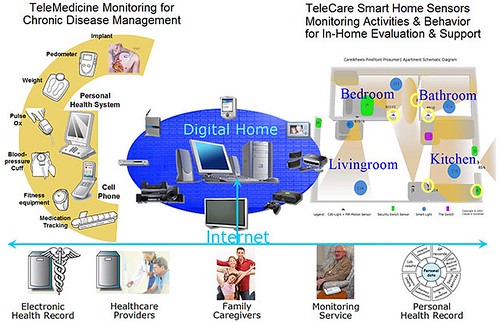
Long time digital activist and alpha geek Ron Braithwaite was our guest speaker at Wanderers yesterday. He's moving to Canada shortly to begin work on a new kind of safety net for elders, staffed in large degree by disabled workers and backed by volunteers.

This net provides elders with human contact by telephone, plus raises exceptions when the installed sensors detect deviations from daily routines, e.g. when a medicine cabinet fails to open, or a stove gets left on. If the telecare provider can't handle the exception, e.g. the phone isn't answered, it gets passed to a higher level, e.g. to an on-scene emergency contact and/or 911.

Disabled workers will staff the call centers, either in offices or at home (some people want to "go to work"). A web browser interface will provide the daily contact list and color-coded warning flags. The software is already being field tested.

Given the average smart home generates a lot of data, the current design puts filtering and summarizing algorithms on a client appliance, thereby shielding the more centralized servers from a flood of routine information. Summary reports will help establish baselines so that long term trends might be monitored as well (e.g. increases or decreases in mobility, number of nightly trips to the bathroom and so on).

Also present to provide supplementary detail and background information, was Claude Goodman, founder of CareWheels and originator of this model. Ron and Claude first met when Ron was spearheading CollabTech for Free Geek. Claude remembered me from that venue.

We had a lot of lively discussion, focusing on possible big brother abuses, and on whether living alone was really the best option. Passions ran high, as personal histories were recounted. Ron and Claude held up well under interrogation and we ended up wishing them well in their adventures.

Given many in the private sector expect to generate future revenue from such On-Star-like home monitoring services, Ron feels it's important to get a working model established using open source software and business models. Otherwise, the more money-hungry will hide behind exclusionary regulations and patent claims, to make sure native human smarts and resourcefulness remain enslaved and controlled by self-serving "know better" elites.

Sunday, July 03, 2005

Roller Coaster

We don't have a firm diagnosis yet, but there's some likelihood that Dawn's long-running dry cough and CT scan results mean the cancer has moved to her lungs. This news hit home by email while I was still in Sweden, amusing myself for a couple days after the 3-day conference (given how late the bookings were made on my behalf, no immediate return was available -- a prospect I'd welcomed).

Or maybe it's pneumonia, or a lesion left behind by the radiation. We'd be happy with either.

Life is a roller coaster -- symbolism I was conscious of at the time, in Liseburg.

This wasn't the first time I'd endured a long flight with my guts knotted in grief and sorrow (the MD-11 was packed -- the cabin crew did a good job). I escaped into the pages of Quicksilver, while on inflight TV, Homer put on more weight to qualify as disabled, so he could work from home (I need to lose more weight).

Dawn and Tara came to fetch me from the airport (but the suitcase stayed in Vancouver -- ground crew couldn't fit it on the tightly packed Air Canada Dash-8). Dawn has all her hair back, is so strong and clear in mind and body these days.

We joined a backyard picnic in honor of some moved-away neighbors, back in Portland for a visit. Their daughter Alana and Tara are friends. Jimmy played his guitar, with others joining in. Mom took some time from her peace work to partake of the festivities. Tara and Llysa sang most of an old Dylan ballad they'd learned off a Joan Baez album.

I was glad to be home, experiencing the life of a civilian.

Sweden hasn't sent its young to war for some hundreds of years -- a model. Life is sorrowful enough without we humans doing the killing. What do our computers say, our simulations? Is war a mathematical inevitability? Yesterday's Herald Tribune editorialized that fighting malaria and other such killers should be our priority. I agree. Health care and food services, education, entertainment -- a global university, a city-campus network, all interconnected by airlines, telecommunications, shipping, that's my vision.

Followup (July 13, 2005): The anti-matter scan (PET) indicates anomolies in Dawn's lung are from the radiation field used earlier. Nor were other cancerous hot spots detected, per the preliminary study, which we obtained yesterday. I'm very happy about this news.

Followup (July 21, 2005): The MRI gods, on the other hand, were less kind.