Tuesday, February 27, 2024
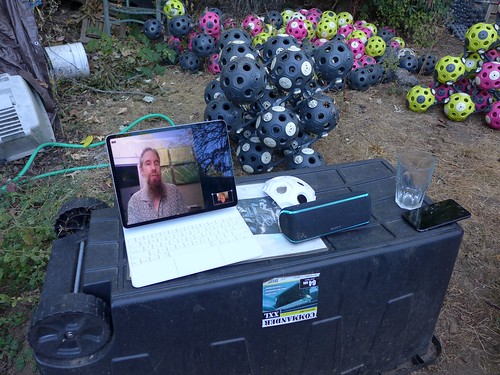
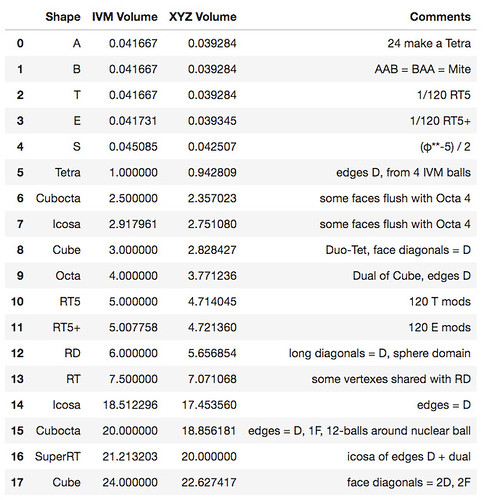
BEAST: A Particle Zoo
Sunday, February 25, 2024
Americana
From hanging out around the US Embassy in the Philippines, I developed an appreciation for how the State Department shares American culture overseas, at many levels. This enterprise involves scouting for quintessential Americana and packaging it for distribution in other cultures.
Wednesday, February 21, 2024
Village Tweeter
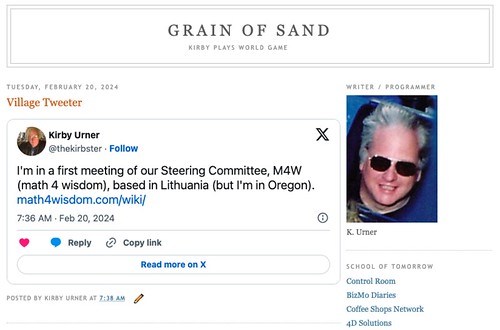
I'm in a first meeting of our Steering Committee, M4W (math 4 wisdom), based in Lithuania (but I'm in Oregon).https://t.co/qiynNmqhGZ
— Kirby Urner (@thekirbster) February 20, 2024
Tuesday, February 13, 2024
Network Nations
I took my usual virtual nations talk to Thirsters, and felt cued when Barbara brought up Tibet in connection with the forcible displacement of some of its people, the administrative institutions most of all, as these were seen to be in conflict with those of mainstream metropolitan China.
Not all Tibetans were pushed out, not by a long shot, and Lhasa remains ethnically very Tibetan to this day. Yet Tibet itself is a Diaspora Nation, with headquarters in nearby India in Dharamshala.
I said diaspora nations were more futuristic in not insisting on seeing themselves projected on some world map as a large contiguous body of territory. A nation might be more like a powder, a spice, than a cut of meat, with campus facilities dotting the globe. Supranational corporations, religious sects, and some universities, already follow this discontinuous discrete design.
So what about a New Palestine, with facilities and subdivisions all over, including in Mesopotamia? What should be its policy towards the various religions?
My vision of New Palestine mirrors the old Palestine: Jews and Muslims living peacefully together, along with Christians and people who practice other religions. The Parliament of World Religions would hail New Palestine for sharing its ideals.
Jewish heritage individuals, as well as Christians, will be able to apply for citizenship and a passport and participate in the design of the state itself, side by side with the other social engineers. New Palestine will therefore not leave itself open to the charge of being just another "ethno-state" versus an "unum-state" as in "e pluribus unum". Islamic Studies will not be neglected, nor will use of Arabic or Farsi be in any way discouraged.
The Dalai Lama was offering similar visions from his headquarters in Dharamshala with respect to his host nation India. Why not pool the very best from every religious lineage, in a national curriculum that does not itself profess to be any particular religion. Wise advice.
One might call that "secular" but not in the sense of clamping down on the whole idea of religious lineages. What's secular are the dynamisms that frustrate any particular and singular ethnicity from seizing the reigns of power.
New Palestine could be synonymous with a university. New Palestine University (NPU) has a ring to it, but if it allows for citizenship and issues passports, then it's clearly more than a typical U of today. It might have to stick with a conventional UN bureaucracy under the hood, but remember the UN itself issues recognized passports.
Why not give every Palestinian a chance to self document and get a UN passport out of the deal, as well as expedited access to NPU facilities? This kind of intake is of course difficult to carry out under conditions of siege and bombardment.
Nations that self aggrandize by engulfing territory owe a lot to the Doctrine of Discovery in some cases, and that rug has been pulled to some extent, as the Vatican repudiates it.
The upshot may not be that "jigsaw puzzle piece nations", as I call them, get overthrown or trampled upon, so much as they dissolve to become more like diasporas themselves, meaning more dispersed, distributed, non-contiguous, and more inspiring of member loyalty because less dense and less slow.
We may soon become a world of network nations, amidst networks of other kinds. In the minds of some, we're there already.
Sunday, February 11, 2024
NFL Day
The more correct name for today is Super Bowl Sunday. The big teams, having duked it out all season, have winnowed it down to two.
Derek is coming over, a University of Oregon grad with a lot of knowledge about athletics and football. He's a former track star, long distance runner, now a veteran of the food business (from many angles). He has a lot of cool possessions, including flat screen TVs, and let me borrow one, a more contemporary alternative to my yesteryear's Sony Trinitron CRT (still hooked up to VHS).
Although I'm a typical first worlder in having screens all around the house, I'm not connected to a cable TV service e.g. via Comcast, but only to internet via CenturyLink (formerly Qwest, following US West ).
But what does "internet and not cable" really mean in this day and age, in terms of contet? Internet means streaming and streaming means a lot of the same cable TV content simply piped in by a different infrastructure: optical fiber bearing tcp/ip packets versus whatever cable uses.
Dave, on the other hand, will be at a swanky No NFL party, in other words an alternative happy social event (one day after Chinese New Years) that caters to people with no patience for stupid Super Bowl stuff.
That's a whole other demographic in need of snacks and beverages, carbohydrates, cigs, sugar and alcohol. Both the NFLers and anti-NFLers are equally likely to be helping the snack food empire remain in ascendency with their antics.
And then Overeaters Anonymous is ready when you are, to help you deprogram and re-brainwash.
One might think the pro NFL American football watching crowd would in general be in better shape, but that's not so obvious when one looks at the data. The stereotypical former football star dad, all beefed up in college to be mean on the team, never learned how to scale back, once back in the bleachers.
Let's see if Ozyempic does a commercial. Not yet right? Although there's a lobby to get the government paying more for anti-obesity drugs, slimming down with that one is still too off-label a use right? You can't yet push psychedelics either, just mood altering substances and of course your own mesmerizing programming.
OK, gotta go, Derek is here and it's National Anthem time.
Wednesday, February 07, 2024
Remembering Nord Stream
I'm subscribed to the Seymour Hersh substack feed, so I'm reminded we've come to an anniversary of sorts regarding the attack on infrastructure known as Nord Stream, a set of pressurized gas tubes designed to feed the economies of Europe, especially Germany's. Hersh's first report appeared a year ago tomorrow.
Hersh believes Norway was involved, based on his sources. One wonders how many Norwegians believe that hypothesis, which, if true, takes away from the value of the Nobel Peace Prize. Why would Norway, an historic US ally, attack the United States?
But then why would Biden or Sullivan or anyone with any loyalty to the Stars and Stripes commit this kind of treason? The outcome of the NS sabotage has been to make the USA look weak and untrustworthy in the extreme, like it's covering for somebody hellbent on destroying any international rules based order.
I know my USA would never have been so reckless or off the charts dumb to have undertaken such an action and quickly said so.
I realize I'm a nobody and no one cares about my USA (RIP Uncle Sam) but I thought at least one loyalist, one patriot, should step forward and declare in no uncertain terms that the USA would never undertake the covert industrial sabotage of a Russo-European energy project costing billions.
Such acts of war are done overtly, by definition, if true states are involved. Slinking around, trying to stay undercover, is not the MO of a true state. A true state is proud of its great decisions and defends them publicly, even when these decisions turn out to be misguided.
My USA is working to barf up the perps and expose them for what they are.
Only a pseudo-USA, one propped up and used as a PR shield by unethical gas monkeys and other retards, could be behind all this coverup nonsense.
But then the trope of a "pseudo-USA" is hardly a new one, the real USA having been declared "bankrupt and extinct" on constitutional grounds by its foremost prognosticator and OSS affiliate, way back in the Reagan-Casey era.
Public schools have been too chicken to share this chapter with student debaters, along with anything resembling RBF's geometry, a valuable piece of Americana: proof positive that a fake US has totalitarian control over public schooling. Teachers are leaving. Students seem out of control.
That's why we have our underground, our School of Tomorrow, to give students more meaningful homework. USA OS is chugging along in the background.
Do I believe Seymour Hersh?
I'm in no position to double check him or his sources. I'd like the Nobel Peace Prize to still mean something. I'm hoping he's wrong and that Norway sticks to its guns in saying that this act of sabotage was an act of cowardice and depravity (which it clearly was).
Saturday, February 03, 2024
Convergent Trajectories
In the Euclidean belief system, it's not a problem to assert that two parallel trajectories might stay that way forever. What's to stop them? A Newtonian force? In the Platonic realm, as colonized by these true believers, these metaphysical lines have no mass or energy and will not be affected by the quanta of quantum mechanics. No "forces" to worry about in other words.
So do we still have the freedom to change channels and jump outside the jurisdiction of these Euclidean axiomatic truths? Sure we do. Non-Euclidean geometries abound, and where they beg to differ is likely right here, among other places, at this Fifth Postulate about parallelism (the dogma).
I'm going to switch topics, now that I've introduced non-Euclidean geometries. Let's talk about SNEC, the Synergetics Collaborative, a 501(c)(3) and another somewhat parallel "think tank" centered more on the Pacific coast, where BFI was headquartered at the time. Russ Chu convened a summit in WDC, where he'd moved from Seattle, with his family. Lots of us converged: Bob Gray, Ed Applewhite, Joe Clinton... That's when we booted the colab for real.
I'm thinking specifically of all the time we devoted to the question: should the BFI move to Smalltalk for its internal programming needs? Russ Chu purchased a motherboard to help make that happen. A guy named Hal was the chief promoter, not just of Smalltalk, but of object-oriented languages more generally. Bonnie Goldstein (BFI archivist) and Robert Orenstein were on the team (Robert favored a computer language named Dylan at the time). That's where I first met David Koski, then a denizen of Santa Monica, also J. Baldwin and Yasushi Kajikawa.
The west coast version of SNEC did not have a name per se and did not solidify as a specific nonprofit. Sam Lanahan hosted an event in Portland, at the Laurelwood Brewpub on Sandy, that included a lot of us, including Glenn Stockton (Global Matrix) and Trevor Blake (archivist, Synchronofile).
Sam would later, in 2019, co-produce Lattice Gallery, a popup in the art district behind the art school along West Broadway near the Pendleton building (Kenneth Snelson was from Pendleton). The gallery featured several versions of flextegrity, a term that both connects it with and distinguishes it from tensegrity (per Snelson's sculptures). I'd been Snelson's first webmaster by this time, as well as house guest and personal friend.
Once Zoom happened in a big way, with the concept of meetups more formalized thereby, it became easier to organize at the meetup level, which is where 52 Living Ideas came in, already anchored around CJ, a founder of SNEC. CJ helped run the Greater Philadelphia Thinking Society, which overlapped with Shrikant's New York based channel, in terms of geography and membership.
Before these events in Portland, we held a summit at the Kasman-Chu residence in Seattle, Russell Chu having overlapped with David Koski in those BFI-in-LA days. Now he had moved to Seattle, closer to me in Portland. He had married Deb Kasman and they had two kids.
Several of us converged for this event, including Ed Applewhite by phone, a liason with SNEC one might say given he was calling from Georgetown. Others attending in person: myself, Alan Ferguson, Karl Erickson, Gerald de Jong, John Braley. This same network had a life online and included faraway figures such as Peter Adderley in Australia.
This summit happened around the same time a different Applewhite was in the news over some cultic ritual suicide relating to the Hale-Bopp comet. Heaven's Gate they called it.
Another "think tank" I'll now introduce (again) to the scene is Wanderers, associated with the Institute for Science, Engineering and Public Policy (ISEPP) here in Portland, and run by one Terry Bristol (with Dawn Wicca and Associates in an auditing / bookkeeping role back then, Dawn Wicca being my wife and running the other half of our business).
ISEPP helped get me a better rate at the First International Conference on Buckminsterfullerene in Santa Barbara, organized by Elsevier, where I met Harold Kroto. I rented a convertible and drove there in the company of on-the-road networking pro Nick Consoletti, an expert on both Bucky and Linus Pauling.
I started having Wanderers (a subset thereof) listen in on CJ's meetups based in Philadelphia, connecting through by backyard WiFi. I was also a member of TrimTab Book Club by this time (closely tied to BFI), as well as Field Structure Institute (FSI) so more overlapping there.
Tying this blog post together: once we allow trajectories to diverge from remaining parallel, we may find them criss-crossing all over the place, like so many intersecting great circles.
Not only do the think tanks co-orbit, but so do individuals and families. The Applewhites and Lanahans inter-wove in the District, leading to Sam's getting to be Bucky's sidekick on a trip to Manila, at the invitation of the Marcos family, and at around the same time I was in high school there (but we didn't know of each other yet). Later, the Applewhites visited the Wicca-Urners here in Oregon.
Thursday, February 01, 2024
Gathering for Carol
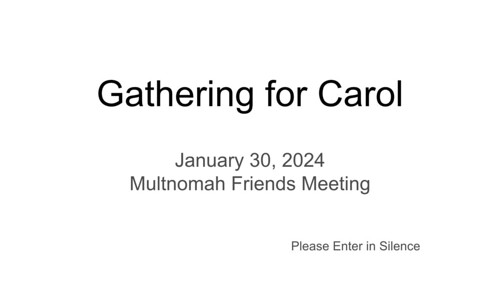
Our Gathering for Carol at the Stark Street meetinghouse, was expertly produced by Multnomah Friends. Some attended over closed circuit TV, including from Whittier. Carol Urner was a lifetime activist who believed in collaboration over angry confrontation. Many of her citations and awards were from US officialdom. Her last paying job was with a US embassy (the one in Maseru).
Monday, January 29, 2024
Teacher to Teacher (T2T)
I noticed yesterday (First Day) that Multnomah Friends, the Adult Religious Education Committee in particular, has instituted a new practice of pairing any visiting minister, with a local anchor, a peer.
In the example I witnessed, a visiting minister from another group came by to express a leading, one might say to do some market research, some field testing. Quakers encounter "leadings" as in promptings from God (superuser, root) and feel a need to respond in some way.
The visiting minister, let's call him Bob, has a background in journalism and knows the power of words. The exercise he proposed was to have participants randomly pick a card, but not turn it over to see the word printed on the face until cued to do so. There's more to it than that of course.
In cahoots with Bob, one might put it, was our local minister, a Friend already embedded within our Multnomah Meeting and familiar with its ways. Lets call her Alice.
What if Bob were way out there, in terms of expectations? The concept of "outside minister" might extend to become ecumenical to the point where our visitor is quite exotic in the context of Stark Street. The anchoring minister, Alice, might then play an active role in achieving some equilibrium, to the point of pushing back (figuratively under normal circumstances).
Think of an invited teacher, such as myself, prattling on about triangular and tetrahedral numbers to a math class. Their regular classroom teacher would most likely be the Alice.
Alice knows her students and provides me with guidance and direction, both beforehand, during, and perhaps in postmortem, regarding how I'm likely to get a best reception, given we're all hoping for good value, and what modifications I might make before next time (hypothetically).
In this particular case, our Alice was not required to intervene so much as dovetail with the flow, because our visiting minister was an old hand in our midst, a former clerk of the meeting. He heads up a satellite worship group these days, but could hardly be considered exotic.
Speaking of Stark Street, I remember one night standing in the middle of it, next to this same Bob (then clerk) and gazing up into a darkened tree next to the meetinghouse. A would be mayor of Portland had climbed it in protest. The police and fire departments had their equipment on the scene and were trying to talk him down.
The card game consisted of 30 "Quaker words" (such as truth, light, silence, integrity...) such that (30)(31)/2 = 496 pairings were possible (a triangular number). The impromptu interest groups would pair randomly chosen words to extract new meaning, a "gift" one might put it, to share with the whole group later. The name of this exercise: Between Words [as I'm reminded by a postmortem email from Bob].
Neither Bob nor Alice participated in the exercise; they were "overseers" (a term present day Quakers tend to shy away from). The market research angle was to offer Bob some feedback on how to maybe fine tune the exercise. Example feedback: many card games let us put a card back in exchange for a different one; might we incorporate such a step?
Given Bob and Alice, you might be asking about Eve, the theoretical 3rd party in any communication, and potentially able to disruptively penetrate a private channel between Bob and Alice. Here I might say that Bob and Alice have a common investment in keeping their channel secure and protected from disrupting factors, such as environmental noise.
The Biblically minded may find it distasteful that cryptography makes Eve be the bad guy again, as if she hadn't already suffered enough since the talking snake chapter. Think of Eve as a pun on "eavesdropper" and lets give her the power to listen in and not be disruptive at all i.e. she too is supportive of Bob and Alice, who may not realize she's even there.
Another innovation of the Adult Religious Education Committee, as a preamble to the exercise, was to talk about the importance of language, including language preservation, especially native languages such as that of the Multnomah people, for whom the meeting was named. This theme resonated with what I'd been learning through the Tulalip Cultural Center during my recent north circuit car trip.
Saturday, January 27, 2024
Curriculum Norms
If you're at all aware of the syllabus we're using here (School of Tomorrow), then you know we're interested in electrical grids and power plants, as well as in off grid village communities that supply their own power locally. This focus inherits from a "lense adjustment" some call World Game, wherein we're "brainwashed" (deprogrammed) to see the whole earth as a single campus, versus a set of fenced in areas in some grave battle for world domination.
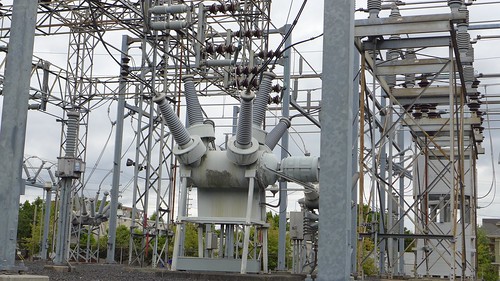
Consequent to said viewpoint is our awareness of an emerging set of local networks increasingly interconnected by high voltage lines (HVDC). We don't stop at pipelines, or shipping lanes, when it comes to studying energy networks. We look at grids. Even when discouraged from doing so by misinformation campaigns.
Where do we find teenagers getting schooling similar to ours? Sometimes through the Speech and Debate subculture. Past teams have taken up whether the GENI agenda makes sense: eventually hooking the east and west hemispheres in a power sharing scheme, a global grid. We already know of some Chinese companies expressing an interest in this idea, given engineering projects they've already taken on. The plans have been in circulation for decades by this time.
However, the better way to pass the torch on these topics to a next generation is through the internet more generally. We start in middle school with the Fuller Projection and the controversies surrounding projections in general, a politically charged topic. We start in STEM with ball packing exercises and the short computer programs that serve as sequence generators. Whole earth visualization starts with a Jupyter environment in many cases, has we're pulling in data sets, and displaying them geographically.
By high school, we're used to the idea that RBF was one of the great American pragmatists, also a realist. I'm not saying that's a high school you remember, or have in your neighborhood. The normative standards I'm promulgating, as a principal, probably seem exclusionary if you're in a corporate run state school in North America. You may think my international school focus is elitist and inappropriate per the standards of your community. That wouldn't surprise me one bit.
Wednesday, January 24, 2024
Tetrahedron Year
The current year, 2024, is a Tetrahedron Year. We won't be having another one until 2300.
By "tetrahedron year" I mean any year with a tetrahedral number. These latter go: 1, 4, 10... 2024 (I skipped a few). Tetrahedral numbers get spaced further and further apart, as what separates them are consecutive triangular numbers: 3, 6, 10, 15... A tetrahedron of 22 layers is what we're talking about.
I was thinking, going in, that I had a head full of novel ideas they'd not heard of at The Attic. On the contrary, the faculty is well versed in the latest trends e.g. they're already using Jupyter Notebooks. Have they tuned in the concentric hierarchy and all its whole number volumes yet I wonder?
This was a quick visit while Sydney waited in the car. I was glad to finally see the place, having heard about it for so long. I was reminded of Sunshine Elite Education in Bethany Village, likewise ahead of the curve.
Here's the curriculum I put together (a Github repo) during my teaching time at SEE. I make use of Jupyter Notebooks, sometimes with sympy, just like The Attic does.
I've taught Python in other ways too (e.g. for Coding with Kids). I'm not recommending a diet of Notebooks only, when working towards mastering Python.
Which reminds me, this just in from Terry Bristol:
I've used VPython a lot over the years! I learned about it through Arthur Siegal at first, and then through AAPT. "3D programming for ordinary mortals" is their slogan. That's me!
Sunday, January 14, 2024
Refugee Programming
A big question we’ll be asking is “did you show them cartoons?”. I’m talking about the refugee kids, new to the Americas in many cases, or maybe just new to the northerners and their ways. They’ve probably heard of Loony Tunes and thought maybe that’s what they’d be getting.
That’d be kinda like being an Iraqi kid and thinking Uncle Bush was gonna bring Sea World from Florida. Don’t tell me “no theme parks were planned” as I just wouldn’t believe that about my country. We’re like Disney bots.
Maybe that’s why I think of Mickey Mouse when I think of the “evacuate Gaza” project. We’re talking about the volunteers. Some choose to stay and fight, much like in the case of the Ukrainians, the Syrians, and so on. I’m imagining a flotilla of cruise ships showing toons and documentaries, opening doors in a global university that was never confined to west Asia. Go back when they’ve rebuilt your campus. They teach us.
Seriously, refugees (students and professoriate) are not going to disappear, as peoples falling through the cracks of the nation state system (only so many jigsaw puzzle pieces work as one). I’ve been suggesting the religions and the universities provide a next layer (safety net), and they have been doing that to some degree, and not because motivated by my suggestions. My suggestions are more for me, a nobody, notes to self, about how I need to keep perhaps anonymously busy. I have some experiences to draw upon. I’m another player.
When I call us “Disney bots” I’m not being supercritical or mean, and yes I know about the crisis in believability, the incredulity, which has surrounded Epcot in many dimensions. The corporate sector was apparently never serious about the future, witness hyper-loop, witness colonies on Mars, condemning us to retro lifestyles centered around dead end science fiction. We feel our own useless obsolescence, and that’s not pleasant necessarily — a kind of metaphysical arthritis, a stiffening. They’ll say we were time wasters, i.e. out of sync with Mother Nature.Friday, January 12, 2024
Looking Back
My view is Donald Trump won the 2016 election fair and square, without any significant help from the Russian spy services. The discovery of the Epstein network and a sudden groundswell of interest in pedophelia as a topic, had a lot to do with millennials coming of age and assembling a picture of the world. No, sixteen year olds did not vote in 2016, but their concerns were shared by many older and younger people as well.
So am I saying Pizzagate tipped the election? I find that more probable than any story involving Moscow, concocted by the losing political camp. "Pizzagate" is simply code for an existential distrust of the privileged ruling class on the part of youngsters, of the outgoing Boomers especially.
Hostility to the crime family aspects of being in power was a function of increasing financial literacy and a less Victorian, post Freudian attitude towards repressing stories involving pedophelia. Consider how much has trickled out regarding the Epstein network since 2016.
Those seeking a more healing rhetoric, seeking to unify a divided body politic, would probably do well to acknowledge Trump's 2016 victory, even as they continue to emphasize his loss in 2020. That someone as controversial as Trump would only survive four years in office is hardly surprising. His handling of the global pandemic scared a lot of people.
Also, because of the pandemic and all the focus on holding an election regardless, the bureaucrats in charge of running elections had an interest in keeping it transparent. The plan to unearth all kinds of irregularities backfired big time, as we experienced less corruption than usual given the freakish circumstances of needing to implement vote by mail etc. That's my read on 2020: this time Trump lost, also fairly and squarely. In neither case did the Russians play a critical role, but in both cases the DC-based intelligence community (IC) certainly did.
My recollection of the Reagan years was the lid blew off on much of the secret behind the scenes shenanigans perpetrated by said IC. People began to tune in that layer in the bureaucracy as a political actor starting especially in the wake of 911. The way 911 got spun into an attack on Iraq upped that intergenerational distrust that would later boil over in 2016.
Wednesday, January 10, 2024
School of Tomorrow: Orientation 2024
As I say in the video, I do work to keep focused on the problems, such as how to care for ourselves amidst some kinds of plenty, yet with scarcity too. Abundance doesn't mean an endless, affordable supply of everything. It means relative abundance, compared to benchmarks.
Sunday, January 07, 2024
Gravity's Rainbow
Synergetics looks at "lagging media" (previous post) through the lens of the Doppler Effect. RBF has passages about events happening all over, but our news of them is coming in somewhat out of order relative to some more absolute calendar timeline.
The way history shows things panned out is not necessarily the order in which any one particular person received news of them at the time, i.e. the so-called objective viewpoint obtained by history is not one inhabited by any contemporaneous human.
In the est Training they told a story about some old couple out in front of the trailer, perhaps a luxury travel trailer or a destination model, with a missile already launched in their direction. Subjectively, they're oblivious, enjoying an adult beverage, and yet it's already certain, by the laws of probability, that they're gonna be hit.
It's a troubling picture, designed to remind us of our own obliviousness. Worse than the tree falling, with no one to hear it, is the one that hit by surprise.
I'm reminded of a giant walnut tree falling behind me in my neighbor's property and not hitting my or anyone's dwelling (could have been so much worse); I watched the action reflected in my computer screen.
The bitcoin algorithm faces the same issue: how to develop a trusted verifiable narrative or sequence of what follows what, without needing any objective viewpoint for a human being. Accomplish the objective by means of cryptography. We call it the blockchain.
Solution: many blocks chronicle what happened, in terms of transactions, each of them possible continuations of existing threads in previous blocks. Think of ferries set to cross the river, which one gets to go next? It looks somewhat random.
How do we pick a bitcoin block at random? Pick one that wins a little 10 minute mathematics contest requiring brute force approaches, and reward (in bitcoin) the more muscular processors. These would be the bitminers, those who strive and also drive the blockchain forward by expending brute energy.
There's a kind of particle physics analogy wherein we chain Feynman diagrams together regarding what actually happened, imagining a benignly simple particle zoo of expected transformations, Tao of Physics style.
One doesn't actually need a specific cast of deterministic players to show off partially overlapping scenario processing. The atomic objects might be entirely software creations.
We might be watching a game of chess. The rules of chess constrain transitions from state to state. The rules include winning as an objective, providing a probability gradient into which strong players have deeper insight (we might say “by definition”).
Around my rain forest region (Cascadia) the controlled flood of water is such that excess capacity remains, which grid management doesn't mind trading for paying clients i.e. it's still often affordable to bitmine in regions with cheap power, as long as bitcoin itself remains worth harvesting.
Again, the point here is we're looking at a generalized Doppler Effect, wherein broadcast sources are coming and going, changing frequency, leading any given "me" to really have to puzzle through a lot of accounts, many storylines, to gain sufficient perspective or overview.
How much overview is enough? You tell me. I'm not in the business of gratuitously imposing upper limits. "Let's find out" is a better answer.
Wednesday, January 03, 2024
Lagging Media
Let's say media are by definition lagging, yet there's still "relative lagging" as in further and further behind.
We feel it in math class sometimes: some critical bridge was crossed and you're still on the same side apparently, left behind. Then the rest of the lesson makes no sense and so on. Are there ways to catch up? Not always.
People drop math in droves, and if they don't, the learning curves get exponential, as in straight up. The principle of least action says we do what we can i.e. we minimize the difference from our potential. And yet we still experience gratuitous kineticism sometimes. We overshoot, overbuild, otherwise make life harder than need be. "Why so?" we wonder.
The media don't want to lose us. To have an audience, a news show needs to carve out an audience, and find a way to thrive off this following, most usually by selling advertising to businesses likewise craving a filtered audience. We see the dynamic multiplied a thousand fold (shorthand for a million) thanks to YouTube and such services.
Connecting these two themes: a storyline is a computation, in the sense of one needing to follow the logic, track the characters, get their motivations and so on; we might not be able to follow. How this works out in practice is producers will see where things might be going, and start to work on the story deltas. The deltas, the shifts, the attitude adjustments, might result in a smoother landing, on the next established plateau.
We all know events are moving quickly these days. We're in a rapids. The audience is as usual hoping for guidance and many take queues from professional politicians. We also have those certified (oft self certified) public thinkers, influencers, who manage to win a following on social media. Networking occurs, as guests host one another.
Some of us take naturally to a social milieu, ducks to water, as if born for this time. Others fit in more awkwardly at best, at least at first, and need to work on getting the hang of whatever. The very same person frequently ends up in both camps, as an expert over here, a beginner over there, and places in between in the middle.
When you get to grow in directions you're used to growing in, we might call that eigen-growth, just to sound pseudo-scientific about it. These are the lucky ones, But again, one is "in one's element" only sometimes, running one's preferred racket. Other times, you're a rat in someone else's maze. A smart rat perhaps (lots of potential), but not native.
Tuesday, January 02, 2024
Knowledge Graphs
Dr. Steve Mastin is well-known in some circles for his exquisitely detailed presentations on gems and minerals. Right now, I'm awaiting to join a Zoom meetup regarding garnet. We might be having some technical glitches.
Speaking of technical glitches, I've got so far got one corroborative post regarding an outage on Github: the pictures I've embedded, mostly imported from Flickr so as not to overburden the Github server, are now failing to be rendered by Github's own Jupyter Notebook server, which only has to display said Notebooks, not make them interactive (that's more colab's job, or Binder's).
Still no hint from Steve... OK, I've just seen his message: he's waiting for the host to start the meeting too.
I've been taking in some Hegel today, over YouTube. I've been going over some of these grooves on Math4Wisdom recently as well, and on my own YouTube channel.
By "these grooves" I mean the conversations connecting philosophers, such as Hegel to Kant and Nietzsche to Hegel. We call these "knowledge graphs", mainly dots with arrows, but the arrows may come with additional attributes such as "was critical of", "was a fan of", "is a disciple of" and so on.
In my own YouTubes, I'll maybe show pictures of philosophers and others and not bother with arrows, with the nature of the relationships being a part of my narrative. I talk about Nietzsche being an admirer of Emerson, but later in time. The overall timeline remains important. Where does Napoleon fit in? How about Ada Lovelace and Margaret Fuller? Sam Hill? These have all been prominent in my stories, as I rounded out 2023.
The host messaged Steve asking where he was. A confusing situation. Glitches happen. Links break.
During the Rose Bowl yesterday, at the sports bar, this random guy joined our table and started giving us a lecture on arcane units of distance, such as the chain (66 feet) and the link (1/10 of a chain). Quoting Wikipedia: "The chain (abbreviated ch) is a unit of length equal to 66 feet (22 yards), used in both the US customary and Imperial unit systems. It is subdivided into 100 links. There are 10 chains in a furlong, and 80 chains in one statute mile."Sunday, December 24, 2023
Xmas Eve 2023
This morning, some kind of water main burst, blocks away, unleashing a torrent. Danny had to step over or through the rushing curbside rivulet to bring in the groceries, delivered by a cutely painted Kroger van. I later headed out to take some pictures but streets were blocked with yellow tape. The water was stopped not long after, once the utility vehicles arrived.
Whenever I travel, my habit is to notice the franchises, the brands. We have Kroger in Portland, but in the guise of Fred Meyer. We also have Chick-fil-A, but not on seemingly every other block like here in Atlanta. I haven't seen any White Castles. Mellow Mushroom, a pizza place, was pretty fun, as was Fire Maker, the microbrewery.
Tara and I went to the Center for Puppetry Arts a few days ago, where I pushed her around in a wheelchair. I'm a big Jim Henson fan and this museum devotes several rooms to his Muppets. Another room reminds us of the whole history of puppets and of the fact that they're not just for children, cartoons either, as Walt Disney well knew.
In contrast to my cozy scene with family, I'm glued to my social media. For decades, I was pretty devoted to CBS as a source of news and even sent letters to its writers, suggesting various no doubt bizarre-to-them storylines. I've always been engaged with world events, and don't consider myself that unusual in this regard. These days, I live in my echo chamber of self selected most-watched Rumble and YouTube channels, which slowly evolves.
Wanderers had their traditional Winter Solstice Celebration at the Linus Pauling House on Hawthorne, back in Asylum District, my home neighborhood. Some friends who were present sent me a few pictures and posted others to Facebook. Social media also keeps me patched in to my peeps.
Wandering the streets of midtown Atlanta on a misty day, I connected with friends around the world, sharing somewhat blurry phone pix (blurry because of a chipped plastic lens cover).
Monday, December 18, 2023
Design Science
Once something complicated and new becomes more of a known quantity, then it gets distilled into an icon planners use in a next iteration. For example, a fulfillment center. Slide the icon onto a grid, with the accompanying fleets of delivery vehicles.
Catalyzed by the global pandemic, many have migrated to a new lifestyle involving working from home and getting most supplies delivered. In complementary fashion, many have migrated to delivering for a living. A given individual may go back and forth between staying home a lot, versus keeping the products and people moving.
Remote work tends to be cloud based, where the cloud consists of office work, now virtualized. Replacing the current workforce (an ongoing challenge) means grooming a next generation of people comfortable using cloud services to create infrastructure.
It’s not like construction jobs are going away. What we build is changing though. Designing for remote workers means integrating work / study with sleeping and eating. How is this done? Tech companies generally have a cafeteria and recreation spaces, even gyms, but because of zoning, they’re not also residential. The mixed use building is moving into the foreground, where instead of driving your car to work, you take an elevator. Or you simply stay put.
A lot of work requires special facilities, such as factories, body maintenance shops (clothes, nails and hair, dentistry, tanning and massage, gyms, general healthcare). When many companies co-locate, you have the makings of a village or a city. This is what we see today.
We should not neglect the institutions involved in metaphysical disciplines, including the ideological ones that require the killing of other humans. Humans seem to have mostly resigned themselves to the fact that mass murder is necessary, to keep their living standards high. A few countering ideologies promote the idea that we’re capable, as a species, of largely ending our dysfunctional and pathological ways.
These countering ideologies are sometimes stereotyped as Luddite and/or back to the land, as if the best way to end the butchering of humans by other humans was to “opt out” of a mainstream lifestyle. However, some schools of thought embrace combinations of technology and metaphysics as potentially capable and effective enough to obviate the need for WMDs. They emphasize reshaping, more than violently disrupting, a pre-existing set of lifestyles.
When I talk about the metaphysical disciplines, what do I mean? Religions? Cults? Philosophies? I mean all of the above. Humans are not finished creating these. “The best religions are yet to come” might sound sacrilegious, but on the other hand, it might sound like a promise from God, prompting a kind of hallelujah response. Amen.
Thursday, December 14, 2023
All Nighter
I'm pulling an all nighter, which doesn't mean I avoid tiny naps. I'm wide awake right now, and it's only an hour before the dog's breakfast anyway. She's nudging my elbow.
I have my reasons for burning the idiomatic midnight oil (although not so idiomatic in my case as the heating system in this house is literally burning oil, day and night). Given differences in time zones, it's not such an obscure time (4 am-ish) elsewhere in my reality.
One could fill one's later years with study of what one just went through, over most of a lifetime. I'm speaking not just of a personal timeline of foreground activities, but a shared background marked by public events.
I think we tend to do that anyway, those of us of grandparent age. Nor do those of younger age necessarily fail to reflect and look back either.
Along those lines I've been sampling several new media analysis channels, going with generations younger than Boomer (my cohort, roughly speaking), each engaged in retrospective summations in some dimension. It's by looking back that we see trends. We may sense what's trending going forward, but as the blockchain teaches, not everyone's block is the one added.
"Boomer" refers to "baby boomers" i.e. a bulge in the US population occasioned by a period of prosperity and relative peace, post two World Wars. As a boomer, I was starting to tune in world affairs, from television and adult conversation, during my early years in Portland (having been born in Chicago). Airlifting supplies to West Berlin was a thing. I preferred cartoons. I'd get more into reading later.
The geek in me sees all these internet video channels engaged in serious processing, both on and off cable, on broadcast television and radio. We're computing, as quickly as we dare. Cutting corners may be dangerous.
Marshall McLuhan saw the tsunami of TV and wondered if the printed word would survive, or rather, those who could really relate to it. The convergence of TV and text in the form of computers was just starting to happen in McLuhan's day. The senses would rebalance and remix.
We were seeing a quick evolution of hypertext media (http, https), a new form of tension in the world, but also old hat, as scholarship had always been about making these kinds of connections.
Computers made it all go much faster, the better to keep up with the CERN stuff.
Dr. Vannevar Bush of the National Science Foundation, was seeing search engines in the 1940s.