Wednesday, October 20, 2021

The Design Way and Dissipation

Back in the day, and even still, I've written of "designer religions".  Wicca comes to mind. A designer religion may be just right for the times, the perfect catalyst, and then, its job completed, it dissipates. That doesn't mean something bad happened to the followers.  They let it go, with a sense of completion.

My attitude somewhat carries over from my skepticism regarding corporate immortality, and whether even that is a worthy goal, in and of itself.  Put it another way:  what's the scandal, what's the controversy, when a big company, such as Kodak, diminishes or goes out of business.  

Kodak performed great service in getting the world of photography popularized.  That it didn't turn into the world's top digital camera maker should have surprised no one.  That wasn't Kodak's area of expertise.

I think of movie companies.  These may come together to provide enough structure for the template called "making a movie" to be pulled off, in one form or another.  Once the movie is made, other dynamics kick in, and the original production company may disband.  Is that a tragedy, and must we go back and analyze all the so-called mistakes?  If the default position is "immortality is the norm and anything short of that is failure" then yes, maybe we must.  But why that default position?

The above ruminations bring me to The Design Way, a book, which has been a convergence topic for several interconnected meetups across Zoom world.  New York and Philadelphia have been doing most of the talking, with Portland, i.e. my backyard group in Oregon, listening in.  

I also catch up on my own, sampling Youtubes on Louis Sullivan, Buckminster Fuller, and some other names most familiar to architects.  Shrikant (52 Thinking Ideas) has found himself drawn to architects, likely thanks to their polymathy.

The Design Way opens a space wherein conspiracies may develop around client desiderata, whereby design teams form, and under the direction of designers, make something (some vision) real, according to ideals (idealism) and in cooperation with useful truths (pragmatism).  The process is according to schemas, which develop over time as a designer gains experience bootstrapping a designer culture within which to strive and perhaps thrive.

That sounds a lot like the movie industry to my ears, likewise steeped in the logistics of special skill sets. In Martian Math we learn the story of Orson Welles, and of the partially overlapping scenario of Agnes Moorehead, in the cast of Mercury Theater company at that time.  

The troupe enacted "Mars attacks!" in the format of a CBS radio news story, but for entertainment, creating an aura of authority and credibility that fooled many.  Hollywood recognized their talent and the rest is history (Citizen Kane etc.).  

Orson Welles gets to be a designer-director in this story, the client being RKO Studios and, more invisibly, the movie-going public and future connoisseurs of film.  

Companies come and go in Design World,  because they're "designer companies" meant to fill a niche and then go on a shelf.  Like a rock band, a company may in some cases jump off the shelf and reform, but if it doesn't, that doesn't negate the work it accomplished.  

Kodak moved mountains in many dimensions.  Don't believe business school teachers, or preachers, who hold up "immortality" as a necessary criterion for success.  Dissipation in a clean designed way, without a lot of loose ends, may be a beautiful part of the overall performance.

Thursday, October 14, 2021

World Game: A Psychodrama

I grew up in a hayday of tourism for Americanos. As a then-resident of Rome, I saw tourists more from outside the bus, as one of the urchins playing on Trevi Fountain.  Got pix?  I'd sometimes go there with my friends from near Trastevere, after school or on weekends. 

My sister claims we tried taking the money at one point (tourists throw coins) and got in trouble -- however I have no recollection of that and don't think we ever did. I had plenty of lira for Mars bars and bus fare.  Rome has a fantastic bus system.

If It's Tuesday It Must Be Belgium typified the American Express debt card whirlwind so many Americans would go on.  They'd shoot oodles of pictures and go home to share slideshows. Kodak was King.  The Japanese middle class couldn't wait to get on board, joining our world of fat families with diabetes.

Then comes another form of "touring" as in "tour of duty". These personnel arrive in camo, live on bases, and tend to expect obedience from the locals, who are in some sense under their authority and jurisdiction.  Those who take orders for a living like to be obeyed when it's their turn to command respect. Sexaholics have a field day if lucky, the whole point for some adventure-seekers.

When tourism gives way to tour of dutyism, as happened in Afghanistan (we went through as tourists, from Peshawar to Kabul on a local bus, out on Aeroflot to Tashkent), the locals get to stirring up trouble, triggering a need for "special forces" and so, another "dirty war" begins.  

The Pentagon encounters insurgencies no matter where it tries to invade, including in Lower48.  Many vets swarm to the police stations, and meet many of the same characters who refuse to do their bidding. "What's wrong with these people?" who came to the New World to escape all types of establishment-arianism, most especially the authoritarian type (tyranny).

One wishes one could turn back the clock, to those confidant days in the 1960s, with Americans offering a freshly optimistic face to the world, after decades of gruesome wartime and some far out futurama ala Montreal 67. 


The American Express generation wanted to "buy the world a coke" and celebrate its freedom and autonomy, vs-a-vis those poor oppressed communists.  But then the Empire stumbled, electively entering various quagmires, to prove itself worthy of the Imperial mantle, starting with war in the Philippines and continuing through the Korean and Vietnamese Peninsulas.

If freedom-loving Americans had really wanted to assert their values and have the world be safe for their kind, then more tourism is what was indicated.  

Putting more boots on the ground is a way to self alienate and self weaken.  That's called putting the wrong foot forward or waking up on the wrong side of the bed.  Americans don't lust for empire the way some generals imagine they must.  Their recalcitrance has more to do with their cognitive powers than with any inherent cowardice or unimaginative view of their destiny.

Americans need to train their young to enjoy the challenge of rugged travel, as work-study students and faculty on a spherical global campus, dotted with superfund sites and other mementos of man's folly. A major role, a calling for many, is that of cleanup or sanitation engineer.  Undoing the damage of previous generations has gotten to be a priority undertaking.  

A janitorial and/or care-taking role is nothing to sneer at.  Course catalogs that offer no such relevant coursework are maybe fair game however, as targets of mockery.

Monday, October 11, 2021

Lunch With a Philosopher

I don't get to have lunch with other philosophers that often.  

By "philosophers" I mean those up on the gossip of Philosophy.  

Take Rorty for example, my prof at Princeton.  Was he unhappy at Princeton because the Anglos always want to be Analytic?  My impression of Haack's critique of Rorty is that it has to do with the latter's lack of appreciation for Peirce.

My take on that front is Rorty took the later Wittgenstein seriously and didn't see a future for Logic in the sense of Fundamentals ala Bertrand Russell.  

So a fourth volume was to take up geometric beginnings, and Whitehead was to write that one?  Whitehead is classified as an American philosopher because of his focus on Process?  I hadn't heard that.  

Peirce's inability to score a lasting position at Harvard wasn't Rorty's fault at least.

Propositional Calculus kept the seat warm for electronic modeling languages to come, in some respects.  Boolean Algebra came into its own during the silicon circuitry revolution.  If the pragmatic task at hand is to model the workflows of a busy airport, then isn't Python way more competent than anything from the age portrayed in Logicomix? 

To what extent is the formal logic of the 20th Century an art form, on which little of practical value now hinges?  Computer languages, and computer science, have relieved the logicians of their "heavy" burden.

Some detractors say Rorty's skills as a logician were too limiting, which is why his contributions to philosophy were at best mediocre (mean). 

Others say his focus, on Continental authors, and on ethics and aesthetics, areas irreducible to logic, were consistent with his view of philosophy as a branch of literature, less a STEM subject, not a science.

Friday, October 08, 2021

Shades of Invisible Landscapes

Age of Radio

I like this exercise of drawing mind maps.  Our textbooks have well-evolved conventions for both 2D and 3D displays.  Sometimes I like to see Synergetics as encouragement to the biz community (aka buzz community) to get off the plane and do org charts in space.  Use planets for orgs.

Where to draw inspiration:  Little Prince.  Sun Ra.  Star Trek. 

To tune in a system is to pull up alongside a planet, another spaceship, an encounter of a "we-to-a-WTF" kind.  

Newspapers always gave us The Daily Planet.  Thinking in the round about our planet is nothing new, I think I hear Bucky saying, just that we've always had landlubber flat-earther types, and they're not necessarily only the "out" ones you'd think of.  

Like he'd like "tongue-lash" professors at MIT for their obsolete "sun comes up and goes down" jargon, though I think "tongue-in-cheek" is also apt.  His outbursts were cartoonish, as in politically animated.  He did some cannon balls off the diving board into our public swimming pool, making waves at 90 degrees.

One may say one is "apolitical" but on the world stage that just makes one another type of actor.  Earth to Little Prince: "Welcome to PolyTiks Planet".  I'm punning on "poly" as in "polyhedron" and "poli" as in "polis police politics" -- a pseudo-etymology, a form of wordplay.  The Tik sounds like TikTok, suggesting all TikTokkers are political actors. That's what I'd call "spin".

I do enjoy TikTok BTW, as well as Instagram. Lots of design related stuff goes on through these archives, continually sifted-through by mind-guided brains.

The inevitability of our "playing politics" is that same inevitability as of our playing World Game. We want "the right" to get off the boat so to speak ("don't judge me as you would a world game player"), and maybe protest too much about it.

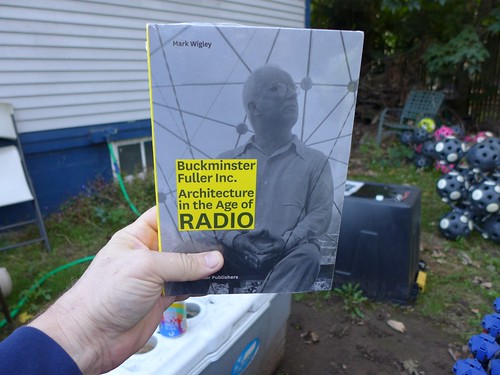
I just got Architecture in the Age of Radio delivered by the Borg (Amazon), and flashed it around, still shrink wrapped, on camera with Shrikant, during the pre-meeting yesterday. 

https://flic.kr/p/2myLcjQ  (picture of the book, still in plastic)

I was in lurk mode during the event, given other Wanderer types were gathered in my backyard, with the iPad like our flickering fire, complete with storytellers. I later moved the show indoors when it got dark. 

The "analog background" versus "digital foreground" theme was hugely front and center last night, as you might hear from the upcoming Youtube.

Still Shrink Wrapped

Monday, September 27, 2021

Sunday, September 26, 2021

Silicon Valley versus Big Bang Theory (movie review)

As my longtime readers may realize, I file TV shows under "movie review" and even Youtubes sometimes, such as when Tiffany shared that interview of herself and her parents.  I bring up Tiffany because Anthropology, the A in STEAM (not Art) is the name of the game.

Silicon Valley is smart and tight, Mike Judge satire.  Judge's resume includes Beavis and Butthead, King of the Hill, and most relevant, Idiocracy.  I regard him as a genius-polymath.  Hey, he makes films, yet he's lived on the inside in engineer world, with "engineer" broadly defined to include such characters as Silicon Valley features. In software engineering world, you're still allowed to be "self taught" as in "self made" although having a CS degree certainly helps.

Big Bang Theory has a different agenda as it's almost exclusively about nerds, not geeks.  Geeks have made it out of their larval stage (as nerds, ugly ducklings -- not physically ugly necessarily, there's always the makeover) and actually have excellent communications skills, even if only with each other.  They ascend through Gamer World, the focus of military recruiters these days.

The range of characters in Silicon Valley is impressive, from billionaires of different breeding, to VC firms, competing companies and teams with incestuous relationships (lots of spying), and yet the nucleus has many traits in common with the Big Bang crew.  The latter core cast is more of a subset of the former, likewise males sharing a common living space, but more confining.  One of the principals, Sheldon, is a physics nerd, not a software engineer.

Software engineering is an attractive vocation in India, conventionally for XYs and awkwardness around XXs gets much attention in both shows.

As a Geek, I much prefer the portrayal of my world through the Mike Judge version.  However I'm in the Silicon Forest, not the Silicon Valley.  An old story about the Oregon Trail recounts a mythical fork in the road whereat some would head for the verdant valleys of the Pacific Northwest, seeking a secure life in real estate and agribusiness, and others would head south to get-rich-quick country, the land of gold diggers and venture capitalism (high stakes gambling).

The way I think of it, my Pacific Northwest tribe was already here, vested in the fish business.  The year I was born was the year agribusiness asserted its upper hand, by drowning Celilo Falls behind the Dalles dam. I find dams fascinating and have them at the center of Martian Math.  My Martian Math science fiction has a lot in common with WestWorld, as I've always used the "tunnels under Disneyland" motif from engineering (akin to the Control Room trope), and more specifically from The Time Machine by H.G. Wells.  We're the Morlocks.

Big Bang Theory had a prime time slot, translating into safe to rebroadcast in rerun slots, so the script has a PG13 flavor, whereas Silicon Valley on HBO was more TV-14, bordering on R for language but without nudity or violence.  Congratulations on the lack of gun play in both of these, the blight of American television, reflecting the "eats their own young" parasitical civilizations that have set up tents here.

I believe Big Bang might've had a live audience as the producer denies using any "sweetening" i.e. a doctored laugh track.  Silicon Valley does not have a laugh track at all, real or artificial, which frees it to be more "adult" given how these days a laugh track more often than not feels manipulatively condescending, and/or in self parody.

Monday, September 06, 2021

Studying the History of New York City

Have I gotten lazy about blogging?  A lot of my autobiographical Quaker journaling type content fed into my Youtube channel, likewise with its autobiographical threads.  Threads add up to a process in NerdSpeak, in Apache.  Has my throughput diminished or simply shifted around on the spectrum, or even increased?  No answer is implied.

Over the last couple days I've watched the Ric Burns PBS documentary on New York, episodes 6 and 7, featuring Mayor La Guardia, and Robert Moses.  

Although the 1939 World's Fair is given significant treatment in Episode 6, Episode 7 made no mention of the 1963-64 World's Fair.  I've studied both from multiple angles, including through Defunctland, with documentaries by Kevin Perjurer.  

I've transferred some of these threads to my Youtube channel, mentioning T.C. Howard, Kenneth Snelson, and again, Robert Moses.  And of course Disney, as EPCOT figures in, with its iconic Spaceship Earth goliath golf ball.  The USA / USSR rivalry, likewise defunct, comes to a head in Critical Path in the mytho-poetics of one Buckminster Fuller.

I just returned those and other videos to Movie Madness on Belmont, by bicycle, stopping for a beer at Glenn's on the way back.  We're both reading Ernst Cassirer and Felix Klein these days.  ISEPP is building a curriculum timeline, with lots of emphasis on the Carnots, Lazare and his son Sadi.  

All of these authors are interested in the grammatical matrix whereby terms such as "energy" "velocity" "work" and "action" arise, in a Newtonian mechanical sense, but in alternative senses as well, perhaps presaging more contemporary uses (meanings) in some cases. Klein is more interested in the pure abstractions of mathematical language, but does not neglect the intersection of same, with physics.

The Ric Burns documentaries make that case the Le Corbusier and Robert Moses were somewhat anti-city in the sense of repulsed by crowded street life and pedestrian friendly organic villages taking up within a metropolis. Greenwich Village for example, which, in the person of Jane Jacobs, successfully repulsed a disfiguring slash from Robert Moses, the plastic surgeon.

Before these, I was watching the full Ken Burns documentary on Prohibition.  The Al Capone story branches to Bucky's.  The first two seasons of Silicon Valley (Mike Judge et al) are now also behind me. On Youtube, I've been going through the Common Sense Skeptic assaults on various favored, contemporary, science fiction flavored, narratives.

Wednesday, September 01, 2021

The Opinion Dispensary Model

When attending high school in Manila, by then adjusted to life in the Philippines more generally, coming from Southeast High, Bradenton (FL), I was caught up in a polarity.  

One the one hand, I liked to talk and participate in conversations. I was not a wallflower.  

On the other hand, I attached little weight to "opinions on the fly" and didn't think a conversation had to be about soliciting or offering opinions all the time, by which I include judgements.

I would push back at my teachers sometimes, especially in journalism class, saying things like "why are you asking me to have an opinion about a topic I barely know anything about?  I'm just a dumb teenager without even a high school level of education yet.  I wouldn't have any respect for my opinions if I hadn't really had time to do a lot of homework first, so why must I have them?"

Now of course it's obvious we judge constantly if not continuously and once in a judgemental mindset, it's hard to get from one moment to the next without rendering judgement on every significant aspect of one's circumstances.  

However I'm circling that mindset as a pitfall, as a sign of an overheated and distracted "thought process" (in quotes because I speak more in metaphor than as if I knew something about how brains work).

What I've since come to is that the caricature of "being an individual" that's often peddled, is that of a know-it-all type with opinions on everything.  

The opinions are allowed to be shallow.  

It's more important to have an opinion on a matter, than to have a malformed one.  The idea of "public debate" is we shape one another's opinions through discourse, but best to have a dog in the fight at least, or there's nothing to shape.  

"Having an opinion on" is considered the opposite of "being apathetic about". 

I would now counter that forming judgements and opinions need not be a high priority, especially during a time when you just want to investigate and not have a bias or prejudice get in the way.  

You find the attitude of open mindedness and "not knowing" to be refreshing and adopt it whenever justified, and it's often justified, because the horizons of one's ignorance may indeed be vast.

Wednesday, August 25, 2021

Critical Race Theory

[ cutting and pasting from Facebook ]

I was just listening to KBOO and the professor who seemingly favors CRT was into debunking that it had anything to do with the Frankfurt School or Herbert Marcuse. But why defend it if that's not what they're committed to calling it. CRT means "cathode ray tube" after all.

I gather the NAACP favors teaching true history, uncensored and unfiltered (like "for adults"), and doesn't claim to want CRT in the schools. We could assign that book Caste for example (good one! I'm reading it now! -- shows similarities of Jim Crow laws to Nazi Germany, which actually studied the American example as exemplary).

NAACP is saying (let me know if I'm wrong): "CRT in the schools is a red herring and those trying to ban it are really just trying to push rotten textbooks purged of anything ugly, which is itself ugly."

The interview mentioned some laughable Texas textbook wherein the word "slavery" was purged. Really? I'd like to add that one to my collection.

I think that old canard that what Texas chooses in the way of textbooks, thereby has to be the choice of many other states, given the economics, is entirely bogus. Not allowing textbooks to be distributed electronically, thereby allowing for far more diversity, is systemic racism in action.

Friday, August 20, 2021

From a Quaker Website

When it comes to the European experience, we already tell the story of the United States as one of east-to-west expansion, complete with the Louisiana Purchase, followed by Lewis & Clark and covered wagons.

Before the Civil War, Quakers moved westward for a reason many did:  to escape the stigma of being anti-slavery, an institution supported by local and federal governments. Those against it were a kind of terrorist in the eyes of their slave-holding neighbors and they fled west to escape persecution.

One Quaker I follow, in this westward migration, from the Carolinas to Minnesota, is Sam Hill.  He later made it all the way out to Seattle and settled on the north side of the Columbia River, hoping other Quakers would follow to build a settlement there. Conditions were bleak however and the vinyards would come later.

So for many years, his palatial Maryhill stood alone in desolate country, followed by his remake (scale model) of Stonehenge.  His passion: to build some world class roads. He had discovered their critical importance in his world travels.

In addition to building a first paved road along the Columbia, a demonstration project, Sam conspired with royalty and celebrities of Europe to turn Maryhill into a cultural museum.  Queen Marie of Romania came all that way out west, by Pullman, to bestow upon Sam a train full of art treasures from old Europe. 

Europeans were interested in the intersection of high culture and democracy.  How would the ethic of egalitarianism play out?  Sam Hill, a self made gentleman, was helping to show the way.

I'm seeing Unitarianism as a later wave of anti-slavery sentiment, reaching its peak after Quakerism did.  With headquarters in Boston, centered around Harvard, the Unitarians gave rise to the Transcendentalists, who formed a literary and philosophical movement that also spread westward. 

Walt Whitman, a poet associated with Transcendentalism, was an early admirer of Elias Hicks. 

The Unitarians, at their apex of power and influence, were well aware of the Quakers who had come before them, and who had already reached their apex of power and influence earlier, in Philadelphia. 

Quakers were against participating in what became the Indian Wars, in addition to disowning any who practiced slavery, thereby proving themselves out of step with their Anglo-European compatriots and their Manifest Destiny ideology.

Among the Transcendentalists, playing a central role, was one Margaret Fuller (1810 - 1850), who would drown with her small family, within sight of land, coming back from her adventure in Italy.  Her grand nephew would be R. Buckminster Fuller (1895 - 1983). 

Margaret, like Thoreau (with his "night in jail" scene), and like Transcendentalists everywhere, was not enamored with the idea of an American Empire, foreshadowing Mark Twain and the Anti-imperialist League.

One of my favorite philosophy professors, Richard Rorty, whom I met at Princeton pre 1980, later went on to write Achieving Our Country, a slim volume outlining his vision of a future American Left without all the Marxism. 

He traces his own leftism back through such figures as Emerson and Whitman in places, right back to Hegel and German Idealism more generally.  Nietzsche admired Emerson, not many people know, and used him as a role model for his Zarathustra character, by his own admission.

Will Quaker institutions of higher learning perhaps capitalize on these intellectual roots going forward? 

My approach is to show what that might look like, in terms of curriculum designs and reading programs. 

In the words of Dr. Steve Brule:  Check it Out!


Original Posting

Wednesday, August 18, 2021

On The Will to Truth

Simple Recipe

Depending on context, one may inadvertently highly overrate Truth.  

I've already filed many complaints against "existence" as an onerous attribute to have to argue about, in some nevertheless important language games.  I make fun of "egg zist ence" and cite the movie eXistenZ.

Today though, I'm picking on Truth.  

Imagine being hungry, having only specific provisions, and wanting to eat a healthy, hearty, well-prepared meal.  It's on you to perform.  You're the chief chef in this picture, and you get to eat your own dog food (an open source slogan -- means you make your own bed).  

What you'll need, working backwards from available ingredients, is an apropos recipe.

Now, are recipes True or are they False?  They may be irrelevant, for sure, if you don't have the ingredients or anything that will do as substitutes.  Ingredients may include heat, the ability to boil water, chopping devices, mixmaster machines.

In Python-verse, just about anything is True unless it's completely empty, like a recipe for making nothing.  Even that sounds truthy to me.  Does "true" merely mean "of substance"?  Is a brick wall true by definition?  Even if it's just in a cartoon?

So you have lots of recipes to keep in mind, and maybe no book to put them in.  Reading hasn't been invented.  Or they're in a language you haven't learned.

What if the rest of your knowledge base consists of elaborate fictional "fairy tales" (memorable fables) into which are woven the many recipes, invented and handed down through the ages.  To learn the lore of your culture is to acquire an amazingly efficient store and retrieval mechanism.

Humans think in terms of stories.  Stories are easier to memorize.  

So harness stories to store astronomical data, for example.  That's your clock, out to weeks, months, years and generations, whole epochs.  The night sky teaches about geological time.  The mind fills with ways to remember.  Mythology is born.  

Shallow scholars come along later and ridicule these fictional fairy tales for being "untrue" while completely ignoring their important mnemonic role.  The Earth's axis is slowly precessing, from one constellation to a next.  The complete cycle takes just under 26K years.

Beware, in your quest for comprehensivist viewpoints, of any Lust and/or Greed for Truth, as that's likely just the siren song of an attractive dogma du jour.  Be willing to give space to your ignorance, and acknowledge the limits to your knowledge, without giving up on the idea of increasing it.

Think in terms of algorithms (recipes) you might need, and ways of accessing them.  Moves in a martial art.  Kung fu.  Or moves in a sport.  Muscle memories in complement with "storied" memories.  Hardware and software.

What's "true" about choreography?  

As if language were all about "telling the truth" and nothing else equally practical.

Go wash out your mouth with soap (figuratively will do) the next time you catch yourself saying or thinking something so nonsensical.

Sunday, August 01, 2021

Wednesday, July 28, 2021

Of Arrogance and Pronouns

We've been treated to a lot of "I talk" meaning the "I" is very insistent on what pronouns we use to refer to it. 

However the pronoun that interests me more is "we".  There's this silent "we" I often want to demur from being any part of, yet polite conversation dictates that the speaker has a right to its "we" usage. We're not to question it.

Where this linguistic tension pops up in its most pithy form is in the American idiom "what we whiteman?" I often hear myself thinking this when some self-flagellant testifies to the war crimes of his tribe. "We bombed them anyway".  With the tacit assumption of shared guilt.  That's where the arrogance comes in.

I'm sure y'all know what I mean.  Sometimes one just needs a safe space to not get involved in all these "we" groups out there, that want to just assume you're their partner in arms.

Monday, July 19, 2021

More Pythonic Andragogy


Follow up Links:

Friday, July 16, 2021

One Dimensional Thinking

Take the color dimension, for example.  A corporate kindergarten mindset, frequented by unimaginative bureaucrats, wants the ethnicity picture simplified as follows:  a laminated panel of emoji faces, randomly ordered as red, yellow, brown, black, white.  

You are one of these, or a mix.  Unless you insist on filling in Other, just pick the one you're the most of and don't make a big fuss about it.

Anti-Racists despise this simplification to five or nine or twenty-nine colors.  A single color dimension is insufficient to map a complex territory.  

The mono-dimensional thinkers just what to impose an order they understand.  If there's strife within that order, e.g. yellow versus brown, that's OK, because at least it's according to the framework.  

It's when world events seem to have nothing to say to mono-dimensional thinkers that they get nervous, as they should, as they aren't "the meek" about to inherit the earth many imagine themselves to be.  No points in heaven for the five color race game, sorry.

Wednesday, July 14, 2021

Finite Structural Analysis

I learned from an architect recently that finite element analysis software is what's to blame for the logjam in giant dome experiments.  

We were all fully expecting Whole Earth Catalog types would be vying for a world record, in terms of height and diameter, if not at Burning Man, then perhaps in the deserts of Arabia (because there's uninhabited land for it, but also engineers used to large scale experiments).

Apparently, large scale domes, big enough to cover small towns at least, would build up anomalous stress points if constructed too regularly, or too strictly by the book, according to some well-known grid pattern.  

Here then that is what we want to test, in building precisely these structures.  

How well does the software predict reality?  You never know until you try it.

Fortunately, the budgets involved are not gargantuan, and the real long term benefits, in terms of gained experiences, are bound to pay off down the road.

We're not talking covered structures necessarily i.e. domes with coverings.  The focus is the skeleton and its pull and push points.  Said skeleton is likely made of repeated sub-triangles, or LCD triangles.  These were the kinds of structures Buckminster Fuller prototyped, when traveling from one university to the next.

Although honored in the field of architecture with various prizes and awards, Fuller worried about how much this discipline, supposedly concerned with the problem of sheltering humanity, had become the creature of those mainly seeking to erect monuments to their own egos.  

Skyscraper graveyards dominated the urban landscape, with contemporary humans living homeless in their shadows, in a post-apocalyptic dystopia.  Architecture seemed more about the afterlife, perhaps not surprising given its roots.

Once we get to coverings and enclosures, the more ambitious experiments will be underwater.  How big an underwater dome makes sense, and for what reasons?  Don't let structural analysis software give you premature answers.

Saturday, July 10, 2021

From Facebook

Friday, June 25, 2021

Dogfight Meme

No, I don't mean dogs fighting, like pit bulls in a pit.  

I mean airplanes dodging and trying to shoot at one another down, and I specifically mean dogfights involving single propellor planes with a fuselage-mounted machine gun that shoots through the spinning propellor blades.

Writing about Synergetics:

Comprehension is frustrated by our misconditioned seeking for the instatic synopsis viewpoint, or call it the search for Instant Universe which, once conceived, could be some desk-top model, like an astrolabe, that is IT! Instead, comprehension comes with patient application of operational terms associated with very generalized assortments of desk-top items: polyhedrons, marbles, models constructed from paper, wood and thread. MIND brings light to the workspace. But first, brain must get out of the way by placing itself in a subordinate position. This happens out of acceptance and recognition of the importance of non-simultaneity of Universe events meaning: the discrete quantum special-case experiences with desk-top items needed to inter-associate to create comprehensible models of great metaphysical integrity occur “out of order” and wildly scattered in linear duration. MIND orders the sewn in harvested packages thick with demonstrations of principles. For example: Synergetics 522.00 develops our conception of the deliberately non-straight line. )recall: the WWII airplane dogfight (522.23). )recall: the setting Sun (522.21).

Thursday, June 03, 2021

TikTok Meets GST

The didactic content on TikTok is pretty high, and users with cells (not usually in cells) both consume and produce, meaning the community supplies its own demands, with advertising paying the bills.

As is the case with Youtube, this social medium puts an emphasis on the individual as the unit of on camera (or in camera) talent, with sound, effects, formats provided.  Make a splash in a controlled environment.

This morning I was following a truck driver, presumably in real time, with viewers communicating via comments.  

The trucker's PWS (personal workspace) is live streaming to TikTokers joining in live.  The Trucker Exchange Program is on track to become a reality.

Tuesday, May 18, 2021

Riffing On Rorty

Achieving Our Country by R. Rorty

Date: Tue, 18 May 2021 07:10:54 -0700 
Subject: Re: The children's story 
From: kirby urner 
To: Trimtab Book Club

Yes, thank you hugely Maurice.  This was a really interesting podcast and my plan is to download more Rorty books to my Kindle (my daughter just bought me one, smaller than the original, same graphite grayscale, plus I use Kindle software on other devices).

The podcast deals with Rorty's 
(a) pragmatism 
(b) liberalism 
(c) nationalism.  

The last (c) may seem not to belong and indeed Rorty took incoming from the left especially, which had soured on nationalism to the point of fomenting anti-Americanism, whereas, in Rorty's view, the framework of liberal democracies (the US among them, along with Canada) was a last bastion between us and tyranny.  

Extending this thread a bit...  I found Achieving Our Country (AOC) in Archive.org for checkout.  You get to "keep" a digital image for 14 days.  A short tome:  a couple "lectures" and an appendix.  One thing I remember about Rorty's in-person lectures is he'd hand out dense, single-spaced, well-written multipage notes ahead of his presentation.  The implication I got is we were free to immerse ourselves in the talk and not furiously take notes, the kind of attention dividing many profs see as unhealthy to begin with.

Anyway, AOC is about Rorty, who grew up in a "leftist" (meaning liberal) family matrix (interesting autobiographical section), pointing out that the New Left of more Marxian and more anti-American vintage is a johnny come lately, that there's an older liberalism focused on labor rights, anti-racism, anti-imperialism, predating Marx, and owing much to Hegel nevertheless. Somewhat surprisingly, Walt Whitman was in this camp.  Yes, he read some Hegel.  And John Dewey, Rorty's hero through all his works.

This Old Left has more benign views of the New World's long term potential as it connects to the idealism of the Transcendentalists, although he doesn't invoke this school by name (Emerson...). William James and later "pragmatism" fall in the same line. Per this old left, fighting the Cold War was a good idea as Stalinism was terrible, like Hitlerism.  One could unite heros like James Baldwin (Rorty's pick) and later Muhammad Ali (my example), with some of JFK's best and brightest, going back to FDR.  America is not a "lost cause" and liberalism may include anti-communism.

At the beginning he writes:

National pride is to countries what self-respect is to individuals: a necessary condition for self-improvement. Too much national pride can produce bellicosity and imperialism, just as excessive self-respect can produce arrogance. But just as too little self-respect makes it difficult for a person to display moral courage, so insufficient national pride makes energetic and effective debate about national policy unlikely. Emotional involvement with one's country -- feelings of intense shame or of glowing pride aroused by various parts of its history, and by various present-day national policies -- is necessary if political deliberation is to be imaginative and productive. Such deliberation will probably not occur unless pride outweighs shame. 
 
The need for this sort of involvement remains even for those who, like myself, hope that the United States of America will someday yield up sovereignty to what Tennyson called "the Parliament of Man, the Federation of the World." For such a federation will never come into existence unless the governments of the individual nation-states cooperate in setting it up, and unless the citizens of those nation-states take a certain amount of pride (even rueful and hesitant pride) in their governments' efforts to do so. 
 
Those who hope to persuade a nation to exert itself need to remind their country of what it can take pride in as well as what it should be ashamed of.
I would contrast that 2nd paragraph with where Bucky goes with his own narrative since WW2, with himself as an epic character ("great pirate" etc.). 

The desoveriegnization process Bucky posits is more Hegelian in nature, but less a natural "withering of the state" (Marx) and more a natural "canceling out" (draining of significance, desanguination) of older patterns of thought, in the crush (fusion) of our one-planet one-media "global village" (McLuhan) or blooming buzzing "radio garden" (a computer app).

Looking back, the states didn't "yield" regarding the ongoing terraformation or "Borgification" (Star Trek epic) so much as they became compacted together in a cosmic inferno (ongoing) of swiftly integrating circuitry ("networks and networking"), always with a risk of meltdown (overheating).  Bucky-the-cold-warrior helped keep it cold vs. letting it become a theater for hotheads.

Either way, by Rorty's narrative route or by Bucky's, we have a USA to look back on with some pride in its contribution to what we have today, going forward.  Bucky was awarded a Medal of Freedom, like at the end of a Star Wars episode, upon declaring an end to the USA we have known, and the launch of a Grunch sponsored version.

Kirby