Saturday, November 28, 2020

Dockerizing My BizMo

Given I have this whole other BizMo Diaries journal (chronofile, blog...), why am I posting this one here?  A mistake?  More a cross-filing. 

I don't want World Game Player (Grain of Sand) to be oblivious when it comes to "a life on wheels" we could call it (leaving room to keep it metaphoric, as usual).  "Grain of Sand" being me, or any one of us, but why not "as a member of a bizmo team" in some chapters?  I need my left brain to remember what my right brain is up to, and vice versa.

Let's get to BizMo now:

BizMo: you go into the garage, where the many plain vanilla models are arranged. They come in many shapes and sizes.  Once you're in the one you've been assigned, based on your selections, you're ready to download your familiar cubby, the personal workspace environment you're accustomed to using. This rig is outfitted for business but doesn't presume to tell you what that means, in terms of desktop layout, icons, favorite playlists and so on.  That's something you craft, and port from vehicle to vehicle.

FAQ:

Some of you are thinking: all very fun science fiction but what's this 'dockerizing' business in your title, makes no sense. 

That's likely a minority, but who knows, don't feel left out.  In my vocab a Docker container is something that comes to you over tcp/ip, and equips your local workspace with a bunch of versions of stuff, all tested to work by whomever designed this container in the first place.  So you sit in the cab of your vehicle, enter some codes, and you get the kinds of applications you need to do the kind of work that you do.

You might be thinking:  why go to all the trouble to install anything locally when your vehicle has full time access to the cloud?  

You see how I set that up to contain the answer:  your assumption about full time access to the cloud is not assumed.  The team needs to operate remotely, off grid, perhaps on battery, and there's no seeking for signal in all circumstances.  But then another reason is response times, ease of use and so on, even when cloud access is maintained.

I'm using Docker in the following way these days:  

I like using the Python language but it's always moving ahead to a next version.  Sometimes I want to play around with the next version without yet changing my everyday work bench, so I turn to Docker.  Thanks to one of those containers, I'm able to boot up the newest Python and work out in its shell, import its Standard Library modules, sometimes cutting and pasting to Quora, where I'm storing my answers to questions, as a way of giving back and working out.

I could be doing all this from within a wheeled BizMo, an actual van of some kind, in which case I might have given myself a Cascadia themed dashboard that talks a lot about geology as we're driving by (something designed by Patrick and Diane).

Saturday, November 21, 2020

Pythonic Polemics

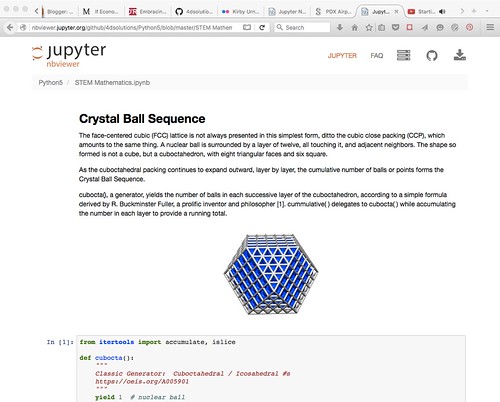
jupyter_window

I've been circling the block, pounding the pavement, knocking on doors, none of that literally, to advance the just cause of (drum roll)... lets just call it: sharing the Pythonic ecosystem.  Yes, "python" sounds like a scary snake, eating up the everglades in Florida.  Monty Python is funnier, but is also esoteric.  But then geeks enjoy esoterica... 

I'm talking about Python the computer language, invented by a Dutchman named Guido, with a lot of help from his friends.  It's a gateway language, a grand central.  Get oriented in Python, then use it as your bridge to something else.  Take advantage of those added smarts.  Python fits your brain.

"Pythonic" means pithy, to the point, according to the principle of least action, optimized.  It doesn't mean densely clever or tricky, what the Djangonauts call "being an astronaut". 

When you code in Python, you're ideally not showing off so much as upholding standards.  You're aiming for readability, almost personability. Pythonic code is reader-friendly.

On Quora, I answer a lot of questions about Python, though I'm starting to branch out more.  Answering questions about Python helps me improve my writing and teaching ability, or to at least stay in shape.

This ecosystem includes more than just the one tool however.  We have that whole Anaconda business, with the flagship Jupyter, both Notebooks and Labs. 

I saw another thing calling itself Pluto out there.  Imitation = sincerest form of flattery. That's what they say.  We're not talking about planets here, but types of interactive "notebook". Know what I mean?

I'm the guy thinking it's a travesty to offer something called "high school", which is supposed to get to the median hard core of whatever the current culture has to offer.  Yes, that includes skills like:

cooking
supplying the cooks
cooking for groups
nutrition
programming
driving
playing sports
reading maps
making jewelry, other adornments, clothing
studying infrastructure (both global and local)
tilling the fields, planting
caring for animals
personal and public health... 

... and then, as usual, academics: PATH + STEM.  

Jupyter stuff would usually go under STEM but could just as much be Literature (silently between A and T, anthropology and theater) or natural language processing (NLP).

As a futurist, I work to keep pace with the Zeitgeist, not hang back and pretend like I still live in the past. 

Not having a command line, a shell, a place to store files, electronically, in the cloud and/or locally, is so forty years ago by now.  

I remember my gig with the police in Hillsboro, Oregon, who were pissed.  Why inspire fear among the youth, around the criminality of copying (piracy) -- Napster was new -- when the copyleft cultures exist?  

You don't need to pirate Windows when you can legally copy Debian, and distribute it to all your friends. This liberated media culture had legally free music tracks, as well as free executable programs.

These police, led by a second generation Chinese police chief, resolved to teach about that Copyleft World themselves, at the police station, if the schools were too cowardly to do so. I'd hazard most were more lazy than cowardly. 

The police hired a Linux + Python teaching duo, Jerritt Collard and myself.  Officer Heuston (since retired) was our man on the inside.

So yeah, if you went through high school in the last five to ten years, or make that twenty to thirty, and had no exposure to Python, or Jupyter Notebooks, then you live well below the poverty line in my book.  You've been oppressed.  

I'm not saying to therefore act like a victim.  

I'm saying it's your work to fight back.

The Zen of Python, by Tim Peters


Beautiful is better than ugly.

Explicit is better than implicit.

Simple is better than complex.

Complex is better than complicated.

Flat is better than nested.

Sparse is better than dense.

Readability counts.

Special cases aren't special enough to break the rules.

Although practicality beats purity.

Errors should never pass silently.

Unless explicitly silenced.

In the face of ambiguity, refuse the temptation to guess.

There should be one-- and preferably only one --obvious way to do it.

Although that way may not be obvious at first unless you're Dutch.

Now is better than never.

Although never is often better than *right* now.

If the implementation is hard to explain, it's a bad idea.

If the implementation is easy to explain, it may be a good idea.

Namespaces are one honking great idea -- let's do more of those!

Tuesday, November 10, 2020

Another Russiagate Postmortem

I think Trump is a lifelong real estate and casino owner crook (of the kind that do well in this country) and digging into his inner workings is definitely going to yield dirt, lots of dirt. Reminds me of vice president Johnson, in the sense of lurking scandal. Saved by the bell.

The Dems were diligently doing that digging, paying Steele, and enlisting the support of FBI operatives in going after Flynn, whom they feared might be a loose cannon (Obama considered him a nutcase).

Trump's assertion he could get along with the Russians was indeed alarming. Presidents don't get to say whatever comes into their heads like that, not when it comes to national security. Trump was a rank outsider with no District experience. "Spy upon him we must" was the sense around the FBI, according to testimony as recently as today's. The McCabe Cabal was getting grilled again, for abusing FISA.

As for the two main aspects of the Russiagate story:

(1) Russians have as much right to troll farms as anyone and Facebook users are not intrinsically protected against the PR / propaganda efforts of paying users. 

Lots of trolls use Facebook to influence public opinion, including Brit and Israeli IDF, so to single out Russians is just bigotry and part of that old timey "how we make money in the District is scare people about commies" (even if Russians aren't commies anymore -- doesn't matter that much, people aren't paying that much attention to begin with) and ...

(2) it wouldn't take a large crew to write the technical parts of the CrowdStrike report, wherein the GRU are depicted as hearing Trump publicly call for digging into Hillary's emails, and deciding to hop to and stay late, beginning phishing operations right then and there, eventually snagging Podesta perhaps.

It reads like a screenplay, complete with comical swear words, the cursing of Crowdstrike by Guccifer 2. I wonder how many government documents of such gravitas contain such silliness.

A few people with an intimidating level of internet jargon (plus omniscient author viewpoint, self conferred) will have no problem crafting a narrative that presumes to reenact what the perpetrators were up to. Really close readers will "discover for themselves" this date/time coincidence and draw their own conclusions (that Trump is secretly signaling the GRU in his speech, cue CNN).

It's like one of those Qanon puzzles: if the light goes on in the reader's head in a way that makes them feel like Sherlock Holmes, then you've scored. 

I put Russiagate on the same moral and intellectual level as Qanon, i.e. in the supermarket checkout tabloid lane, same place where Hillary has an ET love child.

I know the Russiagaters consider themselves intellectual overloads, obedient to Science, and oh so superior to those superstitious Trumpers, but I find this self perception largely unearned. 

This naive "do you really think intelligence services would lie to me?" (big eyes, quivering lip) after decades of being lied to (Vietnam, Central America, Iraq), just seems pathetic.

Thursday, November 05, 2020

EPCOT Revisited

Defunctland: Walt Disney's City of the Future, E.P.C.O.T.

I like that Kevin, the narrator, brings up the "science fiction meets reality" issues that EPCOT would have to grapple with. What about civil unrest, what about voting? What about democracy?

If you watched the Defunctland deep dive into the Robert Moses project: the New York World's Fair of 1964-65 (in which Disney was intimately involved), you might remember the worker slowdown.  In today's terms, one might say "the Black Lives Matter movement was not entirely happy with these white supremacist plans" -- which is how they came across on many levels.

I like to think the Old Man River City project was set afloat in the culture to grow organically.  There's no top down support for it, just as there isn't for Fuller type futurism, which I assume many still confuse with a kind of technocratic fascism.  I'll be addressing these topics on my Youtube channel, perhaps tomorrow.

Friday, October 23, 2020

Sunday, October 18, 2020

Philosophy Group Meetup


I know about this channel thanks to CJ, who anchors my network (from my angle) in Philly, with a connection through Quakers in that I'd visit when going to AFSC corporation meetings.  

I was also at the founding of SNEC (Synergeticists of the Northeast Corridor), a Russell Chu production (the founding itself, a big gathering including Yasushi Kajikawa), after he and Deb had moved to DC.

The focus here is the opening two chapters of Operating Manual for Spaceship Earth, by R. Buckminster Fuller, and listed in Nature as one of the more influential "big picture" books of its day -- or any day by implication.

The moderator, Shrikant, does a good job integrating Fuller's specific (specialized) terminology with his own, and with that of "System 1 versus System 2" by yet another thinker. Lots of synergy happening. Then he brings in volunteers from the group, scheduled beforehand, who get "lightning talk" opportunities, with feedback from the moderator as to whether they're on topic.

I'd been pestering CJ about his leaving out the "Great Pirates" in his website overview, as to me that's the signature concept on many levels. 

He didn't want to dismay those doing truth mining i.e. what if "Great Pirates" are more mythic meme than hard core fact?  Anyway, this group had no trouble grokking the poetic angle, so I needn't have worried.  

The term "comprehensivist" is getting bandied about a lot, in addition to "polymath" -- not in this meetup especially but in the channel more generally.  

I was glad to hear Ken Wilbur mentioned, against the backdrop of such "est people" -- like the moderator, a lover and maker of useful diagrams of metaphysical matters.

Friday, October 16, 2020

Reposting from DOME


https://mybizmo.blogspot.com/2009/01/about-habitats.html

The Youtube embedded in the above blog post hearkens back many years, and shows me addressing an unseen audience at the Linus Pauling House. That same boyhood home of Linus Pauling may be seen in the slides that go by in Hanging By a Thread (the video below).

Bucky's vision was the aerospace sector could take on the problem of providing shelter in a big way. His vision inspired many DIYers (do it yourselfers) and indeed many small businesses, such as Oregon Dome in Eugene. Maybe the closest we got in practice to aerospace sector participation was Airstream.

Lets not forget the original Dymaxion House concept was not a dome, but a yurt.

My Youtube channel takes up some of the divergent views of the future we might invent. That's where I emphasize the importance of science fiction to Martian Math.

Reviving popular interest in "the industry industry missed" (new kinds of housing) doesn't have to be in lieu of driverless cars, or transportation in general. We need to think of seamless ways to weave our shelter and transportation needs together. Batteries will be playing a bigger role.

Wednesday, October 14, 2020

Grunch.net Compromised

Yummy Scum

A sincere Bucky and dome fan, whose site I just joined, sent me a heads up today that heading into my Alexander Bell page from a search engine, would likely redirect to an erectile dysfunction countermeasures site.  

I got on the horn with GoDaddy, to whom I pay extra to keep a junky WordPress site from being compromised.  It's not that I don't value the content.  On the contrary, I've done well on a low budget in my estimation but... there's always pushing WordPress to far.  To upgrade this time, it wants a higher version of PHP and apparently that's an operation attended to in the GoDaddy back office.

In the meantime, short of upgrading (I consider that in process) the security agreement entitled me to a cleaning, and, sure enough, all kinds of grotty yuck came out in the wash. I got several emails listing the many nasties found floating in my WordPress glass.  Hosting websites can be so unsanitary.

Grunch.net warehouses backed up hand coded, static HTML for the most part, my Synergetics on the Web.

Thursday, October 08, 2020

Sam Hill: Citizen Diplomat

Students following my place based curriculum may have followed me up the Columbia Gorge, where landscape photography was pioneered, before the data centers, to Maryhill Museum aka "Castle Nowhere".  Sam Hill conspired with Loie Fuller and Queen Marie of Romania, to make Maryhill a museum long before he died.  He thought ahead, in terms of after death, building monuments, and most of all, public roads along the Columbia.

Situate Sam Hill against the backdrop of Theodore Roosevelt, whom Sam had a low opinion of based on the latter's racism towards his touring Japanese troupe of jujitsu artists. Sam had been to Japan, to Russia, to points all over, having married, had kids, and "retired" to the hard work of private enterprise and travel. He'd made his fortune in Seattle practicing law and investing in the emerging phone business.

Now separated from his Catholic wife (with no talk of divorce of course) his main mistress, Mona Bell, was one of those out there amazing new kind of women, who rode bareback for the wild west show, and swam across an icy cold channel, as was the fad in those days.  From humble beginnings, this Minnesota girl had leveraged her vivacious beauty towards becoming a socialite and minor celeb, although she could pass for a cowboy too (she'd disguised herself for the rodeo in an early chapter).  She and Sam met in San Francisco.  

Situate Sam as a contemporary of Homer Davenport of Silverton, Oregon and oft time political cartoonist for the Hearst Empire and its Spanish-American war.  

Picture Mark Twain and the anti-imperialist league.

The idea of a "public road" goes to the heart of democracy. Some would "own" it and put toll booths. Others would close it temporarily so the royal entourage could enjoy exclusive use thereof.  That's anything but public.  

Queen Marie of Romania had been impressed by the Emersonian dream of co-equality and self reliance.  She toured the new nation (the United States) by train, in an entourage of cars (donated by the railroads, in exchange for publicity), determined to rub shoulders with "everyman" i.e. her technical co-equals in this brave new land.  Sam Hill's place was to be her destination. The train was crammed with paintings, furniture, all things Romanian. 

She was married, the King sick with cancer. Sam would have loved if she could have stayed I bet. He had a serious crush on her. The dedication of Maryhill Museum was lovely, although Loie Fuller (Marie's best friend) stayed in the train, thinking herself too low class and a possible source of embarrassment.  Old reflexes die hard.

The public roads, like the museum, came to be, as did the easing of royals into the life of celebs.  Queen Marie had been hoping to go to Hollywood, but those railroads weren't into taking her around for free.  

She might have been a movie star herself, as she already was on the world stage, in the newsreels.

Quakers haven't done a lot on their side to bring Sam Hill into the fold. That Quakers didn't move to desolate, windswept, rather dry farmland, was testament to their good sense as farmers, but ideologically Sam was anti-slavery, pro equality and I'd say a pacifist. His Quaker family had escaped persecution back east, as had many Friends, due to their abolitionist mentality, moving to the midwest, part of a larger refugee migration pattern.

True, later in life he obsessed about the Soviet menace, and earlier shared in the demonization of Germans when it mattered. He was not such a contrarian as to not fit in.  

But his Peace Arch on the border with Canada, along with Stonehenge, were meant to keep us looking back on war, grateful for the more peaceful road ahead. That the world would stay so uncivilized was not his doing.  On the contrary, he was a positive futurist, and his own projects were prescient.

I, for one, will be welcoming citizen diplomat Sam Hill into the fold of great Quakers, weighty Friends.  I have no trouble thinking of him as a friend of Jesus, whether or not he found the time to sit in Meetings for Worship.

Thursday, September 17, 2020

Parking Space

Parking Space
Fig 1: exaggerated view

David Koski and I have long wondered how best to model an intermediate stage in an "S-Factor Transformation" which relates to the Jitterbug.

The Jitterbug starts off with a 20 --> 18.51... reduction in volume, as the cuboctahedron contracts to become an icosahedron.  One application of the S-Factor reciprocal i.e. 18.51/20 ~ 1/1.08 takes us from 20 to the target shape.

A next application of the same constant takes us where?  Two applications take us to another cuboctahedron, with faces flush to the same reference octahedron as the target icosahedron's.

Fig 2.: Icosahedron and Cuboctahedron,
flush to the reference Octahedron

Our current thinking is to park the shape resulting from one application of the S Factor, in between (Fig 1.), yet flush to the same reference octahedron.

Thursday, September 03, 2020

Building Ubuntu (School of Tomorrow)


I've been carving a path, route, throughway, for tourists one could say, through some of the more challenging terrain in our syllabus.  What to make of "non-literal science" and isn't that an oxymoron? Was alchemy ever at all a science?  How about psychology?  The psychologists seem the most like stage magic illusionists, in that they misdirect you in the lab setting.

My focus on irrigation, the management of channels, of water flow from top to bottom, took me along the fly-through in Critical Path, from Polynesia up through Southeast Asia and into the Himalayas, a flight with mnemonic value in that now you have seen some great river systems and thought about how humans feed themselves, not forgetting the fish in those rivers.  They also power themselves, harnessing the river's momentum to force light to move, through circuits.

My narrative patter focused on "what was scary" in Critical Path without being scary. 

There's the fact it's about money, but minus the crypto-currencies as it was published in the 1980s (St. Martin's Press). Yet much about money is cryptic in that its symbolic manifestations trace to the bull trading cultures of Phoenicia, a sea-based empire we don't learn that much about in school, which is taught mainly by landlubbers.

Then it's about "cold war stuff" as I put it, in the context of continuing to introduce JFK in several permutations.  By this time we've identified Man X and played a game with Joe Rogan videos, regarding the Donald Sutherland character in Oliver Stone's movie JFK.  I then point to a PBS documentary and mention the Cuban missile crisis.  Mostly I talk about the inward and outward facing observer satellites and the data they've been giving us.

Finally, the irrigation discussion becomes more focused on electricity, but as we've seen, the two were unified from the beginning as water wheels became hydropower. 

I'm leaving it to my more serious students to actually read Critical Path, now that I've warned them of its mythopoetic backdrop, an opera we could "make work" I suggest, but without taking it on.

Throughout, I'm remaining friendly to Oregonians who may have sampled the kool-aid and decided not to go with my "culty stuff" meaning the Concentric Hierarchy of Polyhedrons (Kepler-like) in Synergetics.

That's spreading in alien terrain perhaps, but I need to walk my talk when I invite teachers to customize. Maybe it's just the workflow, of web hosted videos, embedded in notebooks, on version control systems, on school servers, that they wish to copy.

Monday, August 24, 2020

Friday, August 07, 2020

Tuesday, August 04, 2020

Saturday, August 01, 2020

Ecology of Systems

Sometimes it's fun to re-compartmentalize i.e. keep thinking in terms of "subjects" (as in "academic subjects" aka "disciplines") just different ones. Be inventive.

For example the way psychology managed to squeeze into the liberal arts and overlap religion; that sure changed how people compartmentalized. 

You didn't have a large medical establishment working alongside the church to address "mental illness" (Foucault talks about all this of course). 

When I studied Wittgenstein's stuff at Princeton under Rorty et al, I kept bopping back and forth between Philosophy and Religion departments for classes, yet I think his investigations also fall between Anthropology and Psychology (both still young disciplines in his day -- he wrote about both).

Thursday, July 23, 2020

Americana


I think literature teachers are possibly a little shocked how I:

(a) go for film on top of other texts and 
(b) weave through specific films

The film here is Citizen Kane, already in the film school Vaults of Parnassus, so what's the fuss there? The scenario (hike) is through the two DVD set, meaning the movie, and then the American Masters series on Hearst versus Welles, WGBH, Sloane Foundation. 

Why?  Two reasons right off the top:

(a) Welles is already important in our Martian Math sequence, for his scary performance of the Mars Attacks story, meaning War of the Worlds by H.G. Wells (easy mnemonic there: Wells and Welles) 

(b)  WGBH American Masters also did Thinking Out Loud about Buckminster Fuller, around the same time, another high quality documentary.  We'll be watching them both, perhaps back to back, with some discussion of the documentary style.

The reasons don't stop there.  Here in Silverton, Oregon we have a lot of excellent history, and fellow Wanderer and historian Gus Frederick has curated a lot of it.

He's our local expert, I'd say world expert, on Homer Davenport, the powerful political cartoonist and Arabian horse enthusiast whose career intertwined with Hearst's on many levels.

In other words, I'm trying to branch out to pick up more and more history, such as the Spanish American War, such as the Anti Imperialist League (Mark Twain, Andrew Carnegie...), such as the American war in the Philippines, not that many decades before the American war in Viet Nam....

Once we've studied Hearst as a model, we'll jump to other oligarchs.  I'm not the only curriculum architect able to connect the dots around here.

I just want to be sure to underline this section of the pipeline:  Welles on CBS doing War of the Worlds, and the whole arc of Orson's career, vis-a-vis that of his contemporaries.  He knew Hemingway...

Another puzzle piece:

In this placed based curriculum we study the Columbia Gorge for at least these reasons:

(a) geology since Missoula Flood
(b) the invention of scenic photography with the Gorge a target
(c) submerging Celilo Falls, and the civilizations that converged there
(d) Sam Hill's commitment to state of the art road building along the Gorge
(e) hydropower dams, grids, ecology (along the Gorge and elsewhere)
(f) Hanford and the Manhattan Project and the chronology of nuclear testing (including with human subjects)

That's a lot of reasons to take in the Columbia Gorge, and we're just getting started.

DVD Set

Tuesday, July 21, 2020

RSA > USA

Having traveled around in South Africa some (not a lot, didn't get to Joburg at all), I'm going to say this:

(a) the racism picture is more complex there
(b) the solution space is further evolved there

I go back to this story:  feedback I got when in RSA, regarding earlier relations with Quaker AFSC, was that Americans were too quick to elder others, drawing on their own civil rights history as definitive and all encompassing, a source of lessons for others to learn from.  In other words:  Americans suffer from ethnocentrism.  I wouldn't step in as their lawyer at this point.  "English too" I'd pile on.

But then English, in having been a real empire, did grow up worldly, and to this day NPR turns over to BBC the more serious world news telling.  For night owls.  Nerds.  And English are one of the ethnicities in the RSA mix.  Like I said, more complex, more nuanced.

Yes, I'm a Die Antwoord fan. I met a new relative (extended family member) from there who expressed embarrassment over their antics.  I was in drop jawed awe over the brilliance of Chappie for example.

Seriously, when my parents were co-clerking a Yearly Meeting, prior to the accident, I got to sit in on some reminiscing and post mortems.  We weren't far from Maseru, the family headquarters. Dawn taught a labyrinth workshop.

Apartheid was in the rear view mirror already.  Mandela.  Bishop Tutu. Truth Process... So much water already under the bridge.  I visited the Quaker Peace Centre and met the Routledges. We were later guests in their home in Cape Town, when Madlala was Deputy Minister of Defense (an unusual position for a Quaker, somewhat Mithraic). This was during the 1999 Parliament of World Religions. Dawn also took in a transmission, from the Dalai Lama, in Durban.

What I learned from Hendrik W. van der Merwe especially was about the delicate cybernetics of it all.  As a mediator, like a ref, he'd literally swing his chair around to side more with the police officer, if the power dynamic suggested he should throw his weight in that direction.  I think "precession".

Friday, July 17, 2020

CareWheels: Retrospective

DigitalHomeTechConvergence

From my Facebook profile, today:

Me:

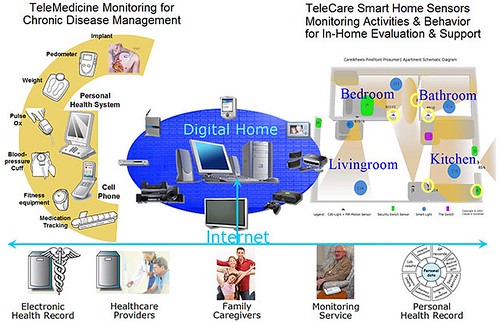
Thinking back to CareWheels and spin-offs. This was to be a home monitoring service whereby elders, seniors, I'd add unsupervised teens and children, any age really, with caveats (not infants), would stay in their homes but send off lots of signals just by moving around and doing stuff. It's not about spycams which no one has time to look at or space to store.

It's about medical cabinet open close, bathtub use, shower on/off etc.

Ron Braithwaite could tell you how Machine Learning informs a human staffed set of dashboards (humans working from home also, they monitor each other), with dispatch teams at the ready for both scheduled and unscheduled home visits.

Like if the pill dispenser isn't activated within a time frame, or the bathtub gets turned on but not off... or a stove burner. IoT. Protocol might be to call first, contact a signed up neighbor if no response, only escalating as makes sense.

You don't dispatch a team at the drop of a hat. Patients at especially high risk for some medical condition will presumably have sensors for that, e.g. blood pressure or whatever. It's up to you and your doctor what level of monitoring is indicated. Some people opt out of some options.

Machine Learning has only gotten better since this infrastructure was first envisioned.

Ron Braithwaite:

Yeah, CareWheels was a fantastic idea. In fact, it was one of the driving reasons why we were going to move to Canada.

Honeywell owned (owns) a bunch of patents in this area, which they have never done anything with (TTBOMK), so we thought we would make it happen in Vancouver, BC with the help of a couple of non-profits.

The basic idea was to use machine learning (https://en.wikipedia.org/wiki/Bayesian_statistics) to determine when things usually happened and how long they would take, using simple sensors all over the place, wiring up an elder’s home to allow them to age in place.

I worked out a deal with Canada’s largest non-profits working with elders and another working with those who were disabled to provide a computer and modem on each end, targeting those who were primarily house-bound both as clients and as care providers.

When our machine learning algorithms detected something unusual, they would contact the assigned care provider, who would attempt to contact the client and, failing that, then contact designated family members, and (worst case) emergency services. In addition, the care provider was tasked with making contact with each of their assigned clients every day.

Just as an aside, did you know that 90% of all calls to emergency services by elders are for socialization? People get lonely living at home, so having someone - anyone - calling them daily takes a huge load off emergency services.

At any rate, the way it worked is that each sensor for each person had a specific typical time value associated with when the sensor detected activity. If the elder typically uses the restroom for 45 minutes at 9am, but doesn’t exit the restroom after 90 minutes, somebody needs to check up on them, just to make sure they haven’t slipped in the tub and broken their hip. The Bayesian algorithm learned the pattern of each client, so we were looking for exception conditions for that specific person and avoiding the problems rule-based expert systems.

Perhaps the most heart-breaking tragedy of getting turned away by a Canadian Immigration agent (I have always assumed it was because I’m an obvious hippie, but I really don’t know) was having to call the first person I had hired as a caregiver. I had interviewed several and picked him to lead the caregiver cohort, for a variety of reasons. Not the least being that he had suffered a traumatic brain injury about 12 years previously and couldn’t get a job, even though he was not cognitively impaired. He sobbed into the phone as I told him that we were turned away and it wasn’t going to happen.

I still think it is a viable service and I would love to contribute to the project if someone else were to resurrect it.

Thanks for reminding me of this, Kirby. This was fun to dredge up old memories of tilting at windmills.

Friday, July 10, 2020

Oregon as a Campus Context

West Side Roof

The roofer guy, who came here to give me an estimate on the Owens Corning system solution, said I'd first need to get the west side walnut tree cut back.  My upbringing in the subtropics leaves me somewhat too comfortable with the advance of nature vis-a-vis these temporary human abodes.  I've been thinking about Logan's Run, the later scenes, when they're out of the bubble, in the former capital.

In the meantime, I'm still thinking Asylum City as a code term for Campus, which is just as well a Base.  Depending on how we want to shade things, or colorize them, we have these different lingos.  The Vortex and Woodstock festivals, Oregon's Country Faire, the failed Rajneesh Puram experiment, all feed into my alchemical cauldron when I cook up visions of schooling options in eastern Oregon.

Your actual campus might be somewhere remote.  You would learn to operate a windmill and solar panel powered campus, with various backup fuels, new kinds of batteries.  Attaining self sufficiency to some high degree is one of the challenges, but this isn't Biosphere 2.  

There's no attempt, in these experiments, to somehow dome over the entire community, even if domes do feature, as theaters and planetariums perhaps.  Or as greenhouses.  Gymnasiums.  How were these structures delivered?  Do we want to experiment with Bucky's vision, and use helicopters quite a bit?  How about dirigibles?  Is the campus served by blimp?

Thursday, July 02, 2020

All Classic FM

Thursdays at 3.  All Classic FM.

I'm doing a lot more on Facebook than I used to, whereas I've throttled back on making Youtubes a whole lot. That's a stash in inventory ready for service if and when.

I'm eager to keep that "3rd culture" meme going, not my invention, as there is some camaraderie among international school students that transcends "culture of origin".  

I tend to recreate such microcosms, or seek them out, when left to my own devices, hence all the AFSC work.  We "3rd culture" folks tend to feed, or feed on, a kind of loneliness that goes with Lonely Planet (the sense of tourist at large, like a National Geographic veteran).

Speaking of global awareness, I'm still enjoying radio.garden the website app.  There've been chapters wherein it stopped working, but at the moment it's blaring away in my ear.  I'll get my OPB this way. Since I stopped driving as much during Covid, I'm not getting those hits off my radio.  

Or am I on KBOO at the moment?  Playing Blackbird by The Beatles, instrumental only.  

I'll note when I hear call letters (station self identification).  The app lets you point to dots on a globe, then snarfs the feed (assuming the station streams) via tcp/ip.

Domestic adventure:  Carol was in the car already when I realized I'd locked my keys inside.  The ladder helped, but don't try it, as probably not in the way you think.  

Also:  the snake got out again, but I found him.  

Oh wait, I think this might be Portland Classical.  Yeah, All Classical FM.  Listening through optical fiber, playing on the Asus Windows tablet, the current Blender machine.  I'm blown away by what people can do with Blender.  

Everyone is a Michelangelo.