Saturday, February 26, 2005
A Bug's Life (movie review)
An innovative ant, with creative assistance from the circus, stages a design science revolution against tyrannical grasshoppers and wins (Disney/Pixar 1998, rated G).

Tuesday, February 22, 2005
Education Reform (part N, N > 2)
"What will it take to maintain the United States' position as a hotbed of innovation? Robert J. Herbold has an answer: improve K-12 education" (quoting from the Boston Globe). A big part of it is the usual thing about paying the best teachers a lot more money ("$125,000 or $150,000 if they're really good").
But I think in some ways this is a typical CEO mistake. In CEO world, net worth is an important parameter, and it's often not so much the job itself one loves (something about insurance), as the status and clout that comes with being able to name at least six figures on your personal income statements, maybe more. But teachers usually don't earn their clout by bragging in that way. They've had to evolve a more-with-less aesthetic, meaning it's efficiency and economy they admire.
In contrast to using personal net worth as a key parameter, consider how it goes in the military. Here the fun is in access to institutional wealth. No one with a piddling six-figure income can afford a personal F16 or an aircraft carrier, let alone a personal nuclear submarine. These are like corporate assets, which CEOs use as well: the company jet, a private retreat in the mountains someplace. But the point is these assets are on the books as owned-in-common (with taxpayers, in the case of the military, with shareholders in the case of an LLC).
So now consider really good teachers. How is a mere six figures going to make better infrastructure materialize? What about those DVD juke boxes? The cost of the hardware is tiny compared to the amount of hours needed to stock them with clips.
Consider a teacher such as myself. At OGI I get a ceiling mounted projector, fast Internet, and every student has a fairly decent workstation. That's the kind of apparatus I need to make my curriculum go. If I'm at Podunk High, and you start paying me six figures, is it that I'm supposed to go out and buy this stuff for my school? That'd be silly. So how are my dreams for a dynamite curriculum being advanced by teachers having all this new personal income, minus any infrastructural improvements? That's like tripling a soldier's pay, yet providing no better armory. So you get to live high before you die. But really, what was the gain professionally?
I want a bizmo, a home office gizmo. It'd be one of many, part of this fleet of "master teacher mobiles" fanning out across the country and representing a more futuristic and secure planet (a next upgrade for Spaceship Earth). We're backed by control rooms, and have dynamite curriculum to share, like really cool GPS/GIS and folding/unfolding Fuller Projections courtesy of National Geographic. We already have the technology. It's just a matter of fitting existing puzzle pieces together.
We go into communities and stir things up with appealing imagery of Tomorrowland, only in some sense it's already here and happening. We're happy to recruit new teachers into this lifestyle, or one like it, just like the military does, with flashy toys, eye candy, and promises of adventure. We'll compete, and on a more level playing field. Like, we'll have some real institutional wealth to show off, including USG supported, corporately co-sponsored campuses you can apply to, as a student, as a teacher -- just like on Star Trek (well, sort of).
But I won't be able to do any of this with a mere six figures. Pumping a lot of money into "best teacher" wallets is a divide and conquer strategy, aimed at keeping we the people from demanding public investment in shared infrastructure. CEOs tend to not understand the idea of public wealth, even as they enjoy corporate assets, because so often their job is to externalize costs i.e. to erode public wealth, to pollute, to politically corrupt, in order to concentrate profits and buy fancy boats (which more than half the time just sit in the marina). In fact, a lot of the time, externalizing costs means making the military pay for it.
So I guess I'm more interested in hearing what career military people have to say about improving our education system. At least they understand socialized/institutional wealth. They understand that master teachers are masters because they have high powered professional/public goals e.g. to develop a more realistic and positive brand of futurism, and not just private/personal ones e.g. access to health care. Master teachers are committed to evolving the infrastructure, and that includes curriculum.
Also, on another front, Herbold doesn't say anything about our Fuller School and our many curriculum contributions. Again, I'm more inclined to tune in the Pentagon Channel. A lot of these private sector CEOs are really quite ignorant of American history, of the global military situation. I'm having an increasingly hard time taking them seriously. They've been too busy making money to make sense. They need a new curriculum as much as anyone.
Some earlier ed reform posts (this blog): [1][2]
But I think in some ways this is a typical CEO mistake. In CEO world, net worth is an important parameter, and it's often not so much the job itself one loves (something about insurance), as the status and clout that comes with being able to name at least six figures on your personal income statements, maybe more. But teachers usually don't earn their clout by bragging in that way. They've had to evolve a more-with-less aesthetic, meaning it's efficiency and economy they admire.
In contrast to using personal net worth as a key parameter, consider how it goes in the military. Here the fun is in access to institutional wealth. No one with a piddling six-figure income can afford a personal F16 or an aircraft carrier, let alone a personal nuclear submarine. These are like corporate assets, which CEOs use as well: the company jet, a private retreat in the mountains someplace. But the point is these assets are on the books as owned-in-common (with taxpayers, in the case of the military, with shareholders in the case of an LLC).
So now consider really good teachers. How is a mere six figures going to make better infrastructure materialize? What about those DVD juke boxes? The cost of the hardware is tiny compared to the amount of hours needed to stock them with clips.
Consider a teacher such as myself. At OGI I get a ceiling mounted projector, fast Internet, and every student has a fairly decent workstation. That's the kind of apparatus I need to make my curriculum go. If I'm at Podunk High, and you start paying me six figures, is it that I'm supposed to go out and buy this stuff for my school? That'd be silly. So how are my dreams for a dynamite curriculum being advanced by teachers having all this new personal income, minus any infrastructural improvements? That's like tripling a soldier's pay, yet providing no better armory. So you get to live high before you die. But really, what was the gain professionally?
I want a bizmo, a home office gizmo. It'd be one of many, part of this fleet of "master teacher mobiles" fanning out across the country and representing a more futuristic and secure planet (a next upgrade for Spaceship Earth). We're backed by control rooms, and have dynamite curriculum to share, like really cool GPS/GIS and folding/unfolding Fuller Projections courtesy of National Geographic. We already have the technology. It's just a matter of fitting existing puzzle pieces together.
We go into communities and stir things up with appealing imagery of Tomorrowland, only in some sense it's already here and happening. We're happy to recruit new teachers into this lifestyle, or one like it, just like the military does, with flashy toys, eye candy, and promises of adventure. We'll compete, and on a more level playing field. Like, we'll have some real institutional wealth to show off, including USG supported, corporately co-sponsored campuses you can apply to, as a student, as a teacher -- just like on Star Trek (well, sort of).
But I won't be able to do any of this with a mere six figures. Pumping a lot of money into "best teacher" wallets is a divide and conquer strategy, aimed at keeping we the people from demanding public investment in shared infrastructure. CEOs tend to not understand the idea of public wealth, even as they enjoy corporate assets, because so often their job is to externalize costs i.e. to erode public wealth, to pollute, to politically corrupt, in order to concentrate profits and buy fancy boats (which more than half the time just sit in the marina). In fact, a lot of the time, externalizing costs means making the military pay for it.
So I guess I'm more interested in hearing what career military people have to say about improving our education system. At least they understand socialized/institutional wealth. They understand that master teachers are masters because they have high powered professional/public goals e.g. to develop a more realistic and positive brand of futurism, and not just private/personal ones e.g. access to health care. Master teachers are committed to evolving the infrastructure, and that includes curriculum.
Also, on another front, Herbold doesn't say anything about our Fuller School and our many curriculum contributions. Again, I'm more inclined to tune in the Pentagon Channel. A lot of these private sector CEOs are really quite ignorant of American history, of the global military situation. I'm having an increasingly hard time taking them seriously. They've been too busy making money to make sense. They need a new curriculum as much as anyone.
Some earlier ed reform posts (this blog): [1][2]
Sunday, February 20, 2005
A Methodist Morning
Today I accepted an invite to attend a Probers gathering in Lake Oswego, where Dr. David Smith, former staff psychologist with the CIA, was presenting on the topic of "U.S. Intelligence Reform, Is It Enough?" (quoting from the double-sided handout). Apparently he'd taught some weeks earlier, so this audience of United Methodists was already up on a lot of the jargon (DI vs. DO, DIA vs. CIA and the rest). He screened a Great Decisions episode featuring ex acting DCI John McLaughlin and a couple other white guy experts, talking about various possible post-911 reforms.
This was a pretty upscale crowd, and the campus, which architect Harold Long helped design, bespeaks much socialized wealth. Some of the older guys get to wear colored robes (we Quakers don't have that) and everyone's spiffed up in their Sunday best. I felt slightly out of place, in the company of Harold's gregarious ex, wearing black jeans and T-shirt under a bright red and black windbreaker with the fleece removed. My nametag looked homemade, instead of slick and glossy.
David surveyed the audience to find out what security issues Probers might be concerned about. Many worried about the politicization of intelligence, and about the Pentagon getting the lion's share of the IC budget (like 80%). But ex Pentagoners in the audience were quick to point out that satellites and submarines are expensive to operate, and even if their brassy bosses were Kings of the Jungle, at least their reign was benign, their power willingly shared with the CIA and the rest of the IC.
David was clearly loyal to his agency and, like the bright stars on TV, thought analysis, not just collection, deserved more budget. Congress took flak for being dysfunctional -- no one seemed inclined to defend Congress, although some lip service was paid to its oversight responsibilities.
I piped up once from the sidelines during a feedback interval to plug Mahle's book, which David had on display (one of four, Clarke's another), though I had to admit not having read it yet (I saw her on C-SPAN, and later on Buzzflash). I wanted to second her eagerness to see a more mixed demographic in the upper ranks. Maybe an Arabic-speaking Asian would be too big a shock, but could we at least see some more women? This proposal seemed acceptable to many in the audience, which included a female ex bishop.
After the presentation I went up to plug Lindsay Moran's book -- at least she was embedded with Bulgarians, even before joining. David could see where having a Bulgarian boyfriend might raise some eyebrows in his agency. Background checks -- always a big issue.
In the car afterwards, Maureen queried whether I thought God's plan was for white males to continue as the somewhat ruthless global masters of the universe. I went into some riff about dogs and how we have lots of mutts 'n pedigreed blends but don't feel a need to decide exactly which dogs rule (I said not a word about bitches). I just wasn't into narrating the movie using lame genetic metaphors -- plus there's all this confusion about ethnicity atop the pseudo- biology.
Harold, a student of Frank Lloyd Wright, had lunch with me and Ed Applewhite at John's Landing that time, almost a decade ago. Ed was really interested in architecture, and Harold in Bucky, so I thought it'd make a good meal. Ed was from Harvard and Yale, as well as the CIA, and hinted a few times I'd look good in a suit (I look OK in a suit). I pointed out he always wore a tie, which he agreed was habitual -- and to his credit, he didn't wear one the next time we met in Portland. And I wore a spiffy gown coat, the next time we met inside the beltway. We learned from each other, exchanged intelligence. What more can one do?

This was a pretty upscale crowd, and the campus, which architect Harold Long helped design, bespeaks much socialized wealth. Some of the older guys get to wear colored robes (we Quakers don't have that) and everyone's spiffed up in their Sunday best. I felt slightly out of place, in the company of Harold's gregarious ex, wearing black jeans and T-shirt under a bright red and black windbreaker with the fleece removed. My nametag looked homemade, instead of slick and glossy.
David surveyed the audience to find out what security issues Probers might be concerned about. Many worried about the politicization of intelligence, and about the Pentagon getting the lion's share of the IC budget (like 80%). But ex Pentagoners in the audience were quick to point out that satellites and submarines are expensive to operate, and even if their brassy bosses were Kings of the Jungle, at least their reign was benign, their power willingly shared with the CIA and the rest of the IC.
David was clearly loyal to his agency and, like the bright stars on TV, thought analysis, not just collection, deserved more budget. Congress took flak for being dysfunctional -- no one seemed inclined to defend Congress, although some lip service was paid to its oversight responsibilities.
I piped up once from the sidelines during a feedback interval to plug Mahle's book, which David had on display (one of four, Clarke's another), though I had to admit not having read it yet (I saw her on C-SPAN, and later on Buzzflash). I wanted to second her eagerness to see a more mixed demographic in the upper ranks. Maybe an Arabic-speaking Asian would be too big a shock, but could we at least see some more women? This proposal seemed acceptable to many in the audience, which included a female ex bishop.
After the presentation I went up to plug Lindsay Moran's book -- at least she was embedded with Bulgarians, even before joining. David could see where having a Bulgarian boyfriend might raise some eyebrows in his agency. Background checks -- always a big issue.
In the car afterwards, Maureen queried whether I thought God's plan was for white males to continue as the somewhat ruthless global masters of the universe. I went into some riff about dogs and how we have lots of mutts 'n pedigreed blends but don't feel a need to decide exactly which dogs rule (I said not a word about bitches). I just wasn't into narrating the movie using lame genetic metaphors -- plus there's all this confusion about ethnicity atop the pseudo- biology.
Harold, a student of Frank Lloyd Wright, had lunch with me and Ed Applewhite at John's Landing that time, almost a decade ago. Ed was really interested in architecture, and Harold in Bucky, so I thought it'd make a good meal. Ed was from Harvard and Yale, as well as the CIA, and hinted a few times I'd look good in a suit (I look OK in a suit). I pointed out he always wore a tie, which he agreed was habitual -- and to his credit, he didn't wear one the next time we met in Portland. And I wore a spiffy gown coat, the next time we met inside the beltway. We learned from each other, exchanged intelligence. What more can one do?
Friday, February 18, 2005
Adventures in Radio Land (part 2)
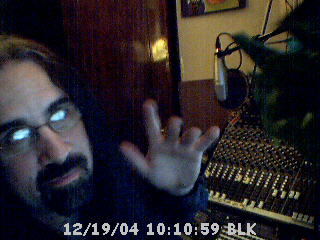
James Arthur Jancik
(web cam snap)
(web cam snap)
Per my blog entry back in October, 2004, Sunanda and I were interviewed by James "Black Knight" Jancik for a talk radio station syndicating out of Chicago. I've archived the page advertising this coming Sunday's broadcast since it'll go away soon. The broadcast itself should remain accessible in the past shows section off the show's main web page.
I've heard the broadcast and like it OK, although the audio quality sucks in the first 12-13 minutes -- the boost on the phone line adds an annoying hum. Plus I'll rightly take flak for saying blacks outnumbered whites in the lower ranks in Vietnam -- I should have said blacks were under represented in the higher ranks.
The gist of my remarks: insofar as we still have any great pirates, they'd be operating collaboratively to raise global living standards, as it'd be in their own best interests to do so. However, the petty pace at which we creep suggests the breed has died out.
This analysis'd be consistent with Bucky's Operating Manual for Spaceship Earth wherein he suggests those with the best overview kept their grip on power by keeping others specialized and compartmentalized. This strategy backfired when science pushed the frontier into the extrasensory realm, off the visible spectrum, and pirates could no longer see their treasure i.e. their ability to follow the action was drastically reduced. By now, everyone is overspecialized and no one has overview (the headless chicken syndrome).
However, if you're still looking for great pirates, I suggest knocking on doors in Japan, as that's where miniaturization and more-with-less innovation seem to be happening the fastest.
My colleague, elder and co-interviewee, Micheal Sunanda, provides more of his trademark back to nature, unreformed hippie perspective (he's been on this show before). The fact that we're opposites in so many ways (yet both students of Fuller) sharpens our banter with contrasting shadows and polarized light.
Given the trickle of new browsers to my grunch.net page coming from this radio show site, I figured it was finally time to fill in the blanks re food, shelter, energy, education and health. I kept it short, commensurate with the expected average attention span.
Excerpts in Real Media (.rm) format:
[ school of nature ] [ recruiting ] [ russia & japan ] [ cold war ]
Excerpts in .mp3 format:
[ school of nature ] [ recruiting ] [ russia & japan ] [ cold war ]
Excerpts in Real Media (.rm) format:
[ school of nature ] [ recruiting ] [ russia & japan ] [ cold war ]
Excerpts in .mp3 format:
[ school of nature ] [ recruiting ] [ russia & japan ] [ cold war ]
Sunday, February 13, 2005
Adult First Day Program
"First Day" is archaic Quakerese for Sunday, and I suppose traces to a time when naming a day for our local star and fusion furnace was considered problematic. Nowadays, we perpetuate the jargon for its anachronistic charm, ala that Planters Peanuts logo.
Our guests this morning, Henry and Scott Sakamoto, were invited to share about civil liberties and the internment of Americans of Japanese ancestry following Pearl Harbor. Henry was 15 at the time, and attending Lincoln High. He completed high school at the Minidoka Relocation Center (Hunt Site) in Idaho, then went on to college in Ohio.
Scott, his adult son, experienced the shock and horror of 911, followed by trepidation over the possible backlash against Americans of Middle Eastern ancestry. He assumed a community leadership role with an intent to keep history from repeating itself.
The USG did eventually acknowledge the whole policy was wrong. A 1988 government commision determined that Executive Order 9066 was more a result of racism, war hysteria, a failure of political leadership than a response to any real military need.
The camps were dismal, and Henry lost his older brother to a curable illness, but they were not mirror images of the Nazi death camps in Europe. The internees had access to mail order catalogs (e.g. Sears Roebuck and Montgomery Ward), were not tortured, and could apply for jobs or school on the outside. For example, Seabrook Farms in New Jersey made a special point of hiring workers out of the camps.
The exclusion zone was from the Pacific Coast to about 200 miles inland, so families with means could relocate, and thereby escape internment. For example the Naito family, still very prominent in Portland, moved to Salt Lake City.
Since these Americans had only about a week to settle their affairs before being interned, many were forced to sell land or stores at pennies on the dollar. Sometimes a neighbor or true friend held a farm and returned it. Other families weren't so fortunate and had to start over in late middle age.
After Adult First Day, the Sakamotos joined our children for more discussion. Rachael wondered if the inmates had radio access to baseball games and music, without which she would go crazy. They did, but in remote Minidoka, AM radio reception was rather poor. Emily wanted more details about the barracks, and took notes; she's doing a research project on the internment camps for school. Lucy discussed the importance of organizing in defense of civil rights.
Our meeting gave the Sakamotos a copy of Lives That Speak (ISBN 2-888305-32-0), plus I gave Scott a copy of My Dinner with Kiyoshi. Kiyoshi, Fuller's adjuvant, was born in the Heart Mountain Internment Camp.
We plan to purchase a curriculum about this chapter of American history from the Portland JACL -- another treasure for our meeting.
Additional Reading:
Jack Seabrook explains (Realaudio file, Kurt Vonnegut narrating)
Our guests this morning, Henry and Scott Sakamoto, were invited to share about civil liberties and the internment of Americans of Japanese ancestry following Pearl Harbor. Henry was 15 at the time, and attending Lincoln High. He completed high school at the Minidoka Relocation Center (Hunt Site) in Idaho, then went on to college in Ohio.
Scott, his adult son, experienced the shock and horror of 911, followed by trepidation over the possible backlash against Americans of Middle Eastern ancestry. He assumed a community leadership role with an intent to keep history from repeating itself.
The USG did eventually acknowledge the whole policy was wrong. A 1988 government commision determined that Executive Order 9066 was more a result of racism, war hysteria, a failure of political leadership than a response to any real military need.
The camps were dismal, and Henry lost his older brother to a curable illness, but they were not mirror images of the Nazi death camps in Europe. The internees had access to mail order catalogs (e.g. Sears Roebuck and Montgomery Ward), were not tortured, and could apply for jobs or school on the outside. For example, Seabrook Farms in New Jersey made a special point of hiring workers out of the camps.
The exclusion zone was from the Pacific Coast to about 200 miles inland, so families with means could relocate, and thereby escape internment. For example the Naito family, still very prominent in Portland, moved to Salt Lake City.
Since these Americans had only about a week to settle their affairs before being interned, many were forced to sell land or stores at pennies on the dollar. Sometimes a neighbor or true friend held a farm and returned it. Other families weren't so fortunate and had to start over in late middle age.
After Adult First Day, the Sakamotos joined our children for more discussion. Rachael wondered if the inmates had radio access to baseball games and music, without which she would go crazy. They did, but in remote Minidoka, AM radio reception was rather poor. Emily wanted more details about the barracks, and took notes; she's doing a research project on the internment camps for school. Lucy discussed the importance of organizing in defense of civil rights.
Our meeting gave the Sakamotos a copy of Lives That Speak (ISBN 2-888305-32-0), plus I gave Scott a copy of My Dinner with Kiyoshi. Kiyoshi, Fuller's adjuvant, was born in the Heart Mountain Internment Camp.
We plan to purchase a curriculum about this chapter of American history from the Portland JACL -- another treasure for our meeting.
Additional Reading:
Jack Seabrook explains (Realaudio file, Kurt Vonnegut narrating)
Thursday, February 10, 2005
Memorandom FS-4702

Happy New Year!
I proposed a 45 minute talk at OSCON, but the short synopsis left organizers begging for more technical detail. I filed background info regarding Elastic Interval Geometry and some of our sphere packing studies (Watermans etc.), research undertaken with open source tools. Plus I'm doing a class at OGI that wires the concentric hierarchy to Python programming.
Coincidentally, python dot org itself has been down today. Fortunately, we have a lot of mirrors (I say "we" as one of the site's content administrators).
Not so fortunately, my collection of copyleft DVD clips for the bizmo jukebox is behind schedule. I can't yet promise OSCONers a sneak peak at a lot of cool geek channel clips, weaving Fuller Projections with TCP/IP networks, Neal Stephenson's 1996 article for Wired notwithstanding.
I also wanted to talk more about how our school's commitment to open source global data sharing is making a difference in universities, but the rank and file is slow to pick up on our syllabus. The Pentagon, in contrast, is the very model of responsiveness, not a headless chicken at all, and I'm quite pleased about that.
Anyway I'll be understanding if OSCON turns me down -- hey, there's always 2006. I haven't given up though, not by a long shot. Maybe the Pentagon Channel will have a cartoon feature for all those kids on base: Lt. Col. SpongeBob's Encounter with the Icosahedron or something. Plus Pentagon kids need programming skills. But do we start 'em out with Ada? I don't think so.
Followup (2005.3.7): OSCON accepted my talk proposal.
Tuesday, February 08, 2005
Exit Strategy Part 2
I'm looking foward to my power lunch with local area geeks at the Kennedy School. I don't know if it'll come up, but if conversation turns to Iraq, I'll share my position, which is as follows:
I think the Sunnis are playing it smart, offering to hop on board the democracy train (now leaving the station), plus do their best to put the brakes on terrorism, through their contacts within the militant underground, provided the occupying military machine gets moving with that exit strategy.
Sunnis don't want to be perceived as quislings, as hapless puppets doing the bidding of their imperial masters. That'd wreck any chance the nascent government might have for long term credibility in the eyes of young Iraqis, the next generation of potential militants.
This mechanism (politicos unify, militarism goes out of style) will solve a lot of problems: civil war will be averted, as various political factions with shared goals will gain practice working together, and US soldiers will get to go home, mission accomplished, Iraq well on the way towards a democratic future.
Neighbors have signaled their readiness to help, plus their intention to implement democratic reforms themselves. What more could we reasonably expect at this point?
There's a real window of opportunity here. How long will it stay open?
Given the Pentagon's stated purpose is to back Iraqi police against the criminal element, the tools at hand need to fit this purpose. There's a lot of irrelevant heavy machinery littering the landscape (and seascape) over there, that serves no purpose but to remind people that they're occupied.
I think now is the time for the Pentagon's top managment to show us it has control of the situation and realizes what a golden opportunity it has to make things right. I've seen some glimmers of intelligence certainly, which is a good sign.
The decayed state of Iraqi infrastructure, in the health care sector especially, is responsible for many more deaths per diem than the militants, even though that's rarely reported.
The focus needs to shift to infrastructure, and Iraqis working together, with some outside help, to get electricity and water 24/7 365/365. That's the only agenda really worth pursuing, from the standpoint of those depending on public support to stay in office (the premise of democracy).
If every car bomb is used as an excuse to keep an overkill force overdeployed, then obviously we're just dealing with a mindless bureaucracy, a chicken with no head.
I'm interested to find out what kind of animal we're dealing with, and I don't feel like I'm the only guy watching.
But as I said, Iraq may not even come up. Mostly we're just gathering to talk about a big domestic civilian project we're storyboarding.
Iraq is a long way away, and DC prides itself on handling such situations. Most people in the Near East (as some call it) have never heard of PDX, and our civic discourse is more focused on other matters, as it should be.
Portland is not a headquarters for any vast imperial power and to become such would represent a drastic lowering of our high living standards.
Followup: Well, Iraq never came up. We stuck to more geeky topics like World of Warcraft, a LAMP solution for a local NGO, Plone, OSCON, Motorola Canopy, other stuff. My lunch was paid for, as I was on tap as an expert in one or more of the above. Now for my 14 mile bicycle loop -- it's time to start gearing up for the STP again.
Relevant background reading: Exit Strategy (part 1), Oct 2, 2004
I think the Sunnis are playing it smart, offering to hop on board the democracy train (now leaving the station), plus do their best to put the brakes on terrorism, through their contacts within the militant underground, provided the occupying military machine gets moving with that exit strategy.
Sunnis don't want to be perceived as quislings, as hapless puppets doing the bidding of their imperial masters. That'd wreck any chance the nascent government might have for long term credibility in the eyes of young Iraqis, the next generation of potential militants.
This mechanism (politicos unify, militarism goes out of style) will solve a lot of problems: civil war will be averted, as various political factions with shared goals will gain practice working together, and US soldiers will get to go home, mission accomplished, Iraq well on the way towards a democratic future.
Neighbors have signaled their readiness to help, plus their intention to implement democratic reforms themselves. What more could we reasonably expect at this point?
There's a real window of opportunity here. How long will it stay open?
Given the Pentagon's stated purpose is to back Iraqi police against the criminal element, the tools at hand need to fit this purpose. There's a lot of irrelevant heavy machinery littering the landscape (and seascape) over there, that serves no purpose but to remind people that they're occupied.
I think now is the time for the Pentagon's top managment to show us it has control of the situation and realizes what a golden opportunity it has to make things right. I've seen some glimmers of intelligence certainly, which is a good sign.
The decayed state of Iraqi infrastructure, in the health care sector especially, is responsible for many more deaths per diem than the militants, even though that's rarely reported.
The focus needs to shift to infrastructure, and Iraqis working together, with some outside help, to get electricity and water 24/7 365/365. That's the only agenda really worth pursuing, from the standpoint of those depending on public support to stay in office (the premise of democracy).
If every car bomb is used as an excuse to keep an overkill force overdeployed, then obviously we're just dealing with a mindless bureaucracy, a chicken with no head.
I'm interested to find out what kind of animal we're dealing with, and I don't feel like I'm the only guy watching.
But as I said, Iraq may not even come up. Mostly we're just gathering to talk about a big domestic civilian project we're storyboarding.
Iraq is a long way away, and DC prides itself on handling such situations. Most people in the Near East (as some call it) have never heard of PDX, and our civic discourse is more focused on other matters, as it should be.
Portland is not a headquarters for any vast imperial power and to become such would represent a drastic lowering of our high living standards.
Followup: Well, Iraq never came up. We stuck to more geeky topics like World of Warcraft, a LAMP solution for a local NGO, Plone, OSCON, Motorola Canopy, other stuff. My lunch was paid for, as I was on tap as an expert in one or more of the above. Now for my 14 mile bicycle loop -- it's time to start gearing up for the STP again.
Relevant background reading: Exit Strategy (part 1), Oct 2, 2004
Monday, February 07, 2005
Children's Program
So in this month of February, 2005, I'm childrens program czar for BCFM (alphabet soup alert!). My predecessor, Jane, and clerk of our committee, had done a lot of legwork around Sparklers, Too!, a 1989 work by Nancy Pickering, and a publication of FGC.
However, given this pre-web material would require yet more legwork, in the form of trips to the library, and given I'd feel more energized were I to indulge my penchant for doing my own curriculum writing, I resolved instead to google for gold. Jane relayed her support for my taking the intiative, yet expressed nostalgia for programming around physical childrens books as well (not just web stuff), as some of these are quite beautiful.
The goldmine I found was A Visual Glossary of Religious Symbols. My reasoning was this: these younger children for which I was preparing a lesson plan have much first hand experience with not reading, are indeed many of them still native nonreaders. And yet human language has for ages had to reach a majority of nonreaders, as literacy in the modern sense was a rarity among the common folk for many centuries.
But the prevelance of illiteracy didn't mean the PR gurus and spinmeisters of old were helpless to communicate with their flocks or other target audiences. Obviously they wielded the spoken word, plus song, and dance -- some things never change. And in place of these dictionary words (as we now refer to them) they used petroglyphs, cave paintings, tapestries, mosaics, etchings in wood, stone, and skin (tatoos), even hand signs. As semiologists might say, a web of signifiers was cast, a network of mnemonic triggers, nevermind if most people still couldn't "read" in the modern sense -- they could still read in a way that mattered.
So... (my wheels were still turning) let's investigate this world of signifiers that aren't words, and in particular let's consider the role of such signs in religion. How have humans wordlessly communicated about matters of spiritual and/or eternal significance? However, let's also not be too strict about dividing the world of symbols into the religious and the not-religious, the sacred and profane. Human is human, after all.
Consider a large multi-national airport. The humans going through there, but for the youngest, are for most part literate; they can read as well as write, but you can't in practice use all their local encodings on every bathroom door -- there're just too many of them. So you still need some universal symbols for Men and Women. And on the computer desktop what do we find: icons -- and logos from advertisers, often obnoxiously popping up when we least expect them. Our languages, our religions, our sciences, still demand so much more from language than mere words, as useful as words may be.
As it turned out, this First Day only three children showed up, two of them sisters and quite young. Fortunately, within my OSCON bag of tricks were two cultural icons, both stuffed and cuddly: Tux the Penguin and Elmo of Sesame Street. The older boy was beyond such dolls but I had other goodies for him, including a dissectable cube (not really a symbol, but geometric at least).
Dave led the session with Rocky (the psychologist, and the boy's dad), with Martha (the girls' mom) and I helping out. We spread out the symbols I'd printed off the web on my HP DeskJet 952C and then each chose a few to redraw with colored pens.
Much interesting conversation transpired as we doodled, on many levels, with the children included. Dave copied a caduceus while Martha looked up its meaning in a dictionary I'd brought (Cirlot's). All of us marveled at the emblem of the Tohono O'odham and their proud nation. None of us appeared to have tuned in the emblem of the Unification Church before. Dave and I agreed the compass and square seemed especially relevant, in light of the fact that MMM (an affiliated meeting) is still eyeing that next door Masonic temple (and its parking lot). I drew attention to the Glastonbury insignia, as Dawn is planning a pilgrimmage to that site come spring.
All in all it was a good lesson and a good time was had by all. I've banked much of the material in the BCFM archive (a plastic box) for future reference, including some literature we might want ot take up later in Adult First Day (a different program).
After the rise of meeting, I discussed blogs with Darl, mine being the first she'd visited (though she'd long been aware of the phenomenon). We agreed that keeping blogs was natural for Friends, given our pronounced proclivity for journal-keeping. Indeed, Darl and I could well-imagine republishing some favorite Quaker journals in blog format, complete with original dates. Imagine reading the journals of George Fox or John Woolman or Margaret Fell right here on blogger dot com! The only hitch is the current interface doesn't allow back dating posts that far -- a limitation we might take up with Google at some point.
Tara and I watched the Superbowl yesterday, starting with the half time show (she's a true Beatles fan, sang along, wondered about Ringo). I liked the commercials a lot better this year. Toyota's was good -- used the word synergy (and yes, the getting-nowhere pace has been frustrating). Bud's designated driver ad was fun. The popsicle sports car driver was humorously macabre. All those corporate logos in one room, eating together -- heart warming. Plus Pepsi showed off some of its delivery fleet on steroids (bizmos!). And those imaginary beings teaching dad to be more generous with the snacks was inspiring.
Speaking of imaginary beings, Tara had a new toy to show me this evening, not one I'd seen: a plastic three-headed dog, all heads looking pretty vicious and mean. I recognized it from mythology and offered that we might google for its proper name. Someday, when I get my digicam replaced, I'll upload its picture.
Followup: Tara and I followed up on Cerberus this morning. I suggested nicknaming her toy Cera, an allusion to our one-headed pet, but Tara felt Berus would be better, as she considers him a boy. I described his job as "border guard" between two worlds (ours and Hades -- not so much Hell as prechristians were less judgmental of its inhabitants). And speaking of Negative Universe (that's one reading), I got a call from Ashley this morning, regarding Ed, her dad, who is truly not long for this world. Bonnie is flying out there to be with him, a messenger of our love and best wishes.
However, given this pre-web material would require yet more legwork, in the form of trips to the library, and given I'd feel more energized were I to indulge my penchant for doing my own curriculum writing, I resolved instead to google for gold. Jane relayed her support for my taking the intiative, yet expressed nostalgia for programming around physical childrens books as well (not just web stuff), as some of these are quite beautiful.
The goldmine I found was A Visual Glossary of Religious Symbols. My reasoning was this: these younger children for which I was preparing a lesson plan have much first hand experience with not reading, are indeed many of them still native nonreaders. And yet human language has for ages had to reach a majority of nonreaders, as literacy in the modern sense was a rarity among the common folk for many centuries.
But the prevelance of illiteracy didn't mean the PR gurus and spinmeisters of old were helpless to communicate with their flocks or other target audiences. Obviously they wielded the spoken word, plus song, and dance -- some things never change. And in place of these dictionary words (as we now refer to them) they used petroglyphs, cave paintings, tapestries, mosaics, etchings in wood, stone, and skin (tatoos), even hand signs. As semiologists might say, a web of signifiers was cast, a network of mnemonic triggers, nevermind if most people still couldn't "read" in the modern sense -- they could still read in a way that mattered.
So... (my wheels were still turning) let's investigate this world of signifiers that aren't words, and in particular let's consider the role of such signs in religion. How have humans wordlessly communicated about matters of spiritual and/or eternal significance? However, let's also not be too strict about dividing the world of symbols into the religious and the not-religious, the sacred and profane. Human is human, after all.
Consider a large multi-national airport. The humans going through there, but for the youngest, are for most part literate; they can read as well as write, but you can't in practice use all their local encodings on every bathroom door -- there're just too many of them. So you still need some universal symbols for Men and Women. And on the computer desktop what do we find: icons -- and logos from advertisers, often obnoxiously popping up when we least expect them. Our languages, our religions, our sciences, still demand so much more from language than mere words, as useful as words may be.
As it turned out, this First Day only three children showed up, two of them sisters and quite young. Fortunately, within my OSCON bag of tricks were two cultural icons, both stuffed and cuddly: Tux the Penguin and Elmo of Sesame Street. The older boy was beyond such dolls but I had other goodies for him, including a dissectable cube (not really a symbol, but geometric at least).
Dave led the session with Rocky (the psychologist, and the boy's dad), with Martha (the girls' mom) and I helping out. We spread out the symbols I'd printed off the web on my HP DeskJet 952C and then each chose a few to redraw with colored pens.
Much interesting conversation transpired as we doodled, on many levels, with the children included. Dave copied a caduceus while Martha looked up its meaning in a dictionary I'd brought (Cirlot's). All of us marveled at the emblem of the Tohono O'odham and their proud nation. None of us appeared to have tuned in the emblem of the Unification Church before. Dave and I agreed the compass and square seemed especially relevant, in light of the fact that MMM (an affiliated meeting) is still eyeing that next door Masonic temple (and its parking lot). I drew attention to the Glastonbury insignia, as Dawn is planning a pilgrimmage to that site come spring.
All in all it was a good lesson and a good time was had by all. I've banked much of the material in the BCFM archive (a plastic box) for future reference, including some literature we might want ot take up later in Adult First Day (a different program).
After the rise of meeting, I discussed blogs with Darl, mine being the first she'd visited (though she'd long been aware of the phenomenon). We agreed that keeping blogs was natural for Friends, given our pronounced proclivity for journal-keeping. Indeed, Darl and I could well-imagine republishing some favorite Quaker journals in blog format, complete with original dates. Imagine reading the journals of George Fox or John Woolman or Margaret Fell right here on blogger dot com! The only hitch is the current interface doesn't allow back dating posts that far -- a limitation we might take up with Google at some point.
Tara and I watched the Superbowl yesterday, starting with the half time show (she's a true Beatles fan, sang along, wondered about Ringo). I liked the commercials a lot better this year. Toyota's was good -- used the word synergy (and yes, the getting-nowhere pace has been frustrating). Bud's designated driver ad was fun. The popsicle sports car driver was humorously macabre. All those corporate logos in one room, eating together -- heart warming. Plus Pepsi showed off some of its delivery fleet on steroids (bizmos!). And those imaginary beings teaching dad to be more generous with the snacks was inspiring.
Speaking of imaginary beings, Tara had a new toy to show me this evening, not one I'd seen: a plastic three-headed dog, all heads looking pretty vicious and mean. I recognized it from mythology and offered that we might google for its proper name. Someday, when I get my digicam replaced, I'll upload its picture.
Followup: Tara and I followed up on Cerberus this morning. I suggested nicknaming her toy Cera, an allusion to our one-headed pet, but Tara felt Berus would be better, as she considers him a boy. I described his job as "border guard" between two worlds (ours and Hades -- not so much Hell as prechristians were less judgmental of its inhabitants). And speaking of Negative Universe (that's one reading), I got a call from Ashley this morning, regarding Ed, her dad, who is truly not long for this world. Bonnie is flying out there to be with him, a messenger of our love and best wishes.
Wednesday, February 02, 2005
State of the Union
I've not heard nor read the president's State of the Union speech yet, though some USA Today outside Noah's Bagels flashed news of a hopeful tone. Sounds good; I could use some uplifting. Yesterday left me in a cranky mood, what with the sudden firings in the small world I frequent. Both Dawn and I had friends put down.
If you've watched The Apprentice (I haven't yet) and concluded that it's only inside these Trumpy for-profits that people get vicious and paranoid, around money issues especially, you'd be wrong. Life gets just as ugly in the NGO and GO worlds, as any veteran could tell you.
Plus I have some hopeful news of my own to report. Our battle for hearts and minds under the No Child Left Behind initiative is going well. So on that front at least, the Union is lookin' good.
You may well wonder why a self-proclaimed liberal like me is keeping company with "the right wingers of the NCLB" (sounds like a Playboy issue). Well, I'll tell you why. It's because I'm a liberal that I think our kids' education is way too important to become a mere political football. I'll work with whatever cards I'm dealt to make sure we don't lose stray sheep to the wolves (although in Oregon, if you do see a wolf getting lucky, you're no longer allowed to shoot it -- the law sides with the grays out here).
And so I've got my capable herd dogs working overtime, shepherding the flock along. Just call me The Pastor (some Quakers are pastoral BTW, the majority in fact -- we call them programmed Friends, vs. those of the more liberal unprogrammed variety).
So that's how to talk out of the right side of your mouth I'm learning: just work in lots of Biblical allusions and you'll be fine (and if you're talking to imams, better bone up on your Qur'an). And if they paint you with horns and a tail, just say you're flattered to be associated with FreeBSD. Like our geek saint Richard Stallman, I believe any good religion is meant to be free and open source -- free as in freedom.
Followup the day after: Yeah, lots of gray in the mirror over here too. Those DCers program in a strange language I don't quite follow (lots of significant standing up and sitting, like a Catholic mass on steroids), but the tone was up beat and I parsed the bit about upgrading the electrical grid. I'm thinking grid talk might be a good ice breaker for when I'm partying with ayatollahs (a rare event in PDX, I admit -- Ed was here once). Speaking of Ed, Synergetics at Bob Gray's site has been down all day; I asked Chris Fearnley if maybe we could set up a mirror at SNEC and he agreed that'd be feasible, desirable. I'll probably go roller skating tonight (I'm getting better at it).
If you've watched The Apprentice (I haven't yet) and concluded that it's only inside these Trumpy for-profits that people get vicious and paranoid, around money issues especially, you'd be wrong. Life gets just as ugly in the NGO and GO worlds, as any veteran could tell you.
Plus I have some hopeful news of my own to report. Our battle for hearts and minds under the No Child Left Behind initiative is going well. So on that front at least, the Union is lookin' good.
You may well wonder why a self-proclaimed liberal like me is keeping company with "the right wingers of the NCLB" (sounds like a Playboy issue). Well, I'll tell you why. It's because I'm a liberal that I think our kids' education is way too important to become a mere political football. I'll work with whatever cards I'm dealt to make sure we don't lose stray sheep to the wolves (although in Oregon, if you do see a wolf getting lucky, you're no longer allowed to shoot it -- the law sides with the grays out here).
And so I've got my capable herd dogs working overtime, shepherding the flock along. Just call me The Pastor (some Quakers are pastoral BTW, the majority in fact -- we call them programmed Friends, vs. those of the more liberal unprogrammed variety).
So that's how to talk out of the right side of your mouth I'm learning: just work in lots of Biblical allusions and you'll be fine (and if you're talking to imams, better bone up on your Qur'an). And if they paint you with horns and a tail, just say you're flattered to be associated with FreeBSD. Like our geek saint Richard Stallman, I believe any good religion is meant to be free and open source -- free as in freedom.
Followup the day after: Yeah, lots of gray in the mirror over here too. Those DCers program in a strange language I don't quite follow (lots of significant standing up and sitting, like a Catholic mass on steroids), but the tone was up beat and I parsed the bit about upgrading the electrical grid. I'm thinking grid talk might be a good ice breaker for when I'm partying with ayatollahs (a rare event in PDX, I admit -- Ed was here once). Speaking of Ed, Synergetics at Bob Gray's site has been down all day; I asked Chris Fearnley if maybe we could set up a mirror at SNEC and he agreed that'd be feasible, desirable. I'll probably go roller skating tonight (I'm getting better at it).
Sunday, January 30, 2005
A Salute to Iraq
I was submerged in teaching and programming during the actual elections, which were more like on Saturday given the difference in time zones. I'm just now coming up for air and spouting some words on this topic.
The news reports look promising. Iraqis risked life and limb en masse, in a good faith show of support for that bright democratic future they've been repeatedly promised. "Are we there yet?" I'm hearing them ask. Of course there's still a long row to hoe, but let's put the swords away and do it with ploughshares shall we? Such is the fond hope.
So now all eyes turn to the US military. Looking out from my control room, I've seen many promising signs that the exit strategy is in place, awaiting the signal. I've seen the commercials, the positive reviews from the field. Iraqi security personnel are ready to deal with the criminal element. The Marines think so too. Even the Navy has shown a willingness to defy conventional wisdom and get with the program (too bad about that sub by the way).
Of course some clueless neocons and arm chair retirees think they have the inside scoop: the secret strategy is for the military to pump up its muscles in the Iraqi gym, while the USAF grids Iranian air defenses and gets ready to soften targets. It'll be Operation Preemptive Thunder Part 2. General Custer will sound the battle cry, like Howard Dean on steroids, and we'll crush those Iranian heathen under the hooves of our awesome cavalry. And if we're really lucky, the promised Apocalypse will soon follow (anyone seen the Antichrist yet?).
But we've always had crazies in the Pentagon (like, what big bureaucracy is immune: witness Dilbert). What changed after 911 is they got out of the box and ran with the ball. Osama freed them. So the State Department was sidelined, and the CIA was told to put its propaganda machine into overdrive (which, ever the obedient servant, it dutifully did).
But that was then and this is now. The chain of command is in no mood to be dictated to, what with the commander in chief feeling galvanized and encouraged, free and independent. If there's to be another fight against terrorism, it'll be quick and to the point, and at a time and place of our own choosing.
In the meantime, there's lots of domestic dry rot that needs attention. The infrastructure is failing (schools included). Children are getting left behind, everywhere you look. Uncle Sam wants to show us the ropes in the stock market, but hasn't a dime to bet with (like any wise investor, he uses other people's money).
Both the USA and Iraq need rebuilding. That'll take a lot of civilian smarts and savvy, a lot of management know-how. So what better time to be friends with a diverse and thriving society living in the cradle of civilization? May we learn from one another's experience, what real democracy is all about. Let's keep it a two way street, live long and prosper.
The news reports look promising. Iraqis risked life and limb en masse, in a good faith show of support for that bright democratic future they've been repeatedly promised. "Are we there yet?" I'm hearing them ask. Of course there's still a long row to hoe, but let's put the swords away and do it with ploughshares shall we? Such is the fond hope.
So now all eyes turn to the US military. Looking out from my control room, I've seen many promising signs that the exit strategy is in place, awaiting the signal. I've seen the commercials, the positive reviews from the field. Iraqi security personnel are ready to deal with the criminal element. The Marines think so too. Even the Navy has shown a willingness to defy conventional wisdom and get with the program (too bad about that sub by the way).
Of course some clueless neocons and arm chair retirees think they have the inside scoop: the secret strategy is for the military to pump up its muscles in the Iraqi gym, while the USAF grids Iranian air defenses and gets ready to soften targets. It'll be Operation Preemptive Thunder Part 2. General Custer will sound the battle cry, like Howard Dean on steroids, and we'll crush those Iranian heathen under the hooves of our awesome cavalry. And if we're really lucky, the promised Apocalypse will soon follow (anyone seen the Antichrist yet?).
But we've always had crazies in the Pentagon (like, what big bureaucracy is immune: witness Dilbert). What changed after 911 is they got out of the box and ran with the ball. Osama freed them. So the State Department was sidelined, and the CIA was told to put its propaganda machine into overdrive (which, ever the obedient servant, it dutifully did).
But that was then and this is now. The chain of command is in no mood to be dictated to, what with the commander in chief feeling galvanized and encouraged, free and independent. If there's to be another fight against terrorism, it'll be quick and to the point, and at a time and place of our own choosing.
In the meantime, there's lots of domestic dry rot that needs attention. The infrastructure is failing (schools included). Children are getting left behind, everywhere you look. Uncle Sam wants to show us the ropes in the stock market, but hasn't a dime to bet with (like any wise investor, he uses other people's money).
Both the USA and Iraq need rebuilding. That'll take a lot of civilian smarts and savvy, a lot of management know-how. So what better time to be friends with a diverse and thriving society living in the cradle of civilization? May we learn from one another's experience, what real democracy is all about. Let's keep it a two way street, live long and prosper.
Thursday, January 27, 2005
Thrill Seekers

Just following the rails folks!
Dawn doesn't usually do coasters, so this was something of a coup. Me, I'm a big fan of these rides. In 2000, Matt and I drove a small U-Haul pickup, with stuff from Mom's shipment, from PDX to her place in LA. We made a special point of visiting Magic Mountain, a Six Flags coaster park, and spent the day seeking thrills.
Note: I'm just gonna coast here for awhile, but not because of writer's block or anything; per the sidebar, you'll see I've just launched two new blogs. I'm moving the action to those for awhile. Here, I'll just enjoy the ride for a spell.
Tuesday, January 25, 2005
Some Space Program History
Tara has been home from school with a cold. Our house rule is no TV or computer for the time she'd normally be in class -- bed rest and reading OK. An exception to this rule would be parent- approved educational programming, and we've been using this down time to plough through many more episodes of From The Earth to The Moon, an Emmy award winning HBO series about NASA's golden age, inspired by JFK in that famous speech, and culminating in the Apollo moon landings. In Apollo, a perennial human longing had at last been fulfilled (which isn't to say we've had our fill of such adventuring).
I'm somewhat confused where I even got these two VHS tapes (it gets that way at chaos manor). I thought maybe from Larry but he denied it after Meeting for Worship on Sunday, where I spent some time vacuuming up crumbs with a Hoover (we had a party to celebrate Bridge City Friends Meeting's new and transferring members, with my own self-made nametag reaffirming my attender status -- a long story).
Tara and I have both learned a great deal of history we didn't know from these tapes. This morning's fare included Sam Shepherd's story (Episode Nine) which I found one of the most compelling, perhaps because he went to the moon as a somewhat older guy (47) like me (46). Plus I really empathized with that MIT geek who had to program around a faulty abort switch under extreme time pressure -- wow, nice save! And I really liked that Grumman CEO in earlier episodes -- the guy behind the LEM (the lunar module). So how true to fact is this series, in minute detail? I haven't had time to run many fact checks, even with Google right here at my elbow. Like, did he really let off steam that way, by bouncing a rubber ball against the wall?
I hear some readers asking themselves "so when do you do your job Mr. Urner, if you spend all this time on TV-viewing marathons?" My answer: "this is my job." Like, I'm a parent for crying out loud. This series provides a lot of historical context, showing anti-war demonstrations, assassinations, unfolding tragedy in Vietnam. My daughter (10) could use some perspective on all that, and what better person to provide some than her dad, who actually lived through a lot of it? Plus I just made her a hot lunch (ravioli from Trader Joe's). Her mom is snowed under with year-end bookkeeping tasks, so yes I'm on child care duty, and that's cool with me.
In fact, one of the bizarre features of dark ages America was how even single parents would have to work long hours just to scrounge enough money to pay for other adults to take care of their kids. In this way, families were put asunder so a few privileged shareholders could "earn a decent living" on the backs of the working poor. I thought Moore's Bowling for Columbine did a good job of investigating this phenomenon -- a stronger piece of filmmaking than Fahrenheit 911, maybe because he wasn't trying so hard to both write history and make it at the same time. And no, I haven't yet seen Mel Gibson's magnum opus -- I'll get it from Netflix for some rainy day. And I wonder if the Dalai Lama has seen Kundun yet; last I heard, he hadn't.
Anyway, back to the space program. Per Critical Path (1981), Bucky's hope was the kind of high tech management and training programs which'd enabled humans to set foot on the moon (even drive on it) in but one short, tumultuous decade, would then turn itself to the larger job of designing a way out of the dark ages. We'd use our newfound smarts to really start getting our house in order (Spaceship Earth). Now that Apollo-Soyuz had symbolically converged the two hemispheres, WWIII (aka the Cold War) would finally fizzle in the desolate moonscape of Afghanistan.
But it didn't happen so easily. LAWCAP (defined in a chapter called Legally Piggily) didn't like this scenario and resolved to not go quietly. The USA, which LAWCAP selfishly (and mistakenly) thought it might own and control, would finally have its unilateral day in the sun, as the last/only superpower, and an Imperial Presidency would gaze out over some grand unified end times, the envy of other would-be tyrants around the world.
Bucky lived just long enough to see this new battle for hearts and minds shaping up (exDCI Woolsey aptly named it WWIV), and knew this one'd be highly cerebral, because this more hopeful agenda would be based on longing more than fear, a mix politicos weren't especially familiar with. So in Grunch of Giants (1983) he focused on the CIA a lot. This made perfect sense: inside our intelligence community is where a lot of the invisible power struggles would inevitably occur, almost by definition (his analysis was "grammatically correct" as Ludwig Wittgenstein might have put it (some philosopher I like)).
So yes, Bucky anticipated all this way back in 1983, when President Ronald Reagan awarded him the Medal of Freedom. Nor were Reagan and then-DCI Casey clueless about the impending battle. Nor were the Russians of course. The American people, on the other hand, seemed largely oblivious, were too busy earning a living to catch up on their reading. And the dark ages school system, including the universities, continued suffering from hyperspecialization's chief symptom: a severe lack of overview. LAWCAP capitalized on this sorry state of affairs, and behind-the-scenes proceeded with plans for global domination by force of arms. The tragic and horrific events of 911 played right into its hands. With the pre-emptive invasion of Iraq a fait accompli, it looked like the dawn of a New American Century had finally arrived.
And in some sense, it had -- although the Russians and Chinese felt in no way compelled to keep calling it that. Because, under the surface, the transition from LAWCAP to GRUNCH (Bucky's economical shop talk -- others will have their own words for telling this story) was much more evolutionary and transformative than a matter of anyone wresting control. As the level of disinformation in the media was gradually lowered, in large degree through networking in cyberspace, people spontaneously began to wise up, to become more aware of their options, and this Spaceship Earth idea took on a renewed realism. The prospects for humanity began to spontaneously brighten. So in this sense, the American dream of greater freedom and democracy for humankind was beginning to bear fruit. Henceforth, tyranny would find little purchase or foothold.
However, to be honest, fear did, and still does, play a role, even though longing now has the upper hand. The prospect of global warming, of an ecosystem dangerously out of balance, was and still is unsettling. Clearly nature would not be put on hold while petty minds raced to keep track of petty differences. Bigger changes were clearly afoot, events of a more cosmic nature. Human beings, now more than ever, need to remain engaged as information harvesters and problem solvers in Universe, as Bucky liked to put it. The looming challenges ahead are real.
Humanity has always been somewhat spiritually adept, mind-endowed, intuitively aware (God fearing, as some put it), and therefore simply the passage of time has made our hopes for a better tomorrow seem ever less dismissable. This natural evolutionary process has gotten us to the point where, by now, in late January of 2005, I'm able to write all this using a fairly matter of fact tone. I'm not peddling some brand of hopelessly naïve utopianism here.
Now of course I'm mindful of the fact that some of my contemporaries are going to read this strange and unfamiliar (to them) omnitriangulated historical narrative and deride it as just more outrageous and unfounded Fuller School propaganda, space case lunacy at best. But hey, this is my blog and I'm free to tell it as I see it. Send me an email if you think I'm full of it. Maybe I'll get back to you.
Followup: I see Friend Johan Maurer is picking up on a lot of these same themes (including Reality TV) in his blog Can you believe...?. I'm glad to see we're on parallel/convergent tracks. I initially launched this blog back in September 2004, after reading in his.
I'm somewhat confused where I even got these two VHS tapes (it gets that way at chaos manor). I thought maybe from Larry but he denied it after Meeting for Worship on Sunday, where I spent some time vacuuming up crumbs with a Hoover (we had a party to celebrate Bridge City Friends Meeting's new and transferring members, with my own self-made nametag reaffirming my attender status -- a long story).
Tara and I have both learned a great deal of history we didn't know from these tapes. This morning's fare included Sam Shepherd's story (Episode Nine) which I found one of the most compelling, perhaps because he went to the moon as a somewhat older guy (47) like me (46). Plus I really empathized with that MIT geek who had to program around a faulty abort switch under extreme time pressure -- wow, nice save! And I really liked that Grumman CEO in earlier episodes -- the guy behind the LEM (the lunar module). So how true to fact is this series, in minute detail? I haven't had time to run many fact checks, even with Google right here at my elbow. Like, did he really let off steam that way, by bouncing a rubber ball against the wall?
I hear some readers asking themselves "so when do you do your job Mr. Urner, if you spend all this time on TV-viewing marathons?" My answer: "this is my job." Like, I'm a parent for crying out loud. This series provides a lot of historical context, showing anti-war demonstrations, assassinations, unfolding tragedy in Vietnam. My daughter (10) could use some perspective on all that, and what better person to provide some than her dad, who actually lived through a lot of it? Plus I just made her a hot lunch (ravioli from Trader Joe's). Her mom is snowed under with year-end bookkeeping tasks, so yes I'm on child care duty, and that's cool with me.
In fact, one of the bizarre features of dark ages America was how even single parents would have to work long hours just to scrounge enough money to pay for other adults to take care of their kids. In this way, families were put asunder so a few privileged shareholders could "earn a decent living" on the backs of the working poor. I thought Moore's Bowling for Columbine did a good job of investigating this phenomenon -- a stronger piece of filmmaking than Fahrenheit 911, maybe because he wasn't trying so hard to both write history and make it at the same time. And no, I haven't yet seen Mel Gibson's magnum opus -- I'll get it from Netflix for some rainy day. And I wonder if the Dalai Lama has seen Kundun yet; last I heard, he hadn't.
Anyway, back to the space program. Per Critical Path (1981), Bucky's hope was the kind of high tech management and training programs which'd enabled humans to set foot on the moon (even drive on it) in but one short, tumultuous decade, would then turn itself to the larger job of designing a way out of the dark ages. We'd use our newfound smarts to really start getting our house in order (Spaceship Earth). Now that Apollo-Soyuz had symbolically converged the two hemispheres, WWIII (aka the Cold War) would finally fizzle in the desolate moonscape of Afghanistan.
But it didn't happen so easily. LAWCAP (defined in a chapter called Legally Piggily) didn't like this scenario and resolved to not go quietly. The USA, which LAWCAP selfishly (and mistakenly) thought it might own and control, would finally have its unilateral day in the sun, as the last/only superpower, and an Imperial Presidency would gaze out over some grand unified end times, the envy of other would-be tyrants around the world.
Bucky lived just long enough to see this new battle for hearts and minds shaping up (exDCI Woolsey aptly named it WWIV), and knew this one'd be highly cerebral, because this more hopeful agenda would be based on longing more than fear, a mix politicos weren't especially familiar with. So in Grunch of Giants (1983) he focused on the CIA a lot. This made perfect sense: inside our intelligence community is where a lot of the invisible power struggles would inevitably occur, almost by definition (his analysis was "grammatically correct" as Ludwig Wittgenstein might have put it (some philosopher I like)).
So yes, Bucky anticipated all this way back in 1983, when President Ronald Reagan awarded him the Medal of Freedom. Nor were Reagan and then-DCI Casey clueless about the impending battle. Nor were the Russians of course. The American people, on the other hand, seemed largely oblivious, were too busy earning a living to catch up on their reading. And the dark ages school system, including the universities, continued suffering from hyperspecialization's chief symptom: a severe lack of overview. LAWCAP capitalized on this sorry state of affairs, and behind-the-scenes proceeded with plans for global domination by force of arms. The tragic and horrific events of 911 played right into its hands. With the pre-emptive invasion of Iraq a fait accompli, it looked like the dawn of a New American Century had finally arrived.
And in some sense, it had -- although the Russians and Chinese felt in no way compelled to keep calling it that. Because, under the surface, the transition from LAWCAP to GRUNCH (Bucky's economical shop talk -- others will have their own words for telling this story) was much more evolutionary and transformative than a matter of anyone wresting control. As the level of disinformation in the media was gradually lowered, in large degree through networking in cyberspace, people spontaneously began to wise up, to become more aware of their options, and this Spaceship Earth idea took on a renewed realism. The prospects for humanity began to spontaneously brighten. So in this sense, the American dream of greater freedom and democracy for humankind was beginning to bear fruit. Henceforth, tyranny would find little purchase or foothold.
However, to be honest, fear did, and still does, play a role, even though longing now has the upper hand. The prospect of global warming, of an ecosystem dangerously out of balance, was and still is unsettling. Clearly nature would not be put on hold while petty minds raced to keep track of petty differences. Bigger changes were clearly afoot, events of a more cosmic nature. Human beings, now more than ever, need to remain engaged as information harvesters and problem solvers in Universe, as Bucky liked to put it. The looming challenges ahead are real.
Humanity has always been somewhat spiritually adept, mind-endowed, intuitively aware (God fearing, as some put it), and therefore simply the passage of time has made our hopes for a better tomorrow seem ever less dismissable. This natural evolutionary process has gotten us to the point where, by now, in late January of 2005, I'm able to write all this using a fairly matter of fact tone. I'm not peddling some brand of hopelessly naïve utopianism here.
Now of course I'm mindful of the fact that some of my contemporaries are going to read this strange and unfamiliar (to them) omnitriangulated historical narrative and deride it as just more outrageous and unfounded Fuller School propaganda, space case lunacy at best. But hey, this is my blog and I'm free to tell it as I see it. Send me an email if you think I'm full of it. Maybe I'll get back to you.
Followup: I see Friend Johan Maurer is picking up on a lot of these same themes (including Reality TV) in his blog Can you believe...?. I'm glad to see we're on parallel/convergent tracks. I initially launched this blog back in September 2004, after reading in his.
Monday, January 24, 2005
The Assassination of Richard Nixon (movie review)
I was thinking maybe to see Ray or Hotel Rwanda, but Matt said he'd prefer something more uplifting, so after an early dinner at McMenamins on the park blocks, we wandered over to Fox Tower for a last economy-priced showing.
Sam Bicke, played very effectively by Sean Penn, is a guy in need of an extreme makeover. If you watch as his guardian angel (the camera's viewpoint), you'll see lots of missed forks in the road. He's another grain of sand determined to make a difference and even has these fantasies of starting a business on wheels (me too). However, unlike me 'n Sean Penn, he's short on skills, and that leads him to shipwreck and disaster.
The easy diagnosis is that, unlike Napoleon Dynamite, he's cowardly; one longs for more measured and proportionate acts of defiance, versus that final inept sicko wipeout ala 911. Trying to sell Black Panthers on his Zebra concept was a promising step, but he should've just taken the initiative and started a chapter. When asked to shave his mustache, he could've pulled a Bartleby and said "I'd prefer not to" -- maybe no happy ending that way, but no hellish climax either.
A deeper reading accepts his basic human integrity and looks to the surrounding culture for better options. The self-help materials he got from his mentor Jack Jones (whom I liked) didn't really speak to his condition, were too intertwined with salesmanship and moneymaking. Had he been younger, maybe growing his hair and joining the counter-culture would've saved his life. A few years later, there'd've been est. Today, he'd've had the Internet.
His brother was too stern and proud of his rectitude to offer any constructive suggestions. Like, hey guy, why not visit a rabbi? If those little sales tricks are so bothersome (shall we deliver this desk tomorrow or the day after?) why not join a religious order? Or the military?
In a parallel universe, Sam might've taken that bitterness at being denied the American dream, and turned it into more constructive hatred for one of America's officially sanctioned enemies: communists and/or satan. At least this would have turned him into a tool of the state and/or church, either of which could have put his anger to work in some more coordinated institutional framework.
Basically, Sam just needed a bona fide community (sangha) -- people who wouldn't turn away when he indulged in crazy talk about wanting respect, dignity and taking on "the system" to improve his lot. Plenty of people were talking that way in his day (those Indians on TV for instance), yet he never found his niche, remained isolated and lonely, with only a faulty guidance system to fall back on. Those around him, even his one friend, weren't savvy enough to point him in the right direction, nor really fathom the depths of his despair (they had their own to contend with).
What some critics might bleep over is that Nixon too felt like a cornered man running out of options. A kind of subtle doubling is going on in this film. True, Nixon was a much smoother operator, and had found his niche, his community -- though not many close friends (Bebe Rebozo comes to mind, and to a lesser degree Kissinger). And because he'd more successfully adapted, he passed enough screen tests to gain long term access to the cockpit (the Oval Office). Nixon, unlike Sam, managed to get a lot of planes to fly low. Angels (or Friends) should've provided better guidance in his case as well.
Addendum:
Speaking of community, just previous to hopping a bus downtown for dinner and this movie, my job was to participate in an Internet Orientation at West Precinct, Hillsboro. I joined a chat room from my Portland office using an alias. Although these kids were all in the same RedHat9 computer lab at the station, they didn't necessarily know one another's aliases (part of the fun), plus only at the end was it revealed that one in their midst had been a stranger.
The purpose of this exercise was to sensitize kids to the possibility of anonymous individuals surfing in chat rooms, perhaps up to no good. We want our next generations to really enjoy the new freedoms provided by high tech, which includes an ability to steer clear of pitfalls. I'm linking to this souvenir snippet of our on-line banter without revealing any true identities but my own (I'm jojo).
And speaking of buses, these days in greater Portland we don't have much advertising inside (outside we do) to catch those wandering passenger eyeballs; we have poetry. Really. I'm so proud of our town.
Sam Bicke, played very effectively by Sean Penn, is a guy in need of an extreme makeover. If you watch as his guardian angel (the camera's viewpoint), you'll see lots of missed forks in the road. He's another grain of sand determined to make a difference and even has these fantasies of starting a business on wheels (me too). However, unlike me 'n Sean Penn, he's short on skills, and that leads him to shipwreck and disaster.
The easy diagnosis is that, unlike Napoleon Dynamite, he's cowardly; one longs for more measured and proportionate acts of defiance, versus that final inept sicko wipeout ala 911. Trying to sell Black Panthers on his Zebra concept was a promising step, but he should've just taken the initiative and started a chapter. When asked to shave his mustache, he could've pulled a Bartleby and said "I'd prefer not to" -- maybe no happy ending that way, but no hellish climax either.
A deeper reading accepts his basic human integrity and looks to the surrounding culture for better options. The self-help materials he got from his mentor Jack Jones (whom I liked) didn't really speak to his condition, were too intertwined with salesmanship and moneymaking. Had he been younger, maybe growing his hair and joining the counter-culture would've saved his life. A few years later, there'd've been est. Today, he'd've had the Internet.
His brother was too stern and proud of his rectitude to offer any constructive suggestions. Like, hey guy, why not visit a rabbi? If those little sales tricks are so bothersome (shall we deliver this desk tomorrow or the day after?) why not join a religious order? Or the military?
In a parallel universe, Sam might've taken that bitterness at being denied the American dream, and turned it into more constructive hatred for one of America's officially sanctioned enemies: communists and/or satan. At least this would have turned him into a tool of the state and/or church, either of which could have put his anger to work in some more coordinated institutional framework.
Basically, Sam just needed a bona fide community (sangha) -- people who wouldn't turn away when he indulged in crazy talk about wanting respect, dignity and taking on "the system" to improve his lot. Plenty of people were talking that way in his day (those Indians on TV for instance), yet he never found his niche, remained isolated and lonely, with only a faulty guidance system to fall back on. Those around him, even his one friend, weren't savvy enough to point him in the right direction, nor really fathom the depths of his despair (they had their own to contend with).
What some critics might bleep over is that Nixon too felt like a cornered man running out of options. A kind of subtle doubling is going on in this film. True, Nixon was a much smoother operator, and had found his niche, his community -- though not many close friends (Bebe Rebozo comes to mind, and to a lesser degree Kissinger). And because he'd more successfully adapted, he passed enough screen tests to gain long term access to the cockpit (the Oval Office). Nixon, unlike Sam, managed to get a lot of planes to fly low. Angels (or Friends) should've provided better guidance in his case as well.
Addendum:
Speaking of community, just previous to hopping a bus downtown for dinner and this movie, my job was to participate in an Internet Orientation at West Precinct, Hillsboro. I joined a chat room from my Portland office using an alias. Although these kids were all in the same RedHat9 computer lab at the station, they didn't necessarily know one another's aliases (part of the fun), plus only at the end was it revealed that one in their midst had been a stranger.
The purpose of this exercise was to sensitize kids to the possibility of anonymous individuals surfing in chat rooms, perhaps up to no good. We want our next generations to really enjoy the new freedoms provided by high tech, which includes an ability to steer clear of pitfalls. I'm linking to this souvenir snippet of our on-line banter without revealing any true identities but my own (I'm jojo).
And speaking of buses, these days in greater Portland we don't have much advertising inside (outside we do) to catch those wandering passenger eyeballs; we have poetry. Really. I'm so proud of our town.
Sunday, January 23, 2005
Beyond the Gene
So Friday night was another ISEPP lecture at the Arlene Schnitzer Concert Hall on Broadway, our most opulent old-style downtown theater. We have a district named Hollywood too (where I used to rent a basement studio) so maybe we're trying to mirror the American showbiz world in microcosm. Plus our ISEPP lecture series mirrors way more than that: top name scientists and mathematicians from all over the world have helped make this one of the most prestigious gigs in the country (as that Morgan Stanley guy exulted from the podium, with special thanks to Terry) . We've heard lectures (sometimes more than one) from Jane Goodall, Stephan Jay Gould, Stephen Hawking, Carl Sagan, Lynn Margulis & Dorion Sagan, Richard Leaky, Jean-Michael Cousteau (son of Jacques)... and the list goes on and on. You can check out the stellar roster at our web site (I say "our" because my wife Dawn is the ISEPP bookkeeper).
Our featured talent of the evening was Dr. Evelyn Fox Keller, a physicist turned biologist. The gist of her talk was that (a) she'd been prescient in predicting that yesteryear's gene talk would be overtaken by a more sophisticated chatter in which the atomistic idea of "genetic building blocks" would come to appear quaint and obsolete and (b) biology shows signs of eclipsing physics at center ring in this circus. Biology is where the action is -- and the money (more about that below). However, fortunately for the other sciences, biologists are ravenous for expertise in other disciplines, including physics, and especially computer science. The new management isn't going to be mean, arrogant and elitist (unlike some other managements we know).
Given Dawn and I have been ISEPP groupies from the beginning (we've known Terry since well before the Ione Plaza penthouse, which was in turn well before the newly restored Linus Pauling House on Hawthorne), we usually attend the more intimate followup dinners at the nearby Heathman Hotel, where our illustrious guests are wined and dined then put back behind a podium, to take questions from some of Portland's most science-literate (we might've been podunk before, but after all these lectures, we're quite the discriminating crew -- like Viennese to music).
Dawn asked a cancer-related question, which got Dr. Keller launched on a diatribe against moneymaking. What happens, all too often, is corporations will find a financially rewarding formula, and then stymie further evolution, because money is the sole measure of success. So even if the biology is from the dark ages, as long as consumers don't know any better, advances are slow, and all too often merely superficial and cosmetic. And unfortunately consumers may be counted on to not know any better, because look at the sorry state of their knowledge base (present company excluded of course). Like, most people still buy into the old gene talk, are pretty darned clueless about the ongoing renaissance in the life sciences. This was music to my ears of course, given recent brainstorming about pedagogy going on among the Wanderers.
Speaking of Wanderers, "ecology boy" was to my right (I added him to my cell phone, with a photo), and "energy boy" to my left next to Dawn. I'm concealing their true identities (not trying to be patronizing -- these "boys" are both among my heros). Energy boy schedules megawatts for daily delivery over the regional power grid, but for a firm with far more integrity than Enron. We often indulge in grid talk, which, after a few glasses of wine, tends to get rather raucous and jovial. He's quite the libertarian.
Our featured talent of the evening was Dr. Evelyn Fox Keller, a physicist turned biologist. The gist of her talk was that (a) she'd been prescient in predicting that yesteryear's gene talk would be overtaken by a more sophisticated chatter in which the atomistic idea of "genetic building blocks" would come to appear quaint and obsolete and (b) biology shows signs of eclipsing physics at center ring in this circus. Biology is where the action is -- and the money (more about that below). However, fortunately for the other sciences, biologists are ravenous for expertise in other disciplines, including physics, and especially computer science. The new management isn't going to be mean, arrogant and elitist (unlike some other managements we know).
Given Dawn and I have been ISEPP groupies from the beginning (we've known Terry since well before the Ione Plaza penthouse, which was in turn well before the newly restored Linus Pauling House on Hawthorne), we usually attend the more intimate followup dinners at the nearby Heathman Hotel, where our illustrious guests are wined and dined then put back behind a podium, to take questions from some of Portland's most science-literate (we might've been podunk before, but after all these lectures, we're quite the discriminating crew -- like Viennese to music).
Dawn asked a cancer-related question, which got Dr. Keller launched on a diatribe against moneymaking. What happens, all too often, is corporations will find a financially rewarding formula, and then stymie further evolution, because money is the sole measure of success. So even if the biology is from the dark ages, as long as consumers don't know any better, advances are slow, and all too often merely superficial and cosmetic. And unfortunately consumers may be counted on to not know any better, because look at the sorry state of their knowledge base (present company excluded of course). Like, most people still buy into the old gene talk, are pretty darned clueless about the ongoing renaissance in the life sciences. This was music to my ears of course, given recent brainstorming about pedagogy going on among the Wanderers.
Speaking of Wanderers, "ecology boy" was to my right (I added him to my cell phone, with a photo), and "energy boy" to my left next to Dawn. I'm concealing their true identities (not trying to be patronizing -- these "boys" are both among my heros). Energy boy schedules megawatts for daily delivery over the regional power grid, but for a firm with far more integrity than Enron. We often indulge in grid talk, which, after a few glasses of wine, tends to get rather raucous and jovial. He's quite the libertarian.
Friday, January 21, 2005
FAQ: So what's Global Data?
Corporate media tell us the key equation in Iraq is the preparedness of its new domestic security force. But what about the state of its infrastructure? Talk to your average Iraqi and you'll get an earful about that. Politics is expensive, especially democratic politics (so many movers and shakers!). Providing all that champagne and cake to upper deck ballrooms requires a state of the art cruise ship. Beyond a well-appointed kitchen, you need smooth sailing, which entails a well-equipped bridge, 24/7 engineering, GIS/GPS and other sensors, densely informative interfaces. Aircraft pilots will identify, but most police aren't certified on such equipment. And demolition engineers don't build cruise ships, democratic or otherwise. They just send enemies to the bottom (where Iraq already is, so what's their mission again?).
Here in PDX, I have easy access to diagrams of under-street pipelines if I want them, plus satellite imagery of my neighborhood. Our kids need to learn that water from the tap doesn't appear by magic and won't keep flowing without continued planning and maintenance. I've urged OMSI to consider a permanent exhibit regarding our regional water supply, featuring Joe Miller's Bull Run and all the rest of it. An open society educates its children about their heritage, and that includes the infrastructure. Here at the Global Data Corporation, we consider the whole planet, its long term management and care, to be your problem (ours too). And so we want you to have all the data you might need -- and packaged in a form that's usable (by you).
OK, so how are you going to get fuel and power reliably flowing to the Iraqi people? What's your plan? You might need to play with Sims while exploring your options. So, does the Iraqi grid connect to others? If not, why not? Who drew the plans we have today? Are they any good? And if no one asked you, how democratic is that? Oh, so you're not an Iraqi? That never stopped the Americans from making plans for the region. So I guess you don't have to be an Iraqi to think and care about the cradle of civilization -- nor by the same token an American to think about how America might be rewired. Global grids are like that: limiting your thinking to just one patch of Earth, because of some design in your passport, just makes you retarded. Flags, logos, brands, bar codes -- lots of grist for our data base mills.
Here at Global Data we really do care about quality and want our brand to inspire confidence. We don't want you risking big money on the basis of warped or incomplete information. In school they show you a colorful patchwork of countries, all with capital cities -- so what? How usable is that information? National Geographic does a lot of good work to fill in the blanks. But what if their next issue isn't focused on your problem? TV is even more frustrating, compared to what it could be. As if the readiness of the Iraqi police was all you needed to know about. What nonsense. More die from bad water than from car bombs.
Let's show Iraqis some competent management for a change, and with their best interests at heart. If Bechtel and Halliburton won't do it, let's do it without 'em. How about more indigenous consortia? Or maybe invite some Brazilian supranational to the table. The permutations are endless. Whom do Iraqis trust? Run some opinion polls why not? And why shouldn't some of the infrastructure be state run? Because Paul Bremer said so?
We could start with better media: more global data on the screen, and more rational discussion about infrastructure. That means more engineers, fewer politicos. Maybe it's time to get that geek channel showing some control rooms. I know, I know, people are really busy; B2B takes time.
How about we stop abusing the military as a cover story -- as a human shield -- to keep the real deal under wraps? Tell us more about that oil. The global literacy level has gotten too high for those same old bedtime stories, over and over. Our collective IQ won't permit this snail's pace any longer, all this business as usual. We just can't afford to wait for LAWCAP era CEOs to weigh and reweigh the risks -- too risky. Just give us the all data we need, filtered through multiple perspectives, and we'll take it upon ourselves to learn the chatter and start processing, even if we're still just teenagers growing up in Tikrit. The brains are out here in plentiful supply, and real democracy is inclusive, by definition. Let's dive head first into world game.
There's this copout convenience which the prospect of terrorism presents: we can't let you know the real deal about infrastructure, because you might be a terrorist, or, even if you're not, glasnost is simply too dangerous. We can't afford to move ahead with perestroika because of 911. In other words: terrorism has won and you, dear reader, are destined to remain forever in the dark, in some "just trust us" charade wherein this tiny elite decides what's best on your behalf. Sure, there's a facade, a Hollywood set, called "freedom and democracy" but scratch the surface and you'll find it's just a made-for-TV sham.
So, thanks to terrorism, and those using it to their own exclusive advantage, you've been walled out. You're a human being, designed to think and act locally (yeah it's a podunk solar system, but we like it), and yet all those pretentious mickey mouse executives won't let you do your job, won't share any information. OK, so I guess the problem for you right now is to find out how to work around 'em. Perhaps Global Data will be of service (we hope you'll like our commercials).
Obviously my management team considers much of the 911 rhetoric a ploy, used by the selfish to keep what should be common knowledge under lock and key. Sharing the gist of how the water system is set up, in either Portland or Palestine, doesn't mean handing out all the secret access codes. Security is a concern, and unauthorized access is something to protect against -- at least half the time because the incompetent will just get themselves killed for no reason, and maybe win a Darwin award. We don't want that. But nor do we want the crew aboard Spaceship Earth to be kept dangerously clueless about the proper care and feeding of her electrical system, her satellite system, her circulation system, her metals. The CIA World Fact Book was just a beginning in our view.
Nor do we imagine any special "white man's burden" such as Kipling once penned about. The once big secret of the dismal scientists, the inevitability of a Malthusian melt down, is neither secret nor widely accepted dogma any more. Sure, some cults hold to it, but here at Global Data, we're admittedly influenced by Fuller's World Game projections (we plan on using his map a lot, even more than we have been). We tend to think the espousers of apocalyptic prophecies are merely singing their own swan songs, projecting their small-minded myopia on the big screen, and scaring themselves silly. These aren't the kind of people you want on the bridge, right? Haven't you already heard enough phony fear mongering and wolf crying to last a lifetime? Well, if you do miss your doomsayers, feel free to campaign for them. It's a free country after all. But don't expect Global Data to back your guys (our yes men might). Our favorite candidates spit a much cooler fire.
Here in PDX, I have easy access to diagrams of under-street pipelines if I want them, plus satellite imagery of my neighborhood. Our kids need to learn that water from the tap doesn't appear by magic and won't keep flowing without continued planning and maintenance. I've urged OMSI to consider a permanent exhibit regarding our regional water supply, featuring Joe Miller's Bull Run and all the rest of it. An open society educates its children about their heritage, and that includes the infrastructure. Here at the Global Data Corporation, we consider the whole planet, its long term management and care, to be your problem (ours too). And so we want you to have all the data you might need -- and packaged in a form that's usable (by you).
OK, so how are you going to get fuel and power reliably flowing to the Iraqi people? What's your plan? You might need to play with Sims while exploring your options. So, does the Iraqi grid connect to others? If not, why not? Who drew the plans we have today? Are they any good? And if no one asked you, how democratic is that? Oh, so you're not an Iraqi? That never stopped the Americans from making plans for the region. So I guess you don't have to be an Iraqi to think and care about the cradle of civilization -- nor by the same token an American to think about how America might be rewired. Global grids are like that: limiting your thinking to just one patch of Earth, because of some design in your passport, just makes you retarded. Flags, logos, brands, bar codes -- lots of grist for our data base mills.
Here at Global Data we really do care about quality and want our brand to inspire confidence. We don't want you risking big money on the basis of warped or incomplete information. In school they show you a colorful patchwork of countries, all with capital cities -- so what? How usable is that information? National Geographic does a lot of good work to fill in the blanks. But what if their next issue isn't focused on your problem? TV is even more frustrating, compared to what it could be. As if the readiness of the Iraqi police was all you needed to know about. What nonsense. More die from bad water than from car bombs.
Let's show Iraqis some competent management for a change, and with their best interests at heart. If Bechtel and Halliburton won't do it, let's do it without 'em. How about more indigenous consortia? Or maybe invite some Brazilian supranational to the table. The permutations are endless. Whom do Iraqis trust? Run some opinion polls why not? And why shouldn't some of the infrastructure be state run? Because Paul Bremer said so?
We could start with better media: more global data on the screen, and more rational discussion about infrastructure. That means more engineers, fewer politicos. Maybe it's time to get that geek channel showing some control rooms. I know, I know, people are really busy; B2B takes time.
How about we stop abusing the military as a cover story -- as a human shield -- to keep the real deal under wraps? Tell us more about that oil. The global literacy level has gotten too high for those same old bedtime stories, over and over. Our collective IQ won't permit this snail's pace any longer, all this business as usual. We just can't afford to wait for LAWCAP era CEOs to weigh and reweigh the risks -- too risky. Just give us the all data we need, filtered through multiple perspectives, and we'll take it upon ourselves to learn the chatter and start processing, even if we're still just teenagers growing up in Tikrit. The brains are out here in plentiful supply, and real democracy is inclusive, by definition. Let's dive head first into world game.
There's this copout convenience which the prospect of terrorism presents: we can't let you know the real deal about infrastructure, because you might be a terrorist, or, even if you're not, glasnost is simply too dangerous. We can't afford to move ahead with perestroika because of 911. In other words: terrorism has won and you, dear reader, are destined to remain forever in the dark, in some "just trust us" charade wherein this tiny elite decides what's best on your behalf. Sure, there's a facade, a Hollywood set, called "freedom and democracy" but scratch the surface and you'll find it's just a made-for-TV sham.
So, thanks to terrorism, and those using it to their own exclusive advantage, you've been walled out. You're a human being, designed to think and act locally (yeah it's a podunk solar system, but we like it), and yet all those pretentious mickey mouse executives won't let you do your job, won't share any information. OK, so I guess the problem for you right now is to find out how to work around 'em. Perhaps Global Data will be of service (we hope you'll like our commercials).
Obviously my management team considers much of the 911 rhetoric a ploy, used by the selfish to keep what should be common knowledge under lock and key. Sharing the gist of how the water system is set up, in either Portland or Palestine, doesn't mean handing out all the secret access codes. Security is a concern, and unauthorized access is something to protect against -- at least half the time because the incompetent will just get themselves killed for no reason, and maybe win a Darwin award. We don't want that. But nor do we want the crew aboard Spaceship Earth to be kept dangerously clueless about the proper care and feeding of her electrical system, her satellite system, her circulation system, her metals. The CIA World Fact Book was just a beginning in our view.
Nor do we imagine any special "white man's burden" such as Kipling once penned about. The once big secret of the dismal scientists, the inevitability of a Malthusian melt down, is neither secret nor widely accepted dogma any more. Sure, some cults hold to it, but here at Global Data, we're admittedly influenced by Fuller's World Game projections (we plan on using his map a lot, even more than we have been). We tend to think the espousers of apocalyptic prophecies are merely singing their own swan songs, projecting their small-minded myopia on the big screen, and scaring themselves silly. These aren't the kind of people you want on the bridge, right? Haven't you already heard enough phony fear mongering and wolf crying to last a lifetime? Well, if you do miss your doomsayers, feel free to campaign for them. It's a free country after all. But don't expect Global Data to back your guys (our yes men might). Our favorite candidates spit a much cooler fire.
Wednesday, January 19, 2005
A Morning's Meditation: Energy Slaves
OK, so here I am, reducing the overall entropy in "chaos manor" (an allusion -- this blog is full of 'em), which includes vacuuming (I have this story about the time these Kirby people showed up and tried to sell me one, but I'll save it for later), and meditating on Bucky Fuller's concept of "energy slaves." Instead of using imaginary horses as a unit of power (at one time a good analogy, but growing remote), Bucky thought in terms of imaginary humans, and how many it'd take to screw in a light bulb or complete other energy-consuming tasks.
Like, you hear these slogans, like Seven Billion Billionaires (an upcoming title I believe), and think, "oh Bucky, how could you be so naïve?" Clearly we don't have enough gold to give everyone their own stash of bricks, and those giant Rockwell International machines @ usmint.gov would burn out before we could ever keep up with all the inflation this'd create (maybe they've already been replaced -- I'm not fully up to speed on Treasury business). So, Bucky, how could you really mean anything by such silliness? Fuller's answer was simple, essentially the same one he gave in Fortune: energy slaves.
The realistic "gold standard" by which to measure living standards is not in terms of the periodic table element Au, but in terms of today's compared with yesterday's. Like, we were touring in the USSR that time, and maybe thinking the standards weren't all that good. But that's not how the Russians saw it. They were still remembering WWII, which so many Americans experienced only vicariously. From the Russian perspective, what counted was security, and now, at long last, they had some. Sure, the Cold War was unsettling, but Apollo-Soyuz proved that mir was just around the corner. By now, moscuvites have their own monorail (line M1) -- pretty cool.
So, how many energy slaves does the average American have at her disposal? You may immediately think "vacuum cleaner" (like I have this nifty bagless Bissell, with a separable suck unit), flash on other household appliances. Yeah that's part of it, sure. But there's more. Think Google. Think NNTP, FTP, SMTP, HTTP, ICMP... all sitting atop TCP/IP. How many energy slaves is that? (I know: you have no clue).
Think of it this way: you're a top information harvester and problem solver for the King of England, circa the time of George III. If you'd had Google then, what kind of advantages over your non-Googling enemies do you think you'd have had? Couldn't you have just slaughtered those obstreperous Americans? OK, dumb question. The whole idea makes no sense. I got it. But still: you get my point, yes? You're a goddamn King of the Hill (or Queen, or choose a title). At my beck and call, at the touch of a mouse, I've got a veritable army of energy slaves going about my business, 24/7 365/365. The Wizard of Oz never had it so good, let alone Mickey, who got in over his head (yes, another allusion -- treat yourself: see Fantasia if you've never, or even if you have (my cell's ringtone is Night on Bald Mountain by the way)).
Last thought: so how do I get away with being this ultra-high- powered CEO of the Global Data Corporation if I spend my days in some nondescript battleship-gray chaos manor, vacuuming my own floors? Don't I at least need to have servants? There you go again, thinking like some 20th century numbskull (they had an excuse back then -- it was the 20th century). Look, my family has had household help, great individuals, and we're still in touch with Flora & Victoria to this day (we drove north to visit Victoria in Canada in 2003); but when it comes to living high and mighty, all I really need is energy, intelligently channeled. Bonneville takes care of that, and Qwest, and like that. I capitalize in business by leveraging what many ordinary Americans already have at their disposal. I just happen to take fuller advantage of the assets I'm given. Like, I don't just know how to click a mouse, I know how to write a mouse driver (OK, I lied, but I do know a lot of tricks -- I'm a native to this brave new America, let's just say).
And I'm not just talking about the Internet (although hypertext is the answer to so many of my prayers). I've got all these VCRs (some queued to tape: viewed Rushing on NOW just now), radios, DVD players, Netflix... I've got equipment like Sir Walter Raleigh would have killed for (unless magic really worked as advertised back then).
PS: I think my BizMo should have that cosmic fish logo stuck on it with maybe no others as prominent, because through someone who knows someone, we're all connected, and designed to advantage one another, and that wisdom is simply integral to the native American psyche (we call it basic intelligence -- the kind of thing you learned in kindergarten).
Like, you hear these slogans, like Seven Billion Billionaires (an upcoming title I believe), and think, "oh Bucky, how could you be so naïve?" Clearly we don't have enough gold to give everyone their own stash of bricks, and those giant Rockwell International machines @ usmint.gov would burn out before we could ever keep up with all the inflation this'd create (maybe they've already been replaced -- I'm not fully up to speed on Treasury business). So, Bucky, how could you really mean anything by such silliness? Fuller's answer was simple, essentially the same one he gave in Fortune: energy slaves.
The realistic "gold standard" by which to measure living standards is not in terms of the periodic table element Au, but in terms of today's compared with yesterday's. Like, we were touring in the USSR that time, and maybe thinking the standards weren't all that good. But that's not how the Russians saw it. They were still remembering WWII, which so many Americans experienced only vicariously. From the Russian perspective, what counted was security, and now, at long last, they had some. Sure, the Cold War was unsettling, but Apollo-Soyuz proved that mir was just around the corner. By now, moscuvites have their own monorail (line M1) -- pretty cool.
So, how many energy slaves does the average American have at her disposal? You may immediately think "vacuum cleaner" (like I have this nifty bagless Bissell, with a separable suck unit), flash on other household appliances. Yeah that's part of it, sure. But there's more. Think Google. Think NNTP, FTP, SMTP, HTTP, ICMP... all sitting atop TCP/IP. How many energy slaves is that? (I know: you have no clue).
Think of it this way: you're a top information harvester and problem solver for the King of England, circa the time of George III. If you'd had Google then, what kind of advantages over your non-Googling enemies do you think you'd have had? Couldn't you have just slaughtered those obstreperous Americans? OK, dumb question. The whole idea makes no sense. I got it. But still: you get my point, yes? You're a goddamn King of the Hill (or Queen, or choose a title). At my beck and call, at the touch of a mouse, I've got a veritable army of energy slaves going about my business, 24/7 365/365. The Wizard of Oz never had it so good, let alone Mickey, who got in over his head (yes, another allusion -- treat yourself: see Fantasia if you've never, or even if you have (my cell's ringtone is Night on Bald Mountain by the way)).
Last thought: so how do I get away with being this ultra-high- powered CEO of the Global Data Corporation if I spend my days in some nondescript battleship-gray chaos manor, vacuuming my own floors? Don't I at least need to have servants? There you go again, thinking like some 20th century numbskull (they had an excuse back then -- it was the 20th century). Look, my family has had household help, great individuals, and we're still in touch with Flora & Victoria to this day (we drove north to visit Victoria in Canada in 2003); but when it comes to living high and mighty, all I really need is energy, intelligently channeled. Bonneville takes care of that, and Qwest, and like that. I capitalize in business by leveraging what many ordinary Americans already have at their disposal. I just happen to take fuller advantage of the assets I'm given. Like, I don't just know how to click a mouse, I know how to write a mouse driver (OK, I lied, but I do know a lot of tricks -- I'm a native to this brave new America, let's just say).
And I'm not just talking about the Internet (although hypertext is the answer to so many of my prayers). I've got all these VCRs (some queued to tape: viewed Rushing on NOW just now), radios, DVD players, Netflix... I've got equipment like Sir Walter Raleigh would have killed for (unless magic really worked as advertised back then).
PS: I think my BizMo should have that cosmic fish logo stuck on it with maybe no others as prominent, because through someone who knows someone, we're all connected, and designed to advantage one another, and that wisdom is simply integral to the native American psyche (we call it basic intelligence -- the kind of thing you learned in kindergarten).
Tuesday, January 18, 2005
Brainstorming About Pedagogy
So today was another Wanderers meeting, at Linus Pauling's boyhood home on Hawthorne. Eve Menger and George Hammond, both accomplished chemists, presented their ideas for a new introductory science text book aimed at non-science majors, prompting a lively discussion among the many scientists present.
I took a plastic bag with some favorite writing examples, including one purchased yesterday for 20% off at Barnes and Noble, where I became a member for $25 (netting another 10% discount, plus no sales tax, because I live in Oregon -- and thank you Subaru, for picking up the tab on that drive train job): Head First Design Patterns (ISBN: 0-596-00712-4). This book is the latest in the Head First series, which O'Reilly is justifiably excited about. I know Guido'd like to see a Head First approach to Python, but the market is more Java-centric these days. Fortunately, if you know Python, a reading knowledge of Java is not hard to come by. I also bought Ruby In a Nutshell, Ruby being, like Python and Perl, another scripting language, with a big following in Japan.
What's special about this book (pre-figured in Who is Fourier?, another title in my bag), is the attention given to the proper care and feeding of the human brain. Without pretending to any advanced neurological theory, the authors (with background at Disney) intersperse clever graphics, scrawled handwriting, jokes, stories, puzzles. Why they do this is spelled out in the Intro, and raves on the back (hi Ward) are testament to the effectiveness of their approach. I'd say the "for dummies" series (with wanderer Allen Taylor one of its authors) has also pioneered in this direction, but with O'Reilly there's not even the pretense that the readership is dumb. One of my favorite graphics is on page 12: this arms-folded, somewhat defiant-looking young woman has this thought bubble: "I don't see why you have to use an interface for FlyBehavior. You can do the same thing with an abstract superclass. Isn't the whole point to use polymorphism?" Hah, I love it.
Anyway, George and Eve were very open to this kind of informalizing, yet purposeful innovation. Allen pointed out that Head First is a trade book, not a text book -- a distinction publishers sometimes worry about. I also had Concrete Mathematics in my bag (a true text book), which I thought prototypical in its use of marginalia to make things friendlier. Beyond that, it's more typical of math texts: austere, intimidating, a monument to the authors' intellect.
The Hammond-Menger approach to energy as a unifying theme is also refreshing: the sun powers earthly operations, and we take in a lot of that energy as calorie-laden foods. Relating physics to personal human experience is also our approach in First Person Physics, which will have a precessional impact with or without NSF funding.
The geek channel I've been brainstorming (including in this blog), takes these kinds of pedagogical advances to the next level. We won't be abandoning book learning, but high bandwidth audio-video will tap into even more brain power. As David Feinstein pointed out, 60% of our brain circuitry is about visualization, and 20% of that is about sensing motion. So if you supplement your pedagogy with moving pictures (e.g. animations), you're ipso facto making your audience more intelligent, and your content more illuminating. Bill Nye the Science Guy always stands out in my mind as a great pioneer in this direction.
George and Eve also circulated copies of A Dangerous Signal to Science, an editorial by Alan Leshner of the AAAS (Science, Vol 306, 24 December 2004, page 2163). Many wanderers expressed their concern that fear parasites are draining the budget for civilian science education, leading to a dumbing down of ordinary Americans. That's all by design of course. If Americans were more science-savvy, they wouldn't be such easy prey for those capitalizing off Pentagon waste (e.g. unnecessary soldier deaths), thereby undermining our long term social security, which is not their concern (yet it is our president's, who, like Reagan, is no dummy -- something the Russians could tell you).
Followup 2005.1.20: per email from Eve and George, I fixed their surnames. Plus I watched the USA's presidential inaugural this morning. Although cameras picked up protestors being escorted away by police, the corporate media I heard was too busy manufacturing consent to comment -- an interesting novent given the content of the speech itself (which was right on the money in a lot of ways). My family is honoring various boycotts today, our way of helping Cheney defend the Constitution against foot-dragging domestics -- LAWCAP slowpokes that're hardly moving compared to an up-to-speed USA. Last night, I watched Inside Iraq again, using the external Sony DVD drive on KTU2.
I took a plastic bag with some favorite writing examples, including one purchased yesterday for 20% off at Barnes and Noble, where I became a member for $25 (netting another 10% discount, plus no sales tax, because I live in Oregon -- and thank you Subaru, for picking up the tab on that drive train job): Head First Design Patterns (ISBN: 0-596-00712-4). This book is the latest in the Head First series, which O'Reilly is justifiably excited about. I know Guido'd like to see a Head First approach to Python, but the market is more Java-centric these days. Fortunately, if you know Python, a reading knowledge of Java is not hard to come by. I also bought Ruby In a Nutshell, Ruby being, like Python and Perl, another scripting language, with a big following in Japan.
What's special about this book (pre-figured in Who is Fourier?, another title in my bag), is the attention given to the proper care and feeding of the human brain. Without pretending to any advanced neurological theory, the authors (with background at Disney) intersperse clever graphics, scrawled handwriting, jokes, stories, puzzles. Why they do this is spelled out in the Intro, and raves on the back (hi Ward) are testament to the effectiveness of their approach. I'd say the "for dummies" series (with wanderer Allen Taylor one of its authors) has also pioneered in this direction, but with O'Reilly there's not even the pretense that the readership is dumb. One of my favorite graphics is on page 12: this arms-folded, somewhat defiant-looking young woman has this thought bubble: "I don't see why you have to use an interface for FlyBehavior. You can do the same thing with an abstract superclass. Isn't the whole point to use polymorphism?" Hah, I love it.
Anyway, George and Eve were very open to this kind of informalizing, yet purposeful innovation. Allen pointed out that Head First is a trade book, not a text book -- a distinction publishers sometimes worry about. I also had Concrete Mathematics in my bag (a true text book), which I thought prototypical in its use of marginalia to make things friendlier. Beyond that, it's more typical of math texts: austere, intimidating, a monument to the authors' intellect.
The Hammond-Menger approach to energy as a unifying theme is also refreshing: the sun powers earthly operations, and we take in a lot of that energy as calorie-laden foods. Relating physics to personal human experience is also our approach in First Person Physics, which will have a precessional impact with or without NSF funding.
The geek channel I've been brainstorming (including in this blog), takes these kinds of pedagogical advances to the next level. We won't be abandoning book learning, but high bandwidth audio-video will tap into even more brain power. As David Feinstein pointed out, 60% of our brain circuitry is about visualization, and 20% of that is about sensing motion. So if you supplement your pedagogy with moving pictures (e.g. animations), you're ipso facto making your audience more intelligent, and your content more illuminating. Bill Nye the Science Guy always stands out in my mind as a great pioneer in this direction.
George and Eve also circulated copies of A Dangerous Signal to Science, an editorial by Alan Leshner of the AAAS (Science, Vol 306, 24 December 2004, page 2163). Many wanderers expressed their concern that fear parasites are draining the budget for civilian science education, leading to a dumbing down of ordinary Americans. That's all by design of course. If Americans were more science-savvy, they wouldn't be such easy prey for those capitalizing off Pentagon waste (e.g. unnecessary soldier deaths), thereby undermining our long term social security, which is not their concern (yet it is our president's, who, like Reagan, is no dummy -- something the Russians could tell you).
Followup 2005.1.20: per email from Eve and George, I fixed their surnames. Plus I watched the USA's presidential inaugural this morning. Although cameras picked up protestors being escorted away by police, the corporate media I heard was too busy manufacturing consent to comment -- an interesting novent given the content of the speech itself (which was right on the money in a lot of ways). My family is honoring various boycotts today, our way of helping Cheney defend the Constitution against foot-dragging domestics -- LAWCAP slowpokes that're hardly moving compared to an up-to-speed USA. Last night, I watched Inside Iraq again, using the external Sony DVD drive on KTU2.
National Treasure (movie review)
So I was back at Dick Hannah's getting Razz a new viscous coupler (we name the cars in our family), and decided to see National Treasure at the neighboring mall, with my friend Dave Fabik, a Quaker vietvet.
Like Polar Express, you need to see this as a film for kids -- which makes me suspicious there'll be some theme park ride deriving from it (in the case of the train movie, I'd vote for a real roller coaster over a simulator). In the guise of this somewhat formulaic vehicle, Disney clues newbies that there really is such a thing as intellectual history, that it glues monuments and documents together (by making sense of them), and that it includes such things as secret societies and their cryptic teachings. Indeed, our shared treasure is the historical record itself and what it tells us about ourselves as human beings -- and portends for our future (the booby prize is the big house and fancy car).
On a more adult plane, Multnomah Friends are looking at buying a Masonic Lodge across the street, or risk losing the parking lot (Masons use it Saturdays, which works well, but what if they sell to a competing Sunday user?). The deal hasn't closed -- still processing. Last night I passed on to the clerk my two cents that it'd be worth it to have the deepest pipes snaked to make sure all the under-street plumbing is in working order. In our century-old neighborhoods, that's really not a given, a fact houses on either side of ours have recently had to deal with. When I shared this Friendly concern with Dave he joked that instead of "eye in the sky" my viewpoint was more "camera in the sewer."
And speaking of real national treasure, I phoned Ed Applewhite from the Barnes and Noble (a segue to my next post). He's feeling upbeat that Fuller's legacy is, now more than ever, irrevocable (and I concur). However, Ed himself is starting to say his good byes. We've enjoyed a strong friendship, and I look forward to staying in touch with his kids.
Like Polar Express, you need to see this as a film for kids -- which makes me suspicious there'll be some theme park ride deriving from it (in the case of the train movie, I'd vote for a real roller coaster over a simulator). In the guise of this somewhat formulaic vehicle, Disney clues newbies that there really is such a thing as intellectual history, that it glues monuments and documents together (by making sense of them), and that it includes such things as secret societies and their cryptic teachings. Indeed, our shared treasure is the historical record itself and what it tells us about ourselves as human beings -- and portends for our future (the booby prize is the big house and fancy car).
On a more adult plane, Multnomah Friends are looking at buying a Masonic Lodge across the street, or risk losing the parking lot (Masons use it Saturdays, which works well, but what if they sell to a competing Sunday user?). The deal hasn't closed -- still processing. Last night I passed on to the clerk my two cents that it'd be worth it to have the deepest pipes snaked to make sure all the under-street plumbing is in working order. In our century-old neighborhoods, that's really not a given, a fact houses on either side of ours have recently had to deal with. When I shared this Friendly concern with Dave he joked that instead of "eye in the sky" my viewpoint was more "camera in the sewer."
And speaking of real national treasure, I phoned Ed Applewhite from the Barnes and Noble (a segue to my next post). He's feeling upbeat that Fuller's legacy is, now more than ever, irrevocable (and I concur). However, Ed himself is starting to say his good byes. We've enjoyed a strong friendship, and I look forward to staying in touch with his kids.
Sunday, January 16, 2005
Text Drives Graphics
Python + VRML
An important point to emphasize with a new generation of computer-savvy student, wowed by eye candy, is that even if the graphics are glitzy, the source code behind them is still text-based. In other words, the programmer's world still looks more like free verse poetry than Saturday morning cartoons.One way to show this is to start with a VRML graphic, such as the 5-frequency icosasphere in the right window above, let students interact with it, using interface controls (Cortona's in this shot), then switch to the left window, where a scrolled session demonstrates a corresponding text-based API. What bridges left and right is a lot of scripting language, in this case Python. These scripts take user parameters and generate the underlying .wrl file (world file), which the VRML browser then processes and displays.
Likewise, even where the effective use of such scripts is to valve electrons on a motherboard, in order to make state changes to a hard drive, the engineers who designed this mutiple layering of hardware and software used a lot of human-readable text in the process. We're still firmly anchored to what we most need: comprehensible readings (even if highly technical sometimes).
The moral of the story is, contrary to outward appearances, the culture is not moving away from reading, i.e. the process of eye-balling text to extract meaning. The right brain is getting more of a workout, what with all the visual cortex stimulation, but so is the left. So the old balance between left and right is still recognizable.
Fuller's goal in writing Synergetics was to make a more geometrically sophisticated right brain process accessible to strong readers in the humanities. Per Applewhite, Fuller was even contemplating a free verse format. The idea here was that artists and designers of our future artifacts would need to have a strong background in the humanities and the sciences. In developing a more mathematically informed poetics that would excite the liberal arts reader, while at the same time driving a set of precise geometric visualizations, Fuller hoped to bridge what C.P. Snow considered a chasm between the two cultures.
Most scientists and mathematicians who've taken a look at Synergetics, thinking it might be a work in their discipline somehow, have come away frustrated because it doesn't yield the kind of strictly literal "bottom line" interpretation favored by fundamentalists.
Readers in the humanities, however, although more tolerant by training of multi-dimensional readings, typically disconnect early-on, because this really doesn't look like anything they're used to in American literature. Too crazy-making. They'd rather take the easy path and try to write Fuller off as a naïve technophile who couldn't really master the language. But his strong track record in terms of real world physical artifacts made that difficult. Plus he'd held the Charles Eliot Norton chair at Harvard for awhile (see Critical Path, Chronology of Prominent World Events: 1962), and coined the term Spaceship Earth. Not so forgettable, huh guys?
As a liberal arts student at Princeton with a strong background in Wittgenstein's philo, I wasn't so hooked on the need for a literal meaning, plus I was willing to let Fuller develop his own meanings operationally, i.e. through use. Erhard's est Training also helped provide focus in that the Centers Network was clearly taking Bucky very seriously, thereby reinforcing the idea that American philosophy ultimately wasn't going to bleep over a powerful contribution to American literature, regardless of what the rank and file in academia might be about. Plus I noticed another sector of American society that was taking Fuller very seriously: the CIA. My CIA Report on the Centers Network (1985?) was an attempt to better unify these two threads (I think Stanford has a copy -- can't find mine right now).
All of which brings me to American history: if you haven't been paying attention to either the literature, or the philosophy, then how much about it do you really know? Something to think about (especially if you consider yourself an American): some Russians know it better than you do.
Saturday, January 15, 2005
Freezing Rain
We have freezing rain in PDX today with traffic conditionings worsening. Saturday Academy is canceling across the board. In more normal conditions I'd be driving out to Oregon Graduate Institute this morning. I phoned all my students. Qwest.net is having email problems in multiple states per a recording on their support line.
Dawn has this tenderness in her armpit, and that's keeping me on edge. Probably nothing, but once you've had IBC, you're always sensitive to any signs. If it doesn't abate, we'll phone a doctor next week.
When Bucky lost his first daughter, his despair was at first self-directed and he strongly considered suicide. Then he realized that, despite not making a lot of money, he'd been a productive human being (he'd served admirably in the navy, had some civilian structures to his credit -- the domes were still in his future) and he came to another place: human society was backward and behind schedule, i.e. if only we'd advanced further along our destined path, medical sophistication would've been greater, and his daughter might have lived (and yes, in 2005 she likely would have).
So Bucky committed to becoming an engine designed to propel us forward -- as a whole species, not just as one specific family, tribe, or nation. He felt his effectiveness in the world actually derived from his commitment to the whole. And the objective record is testament to his effectiveness. Lots of Chinese read his books with interest, and not because they thought he was brainstorming about ways to kill them (refreshing).
I share Bucky's sense that we're dangerously slow, especially in light of the fact that, even after giving it his all, we tend to dismiss his life's work. Academia has moved on, in a way that mostly just bleeps over, never comes to grips with, his contribution. Like at least he bequeathed some good American literature, right up there with Edgar Allan Poe's (I'm thinking of Applewhite's speech at the Bucky symposium last March, a day or two before I learned of Dawn's cancer diagnosis).
So why don't we read his poetry at least -- for credit, in university? And the concentric hierarchy, his way of organizing simple shapes: I've taught it to 2nd and 3rd graders with no problems, and yet mostly I meet with blank stares when I mention it to adult educators, and we're talking thirty years after the publication of Synergetics.
Yes, there's a lot going on in our little network. We're not at all moribund. In my class today, I was going to show off Braley's VRML interpretation of the pillow dome skeletons, used in Cornwall for the Eden Project. We have a Win2000 lab, so the Cortona plug-in would be the way to go. Then I was going to show how I'm able to generate VRML files on the fly using a set of Python utilities written by Adrian. Because they're open source (BSD license), I'm able to modify them. Likewise, I've contributed a lot of code, a lot of curriculum materials, aimed at making the Bucky stuff more contemporary and accessible.
No one has paid me to do this. Getting this paying gig with Saturday Academy is new, and I think a good sign. But I can't shake this feeling that we're running behind schedule. No matter how effective I am, I can't completely compensate for all that waste in the Pentagon for example. It's just not an even fight. Like, they're losing big time, true, but why do they fight against their own USA? Don't they realize: resistance is futile, we are borg?
A message from the Fuller School: you won't beat us, so how about joining us? Make those geometry cartoons show up in the dot mil domain how 'bout? And what about those BizMos? I should already have one by now. I blame the United States Navy for not being on the ball. Like, aren't those admirals supposed to have great overview or something?
Followup: Dawn's new theory is the pain is actually joint pain owing to the Arimidex -- definitely a more positive spin. Tara and a friend are planning to stay indoors and watch Spiderman. Nick is a guest in our basement, but I think he's out on the coffee shop circuit, per usual. Mom phoned from DC in high spirits -- she's been working with Congress and making significant headway in her own estimation, and I have no reason to doubt her.
Dawn has this tenderness in her armpit, and that's keeping me on edge. Probably nothing, but once you've had IBC, you're always sensitive to any signs. If it doesn't abate, we'll phone a doctor next week.
When Bucky lost his first daughter, his despair was at first self-directed and he strongly considered suicide. Then he realized that, despite not making a lot of money, he'd been a productive human being (he'd served admirably in the navy, had some civilian structures to his credit -- the domes were still in his future) and he came to another place: human society was backward and behind schedule, i.e. if only we'd advanced further along our destined path, medical sophistication would've been greater, and his daughter might have lived (and yes, in 2005 she likely would have).
So Bucky committed to becoming an engine designed to propel us forward -- as a whole species, not just as one specific family, tribe, or nation. He felt his effectiveness in the world actually derived from his commitment to the whole. And the objective record is testament to his effectiveness. Lots of Chinese read his books with interest, and not because they thought he was brainstorming about ways to kill them (refreshing).
I share Bucky's sense that we're dangerously slow, especially in light of the fact that, even after giving it his all, we tend to dismiss his life's work. Academia has moved on, in a way that mostly just bleeps over, never comes to grips with, his contribution. Like at least he bequeathed some good American literature, right up there with Edgar Allan Poe's (I'm thinking of Applewhite's speech at the Bucky symposium last March, a day or two before I learned of Dawn's cancer diagnosis).
So why don't we read his poetry at least -- for credit, in university? And the concentric hierarchy, his way of organizing simple shapes: I've taught it to 2nd and 3rd graders with no problems, and yet mostly I meet with blank stares when I mention it to adult educators, and we're talking thirty years after the publication of Synergetics.
Yes, there's a lot going on in our little network. We're not at all moribund. In my class today, I was going to show off Braley's VRML interpretation of the pillow dome skeletons, used in Cornwall for the Eden Project. We have a Win2000 lab, so the Cortona plug-in would be the way to go. Then I was going to show how I'm able to generate VRML files on the fly using a set of Python utilities written by Adrian. Because they're open source (BSD license), I'm able to modify them. Likewise, I've contributed a lot of code, a lot of curriculum materials, aimed at making the Bucky stuff more contemporary and accessible.
No one has paid me to do this. Getting this paying gig with Saturday Academy is new, and I think a good sign. But I can't shake this feeling that we're running behind schedule. No matter how effective I am, I can't completely compensate for all that waste in the Pentagon for example. It's just not an even fight. Like, they're losing big time, true, but why do they fight against their own USA? Don't they realize: resistance is futile, we are borg?
A message from the Fuller School: you won't beat us, so how about joining us? Make those geometry cartoons show up in the dot mil domain how 'bout? And what about those BizMos? I should already have one by now. I blame the United States Navy for not being on the ball. Like, aren't those admirals supposed to have great overview or something?
Followup: Dawn's new theory is the pain is actually joint pain owing to the Arimidex -- definitely a more positive spin. Tara and a friend are planning to stay indoors and watch Spiderman. Nick is a guest in our basement, but I think he's out on the coffee shop circuit, per usual. Mom phoned from DC in high spirits -- she's been working with Congress and making significant headway in her own estimation, and I have no reason to doubt her.
Subscribe to:
Posts (Atom)