Wednesday, July 27, 2022

Abduction

folk art

I think most of us know what "abduction" means in a popular (folk) culture context, as in "abducted by aliens". Or rather, we may not know precisely what abduction would entail, but we have a ballpark meaning, and leave it to the science fiction author to spell it out in more detail.  What happens to a person when abducted by aliens?  The same question arises as with kidnapping:  are they ever returned?  Were persons sold into slavery "abducted"?

However, what I didn't know, until today, was that the pragmatist philosopher Charles Peirce had introduced "abduction" in concert with the more familiar induction and deduction i.e. in the namespace of logic and its mental processes (algorithms).  The process of abduction involves improvisation, coming up with a ready explanation.  The question is how does one do that effectively.  Another related question is how does one test one's abduction through deduction and/or induction, by way of verification?

A word similar to Peirce's meaning of "abducted" might be "adduced".  However, "to be abducted" in the passive sense, as if by aliens, is closer to that sense of intervention by divine grace and/or demonic possession.  The impulse comes from outside, inspiring the intuitionist.   Ramanujan said as much.

The latter intuitionist, lightning struck by some insight, then needs to perform reality checks, as to whether A really does provide insights regarding some surprising development C (these are the letters Peirce uses).

In the folk religion of the Subgenius (Church of), the aspiration to be abducted on X-Day (one of the dogmas), might be understood as metaphoric, but also as a prayer for ascendancy and revelation, through moments of Genius and/or Gnosis.

One visits (passes through) a genius state ("cosmic zero"), from a default awaiting state of sub-genius-hood.  

A "higher power" (a deity, muse or spirit) has to provide the juice, the impetus, the catalyst, in order for the sub-genius to "make the leap" (through that moment of enlightenment) and then return to the default (faulty?) or deficit state.  

From the perspective of genius, the sub-genius state may indeed be considered fallen or faulty, which is why the proper attutude of humility is chosen by Subgenius disciples.  Bob gets lucky.  Bob bumbles.  Normalizing the faulty state is the business of the normative bureaucrat, lost in the Matrix, out of touch with how weird that is, to be "normal".

Abduction

To excerpt from Mapping the Mapper, by Paul Taylor & John Wood in 1997 [1]:

The mathematical concept of mapping

This project attempts to map the ideas and designs of Buckminster Fuller, who himself developed maps: actual geographical maps and intellectual maps of fields of study relevant to design. In conjunction with a mapping of his totalistic conception of design thinking, the notion of mapping itself underpins the application of Peirce's notion of abduction, here construed as a mechanism of conceptual development and problem solving. The facilities afforded by hypertext enable the user to abductively relate disparate ideas within the field of design and outside it, in such a way that, in the process of mapping the range of concerns presented by Fuller, the user becomes aware of the issue of mapping itself, and thereby increasingly self-aware in respect of the mappings she herself develops in interaction with this hypertext environment. Thus, the user is enabled to develop a mental map of the inter-relationships between various fields and ideas relevant to the specific issues, which concern her. Beyond this, however, lie questions of mapping and modeling, which arise in the particular case of the subject matter of this hypertext. Fuller's geometrical theories can be conveniently investigated in this form, and can be tested and applied to other aspects of his work, as well as to other design questions.

Finding closer affinity with Pierce comes as a surprisingly valuable puzzle piece.  The gist of Richard Rorty's somewhat autobiographical Achieving Our Country was to put patriotism on a psychologically  secure basis within an American context that included Pragmatism, followed backward through certain writers, many of them activists.  

Moving forward, we have the Buckminster Fuller lineage, inheriting from Transcendentalism, itself a literary movement.  In Synergetics we find the integration of the visually vectorial with the more viscerally incommensurate, a marriage of Eulerian and Gibbsian attributes, in that namespace.

Patriotism might be construed as the free flow of libido (free love, not costly in karmic terms) within a personalized or customized Universe, containing ones folk, people or peeps.  

From the outside, a patriot appears as a specimen of some proud ethnicity, a member of some subculture, with patriotism emanating as a sense of "we" i.e. of community and shared subculture.  "We the people" suggests a pueblo, or a folk.  A spirit of inclusivity and/or diversity need not necessitate surrendering one's sense of taste nor one's powers of discrimination.

Per the James Hillman doctrine and discipline of soul-making or self-making, one might locate a self within an environs, as the complementary semantic space.  The two grow and develop together, one's self and one's country (a space of others in relationship), which country may be: a whole planet; some bordered region thereof; and/or a network of affiliated campuses -- all depending on one's sense of selfhood.

The IDEAbase idea of Paul Taylor and John Wood involves consciously thinking about hypertext in connection with the abductive process.  Hypertextual approaches to a discipline involve assembling a puzzle, piecing together structures, establishing mnemonic - neuronic highways and byways.  These structures are non-linear and their traversal is by default somewhat plodding.  However, when the insights kick in, harmonic resonance is achieved, in the form of epiphanies, fits of genius, related to concepts of "possession" and "seizure", or "abduction" in other words [2]:

Work on the IDEAbase system has focused on the abductive aspects of design thinking, as this provides an identifiably typical thinking process. This use of the notion of abduction is attributed to C.S. Peirce : "A surprising fact, C, is observed. But if a proposition, A, were true, C would be a matter of course. Hence, there is a reason to suspect that A is true." It has been recognized (Wood & Taylor, 1994) that designers rely heavily on abductive modes of thinking because it helps them to seek answers to immediate problems that cannot be found within the problem space itself. In other words, they will probably have to look beyond the confines of the design problem itself to find a workable solution.

[1] Taylor, P., & Wood, J., (1997), "Mapping the Mapper", a chapter in "Computers, Communications, and Mental Models", eds. Donald Day & Diane Kovacs, Taylor & Francis, London, ISBN 0-7484-0543-7, pp. 37-44, January 1997.

[2] Wood, J., (1994), "Chaos and the Virtual Library - strange attractors in the design studio", paper given at IDATER "94 conference (International Design and Technology Education Research) at Loughborough University, Leicestershire, UK, (August, 1994). 

comical nation
 

Sunday, July 24, 2022

Wednesday, July 20, 2022

Back to School

Those of you following my several efforts already know I have a goodly amount to say on the matter of "maths pedagogy" (my US heritage spellchecker says not to pluralize "math"). 

I also take up the term "andragogy" for good measure, meaning why give up on the adults?  Let them experience high school again too, not because they've failed but because of Future Shock per Toffler.  

Things change enough in one lifetime now, that going back to high school is not seen as a dis. The challenges are logistical.  The devil is in the details (a great cliche).

Actually, "Pythonic Andragogy" (spellchecker goes wild, "adding to dictionary" twice) is more what I'm known for on the Pycon and OSCON circuits, per whatever buried archival footage (I've curated some of it).  Part of maths pedagogy is to phase in a computer language and mix the two:  maths and programming.  Not really a new idea.  Lots of curricula explore these possibilities.

High school for adults would allow for more adult behaviors.  We'd have an outdoor camp-site based aesthetic in part to cut costs, in part to impart "camping skills" to a largely civilian population.  Come to one of our campuses and camp out.  If you want a dorm room in an apartment complex, we likely have those options.

A question is what adults have time to take off work and abandon their families in order to regress to a high school existence, much as some might like to.  This conjures the wrong picture.  A lot of high schoolers keep mixing it up (deliberately) with work and don't need to go anywhere.  Others might opt for a campus experience, but as a family camping expedition.

Another feature of high school for adults is they don't make you rack up debt.  Society benefits from your efforts to stay abreast societal changes, picking up another language (human or computer), learning to run a lathe, other power tools (3D printer, electric ATV...).

One reason I label it "high school" is to underscore the fundamental nature of this layer, already, in the present day.  Driving habits, dating habits, study habits... this is a formative time in the teen years, wherein various self disciplines become established, or don't.  We connect high school to the process of becoming who we will be.

What about designers who choose not to adopt this model and insist on "re-education camps" or "college" where adults (some with kids) are concerned.  The PR around "re-education camps" is already very negative and is associated with brainwashing.  Such camps are at the bottom of the barrel, like Guantanamo (a military prison).  

That leaves "college and university" as institutions we keep going back to, for another dip in the well of knowledge.

I'm planning not to quarrel too much about how other designers design their semantic spaces.  I've got the namespaces I've got, and those who take up studying my stuff end up knowing their way around from the inside.  Such is the pattern, vs-a-vs just about anyone.

Why I'm pitching my curriculum at more or less the high school level is I think our maths especially is in that sweet spot.  We have a geometry of vectors in a vector space, but with some alternative stipulations as to apparatus, making our IVM-based system "an API" to the more conventional XYZ one.  

Having two geometries going in tandem is eye-opening, not to mention enlightening.  As maths should be.

Another reason I focus on "high school level" is probably political, in that we still do associate the institution of high school with juveniles, and what's being revealed about so many in the political cast (or class) is their oft times juvenile habits, inculcated, likely as not, in their habit-forming teen years.  

Making more room for young adults to assume responsibility involves deprecating the namespaces frequented by adults with stale skills and stale views.  Some adults in expensive clothes, appearing on TV, would not appear so fashionable if we could see more directly into their profiles.  They rely on screenwriters for lines anyway, most of them.  Producers and directors like to stay off camera.

Many politicians continue operating in delinquency, way past a decent pull date.  

But why not follow Hollywood with the extreme makeover schools and trainings (no, I'm not just talking about Scientology)?  

Go back to school and learn some new language games.  Then rejoin the youth more productively, with a shiny new education, more as contributing members of society than as an elderly boor stuck in pig-headed complexes from whatever past military-industrial age.

Again, the science fiction with the many campuses (converted bases in some cases), happy campers, sound stages, prototypes, is for a more mature and science-minded civilization than this one.  It'd take a lot of work (including planning) to get there (Asylum City) versus indulging in tawdry war crime melodramas or worse.  

Some of the upcoming designers appear up for doing some serious overhauls, and not in the genre of reckless accelerationism, another juvenile behavior.  

Designing is a process and requires feedback loops to stay in touch with reality.  Many designs remain science fiction, yet nevertheless tantalize us with their realism in some cases.

Tuesday, July 12, 2022

Antsy Engineers

One can sense the engineers are unhappy.  Why not let us play with the new toys?  We'll keep gas levels where you need them politically, but let us test the new equipment.  You need to afford us that opportunity if you want us to stay in your employ.

The politicians do not want that to happen.  The newly completed NS2, the second nostril, must not be used, even though NS1 is now closed and Germany is not getting enough gas.  It can only hold its breath for so long.  The engineers want to breathe through the other nostril.  

The politicians, lawyers for the most part, do not buy into "code is law" or any of the "world domination"  bull crap.  Engineers do not really exist as a class.  Said the Eloi, about the Morlocks.

Monday, July 11, 2022

The Geoscope

Dymaxion Globe

Fuller's critics may object that he no more invented the idea of a globe than Copernicus discovered the sun, and this is true. 

What he invented he named the Geoscope and once you have a word to your name, it's yours to aim and fire, so to speak, meaning it's up to you to impart spin and trajectory.  

In Bucky's case, this meant another overture to the United Nations, as his crowning achievement in the geoscope department would have been the one in the East River.  In his oeuvre Critical Path, in conjunction with Kiyoshi, Fuller was celebrating the UN even as he claimed to chronicle the twilight of the world's power structures.  Erhard's group was celebrating the UN around the same time.

If you wonder about where the Foster Gamble camp inserts a bifurcation, distancing itself from the Fuller School, it's in its choice of conspiracy theories that cast the United Nations as a bad egg.  Bucky is less interested in goodies versus baddies, first of all, nor is he against the spread of rights to humans, versus to pseudo-humans (the bots, the corporations).               

The Geoscope would not have meant what it did had the same inventor not come up with a certain world map, deemed by analysts to be unique, less for its mathematics (it achieved the same low distortions as the best of them) than for its deployment of the sinuses to echo new Cold War themes, and also the themes of commercial jet travel.  

In both cases, the polar route, and in particular the north polar route, had become center stage. As development moves to that arctic circle, the same configuration of the continents is likely to suggest itself.

However, missing from the above analysis is the more obvious distinction:  the Dymaxion Map was not about the political anatomy of the world as dreamed up by skilled imagineers (a term from Disney).  

The Fuller Projection was not especially friendly to the nation-state jigsaw puzzle in other words, a way of keeping it less dated, more timeless. 

Maps go out of date as nations come and go.  Not so the Dymaxion.

map1

Those of us who do care about the mathematics are more interested in the tiling algorithms, and how these design and serve hexagons and pentagons from any stash of global data.  Or do they serve other polygons, perhaps trapezoids.  The latitude-longitude grid lines define a trapezoidal framework.  Those could be useful too.

Showing several hexagons around the Texas-Mexico border, when doing weather for example, would help burn in the major towns and roads, mountains and rivers.  Weather reporting is a daily geography lesson. As truckers become accustomed to a driving region, they come to know its highways and byways.  

This is what truckers come to know:  their GPS systems.  The first thing any truck simulator should provide is one of those hexagonal tile displays with global data.  How do we know it's hexagonal?  I'm talking about commercial branding.  I'm talking about World Game now.

Saturday, July 09, 2022

A Saturday FSI Meetup

Screen Shot 2022-07-09 at 10.36.00 AM
what is a field?

That was an illuminating FSI meeting.   Let me journal some content while memories are fresh.

Gary Doskas, a talented engineer, showcased some tetrahelix-making software of his own devising, but in this rendition, the tetrahedra have disappeared (optionally, a toggle) and we're looking at the "pipes" inside.  

Yes, back to pipes.  A duct works.

Picture a tetrahedron as an elbow joint with a pipe connecting two holes at the centers of adjacent faces (any two faces are adjacent in this shape).  

Now start face-joining ghost tetrahedrons, pipe to pipe, starting with a simple helical tetrahelix.  

 "Ghost tetrahedra" means they're allowed to interpenetrate (my word for it) i.e. conduit-defining tetrahedra comprise a coordinating system for laying pipe in space, and need not "get in the way" of each other.

"Interweaving pipe loops" characterizes the Don Bridell models of field structures pretty well.  Gary is approaching the ability to weave these, and in so doing, give them unique labels in terms of a genetic code.

The sense of hydraulics and electrical circuits was strong in our session, meaning a sense of physics was in the air, intentional in the case of field structures.

Elastic Interval Geometry (EIG) already had me in the mood to imagine long balloons or cigars, as the visible compression elements in a tensegrity. Gerald was on this same call by the way, from Europe, making astute observations.

Then came Flextegrity in my experience, no mere metaphor either, in terms of museum-quality models.  Flextegrity is about load-bearing, stress-managing extensible lattices, against the backdrop of the IVM apparatus (similar to XYZ, also ghostly).

Now I have acquired this new hyperloopy drinking straw metaphor with a lot of hypertoon associations, and I'm learning more about how the sausage is made so to speak. 

"Partially overlapping scenario Universe" (a Buckyism) is what it all looks like to me, or flying spaghetti monsters (that's local esoterica). Make them as hyperdimensional as you wish, in whatever phase space. Continuity is what's key (smoothness of action, in the sense of logic followed).

Speaking of riding the rails, I think of theme park roller coasters (e.g. Twisted Dragon), but also of what the industry calls "dark rides" meaning indoor scenario more simulated experiences, also usually rail-based.  Disney specialized in these, but also roller coasters. The genres are to some extent blendable.

Anyway, what one mentally maps to these mental maps is their business mostly, with role model examples trending towards physical interpretations, and with attention to the precise geometry, the engineering.  

Science takes in interest in the details, where the devil is, they say (as in "the devil is in the details"). 

In this case, the tetrahelix was king, but in a ghostly background kind of way.  Snaky pipe networks were in foreground, like rides in a water park.

Gary shared some amazing animations showing us twisty pipe loops that could get more and more twisty, changing symmetries and finally ending up in a simple base loop pattern.  

That's not easy to visualize without more information, I realize.  You had to be there I guess.  Actually the talk was recorded, so maybe it will surface on the FSI YouTube channel eventually. Bravo Gary!

Here's a screenshot of my recent use of Don's field structure model, in a hypertoons talk.

Screen Shot 2022-07-09 at 9.09.27 AM

Thursday, July 07, 2022

A Political Recap

You might get from my critics that I'm close to incoherent when it comes to stating my views.  That's hardly the case.  

When it comes to recent domestic politics, I stood up for General Flynn at first, on the principle that new administrations need a long leash.  Let them bark up the wrong trees at first.  Don't undermine a president too early or you risk making a mockery of the office, from which legitimacy extends.

So yes, I thought the FBI was playing a risky game, and as it came out the game was mainly against Trump himself, it became increasingly a story of a deep state against an elected president, a descent into Banana Republic status.  No, I was never a Trump fan.  I'd voted for Hillary, and Obama before that.  I was attracted to Tulsi for her good American Samoan sense, her Hindu leanings not a problem, but I had no illusions that she could ever be enough of a scoundrel to occupy the post constitutional oval office.

Through the unraveling of Russiagate, three things became clear (a) the UK was still Meddler in Chief when it came to pulling strings in DC and (b) there would be no recovery from Banana Republic status (the presidency had pretty much died as an office) and (c) the insanity of the "rigged voting machines" crowd, which included the former president and his waylaid general.

Going forward: (c) interests me most, all insanity aside, as voting machines continue to be susceptible, just probably not in ways invented by amateurish storytellers with no real street smarts or savvy.  I think the Trump camp's rush to concoct fables regarding these particular voting machines was ill-fated from the get go, though they had little choice but to go with the hand they were dealt.

The beleaguered voters were trying especially hard to get it right in a pandemic.  Yes, certainly last minute measures were taken to let mailed-in ballots pile up.  Those would run through the counters after the votes cast on election day, and would outnumber in-person voting (again, because pandemic).

Because voters were trying so hard to have integrity, as a way of clinging to remaining sanity in hard times (they knew their critics were harsh and vigilant), the accusation of widespread hanky panky with the voting machines was just too much of an attack on the heart of the country's pride.  

The implication that Venezuelan malware had outwitted and subverted hard-working college-educated IT bureaucrats, or that vote counting had been outsourced to foreign agents in league with globalists, just seemed too great of an insult to ever forgive in some cubicles.

Our president was saying we can't or don't have free and fair elections no matter how hard we try, and  wanted to substitute his own judgement in such chaotic circumstances, to impose fairness by other means, never before attempted in United States history.  Talk about a Mad Cow disorder. 

People were not up for this circus.  The coup attempt collapsed because it relied on the slippery lie-for-money strategies of the so-called intelligence community ("my cousin overheard Hugo Chavez brag at a party that..."), as unqualified to define intelligence as Mensa.

Yes, beyond these foreground stories, of the District losing its grip, comes a longer backstory in which journalism managed to stop updating people on a lot of the intellectual happenings.  YouTube and such media came to the rescue on that front, and education acceleration with automation is getting us back on track to some degree.

Tuesday, July 05, 2022

Regarding Storytelling

In this blog, which I mix with the idea of Quaker journal (Quakerism encourages journaling), I spend a lot of time wondering what's up with the storytelling industry.  Why do they have such crushing and unimaginative stories for us to live through?

Obviously, I am not the only one asking this question, and after looking into it for awhile, one realizes one is looking at a bucket full of writhing snakes, the "narratives" or "stories" or "scenarios" I'm talking about. I see a lot of them, and I see they're roiling i.e. not lying still.

A narrative is a mnemonic device in large degree.  That doesn't equate to a record of what happened exactly. Maybe a precise factual account is a part of some story somewhere.  Maybe not.  We weave stories to hold facts in our head, or rather to hold points of view.  The latter factors in the aesthetic and moral dimensions of concern to philosophers, if only to keep quiet about say in Wittgenstein's case.

Some stories are considered toxic and/or poisonous in some way.  These stories intertwine with ideologies, sometimes in the form of myth.  To those holding to these stories, they may be comforting and useful. Stories clash, snakes fight, or seem to.  Anything going on this long has to be seen as a natural process, a characteristic of the species.

Have we only been fighting over narratives since the Tower of Babel?  That's a funny question, given how few believe in that story.  Do I mean it seriously?  The question simply points back to our current state of confusion, post Tower.  The confusion seems deep seated.  But was there a time when we didn't have it?  Is that a sensible question at all?

In the primordial or archetypal sense of mythic objects, or guiding lights, we're happy to admit we're not doing physics.  A person interested in physics stories might find the archetypal realm a neighbor because of the continuity we impute, to electrons on the one hand, and to the psychological phenomena on the other.

I've been delving into the literature around the Wolfgang Pauli - Carl Jung collaboration, reminding myself of the tenuous relationships between physics and psychology.  Carl wanted to hold on to his credentials as a man of science, goes the narrative, and his work on "synchronicity" as a concept was an attempt to contribute to the literature of causality.  He was avoiding being labeled a theosophist for example. He didn't want to be a Rudolph Steiner.

Another contributor oft referred to in this context is Isaac Newton, one of the greatest of the physicists. He did not abandon his psychological fascinations either.  The publishing industry and those who sort narratives by genre, probably had more to do with making physics and psychology go their separate ways, than the principal authors, but they never fully succeeded with their enforcement, and the two are always coming together here and there, especially in California.

Told a different way:  alchemy, astrology and religion, rebranded as psychology and thereby remained rooted enough in the sciences to continue making alliances with other sciences.

Friday, July 01, 2022

Goofing Up

Just a little pin prick, a drop of blood, and a spendy strip that feeds the blood into the machine.  I got trained, I performed fine in the training.

It's not my finger.  The poking device elicited the expected "lady bug" size droplet.  However, applying it to the strip wasn't working.  The strip appeared to suck up the lady bug, but the machine refused to process.

Going back to an earlier archeological level, me at Overseas School of Rome (OSR), I remember losing at ping pong in a tournament setting.  In frustration, I threw the racket, pretty hard, and smashed a window.

Dr. Gillespie as was a real MD.  He wasn't licensed to practice in Italy however, and I don't think he needed the work.  He was happy to teach 8th graders instead, and joined the faculty as a full time biology teacher. He taught it like first year medical school in some ways.

Dr. Gillespie extracted my confession. I was hoping no one one notice, or if they did notice (how could they not?) maybe the didn't need the whole story.  However letting me get away with vandalism would've been bad for my character.

What I remember more than dodging blame at first, was how I'd choked in the tournament. I knew that feeling of panic, at a low level, this was ping pong.  But I knew what it meant to wipe out.  I wasn't that great at ping pong to begin with.

I'm scheduled for a retraining with the device, meaning I'll have to get mom over to the medical office buildings again.  We have a date.  I left the first training full of confidence this would be a piece of cake.

I don't see myself as unreliable, but nor do I see myself as immune from wiping out, especially when operating technology I'm unsure about.  Lots of steps, lots of do this then that. I get riled, I get frustrated.  I get this way when I lose stuff, like my car keys, like right before I need to go somewhere, like to teach a class.

I remember going over to assist with that est stuff in the 1980s, taking the PATH train to the New York Area Center in the East Side Port Authority Bus Terminal building.  Sometimes I would be late.  Since the whole assist gig was about looking at oneself and one's patterns, I would get confronted and asked some questions.  

I remember saying how I felt like a caged animal, being late yet unable to go any faster.

Another time I've felt panic is when I'm supposed to go on stage in a cyber environment (on Zoom), not as the host, but as the instructor.  A DJ is supposed to show up and get the meeting going, by showing a banner page with my name on it, and playing music.

When the DJ didn't show up that time, I could do nothing except dismiss the students via Slack, in real time, after an appropriate waiting interval. I felt like a fish out of water, a beached whale.  I tried contacting my counterparts on another continent.

These glitches happen.  I am happy to have a DJ host the channel and still appreciate that setup, even though it has more moving parts.

A sense of goofing up may be multi-level.  One my go through it as an individual, but also as a member of a group or cult (subculture).  

I remember when Multnomah Quakers got thrown into an international controversy when a couple of its volunteer, temporary leaders, promised the meetinghouse to a Radfems, a controversial group, without running it by Business Meeting for prior approval.  

There was a sense of disorientation among the members and attenders, once this news became known. The meeting ended up breaking its promise, from the point of view of the would-be renters of the space.

What I imagine goes on in the District from time to time, is a kind of awakening from groupthink of one kind or another. A collective bubble bursts.  A reality crumbles.  Trump's not getting a second consecutive chance at bat, as the POTUS, was reality-crumbling experience for some.  JFK's abortive presidency was even more jarring.

The goof-up might have been putting too many eggs in one basket.  That happens.  But do the groupthinkers eventually come to see it that way?  

Maybe we have other eggs in other baskets outside the District?

Tuesday, June 28, 2022

Saturday, June 25, 2022

Telecommuting

Screen Shot 2022-06-25 at 8.06.52 AM

Today is a Saturday.  I've been immersed in data analysis and visualization classes pretty recently (leading them). 

More recently, I've had one or two planning meetings to attend, with FSI and/or TrimTab. I call them planning meetings given the anticipatory designing that goes on, much of it imaginary, like in Critical Path.  

The geoscope near the UN was never built.  Ephermeralization.

Saturday, June 18, 2022

Newtonian Units

I used to do movie reviews rather frequently. I still see movies, but my energies have been directed elsewhere. I will explore ways to move the movies back into my blogs, without necessarily adopting a "movie review" format. 

For example, Quantum of Solace, a Bond film, one I'd so far missed (I've caught the majority I'd hazard, back through several chapters), got me thinking of the concept of Power once again. We started talking power during a TrimTab meeting and I stuck up for the Newtonian meaning: energy per time. 

What's the connection? 

When Bond and the Bolivian hellion need a hotel for the evening, she has this cover story worked out for two teachers, clearly of limited means. The hotel is far less than four star. Bond is having none of it, and insists they have the best most palatial digs anywhere on the circuit. He tells the desk the same story: two teachers... whom've just won the lottery. 

The Bolivian is impressed with Bond's power to spend money like water, and a swiftly flowing river of water at that. 

When nature is being powerful, she's showing off some combination of inertia and pattern-making. She goes for high wattage, but doesn't lose the structure, or if she does, an explosion takes its place, representing what until a moment ago had been more cohesive. 

The stately, one could say placid, flow of the lower Columbia, gets forced through what pass for water wheels on their sides, although we call them turbines today. The torque the river pushes against is that of magnets resisting the steady twirl. The current goes out across the lines at very high voltage, to stepping stations able to reduce the power to match conventional loads. 

Newtonian units also get into Work, not just Power, another politically loaded term. An anti-employee accomplishes negative work, but perhaps by burning the same calories as would a hard worker. Work is measured against a stipulated end state, so that syntropy and entropy compete in the business of making stuff happen. 

Was the design conducive to getting work done in the first place? 

Did anyone even know what the end goal was? 

Entropy might've been high from the beginning. 

Bond is not only burning through funds, he's making an effective difference from the standpoint of the crown. Lower life sycophants may have sold out, but 007's boss, a queen bee, has a lot of faith in his ability to evade her own henchmen. Now there's an interesting pattern for ya.

Wednesday, June 08, 2022

Positive Developments

render_me

The Youtubers of the moment share a lot of negativity.  Of course I'm able to sample from many time frames, so the current inflationary conflagrations in the eastern hemisphere, with repercussions around the globe, is only optionally a focus. I do believe in staying current, although I know that's relative. My grasp of UK politics has improved but I'm still not getting the India-China-Pakistan matrix that clearly, whereas obviously it's very important.

I should add that my bizmo (meaning "body" in this case) has toured in all of those nation-states. We walked across the border from India to Pakistan somewhere near Kashmir, ending up in Islamabad, then Peshawar, then Kabul... my mom is an Abdul Gaffar Khan fan, though they never met in person.  My good friend Glenn Baker had come from Islamabad to join us in the Philippines, in my senior year of high school.

Anyway, the good news is I was gifted with a hand-me-down Mac Pro, a lot like the one I already have and got used from Fubonn Shopping Center on SE 82nd.  However this next one volunteered to upgrade itself to Monterey, a big jump from Yosemite (these are names of Apple Mac computer operating systems, from the Intel chip days).  I've been having a good time beefing it up with my favorite software, including a POV-Ray, not through homebrew this time.


Friday, June 03, 2022

Navigating Bureaucracy

Getting one of my bank cards replaced, at the teller window, reminded me my driver's license had expired. DMV now has online renewal, and with proof of payment in the glove compartment, I'm good to go.

I've got mom's Medicare call in my queue.  We'll see if they let me do an in-home administration of the blood check.  I'd need to get trained.  Providence is fine with it.

Matthew took me to lunch at Barley Mill today.  Then we walked due south through Ladd's Addition to Palio on Ladd's Circle.  I've talked around these places before.  The Ladd sisters had a houseboat on the Columbia, where the original scenic photography hobbyists would gather.

Friday, May 27, 2022

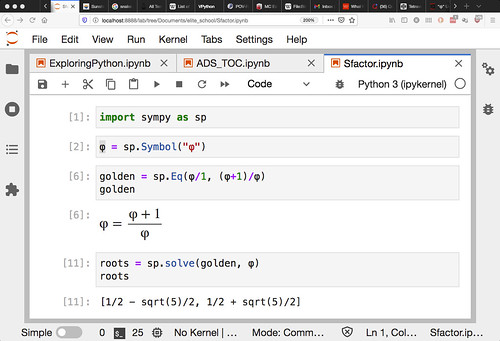
Puttering with Sympy

sfactor_1

sfactor_2

Sfactor


A synergeoist on Synergeo wondered by what factor we would scale the icosahedron of edges one, to give it a volume of 20, i.e. what would the new edges have to be? 

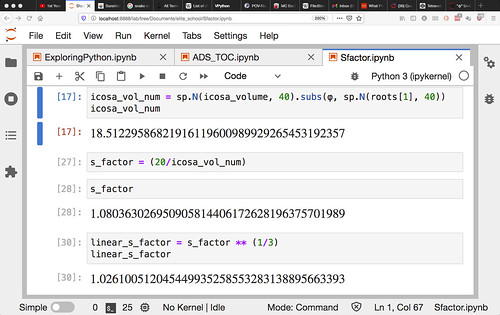
We think of the Jitterbug Transformation and how s_factor = jb_cubocta / jb_icosa (snake case) i.e. jb_icosa times s_factor takes its volume from 18.51... (tetravolumes) to 20 (ditto). 

In other words, the factor in question is a 3rd root of the s_factor, since the latter scales volume, meaning its 3rd root is our linear multiplier.

The s_factor appears again when we morph the icosahedron into a cuboctahedron by a different route. Start with the icosa with faces flush to an octahedron's.  Rotate the tilted triangles to a minimum volume 2.5 cuboctahedral conformation.  Two applications of 1/s_factor does the trick.


Wednesday, May 18, 2022

More About Branding

Today's lunch conversation was about the physics of consciousness.  That's become the field.  I've questioned the priorities there, as a kind of psychologist, as what we need help with, as a faculty, is the unconscious.  Everyday dream time awareness, so-called consciousness, is something I tend to scoff at (just kidding).

Anyway, what kind of "psychologist" do I suppose I might be?  Do I hang out a shingle somewhere?  In the 1980s I think it was, the philosophers thought they might do this, making the claim that what ails people is more metaphysical than merely psychological.  

I could see the appeal.  Philosophy has been on the self help shelves in the past.  Stoicism and so on.

No, the psychology of individuals was my focus in the past, as a reader of Freud and like that.  Adler. But mass psychology, whatever that means, is more my focus today, and that means marketing and advertising, lobbying and propaganda i.e. changing the collective psyche i.e. politics.

Yes, I've called myself a lobbyist.  Once I realized the political process had a hand in determining curriculum, somewhat shocking to realize at first, I jumped into the business of pushing discrete math.  This had to do with high school level topics, and whether delta calculus would maintain its same level of dominance.  I posted tons to Math Forum about it, before the public forums were canceled.

But then of course Oregon Curriculum Network is more niche market than that.  Under cover, I've been an agent for Python Nation, not that our legals at PSF think there is such a thing.  

Guido's term as benevolent dictator was more tongue in cheek, somewhat mocking actual dictators.  That's true of Python Nation as well, similar to Rogue Nation (a brewery in Oregon) in taking the claptrap, the pomp, of nation-states, and using it for branding.

What's a nation-state, or a religion for that matter, beyond a brand?  One could say the difference is immeasurable as a brand is nothing without a substantial subculture to back it up.  Betty Crocker.  McDonald's. 

Exactly.  Ethnicity matters.  You need those subcultures.  The US had its deep believers in democracy.  The flag decals wouldn't mean anything without those old timers.  Other ideologies would adopt them.

Advertisers who believe in the Holy Ghost (a Zeitgeist) have an edge, one might believe, as a matter of faith. Or call them propagandists, as the Catholics do, or did, when everyone important spoke Latin.

Hollywood will tell you it's all show business.  I'm not saying that I disagree.  The show must go on.

If physicists want to be the next priesthood, or maybe that dream has come true already, we should get them involved in the treatments.  Help us with the mental health issues, war a chief pathology.  

That means curriculum development.  That means programming, as in television programming.  

But then television doesn't mean what it used to mean, either.  The internet (tcp/ip) has created the new groundwork.

I work at being a nationalist, a patriot, but for Python Nation, a science fiction virtual nation the PSF doesn't necessarily believe in.  That doesn't mean I've abandoned USA OS (my idea of a democracy, based on the one that died in darkness).  

I think we need practice in re-basing our nationalism in the cloud, more like the religions have done (the more successful ones).  

Cloud-based nationalism helps take the stress off the planetary ecosystem, freeing it from service as a mere backdrop for our nationalist fantasies.

Sunday, May 08, 2022

American Polymathy

This notion that we should divert attention back to the Platonics and sister polys, has a few champions in every era, however the question is what have we new to say about this vista? The theory of Regular Polytopes was nailed down in H.S.M. Coxeter's book by that title, anchoring a consequent literature of n-dimensional graph theory, or topology we might as well call it.  Don't we teach that already?

That a next American pragmatist, literally an inventor, would present with a lot of new chatter about polyhedrons, was not necessarily a welcome development in Europe and/or the UK, except in rarefied circles.  Germany and the Bauhaus School still had a history of architecture to tell, and the geodesic domes had to be part of that, tracing to the Walther Bauersfeld planetarium on the roof of Zeiss company headquarters in Jena.  RBF could remain "an American architect" who popularized dome designs.

The graph of famous inventors in structural engineering had to include the man who patented the octet truss, popularized by other architects and likewise researched by A.G. Bell, the telephone guy.

Peter Sloterdijk, the famous German language contemporary philosopher, embarked upon his Spheres trilogy: Globes, Bubbles and Foams (each a volume), with our American scattered throughout, a vertex oft returned to.  That work, like Hugh Kenner's The Pound Era suggested the architect-only view was far too narrow.  

RBF was in fact a polymath whose cross-disciplinary forays were a way of unlocking new synergies.  A pure mathematician might look askance at the tensegrities and wonder at their entanglement with physical forces.  A physicist might wonder how RBF could be anything but a crank if he actually believed in ESP, which he seemed to.  The risk was opening the philosophy department to ridicule, whereas it had already settled on its particular risk avoiding canon.

On the other hand, history moves on, and in the rear view mirror we have more thinkers to accommodate. What looked too embarrassing to include in one era, becomes embarrassing to exclude in a next. A survey course in philosophy without Bucky, is getting to seem like a survey statistics course without Bayes. The priors have changed, as the machines keep learning.

What was new about the polyhedrons had to do with the simplex, the regular tetrahedron in particular, and its ability to divide evenly into the others, volume-wise, even more successfully than the cube, the new "volume three" in this system. 

An octahedron with the same edges, is four times the unit volume, a rhombic dodecahedron six times, with its long face diagonals our unit tetrahedron edge.

Although the logic was there, and the context (closest packed geodesic spheres in a lattice, the octet truss), it was elementary, more like Wittgenstein's remarks on the foundations of mathematics.  Words like "concave" and "convex" and "spin" came in for grammatical investigation within a growing web of semi-tautologies, metaphorically cast.  Synergetics would have the hallmarks of a philosophy, and that would take some grappling with.

However the Continentals and the Analytics were both averse to this new American Pragmatism -- a lineage uncoiling forward through Rorty's work (one of my profs) -- but for different reasons.  

From Europe's point of view, America had outlived its role as an exotic upstart, a revolutionary presence, and was settling into the familiar mode of Roman imperialism, a model dear to many UKers but not one to admire or take instruction from. 

Why rock the boat with a retreat to Transcendentalism, with which this new flavor of pragmatism was blended?  Why think like Thoreau or Margaret Fuller, and question an expanding empire?  

Phrases like "legally piggily" (a whole chapter in Critical Path) melded with critical attacks on lawyer-capitalism and specialization itself...  how could such writings be good for the establishment?  

The mythos and ethos here, questioning authority at every turn, was more hippie-bohemian, even if somewhat engineering-savvy, and therefore too counterculture for any aspiring button-down corporate culture, what many universities aspired to be at the time, and still do to this day.  Yet Bucky always dressed like a banker.

Had the new language games with polyhedrons been buried in a jocular Scientific American article, say by J.H. Conway or Martin Gardner, and filed under recreation, then the spark might have more easily spread, but perhaps fizzled much sooner.  

The problem people had with this philosophy is that the new casting of the polyhedrons in a nested arrangement was supposed to be significant to children and to the future of humanity.  It was supposed to be important, and dared to clamor for attention.  

Teachers did not want to positively reinforce this message as it was subversive to their ongoing dismissal.  "Don't encourage disruptive behavior." "Ignore attention-seeking behavior."

The prospect of introducing some positive futurist science fiction within the core curriculum would have many implications and the easier course was to keep the lid on these developments.  Elon Musk proved disruptive in this regard as well, even if his plans were less grounded in a philosophy.  People were dreaming about the future again, and contrasting that with what the politicians felt able (i.e. unable) to deliver.

The chief advocates for introducing these education reforms no longer had their charismatic leader and their army seemed tiny and unimpressive, almost invisible.  The juggernaut of mainstream philosophy could afford to dismiss this new philosophy as irrelevant, therefore, at least for the time being.  That seemed to be the thinking, looking back.

Wednesday, May 04, 2022

German Pseudo Science?

Is racism a holdover from German pseudo-science?  People try to make a race out of everything, confusing DNA with ethnicity.  The two could hardly be more different.  Hardware is one thing, software another.  But then software makes sure hardware counts for a lot, in terms of how the sorting algorithms work.  "What race is he?"  

It still sounds out of line to reply "I don't keep track of races" as people think that's a claim to color blindness, as if one were literally unable to pick up the RGB value of someone's skin tone.  Well, put in those terms, maybe I am color blind, as I'm not "perfect pitch" going from an observed tone, to the actual catalog combo.

"He's what people call Black" is better, and for sure he has dark skin.  But then so do people considered "not Black" by some.  The use of the word "colored" never really went away, but became People of Color.

Anyway, the short answer is no.  German pseudo-science was bolstered by the eugenics movement, which was strong in North America, to the point of making laws.  Insofar as "racial purity" might be a thing, the eugenicists and the KKK had a leadership position.  

As an elitist, I might say the bottom half of the Bell Curve believes in races, but that wouldn't be an IQ curve.  A lot of people who do well on standardized IQ tests nevertheless believe in races.  One's ethnic conditioning is "orthogonal" to one's IQ, is how someone with a high IQ might put it, using an ethnic (as in niche) way of talking.

Some ethnicities obsess about race more than others.  To obsess about race doesn't mean admitting to being racist.  Few people I know would go with the definition:  a racist is someone who believes in races. That sounds as wrong as: a nationalist is someone who believes in nations.  "Of course we believe in races and nations.  That doesn't make us racist or nationalist."  That would be the mainstream view.

Thursday, April 21, 2022

HB2U Carol Urner

My mother Carol is sleeping most of the day away in the living room.  She slept through last night in this chair, me on the couch.  We talked at around 4 AM.  I sent an email to Alex and went back to snooze mode.  She knew it was her birthday at that point.  I'd also wished her a happy birthday at midnight.

As the day has gone on, she has had well wishers come through.  Eileen Gannon, Beth Read, Lucinda by phone.  Julie, Carol's daughter, is here for the occasion.

I'm on the hook to dive into numpy and pandas this coming week.  I'd started out hoping I could warm up with my 8th graders, but when they say "algorithms + data structures" they mean CP (competitive programming).  Anyway, I've filed my flight plans elsewhere, like on edu-sig.

Carol has been a lifelong peace activist, ever since she found out about radio-toxins in the milk (Strontium-90?). Her life, like mine, was against a background of endless wars.  Being a peace activist feels like working against the gain, and yet humanity seems to yearn for an opportunity to express itself with greater glory.  Maybe not against the grain of human nature after all.

I inherited a belief in non-violence as a way to go.  I stayed with Quakers, although I resigned membership in Multnomah Meeting at one point.  I wanted to pioneer the role of attender, and took it all the way to clearing people for membership.

I left a message with Sonya Pinney regarding it being Carol's birthday.  She called back a few minutes later. We had a good talk.  The Pinneys and the Urners were among the original families to express themselves in the form of Multnomah Meeting, some generations ago.  The meeting overlapped with Electroscientific Industries (ESI) in terms of facilities:  ESI sold its old factory to the Meeting for a dollar.

Tuesday, April 19, 2022

Machiavellian Country

On my end, the Orwellian Memory Hole theme (see previous blog post) resonates with the "verboten math" meme i.e. a strain within STEM that we'd maybe be better off not considering, if we want a career with the big guys.  Whom to salute?  In civilian life at least, that's not often so clear. 

Actually, I'm not entirely sure how to characterize the threat, or call it the risk, to one's reputation, and then there's always the other side of it:  what risk is one taking by overt obeisance to some status quo rule makers?  Will these be the administrators going forward?  Much to think about.

Academics might rib each other for past citations i.e. if Mein Kampf was a book you cited often, approvingly, in service of your own views, there might come a day when your peers gave you flak for this chapter.  I'm thinking of how professor Kaufmann was pretty unmerciful when it came to interrogating Herr Heidegger, while standing up for Nietzsche as having nothing to do with Germanic fascism.

Back to those toeing the line, being good minions beyond a safe pull date: a published disavowal might have helped notify the world of a change of heart.  But maybe you weren't sure at the time that it would help, and so on. 

In retrospect, you (not pointing fingers, if the shoe fits) played your cards rather inexpertly, but then so did a lot of people.  Factored in to one's playbook are one's predictions of who the winners and losers will be.  One gambles.  One might be wrong.

"Throwing one's lot in with" another is like "hitching one's star to" in terms of comparable idioms. 

Then there's "riding the coattails of" which comes off as more minion-like.  

The winning team appoints its own to the coveted desk jobs around town.  That's not scandalous or unusual, but evidence the system works as designed, assuming the power to overturn administrations was a built in feature.  

Monarchies may, in contrast, may have a hard time scripting their own demise, lets admit the obvious, not that orderly transitions haven't happened, in cases of an heir apparent.  Dynasties are certainly a thing.

Allegiances and loyalties, expressed or implied, are what we're talking about here.  Machiavellian Country.

What's true in our case is our subversive author was never entirely purged from respectable publishing, thanks to some anticipatory efforts by the Bohemian generation, in collaboration with Boomers in many cases.  

I'm thinking about , for example, still actively tapping the "verboten" roots of our counter-culture (cite Private Sky etc.), continuing to bring a positive futurism to light in fresh ways.

When I talk somewhat tongue-in-cheekily about our not indulging in "EU metaphysics around pi" i.e. concerning the "real numbers" (their theoretical foundations), I'm circling the wagons, so to speak, and protecting my West (the Americas) from the undue influence of Continental beliefs, religious and otherwise. 

We'll study their beliefs, sure, but not necessarily at the expense of suspending our own.  Our practice of globalism need not imitate theirs either.  

As an Oregonian, I'm not into picking elective fights with my counterparts in the Stans, for example, let alone in Persia.  The Pacific Rim is pacific for a reason.  We don't behave like we're a part of some Atlantic alliance, nor would it be a dream come true if we did.