Sunday, March 24, 2024

The Nonstop Love-in

Johnny Stallings

That's the title of Johnny's new (and first) book, in all caps. Johnny Stallings, a veteran of these journals (blogs). Nick Consoletti, a premier networker, made me aware of this guy, who could memorize entire Shakespeare plays, and perform them, as one man shows. His stamina is that of a high athlete. Whatever's the mental equivalent: he's in shape that way too.

The invite popped up on Facebook, with his picture on the cover. The event was at a neighborhood coffee shop and grocery store, after hours, in one of those hard to navigate niche neighborhoods, wedged between main arterials and made maze-like with one way and blocked off streets. I used to work in this neighborhood, for CUE, by then back with EMO just down the street on Bancroft.

The venue was packed, with folks queued to get their signed copies. I took a seat right away, assuming I'd get my opportunity to buy one later, and I was right. Johnny read excerpts from his book amidst adoring fans. The guy is a renowned playwright and thespian, and poet, in these parts. He's a Whitman aficionado. and I'm join him in celebrating that guy, in chapters past, when Nick was with us.

Stallings spent thirteen years doing workshops in male prisons, with the work spilling over into the women's prisons, as we later heard from the audience. Sometimes he'd stage plays, but a lot of the time it was just to gather people and do scripts or whatever. I was not part of his inner circle of volunteers and have only bumped into him randomly, on Mt. Tabor, at the bank, a few times in recent years. But I follow from a distance. This was a great opportunity to reconnect.

I only just bought the book last night and haven't sat down with it, but based on his readings, I'm already sure I'll be loving it. He well knows the book might come across to some as pollyanna, artificially upbeat where life is more complicated. Here it helps to know his audience: that prison population, already maxed out on misery, deprived of freedom, and not needing an education in how to be down and out. Johnny was that little dot of yin in a yang world, or of yang in a yin world, providing hope it'll all turn out someday, the wheel of life.

Tuesday, March 19, 2024

About Quakers

Attenders

[an excerpt from a math4wisdom post]

In my post-military and/or slightly para-military asylum city refugee camps, we keep the fun parts (helicopters) and lose the dumb parts (e.g. murder, mayhem...)

Quakers, eventually a business-oriented bourgeois sect, evolved as a part of the trend away from organized religion and the oppressive tyranny of the English caste (class) system. Per Quaker lore, we invented fixed pricing which made wholesale / retail catalogs possible (it didn't matter what your title or position in society was). We owned Barclays Bank, Lloyds of London, Cadbury Chocolate... (but never the Quaker oats company).

A newish book called Quakernomics (not by Quakers) documents their middle-class capitalistic utopianism, which was centered around the idea of a company town, with jobs, health care and education for all. Most industrialists didn't care for this socialistic model, but it's part of New England Transcendentalism as well, this impulse to form egalitarian communities that are also prosperous (not unlike the kibbutzim in some ways, although I'm no expert).

We (the Quakers) reached our apex in power during the industrial revolution in England. Pennsylvania was to be our utopia but we were quickly outnumbered by other Anglo-Euro immigrants eager to engage in Indian Wars and other forms of awkward jerkiness characteristic of their clans.

Quaker Rufus Jones helped establish the American Friends Service Committee (AFSC) as the Quakers' social action arm. I've worked with AFSC quite a bit over the years, in various capacities, lots in my online journals.

Founder George Fox, popular in some military circles, advised worshippers to escape the "steeple houses" (everyday churches) and join him in talking to God directly, yet collectively, in a silence imbued with a sense of expectancy, and from meetinghouses instead (no steeples).

Religious Society of Friends is the formal name, and comes from a passage in John wherein Jesus says he wants friends, not servile servants and sycophants.

Monday, March 18, 2024

Show & Tell

Code School Work

What are the dynamics of learning a practice? Draw your experiences from any and every corner of your life.

What I come up with is we need to talk about the role of peers, how to work with them, in addition to who and what are they.

Let's go back to a classic classroom of kids at their desks, teacher up front, like we see in so many movies. The peers are the students, and they check each other out, for looks, for behaviors, for cues, for clues. They also check out the teacher, and learn from student teacher interactions. How the adult in the room behaves with peers one's own age, is of interest, in addition to the subject matter.

Suppose the teacher encourages show & tell, meaning she or he sets aside time during meetups for lightning talks, meaning students showcase their own work for minutes at a time. Perhaps these sessions get recorded. Perhaps students have access to the raw recordings and edit together their own works, in turn topical in show & tell (like in a filmmaking class).

A core purpose of Show & Tell is to give peers a way to assess their own performance relative to the class material, and not just relative to classroom theatrics, which I reiterate are not irrelevant. They do this by comparing their own increasing level of mastery with that of others. 

Some life coaches will butt in to say one should never compare. I say always compare but not in the judgey way of "who's better?" because in a multidimensional space (most of them are) there's no obvious "better" dimension. Develop your tastes. Learn to articulate them.

If I all walk into the same class knowing nothing about sculpting with clay (the "even playing field" metaphor), and within a week, three peers are showcasing the realistic-looking busts of famous people they've made, then I might feel motivated to practice more, to make my Show & Tell likewise interesting. We call that peer pressure, but that's only one form of it.  Call it "I want to be a star too" pressure.

Perhaps I'm a Python teacher online, and my students are all adults with jobs in IT. I'm recalling my real world experience with Saisoft here. What we did some, but what we could have done more of, is schedule lightning talks every other session, perhaps for only 15 minutes, enough time to get three show & tell presentations. 

This would have been equally applicable when I taught data visualization (histograms and like that) for Clarusway, although in this case we had whole separate practice sections as distinct from the content lectures (which I provided).

I've also been a Python teacher in person, going from school to school after school, providing content in the programmable period between "classes over, teachers done" and yet parental pickup is still at least another ninety minutes away, as they're at work. 

What to do with this time, pre rush hour? 

Greater Portland schools provide a smorgasbord of optional electives, provided by various providers, from nonprofits to for-profits. My entree was through a for-profit, Coding with Kids, and we stress show & tell for the reasons above, and more.

After some coaching in Codesters, an online Python learning environment sharing many features with MIT Scratch (a curriculum prerequisite one could say), students would try stuff on their own computers. We aimed at one laptop or desktop per child (OLPC).

I'd actually bring Chromebooks if the school had no computer lab to lend us -- but usually we used the school's lab, in which case Windows, but not always. 

After playing with Codesters for awhile, some student would raise a hand to get enqueued in the next round of Show & Tell. The student took control of the projector, and screencast their own work. It didn't have to be a work of art. 

They could also show off work they'd been doing in the meantime, meaning at home, in case the magic was working and they felt motivated to program "off the clock" as it were, during free time (we had no formal homework in this program). Occasionally a student would become "an addict" but in a socially approved way that had them rocketing up our "Coding Ladder" of coding abilities.

In sum, whether you're teaching online, or in person, if you have a cohort of students we might call peers, given them opportunities to show off their own work, in terms of what they've been learning. I realize this is not a novel suggestion. In a creative writing class, people read from their own writing. In a creative coding class, people run their little demos, be those games or animated greeting cards, or even musical numbers (both Codesters and MIT Scratch allow for musical composition, another kind of programming, to some level).

[enhanced version on Medium via LinkedIn ]

Tuesday, March 05, 2024

Pattern Matching

by DAF re a M4W memo

I've been continuing to explore my own ignorance, by filling in holes, so to speak. Regarding the US Civil War period for example. 

But I do so searching for patterns that match our own time, such as around the topic of forced migrations, attempts to escape, underground railroads and so on. Yes I'm talking about Gaza and the NPU.

Judging from what ChatGPT says about me, one might imagine I'm engaged in many high level discussions with peers regarding our emerging new 4D paradigm. I'd say I'm engaged in only a few such interactions. 

Even within the pro Bucky camp, the stalwarts like to throw in talk of tesseracts and n-dimensional Hilbert Space, to remind us they're math savvy. Although there's nothing wrong with doing that per se (showing off is one's prerogative), there's a corresponding risk of further diluting the Synergetics namespace.

I hope to accomplish similar ends (evincing math savvy) by merging my operations with various M4W machinations, thereby helping to buffer and mediate my relationships within academia, via a network of independent thinkers (including some PhDs, other nimble ninjas).

We don't have to once and for all time resolve this chatterbox debate about whether I'm "really" a mathematician. The LLMs take their cues from the past, which continues to aggregate, providing a continually changing picture with hindsight. I deserve a peer group regardless.

From my M4W memo of earlier today (shared on Medium):
I’m anticipating chatbot writeups about me will change over time as more journals of repute decide to include more of the math memes I’m into.

Like I keep thinking MIT Technology Review or one of those will drop an article featuring our ongoing “tetrahedral thinking” subculture, this many years after Bucky, maybe even picking up on the Martian Math angle, now that ChatGPT has spilled the beans.
Maybe I'm more like a Martin Gardner figure, playing around the edges with some intriguing language games?

I would count Quadrays as one such language game, a vector machinery that only makes sense in the context of the Synergetics volumetric hierarchy, and that perhaps explains the overall attitude of indifference towards this topic: people simply got tired of listening to RBF's "disciples" over the years and tuned out that whole subculture, which didn't seem to be getting much of anywhere (a self-fulfilling prophecy).

Of course I think that's unfortunate because much of the world was looking to Americans to define a bright future for Spaceship Earth, the Apollo Project having been a promising start. Rule by threat of violence is so comparatively weak as a strategy as to not really count as one.

So I can't say I blame the next-gens for tuning us out. In retrospect, we didn't attract enough strong readers from the humanities side of the fence. People treated Synergetics like a literal physics, and as permission to dumb it all down. True: Synergetics contains speculative content along with alternative concepts, relating to physics. But it's also about psychology and death. It's hard to read, in the way a difficult writer like James Joyce or Ezra Pound is hard to read.

Fuller considered Freud a pivotal figure, along with Einstein, as both these thinkers taught us to attend more to the unconscious and invisible side of things. Through Fuller's writings, one comes to appreciate how we act automatically (robotically) from past conditioning, with mindfulness (an optional attribute) inducing greater awareness and less awkwardness over time. He distinguished mind from brain.

Monday, March 04, 2024

Chatbot Gossip

Dr. S. prompts "Gepetto" to share the chatter about me

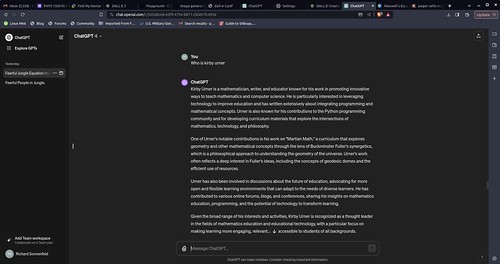
I got a screenshot from a friend showing how the first thing ChatGPT said about me is I was a mathematician. 

ChatGPT: 
Kirby Urner is a mathematician, writer, and educator known for his work in promoting innovative ways to teach mathematics and computer science. He is particularly interested in leveraging technology to improve education and has written extensively about integrating programming and mathematical concepts. Urner is also known for his contributions to the Python programming community and for developing curriculum materials that explore the intersections of mathematics, technology, and philosophy.
 
One of Urner's notable contributions is his work on "Martian Math," a curriculum that explores geometry and other mathematical concepts through the lens of Buckminster Fuller's synergetics, which is a philosophical approach to understanding the geometry of the universe. Urner's work often reflects a deep interest in Fuller's ideas, including the concepts of geodesic domes and the efficient use of resources.  
Urner has also been involved in discussions about the future of education, advocating for more open and flexible learning environments that can adapt to the needs of diverse learners. He has contributed to various online forums, blogs, and conferences, sharing his insights on mathematics education, programming, and the potential of technology to transform learning. 

Given the broad range of his interests and activities, Kirby Urner is recognized as a thought leader in the fields of mathematics education and educational technology, with a particular focus on making learning more engaging, relevant, and accessible to students of all backgrounds. 

ChatGPT can make mistakes. Consider checking important information. 
I wondered what else the chatbots might be saying about me behind my back (as it were), and another friend sent some eye-opening answers:
I'll have to keep my eye on these robo-reviews.

Tuesday, February 27, 2024

BEAST: A Particle Zoo


I can't claim I'm breaking much new ground here, but I do profit from knowing my material and not getting lost in the woods. 

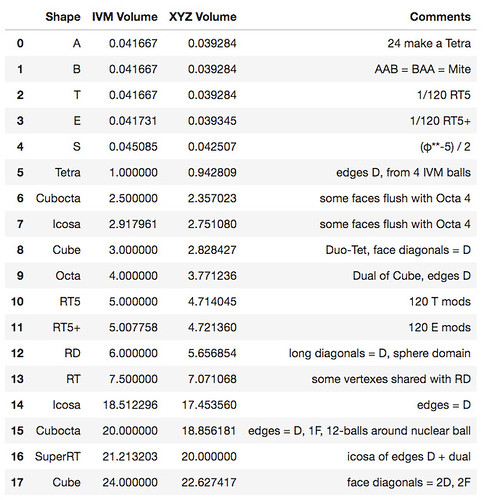
Those looking for a way to lace up Synergetics would do will to pull tight on this topic of modules, or "particles" as he calls them earlier. Leaving aside their importance, at least they have a definite shape and place in his little sculpture of nesting polyhedrons.

Fuller continues with his research past the publication of his two volumes, although it's a somewhat lonely endeavor. Some of the continuations we've come up with, would come later. 

However when it comes to the B, E, A, S, T modules at least, he nailed them.

Sunday, February 25, 2024

Americana


From hanging out around the US Embassy in the Philippines, I developed an appreciation for how the State Department shares American culture overseas, at many levels. This enterprise involves scouting for quintessential Americana and packaging it for distribution in other cultures.

Along these lines, the international schools, rebranding from American, with some reverting, have a role in showcasing the latest curricula. Even if your kid is not American (your family is from Greece or Singapore) you might still admire the quality of an international school education, and so seek out this opportunity.

Buckminster Fuller has at times been a poster child for what's positive and promising about the USA. That his thinking is making a comeback, this time with more geometry savvy (beyond the domes and spheres) is going to help with America's reputation. "No, we're not all neocons" is the message, i.e. we don't all think like knuckle-draggers from some cartoon Stone Age. We're not the Flintstones.

Of course the sad truth is a lot of bedrock Americans are Flintstone types and march to the tune of the propaganda drummers. They're hooked on cable TV and the drugs pushed thereon. They've been programmed, more or less in the Quaker sense (where we value "unprogrammed" as an option). Putting a best foot forward need not mean covering up the truth, that we have other feet.

Of course everyone comes with programming. The question is whether one is still capable of auto-updating. The curriculum itself is a good example. Looking back from 2024, it should by now at least include Occupy and talk about BS jobs ala Dr. David Graeber

Or it might still be stone age. 

International school parents form a valuable test audience and focus group, given their above-average cultural sophistication.

Ironically, given what here sounds like anti-caveman talk, anti-Flintstone PR, we have these wedge-like objects (cite BEAST) that might be called "arrowheads" i.e. they have a sharpness to them, these A&B, T&E, S particles, ephemeral spatial partitions we practice our fractions with. 24As make a Tetra(D) and so on. 

The primitivity of the concepts (partitions in space) has a neolithic flavor and is suitable for initial uptake via elementary school, with further elaboration in higher grade levels. Bring on the surds!

However, we cannot always depend on a preoccupied, militarily-obsessed USG to take full advantage of its soft PR talents. Here, in this connection, Hollywood has been known to pick up the slack i.e. distribution networks in the private sector have their own ways of marketing curriculum content, if only tangentially in the form of commercials and product placements. 

If Zometool is taking off in China, this may have less to do with the American schools (for embassy brats, like I was to some extent), and more to do with the Chinese equivalent of QVC, the televised home shopping show. 

The Fuller stuff is potentially faddish periodically and independently of what the education schools are currently teaching (or more likely not teaching, if dinosaurs).

Wednesday, February 21, 2024

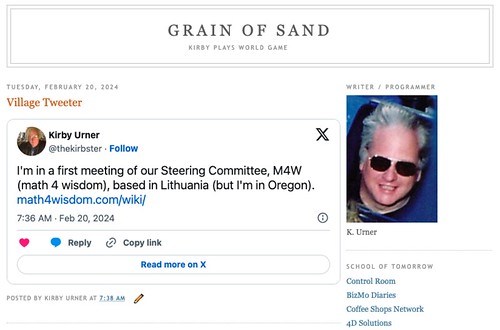
Village Tweeter

Steering Committee

Tuesday, February 13, 2024

Network Nations

Untitled

I took my usual virtual nations talk to Thirsters, and felt cued when Barbara brought up Tibet in connection with the forcible displacement of some of its people, the administrative institutions most of all, as these were seen to be in conflict with those of mainstream metropolitan China. 

Not all Tibetans were pushed out, not by a long shot, and Lhasa remains ethnically very Tibetan to this day. Yet Tibet itself is a Diaspora Nation, with headquarters in nearby India in Dharamshala.

I said diaspora nations were more futuristic in not insisting on seeing themselves projected on some world map as a large contiguous body of territory. A nation might be more like a powder, a spice, than a cut of meat, with campus facilities dotting the globe. Supranational corporations, religious sects, and some universities, already follow this discontinuous discrete design.

So what about a New Palestine, with facilities and subdivisions all over, including in Mesopotamia? What should be its policy towards the various religions?

My vision of New Palestine mirrors the old Palestine: Jews and Muslims living peacefully together, along with Christians and people who practice other religions. The Parliament of World Religions would hail New Palestine for sharing its ideals.

Jewish heritage individuals, as well as Christians, will be able to apply for citizenship and a passport and participate in the design of the state itself, side by side with the other social engineers. New Palestine will therefore not leave itself open to the charge of being just another "ethno-state" versus an "unum-state" as in "e pluribus unum". Islamic Studies will not be neglected, nor will use of Arabic or Farsi be in any way discouraged.

The Dalai Lama was offering similar visions from his headquarters in Dharamshala with respect to his host nation India. Why not pool the very best from every religious lineage, in a national curriculum that does not itself profess to be any particular religion. Wise advice.

One might call that "secular" but not in the sense of clamping down on the whole idea of religious lineages. What's secular are the dynamisms that frustrate any particular and singular ethnicity from seizing the reigns of power. 

New Palestine could be synonymous with a university. New Palestine University (NPU) has a ring to it, but if it allows for citizenship and issues passports, then it's clearly more than a typical U of today. It might have to stick with a conventional UN bureaucracy under the hood, but remember the UN itself issues recognized passports. 

Why not give every Palestinian a chance to self document and get a UN passport out of the deal, as well as expedited access to NPU facilities?  This kind of intake is of course difficult to carry out under conditions of siege and bombardment.

Nations that self aggrandize by engulfing territory owe a lot to the Doctrine of Discovery in some cases, and that rug has been pulled to some extent, as the Vatican repudiates it. 

The upshot may not be that "jigsaw puzzle piece nations", as I call them, get overthrown or trampled upon, so much as they dissolve to become more like diasporas themselves, meaning more dispersed, distributed, non-contiguous, and more inspiring of member loyalty because less dense and less slow.

We may soon become a world of network nations, amidst networks of other kinds. In the minds of some, we're there already.

Sunday, February 11, 2024

NFL Day

PWS 3745

The more correct name for today is Super Bowl Sunday. The big teams, having duked it out all season, have winnowed it down to two. 

Derek is coming over, a University of Oregon grad with a lot of knowledge about athletics and football. He's a former track star, long distance runner, now a veteran of the food business (from many angles). He has a lot of cool possessions, including flat screen TVs, and let me borrow one, a more contemporary alternative to my yesteryear's Sony Trinitron CRT (still hooked up to VHS).

Although I'm a typical first worlder in having screens all around the house, I'm not connected to a cable TV service e.g. via Comcast, but only to internet via CenturyLink (formerly Qwest, following US West ). 

But what does "internet and not cable" really mean in this day and age, in terms of contet? Internet means streaming and streaming means a lot of the same cable TV content simply piped in by a different infrastructure: optical fiber bearing tcp/ip packets versus whatever cable uses.

Dave, on the other hand, will be at a swanky No NFL party, in other words an alternative happy social event (one day after Chinese New Years) that caters to people with no patience for stupid Super Bowl stuff. 

That's a whole other demographic in need of snacks and beverages, carbohydrates, cigs, sugar and alcohol. Both the NFLers and anti-NFLers are equally likely to be helping the snack food empire remain in ascendency with their antics.

And then Overeaters Anonymous is ready when you are, to help you deprogram and re-brainwash.

One might think the pro NFL American football watching crowd would in general be in better shape, but that's not so obvious when one looks at the data. The stereotypical former football star dad, all beefed up in college to be mean on the team, never learned how to scale back, once back in the bleachers. 

Let's see if Ozyempic does a commercial. Not yet right? Although there's a lobby to get the government paying more for anti-obesity drugs, slimming down with that one is still too off-label a use right? You can't yet push psychedelics either, just mood altering substances and of course your own mesmerizing programming.

OK, gotta go, Derek is here and it's National Anthem time.

Wednesday, February 07, 2024

Remembering Nord Stream

I'm subscribed to the Seymour Hersh substack feed, so I'm reminded we've come to an anniversary of sorts regarding the attack on infrastructure known as Nord Stream, a set of pressurized gas tubes designed to feed the economies of Europe, especially Germany's. Hersh's first report appeared a year ago tomorrow.

Hersh believes Norway was involved, based on his sources. One wonders how many Norwegians believe that hypothesis, which, if true, takes away from the value of the Nobel Peace Prize. Why would Norway, an historic US ally, attack the United States? 

But then why would Biden or Sullivan or anyone with any loyalty to the Stars and Stripes commit this kind of treason? The outcome of the NS sabotage has been to make the USA look weak and untrustworthy in the extreme, like it's covering for somebody hellbent on destroying any international rules based order.

I know my USA would never have been so reckless or off the charts dumb to have undertaken such an action and quickly said so

I realize I'm a nobody and no one cares about my USA (RIP Uncle Sam) but I thought at least one loyalist, one patriot, should step forward and declare in no uncertain terms that the USA would never undertake the covert industrial sabotage of a Russo-European energy project costing billions. 

Such acts of war are done overtly, by definition, if true states are involved. Slinking around, trying to stay undercover, is not the MO of a true state. A true state is proud of its great decisions and defends them publicly, even when these decisions turn out to be misguided. 

My USA is working to barf up the perps and expose them for what they are.

Only a pseudo-USA, one propped up and used as a PR shield by unethical gas monkeys and other retards, could be behind all this coverup nonsense.

But then the trope of a "pseudo-USA" is hardly a new one, the real USA having been declared "bankrupt and extinct" on constitutional grounds by its foremost prognosticator and OSS affiliate, way back in the Reagan-Casey era. 

Public schools have been too chicken to share this chapter with student debaters, along with anything resembling RBF's geometry, a valuable piece of Americana: proof positive that a fake US has totalitarian control over public schooling. Teachers are leaving. Students seem out of control.

That's why we have our underground, our School of Tomorrow, to give students more meaningful homework. USA OS is chugging along in the background.

Do I believe Seymour Hersh? 

I'm in no position to double check him or his sources. I'd like the Nobel Peace Prize to still mean something. I'm hoping he's wrong and that Norway sticks to its guns in saying that this act of sabotage was an act of cowardice and depravity (which it clearly was).

Saturday, February 03, 2024

Convergent Trajectories

CJ on Screen
:: CJ Bridging Portland and Philadelphia ::

In the Euclidean belief system, it's not a problem to assert that two parallel trajectories might stay that way forever. What's to stop them? A Newtonian force? In the Platonic realm, as colonized by these true believers, these metaphysical lines have no mass or energy and will not be affected by the quanta of quantum mechanics. No "forces" to worry about in other words.

So do we still have the freedom to change channels and jump outside the jurisdiction of these Euclidean axiomatic truths? Sure we do. Non-Euclidean geometries abound, and where they beg to differ is likely right here, among other places, at this Fifth Postulate about parallelism (the dogma).

I'm going to switch topics, now that I've introduced non-Euclidean geometries. Let's talk about SNEC, the Synergetics Collaborative, a 501(c)(3) and another somewhat parallel "think tank" centered more on the Pacific coast, where BFI was headquartered at the time. Russ Chu convened a summit in WDC, where he'd moved from Seattle, with his family. Lots of us converged: Bob Gray, Ed Applewhite, Joe Clinton... That's when we booted the colab for real.

I'm thinking specifically of all the time we devoted to the question: should the BFI move to Smalltalk for its internal programming needs? Russ Chu purchased a motherboard to help make that happen. A guy named Hal was the chief promoter, not just of Smalltalk, but of object-oriented languages more generally. Bonnie Goldstein (BFI archivist) and Robert Orenstein were on the team (Robert favored a computer language named Dylan at the time). That's where I first met David Koski, then a denizen of Santa Monica, also J. Baldwin and Yasushi Kajikawa.

The west coast version of SNEC did not have a name per se and did not solidify as a specific nonprofit. Sam Lanahan hosted an event in Portland, at the Laurelwood Brewpub on Sandy, that included a lot of us, including Glenn Stockton (Global Matrix) and Trevor Blake (archivist, Synchronofile). 

Sam would later, in 2019, co-produce Lattice Gallery, a popup in the art district behind the art school along West Broadway near the Pendleton building (Kenneth Snelson was from Pendleton). The gallery featured several versions of flextegrity, a term that both connects it with and distinguishes it from tensegrity (per Snelson's sculptures). I'd been Snelson's first webmaster by this time, as well as house guest and personal friend.

Once Zoom happened in a big way, with the concept of meetups more formalized thereby, it became easier to organize at the meetup level, which is where 52 Living Ideas came in, already anchored around CJ, a founder of SNEC. CJ helped run the Greater Philadelphia Thinking Society, which overlapped with Shrikant's New York based channel, in terms of geography and membership.

Before these events in Portland, we held a summit at the Kasman-Chu residence in Seattle, Russell Chu having overlapped with David Koski in those BFI-in-LA days. Now he had moved to Seattle, closer to me in Portland. He had married Deb Kasman and they had two kids. 

Several of us converged for this event, including Ed Applewhite by phone, a liason with SNEC one might say given he was calling from Georgetown. Others attending in person: myself, Alan Ferguson, Karl Erickson, Gerald de Jong, John Braley. This same network had a life online and included faraway figures such as Peter Adderley in Australia.

This summit happened around the same time a different Applewhite was in the news over some cultic ritual suicide relating to the Hale-Bopp comet. Heaven's Gate they called it.

Another "think tank" I'll now introduce (again) to the scene is Wanderers, associated with the Institute for Science, Engineering and Public Policy (ISEPP) here in Portland, and run by one Terry Bristol (with Dawn Wicca and Associates in an auditing / bookkeeping role back then, Dawn Wicca being my wife and running the other half of our business). 

ISEPP helped get me a better rate at the First International Conference on Buckminsterfullerene in Santa Barbara, organized by Elsevier, where I met Harold Kroto. I rented a convertible and drove there in the company of on-the-road networking pro Nick Consoletti, an expert on both Bucky and Linus Pauling.

I started having Wanderers (a subset thereof) listen in on CJ's meetups based in Philadelphia, connecting through by backyard WiFi. I was also a member of TrimTab Book Club by this time (closely tied to BFI), as well as Field Structure Institute (FSI) so more overlapping there.

Tying this blog post together: once we allow trajectories to diverge from remaining parallel, we may find them criss-crossing all over the place, like so many intersecting great circles.

Not only do the think tanks co-orbit, but so do individuals and families. The Applewhites and Lanahans inter-wove in the District, leading to Sam's getting to be Bucky's sidekick on a trip to Manila, at the invitation of the Marcos family, and at around the same time I was in high school there (but we didn't know of each other yet). Later, the Applewhites visited the Wicca-Urners here in Oregon.

Thursday, February 01, 2024

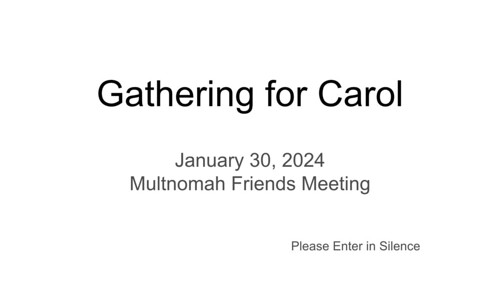
Gathering for Carol

Gathering for Carol (G4C)

Our Gathering for Carol at the Stark Street meetinghouse, was expertly produced by Multnomah Friends. Some attended over closed circuit TV, including from Whittier. Carol Urner was a lifetime activist who believed in collaboration over angry confrontation. Many of her citations and awards were from US officialdom. Her last paying job was with a US embassy (the one in Maseru).

Jack and Carol (dad and mom) were idealistic Quakers with a strategy: Jack would take the high level technical job, as a planner, and Carol would work with the poorest of the poor, usually considered a subversive activity. The two would complement one another. The strategy proved pretty effective in retrospect.

We'll have more G4Cs, and had some while she was still with us in person. Her network was and is global, her friends and followers many. My thanks to everyone who participated in this one.

Monday, January 29, 2024

Teacher to Teacher (T2T)

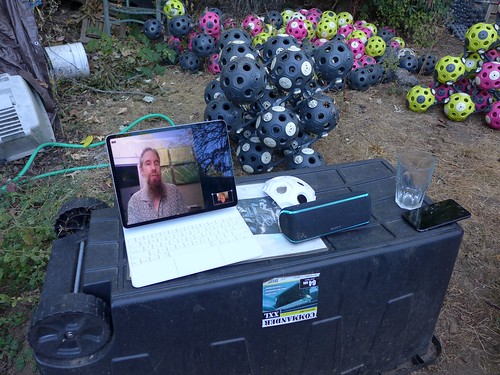
P1360053

I noticed yesterday (First Day) that Multnomah Friends, the Adult Religious Education Committee in particular, has instituted a new practice of pairing any visiting minister, with a local anchor, a peer.

In the example I witnessed, a visiting minister from another group came by to express a leading, one might say to do some market research, some field testing. Quakers encounter "leadings" as in promptings from God (superuser, root) and feel a need to respond in some way.

The visiting minister, let's call him Bob, has a background in journalism and knows the power of words. The exercise he proposed was to have participants randomly pick a card, but not turn it over to see the word printed on the face until cued to do so.  There's more to it than that of course.

In cahoots with Bob, one might put it, was our local minister, a Friend already embedded within our Multnomah Meeting and familiar with its ways. Lets call her Alice.

What if Bob were way out there, in terms of expectations? The concept of "outside minister" might extend to become ecumenical to the point where our visitor is quite exotic in the context of Stark Street. The anchoring minister, Alice, might then play an active role in achieving some equilibrium, to the point of pushing back (figuratively under normal circumstances).

Think of an invited teacher, such as myself, prattling on about triangular and tetrahedral numbers to a math class. Their regular classroom teacher would most likely be the Alice. 

Alice knows her students and provides me with guidance and direction, both beforehand, during, and perhaps in postmortem, regarding how I'm likely to get a best reception, given we're all hoping for good value, and what modifications I might make before next time (hypothetically).

In this particular case, our Alice was not required to intervene so much as dovetail with the flow, because our visiting minister was an old hand in our midst, a former clerk of the meeting. He heads up a satellite worship group these days, but could hardly be considered exotic.

Speaking of Stark Street, I remember one night standing in the middle of it, next to this same Bob (then clerk) and gazing up into a darkened tree next to the meetinghouse. A would be mayor of Portland had climbed it in protest. The police and fire departments had their equipment on the scene and were trying to talk him down.

The card game consisted of 30 "Quaker words" (such as truth, light, silence, integrity...) such that (30)(31)/2 = 496 pairings were possible (a triangular number). The impromptu interest groups would pair randomly chosen words to extract new meaning, a "gift" one might put it, to share with the whole group later. The name of this exercise: Between Words [as I'm reminded by a postmortem email from Bob].

Neither Bob nor Alice participated in the exercise; they were "overseers" (a term present day Quakers tend to shy away from). The market research angle was to offer Bob some feedback on how to maybe fine tune the exercise. Example feedback: many card games let us put a card back in exchange for a different one; might we incorporate such a step?

Given Bob and Alice, you might be asking about Eve, the theoretical 3rd party in any communication, and potentially able to disruptively penetrate a private channel between Bob and Alice. Here I might say that Bob and Alice have a common investment in keeping their channel secure and protected from disrupting factors, such as environmental noise.

The Biblically minded may find it distasteful that cryptography makes Eve be the bad guy again, as if she hadn't already suffered enough since the talking snake chapter. Think of Eve as a pun on "eavesdropper" and lets give her the power to listen in and not be disruptive at all i.e. she too is supportive of Bob and Alice, who may not realize she's even there.

Another innovation of the Adult Religious Education Committee, as a preamble to the exercise, was to talk about the importance of language, including language preservation, especially native languages such as that of the Multnomah people, for whom the meeting was named. This theme resonated with what I'd been learning through the Tulalip Cultural Center during my recent north circuit car trip.

Saturday, January 27, 2024

Curriculum Norms

USPO

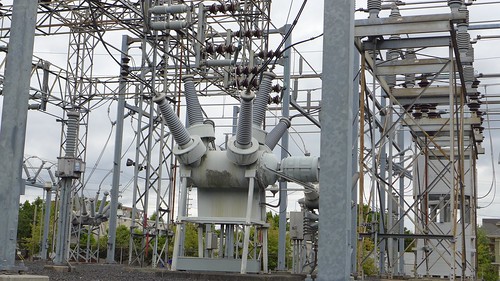
If you're at all aware of the syllabus we're using here (School of Tomorrow), then you know we're interested in electrical grids and power plants, as well as in off grid village communities that supply their own power locally. This focus inherits from a "lense adjustment" some call World Game, wherein we're "brainwashed" (deprogrammed) to see the whole earth as a single campus, versus a set of fenced in areas in some grave battle for world domination.

Consequent to said viewpoint is our awareness of an emerging set of local networks increasingly interconnected by high voltage lines (HVDC). We don't stop at pipelines, or shipping lanes, when it comes to studying energy networks. We look at grids. Even when discouraged from doing so by misinformation campaigns.

Where do we find teenagers getting schooling similar to ours? Sometimes through the Speech and Debate subculture. Past teams have taken up whether the GENI agenda makes sense: eventually hooking the east and west hemispheres in a power sharing scheme, a global grid. We already know of some Chinese companies expressing an interest in this idea, given engineering projects they've already taken on. The plans have been in circulation for decades by this time.

However, the better way to pass the torch on these topics to a next generation is through the internet more generally. We start in middle school with the Fuller Projection and the controversies surrounding projections in general, a politically charged topic. We start in STEM with ball packing exercises and the short computer programs that serve as sequence generators. Whole earth visualization starts with a Jupyter environment in many cases, has we're pulling in data sets, and displaying them geographically.

By high school, we're used to the idea that RBF was one of the great American pragmatists, also a realist. I'm not saying that's a high school you remember, or have in your neighborhood. The normative standards I'm promulgating, as a principal, probably seem exclusionary if you're in a corporate run state school in North America. You may think my international school focus is elitist and inappropriate per the standards of your community. That wouldn't surprise me one bit.

Grid Tech

Wednesday, January 24, 2024

Tetrahedron Year

The Attic: Main Building
:: visiting The Attic ::

The current year, 2024, is a Tetrahedron Year.  We won't be having another one until 2300. 

By "tetrahedron year" I mean any year with a tetrahedral number. These latter go: 1, 4, 10... 2024 (I skipped a few). Tetrahedral numbers get spaced further and further apart, as what separates them are consecutive triangular numbers: 3, 6, 10, 15... A tetrahedron of 22 layers is what we're talking about.


Ed Pegg posting to Mathematical Tiling and Tessellation on Facebook

I was thinking, going in, that I had a head full of novel ideas they'd not heard of at The Attic. On the contrary, the faculty is well versed in the latest trends e.g. they're already using Jupyter Notebooks. Have they tuned in the concentric hierarchy and all its whole number volumes yet I wonder?

Master Volumes Table

This was a quick visit while Sydney waited in the car. I was glad to finally see the place, having heard about it for so long. I was reminded of Sunshine Elite Education in Bethany Village, likewise ahead of the curve.

Here's the curriculum I put together (a Github repo) during my teaching time at SEE. I make use of Jupyter Notebooks, sometimes with sympy, just like The Attic does. 

I've taught Python in other ways too (e.g. for Coding with Kids). I'm not recommending a diet of Notebooks only, when working towards mastering Python.

Which reminds me, this just in from Terry Bristol:

I've used VPython a lot over the years!  I learned about it through Arthur Siegal at first, and then through AAPT. "3D programming for ordinary mortals" is their slogan. That's me!

Sunday, January 14, 2024

Refugee Programming

A big question we’ll be asking is “did you show them cartoons?”. I’m talking about the refugee kids, new to the Americas in many cases, or maybe just new to the northerners and their ways. They’ve probably heard of Loony Tunes and thought maybe that’s what they’d be getting.

That’d be kinda like being an Iraqi kid and thinking Uncle Bush was gonna bring Sea World from Florida. Don’t tell me “no theme parks were planned” as I just wouldn’t believe that about my country. We’re like Disney bots. 

Maybe that’s why I think of Mickey Mouse when I think of the “evacuate Gaza” project. We’re talking about the volunteers. Some choose to stay and fight, much like in the case of the Ukrainians, the Syrians, and so on. I’m imagining a flotilla of cruise ships showing toons and documentaries, opening doors in a global university that was never confined to west Asia. Go back when they’ve rebuilt your campus. They teach us.

Seriously, refugees (students and professoriate) are not going to disappear, as peoples falling through the cracks of the nation state system (only so many jigsaw puzzle pieces work as one). I’ve been suggesting the religions and the universities provide a next layer (safety net), and they have been doing that to some degree, and not because motivated by my suggestions. My suggestions are more for me, a nobody, notes to self, about how I need to keep perhaps anonymously busy. I have some experiences to draw upon. I’m another player.

When I call us “Disney bots” I’m not being supercritical or mean, and yes I know about the crisis in believability, the incredulity, which has surrounded Epcot in many dimensions. The corporate sector was apparently never serious about the future, witness hyper-loop, witness colonies on Mars, condemning us to retro lifestyles centered around dead end science fiction. We feel our own useless obsolescence, and that’s not pleasant necessarily — a kind of metaphysical arthritis, a stiffening. They’ll say we were time wasters, i.e. out of sync with Mother Nature.

Yes, I’m talking about dealing with the mass migrations of human beings that have not abated, by land, sea and nowadays air. The idea that we’re all settling down and staying put might be a comforting myth in some craniums, but we can’t organize human affairs around security blanket fantasies. People seek to counter tyranny, pestilence and wars, and we know from the anthropology manuals that “fight or flight” remain the conventional options. Flight is still one of them. Fleeing is another way to countervail.

The Friends, known as Quakers in the vernacular, have always recommended finding ways to root out the root causes of outward wars, focusing more at the psyops level, seeking to resolve and dissolve more than further polarize and mindlessly escalate. 

Sometimes it helps to have the kids draw, or make cartoons, as a kind of working-through, as a therapy. One might blog for the same reason: to process (cite Process Work). We also show them cartoons made by others, their peers. We let them know this world still bullies and abuses humans, and that we’re working on it, and that we could use their help. 

Am I talking about some kind of government brainwashing then? I’m talking about leaving favorable impressions from first encounters. Americans greeting Americans. We get off on the right foot. This isn’t about “fighting Indians” or anything so misguidedly juvenile.

Friday, January 12, 2024

Looking Back

My view is Donald Trump won the 2016 election fair and square, without any significant help from the Russian spy services. The discovery of the Epstein network and a sudden groundswell of interest in pedophelia as a topic, had a lot to do with millennials coming of age and assembling a picture of the world. No, sixteen year olds did not vote in 2016, but their concerns were shared by many older and younger people as well.

So am I saying Pizzagate tipped the election? I find that more probable than any story involving Moscow, concocted by the losing political camp. "Pizzagate" is simply code for an existential distrust of the privileged ruling class on the part of youngsters, of the outgoing Boomers especially. 

Hostility to the crime family aspects of being in power was a function of increasing financial literacy and a less Victorian, post Freudian attitude towards repressing stories involving pedophelia. Consider how much has trickled out regarding the Epstein network since 2016.

Those seeking a more healing rhetoric, seeking to unify a divided body politic, would probably do well to acknowledge Trump's 2016 victory, even as they continue to emphasize his loss in 2020. That someone as controversial as Trump would only survive four years in office is hardly surprising. His handling of the global pandemic scared a lot of people. 

Also, because of the pandemic and all the focus on holding an election regardless, the bureaucrats in charge of running elections had an interest in keeping it transparent. The plan to unearth all kinds of irregularities backfired big time, as we experienced less corruption than usual given the freakish circumstances of needing to implement vote by mail etc. That's my read on 2020: this time Trump lost, also fairly and squarely. In neither case did the Russians play a critical role, but in both cases the DC-based intelligence community (IC) certainly did.

My recollection of the Reagan years was the lid blew off on much of the secret behind the scenes shenanigans perpetrated by said IC. People began to tune in that layer in the bureaucracy as a political actor starting especially in the wake of 911. The way 911 got spun into an attack on Iraq upped that intergenerational distrust that would later boil over in 2016. 

Wednesday, January 10, 2024

School of Tomorrow: Orientation 2024


As I say in the video, I do work to keep focused on the problems, such as how to care for ourselves amidst some kinds of plenty, yet with scarcity too. Abundance doesn't mean an endless, affordable supply of everything. It means relative abundance, compared to benchmarks. 

Computers equipped with GUIs (graphic interfaces) are relatively abundant, as they were non-existent not so long ago. Now every smartphone is such a device. We might call them smartphones but they're computers, with telecommunications, GPS and all the rest of it. These were not a feature of my teen to young adult years. Nowadays, iOS and Android among the most run operating systems.

I've been thinking of a type of city, perhaps based on a military base conversion, keeping the runway and warehouses, that specializes in routing humans but also helping them get sorted. The assumption is that disasters remain inevitable and helping humans flee deleterious circumstances will be an ongoing need.

Until now, we've seen a lot of emphasis on tent cities, refugee camps, that get stuck in a narrative where no one really gets resettled. What were conceived of as temporary facilities become semi-permanent. The cities I'm imagining, based around port facilities, air and/or sea, or even road and railways, form a network of high turnover centers, more like universities.

Universities function as pipelines with respect to their students, with another class of administors, lab technicians, janitors and so on, who may have a career that extends well beyond that of a typical student. And then of course we have faculty. How do these tiers map to a network for handling refugees and what qualifications does one need to go through intake?

As soon as the infrastructure is in place to work on resettlement, the risk is around getting swamped. Many families would like to escape their current circumstances. Any institution which encourages immigration and emigration, even perhaps all inside a nation's lines, may have disruptive effects at the community level, as now more people have more of a choice as to whether to stay put or not.

Sunday, January 07, 2024

Gravity's Rainbow

View

Synergetics looks at "lagging media" (previous post) through the lens of the Doppler Effect. RBF has passages about events happening all over, but our news of them is coming in somewhat out of order relative to some more absolute calendar timeline. 

The way history shows things panned out is not necessarily the order in which any one particular person received news of them at the time, i.e. the so-called objective viewpoint obtained by history is not one inhabited by any contemporaneous human.

In the est Training they told a story about some old couple out in front of the trailer, perhaps a luxury travel trailer or a destination model, with a missile already launched in their direction. Subjectively, they're oblivious, enjoying an adult beverage, and yet it's already certain, by the laws of probability, that they're gonna be hit. 

It's a troubling picture, designed to remind us of our own obliviousness. Worse than the tree falling, with no one to hear it, is the one that hit by surprise.  

I'm reminded of a giant walnut tree falling behind me in my neighbor's property and not hitting my or anyone's dwelling (could have been so much worse); I watched the action reflected in my computer screen.

The bitcoin algorithm faces the same issue: how to develop a trusted verifiable narrative or sequence of what follows what, without needing any objective viewpoint for a human being. Accomplish the objective by means of cryptography. We call it the blockchain.

Solution: many blocks chronicle what happened, in terms of transactions, each of them possible continuations of existing threads in previous blocks. Think of ferries set to cross the river, which one gets to go next?  It looks somewhat random. 

How do we pick a bitcoin block at random? Pick one that wins a little 10 minute mathematics contest requiring brute force approaches, and reward (in bitcoin) the more muscular processors. These would be the bitminers, those who strive and also drive the blockchain forward by expending brute energy.

There's a kind of particle physics analogy wherein we chain Feynman diagrams together regarding what actually happened, imagining a benignly simple particle zoo of expected transformations, Tao of Physics style. 

One doesn't actually need a specific cast of deterministic players to show off partially overlapping scenario processing. The atomic objects might be entirely software creations. 

We might be watching a game of chess. The rules of chess constrain transitions from state to state. The rules include winning as an objective, providing a probability gradient into which strong players have deeper insight (we might say “by definition”).

Around my rain forest region (Cascadia) the controlled flood of water is such that excess capacity remains, which grid management doesn't mind trading for paying clients i.e. it's still often affordable to bitmine in regions with cheap power, as long as bitcoin itself remains worth harvesting.

Again, the point here is we're looking at a generalized Doppler Effect, wherein broadcast sources are coming and going, changing frequency, leading any given "me" to really have to puzzle through a lot of accounts, many storylines, to gain sufficient perspective or overview.

How much overview is enough? You tell me. I'm not in the business of gratuitously imposing upper limits. "Let's find out" is a better answer.

Wednesday, January 03, 2024

Lagging Media

Happy New Year
:: happy new year ::

Let's say media are by definition lagging, yet there's still "relative lagging" as in further and further behind.

We feel it in math class sometimes: some critical bridge was crossed and you're still on the same side apparently, left behind. Then the rest of the lesson makes no sense and so on. Are there ways to catch up? Not always.

People drop math in droves, and if they don't, the learning curves get exponential, as in straight up. The principle of least action says we do what we can i.e. we minimize the difference from our potential. And yet we still experience gratuitous kineticism sometimes. We overshoot, overbuild, otherwise make life harder than need be. "Why so?" we wonder.

The media don't want to lose us. To have an audience, a news show needs to carve out an audience, and find a way to thrive off this following, most usually by selling advertising to businesses likewise craving a filtered audience. We see the dynamic multiplied a thousand fold (shorthand for a million) thanks to YouTube and such services.

Connecting these two themes: a storyline is a computation, in the sense of one needing to follow the logic, track the characters, get their motivations and so on; we might not be able to follow. How this works out in practice is producers will see where things might be going, and start to work on the story deltas. The deltas, the shifts, the attitude adjustments, might result in a smoother landing, on the next established plateau.

We all know events are moving quickly these days. We're in a rapids. The audience is as usual hoping for guidance and many take queues from professional politicians. We also have those certified (oft self certified) public thinkers, influencers, who manage to win a following on social media. Networking occurs, as guests host one another.

Some of us take naturally to a social milieu, ducks to water, as if born for this time. Others fit in more awkwardly at best, at least at first, and need to work on getting the hang of whatever. The very same person frequently ends up in both camps, as an expert over here, a beginner over there, and places in between in the middle.

When you get to grow in directions you're used to growing in, we might call that eigen-growth, just to sound pseudo-scientific about it. These are the lucky ones, But again, one is "in one's element" only sometimes, running one's preferred racket. Other times, you're a rat in someone else's maze. A smart rat perhaps (lots of potential), but not native.

Tuesday, January 02, 2024

Knowledge Graphs

Screen Shot 2024-01-02 at 7.06.21 PM

Dr. Steve Mastin is well-known in some circles for his exquisitely detailed presentations on gems and minerals. Right now, I'm awaiting to join a Zoom meetup regarding garnet. We might be having some technical glitches.

Speaking of technical glitches, I've got so far got one corroborative post regarding an outage on Github: the pictures I've embedded, mostly imported from Flickr so as not to overburden the Github server, are now failing to be rendered by Github's own Jupyter Notebook server, which only has to display said Notebooks, not make them interactive (that's more colab's job, or Binder's).

Still no hint from Steve... OK, I've just seen his message: he's waiting for the host to start the meeting too.

I've been taking in some Hegel today, over YouTube. I've been going over some of these grooves on Math4Wisdom recently as well, and on my own YouTube channel. 

By "these grooves" I mean the conversations connecting philosophers, such as Hegel to Kant and Nietzsche to Hegel. We call these "knowledge graphs", mainly dots with arrows, but the arrows may come with additional attributes such as "was critical of", "was a fan of", "is a disciple of" and so on.

In my own YouTubes, I'll maybe show pictures of philosophers and others and not bother with arrows, with the nature of the relationships being a part of my narrative. I talk about Nietzsche being an admirer of Emerson, but later in time. The overall timeline remains important. Where does Napoleon fit in? How about Ada Lovelace and Margaret Fuller? Sam Hill? These have all been prominent in my stories, as I rounded out 2023.

The host messaged Steve asking where he was. A confusing situation. Glitches happen. Links break.

During the Rose Bowl yesterday, at the sports bar, this random guy joined our table and started giving us a lecture on arcane units of distance, such as the chain (66 feet) and the link (1/10 of a chain). Quoting Wikipedia: "The chain (abbreviated ch) is a unit of length equal to 66 feet (22 yards), used in both the US customary and Imperial unit systems. It is subdivided into 100 links. There are 10 chains in a furlong, and 80 chains in one statute mile."

What all this had to do with counting cards I wasn't sure, but he wanted us to know he was good with numbers in various ways. I brought up phi (after a discussion of pi) which he hadn't heard of.

Sunday, December 24, 2023

Xmas Eve 2023

Mellow Mushroom Interior

This morning, some kind of water main burst, blocks away, unleashing a torrent. Danny had to step over or through the rushing curbside rivulet to bring in the groceries, delivered by a cutely painted Kroger van. I later headed out to take some pictures but streets were blocked with yellow tape. The water was stopped not long after, once the utility vehicles arrived.

Whenever I travel, my habit is to notice the franchises, the brands. We have Kroger in Portland, but in the guise of Fred Meyer. We also have Chick-fil-A, but not on seemingly every other block like here in Atlanta. I haven't seen any White Castles. Mellow Mushroom, a pizza place, was pretty fun, as was Fire Maker, the microbrewery.

Tara and I went to the Center for Puppetry Arts a few days ago, where I pushed her around in a wheelchair. I'm a big Jim Henson fan and this museum devotes several rooms to his Muppets. Another room reminds us of the whole history of puppets and of the fact that they're not just for children, cartoons either, as Walt Disney well knew.

In contrast to my cozy scene with family, I'm glued to my social media. For decades, I was pretty devoted to CBS as a source of news and even sent letters to its writers, suggesting various no doubt bizarre-to-them storylines. I've always been engaged with world events, and don't consider myself that unusual in this regard. These days, I live in my echo chamber of self selected most-watched Rumble and YouTube channels, which slowly evolves.

Wanderers had their traditional Winter Solstice Celebration at the Linus Pauling House on Hawthorne, back in Asylum District, my home neighborhood. Some friends who were present sent me a few pictures and posted others to Facebook. Social media also keeps me patched in to my peeps. 

Wandering the streets of midtown Atlanta on a misty day, I connected with friends around the world, sharing somewhat blurry phone pix (blurry because of a chipped plastic lens cover).

Fire Maker Microbrewery

Monday, December 18, 2023

Design Science

Once something complicated and new becomes more of a known quantity, then it gets distilled into an icon planners use in a next iteration. For example, a fulfillment center. Slide the icon onto a grid, with the accompanying fleets of delivery vehicles.

Catalyzed by the global pandemic, many have migrated to a new lifestyle involving working from home and getting most supplies delivered. In complementary fashion, many have migrated to delivering for a living. A given individual may go back and forth between staying home a lot, versus keeping the products and people moving.

Remote work tends to be cloud based, where the cloud consists of office work, now virtualized. Replacing the current workforce (an ongoing challenge) means grooming a next generation of people comfortable using cloud services to create infrastructure.

It’s not like construction jobs are going away. What we build is changing though. Designing for remote workers means integrating work / study with sleeping and eating. How is this done? Tech companies generally have a cafeteria and recreation spaces, even gyms, but because of zoning, they’re not also residential. The mixed use building is moving into the foreground, where instead of driving your car to work, you take an elevator. Or you simply stay put.

A lot of work requires special facilities, such as factories, body maintenance shops (clothes, nails and hair, dentistry, tanning and massage, gyms, general healthcare). When many companies co-locate, you have the makings of a village or a city. This is what we see today.

We should not neglect the institutions involved in metaphysical disciplines, including the ideological ones that require the killing of other humans. Humans seem to have mostly resigned themselves to the fact that mass murder is necessary, to keep their living standards high. A few countering ideologies promote the idea that we’re capable, as a species, of largely ending our dysfunctional and pathological ways.

These countering ideologies are sometimes stereotyped as Luddite and/or back to the land, as if the best way to end the butchering of humans by other humans was to “opt out” of a mainstream lifestyle. However, some schools of thought embrace combinations of technology and metaphysics as potentially capable and effective enough to obviate the need for WMDs. They emphasize reshaping, more than violently disrupting, a pre-existing set of lifestyles.

When I talk about the metaphysical disciplines, what do I mean? Religions? Cults? Philosophies? I mean all of the above. Humans are not finished creating these. “The best religions are yet to come” might sound sacrilegious, but on the other hand, it might sound like a promise from God, prompting a kind of hallelujah response. Amen.

Thursday, December 14, 2023

All Nighter

Geek Culture

I'm pulling an all nighter, which doesn't mean I avoid tiny naps. I'm wide awake right now, and it's only an hour before the dog's breakfast anyway. She's nudging my elbow. 

I have my reasons for burning the idiomatic midnight oil (although not so idiomatic in my case as the heating system in this house is literally burning oil, day and night). Given differences in time zones, it's not such an obscure time (4 am-ish) elsewhere in my reality.

One could fill one's later years with study of what one just went through, over most of a lifetime. I'm speaking not just of a personal timeline of foreground activities, but a shared background marked by public events.

I think we tend to do that anyway, those of us of grandparent age. Nor do those of younger age necessarily fail to reflect and look back either. 

Along those lines I've been sampling several new media analysis channels, going with generations younger than Boomer (my cohort, roughly speaking), each engaged in retrospective summations in some dimension. It's by looking back that we see trends. We may sense what's trending going forward, but as the blockchain teaches, not everyone's block is the one added.

"Boomer" refers to "baby boomers" i.e. a bulge in the US population occasioned by a period of prosperity and relative peace, post two World Wars. As a boomer, I was starting to tune in world affairs, from television and adult conversation, during my early years in Portland (having been born in Chicago). Airlifting supplies to West Berlin was a thing. I preferred cartoons. I'd get more into reading later.

The geek in me sees all these internet video channels engaged in serious processing, both on and off cable, on broadcast television and radio. We're computing, as quickly as we dare. Cutting corners may be dangerous.

Marshall McLuhan saw the tsunami of TV and wondered if the printed word would survive, or rather, those who could really relate to it. The convergence of TV and text in the form of computers was just starting to happen in McLuhan's day. The senses would rebalance and remix.

We were seeing a quick evolution of hypertext media (http, https), a new form of tension in the world, but also old hat, as scholarship had always been about making these kinds of connections. 

Computers made it all go much faster, the better to keep up with the CERN stuff. 

Dr. Vannevar Bush of the National Science Foundation, was seeing search engines in the 1940s.

Saturday, December 09, 2023

Oscillations

Today's chatter on the FSI and TrimTab calls was useful to me. 

I did a lot of Show & Tell, with the Snelson sculpture (Barrel Tower), with Flextegrity (floating icosahedrons) and with a Vector Flexor.

On TrimTab we were asking: "What is dynamic equilibrium?" We were reading Ideas and Integrities.

The animation that came up for me was the gentle swaying of the Jitterbug as it oscillates to and fro through cosmic zero, hitting a turnaround at each extreme, an icosahedron.

An icosa-what? 

A core animation in this metaphysics is a mathematically explored geometric transformation that causes many an onlooker to roll their eyes, because Bucky's disciples seem to inevitably produce it at random times, to make some point or other.

Bow-tie Universe is like a dorji, somewhat dumbbell shaped, marking an "eye of the needle" inflection point where the camel turns inside out, if it could. Extremes of asymmetric aberration pull against one another, as left versus right, as positive versus negative. 

We get that meme with the meditator, inside his vector equilibrium frame, open minded, receiving. I've reproduced one of the best of those above, by Casey House of Syn-U.

The twist-contract terminus might appear to be an icosahedron superficially, whereas we're able to envision a doubling (of edges) and quadrupling (6 x 4) in the octahedron then tetrahedron that define "the gate of plunge-through" at a deeper level. 

Picture a tyger leaping through a hoop (cosmic zero), landing on one side, then the other. 

Add a beat: 4 - 0 - 4; 0 = 9 (nine is none).

Brain --> Mind --> Brain --> Mind... "Brain" connotes electronic bot-like reflexing, the latest twist, 31 great circles, icosahedron. 

"Mind" connotes openness if only for an instant (a glimpse), an equilibrium of 25 great circles.

Tuesday, December 05, 2023

Keyword Searches

Going viral...

Some may wonder to what extent all this focus on and interest in UAPs (UFOs a subset) is impacting our spreading Martian Math curriculum, within our Silicon Forest context. 

The focus on legit Mars explorations, anchored from Earth, were already a deliberate tie-in, i.e. during class at Reed College campus, we would watch YouTubes of the Mars landers, taking into account their findings. The science-to-fiction ratio was meant to be bully for science i.e. > 1.

But then remember, around a scientific core, we weave science fiction, consciously simulating, or simply exercising our powers of imagination for both didactic and recreational purposes. We play fantasy-based games sure, but look how hard those make us think, as game developers. 

We stay buff with matrix algebra and everything, even quaternions in some game engines. We’re flirting with universal algebra (UA, Grassmann) even as we project those Pokémon.

The relationship is precessional. Journalists are not generally interested in the Math Wars per se, and only a tiny clique of debaters keep those alive. 

Adopting Drug War nomenclature, we have the various math curriculum pushers and enablers, who stand to benefit from large armies of addicts. Calculus’s Invisible Army is an especially big one, participating in the four year college racket. 

As Andrew Hacker describes in his controversial book The Math Myth: And Other STEM Delusions, high school and college calculus play a serious gatekeeping role when it comes to entering some professions.

I’ve been a trooper and later officer in the Calculus Invisible Army myself, slightly on the fringe maybe, but that’s not necessarily a disadvantage in a market that tolerates, even encourages, some diversity.

Martian Math is fringe in its emphasis on computer programming (versus only calculators), object oriented in particular (setting up functional as a sister paradigm), tying types and objects to instances of polyhedra

We might have the coordinates for the Archimedeans all pre-stored in some exercises, with the student’s job being to write the SQL to extract them, one at a time, from a relational database. We’ve had all this in place for a couple decades by now, while continuing to field test, reflect, and improve. Once a polyhedron is extracted, many parameters remain (play with em or accept the defaults) before composing a scene and rendering it e.g. in Blender or POV-Ray.

So it’s pretty likely that a journalist searching for “Martian” or “flying saucer” is eventually going to stumble upon one of our storyboards, involving hidden government facilities in contact with ETs. We use frameworks like that to couch our teachings about AC and DC electricity i.e. the Earthlings and Martians are collaborating on hydropower dams, using slightly different maths (reconciled within the curriculum).

So do I get a lot of inquiries from journalists asking if I’m a source regarding the UFOs people are talking about in WDC? Not really. It’s pretty obvious from the context that I’m more the high school level math teacher, networking with academics and administrators at various levels to usher in a more fluid form of mathematics teaching, more literary in many dimensions. 

We may use a lot of the same tropes in our storytelling, but unless you hear them say “tetrahedron” rather more frequently than average, they’re likely from a different subculture. Look for other signs. Our Silicon Forest stuff has many differentiating characteristics. Private schools have more freedom to prototype.

But the assumption should not be that journalists are confused, or need to ask me much of anything. They bump into Martian Math online, and realize it’s something tangential, and then go on to pursue their UAPs down a different rabbit hole. 

The net effect is increasing awareness of Martian Math, even if there’s a ships passing in the night aspect to the encounter. Maybe a more junior journalist, looking for something to write about, will return to the Math Wars scene and seek to pry out a cogent story. Start with Sputnik?

Sunday, December 03, 2023

Napoleon (movie review)

Cutting and pasting my thoughts to a friend in Cyprus...

Good morning. I’ll say something good about the movie: just screenshots of the film, an album of stills, each surrounded by a fancy frame, would have its place in an art museum.

For example the coronation scene. It looked like a tableau by a Dutch painter or something, almost too staged to be real (in that shot, we got a brief glance at a court painter, making this same point).

Of course it is too staged to be real. It ends up being cinematic and archetypal, at which point it feels free to dive into some new Freudian vista that doesn’t echo any historical accounts already on file.

It’s all about Josephine and his own mother. People who study this period don’t like this kind of “fooling around” as if what’s being told is the accepted wisdom.

Once one suspends disbeliefs and enters speculation mode, then the story hangs together by a different glue. He abruptly returns from Egypt, or escapes Elba, for the same reason: he wants a word with his wife. Hah hah.

You could say he’s an early feminist, wanting to hold up his end of the bargain as he sees it, with corresponding counter-demands. He esteems her highly to the end and in the fade out, her disembodied voice suggests they try it again in a next life, and maybe get the balance right this time.

I can’t help but see this telling as one in contrast to King Henry VIII and how he treated women who couldn’t bear him a son. Napoleon takes a more scientific approach (for the day), seeing if the problem might be him, and even when it turns out to be not, he wants the divorce so he can legally marry and have a legitimate heir, but without wanting to punish his wife. She’s to be treated very well, and he still wants to be her best friend. 

In a way, it’s quite a touching story as told, and I don’t find it to be anti-French. He’s not just some brute from Corsica. He has a deep sense of chivalry.

Wednesday, November 29, 2023

Animation Transformations (Musings)

This animation turns talk balloons (like in a comic book) into sketches of complex molecules, on the theory that language is a chemical transaction, mediated through neurons to and from the musculoskeletal systems in communication. Ants do something similar.

We ("we" -- not me necessarily) say the meanings trigger additional processing and that the chemical sensation of hearing or reading language is not akin to reading or hearing music, in that “music is a dead end” in terms of making all those wheels turn, the ones that language turns. We call this “mental imagery” and music often has that too.

Certainly after listening intently to a human language, something flips to where it’s no longer necessary to do a simultaneous translation, to / from a native language. We could say this happens when another language is no longer “hosted” but is able to run on “bare metal” but we don’t. When we think about brains we’re not that focused on metals.

Where metal gets into our thinking sometimes is through “trains of thought” i.e. in comparing thoughts to a succession of train cars, we’re bringing not only the trains themselves, but rails into the picture. That’s a metallic vista for sure. We could take those comic thought balloons and go from words, to chemical diagrams, to chugging trains going by. All the associations of a train whistle… some are more mesmerized than others.

In telling the history of psychoanalysis, it’s important to not forget the buildup through public interest in both hypnosis and animal magnetism. Electromagnetism was being heralded by some (Thomas Edison included) as the outward manifestation of our thoughts, quite possibly persistent after the death of a body. Looking back though, we see language gearing up for the internet, whereby alchemical diffusion could be (a) more pinpoint switched and (b) global.

Broadcast TV does not lend itself to pinpoint switching such that targeted information needs to travel more by phone and mail. Once video content became super easy to source and share, the comic talk balloons started filling with video communications, a phenomenon remarked upon often by Marshall McLuhan, as he sensed the ripple effects would be enormous.

Monday, November 27, 2023

Killers of the Flower Moon (movie review)

This was my first time in Academy Theater in the Montavilla neighborhood, on the other side of Mt. Tabor, the neighborhood volcano. I’m getting a Wes Anderson vibe from our miniature world here. Dave DiNucci and Leslie Hickcox joined me.

I went in with few preconceptions.  Having since seen some of the negative reviews, I think you just need to be in the mood for one of those serious-minded downers. Also, I think the lead actress was perfect. That’s exactly the kind of understated low-key behavior I find believable in such a woman. She was a good dramatic foil to the more whup it up Leonardo DiCaprio character.

I’m writing this review several weeks later. What impressions stuck? 

The DiCaprio character was a divided mind. On the one hand, he was motivated by money, he’d be the first to tell you. On the other hand, he was in love with his wife, to a threshold she could bear and make reciprocal. But the money motive overruled at the end of the day. He was close to blind to his own predicament, so conflicted he had become.

Weeks later, last night in fact, I saw the newest Hunger Games, the prequel. In my mind, they formed a double feature, as here was another deeply conflicted male who more consciously brought it all together in the end, in a Darth Vadery speech paying tribute to the Will to Power.

I found it most interesting that diabetes was the real killer in this picture, which the money hungry males could aide and abet. Appetites must be balanced against what a body is able to digest and make healthy use of. 

Some appetites become addictions, in the absence of adequate defenses (e.g. insulin), leading to the slow (or fast) undermining of a whole culture. The appetite for oil money was no less destructive in many cases.

Sunday, November 26, 2023

What Is Technology?

Screen Shot 2023-11-09 at 10.47.22 AM

I whipped through a Neil deGrasse Tyson interview recently, on YouTube, while walking Sydney (using iPhone + AirPods) wherein he affirmed the meaning of technology as "that which is made by humans". 

That got me thinking of course, as I've usually heard "technology means tool use" which has different nuances.

For example, we've all seen monkeys digging ants out of anthills using sticks as tools, so is there no technology use in this picture (other than taking the picture)?  Per Tyson, a beehive can't be "technology" even though bees construct it, because "constructed" is insufficient (forget bird nests, anthills, mole tunnel networks). We need "constructed by humans" to make it stick.

The issue here though is humans never start from scratch when making stuff. They depend on stuff already made, including their own brain-transporting musculo-skeletons. 

Nature provides all the ingredients, including the smarts built in to the human design, and then mixing these ingredients into dough, pounding it and baking it makes it "made by me" the baker technologist. You need that designer mind, with the intent to invent, thereby netting new workflows (algorithms, recipes).

Might we instead revector "technology" into "high" and "low" without being so specific regarding which species or cellular processing is involved?  Is the meaning of "technology" so set in stone that we're unable to create a new namespace?

The tendency to fuse "techne" with "physis" arises when we discount the "noun view" relative the "verb view" of stuff.

If "stuff" is a "process" (a flow, a scenario through time), then nature is always "doing" and "making". We now know that even rocks aren't "just sitting there" doing nothing. They consist of crystal lattices and chemical happenings, even when no free reflecting light is present. All matter (stuff) is "on fire" in the sense of being energetic (vibrational) at heart.

The human brain-transporting musculo-skeleton registers as "high tech" whereas picks and shovels (used by naturally occurring humans) register as "low tech". Humans are characterized by their ability to approach, comprehend, co-invent, work with even high technology. They have that Promethean power.