Friday, April 06, 2018

Remembering Uncle Howard

In Memoriam: Howard Lightfoot

I haven't been blogging with the same frequency.  That's just how it goes.

I missed Wilma's memorial, as did Alice, because of work.  She went a little ahead of her partner.  A nurse by training.  Howard told great stories, about everything.  His son Lee is like that too.  I enjoy his writings.  I've seen less of Carol over the years.

What makes me an outsider relative to a tiny core or clique in this family is who ever got to hang out at one of Howard's gold mines.  He held his claims consecutively, not concurrently.  This was a hobby for them and involved keeping in shape around heavy machinery.  If you don't think that takes athleticism, as well as mental acuity, you'd be wrong.

Howard and his brothers always amazed me with their banter, when I'd visit on Mercer Island, the globalist son of a planner and world peace activist, product of international schools, later Princeton. I must have seemed like the quintessential know nothing, which I am and was in so many ways.  I've cleaned up around big machinery, used for Tokamak on Route 1 (Forrestal Campus), but that doesn't make me a machinist.  Bucky had that on me.

Anyway, that whole side of the family is hugely self reliant and pioneer spirited and I've always been proud of them.  Swedish heritage mixed with all kinds of stuff.  I'm talking memetic more than genetics if that makes any sense.

Ed passed of cancer some years ago (his son Ricky was closer to my age -- I went to his wedding), as did their sister Evelyn, mother to Alice and Mary.

Uncle Bill, author of a history of submarine building in the Pacific Northwest (check for blog entries), plans to visit on Amtrak one of these days.  He's ninety something.

My last visit with Howard was at Mary's, at Thanksgiving last year.

Saturday, March 31, 2018

The Man in the Machine (movie review)

I was pretty sure I'd seen this.  I've eschewed the dramatic version.  Docu-dramas are less my thing if real documentaries are available.  Not that it has to be either / or.  I've seen Aung San Suu Kyi's story done with actors too.

Anyway, the director was amazed at the global outpouring of both grief and respect for Steve Jobs when he passed.  The wake was reminiscent of the one for John Lennon, or Prince.  Princess Di even.  "Why?" the director asked; hence this movie.

The episodes from Steve's life that he chooses are indeed choice.  He bangs on his Japanese guru's door, lonely with his own dread.  He's saddled with a burden:  a form of enlightenment.  His first real girlfriend (as in, mother of his first child) only sort of agrees:  enlightened yes, but still with the burden of ego, so in a sense "he blew it".

Of course any film even momentarily entertaining such a thesis would be controversial, given Jobs was the icon of success. How could bachelors be married?  How could the Pope not be Catholic?

The director allows those who idolize Steve to have their say.

Both Glenn and I remarked how much Jobs looked like Tom Cruise as a youth.  This director also went after Scientology, in another movie I've seen.  He's not one for putting mere showmen at the top of his totem pole, and I think in this director's opinion Jobs was a tad pretentious.

He did live and breath his machines.  He did sit quietly in Zen gardens and seem serene.

As for me, I could see where the Think Different campaign would be moving to Jobs and expressive of his values.  What values?  I think giving space to freaks to invent the impossible in a short window. Like Alan Turing did.

He galvanized people to produce in ways we maybe thought only a war to the death really could.  Or was that what this was?  We all face mortality, so it's not like the wartime theater is any more lethal, given morbidity is 100%, eventually.

The film is a trip down memory lane and a quick review of the territory we've covered, since well before the personal computer.  Recommended.  Well made.  Kristen is a serious Apple fan.  There's a religious dimension.  Ray Kroc also understood how customers would be loyal to what had been loyal to them.  The products pleased people, still do.

Full disclosure: I forked over $300 for a use (good condition) MacBook Pro yesterday.  Good thing, because had I done my taxes first, I'd probably have felt too much the mendicant to have continued in my business.

As luck would have it, I went from Glenn's to get my taxes computed afterward.

Some ruthless stranger wants to extort money to blow up children, or send me to jail.  If I were brave and more honorable, I would refuse to pay a dime to the DC gangland oligarch hijackers of a once Constitutional government.

But I'm reconciled to life in the gulag.  Post USA North America, still pumped up with illusions, is a strange place to be.

Probably because of my dark mood regarding the farce my taxes pay for, I really wasn't that disturbed by Apple using Ireland as a tax haven.  Any way to keep the money from feeding these warmonger bozos was all right with me.

I'm used to people saying Buckminster Fuller was a failure, never mind all the patents, awards, honorary degrees.  A showman, a popularizer, and look, the world is still a mess, so Bucky was wrong about our human potential.

Maybe judging people isn't the real work, nor our calling as viewers of these films.  We're putting together a model of reality and taking in what happened.  We need the stories.  We don't need verdicts.  Life is not a court.  Who's naughty and who's nice might not be the whole point.

Saturday, March 24, 2018

The Big March

March for Our Lives

I'm justified in calling this march "big" by Portland standards.  Frequently, a march will assemble in South Park Blocks near the art museum (extends into Portland State's campus, behind the Schnitzer (a grand theater)).  The marchers will snake through downtown ending up at Pioneer Square.

This one massed in North Park Blocks closer to the old customs house, kaddy corner to Union Station (very roughly), and zig-zagged down Burnside, heading east, then south along Broadway, again with Pioneer Square the destination.

By the time Pioneer Square was completely packed with protestors, awaiting the sound stage performance (speakers and live music), they were still emptying out the North Park Blocks.  That whole stretch of Broadway stayed completely populated for a good hour at least, continuously piping a crush of people towards the square.

I was in camera man mode, eager to pan up and down the line.  I'd have taken twice as many pictures had I remembered to fully charge the battery the night before.  My bad.

This protest was against a kind of metaphysical phenomenon going on since the Columbine High School episode.  There's not much agreement on underlying causes.  We no longer entertain theories of possession, in the Buffy the Vampire Slayer sense.  Mental illness is typically discussed in terms of brain chemistry, computer games and television.

Once my battery ran out, I was motivated to visit Yard House, a high ceiling below ground level watering hole.  Derek, my company for this outing, joined me after taking in the full program of speeches and music.  We both had smartphones to keep in touch with, way better than walkie talkies (who here remembers those?). I also Facebooked and likely tweeted.

Later, when I was already on the bus heading home, Derek taking a different route, running an errand, Glenn phoned and we decided to have lunch (I'd only had Boneyard RPMs at the Yard House), this time at the Hop House (I allowed myself one more beer for the day, this being around 3 PM, the start of happy hour).

Glenn knows plenty about guns, has always had them around since he was a kid.  North Americans have their outdoor heritage and I'm all for living in the great outdoors.  The camping side of the culture, with its emphasis on gear, and self reliance, continues our hard won competencies as outdoor humans (with caves and such to retreat to).

A different cultural balance, much healthier, is likely nearby, however the invisible landscape in question has little to do with legislation per se.  Code emerges in the wake of a strong willing emergent mindset, one could say.  Law is what forms in the wake of the moving ship.  Steering involves using psychometrics to respond more appropriately to feedback.

Psychometrics is perhaps a dated term, but is not something bad.  Statisticians and data scientists have the responsibility to collect data measuring public sentiment.  Catching that massive demonstrations happened is more tip of the iceberg.  One looks for analysis and the better analysis is, as we say, data driven.  So lets not begrudge that data gets collected, including on us.

That said, having data for the purpose of fine tuning a model of reality, is distinct from seeking to reshape (versus simply model) said reality.  We don't begrudge academics their modeling, but take umbrage when campaigners wage psywar on behalf of their candidates and clients.  However don't we prefer psywar to violence and mayhem?  I know I do.  I'd make the whole fight be through billboards and other advertising, and computer games, had I that magic wand.

That's all a long-winded way of saying the outward weapons way of settling scores could be set aside for something more computationally intensive, perhaps, but we have an abundance of silicon.  Let us duke it out in social media, including on television, and we won't have to work it out with sawed offs.

The day closed with another visit, where I ate sparingly at Riyadh, a Hawthorne icon, down closer to the old site of Dr. Hawthorne's hospital, a mental one.  The languid Ladd's Addition stretches back from the intersection with SE 12th, where a famous pod of food carts sits kaddy corner from a Burgerville.

I was expecting to see a lot of people I knew at the march, based on past experience. I did encounter Joe Snyder on a street parallel to Broadway, heading the other way.  I was reporting details to Glenn but got off the phone long enough to compare notes with said Friend.  Richard Moley, who often salutes me as Kirby the Obscure, came up and bowed, conveying his customary greeting.


Saturday, March 17, 2018

Logical Fallacies


I'm developing new respect for the field of Statistics, nowadays rebranding as Data Science, given its 21st Century willingness to amalgamate (converge) what had been considered two mutually exclusive approaches:  frequentist versus Bayesian.

As Terry Bristol and I discussed at Tom's over breakfast not long ago, sometimes the most mature science is the one that overcomes a core either/or mentality.  Reality is made of particles.  Reality is made of waves.  Rather than a single Grand Unified Theory, why not have two?  Part of our GUT is we need two ways of looking at minimum.

Operation DuckRabbit.

The prejudice against Bayesian thinking, expressed as antipathy towards its champion, Laplace, might trace in part to a school days lesson most of us learn.

If A then B does not imply B therefore A.  Example:  if it's raining, I will not go to the zoo.  I'm not at the zoo, ergo it's raining.  That does not follow.  It's a bright sunny day, but I didn't feel like going to the zoo, OK?

However, a Bayesian would say, the fact "I'm not at the zoo" constitutes new information vis-a-vis the hypothesis "it's raining".  P(it's raining, given I'm not at the zoo) > P(it's raining).  Given I'm not at the zoo, I'm more willing to bet that it's raining.

Shifting to a more eugenic set of memes, what is the probability a randomly selected member of the population has blue eyes?  Lets say 36%, regardless of hair color.  Now I tell you said person has blond hair.  The chance said person's eyes are blue just went up to 45%.  Why?  Because having blond hair increases the likelihood of having blue eyes.

Draw some probability distribution.  That's my reality right now.  I just draw an invisible landscape of what I consider likely.

Now let new data stream in for awhile.  Roll the dice a few times.  What's my probability distribution now?  How about now? 

My prior beliefs, "compromised" by subsequent data, yield my posterior beliefs.

The credibility curve, in light of new data, stems from the ratio between the likelihood of said data given old beliefs, and the probability of said data for any reason.

My old belief is there's one chance in thousand that I have medical condition X.  Then I take a test that's almost always positive when a person has X.  The test registers positive.  My old belief modifies somewhat, but not a lot, because it was already close to certain that I don't have X.

For years, per the sources I'm studying, Bayesian thinking was delegitimized.  But in the 21st Century, Bayesian thinking was finally accepted, keeping the door open to forms of Machine Learning that had been developed to a high level at Bletchley Park.

Saturday, March 10, 2018

Systems Science

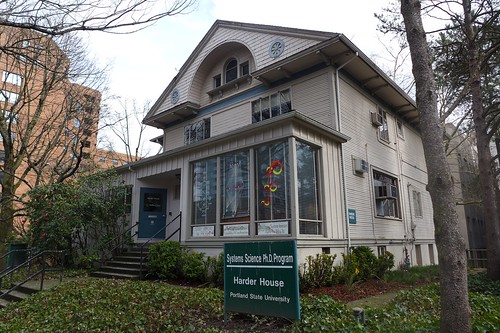
Harder House

Thanks to a grapevine stretching to John "the Architect" Driscoll, the Systems Science PhD program, headquartered in the Harder House (PSU campus) invited me to give a brown bag lunch presentation, an almost weekly event when school is in session, this past Friday (March 9).  Dr. Wayne Wakeland introduced me.  Some people lurked from remote locations.

My topic:  the concept of "dimension" in Synergetics.

"Dimension" is a slippery concept in some ways, as mass, temperature, time, pressure are dimensions, relative to standard units of each, while space is commonly given three dimensions to establish location, named X, Y and Z dimensions.

Conceptually, we may need only an XY grid to establish which piece goes where on a chessboard (King to (r3, c2)), so we say chessboards are 2D, whereas rulers might be 1D.  However a chessboard is more obviously spatial and we simply choose to neglect the board's thickness.  Does "neglect" of a dimension make it go away entirely?  Out of sight, out of mind.

The dimension concept is even more complicated than that though, and we got into that in the midst of making some elbow room for Fuller's meaning, which starts pretty much where Kant starts:  space is a priori, a given of experience.  Adding time the way Einstein does, is different from adding more dimensions of space the way Coxeter does.  Different language games arise, each making use of "4D".

Fuller's paradigm volume, in terms of shape, is neither a cube nor a sphere, but a tetrahedron, of four corners, four faces.  The language games he builds around his core space concept somewhat diverge from those we learn in school, so much of this was new information to those present.  I'm aiming to share some of the same info with summer school students, as part of their literary heritage.

I also learned quite a bit, as one of the students mentioned being led to the writings of Donella H. "Dana" Meadows through Fuller's. I wasn't sure who that was, and as it turned out, my friend Patrick, with whom I went walking that same Friday afternoon, had been in her courses at Dartmouth.  He filled me in.  Dana Meadows, and her husband Dennis, have a lot to do with Systems Science as we know it today.

My overlap with Systems Science is General Systems Theory (GST).  I see these as quasi-synonymous, in terms of opening a large umbrella, under which we'll find many approaches to modeling and data representation.  There's a cybernetic flavor, meaning we're equipped with all the tools of Cyberia, our Global U.  The so-called Noosphere is a temporal-energetic phenomenon these days.

I talked about the Fuller Projection for data sharing as another invention, relating to his "geoscope" or "macroscope" (the "concentric hierarchy" having been my main focus), and how after the World Game chapter, it mostly stays back burner and on the shelf because of its apolitical nature (no political boundaries mar its surface).

"Talk about quixotic!" quipped the same student who mentioned Meadows.  I raise the question of Fuller's "quixoticness" with reference to his daring naively to critique XYZ thinking at the "three dimensionality" of space, conventions we mostly never revisit in later life.

As children we may have our doubts, about the sustainability of "nation-states" included, but in the press of events we usually come to abandon both our skepticism and idealism, along with our teddy bears.  We stop pooh poohing zero dimensional points creating infinitely long lines, and settle in to take them seriously, for the duration.

Sunday, March 04, 2018

Youtube Teachers


When I first started my gradient descent into that hell hole (just kidding) called Machine Learning, I discovered a cast of teachers hitherto not on my radar, Siraj among them.  My first response was one of annoyance, but that didn't last.  Nowadays I have a healthy respect for the Siraj Youtube corpus and recommend them without hesitation to anyone I think might be entertained by his somewhat manic style.

Speaking of manic, another quirky teacher I highly respect is Daniel Shiffman, who covers a lot of the same topics in Machine Learning.  I was learning from both teachers today.  Even though I'm mostly looking at ML / AI through the lens of Python, I'm happy to watch Shiffman coding in Java and Javascript.

With teachers as entertaining and as intelligent as these, I'm thinking the threat of AI is not that serious, or at least not as serious as the threat of serious learning opportunities on-line, to traditional schooling.  You'd rather ride a bus half across town to enjoy far more restricted access to information?  I guess that's your right.  Just realize a lot of kids are rocketing ahead, as peer groups, not just as solo scholars.  Homeschoolers may rule, in generation Z (or have we rolled around back to A, B... already?).

These two teachers are not the only superstars out there, even limiting the sample to the few I know about.  However they're among the best in the knowledge domain I'm currently exploring.  That just tells you I like it quirky.  Demented even.


Followup on October 1, 2018: they co-appeared!  [deleted Youtube]

Follow-up on April 5, 2020: still a Siraj fan but I'm seeing the pushback. Socratica is another channel I freely advertise, along with my own channel. Outside of those topics, I've watched hours of DefunctLand.

Tuesday, February 27, 2018

Professor Marston and the Wonder Women (movie review)

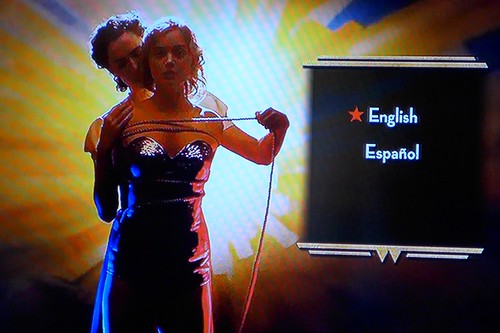
Main Menu

History sometimes hands us a microcosm that reflects the macrocosm in a big way.  The context is women's suffrage, and human rights more generally, in the face of longstanding religious and ritual practices.

Americans were seeing the rate of change of the rate of change on the increase, per future futurist Alvin Toffler's Future Shock.  Comic books were a harbinger, leveraging low cost publishing with high dissemination rates, a forerunner of the World Wide Web.  People were hungry for superheroes, and not all of them could be men.  Wonder Woman to the rescue.

However, the story is more circuitous, in that privileged, educated, elite Americans needed to feel the brunt of the dominant majority's anxious ire, its defense of a brittle integrity, before a more literate and psychologically well-founded formula could be supplied. Female superheroes had been a flop hitherto.

Literature has always played on the edge, like HBO today.  Who pays for a diet of pabulum?  WW would need to be a tad risque. Only risk takers risk risqueness, weirdness, queerness.  People queue for what's quirky and quixotic.

Dr. Marston was the guru, the brains, but not a genius at drawing.  He could communicate what he wanted to see, down to the smallest detail of rope thickness, how tied.  But he didn't work in a vacuum, as comes out during his inquisition, in the form of flashbacks.  He's also the front man for a committee, they're a threesome. Or are these women his human subjects?

This inquisition into private lives was even before the Red Scare, which blamed civil rights activism on Russians "sowing discord" among right-thinking Americans.  Prohibition was already in full swing.  The film shows the state of unfreedom that went along with that amendment to the US Constitution, since repealed (although many languish in the prisons thanks to Cannabis Laws).

Marston was not accused of being Communist (McCarthy came later). He was "polyamorously perverse" (to play on Norman O. Brown) in ways that less disciplined more jealous individuals would be unable to coax into a long term molecular family, with kids, a house in the burbs, personal cars etc..  They were living the dream.

However, the nuclear model was about the only one permitted were sex to be involved, despite Biblical precedent.

And besides, wasn't allowing two wives to one man a sliding backwards in any case?  Women were finally coming to own property, after centuries of being owned, as property.

The movie studies these questions, like an earnest student, as we follow this family as only an omniscient camera can, we come to be immersed and perhaps enamored of its charms.  The bottom line is choice. Is compliance voluntary?

The "true story" doesn't need a lot of help, only framing.  When the bullying intensifies, the molecular bonds bend and break under pressure.  Chemistry happens, at every level.

After Dr. Marston died of cancer, his Wonder Woman superhero underwent a sanitizing facelift and became less controversial.  But then her meme was readopted by the feminist movement, and now, with the recent Wonder Woman blockbuster out there, the whole story comes out, behind her genesis.  The Smithsonian Institution helped with the research.

What's always been obvious is the dominant majority feels entitled to use "kinky" "commie" and "pinko" as relatively synonymous, along with "freak" and maybe "egghead". These are the lowlife people we have license to bully, to punish, sometimes only vicariously through horror films, wherein the transgressors face the consequences of depravity (much to the audience's cathartic pleasure).

[ Joss Whedon consciously set about to overturn the whole formula when the protagonists smoke dope, yet don't face extreme rendering, their just deserts, in CGI. ]

Marston enjoys a pretty good life and his creativity lives on.  I'm guessing his story, and that of his wonder women, will filter into common knowledge at least among the comic book aficionados, our future leadership.

Molecular families of the future will have their own reasons to celebrate this superhero's genesis story.

I recommend viewing this in double or triple feature with both Kinsey and Manji.  The former is about a sex researcher facing a lot of the same push-back as the Marstons did.  Manji, possibly hard to find in your neck of the woods, is twisty-turny tale of Japanese trying to sort through their love triangles and finding it no easier in Japan.

Saturday, February 24, 2018

Probability Computations

Training Data

I'm impressed how scikit-learn lets us compare models, such as classifiers, using cross-check validation.  Having scikit-learn is like having a staff of professional statisticians, which may be dangerous if one knows nothing of the pitfalls in that discipline.  So lets make that a responsibility, now that we have these free and open tools.

Sometimes, to give one muscle group a rest, one works out with another.  I use this technique when mining Youtubes.  This morning, without any premeditated plan, I found myself back to the JFK conspiracy theorists (researchers) and decided to snarf down some lengthy testimonials.

The idea of two Oswalds having their identities conflated in the rush of the initial investigation, with a justice system bearing down, doesn't seem that far fetched.  The ostensibly guilty party, a one time defector, now sympathetic to Castro, was close to a comic book caricature of the type needed, if "lone gunman" (LG) was the true hypothesis p(LG | BS) = p(BS | LG) p(LG) / p(BS) where BS = backstory (its probability) and our prior.  Monte Carlo + Markov Chain = the Metropolis algorithm.

Regarding public opinion, I find pollsters too focused on a "general public" whereas the more interesting surveys are of those who've had the time to look in to some matter.  Of those who've spent at least forty hours studying conspiracy X, how many believe Y?  P(Y | X) in other words.  I'm not saying "general public" surveys are unimportant, but lets remember sub-populations who've spent a lifetime driving cars, are the ones we like to write our car reviews. We listen to experts, by definition (I might say "trusted experts" but then "listen" doesn't necessarily mean "believe").

Those in the know are seeing Bayesian thinking flying by, which might be considered "trolling" ("trawling"?) among the frequentists.  Am I trying to piss off some segment in the peanut gallery?  Some might be preparing to feel offended.

By the way, I do think "trolling" and "trawling", though not at all etymologically linked, are conceptually connected.  To "trawl" is to drag a net (dragnet), sometimes across a bottom (bottom feeding) in hopes of turning up some interesting low frequency events, such as two-headed fish in the Columbia Gorge (another specimen for the tribal museum perhaps).

Yes, these same statistical techniques (some call it deep learning) might be used by 911TMer types to study relative probabilities of various scenarios, though in this case we start with the low frequency anomalies, of reinforced buildings melting after bee stings (not to minimize so much as to emphasize their narrow locality or non-existence in the case of WTC7).  I'm not the big expert in this area as I've mentioned repeatedly.  You will find I revisit this thread repeatedly.

Finally, lets turn to Russiagate and the probabilities there.  The "troll farm" or "trawl farm" has been dismissed by Rush Limbaugh as an insignificant provocation.  This might be seen as a left / right flip, as in Castros day, the right wingers were keen to push Castro as the culprit behind JFK's shooting, as to them, the whole point was to gain back their gambling valhalla.  Oswald was looking like the right narrative, given his overt Cuban ties.  One would think a loyal Limbaugh, ostensibly "conservative" would take the radical view that the FBI was going up the wrong tree.

The explanation is fairly simple:  the current president is being cast as high up in the KGB (that's science fiction language, my excuse being Rush uses it), or as being case handled by the Kremlin, so letting the FBI's trolling turn the Internet Research Agency into a low frequency unveiling, of a true spy scandal, is against the White House's best interests.  No one said the executive branch is forbidden to act in its own defense after all; that's why the designing engineers put in at least three government branches.  If the FBI is the weapon of the DNC, as some allege, then clearly the RNC (Rush an ally) is going to back the White House, a highly prized set of offices.

I've been critical of 911TMers for denying they're conspiracy theorists, as there's nothing wrong with theorizing about conspiracies, and a lot of people get paid to do just that, plus get a government pension.  No one should have to apologize about the bare fact of wanting to investigate, do detective work.  That a real investigative journalist would use "conspiracy theorist" in the pejorative is the height of irony.  The quality controls come at a deeper level:  what is the actual quality of the research?  Is this professional grade stuff, like much of the JFK stuff is?  Or is this from an amateur newbie just getting in to the research business, maybe cutting teeth on Pizzagate or on a scikit-learn toy data set?

Wednesday, February 14, 2018

Sharing Slides

 by D.B. Koski using vZome

Some Bucky fans came out of the woodwork for this one.  We've got a new Wanderer in Camus, WA.

Terry showed up with his video gear and kindly provided recording services.  I gave him the slides on a thumb drive.  He may eventually have time to cobble together a video.  In the meantime, this was actually a dress rehearsal for another anticipated talk.

My topic:  the concept of Dimension in Synergetics.  I've talked about this a lot over the years.

Not many read Synergetics, and those that do need some guidance, from those of us who've done the homework.  For example, when Fuller says "4D", he means something different from a geometer like Donald Coxeter, whom he much admired, nor does he mean what Einstein meant, though he greatly admired Einstein also.

I was keen to show that Synergetics did not dead end with the two volumes published in the late 1900s.

Those few willing to work in "tetravolumes" have continued to make new discoveries.  David Koski in particular has specialized in collecting some "low hanging fruit" as we call it.

That the S:E (ratio of S to E modules) equals VE:Icosa (two shapes related by the so-called Jitterbug Transformation) is nowhere mentioned in Synergetics.  The decomposition of volumes into sums of phi-scaled modular subvolumes has also been an active area of exploration. 

These subvolumes may be constitutive in terms of adding in "linear combinations" to give precise bigger volumes (as when sizes of S make a Tetrahedron), but without fitting together as "solid" puzzle pieces, though sometimes they do that too.

Steve Mastin, with training as a crystallography, was intrigued, and thanked me for giving him more insights into this esoteric and off-beat corner of intellectual history.

Glenn also liked the slides, saying they were well organized.

Later today, I went to a new assignment, a public school, to teach MIT Scratch as a part of the after school program.

C.J. Fearnley has been in touch in the background.  Today he tracked down some Karl Menger citations I'd been trying to find.  Excellent. 

Wednesday, January 31, 2018

Wanderers 2018.1.31

This morning was Open Forum, meaning we practice what we preach:  wandering from topic to topic, changing the subject rather frequently.  That doesn't mean many topics are taboo, to be explicitly avoided.  On the contrary, we talked a lot about the SOTU (State of the Union) and the US president's speech, which I didn't catch live, but am aware of.

I have some typical talking points in this chapter.  I'm a globalist, ergo skeptical that nationalism is here for the long haul. However, as the premier local (to Planet Earth) religion, I get why politicians milk it for all it's worth.

"Nation-states are for children" I say, almost with a sneer, but then immediately back off, admitting only a few of us elite need to see it that way ("children are minding the store" shouts the est Trainer), whereas whole-hearted belief in one's "nation" is just fine for the hoi polloi.  What can I say?  We're all programmed (me as much as the next guy).

Barbara was there, though heading off to Guyana.  David Tver and I bantered about Noam Chomsky, agreeing we're not disciples when it comes to his theories about language, me more out of ignorance than having made a concerted study.

I was a philosophy of language guy, who came up against transcendentalists working to make "gravity" rhyme more with "negentropy" ("syntropy") which really looks like a long shot.  So many namespaces need the gravitas that gravity brings to the equations, or table.  There might be a niche market for such discussion, but maybe only in retreat settings where people aren't defending a turf or academic department.

I'm talking about Synergetics of course, wherein Fuller posits "precession" as his escape pod from the Newtonian vortex, wherein gravity is the one-on-one two body phenomenon of "falling in" based on escalating force (as proximity, or closeness, increases).  Precession is meant to explain a lot more of the spinning, reactions not at 180 degrees to equal opposite actions.

The reactions are not equal, yet energy conservation is real, meaning resultants, sometimes unexpected i.e. precessional.  "That's a clever web" I remember thinking, "but will it withstand the test of time?".

Next time we meet on a Wednesday, I plan to field test my new slide show about the concept of "dimension" in Synergetics.  Wanderers is open to people guinea pigging themselves, especially when preparing presentations.  Some aspects of Synergetics are likely to live on through the 21st Century, or so I'm surmising.  Time will tell.

Given my background in Wittgenstein, I have a well-developed sense of the flexibility of language. If words anchored to reality more by "spot welding" as naming theory suggests (both Platonism and nominalism tend to share this same theory), then we might be less upgradable as operating systems.

In his Philosophical Investigations, Wittgenstein was at pains to show that words don't gain their significance by "pointing" to objects, although metaphorically speaking that's one of the easiest (and most misleading) models to comprehend.

I also made the point that, thanks to Prohibition and its subsequent repeal, which made many citizens and syndicates into experienced outlaws, we also have a nation of scofflaws to an extent some prudish nationalists have trouble grasping.

Americans tolerate government precisely because, until recently, it didn't have the big data surveillance powers it now could have, if properly organized, more like an organized religion.  IBM helped the Nazis with its Hollerith machines.

Americans say "Americans are ungovernable" with a sense of pride, and that's a part of their nationalism, their ethos, which presents something of a problem for the mostly literally nationalist, the authoritarians.

Many dream of vengefully bringing the renegades to heel and punishing the defiant. They want to see demonstrations of state power, even as they may still give lip service to more libertarian sounding values.  Even anarchists get this way sometimes.  The "hive mind" syndrome is no respecter of ideologies.

Finally, I mentioned thinking it perfectly legal (in the sense of legitimate) for these nation-states to exert influence on one another through social media.

The idea of Russians buying ads on Facebook doesn't bother me even a little.  The British do it too, which bothers me a little more.  I don't trust British suspicion of the Russians usually, as it relates back to their inheriting Roman Imperialism, a meme virus.  Americans were infected with that too, and tend to crow about it as a chief asset.  Just look at DC's architecture.

Anyway, the idea that nations seek to influence election outcomes does not disturb me.  It's a tiny planet and we all have a stake in the various outcomes.  The sooner we acknowledge what goes on, and stop trying to deal with it by criminalizing it, the better.

A lot of Americans have an inferiority complex when it comes to propaganda, thinking probably others do it better, because they're so truthful and innocent.  It's those other people who get deceitful and "manipulate the masses".  That's a complex to outgrow I'm thinking.

Friday, January 26, 2018

Multi-Tasking


I'm practicing multi-tasking as we speak (as I write), and indeed the whole topic of "multi-tasking" has been much on my mind, apropos of this presentation by a British Sikh, Sukhi Wahiwala. What people have learned from near death is a genre on Youtube that I've been data mining lately, I wonder why.

Sukhi's focusing technique reminds me of Evelyn Wood Reading Dynamics, a course I took in the Philippines and have continued to acknowledge, especially on math-teach (now closed to new postings, as of the end of 2017). The practice of closing the book you're reading, getting out a piece of paper, and actually doing a "recall", or "mind map" if you will (more boxes and arrows maybe), some kind of "diagram" is pretty helpful.  You do some intentional dot connecting before turning your attention to something else.

In Python World, we're much obsessed with age old scheduling challenges characteristic of the Operating System itself.  "What does an OS really do?" people wonder.  It multi-tasks. In practice that means matching hardware resources to work waiting to be done (queued), efficiently (optimally)... or so we hope.  Writing schedulers in software is not easy and I'm not the expert.  I admire from afar.  But then we each have our own multi-threaded lives to contend with, and that supreme Bottle Neck in Chief we picture inside our own heads (the homunculus).

We may get the impression in early training that time management skills get mastered early on, as a prelude to becoming an adult.  As an adult in a later chapter (turning 60 this year), I'd say we're always spiraling through the perennial challenges of even breathing properly.  A lot of Hinduism seems caught up with breath.  Yoga etc.  Why not?  Food too.  In English we have a fair (unfair?) amount of semantic distance between "food" and "medicine", but not so much between "cooking" and "chemistry".  The pharmacist used to be a chemist (Linus Pauling's dad). A cook's kitchen may look a lot like a chem lab, which it literally is.  Alchemist's too.

A theme in these blogs is revisiting how we teach "home economics" e.g. cooking, in early schooling.  Or do we?

Anyway, thanks for the phone call Dr. Tag, and now I must go catch that bus.  I'm heading downtown to the Process Work Institute to register late for a course, which will cost me two more beers.  The course itself is like twenty five beers.

Tuesday, January 23, 2018

ET Math

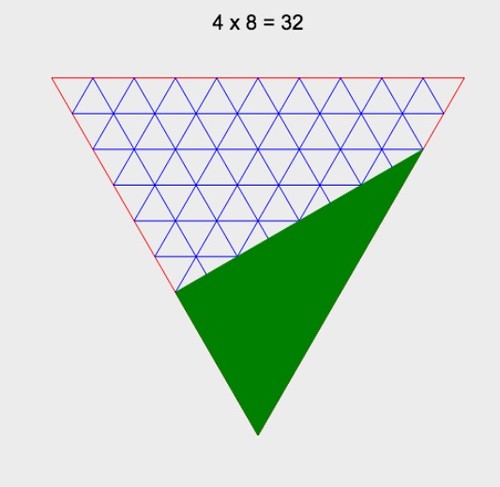
4 x 8 = 32

Copied from Facebook:

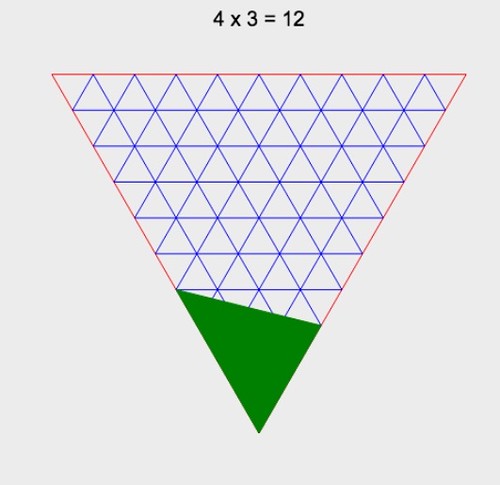
The way I sometimes teach it is we go over A x B the usual way, with A and B perpendicular, and then of course we don't just draw a line from A-tip to B-tip (common origin), we double that triangle to make a full rectangle, filled with squares. That's our civilizational orthodoxy.

Imagine not doing that final doubling and defining A x B as simply "closing the lid" on that right triangle. A x B is always a right triangle (the same area might be any shape, but that's the canonical representation).

Next, we take the extra step of making the angle 60 degrees instead of 90 (yes, it's somewhat arbitrary but 60 has attractive features our ETs may have felt drawn to). We simply draw A and B as vectors at 60 degrees with a common origin, and define A x B as "closing the lid". This is what you see above.

What I'm not showing here is the next step, adding C, another vector, such that A x B x C is three arrows from the corner of a regular tetrahedron. Again, we simply "close the lid" such that volume A x B x C is the tetrahedron with "lid" ABC (origin O). 

We spend some time dwelling on the logical consistency of this logical beginning, before coming back full circle to our Earthian cube. A,B, C must be mutually perpendicular and the right tetrahedron formed by "closing the lid" is only 1/6th of the full hexahedron's volume -- a different approach. Earthians are very right-angle minded.

How will these civilizations get along? Stay tuned. The ETs have a unit volume tetrahedron (1 x 1 x 1 = 1) and use that to anchor volumes of other polyhedrons. A cube, with thrice the volume, when edges = face diagonals, has volume 3 (consistently). Octahedron has volume 4 (same edge lengths). Nice whole numbers. Earthians agree on the ratios, just don't share the same model of 3rd powering (hexahedral versus tetrahedral).


ET means "extraterrestrial" i.e. I'm couching this analysis (aka lesson plan) in the science fiction form. An "outer space" civilization has a different way of modeling 3rd powering based on the regular tetrahedron instead of a cube. We appreciate the logic of their civilization, but don't abandon our own. That's like the TV Guide version. A goal of this lesson is to help students get philosophical and think about foundational questions i.e. what's conventional and what are examples of different flavors of math, thanks to different conventions.

Sunday, January 21, 2018

Reading Rainbow

I'm two weeks out, plus one day, from my own bout of high tech treatment. Nothing cyborgian was implanted, if you're not counting ideas, which may be mini-machines in their own right, with lots of moving parts.  Ideas are variagated.

Thanks to Rosalie, a woman I helped welcome to Meeting, I now have a copy of the Dahlstrom memoir. When Rosalie caught up with him, he was serving as a distinguished member of the Portland State faculty, in the English Department. From this vantage of greater age, and high fluency, he wrote his memoir [1] in the form of a brief window on life, a period of one year serving as a private first class in World War One.

From the standpoint of an academe, he's able to put into words the experience of being a disposable machine or robot, in service of a state, led by officers of vastly higher privilege, and how these class differences rubbed democracy's children (small "d") the wrong way.

The high tech treatment was mostly diagnostic in nature, in a hospital already swamped with new year turmoil, as people tend to put treatment off until after the holidays.  Plus an especially virulent flu season was in full swing as we're seeing in the rear view mirror, as we piece it together.

My condition was statistically predicable in my age class (almost 60, a late fifties baby, slightly post hippie post baby boomer, in terms of US demographics), but without precipitating events, often fatal, where's the incentive to find the root cause?  Of what exactly?  Shortness of breath in my case. So am I just out of shape? I was still climbing mountains (OK, hills).

One of my gigs involves using Codesters, a cloud service that comes with sprites, stage backgrounds and so on, to create games with middle and high schoolers.  I'm thinking about how that same technology serves to make fun grid patterns of both a square-rectangular and triangular pattern.  I'm about to dive in to creating a few examples, expect screen shots soon.

Ellen Thomas phoned today, while I was having a lunch beer with the CRO.  This was between the two conference games (NFL).  The Vikings are playing now, as I write this. I'm watching with Spanish speaking narrators.

Ellen lived on the sidewalk in front of the White House for some years.  I reassured her mom was OK.

Last night I saw Alan Potkin, whom you'll meet elsewhere in these blogs. He has an abiding interest in the aesthetics / ethics associated with large scale engineering projects.

Sometime the left brainers don't want to think in terms of ecosystems and reject a systems approach in favor of pure kilo-wattage, neglecting the energy it would take to restore some of what would be lost.

If you start with a dumbed down model, you'll do unnecessary damage in the eyes of ancestors to come.

Rosalie actually typed the Dahlstrom manuscript and turned it into a book, somewhat as Applewhite catalyzed the Bucky Fuller creation, Synergetics (in two volumes).

Having a critical person between an original font of primary content, and those into publishing, is sometimes essential.  Kiyoshi Kuromiya played a similar role with Bucky, with regard to other books, especially Critical Path and Grunch of Giants.

 [1] Dahlstrom footnote.  Book cover up top.

4 x 3 = 12

Monday, January 15, 2018

C6XTY Meetup

c6xty_meetup

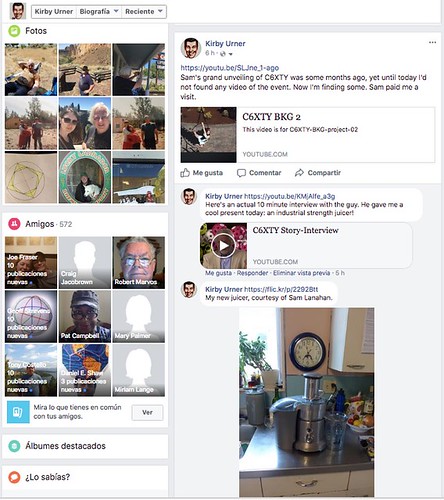
Today was a holiday, MLK Day (memory).  Sam Lanahan, inventor of C6XTY, came by the house, upon learning of my new health and exercise commitments.  He brought me a really high quality industrial strength juicer.  Perfecto!

If you look closely (perhaps by clicking on the picture, then magnifying at the source), you'll see I'm using Spanish as my Facebook language.

That doesn't mean what people post changes to Spanish, only text coming from the Facebook API.

Yes, that's a slightly quirky use of "API" as GUIs (graphical user interfaces, such as Windows) have their own name.

We don't consider the surface of a printed page an "API" either, for somewhat the same reason.

 The verb "to read" applies, as in "read a face" and yet "API" has more of a lexical connotation. A car dashboard is an "API" except that it's more like a GUI.

I'm sure I'm blathering about these matters because I've spent much of the day immersed in the Tkinter API, a guidebook for programmers wanting to make GUIs. I did some similar work in Codesters, designing as Stars & Stripes for practice.

Tuesday, January 09, 2018

Working with AFSC

My history with AFSC (American Friends Service Committee) starts at the Multnomah Meeting meetinghouse in the early 1960s, in a building formerly owned by an electronics firm run by pacifists.

Doug Strain, though not a Quaker, had been a conscientious objector during WW2.  One of his principal clients, at least in the early days, was Hewlett-Packard.

When Doug's company outgrew its Stark Street digs, it was given over to Friends, with the understanding that AFSC, always supportive of conscientious objectors, would keep its offices there as long as needed.

"Friends Meeting House"
from company archives
courtesy of Wanderer Doug Strain

This was around the time I was born (1958) and our family moved to Portland, transferring membership from 57th Street Meeting in Chicago to this newly forming Stark Street meeting.

I've always associated AFSC's work with lots of paper, lots of typing and publishing. Activism is a cerebral thing I discovered, more about thinking and communicating than marching in the streets.  We did a lot of that too though, but with different organizations.

Women's Strike for Peace and Women's International League for Peace and Freedom (WILPF) took up a lot of mom's efforts.  She wanted a better and safer world for her family.  Trace amounts of radioactive materials were showing up in the food supply.  Linus Pauling was warning people of the dangers of a nuclear weapons economy.  His wife, Ava Helen, was likewise in WILPF, though she and mom didn't know each other.

In the summer of 1972, after some years in Rome, Italy, my parents agreed to help run an AFSC camp in Ramallah, at that time a much smaller town than today, on the outskirts of Jerusalem.

The plan was to help build a swimming pool with local Palestinians, in cahoots with students from the American University in Beirut, followed by some time on a kibbutz where we would learn from Israeli experts.

The project came off pretty much as planned though we were far from finishing that swimming pool, which had to be blasted from solid rock.

Fast forward to the mid 1980s and I'm back in Portland after finishing high school in the Philippines (I started at Southeast High in Bradenton, Florida), attending Princeton (Class of 1980) and serving as a high school teacher in Jersey City for two years, among other jobs.

As a young adult, I worked with Paulette Wittwer on the plight of Palau, and Pacific Islanders more generally. The nuclear weapons economy was hurting them too.  Palauans had tried to declare themselves a nuclear free zone, but Washington, DC was in no mood to accept defiance from a protectorate and insisted they keep voting until they get it right and allow nukes, at least in principle.

Palau has since achieved independence and membership in the UN.

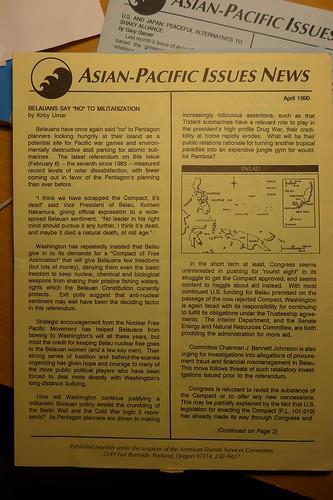
Our AFSC office, now on East Burnside, published Asia-Pacific Issues News.  We looked at issues around refugee resettlement, the dangers of nuclear energy (in Japan especially), and the negative effects of a nuke weapons economy.  I eventually became the editor of this newsletter, which no longer publishes and is hard to find in any archives.

P1040076
:: APIN: archive copies ::

After that, I served AFSC as a volunteer program clerk for several years. We had a youth leadership program aimed at improving communications between Asian and Hispanic (Latin American) high schoolers, and providing opportunities to travel, organize conferences, and produce media.

I participated in staff searches and some of the program activities.  I'd become an advocate for youth-focused programming centered around helping high schoolers develop media skills.  Voz Juvenile was on local community television.  United Voices was our literary magazine.

In a next chapter, I served as a member of the AFSC corporation on behalf of North Pacific Yearly Meeting (NPYM) which paid for my trips to Philadelphia for annual meetings.  In order to ground itself as a Quaker organization, AFSC has an elaborate way of interfacing with various Yearly Meetings.  My accounts of these Philadelphia meetups appear in these online journals (blogs).

Finally, I served on an Area Program Committee in support of staff and program.  However, AFSC was feeling financial pressures and decided to downsize in Portland, moving from East Burnside and ending its work with youth.  As of 2018, I'm not doing anything with AFSC directly.

Friday, January 05, 2018

Health Plan

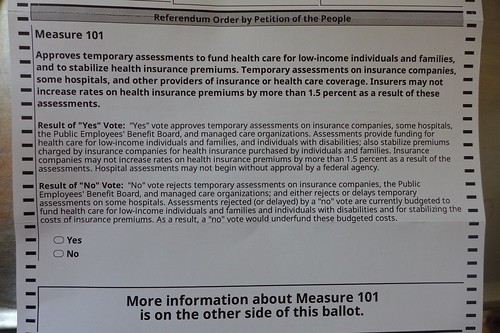
Keep Health Care Alive

Ever since the O'Reilly School closed, I've been adrift in the nation's health system, electing to go with COBRA at first, which took a lot of my severance, and then applying for Oregon Health Plan.  I've been reluctant to seek health care fearing the hassle of changing providers and learning the new maze.

Last night, however, my friends insisted I visit a walk-in clinic as my shortness of breath was acute and I ended up at OHSU (Oregon Health Sciences University), where my care was efficient, professional, and compassionate.

I'm home now, with a diagnosis of lung clots.  The prognosis is still hopeful, though only time will tell.  I'll be picking up my exercise program right where I left off.

I'm glad Oregon state has been taking the business of care of its indigents, such as myself, seriously. Many of my friends enjoy the same benefits.

It's not that I don't work; I'm just not "raking it in" given my career as a freelance teacher-programmer.  Most medical insurance policies for someone in my position are outside of my price range.

My thanks to all the staff who saw to it that I got the best care available.

Monday, January 01, 2018

New Year's Day 2018

After collecting a party at the airport, I got home in time to watch the Internet go down, to my place I mean.

Right in the middle of some random Youtube about Bitcoin maybe collapsing, or otherwise keeping people nervous.

So how did that one go?  I never found out.

The modem light starting blinking red, then green, then red... all the support pages said this'd be temporary and it'd make up its mind.  Red.  Or green.  It never did.

So I left town.

By next morning I was watching rock climbers tackle Smith Rock.  This is where I'm looking to start one of the XRL-based futuristic livingry camps or colleges.  Terrebonne area.

I did some backup photo shots of my brother in law's poetry before packing it in and driving back to Portland.  I use a Lumix from Sam Lanahan these days.  The Fujifilm started becoming unreliable.

Wednesday, December 27, 2017

Blockchain Adventures

Thanks to a Pycon here in Portland, I got hooked up with some Bitcoin enthusiasts and before you know it had a bitcoin wallet with myceleum, a way to send me beer money.  I like beer and peanuts and Lucky Lab and maybe I want to buy my guests some of the same.

However, that Android suffered from a failed battery, my bitcoin public key was hard to find, and people aren't really using it for beer money these days.  They're holding onto it as a speculative asset.

Once the Android was replaced, I didn't bother recovering the empty wallet and removed all traces of the QR-code in question.  A different approach might be required.  There's always the Visa cards.

As most Fintech readers know, Bitcoin is an instance of the blockchain in action, but with the servers entering the fray competitively and not simply acting as a single centralized database, which is what the blockchain boils down to if you take away the public access.

With Bitcoin, an academic institution is free to wade in and audit all transactions, anonymously to a great extent, and never compete as a blockchain solver, or "Bitcoin miner" as they're called.  You can study the interplay of transactions as anyone might, as a passive observer and/or data scientist.

For those new to Bitcoin:  transactions pile up in the various servers, but the one that gets to put its name on the block is the one winning a roughly 10 minute competition to crack a code, per a known algorithm.  Throw more computer power at the problem, and you gain control of the books, but not in such a way that lets you change them.  You just get rewarded with more bitcoin, for being the most powerful miner.

Companies may set up blockchains inhouse, but what that really means in practice is anybody's guess. The crypto-currencies are out there trying to prove a concept, which is that these open source systems for storing and transferring value, have a bright future.  We're still in boot phase.

Friday, December 22, 2017

21st Century Adventures

We took I-285 to the Atlanta airport, a mega-hub, rather early, in case of traffic or other snafus.  Less than a week ago, this airport suffered a major power failure. We'd squeaked through a couple days ahead.  "We" in this case is myself and stepdaughter Alexia (age 38).  We were here to visit with my younger daughter (age 23) and her partner.

The Dollar rental car, a Toyota sedan, rode smoothly, had a backup camera (for backing up) and good radio.  I listened to NPR a lot of the time, to and from Birmingham.  Robert Siegal (age 70) was interviewed by Terry Gross (age 66) on Fresh Air, about his impending retirement and long career in public radio.  Much broadcast discussion of a recently passed US tax bill and haps at the UN.

We all saw Star Wars: The Last Jedi together.  Characters from the first installment are old by now.  Luke Skywalker is a craggy old guy.  I was just starting college when the first Star Wars came out.  Carrie Fisher, who played Princess Leia, died earlier this year.

I'm reflecting on how futuristic the future is, versus taking it for granted.  Watching Westworld on the HDTV contributed to my sense of the recent past, as did my visit to the Birmingham Civil Rights Institute.  Ordinary people get to stage family reunions even when thousands of miles intervene.

Amtrak went off the rails near Olympia while we were gone, in a first attempt to run at higher speeds along a newly enhanced route.

We relied heavily on GPS.  I used the web to book all the reservations.  Our boarding passes came up on my Android.  We got TSA pre check, meaning less time waiting for Homeland Security to clear us for boarding.

I phoned my mom (age 88) from Birmingham.  Their WiFi is terrible.  Sounds like their provider, Frontier, is overwhelmed and under-endowed.  "They" being mom and my sister (age 56) in Whittier.

Wanderers are hosting a Solstice Party at Linus Pauling House tonight, in zip code area 97214.  I don't expect to quite make it, but I'll be close.  That's a miracle in itself.

Friday, December 15, 2017

From BestThinking

BestThinking is shuttering at the end of the year.  We've been invited to recover our postings and share them elsewhere, such as I'm doing here.

Thinking Out Loud
Posted in Technology / Programming / Python

Mining the 20th Century: 

Wittgenstein Meets Buckminster Fuller

Mar. 31, 2016 12:17 pm
Keywords: synergetics, applewhite, anthropology, wittgenstein
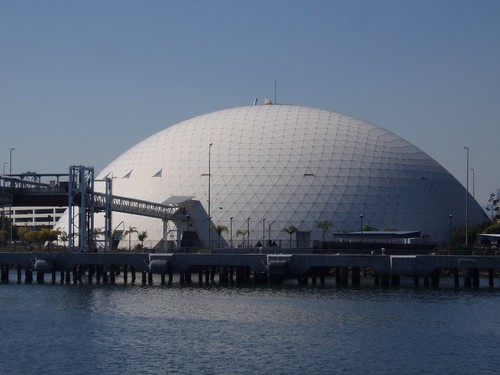
Classic Geodesic Dome

A goldmine of useful memes, textbook examples, blueprints for thinking, missed by most philosophers, is in the intersection of mathematics and anthropology. We tend to call this area "ethno-mathematics" by which we mean studying archaic practices from the past, such as Sumerian astronomy or Viking navigation techniques.

We don't look at contemporary coding subcultures (such as Python's) nor at "alternative mathematics" through the lens of anthropology because of the blinders we impose on that discipline, and because of the religious flavor of some mathematics.

Enter Wittgenstein, who studied and commented upon Frazer's Golden Bough, a first hat in the ring of this emerging discipline, anthropology. Wittgenstein's later philosophy may be seen as anthropology turning on its own culture, the one giving us anthropologists, to become more an investigation into the use of language and thereby more of a philosophical enterprise. Wittgenstein blends two flavors: ordinary language philosophy (which he helped found) and anthropology.

Fast forward to the end of the 1900s, and we get to the publication of another strange work of genius, Synergetics in two volumes, by R. Buckminster Fuller in collaboration with E.J. Applewhite. The latter wrote a separate tome, Cosmic Fishing, about shepherding this exotic text through Macmillan, in addition to recounting the collaboration process itself (Fuller narrated, providing prose, figures and tables, while Applewhite organized and typed). Another four volume tome called the Synergetics Dictionary was produced from Applewhite's documenting process. Both Synergetics and Synergetics Dictionary are available on-line.

How these connect, Wittgenstein's philosophical investigations, and Synergetics, is through the foundations of mathematics, an area much remarked upon by both. Specifically, Fuller develops an alternative geometrical model of 2nd and 3rd powering such that "squaring" and "cubing" would not be the appropriate verbs. We could say "triangling" and "tetrahedroning" instead. We don't of course -- speak that way -- but the fact remains that our mental pictures of 2 x 2, or 4 x 4 x 4, so ingrained, could be altered in a logic-preserving manner. We would enter the wonderland of a new and different culture, a so-called "different paradigm".

As an undergrad at Princeton, I wrote a thesis on Wittgenstein's later philosophy. I later became friends with Applewhite and started sharing my writings on this new doorway twixt Remarks on the Foundations of Mathematics (one of Wittgenstein's) and "explorations in the geometry of thinking" (the subtitle of Synergetics). He really liked the direction I was taking. I wish we could have collaborated more before he passed on.

My wife was diagnosed with a most virulent type of breast cancer (IBC) the day before Ed (short for Edgar) and I were to have dinner in DC. We had met several times before, at his place, at fancy restaurants, also in Portland where his wife June joined us. This meetup looked especially propitious. We had just finished a Fuller Symposium, Applewhite a speaker and now a Pycon was starting (a Python conference, a computer language) on the same GWU campus.

The phone call came through from my poor distraught wife who had just been given a death sentence by her oncologist. She had gone from zero to stage three overnight, with chemo to start immediately. I needed to drop everything and hurry home. Ed and I continued with phone conversations and emails but never got to meet again after that. Ed died on Valentine's Day in 2005. Dawn, my wife, died on St. Patrick's Day in 2007.

What's true about working in a goldmine is the payoff is premised on gold having value, as currency, as a precious metal. Without a culture around me that values these men of genius in the 1900s, and makes use of their ideas, I have only a private language to get lost in, and that's no fun. So of course I'm motivated to push these ideas into the public domain, via Youtubes or whatever media. If you follow the bread crumbs, you'll find me connecting these dots in several venues, including those frequented by Python programmers and mathematicians. In Portland, you'll find me at the boyhood home of Linus Pauling, one of Oregon's top celebs, the two-time Nobel prize winning activist chemist. A group of us, fans and friends, meet every week.

I also engage in talk of STEM and STEAM, the former being the much-hyped science-technology matrix, with the "A" then added to give the humanities more of a foothold, and typically meant to mean "Art". However I say "A is for Anthropology" and bring it back to my pet projects.
 

Tuesday, December 12, 2017

Revised Position

Regarding an improved curriculum design, with the goal of phasing in "programming", I'd bought into the common wisdom that "somewhere around algebra" or even "after algebra" was where programming first started making sense.

I'm not sure why that coupling existed in terms of suggesting programming and algebra be contemporaneous, or that "the math" must always come first.  On the contrary, kids from a very young age have an application for a coordinate system, springing from the same original source as it did in the first place: artists needing to put colors on canvas.

The algebra teacher should be forwardly thinking in terms of students already having some coding background, and building on that.  The formal introduction of "function" in its native namespace, with surjective, bijective and so forth, might then build on already familiar semantics, even coming from purely block-based languages such as MIT Scratch.  It has "define" blocks for organizing other code blocks into shared routines.

So no, I don't think waiting until after algebra makes any sense, and that's a good thing, as the status quo in my neck of the woods is quite the opposite:  kids are diving into coding long before they encounter a traditional subject called "algebra". I'm glad I don't have to fight the status quo on every front, as that gets exhausting.

The main barriers to lexical programming have to do with keyboard abilities.  Yes, we have ways to employ voice recognition and coding is not necessarily about speed, as it's not done to a metronome (not counting the company clock).  Still, faster typing means being able to keep up with one's thoughts, with "thinking in code" more fluent when not held back by slow fingers.

We have all kinds of thoughts about algebra, in terms of "rules of equality" and "finding unknowns" and we'll get to that.  However programming a computer is more like scripting a play, a stage, a theater, or a television.  It's about providing content in a structured manner, at a sustainable rate.  We like things to happen quickly where purely rote processing is concerned.  We should let kids enjoy the speed of their CPUs and GPUs long before we insist that they study these gizmos algebraically.

Wednesday, December 06, 2017

Meteor Man

Astronomer Doug McCarty and Dick Pugh

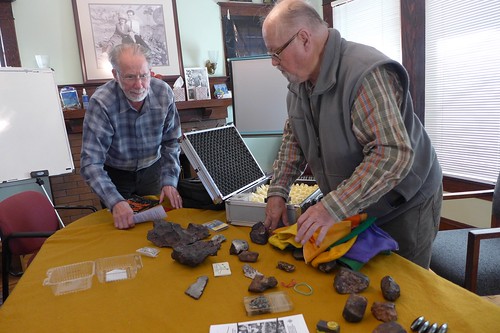
Dick Pugh graced Wanderers with the latest version of his meteor talk this morning.  He has polished this presentation over the years, however there are always new developments to roll into it.

Besides, good stories are worth hearing multiple times, like a favorite record album.  Remember record albums?  Dick is a world authority and former high school teacher.  His talks are engaging.

He's still an avid collector and is savvy regarding the going rates for fragments from specific debris fields.  Part of the fun of his talk is how it's peppered with mentions of obscure treasures, such as a junky old car, now worth oh so much more, now that a meteor has totalled it.

Dick gets several calls a week, average one or two a day, from people hoping what they've found is somehow valuable.  More often than not, they have a piece of Oregon basalt, a ubiquitous material that makes Oregon an especially difficult hunting ground.  The quarry (prey) and the background look so much the same.

Finding meteor fragments is so much easier in a sandy desert or in some arctic setting, where a large chunk of iron, or stone, sticks out and calls attention to itself.

Meteors come from asteroids, but also from Earth's moon and the planet Mars.  High impact events fling fragments from those bodies into space, some of which fall into Earth's gravity well.

Don and I huddled over our computers after the talk, trying to get wanderers-announce working as a Yahoo! group.  We already have wwwanderers (with three ws), which caters to those wishing to yak about issues of the day.  Of late, few are yakking.

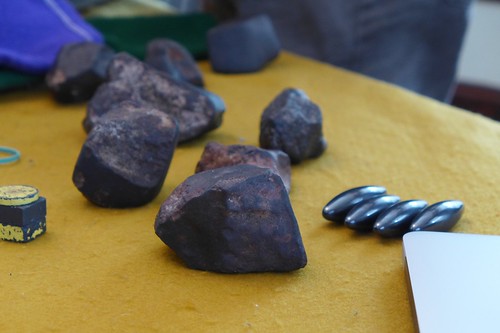
Contrary to popular belief, meteorites are not hot to the touch, even if they were fireballs upon entering the atmosphere.  They've been coasting near absolute zero for eons and a short encounter with the Earth's atmosphere is not going to undo some billions of years of running cold.

Meteor Fragments

Sunday, December 03, 2017

Coco (movie review)

Informants, e.g. Deke, tell me this film is getting high marks from critics, though I've not read a single review.  Melody was also drawn to this film based on previews, which made it seem promising. I was not disappointed.

I'm feeling rather neuro-skeletal myself these days.  Nathaniel Bobbit and I have been talking about a Blender rigging of the skeleton by email.  Mainly it's my left knee that's demanding my attention.  I forced myself up Mt. Tabor this morning, as a diagnostic.  Yikes.  Not again tomorrow.  Where's that microwavable bean bag?  Ibuprophen, do your magic.

The idea of a family altar with ancestors depicted, took me back to the writings of Fletcher Prouty regarding Vietnam, and the hype about how Catholics were being forced south, long story. How true was that, versus how much fake news?  Lansdale was a storyteller, in the midst of wars.  Preying on Catholic fears of non-deists (e.g. "Communists") was big in those days.

Mexico is fine with the concept of an afterlife, and Disney is not afraid to embellish on the metaphysics, as Disney is no stranger to either death or mythologies, these being eternal themes.  I'm happy to have animation delve into various cultures, with expert care.  I still need to see the Polynesian scenario, my bad.

I'm not going to recount the plot.  I'm only going to underline my admiration for a cartoon World of the Dead.  Not heaven, in the sense of angels playing harps on clouds.  Far less stupid.  And there's death in that world too, that comes from being forgotten, or "garbage collected" as we say in the Python world.

Good job Pixar. I'm fine with the lack of priests and churches.  We don't need their mediation to remember the ancestors, or to explain how it all works after death (Purgatory etc.).

Speaking of Purgatory, coming down from Mt. Tabor I stopped in at Common Grounds to nurse my knee and read Harper's December issue. The journalist doing the profile of what it's like to work in refineries in the Emirates seemed a bit of a clod, but really dedicated.  I'll look for the book.  Good job on countering the myth on Middle America (another article), but it's hard to fight ingrained tropes.

Tuesday, November 28, 2017

Post Thanksgiving 2017


I managed to crank out the above Youtube last Sunday, having returned from points north, via Amtrak. I manage to sputter through a Concentric Hierarchy presentation, hoping to connect the RD of volume 6 to the CCP, if that makes any sense (watch the video?).  Getting a train in there was a plus, as Synergetics has it's "great circle train tracks" converging to what we might think of as "Grand Central stations".

Connecting to this content, which I consider American heritage, is my recent writing on Medium, wondering aloud of a charter school network might want to escape the scourge of modern standardized testing, by covering STEAM content not currently tested.  A curriculum might risk anticipating what will be critical tomorrow, versus today.  We call this "looking ahead" (not an original concept).

Along those lines, I've been urging on math-teach (from which I've resigned, given signs of its immanent demise) that we do more with cryptography at the high school level, which includes making use of such tools as pycrypto, though not to the exclusion of studying the bare bones mathematics.  My Supermarket Math component (one of four) is all about eCommerce, which entails HTTPS, which entails RSA.  Some high end high school curricula go there, e.g. Phillips Academy's.  I expect Stuy's does as well.

Edgar Allan Poe fits in here, as a novelist and storyteller who understood the value of encrypted messages as plot drivers.  Didn't I see a whole book on that?  An article?

Wednesday, November 22, 2017

Wanderers 2017.11.22

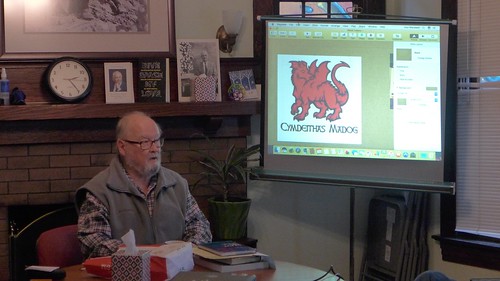
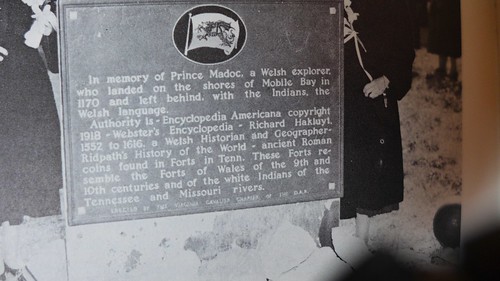
Pugh re Madog

I got to this one a little late, having worked night shift to 10:30 PM, and then diving into boning up on data analysis, something I share about.  The meetup starts at 9 AM.  I was there by like 9:15 or so.

Dick Pugh, last name Welsh, was sharing about a long-lived rumor, regarding "Welsh Indians" pre Columbus.

Quoting from our Yahoo list:
"Welsh Come to America in the year 1170, Long Before Columbus, and Become the Mandan indians, Who spoke Welsh"
9:00 AM, Wednesday morning, November 22, at The Pauling House, 3945 SE Hawthorne.

Hope to see you there!

Don
Apparently one Maddog might have made it from Wales circa 1100 AD and helped establish a new tribe with Welsh customs and artifacts.  Given I came late, I'm not sure by what route.

Mainstream news poo poohs this hypothesis, Dick was quick to admit.  However he wanted to be sure we had a chance to check the evidence.

In general, our understanding of when the Americas entered into trans-oceanic lore, has been getting updated.  The idea of Vikings along the Great Lakes doesn't sound as absurd as it used to.

This rumor, of "Welsh Indians" goes back at least to the time of Thomas Jefferson and the US versus UK boardroom brawl ("American Revolution").

Jefferson asked Lewis and Clark, the great explorers who mapped their way to the Pacific and back, to keep a lookout for any signs of such a tribe.

Dick gave a great presentation and all present felt well informed.  I won't try to do his presentation justice in terms of relaying all its content.  You had to be there.

A later governor had this removed

Sunday, November 12, 2017

A Friendly Convergence

Memorial for Wes

A van of us guys from the Men's Group, organized by Joe Snyder and borrowing the Reedwood van (thank you Friends!), got to Mapleton, Oregon and back in one day.  That's the freeway age for ya.  With time to spare I might add.

Wes had all kinds of ties to Oregon Friends that I'm only just learning about.  Our Stark Street meeting traces back to College Park Association in California, and Iowan Friends striking out on their own upon being disowned by their brethren.  So be it.  The brand "Religious Society of Friends" would not be surrendered.

On the other hand, Gurneyites moved west also, and their trajectory takes other forms, namely Northwest Yearly Meeting, distinct from the more Hicksite flavored North Pacific Yearly Meeting, of which Multnomah Meeting on Stark Street is a member.

Wes Voth traces his schooling back to Newberg, Oregon.  These are more the Hooverite Friends associated with George Fox University (GFU).  There's overlap with Liberal Friends on many fronts, but if you're a scholar of the Quaker lineage, you know we're prone to forking, and don't always think that's a bad thing.

Politics aside, Wes Voth was a naturalist and his thinking was deeply informed by the natural patterns of his watershed.  It may be a cliche to think of watersheds as the lungs of the planet.  They are integral to the way fish live their lives, and thereby serve at the basis of many a food chain.

Pacific ocean salmon start and end their lives in these rivers and rivulets, adding their carcasses to the inland soil, fertilizing rainforests.  Ecosystems don't run on fumes, much as fumes matter.

Wes knew all these basics like the back of his hand, and then could go on about the smaller details, in ways a city rat like me can only marvel at, and I did.  At our last meetup at Great Bear Camp for example.  I sat at his feet, slurping up the lore of the land.

The memorial service was held at the Lions Club which shares digs with the Mapleton Public Library, what used to be a public school.  The meeting hall, which doubles as a theater and gymnasium, was packed with just about everyone in Mapleton, not a big town.  Out of towners rounded out the crowd.

We all respected Wes a lot for his honesty and respectful ways.  He served as a postal carrier in this later chapter, and had maybe just recently retired?  We felt his departure was all too soon.

This was Veterans Day, or Armistice Day as some call it.  Among the songs we sang, was one of Wes's favorites (mine too, for its check on nationalism): This is My Song with lyrics by by Lloyd Stone and Georgia Harkness, to the score of Finlandia by Jean Sibelius.  It's in our Quaker hymnal.

Tuesday, November 07, 2017

Life, Liberty and...


My study groups have been cycling back to Student Debt, which becomes a noose, and the Overdose Epidemic, which becomes a way out, or at least a temporary escape.  Any dose is an overdose where most of these drugs are concerned.

The law abiding become despairing when they recognize that organized crime rules the roost.  This article in Rolling Stone keeps pointing to people in high places, high office, as the ones at the top of some Ponzi scheme.  The state becomes a prison state.

Recently we learned more from the DEA about its losing battle against Big Pharma.  Organized crime has eaten through the medical establishment.  Drug pushing is the backbone of a new economy, breaking the backs of many old ones.  No, we're not talking about glossy mags in marijuana country.  We're talking about fentanyl and worse.

Clearly the student loan crisis and the overdose epidemic go together.  In closing off all promising avenues to a brighter future, one reaps the harvest of hopelessness.

The positive futurism I latched onto in my young adulthood was not a popular brand within academia and those paying high interest for borrowing against their futures were for the most part not schooled in any of it.  Nevermind about the Medal of Freedom.
R. Buckminster Fuller: 
A true Renaissance Man, and one of the greatest minds of our times, Richard Buckminster Fuller's contributions as a geometrician, educator, and architect-designer are benchmarks of accomplishment in their fields. Among his most notable inventions and discoveries are synergetic geometry, geodesic structures and tensegrity structures. Mr. Fuller reminds us all that America is a land of pioneers, haven for innovative thinking and the free expression of ideas.
At issue was the USA itself and whether it had strayed too far from its founding documents to be considered a constitutional democracy anymore.  Had it been hijacked by oligarchs and plutocrats who could now use it to press their own agenda?  Princeton was inclined to see it this way.

Roll forward, and we see the wasteland this land has become.  The morgues fill with its victims.  The criminals get appointed to higher office.  Is there any longer a debate?

Welcome to the Global U, an energy consumer and an intelligent responder, to some degree.  We're plugged into the sun, as so many 120 watt bulbs, thinking of ways to survive, one day to the next.

Our institutions are supposed to leverage our numbers, our individual talents, into orchestrated and constructive responses to our circumstances.  Which ones do this?

The criminalization of nuclear weapons per the UN Ban Treaty, developed by the General Assembly, has at least helped us see how the "rule of law" was a fragile sphere.

Criminal syndicates control human affairs.  The electronic communication networks were our organized response, an attempt to gain traction.

Sunday, November 05, 2017

Playing with Blocks


Back in the early to mid 1990s, I would make trips to California in connection with my work with Synergetics. I went to the GENI organized Centennial in 1995, when Tara was just learning to walk.  Before that, I'd been to a Pergamon Press sponsored conference on Buckminsterfullerene in Santa Barbara. Another time, we had a confab in which "modules" were thematic.  David Koski was curious about what Yasushi Kajikawa and Einar Thorstein were up to, in their respective modularization games.

Much more recently, within the last year, Koski's block-themed play has turned towards a dissection of the E-module, the one published about in Synergetics.  I've called it the Beanstalk Series as that story, of Jack and the magic beanstalk (grown from magic beans) provides etymological roots for the Fe ("fee"), Fi ("fie"), Fo ("Foe") and Fum modules.  Of course there's a tie-in with Grunch of Giants (one of Fuller's last books).

The wrinkle Koski introduces, with all of these shapes, is that of "phi scaling", meaning notching up all straight-line inter-distances by phi, not quite doubling at 1.618.  When linear distances amplify by that factor, volume goes up as a 3rd power of same, giving us a vocabulary of ...E6, E3, E, e3, e6... modules, where the lowercase 'e' signals "phi down" and uppercase "phi up".

Spatial geometry is not getting its just deserts as a curriculum topic these days, especially in kindergarten, because that would mean telling the truth about more things, and truth is not always convenient.  Using a calibrated bucket of liquid to show displacement is also potentially messy when done for real.  The schools that make instructional video making their specialty will have a head start.