Monday, April 11, 2016

A Code School Evening

Code School Evenings

I took my time getting to Tilikum Crossing by bus and light rail, having plenty to read, including Southeast Examiner (neighborhood news) and Willamette Week (WW, April 6 "can't believe I ate the whole thing" cover, 2016).

I'd eaten nothing but Soylent all day.  The Flying Elephant Delicatessen was singing a siren's song when I got off the Max and I headed straight to it.

WW was far harder on 10 Cloverfield Lane than I'd be, were I to write my full movie review.

Yes, it turns absurdist, almost dada at the end, but surrealism is the province of science fiction, to which this film lays claim.  It's a genre question.  I saw it in that place where comedy / sitcom meets horror (more Joss Whedon maybe)?

I also saw it as a throwback to stage theater, with high quality close-up performances, most the emphasis on the acting.  Another really good movie like that, also science fiction:  Ex Machina.

I then wandered to Starbucks for an hour of black coffee and WiFi, before ascending the hill behind the tracks, to PDX Code Guild, passing under a maze of freeway overpasses in route.

Many of the regulars were curious about Elm, a new web dev technology, and so were attending its debut meetup tonight.  So attendance at this Monday night Python meetup was initially fairly light... until the tour group showed up.

Greg and Margaux, of workingIT (dot com) arrived soon after I'd set up my second monitor, borrowed from the standing station.  Greg is a professional auditor and expert in risk-based thinking (RBT), with a background in homeland security.

His daughter Margaux was interested in interviewing some of her peers familiar with the code school experience.

Chelsea and Katie practically live at the code school, and were helping orient a newcomer.  Chris (CTO) helped install Python on the newcomer's laptop.  That's pretty much a first step where <guild /> is concerned.

The code schooler across from me wanted to know more about Vagrant, which I at first confused with some Mozilla tool to create random noise for web clients, simulating a VUCA world.

But that's not what Vagrant is at all.  I was confusing Vagrant with Mozilla's Vaurien, used in front of Nginx, by Luciano Ramalho in Fluent Python to deliberately create a choppy Internet experience for browser testing purposes.

Vagrant, in contrast, works with a hypervisor, like VirtualBox or VMware, to smooth the developer experience in mixed OS settings (very common).  I need to learn more.  Good thing I have Safari.

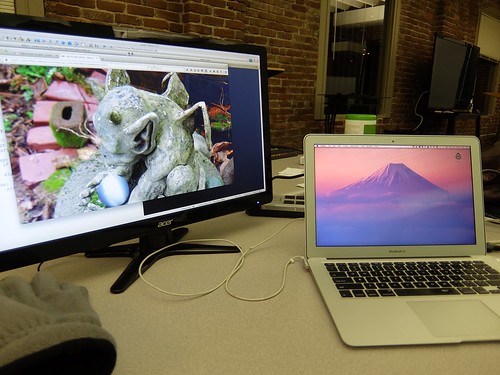
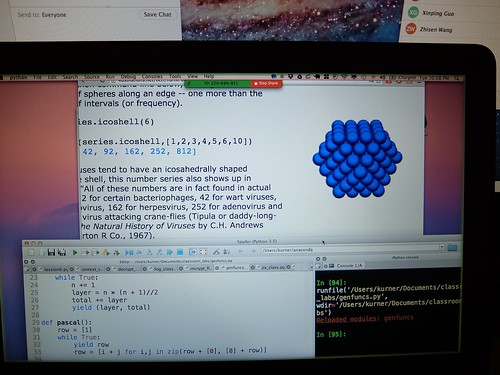
I hooked up a larger monitor so I could show off some of my own projects, for example Peter Farrell's rotating letter F, controlled in Pygame.

I'd needed a gfortran compiler (courtesy of gcc) to get that demo working, and was eager to show off my chops in getting Pygame to actually work on El Capitan.  I was hoping for some applause and approval I suppose, kudos.

I'd also planned to boot up Ted Kosan's MathPiper, a Java-based computer algebra system, but also a study in the generic power of JEdit to run multiple languages, including Clojure.  He'd sent me instructions for getting my tetravolumes demo going.

I also showed off O'Reilly Safari, where I go for a lot of my readings (like tonight's on Vagrant for example).

As I was writing in a memo to Charlie earlier today, I think paywalls like Lydna's and Pluralsight are fantastic for what they have (I've learned plenty from both), however in IT we need to read books a lot too, so paywalls like O'Reilly's need to stay in the game.

I didn't get a picture of the tour group.  Sheri took them off somewhere, and probably out of 2626 to the Business Accelerator building just up the street.  That's where I taught Intro to Programming (accelerated version), which I'd gladly teach again.

Greg and Margaux gave me a ride home, right to my front door.  A productive evening!

Saturday, April 09, 2016

Learnability Versus Complexity


I enjoyed the above presentation by John Allsopp, regarding how we're trading away learnability, in exchange for shorter term convenience, ease.  Are we being lazy in the wrong way?

For those unused to "geek", the word "lazy" may always have negative connotations but it has a positive spin as well:  not too busy in the sense of overwhelmed by urgency (crazed).

Fully mastering the tools that we have, versus frantically trying and throwing away, is what saves us from perpetual infancy.  Complexity is often a function of a lack of mastery.

The vicious circle is: unnecessary complexity detracts from learnability which discourages mastery even more.

Monday, April 04, 2016

Americana


I was chatting with Glenn today, over lunch at Skavone's, about I-5 as an institution, part of the larger I-system, a network of freeways (that sometimes charge a toll).

I'd just driven several hundred miles on I-5 over the weekend:  Portland -> Bellevue -> Tulalip Country -> Stillaguamish Country -> back to Portland.

Freeway means "restricted access"; the only way on or off is via interchange.  They're more restrictive than highways in that way, making higher speeds possible.

Where these exchanges get placed can make or break a local economy.  Congressmen wield power over some of these nuts and bolts.

Glenn knows a lot about the impact of freeways on local highway culture.  The case of Route 66 is famous.  The animated feature Cars (Disney) explores this theme, much as Who Killed Roger Rabbit explored the impact of cars on streetcars.

Glenn filled me on about Harvey Girls, the waitresses who staffed Frank Harvey's chain of track-side restaurants and hotels.  Harvey had an exclusive agreement with Santa Fe railroad.  His restaurants revolutionized the food services industry, setting a new and higher standard for what the general public might expect.

Learning this Americana proved a missing puzzle piece for me.  I'm following up tonight, doing more research.

Sunday, March 27, 2016

Easter 2016


Multnomah Meeting, "Quakers", was close to full today, though we did have some empty chairs, which is good.  I came early for Sunday Morning Adult Discussion (SMAD), an ongoing group with a rotating facilitator.  Today's theme was "respect" as in "what is it, and what would it be like to both receive and give more of it?"

I was able to get my new smartphone on the Wifi easily.  MMM is open to members of the general public, although there's a password, like at a Coffee Shop.

As I was chatting with the Web Keeper a member of Oversight entered the conversation to share about difficulties getting passed the login.  Multnomah Meeting somewhat unfortunately decided it needed to restrict login credentials to the select few able to view the monthly newsletter.

From my angle, that's unnecessary overhead, and a newsletter could be subscriber-based only if not web-published.

Getting would-be recipients of regular publications to join a listserv is easier than trying to maintain website login credentials but then I'm not involved in this Monthly Meeting's IT Committee and had nothing to do with the move to FGC Cloud Services either.

My injuries from the fall on Mt. Tabor must not be too serious as I was able to walk with a fairly normal gait both too and from the meetinghouse.

I shared that code for computing Easter on the mathfuture list, in one of the end notes.

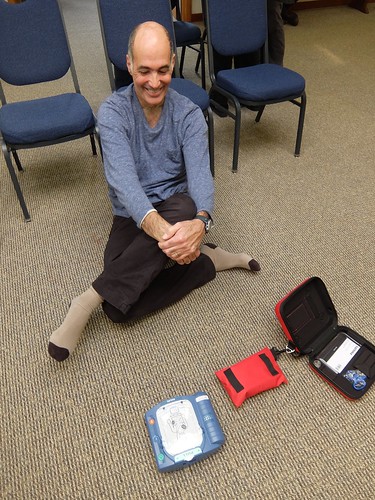
In the spirit of sharing the Easter theme of rejuvenation, even resurrection, one of our medical doctors went over the use of our in-house defibrillator.

DSCF3935

Friday, March 25, 2016

Twists and Turns

Uncle Bill's Visits

 I've been feeling on a longer leash, as no longer a dog's caretaker, and spent an extra long time downtown yesterday, meeting Uncle Bill's train, having lunch at Ringler's and re-depositing him at Union Station, with a quick run through Powell's.

Uncle Bill has a walker and parking is scarce, however that proved the ideal combination.  I used the City Park by the Multnomah County Library and he was able to make it to Ringler's, on Burnside from there, passing by Jake's in route.

The 15 minute spot near the book store proved the ideal pickup point and he was back at the station in time for the 4:05 PM, having arrived, early, from Seattle, on the 1:50 PM Coast Starlight.  He was just out having an adventure, a former mining engineer at ninety-one.

Then I stayed downtown, a luxury, until Patrick could join me, at a Rogue outlet near the Python User Group meetup.  I went back to Powell's and studied their current Python book collection in particular -- I'm talking about the computer language, popular in code schools and one I've taught for a living.

The Portland Python User Group talk was high quality, about civil engineering, the scipy stack, Anaconda and Jupyter Notebooks -- a lot of the same stuff I'm into.  I left feeling confidant the information I've been sharing with Californians (a night school gig) was on the money.

I also reconnected with one of my code school students.  I offered a course in Accelerated Programming as a public service, at PSU's Business Accelerator Center.  Since then, I've been in contact with other brain-stormers in the code school business, an exciting area these days, maybe taking off in Portland, once named Capital of Open Source by Christian Science Monitor.

What happened today was less smooth sailing however.  I hit the micro-gym, then Mt. Tabor, and all was going fine until my routine descent.  The weather was decent, better than decent.

One of the sloping sidewalks near the park entrance is uber-slick with seasonal moss, very ice-like, and down I went all akimbo.  The right ankle got stretched yet again.  Both ankles have taken some abuse of late.  I was hoping to minimize the stress, not set myself back again.

DSCF4004
:: slip zone -- newly exposed moss ::

I hobbled to the Hawthorne bus 14, re-buying the Trimet Ticket app, this being a new phone (HTC running Marshmallow). I was in the role of a grimacing cripple, and only just made it to Townsend Tea on Division, where I met up with Lindsey per our plan.  I used the torture taxi to get there, but then only found parking blocks away.

I'll go for ice and warm packs and take some ibuprofen.

Hey, it coulda been worse.  I didn't hit my head.

At the tea house I pampered myself with an "infantile regression" drink:  bubble tea made from coconut-flavored roiboos with succulent tapioca pearls, sucked through a fat straw stuck through a plastic diaphragm (more packaging than Lindsey could approve).  Yes, it's a silly drink, imbibed mostly for entertainment, but it helped me keep my attention on Lindsey's new plans and off my sore foot.

At the User Group I asked about hexapent tiling, how frequent in his line of work, rubbing shoulders with ESRI and so on.  At the data sampling level, poles in the ground, cell towers, the hexagonal tiling suggests itself, but when modeling the coordinates are always XY (lat / long) or XYZ, so in that sense, the data is not using quadrays or anything like that.

Patrick and I are engaged in discussions of mesh-netting the Everglades, extending cell service to "wastelands" where no Verizon customers are likely to hang out.  But in the Internet of Things era, cell service subscribers may be ownerless devices, too numerous to individually have owners, like chips on a board.  Spread out across an ecosystem, these devices chirp and chat about who is sharing the forest.  Pythons?  In the Everglades, those have been a problem.  Patrick is working on it.

Wednesday, March 23, 2016

A Dog's Life

Sarah the Dog

I've been giving Sarah a long life even though she stopped being able to walk some time ago. '

She's had a healthy appetite, for food, for life more generally. Having a companion at my feet as I kicked back in the big chair, was archetypally satisfying.

However she's gone downhill rather precipitously in the last few days and I think it's time for compassionate end of life care i.e. it's time to take her to the vet to be euthanized.  I have some pain killers but that's a stop gap.  She's clearly become more miserable, not to mention skeletal.

Most people would have put her down months earlier.  A judgement call.

Thank you Sarah, for your long life with our family and all you contributed to our world.

You've been a fantastic dog.

Friday, March 18, 2016

Equinox 2016

Spring Equinox 2016

We all fit around the Pauling House table this time, many of the usual suspects.

Steve Mastin was the first to leave eager to get home while still daylight.  Daylight savings time has only just begun.

Steve's estate is getting pummeled by steady 25 mph winds with gusts up to 60 mph.  We call these the "east winds" and they funnel through the gorge, bringing a cold blast to the East Side especially, as in Gresham (where Steve lives) and Troutdale.

I'd picked Lindsey up at PDX International earlier.  She was coming in by shuttle bus from Corvallis / OSU, bringing impressively heavy bags.

I fought traffic on the Banfield to my exit at 43rd, as we talked about her first semester and pending tour, stopping at Blue House on the way to John's Landing, where we sampled Szechuan Chef and Pier One Imports. I was in chauffeur mode, glad to perform some service for an MVP.

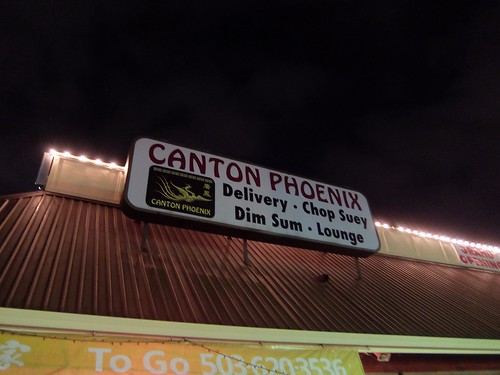
We'd had Szechuan within walking distance of Blue House:  Lucky Strike, in the same building as Hawthorne Theater.  One might think the loud music events within the same building would making fine dining impossible by I never found that to be a problem.  Thick brick.

Lucky Strike closed because the rents went up.  My Chinese food experts circled this place on Macadam as worth a try, along with another place in Sellwood.

Lindsey checked in with a health professional next, also on Macadam, while I took pictures of the handsome river front properties, right across from Ross Island. She loaded up on supplements to help her through a next sojourn in Kathmandu (Patan).

The earthquakes were a year ago.  She was there then too.

She has yet more supplements to pick up in Lake Oswego.

Lindsey's lot as a foreigner is somewhat lonely and difficult in that densely urban environment where she's seen as a "walking ATM" as she puts it.  She has a tight budget to pay her teachers, but to outsiders that looks like deep pockets and an open invitation to further capitalize.

She's learning Newar Charyra Nritya and getting credit towards her BA in so doing, with a PhD to follow most likely.

Barry brought the pork ribs, which Marianne Buchwalter praised, asking for the recipe.  He uses a large grill, which starts open then closes for the tenderizing phase.  He uses only salt and pepper for seasoning.

Nirel and Lindsey -- who showed up on foot after I'd left her cashed out on the couch -- fell into an earnest conversation.  Nirel is well traveled, including in India.  We'd all three been under the weather, starting about two to three weeks ago, when I ferried Lindsey to a mosque, more homework for OSU.

Then the master of ceremonies (not me) suggested we all join in a single conversation, which we did.

Lindsey took the stage given her interesting karma (life path). Dick Pugh suggested she get her degree in cultural anthropology, although switching from religious studies at this point is not really in the cards.  Marianne asked me who Dick was (we don't all know each other).

Marianne had just finished a writing course taught by the author of a novel Zazen, which I added there and then to my Kindle.   By "Kindle" I mean several devices, least of all my actual Kindle which sits unused and discharged, despite its handsome graphite display.

I favor using my Samsung tablet for reading what I buy for Kindle, using the Kindle app.  Otherwise I might read on my phone, until recently a Droid Razr from Motorola.  I just switched to an HTC One M9 which I think will fight me less (it's also from Motorola, but is a much more advanced Droid).

Of course Marianne and I talked about our children and grandchildren, we always do.

Nirel and Marianne then stuck up a conversation in French.  I tried to listen in.  I chatted with Steve Spiegel about Italy.  We'd both toured there in various capacities, me as an elementary then middle schooler, from the late sixties to early seventies.  I was in Manila by the end of ninth grade, with a sojourn in Bradenton, Florida at Southeast High.

I brought the lentils again.  Glenn brought his signature chili.  Good seeing Christine.  S'been awhile.

Remembering Chuck Bolton.

Friday, March 11, 2016

The Global Matrix


The Global Matrix
A Cognitive Map of Cyberspace

The Global Matrix is designed to be a universal and scalable modeling system based on an integral architectural logic.

All the components of the Global Matrix: 

    ▪     search engine
    ▪     graphics engine
    ▪     databases
    ▪     networks
    ▪     geographic information systems

All share the same Integral Architecture.

This is possible because the integral design process reveals a deep connection between structure, process, and order.

A good design should be simple, powerful, and elegant.  Our current computer technology is very powerful, but sadly, neither simple nor elegant.

Simplicity makes for ease of use, elegance makes for an integral landscape, eliminating the need for costly complicated “brute force” algorithms, which simplifies the modeling of GIS and weather systems, cellular growth, radial vectors, bifurcative networks, neural nets, genetic and quantum logic systems, and nanoscale architectures.

Integral system logic and design have the potential to revolutionize all aspects of the computational landscape.

The global matrix integral logic system is the culmination of twenty years of research and design by Glenn Stockton.  Glenn is a former crypto-analyst and linguist at the National Security Agency.  He also attended Antioch College in Yellow Springs, Ohio.  He currently lives in Portland, Oregon.


DSCF3422

Wednesday, March 09, 2016

Wanderers 2016.3.8

DSCF3333

I'm working night shift on Monday and Wednesday, leaving Tuesdays open again, meaning I'm able to join the Wanderers meetups at the Linus Pauling house every other week, and this Thursday I hope to make the ISEPP lecture.

Accounts differ as to how and why the Wanderers were formed, however the best explanation is Terry Bristol, president of ISEPP, was always bringing these big name lecturers to Portland and he needed a cast of ready cognoscenti who could engage said lecturers in witty repartee.

The upcoming lecturer is a big name, the CEO of Mentor Graphics, Dr. Wally Rhines, however he's not from out of town as Mentor Graphics is locally based, and has been a loyal main sponsor of Terry's lecture series.

Big name lecturers have included Jane Goodall, Lisa Randall, Carl Sagan, Lynn Margulis, James Burke, Michael Cousteau, Richard Leaky, Freeman Dyson, Stephen Hawking, Ilya Prigogine, Mario Livio and many more.

In addition to direct funding from Mentor Graphics, a charitable nonprofit, The Mentor Graphics Foundation, makes sure high school aged students and their teachers have access to either free or very affordable tickets.  Many a young mind has been expanded through this program.

Regardless of whether Wanderers are helping out with a speaking engagement, we try to stay in shape intellectually.  Tonight Barry Redd, a retired banker, spoke on the topic of Dark Energy, while Dr. DiNucci, at one time with NASA, performed the role of fact checker.  He's also president of Humanists of Greater Portland.

I'd seen a TED Talk recently in which "believers in homeopathy" were singled out as advocates for pseudo-science.  I'd used the word "homeopathic" recently in an essay, thinking it meant something like using a little of what one is building immunity to, in order to stave off an onslaught of same.

For example, in training on cowpox, the body develops the ability to repel smallpox, a known principle in vaccinations.  Also the body has ways of training T-cells and weeding out those which can't tell the difference between self and other.  One would need some "other" to chew on in that case.

However, the Wanderers set me right:  what I'm imagining is "homeopathy" is not that at all.  I'm off base in thinking I know what it is (a pseudo-science, the TED Talker was right).  Thank you Wanderers.

Thursday, March 03, 2016

Uncle Sam Smartphones


 Students lucky enough to get exposure to RSA (the algorithm) along their math track, like at the exclusive Phillips Academy, are likely having more informed debates in their classrooms, regarding the Apple vs. FBI standoff.

They're certainly better equipped, concept-wise, than less privileged kids who might not even get any SQL, even in all four years of high school (!).

An aspect of that story I see differently reported is:

(A) when the passcode is miss-entered more than 10 times, the phone wipes away its data (99% of the stories put it this way)

(B) the phone doesn't have to wipe out anything except the decryption key, leaving the phone encrypted forever (1% put it this other way).

One might argue the difference between "erased" and "indecipherable" is negligible, but I think it's an important distinction to make.

The "erased" mental model leaves people with an over-simplified understanding of why the FBI couldn't get to the data in that case: it's gone.

The "forever encrypted" mental model reminds the public of something else: the data is still there, just the code is uncrackable. That means ordinary people have access to uncrackable codes? Sure thing, but not everyone understands that, even in 2016.

Those who understand RSA will have a better appreciation for how this might be mathematically possible. One needs a pair of numbers to unlock the scrambled data (N, d). Lose the d, and all is lost, unless N were too small in in the first place. RSA may fall in the future, when quantum computing is more a reality but as of today it's still "military grade" (uber-secure) and embedded in every web browser.

My own view on the matter is a state should not be precluded in principle from running businesses, applying its own decals and ideals, and that Uncle Sam smartphones or whatever could be handed out, perhaps free of charge, to underprivileged, say through public schools.

We all should cell phones, if only for safety reasons. We use them to report suspicious, potentially terrifying activities. If you're family can't afford one, Uncle Sam will step in, even offering classes in how to use it.

The USG branded models be FBI hackable of course (a feature not a bug) and will come with many other benefits only the US is in a position to deliver: a wide range of special apps, foregrounding the many benefits of US citizenship. You'll be able to vote, pay taxes, and check your social security benefits, all from your Uncle Sam smartphone.

My suggestion does not solve the specific problem of the San Bernadino iPhone, however I do think patriots who want to make a statement of support, should be able to go to Walmart or other outlet and buy whatever ideologically correct phone suits their persona.

The USG might even mandate its smartphones be used at work, by Federal employees. The FBI will get to "eat its own dogfood" (practice what it preaches).

Sure, would-be criminals will prefer privacy over affordability and convenience, but then ordinary citizens have access to the same cryptographic techniques they do, no license or background check required.

That cat is well out of the bag.

RSA is no longer under any patent restrictions.

Freely downloaded apps make it easy to encrypt practically any data or communication. We crossed that bridge a long time ago, in the days of Pretty Good Privacy (PGP) and so on.

Extrapolating further: I'd like to see Uncle Sam with its own chain of hotels, a rental car company, an airline... These businesses will need to be open source / open book so people learn from their transparency. They're still have to turn a profit, to pay their own way. They're a source of revenue for the country.

We've taken privatization a long way; let's try going the other way for a change. In the Kingdom of Bhutan, the army helps pay bills by distilling alcoholic beverages, sold in the commercial market.


I'm not talking about the government nationalizing the oil companies or the banks. The USG already runs hospitals (the VA) and a postal service, prisons, a lot of schools. Why not a competitive phone service as well, accessible to ordinary consumers, not just Federal employees?

These businesses could serve as role models, showing other capitalists how it's done. Those who always criticize the government for not understanding about business, will have less of an argument.

Sunday, February 28, 2016

Catching Up


Vladimir Putin has crafted a clever position vis-a-vis Ed Snowden, acknowledging he's more a civil rights activist seeking asylum than anything, while emphasizing the Russian intelligence services have not worked with him and have no real reason to do so -- not counting the above high profile "exchange" (not in real time) of course.

Putin also thinks the District was overly aggressive with its attempts to track him down, which somewhat forced him to find protection in Russia.  That had not been the original plan.

Minus any extradition treaty with the District of Columbia, which Putin claims Russia has offered to institute in the past, only to be rebuffed, there's no mechanism in place to get wanted criminals returned to Russia.

I also finally tuned in John McAfee and his Libertarian party candidacy.  What an interesting guy right?  Former NSA (and CIA) chief Hayden takes a position far closer to McAfee's and Apple's than the FBI's.

Mining Youtube and the rest of the Internet is rewarding when it comes to following a lot of threads.

My hypothesis is the US presidential race has become more farcical in proportion to individuals not trusting they're getting truthful information on so many important topics.

Nixon-Kissinger's secret bombings in Indochina were big contributors to the breakdown in trust, although the Kennedy assassinations really got the ball rolling.

Average people came to realization that lies are the common currency, not truths, at the "highest" levels (whatever that means).

That was a paradigm shift.  Taken to its logical conclusion, we get what we see today:  candidates without the context of gravitas.

Gravitas sans Veritas is mighty hard to sustain over the long haul, lets put it that way.

We could go back to the Business Plot and Smedley "War is  Racket" Butler for more grist for the mill.

Another reason the political sphere is leaking gravitas is people without much of an engineering background may come across as insufficiently literate in the computer age.  Many senators recognize this as a problem.

The foray of legislative bodies into crafting a "Common Core" thereby politicizing STEM content in particular, has made them easy targets for critics.  Why should people this ignorant be making the rules?

Saturday, February 20, 2016

Martial Arts Schools / Coding Dojos

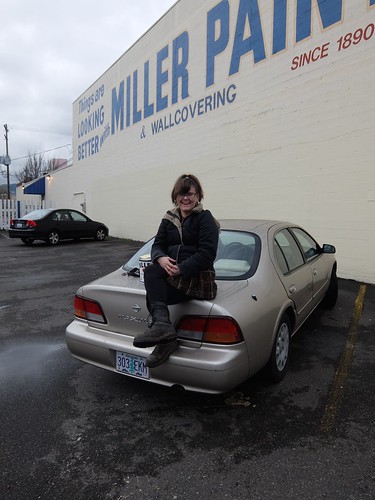
Mel at Miller
:: mel @ miller ::

I tripped holding the dog this morning, or slipped, in the mud.

Dang, first day with these new Tactical brand trousers (got 'em in both black and tan), from Andy & Bax, local army surplus on Grand, across from Miller paint.

I've shopped at Andy & Bax before, getting into various paramilitary looks.

I'm eyeing a certain Boot Camp opportunity, plus the whole software developer community is already crazy with "coding dojos" and other talk of "kung fu" or is it "foo"?

The point being:  not my invention to inter-mix coding and mom & pop martial arts studios.

They co-exist in Portland, as a part of our demographic.

So my other point is my shopping is with a purpose.  I'm branding in a sensible way.

Saturday, February 13, 2016

WILPF on the Road (was Tax Time)

Carol's road trip continues.  She and Ellen Thomas are enjoying a brief stopover in rainy River City before heading north to Seattle.

They've been traveling north from southern California, stopping all along the way (most recently in Corvallis) to meet with people regarding Womens International League for Peace and Freedom (WILPF).

People usually just say "wilpf" which is actually pronounceable.

I've been paying bills and taxes left and right.  Ever since I had a dependent in college I've been filing early in the year instead of April, like I used to.  I'm back to having a Schedule C and tracking expenses, so that 1099s work easily.

That's 2016 however.  2015 was relatively easy and more or less a repeat of 2014 (talking taxes here, regional, state and federal).

The WILPF campaign is connected to the long-running Countdown to Zero, which as been ticking away for some years.

That Zero is not a reference to Ray Kurweil's Singularity. but rather to a strategic military goal of moving humanity past the suicidal stage.  Some top military minds, not just peace-niks, have been working on the problem for quite awhile.

The so-called Intelligence Community has nothing better to do either (Valerie Plame narrated the above movie), especially counting the cadres of officially retired personnel.  Not surprisingly then, the work is bearing fruit in some areas.

A goal of "zero" remember, refers to eliminating the threat of Weapons of Mass Suicide (WMSs), most of them nuclear.  A main enemy is carelessness, awkwardness, and general incompetence, an enemy hard to overestimate.  Evil is indeed banal.

Wednesday, February 10, 2016

Virus (movie review)

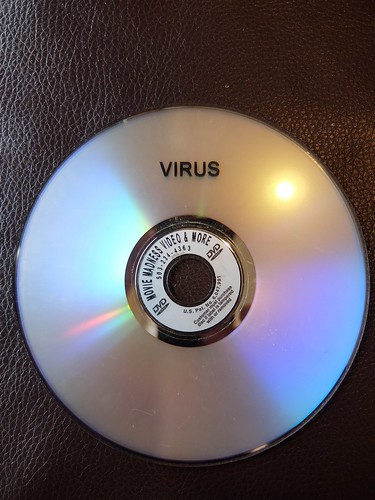
DSCF2957

The official title of this 1980-made science fiction movie is in Japanese, and translates to The Day of Resurrection, which was how I found it on IMDB.  However the DVD-R cover at Movie Madness loudly said Virus was the title.  Either will do.

The film is aimed at a Japanese-speaking audience in that the subtitles came on, in Japanese, when the dialog was in English, which happened quite frequently.  Robert Vaughn and George Kennedy are among the star-studded cast, in a movie about the end of life on Earth is we knew it, circa 1982.  When the characters spoke Japanese, no subtitles appeared.  This DVD-R was without menu or settings, ditto The Devil's Eye pulled from nearby.

The film may be seen as a form of protest against the Sword of Damocles still hanging over humanity, threatening it with self-inflicted uber-damage.  Prophecies of war tend to be self-fulfilling if allowed to gather stream unchecked by diplomats, and in this scenario, Earth is placed on a hair trigger which we learn an earthquake will soon set off.

Meanwhile a lethal virus, a plague of plagues, is unleashed from one of the government labs.  The spread of this "Italian flu" is what prompts a loony general to arm the system, meaning the Soviet retaliatory strike will take out even Antarctica, a last holdout for humankind.  Sending bold volunteers into a Washington DC devoid of human life, in a last ditch effort to turn off the computer, provides a climax before the denouement.

The film is epic in that it attempts to chronicle not only the end of contemporary civilization, but the beginning of a new one around a nucleus in Antarctica.  When even that doesn't work out, yet another chapter is begun, suggesting the rRNA (ribosomal RNA) of future humans, if successful in rebooting, will trace to but a few moms.

The film could go on from there of course.  A vaccine is emerging.  How much of a civilization might a tiny group of specialists pass on, a dimmed holograph, a fading cameo of all that had gone before?  We're not quite back to Adam and Eve.

We lap up against that story, a next epic, after two and a half hours of witnessing our world die.  Clearly it takes lifetimes, not merely epic films, to really get the job done.  Passive spectators get kicked into the sunlight to play some active role perhaps, as the world turns.

The cast and crew had easy access to submarine technology.  That periscope didn't look like a mock-up, even if it looked dated.  Interior shots from an actual museum piece sub appear inter-cut with stock footage, lots of arctic scenery.  Reminding us of the planet's great natural beauty is a part of the message to not crash it.

In the Antarctica chapter, the few remaining bipedal mammals confront their heritage of ingrained nationalism and sexism.  Why should the Admiral assume he's in charge?  Given that males outnumber females by a large ratio, what policies should be implemented.  Naturally, a premium is placed on having babies, regrowing the human race.  Many social conventions, accepted in 1980, may need to be revisited in light of the new realities.

Given we humans are creatures of habit, survivor stress levels run high, to say the least.  Future shock proves mostly nasty and high voltage.  Is Mad Max any less exhausting?

The sound track is somewhat choppy and I'm not referring to the diversity of spoken languages.  I found myself jarred by the transitions sometimes, surprised by a choice of music for example.

But then the subject matter is about a degenerative species that can't get its timing right or self direct effectively.  These unfortunate humans appear herky-jerky in their death throes.  Have other planets fared better?  We save this cosmic question for other films.

Sunday, January 31, 2016

Mom on TV!


Mom and Ellen Thomas are on a road trip, making stops and talking about the Countdown to Zero campaign (known by other names as well).

Also....

Saturday, January 23, 2016

Ethnic Diversity

DSCF2744

The common wisdom around Portland is we're not very racially diverse.  I'll be the first to cop to Oregon's sad history, in having it in the law books that you couldn't be here and be black.  Says who?  Who were these anonymous authorities no doubt claiming Biblical Authority when push came to shove?

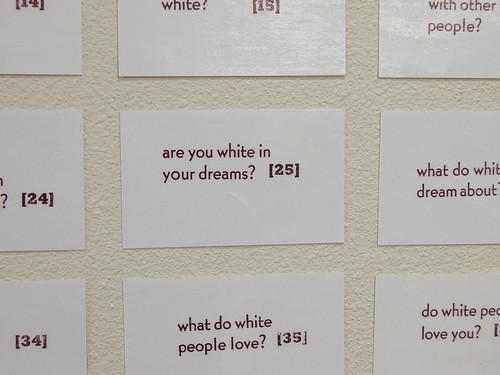
On the other hand, to get right to it:  obsessing about race is what blinds one to ethnic diversity.  You heard me:  thinking in terms of race makes you stupid about ethnicity.  A fool.

We all know this, when we stop to think about it.  A racist can't tell the difference between a Mexican and someone from Guatemala because they're all just Latinos, as if that were a race.  Or as if White were.  As if there were races.  That's a big "as if" says Ashley Montagu, respected anthropologist, but who listens to him?

Portland is extremely diverse, ethnically.  We have people from many lineages from Southeast Asia, Indochina in particular.  My first real job, when I moved back to Portland in the mid 1980s, was in a refugee resettlement agency, a federally funded NGO (oxymoron?) helping Vietnamese, Laotians, Cambodians... get a toehold in this "New World" (certainly new to them, in many cases).

But if all you can see is "races", you miss out on so much.  Remember Boris Yeltzin?  Funny guy.  He came to North America once and said, to this effect:  "hey, why do we fight so much, we're all just white guys, right?"  I thought that was funny but folks were in no mood for boorish humor.  Yes, I've been to South Africa.  Yes, I write "stream of consciousness" (so do you, but we all conform, based on feedback from the locale).

So look, I'm an alien.  As in ET we could just assume.  I have a US passport (have since the 1960s -- jet setter here) and know how to recite the pledge of allegiance, though rarely in adulthood are we required to do so.  Quakers, BTW, do not swear oaths on the Bible.  We're alienated by such quaint customs and think they belong in the dark ages passed.   We're more like Humanists (ethical) in that way.

Racism blinds one to the true dimensions of human diversity, which lie along other axes than those of arbitrary genetics, a grab-bag of attributes, owing to which we say we're more or less pure (i.e. a "pure black" is closer to the archetype, as would be a "pure white" versus various brands of Mongreloid, the "one true race" for the rest of us -- you believe this BS?).  You'll come to Portland and see a lot of "white people" missing completely they're "white Russian" half the time (check Wikipedia).  Don't quote me on "half".  I'm not omniscient, OK?

Nevertheless and in spite of the above rant, I did find this joke funny, and have repeated it:  "Portland.  You're so white your blackest neighborhood is named Albina."  LOL.
DSCF2808

Monday, January 18, 2016

Conspiracy Dynamics


Amateur sleuths and Sherlock Holmes types, when looking to penetrate a cover-up, need to factor in various dynamics.

Having just slogged through more 911 videos, prevalent on Youtube, I feel this observation is apropos:  even if you have no idea who did it, you may see your rank or position as tied to the perception you might know.

As a player, you may wish to foster your reputation for being in on whatever plan.  You might even do this to further your own investigation.  If people know you already know (but you don't) then some who really do know might let their guard down in your presence, imagining you already know their secrets.

Consequence:  many people will adhere to a cover story not because they themselves believe it, and not because they know the truth, but because it's safer or otherwise more productive to follow an insider party line than to sound like an outsider skeptic.

Lets take Allen Dulles for example.  He not only served on the Warren Commission, he of course supported its chief finding, that Oswald acted alone as a lone gunman.

Given Dulles was a one time CIA director and the CIA itself has been fingered as a chief suspect in the Kennedy assassinations, at least the first one, does that mean he knew the details of what really happened?  Not necessarily.  Ditto regarding the U2 "shot down" over the Soviet Union -- he stuck to the cover story.

Working backward from the above, one sees the need for a cover story that people might cling to, an authoritative version of events.  But what if those with the most access to the media don't actually know what happened?  Inventing an official explanation that later unravels at least gives people something official to hold on to, which is what they wanted.  "Playing it safe" is the name of the game.

So serving up a "likely story" is sometimes the next best thing, even when it's full of holes.  Why?  In part to comfort those who were freaking out.  But also to deny one's enemy the satisfaction of controlling the narrative.  Pumping misinformation into a system is a way to degrade it, and sometimes that's the intent, in order to counter a perp.  "If I don't know, nobody else gets to know either" might be the mantra here.

That's another aspect of psychological warfare some people miss.  Lets consider the profile of a serial killer who really wants to be noticed and who takes pleasure in leading the police on a grisly chase, following a path of dead bodies.

The police might intentionally come up with a confused story in which murders the killer had nothing to do with are considered "linked" in the newspapers.  The narrative becomes blurred, misinformed.  The perpetrator experiences frustration at not seeing credit given where credit is due.

The purpose of a cover-story is therefore at least two-fold.  Wannabe insiders, such as politicians who want to seem "in the know", may get to bolster their reputations by supporting a cover story, even a clearly false one.

"They must know who really did it then" the clueless spectator falsely concludes, "which means they're powerful insiders" (what the politician wants these spectators to believe).

But then as mentioned, another purpose of a cover story may be to divert all or most of the attention away from the perp's intended cause or message.  Without even knowing who did it, one may see ways to control the narrative nonetheless, or at least ways to not surrender to someone else's.

My recommendation to conspiracy theorists is to think deeply about what it means to lose control of a narrative.  One becomes an outsider, no longer authorized to tell some story.

Some players fear losing control of the story more than they fear the truth, which seems unlikely to be agreed upon any time soon, and for this reason they continue to cling to a version that feels safe to them, unlikely to come apart at the seams. To others, this same version may seem shallow and phony.

Of course the classic / conventional situation is the cover story is invented by the perps themselves to hide their true motives and actions.  My point here is to counter that over simplification.  Sometimes the cover story is invented not by the perps, but by those still keenly hoping to find out more. That the cover story is clearly full of holes only motivates others to sift through it more.  Who said that's bad?

Saturday, January 16, 2016

Built to Not Last

The title might seem like a typo or misprint.  Aren't we looking for "Built to Last" when we're shopping?  How could baked-in transience be a virtue? Is this more of that silly Geek Talk [tm] wherein "laziness" is a virtue?  You betcha.

The "new car smell" everyone talks about isn't just or only a smell, but the whole ambience of having a new car, unblemished by actual use, like a puppy on its first day in the garden.  Such innocence may be annoying in some contexts.  A fresh laptop is maybe so far from customized to what one needs, but let's not turn pessimistic.

In the Cloud, the analogy is obvious:  "build one to throw it away" means we're free to "just doodle" with some serious resources at our command.  Spin up some JuJu on Ubuntu and define yourself a rig, a rack, a framework, or whatever.  Test your business model, fine tune, unit test, keep it agile. You may want to take it live, but probably after a number of iterations.  Alpha versions mature into betas until an actual release candidate is rolled out to the world.

Likewise on the first day of school, one's desk is pristine.  Students used to have desks unto themselves, not just lockers, where possessions were conveniently stored, persisting from day to day.

That practice may have eroded in many districts, or never caught on.  My personal memories hearken back to the Overseas School of Rome, one classroom in particular.  They tilted up, those desk lids. Lockers start pristine also, at least if all the old stickers come off.

We know from the get go that experiences are a lot like novels or films:  they start, have a middle part, and then they're over.  Life is episodic.  So the specification that it "not last" could be said to belong to "experience itself" (getting philosophical here).

When you know going in that it's a doodle or throwaway version, might you take more risks?  Would you enjoy it more, and therefore gain more, from the challenge?  When the changes are more permanent, one likes to know in advance about one's choices, and mull them over.

However, like ice cream on a summer's day, accept in advance that even with the privilege of choices, none of them were "built to last".  Some elementary particles only fleetingly exist before separating into decay particles that in turn interact and so on.  Lightning happens in a flash.

Role-playing games involve rotation quite a bit, or can.  You're not stuck in a role forever and indeed are better at role playing more generally for having moved around and seen the game from different points of view.

The idea that you needed to be just that one thing when you grew up, like "the milkman" or "the nurse", was a tad too simplistic to ever gain much traction.  Life goes in chapters.  People were not built to be typecast necessarily.

Monday, January 11, 2016

Bootcamp

@ < guild />

I'm lurking in on a boot camp scenario.  That might sound physically onerous but it's more metaphysically steep.  We climb, attain skills.  I'm just a noob in this picture, marginal to the action.

However I'm in the wings, like an understudy, and could be called in front of an audience, as soon as Wednesday. So like theater.

Last night I dove into Volume 3 of Knuth's The Art of Computer Science, just starting to get into it. He immediately turned to permutations, a mathy type object I've been dinking around with.  I felt led to add to my code's capabilities.

My puttering was lassoed for a post to MathFuture, with a link to the current source code.

Saturday, January 09, 2016

Business Logic

DSCF2502

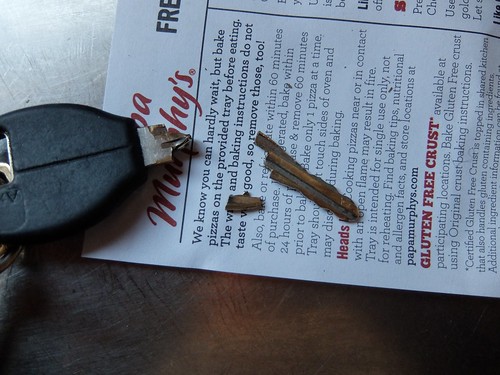
As I was leaving the training facility (<guild />) this afternoon, turning the key in my car's ignition, it broke off. Having a backup key somewhere hidden under the car would have been nice. No such luck. At least I had one at home, and access to public transportation.

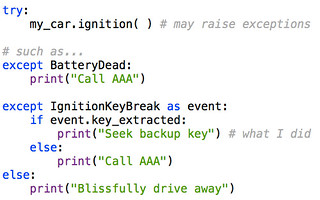
What are the chances of such an event happening? I'd have been less surprised to find my battery dead. However upon polling a few peers, I found many had similar "ignition fail" stories, so the event is not that uncommon, is a contingency we might plan for. Or code for:

biz_logic

and so on.

Python has to be indented that way; the keywords are in blue. Just scanning the code reminds one of the "poetry" of starting one's car, and what failures (exceptions) might occur. One may use one's imagination to further extend the code.

We've designed coding languages to model businesses, to where we might now play "what if" games (simulations) using code as a medium of expression.

The point is not so much to run such code, although it adds to readability if it's grammatically runnable. The point is to use code as a way of giving shape to our thoughts about risk management.

"When we try to do X, what might happen instead, and what ways do we have to handle or cope with these eventualities?" Consider modeling your answer using try / except syntax. Use the grammar of a computer language to tell the stories.

With ISO 9001 2015, "risk management" takes center stage, replacing "preventative measures" as where to focus. The try / except syntax of modern computer languages, common to more than just Python, suggests that language designers have baked risk management into their very fabric.

Computer programs need to deal with the same fact businesses do, that their surrounding world might be VUCA. Might we take advantage of these innovations? Might we sketch the workflows of a company in pseudo code (that runs)?

A secondary motive for modeling workflows, and risks, in simple code, is to bolster our willingness to digest meaning in this form. Given the centrality of IT to so many businesses, the willingness to eyeball source code with comprehension, as a part of everyday business communications, is more than ever a worthwhile commitment.

Management and IT will more smoothly converge to the same page to the extent that high level memos reflect the way a business is actually implemented at the coding level. UML was a step in the right direction. Indeed, what I'm recommending here is already a fait accompli in some board rooms. The whiteboard is typically mix of diagrams and pseudo-coded objects, even when taking the ten thousand foot view.

As we move to assess risk and develop strategies for managing it, lets remember the positive feedback loop, the synergy, between our computer languages and the real world phenomena they strive to capture in running code. As with mathematical notations, of which these languages arguably form a part, once they have been applied to the reality we care about, our powers of imagination kick in and new possibilities open. A language about "what's so" grows to become a language of "what could be", as we bootstrap ourselves towards a better tomorrow.

As for me, I've learned I must make more backup car keys and keep them easily accessible.

Saturday, January 02, 2016

Workaday World


IT firms look for expertise in specific areas.  "The I/O loop as used in Tornado" is one example, and here's a landing page for the above YouTube that explains it.

Think "design pattern".  A Python generator is like a piston that fires through a next cycle when triggered, but is non-blocking in between.  The code above gets many generators going, each eager to take a next step, pending a green light from a socket monitor.

We call them co-routines when we start using send to make the yield statement two-way.  An object may keep spiraling through, interlaced, chronicling a pilgrim's progress through an oft paused journey.

In the co-routine pattern, a Task class drives a generator piston to keep firing it as soon as ready.  Each GET request to the server (relatively slow) is wrapped in a task.  Watch it again to see how the Future class queues up the work that needs doing.

My thanks to Jesse for sharing his expertise.

Thursday, December 31, 2015

New Years 2015-16

Most of the globe has already time-zoned into the new year, per the Gregorian calendar, not the only one going.  PST brings up the penultimate-rear, with zones closer to Guam ending that calendar day, Guam being "where America's day begins" per "sun never setting" meme, big in Britannia.

Being service sector, I work for a living, which these days means lining up something new given the end of a first experiment / pilot by the parent company.  I was privileged to be a part of this bold beginning of something new, and understand the need for an interlude.  In high technology, we don't always expect a position to last.  It's not that they fire us; the whole movie comes to an end, and we were cast.  California is good at Silicon Valley stuff for a reason:  Hollywood is close by.

But then Portland has its Hollywood neighborhood.  We're a micro-tronic version of LA + Bay Area, one might claim, using nanotechnology to fit it all in a pinhead (i.e. me).  Grin.  So yeah, today was a job interview, and things clicked pretty well.  I'll be entering a boot camp like experience, learning some new ropes.  However it's back to gigging it together, as from 1990 on, until I experienced my first "corporate job" with benefits in the person of our parent company.  Soon to be orphaned once more, I'm back into digging gigging.

I've got other paperwork going, plus the ongoing "radio show" serving the State of California.  Despite a competitive mentality, healthy, we're a single Left Coast nation, per this Tuft University analysis.  The Northwest is exploding economically, as is Python (that's what they say: "exploding" -- can't find enough teachers).  I'm happy OSCON is moving to Austin, for Austin's sake: the Silicon Hills need to help us continue Revolution OS, still ongoing.  That other paperwork is what took me to Fred Meyer just now, to buy replacement ink cartridges for the HP Envy, Carol's rig.

Deke (the Geek) is experiencing turnover at his place, meaning new cast, perhaps some new characters for this blog.  Time will tell.  In the mean time, we customarily look back, in these posts as well, especially to the Bucky Ball aspects of the New Years Eve ritual.  These blogs come choc-o-block with references to carbon allotropes and geodesic structures.  Waving hello to Bill Lightfoot, assorted cousins, K. Snelson, Valsquiers, Denny & family, Koskis, Boltons, various consulting firms and medical practices.  We're thinking of refugees on the move around the globe, student-teachers in our Global University (alternatively our Global Psych Ward -- some say "Hotel").

Onwards then, escaping Idiocracy, and towards a Promised Land.

Friday, December 25, 2015

Christmas 2015


No, not my spread, owned by a school district couple in another state. A place well known to me. The drone is fully licensed. NPR is all about drones this morning, supposedly the big toy of the year, though I'm thinking flatscreen HDTVs were still near the top of the charts.

Our crew watched Climate of Change (2010), a climate change documentary, then moved the scene to nearby Tigard for Chinese food.  We ended the day watching old (1970s) episodes of Columbo (starring Peter Falk) on DVD.

DSCF2331

Tuesday, December 22, 2015

Hanukkah Party 2015

DSCF2310

Alexia couldn't make it this year, but I'm glad of how she's doing and really enjoyed seeing Star Wars with her and John.  Tara joined us.  My Hanukkah was happy.

Lindsey, hot off the plane from Kathmandu, through Bangkok and Seoul (a last minute re-routing thanks to a cancellation), practiced saying "Star Wars" as if transliterating into Newar.  Newar uses the Sanskrit writing system to record a Tibetan-like language.  She was in line by 4:30 PM, for the 7 PM show.

Good seeing William again, a war vet friend.  Natalia made the cover of the last O'Reilly School catalog.  She studied Java with us, whereas William, by then a civilian in Afghanistan, became my Python student.  Now in Portland are they.

That's what this season is a lot about (meetups) and that requires a lot of travel, all at once.  They say in China a billion people are on the move by train alone, around Chinese New Year.

I'm wondering how we might keep having shared holidays but maybe telecommute more, spreading out the in-person visits, even if not having fewer overall.  Something to think about.

Les, Elise, and Ruth stopped by.  Les is no longer with the tribal casino; he works for a public school district.  Ruth is spinning her own wool and studying textiles and fabrics more.

Tara was going to focus on "listening" as a topic in Aristotle but thinks she'll get more out of studying philosophy when less involved in departmental politics (she dove into my new Heidegger book).  I understand; it's a boat I jumped from myself as an undergrad.  She has her physics and growing maturity in software engineering.

I cherish my time with family and friends and recognize "facilitating meetups" (making them feasible at all) is a primary raison d'être of commercial air travel.  Indeed, erstwhile house guest Lindsey is out the door again tonight, leaving Blue House for a warmer clime and a family gathering.

We exchanged gifts and enjoyed potato latkes at our cozy party.  I talked quite a bit with a bona fide Star Wars fan who could answer some of my questions.

A wedding occurred at The Bagdad, between the previews and the 7 PM feature.  We had great seats, having been in line early.  I grabbed a gin & tonic, as I'm still doing "no beer".

The audience was highly supportive of the ceremony.  A marriage is a memorable happy festive occasion, and semi-public.  These circumstances met these criteria and even strangers rose to the occasion.

I was glad of the opportunity to get Melody to Union Station today, and to have lunch with Glenn, after Deke came by and helped with Sarah (the floordog).  More meetups planned... tiz the season.

DSCF2301

Thursday, December 17, 2015

Inventors


Two of the inventors I'm tracking are producing new Youtubes these days.

Buzz Hill talks a little slowly, as he bounces back from a stroke. He's inspired by Google Cardboard, a box for enjoying the experience of stereoscopy right off a cell phone.

As an expert in retinal scanning for bio-recognition software (like finger-print recognition), Buzz is excited by the possibility of combining the two ideas.

An affordable self-identifier could come in handy in a variety of applications.   He's busy putting his ideas in the public domain to protect them from patent trolls.  He's branding around '4yeo' (for your eyes only).

Gerald de Jong has been on my radar for a long time as the inventor of Elastic Interval Geometry, a software-based form of exploration involving self-animating characters motivated by the dynamics of changing compression-tension along their elastic members.

In robotics, the idea of "muscle wires" (e.g. Mondotronics by Gilbertson) is germane.

However given the JVM (Java Virtual Machine), purely mathematical renderings become feasible.  Gerald has recently turned his attention back to Tensegrity, the concept that helped inspire EIG in the first place.


Tuesday, December 15, 2015

Wanderers 2015.12.15


We dove right into global climate talk, in which we've become fluent over the years.  Dick is talking about the kelp forests that used to stretch out into the Pacific, much further than today.

Kelp is a fantastic converter of CO2 to O2, in case that's of any interest.  The sea urchins have been devouring said kelp however, unchecked by their natural predator:  sea otters.  Bring back the otters then?  Sea urchins fetch a pretty penny on the sushi market.  We have lots of ways to increase biomass, some more intelligent than others I'm sure.

Pretty much right at 7 PM, the projector came on and started a showing of The Power of Community, a documentary film about Cuba's austerity measures in the face of its pariah status, as enforced by old enemies and expats.

The film has been going around for awhile, but was new to me as of only a couple days ago, when I reviewed it in Control Room.  Showing it tonight was not my idea but was an idea I approved of.  Nothing wrong with Wanderers taking in a documentary now and then, especially given our sustained interest in the planetary gas mix.  Methane was also a hot topic tonight, as were hydrogen, nitrogen and some others.

Recent history around Cuba is a topic I've touched on before in these blogs of mine.  I start traversing that territory, starting early in BizMo Diaries, where I review the docu-drama Motorcycle Diaries, about Che Guevara in the early days, and future friend of Fidel Castro.  Also in these blogs, I touch on JFK, U2, Cold War... themes from my own lifespan.  I've been paying attention at least.

I brought along a brochure from OSU's Valley Library, Special Collections, about the new on-campus museum exhibit, just outside the Doug Strain Reading Room, where the Pauling papers (his and hers) are collected.  I put it in the glass case, comprised of Pauling-related souvenirs.  Linus lived here (in the house where we're meeting, showing this film) as a child, becoming aware of chemistry, experimenting in the basement (we're told), contributions to which would later earn him one of two Nobel prizes.

We enjoyed the film, it seemed to me.  Internet devices geared to help with agricultural engineering might be what's coming.  Maybe that's where we're at now.

Monday, December 14, 2015

Cultural Illiteracy

Six Around One

I was mentioning in an internal memo today, regarding Quaker business, that because our high schools failed to pick up on SQL use as a basic literacy, we're now facing a shortage of clerking skills, recording clerk especially.

We've returned to the days when it seems only an elite minority get to commit records to tables, as instead of ledgers, or even spreadsheets, we now use SQL databases as a matter of course.  But most people never get their money's worth as taxpayers.  Their tax-funded schools let them down.

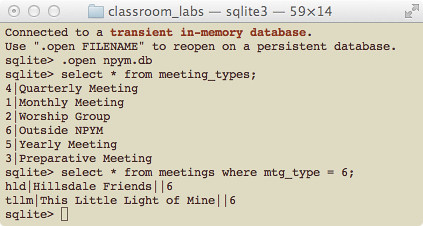
Fortunately for the world SQLite is free and pretty easy to use.  Forget about multi-user access on a complicated web server; an SQLite database is just a text file, yet provides a fully functional SQL API.  The day may soon come when our NPYM meetings swap .db files around like we share .xls (Excel) and .doc (Word) files today.

What else don't we teach in school?  American History has fallen by the wayside.  Civics is pretty much gone.  That's the impression I get anyway, though I understand many students plow into these topics anyway, as learning may begin when they finally get home and have a chance to access the greatest library ever made:  the Internet.  Or maybe not.  Not everyone enjoys such privilege.

I've been suggesting we open a second numeracy track, parallel to Delta Calculus, and put SQL, along with more boolean algebra, sets, data structures, algorithms, other discrete math topics (number bases, more with primes), on this newer Lambda Calculus track.  Get the lexical (programs) to drive the graphical (e.g. rotating polyhedrons).  Connect those left and right hemispheres in a more integrated imagination.

I've done a fair amount of pilot testing in the decades since the 1990s, and before.  I've been interested in pioneering new curriculum ideas under the guise of my Oregon Curriculum Network (OCN).  Then came Digital Mathematics on Wikieducator, in combination with "Martian Math", greatly influenced by Synergetics (more a vehicle for introducing some of its core concepts).

Saturday Academy let me field test with teenagers.  I even got to try out some lesson plans in Bhutan and Lesotho, thanks to my school teaching mother.

What's Synergetics again?  Again, American History has somewhat fallen by the wayside, or this would be more of a rhetorical question.  Many high schoolers honestly don't know, because no one saw fit to connect the dots for them.  Constructivism maybe means "connect your own damn dots" -- but doesn't teacher experience count for anything?

meeting_types_npym

Friday, December 11, 2015

Extended Safari

STEM Class 2015

I'm grateful for the extension on Safari On-Line, which I'm showing off to my students on a shared-screen (my screen) using "Internet radio" an audio format that includes the "call in" feature, i.e. any of my students might get the talking stick and address the group.

As it turned out, after passing the stick around (metaphorically) in the early sessions, we settle on using the message board (chat box) and just let me do the talking, answering what came up in chat (both public and private channels, like IRC).

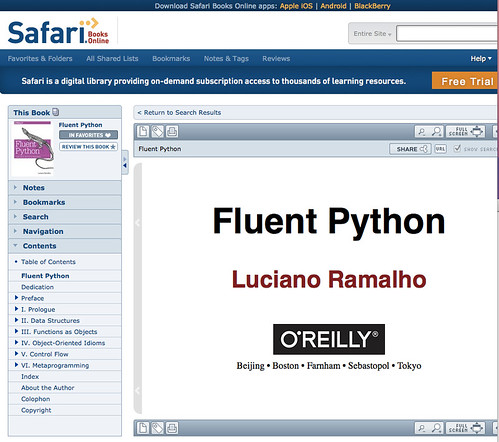
Fluent Python

We had ten sessions in all, four hours each, with labs, so I figure the equivalent of a college course in terms of lectures, but then I was not on the hook to evaluate student work, which has been the focus at OST.

I showed them recent reading:  O'Reilly books on SQLite, Flask and Luciano Ramalho's Fluent Python, all apropos because the coded example in front of us was using all three.  I'm letting them look at a prototype / experimental Flask application by the clerk of IT @ NPYM.

SQLite is award-winning, and free (both as in beer, and as in freedom), with sqlite3 a module in Python's library.  Import it, and you're set to prototype / develop.

Flask gives you a toy web server, facing yourself on localhost, again for web development purposes. The goal is to emulate a standard LAMP stack.

Speaking of LAMP, my course also featured MAMP Pro, for which I forked out $59 this afternoon, deciding its well worth the investment.  That gives me a MySQL ready to connect through localhost, and an Apache ready to serve the same way.

Some of my students were eager for more and vocal about it.  I've been offered another gig.  I'm not at liberty to steer them into OST however, given the impending closure.  However I'll be able to keep Safari On-Line, a benefit offered to former OSTies.

I've abstracted some of the best of OST and mashed it up with other learning to create OCT storyboards, OCT being a hypothetical school modeled in various prototypes.

Friday, December 04, 2015

Touring @ Home

DSCF2104

The area of the world in which I live is undergoing a lot of development, and is certainly not alone in that regard.  Portland is sprouting new skyscrapers, not nearly as tall as New York's, but still part of a growing skyline.  There's a cable car, and a new bridge, open to public transit, foot and bicycle traffic, presumably Segways are fine.

So just to stay mentally more in sync with the times, it pays to get into tourist mode from time to time, and re-visit your home turf.  Those of you living in boom town China will know what I mean I'm guessing.  Drive around and go "wow", or just walk around here in Asylum District, noticing all the turnover.  When did that Growlers move in?   I'm not drinking beer these days but it doesn't all revolve around me, pizza world either.

So that's what I did today.  Actually my driver is a citizen from the neighboring state so really what we did is visit his home town of Vancouver, which is not the big one in Canada, but a small one just over the Columbia River from Portland, Oregon.

The great religious wars that have left so many scars in our region, made it illegal to openly partake of various medicines that have lately become commercialized.  I asked my driver if this were a sign of a weakening central government but he just laughed at that.  States are laboratories and some states get to go first when it comes to experimenting with legalization of new categories of formerly criminalized substance.  Lots of new rule-making, lots of new careers.  So we studied that scene some (I was the more gaga as my driver is a native).

Let me assure my readers, many of whom are far away, that my neighboring state of Oregon is part of the experiment too, as is Colorado and a few others.  In other states I think they've just lowered the fines, this is not my specialty.  Anyway, the rule-making has progressed a lot further in Washington so I was not just seeing "more of the same" (like in Asylum District).

One could say I was in another country, which in the EU would be true, the USA being zoned like an EU, to have "countries inside" called "States of America" (not forgetting "United" by freeways and lots of airports -- I liked the trains a lot too).  We don't need passports or paperwork to move around, though actually there is usually paperwork, or web forms, to fill in.  Touring is easy but changing one's state of residence takes a lot of filing.

In addition to the fifty federally recognized States and myriad Territories (Oregon used to be one of those), sovereignty rights of N8V peoples show on maps.  Warm Springs Reservation for example.

Anyway, I learned a lot, not so much about changes in infrastructure, as with Tilikum Crossing (the new bridge), but about patterns of social and cultural behavior, more economic matters, as well as mental / social.  I'll need some time to digest what I've learned.

Wednesday, December 02, 2015

Useful Youtubes


Sunday, November 29, 2015

MAMP Success

mamp_pro_demo
control panel:  manage MySQL + Apache


MAMP is the community / free version of MAMP Pro, a product out of Germany.

I'm having a pleasant experience getting it to work with the latest Anaconda, meaning I'm able to get not only PHP working against its MySQL database, but also Python 3.5 as a mod_wsgi application under Apache.

Not only that, my Anaconda Spyder IDE is happy to let me connect to the same MySQL database interactively, through the REPL, after using conda install to grab mysql.connector -- pretty painless.

conda_connecting
talking to MAMP's MySQL on localhost:8889 (other ports possible)

First I scared myself with some reading on StackOverFlow, then these excellent two blog posts, at Racing Tadpole by Arthur Street, and this WSGI tutorial from where I grabbed some code.

In practice however, much less was involved in getting all this to work.  I've learned to study log files more and the Apache error log told me what I needed to know:  Target WSGI script '/Applications/MAMP/htdocs/pyhello.py' does not contain WSGI application 'application'.  Thank you.


need_wsgi_app
MAMP shows Apache log files

conda_sql
using conda install to get mysql-connector-python

OK, now that we're through the headlines, let me given some more background:  you might want to use MAMP to mirror whatever LAMP stack you're developing, perhaps still learning about LAMP in general.

I'm using MAMP to finally tackle PHP which the Quakers are using at NPYM.org.  As their Technology Clerk, I want to bring my skill set more into alignment with that org's needs.

I'm reading through a book in Safari On-line, Head First PHP & MySQL by Beighley and Morrison, where we're trying to rescue this guy's dog Fang, which was abducted by aliens. Thanks to mysql.connector, I'm reading the very same database of alien abuction reports from Python as well.

php_book

Anaconda from Continuum Analytics is the hot Science Oriented Distro (SOD) for those wanting a cutting edge slice into scientific Python.

Am I saying it's either / or, as if web development were anti-scientific?  No of course not.  I'm just exulting at the inter-operability of these two well-supported tools.  Note that I'm using #!/Users/kurner/anaconda/bin/python as my shebang line of the wsgi scripts.

wsgi_anaconda
remember to tell Apache which Python we're using i.e. Anaconda's 3.5

Yes, I'm on a Mac.  I'm not sure how all this comes together in Ubuntu, I hope just as seamlessly, and of course on Windows.

Saturday, November 28, 2015

THG: Mockingjay, Part 2 (movie review)

We're like people in the time of Charles Dickens, getting Oliver Twist or whatever in serial format. The episodes are not all collected in one novel yet.  Or at least I gather that's how it went with many of his printed works:  they came spread out over the months or even years.

Like Star Wars, these serialized spectacles come to be seen against the backdrop of one's own life.

I still remember my first Star Wars (the first ever), with the Brodheims on Long Island, all of us fresh from the Philippines, the younger generation heading for college, their family tradition being a Christmas Day movie (do I have that right?).

Mr. Brodheim, a holocaust survivor, hadn't known what to expect (he wasn't following the culture closely), and he wasn't prepared for a soap opera (a melodrama -- not implying a musical).  Was he thinking more a documentary about astronomy or something? -- at least this wasn't Wagner.

The Hunger Games remains interesting to me, a source of reflection.  Katniss is intuitively following the action and like the others is highly fatalistic about her role.  A sense of choice is lacking.  That kind of freedom is in short supply.

The tension between the districts, and the capital, drives a deadly serious game, a form of spectacle, which reminds us of our own role, as consumers of slickly produced broadcasts, filled with spin.

Our screens in this region have filled with relatively benign sports (non-mandatory viewing), mostly featuring an oblate (non-hexapent spherical) ball.  Yesterday (while I was in THG matinee) was the so-called Civil War, an annual event in Oregon, starring Oregon State University (Beavers) versus University of Oregon (Ducks).  Today it's Michigan State versus Ohio State (on right now, 2nd quarter).  Ducks and Ohio Buckeyes won against the Beavers and Wolverines respectively.

Our screens also fill with the violence of the ages (including our own).  On the fear-versus-longing axis, we're tilted towards fear, as the future has mostly been left blank by political leaders, but for some projected Mars adventure. We're afraid we might blow up or starve.

Civilians suffer at the hands of those with ordnance (landmines a lasting legacy). Producing killingry (a Bucky word) with the intent to abort human lives remains more profitable than producing livingry in the form of safe cities e.g. the people of Flint have been poisoned.  Food Not Bombs is still considered a subversive message in 2015, although NPR did focus on food waste recently, with its review of the new movie Just Eat It.

To Katniss, it's all personal i.e. her personal dynamics, high voltage and intense, mirror the war she's fighting.  Others are more caught up in a labyrinth they may not understand, or see differently.  She personifies even as she channels her world's global tensions.  Except I'm unclear on the history, not having read the books.  What was the basic issue anyway?  Lack of food?  I never got a good look at the globe.  That must be Earth?  But when?  I lack the backstory.

The ethics of dealing with "extras" i.e. of turning others into mere pawns in one's own brand of theater, is a core focus of this film.  Collateral damage is inflicted deliberately though perhaps counterproductively.  People will turn against their titular masters if they believe in the effectiveness of their supposed liberators.  What do their potential liberators say on television?

Turning civilians against their own leaders, or spreading mutiny in the ranks, may involve false flag operations, engaged in to manipulate public opinion.  THG is all about media wars, psychological parries and feints.  Snow and the Mockingjay are both spin doctors.  In that world, ethics has a lot to do with one's ability to solve puzzles.  Minus a strong ethical compass, paralysis (staying very still) may seem the better bet.

I might go so far as to suggest these movies are a study in precession: consequences that may be equal, in the sense of conserving angular momentum and inertia, but far from 180 degree opposite in the Newtonian sense of action + reaction.  Maybe split that into three (action + reaction + resultant) for more complexity, a needed leap if intending to play games, war or world, in some militarized theater.

A lot of unpredictability and butterfly effects influence any game worth watching.  Even chess has this element.  Sometimes only the impossible seems to happen, against all odds.