Fictional works may engage our empathy or libido, may present us with villains, characters we love to hate. I am not anti-fiction, and yet I do often worry about its abuse, as a way to channel caring away from the real world into various imaginary ones controlled by soap companies (the root meaning of "soap opera").
In contrast, I have been advocating entwining technical skills trainings with historical content, adding back time-lines where they may have gone missing. Consider the WW2 era Holocaust in Europe for example, and its ties to ideologies and literature emerging as a consequence of Darwin's theories.
The story has been told many times, but not usually in the context of studying the mathematics of record-keeping, or the language of SQL (structured query language). Edwin Black helped move us in that direction. Other scholars have followed his lead.
It's precisely when one is learning about "keeping tabs", collecting information about people in data warehouses, that it makes the most sense to investigate abuses, failed civilizations, inhumane applications of these kinds of technologies.
Schools with a reputation for "denying the Holocaust" or simply refusing to give it any focus, might want to try a different tack and actually pioneer a more direct approach. Study the Eugenics movement intently and relate it to the science of record-keeping. Use the topic of SQL as a bridge to these dark chapters, even as we investigate its power to do good.
One cannot change the past, but one might improve one's prospects for a better future by studying it, not forgetting it.
Am I saying a mathematics class should be an unrelenting tour of the worst parts of human history? No, but only because we should also tour the best parts.
History needs to be there though, smack in the middle of all that technical content.
Think of catalogs of pharmaceuticals, which talk about what they're good for, but also discuss side-effects, contra-indications. When we talk about record-keeping, we need to also talk about privacy issues, abuses of power.
The voting process involves record-keeping, databases.
The right to vote is hard won, for men, women, members of oppressed groups. Going over these travails, even while discussing the anatomy of a voting system, would be a more responsible kind of mathematics education than always focusing on fictional and/or imaginary realms.
Always bleeping over the dark side just feeds it more power, by keeping student awareness low and adding to the sense of a conspiracy of silence and/or apathy where nightmare circumstances have taken hold.
Advocating for serious-minded history in the mix is an extension of my "how things work" approach. A mathematics education should aim to explain how things work behind the scenes, often invisibly in ways undetected directly by the senses.
"How things break" is a subcategory of "how things work" and should focus on healing and repair, restoring quality, preventing future breakdowns. If mathematicians want a reputation for being more logical and cool headed, this should be evident in their manner of engaging with real world problems, not in their ability to exempt themselves from even considering our existential predicament as "humans in Universe".
As a radical math teacher, you could say it's part of my job description to make activists feel less lonely, less like the only kid on the block who remembers and feels moved to do something before it's too late.
One might deride such curricula as being "for bleeding hearts" but I prefer to think of them as suitable for present and future diplomats, and in this day and age, that's a highly distributed function, not confined to embassies.
Increasing the student exchange volume within the Global U somewhat depends on heightening awareness of time-lines, meaning one develops the skills to investigate new chronologies and connect them to what's already known.
One also needs to develop the skills to present what one has learned, effectively and economically. Technical skills enter in here, such as how to coherently summarize data, how to blog, how to use social networking media etc.
Wednesday, August 25, 2010
Tuesday, August 24, 2010
Source to Sea: The Columbia River Swim (movie review)
Christopher Swain made it his life's goal to bring attention to the state of the Columbia River, which is somewhat horrific, though like a film in slow motion. The radioisotopes and other toxins that leach into this once great wildlife refuge, along with the dams, have brought it to the brink.
This is one of the world's most contaminated bodies of water. A great heritage has been lost. The once vast salmon runs are now memorialized in museums, replaced by cultivated hatchery fish.
It's a story repeated around the world, where humans lack the capacity to self-organize and manage their civilizations effectively. Their engineering is of poor quality, their technology nowhere near as finely tuned as Mother Nature's.
The film includes footage from One Flew Over the Cuckoos Nest, a movie Ken Kesey somewhat despised. In the film, Chief Bromden is put in there for alcoholism, whereas in Kesey's novel his distress is specifically owing to the flooding of Celilo Falls, which took place in 1957 (one year before I was born, so I've never seen them except in archival records).
Suicide rates and alcoholism soared when Celilo and Kettle Falls were destroyed in the name of "progress" (a tricky word), by The Dalles Dam and Grand Coulee Dam respectively.
The prospect of removing some of these dams, or allowing them to simply decay, is broached. Given the current level of greed for power, that may not happen for awhile, but these people are patient.
Barge traffic depends on keeping the river navigable (trains don't care so much). However, if the uber-toxins under Hanford further contaminate the river, those dams may be the least of our problems.
There's a thank you in the credits to Lloyd Marbet, for helping to close Trojan.
Christopher set some records with his 13 month swim in icy cold currents, with interruptions to raise some money. He has since tackled other bodies of water. He reminds me of Roz Savage, whom I've been writing about recently (again), who also ministers about the ecosystem, the interconnectedness of all things.
I include the Celilo Falls episode in my Martian Math curriculum, as an example of terraforming. However I don't imply that terraforming, while transforming, is always for the better or towards making a planet more habitable for human beings. We might like it to be, but humans make mistakes. A few mushroom clouds make that point in this film.

Saturday, August 21, 2010
Open Source & Health Care

I read the Willamette Week cover story again, then posted some analysis to the Linus Pauling House list, asking for feedback.
My primary questions revolved around walking one's talk and/or eating one's own dog food. If open source is ingrained within Portland, Oregon's culture, as the article avers, then where is the evidence of that in the public sector?
The article focuses on the private sector and some non-profits, but pointedly points out that the gubernatorial campaigns have not seized on this issue. From a GOSCON point of view (as distinct from OSCON), the thesis for debate might be: if it's government funded, then it needs to belong to the public, meaning open source software should be the result (if software is a result).
Why wouldn't that be a criterion? We're talking civilian applications, like medical records, so if Mercy Corps gets it for free... well, that's what keeps Uncle Sam being a hero, not just some war junkie or spoiled addict who squanders his inheritance -- and the good will of his public.
Imagine for a minute, a university system where students got to study and even hack on the very software used to run that university. They would grasp the difference between public source and private data, already confusing to many.
I've worked around hospitals and know that's a confusion. Some executives suppose that open source means lax about security.
Others suppose it means no one to call when it breaks. I see more legitimate concerns here, even when the solutions are proprietary, as there's frequently disagreement about what's the weak link in the chain: is it a problem with the hardware, or perhaps with Windows itself -- the buck gets passed around, and may not stop anywhere, any time soon.
The argument that more eyes on the source means fewer security leaks has merit, but needs to be encountered in some real world contexts.
Let's teach more about cryptography, not just for the hell of it, but to improve peoples' shared model of what's going on under the hood. We need to focus less on fictional television, which provides fantasy versions of the various professions, and more on reality shows, and not just of the trivial game playing or soap opera variety.
Let's have some community television that does a good job explaining RSA for example, or Diffie-Hellman. Have the source code be public and freely downloadable, through the TV show's web site (with episodes also viewable on line, like with dimensions-math.org -- airing on community television these days).
If you understand how these systems actually work, you know what level of paranoia to dial in, versus what's "over the top" made-for-TV horsepucky. Computer literacy is a prerequisite for authoring sane policies (rules of the road), but how many politicians get the time to sort it out?
I'm suggesting a university background in which these concepts become second nature, because you get ample exposure to working examples via textbook case studies that are also real world.
This kind of education would be what Oregonians need, to not drop the ball.
Given the education system is more an extension of the state, and given the Willamette Week article is not reassuring when it comes to the state's role, the case for vigilance and some political pressure seems clear.
If the Feds are seeking to mandate that doctors automate more effectively by 2015, and if billions are on tap to motivate solutions to these problems, then lets connect the dots and see those billions helping to create software infrastructure that's essentially free to these doctors, not a burden but an opportunity and sometimes even a joy to use (because designed with and by other doctors).
A given practice may want to pay for customization or added features, but this isn't a matter of giving away public money to private companies, only have to buy everything already paid for a second time, at exorbitant prices. That'd be to repeat all the errors of the military sector, which gets ripped off by its cozy revolving door club.
Civilians don't need that high level of secrecy, need the freedom to collaborate in the clear. The liberal arts model applies and universities, not just government labs, are an appropriate venue for doing the work. Teaching hospitals, such as OHSU, are especially well positioned.
That's another reason (the need for openness) to not cast Portland as directly competing with other centers of innovation necessarily (e.g. Prague, Vilnius or wherever). Open source geeks need to pool resources (that's their process), using talented groups in various hubs.
Hospitals able to spell patient names in their native languages will have an edge, and such internationalization will come about more quickly because Portland is well-connected and cosmopolitan (like Cape Town), not xenophobic and not protecting all its secrets from the prying eyes of other states.
Portland has the potential to serve as such a management hub and center of innovation, but only if it pays attention to its own education, teaches about extreme programming, test driven development and all the rest of it. The O'Reilly School of Technology (based in California) might be a role model in this regard.
The public sector needs to keep pace, not leave private companies wondering where all their new recruits will be coming from.
Related story:
Back when I was co-editing Asia-Pacific Issues News and writing about problems with civilian nuke plant designs, in both the USA and Japan, I was struck by how the Japanese protesters were focusing on engineering issues, tracking the details of micro-fractures, paying attention to the technological internals whereas the USA protesters, in contrast, were always seeking to expose a scandal in moneymaking terms, finding villains and/or moralizing, but mostly ignoring the engineering.
Engineering is harder to follow than soap opera politics. The Americans seemed relatively lazy in their journalism, required less of their readership.
Willamette Week openly worries Oregonians might be too lazy.
If we're not teaching digital math with some programming by this fall, in some of Oregon's public high schools, I'd say that's pretty clear evidence the diagnosis is on target. It's more the public sector we need to be watching then.
President Obama has already expressed support for open source at the Federal level. Lets hear what state governors have to say.
Their recent rallying around math standards has not been encouraging, because they contain nothing new, but rather codify and calcify a lot of musty dusty content, put a damper on innovation.
What to remember here is that standards set a floor, not a ceiling, and centers of excellence should not hold back when it comes to embracing the future and covering more digital age topics (e.g. SQL).
Helping improve the health care system will require us to think more like doctors and engineers, and less like lawyers and race track gamblers.
Are we up to it? We shall see. This is not just a Portland problem.
Wednesday, August 18, 2010
Corruption (editorial)
The neo-liberal / neo-con press likes to talk about how President Karzai is so "corrupt" -- as is much of the "developing world" (used to be "3rd world").
The self-righteous tone, coming from an occupying force with no business being there, is pretty awesome. "What? The Pakistanis don't really want us here either? How corrupt could they be? How unfair, as we're only here to help."
The hypocrisy is too deep to stand up in, as there's no way to explain either "operation" (as in "botched surgery") except as a result of greed, fear and ignorance ("corruption" in other words).
What was the original mission in Iraq?
To oust Saddam Hussein and eliminate any weapons of mass destruction (WMDs), although what gave any leader the right to pre-emptively strike, in the absence of clear and present danger, is still an open debate (oh yeah, right: "911" means "debate over").
The Americans were stampeded, against their better judgment, into committing an atrocity. They listened to their so-called best and brightest. Same mistake under Kennedy.
True, some semblance of obeying international law was mocked up by Colin Powell and his team, followed by invasion, occupation and the Bremer Edicts (remember those?).
The WMD thing fell apart pretty quickly, just as Hans Blix and Scott Ritter knew it would, and Saddam was captured by the Kurds and turned over to a vengeful militia.
Some elections were held, with the winners ever promising they'd get the Americans to leave.
So much for democracy.
So what's the pretense today, for hanging out in Iraq? There isn't one really, except one: people need the work i.e. jobs, jobs, jobs.
Americans don't wanna leave Afghanistan because then they "might look weak" -- as if using that rationale were anything beyond the epitome of weakness.
If that's really the game, then game over already. Who's fooling whom?
Again, people need the work. It's a living. Jobs, jobs, jobs is the only reason people flock to Afghanistan.
A crashed economy in the USA provides a big incentive (could these phenomena be coupled? Insightful analysts sometimes connect those dots).
Clearly, the best way LAWCAP knows to "stimulate the economy" is via military spending. This has been true for some decades (since FDR) and the corporate welfare state has become highly dependent on its insolvent Uncle Sam, its dutiful puppet.
"Give us defense contracts or we'll give you death" is the message to cowed politicians, who line up to toe the party line (it's a one party state with an institutionalized opposition -- the better to get nothing done, which is kind of the point).
Now president Karzai of Afghanistan has issued an edict of his own: private security forces should leave or stay sequestered to their embassies. "But that's impossible!"
Immediately we hear about the jobs, jobs jobs that will be lost, by the poor Afghanis as well. Plus Afghan security forces are so corrupt, whereas the occupying "international community" is just there to be professional, to show how it's done.
When politicians talk about a troop draw-down, it's always "redeploy" -- journalists are careful to write that way too. No one wants to suggest a reduction in "absolute numbers" (heresy!).
The broad unspoken agreement is: "defense spending" must go up up up, and eventually the entire population must be in permanent military mode. That's what the War on Terror is all about no? Jobs jobs jobs.
A hard-nosed economist might suggest that paying people just to sit home and watch TV would cost the world far less, in terms of lives lost, oil squandered, opportunities denied.
"Redeployment" should be to vast video-game playing facilities (arcades on steroids), minus the killer drones on the other end. The games could be educational. Real money could be channeled. Sounds like Wall Street.
Could soldiers become bankers then? Having tasted what truly bad investments are like, they might well make better ones. Lets turn some big banks over to veterans and see if they invest in health care and scholarships for themselves. That'd be a bigger stimulus than private security forces. Worth a try?
Sunday, August 15, 2010
Hawthorne Street Fair
I've been thinking about Senator Ted Stevens a lot, not like I'm some know it all or something. The headlines, several days ago, took me by surprise.
I might glance at a hard copy of The Wall Street Journal now and then (eclectic reading), but I fall behind sometimes, on many stories. I sometimes read The Nation in hardcopy as well.
Then there's Common Ground, where I used to read Z, sometimes Mad. Television is packet switched or off DVD for the most part. That dish you'll see driving by: not decoding. However sometimes I visit the neighbors and watch their hi-def.
The car has been mostly for Quaker business, such as ferrying mom and her walker, sometimes only one way. Tara's Jamaica commute was handled by train and another Quaker family, with plane hops through Phoenix. The trips to Reed, first week of August, were also to haul teaching supplies, stereo speakers. LW, co-owner, doesn't drive it, pulls a bicycle trailer, does urban and bike farming.
I've been looking at storyboards for math teaching cartoons. The imagery Glenn gave me, from his time on a big dam construction project, blended with my memories of the Lesotho construction site, other hydro, to come up with this Martian versus Earthling vista: a chasm across which a crane is suspended, delivering buckets of concrete.
Various narratives branch from here, many of them involving multiculturalism occasioned by having Martians in the picture. Saturday morning time slot? Maybe not.
We ventured forth into the street fair, mingling, routing by a spectacles shop, a place where you might get your eyes checked. Close to Noah's Bagels on the north side of the street.
They fixed my sunglasses for free, so now I look a little more like my blog picture.
Most of the rest of the day, I was writing my cartoony scripts, looking for early adopters along the lines of this Martian Math curriculum, a module in this bigger Digital Math thing that I'm doing, in cahoots with various schools and teachers. I blogged at the BFI about some of this stuff.
Richard Hawkins and I worked on ClockTet a long time ago. He did all the heavy lifting with the Silicon Graphics workstation. I was doing these scripts, much as I'm doing these days, and dreaming of hypertoons (since implemented in Python, albeit in prototype form). This geometry cartoon featured at the Fuller Centennial in Balboa Park, San Diego, the subject of my GENI write-up.
Thursday, August 12, 2010
More Martian Math
Mary Roach led a festive and scatological conversation regarding "life at the limits" (as Walter Kaufmann might say). Being an astronaut, especially in the Gemini / Apollo Era, was pretty grim, in terms of the tortuous conditions one needed to put up with. Putrid body odors, flatulence, elimination in zero gravity... these challenges only begin to tell the story.
Mary has a track record of writing outside the lines of prissy politeness, having already produced Stiffs (about corpses) and Bonk (about sex). She's a pioneer in her own right, in the tradition of Ms. Applewhite somewhat.
Our youngest, a minor, was permitted entrance given she was in the company of an adult, even though alcohol was being served. OLCC permits this. She was able to stay through to the end, found the evening amusing. Had she not been allowed to enter, I'd have skipped it as well.
Aside from empathizing with the astronauts and feeling what an ordeal it'd be to really go to Mars (a one way trip?), I was dismayed to not have an "a" key on the Starling-1 netbook. We'd gotten to the venue almost two hours ahead, to be sure of seating, and I'd been hoping to catch up on email.
Apparently the keyboard is always spewing out "a"s, which I could see on the bootup screen, but once in Ubuntu, any use of the "a" key is denied me. That's a pretty important letter.
So when I wrote back to Zubek, responding to one of his routine rants against Synergetics, I had to sacrifice using the "a", which made the email look funny. He suggested I share our thread on Synergeo, so feel free to check it out -- this is more Martian Math after all, the way I spin it at least.
Mary was quite generous with her stories and time, taking one question after another with good humor and grace, long into the night. She expressed sincere appreciation for her husband (I don't think he was present), a good sport in more ways than one.
After space sickness and adapting to weightlessness, there's Earth sickness upon returning to the gravity well. It's less that your muscles have atrophied (although they have some, despite the exercise) and more that your reflexes have been reprogrammed. Those who've spent a long time in space become spastic back on Earth and have to relearn old habits of motion.
The Bagdad was pretty packed for this event. The OMSI Science Pub is a popular event, co-sponsored with Powell's, which offered Mary's book, Packing for Mars, at a 30% discount.
We got the sense from her Q&A that the Russians were more laid back in their approach. The USAers tend to be more uptight and puritanical.
Did Mary think she'd live to see a mission to Mars? She hoped that she would, but admitted it'd be a tough sell, given the extravagant expense. It'd probably only be worth it if it gave humans more reason to pull together and stop starving themselves to death with incessant feuding and flailing, per these lingering dark ages. We'd need to get our act together. The ship itself would probably need to have centrifugal spin chambers to simulate gravity, and permaculture for growing food.
NASA in general seems to be floundering, as the Shuttle program draws to a close. Terraforming Earth with more aerospace know-how, getting our own spaceship ship shape, is what might make the most sense. But how does one get the public to agree that we're already collectively involved in a space program (Planet Earth), one that needs imaginative work to stay viable? The public is kinda slow to appreciate its delicate situation (is "in denial" as the psychologists put it), doesn't think "in the round" all that well (Synergetics might've helped with that?).
Some in the audience asked about varieties of religious experience that astronauts had experienced and been willing to share about. She'd only interviewed a smattering of astronauts and cosmonauts for this book, so wasn't pretending to omniscience. An oft reported sense was of the fragility of the biosphere and its need for our care and protection. Given all these people have been put through, they deserve to be heard. But is NASA listening? Is EPCOT?
Wednesday, August 11, 2010
Wanderers 2010.8.11
We projected some far out "fractals" today, which I put in quotes because they're way beyond what most people have projected. The Athena fractal made my day and then some. Tower of Babel also good.
I get updated on global weather and climate changes through these meetings. More news from Pakistan.
There's some interest in shifting gears and doing more of a rescue operation, suspending the slaughter to serve humanitarian functions. That the gears need to be shifted is telling, though obvious.
Along those lines, I heard some cynicism regarding State Department plans to source the chain of command -- talking about those "permanent bases" that cost a fortune.
Once built, you want your Global U facilities to have a half life, especially if they're not just more "torture castles".
Saddam's castles would have served, were more stylish. I don't see much in the way of boldly innovative architecture here, not even domes.
The airports are nice though, could help with disaster relief.
Exchange student programs will keep the transfer bases from being one way streets. You'll have Iraqis training in New Mexico most likely, some Russians going through. Civilians mix politely and diplomatically for the most part and do not require armed escorts.
I skipped joining folks for lunch, as I have a refrigerator full of fresh vegetables and I don't need to be squandering funds, much as I enjoy their company.
I joined some of them later though, before heading to work on the farm.
Meeting Trevor's dad was a high point of my day. By that time I had a lot of my geometry supplies out. We had some excellent discussions and I gave Trevor his copy of the new Flextegrity book, exotic, well-executed, and hard to get. Given Trevor traffics in esoterica some, I knew he'd be pleased.
Friday, August 06, 2010
Hiroshima Day 2010
My Martian Math class finished today. Students brought their parents or guardians by the computer lab in the Education Technology Center, for the open house in the afternoon. They showed off some of the computer projects they'd been working on, using Python + VPython.
This was a part of the Saturday Academy summer camp at Reed College. Glenn Stockton was also a teacher. Our theme was time, as in "time travel" and my class represented "the future", though what that means was open to interpretation (by design). I'll be posting more about this class and the philosophy behind it in other posts.
The evening was Portland's annual commemoration of our planet's first and only nuclear war to date. Polo was our emcee again tonight, on a lovely summer's day. He was sensitive to the presence of multiple generations, saying kind and inspiring things about young people, and respectful things about old people, many of whom have worked assiduously to rid the world of nuclear weapons (even as others have worked hard to develop and deploy them).
This was the theme of the evening: the heart felt desire of people around the world to end the nuclear threat, and the price already being paid for having developed these weapons in the first place. One keynote speaker spoke of Hanford as the biggest eco-catastrophe in our hemisphere, with the glassification plant alone taking over 20 years to construct. Another spoke of SGI's longstanding compassion for those suffering from nuclear madness, a brand of fiendishness. SGI used to be known as NSA Buddhism and has joined the campaign to rid the world of these underworld devices.
The event was rounded out with a hip hop performance. This same Zulu Nation group had joined visiting Friends at the meetinghouse last Friday according to Eddy Crouch, who sat next to me for part of this event (she's our new Clerk of Oversight, protege of Annis Bleeke).
I got to talk with Marco (formerly with AFSC) and Mike D. as well. And Crystal came by, talking about Portland Free School, just like old times.

Friday, July 30, 2010
Countdown to Zero (movie review)
This movie is in the process of making it's debut across the land. Physicians for Social Responsibility was giving out free tickets (one of which had my name on it). One wonders if it'll hit the ground running. Unlike a Michael Moore film, it lacks much comic relief, other than the excerpt from Dr. Strangelove. However, the production values are high and many of the latest cinematic techniques are exploited to good advantage.
There's some Philip Glassy type music with slow and fast motion, reminiscent of the Qatsi films and Why We Fight. The weapons-based culture is endlessly eerie and ominous, that underworld or Hades that kills and maims for a living. The root meaning of "terrorism" is deeply rooted in this dystopian (sinful) Hell. Appropriately, one of the previews was for the horror movie (Rec 2) showing later in the same theater.
Count Down to Zero is a quick tour of the dark side, wherein exhausted, suddenly awakened, and/or possibly intoxicated world leaders have only minutes to decide the fate of an entire planet. Surrealism runs high. Every day is another 911, an ongoing debacle somewhere on Spaceship Earth. The energy spent on feeding the planet's "killingry addiction" sets up the conditions for nightmare prophesies to become self-fulfilling, as humans "eat their own dog food" (i.e. reap what they sow).
Subtract the nuclear weapons part (which is unfair, as that's the whole point) and one gets some interesting views of the global ecosystem (economy), with its huge container ships and their amazing docking facilities (the interface to trucking and freight trains). We get lots of ariel views of cities (like on Google Earth), other reminders of our shared cosmopolitan existence (Times Square, other tourist destinations).
The film reminded me of a James Bond movie in that sense i.e. it's designed for a global audience and comes across as "worldly" (even if surreal).
The audience is also being conditioned to accept that surveillance cameras are everywhere, taking us all in. Much of the film plays with this theme of the omniscient voyeur, the anxious eye in the sky, in the subways, looking nervously at backpacks, wondering if they really contain bombs or lead canisters of HEU (highly enriched uranium).
Some of the historical footage seemed in the hard-to-find or rarely seen category, with an assorted selection of exotic talking heads telling esoteric stories about actual catastrophes and/or near misses, flirts with mass death: NORAD goes nuts on a training tape; Yeltsin is faced with pushing "the button" after the Americans fumble the football yet again (with excuses); a stray computer chip starts sending the wrong signals... the list goes on and on (nukes lost overboard, nukes crash in farmer's field...). There's no mention of the "hot line" -- not clear that's believed in anymore (1950s technology).
Speaking of oo7 (Bond), the film is top heavy with spooky CIA types, with Valerie Plame Wilson leading the pack as our anchoring narrator. The physicists seem to all come from Princeton (my alma mater as well), plus there's this Harvard dude (no Yale?). Countdown to Zero is somewhat antidisestablishmentarian in flavor, meaning you're allowed to like it and agree with it even if you're an avid right winger supporting those whom you imagine are running the show (what establishmentarians do for a living).
There are no John Lennon types among the talking heads (disestablishmentarians) although Linus Pauling is shown briefly. The film's aim is to get "we the people" up in arms again, about how ultra-stupidly managed we all are. It's a green light from the authorities to the dutiful rank and file, like "OK you can get upset now" (like the applause light in a game show TV studio). Some in our audience felt patronized, you could tell from the subsequent Q&A.
Even the suits are against nukes. They're hoping more activists will pick up the ball and run with it, because without political pressure, the status quo idiocracy will prevail.
Many of our Portland-based activists were at this premier at Cinema 21, which included a short panel discussion at the end, with mom one of the panelists. She spoke encouragingly of some victories in the 1960s, such as countering the bomb shelter duck and cover craze (so-called Civil Defense), and getting a comprehensive ban on atmospheric testing. Women were in the forefront of that movement, whereas the guys were mostly in "go along to get along" mode (except Pauling, a few other heroes).
The Nussbaums were in the audience, and we compared notes on the sidewalk after the showing, as mom and the PSR director were getting interviewed for a KBOO youth program (Underground).
Another of the panelists was a well-known and respected Iranian activist about town. Although not a fan of the current Iranian administration, he wasn't happy with Plame's axiom that Iran's self evident core strategy was to gain access to the nuclear club, thereby redundantly adding to the 23K arsenal of weapons of mass suicide. The US is always pointing the finger, finding fault with everyone but itself, is/was a prevailing criticism of this film.
What if Iran's plan were to expose nuclear club members as hypocritical, to prove technical prowess without incurring the loss of prestige and credibility associated with being a bully-sociopath -- which is more how the US is coming across these days (a Great Satan), as a front for organized war criminals (working hand in glove with organized religion in many cases).
The idea of an Islamic state leading a jihad to criminalize nuclear weapons, with no exceptions, even while building advanced civilian nuclear power plants, is too far-fetched a plot for most American moviegoers though. The party line in the US is that Iran is out to get even with Israel (in terms of building a nuclear arsenal), not to shame the latter into going along with the Nuclear Free Zone concept ("nuclear free" w/r to weapons, not w/r to electromagnetic power necessarily).
Given the vast majority of nations are still free of enslavement to the global nuke weapon trafficking syndicates (masquerading behind the iconography of sovereign statehood) it's little wonder that many humans long for "the good old days" they claim to remember, when the threat of mass extinction was less of a clear and present danger.
On the other hand, once the nuclear equations start changing, more conventional weaponry needs to be looked at as well, as likewise criminally cruel. Smaller nations cling to nukes as a counter to superpower bullying from New Rome (aka Washington, DC). They want some respect, as Pervez Musharaff makes clear (lots of Pakistanis are "dancing in the streets" in this film, jubilant that now their voice must be heard).
If "little countries" (like North Korea -- mentioned a few times) can't boast of big bombs, will they be occupied and overwhelmed, stripped of resources by those with an overwhelming advantage in conventional weaponry? Look what happened in Tibet (where the director of this film has done another documentary). This movie has little time to address these concerns directly -- perhaps the spawned study groups and teach-ins will address them?
I'd say there's a longstanding and not-so-subtle propensity within the intelligence community (as evidenced by this film) to semi-secretly despise outward weaponry of any kind, as the last and/or first resort of the fraudulently phony and/or unintelligent.
There's some Philip Glassy type music with slow and fast motion, reminiscent of the Qatsi films and Why We Fight. The weapons-based culture is endlessly eerie and ominous, that underworld or Hades that kills and maims for a living. The root meaning of "terrorism" is deeply rooted in this dystopian (sinful) Hell. Appropriately, one of the previews was for the horror movie (Rec 2) showing later in the same theater.
Count Down to Zero is a quick tour of the dark side, wherein exhausted, suddenly awakened, and/or possibly intoxicated world leaders have only minutes to decide the fate of an entire planet. Surrealism runs high. Every day is another 911, an ongoing debacle somewhere on Spaceship Earth. The energy spent on feeding the planet's "killingry addiction" sets up the conditions for nightmare prophesies to become self-fulfilling, as humans "eat their own dog food" (i.e. reap what they sow).
Subtract the nuclear weapons part (which is unfair, as that's the whole point) and one gets some interesting views of the global ecosystem (economy), with its huge container ships and their amazing docking facilities (the interface to trucking and freight trains). We get lots of ariel views of cities (like on Google Earth), other reminders of our shared cosmopolitan existence (Times Square, other tourist destinations).
The film reminded me of a James Bond movie in that sense i.e. it's designed for a global audience and comes across as "worldly" (even if surreal).
The audience is also being conditioned to accept that surveillance cameras are everywhere, taking us all in. Much of the film plays with this theme of the omniscient voyeur, the anxious eye in the sky, in the subways, looking nervously at backpacks, wondering if they really contain bombs or lead canisters of HEU (highly enriched uranium).
Some of the historical footage seemed in the hard-to-find or rarely seen category, with an assorted selection of exotic talking heads telling esoteric stories about actual catastrophes and/or near misses, flirts with mass death: NORAD goes nuts on a training tape; Yeltsin is faced with pushing "the button" after the Americans fumble the football yet again (with excuses); a stray computer chip starts sending the wrong signals... the list goes on and on (nukes lost overboard, nukes crash in farmer's field...). There's no mention of the "hot line" -- not clear that's believed in anymore (1950s technology).
Speaking of oo7 (Bond), the film is top heavy with spooky CIA types, with Valerie Plame Wilson leading the pack as our anchoring narrator. The physicists seem to all come from Princeton (my alma mater as well), plus there's this Harvard dude (no Yale?). Countdown to Zero is somewhat antidisestablishmentarian in flavor, meaning you're allowed to like it and agree with it even if you're an avid right winger supporting those whom you imagine are running the show (what establishmentarians do for a living).
There are no John Lennon types among the talking heads (disestablishmentarians) although Linus Pauling is shown briefly. The film's aim is to get "we the people" up in arms again, about how ultra-stupidly managed we all are. It's a green light from the authorities to the dutiful rank and file, like "OK you can get upset now" (like the applause light in a game show TV studio). Some in our audience felt patronized, you could tell from the subsequent Q&A.
Even the suits are against nukes. They're hoping more activists will pick up the ball and run with it, because without political pressure, the status quo idiocracy will prevail.
Many of our Portland-based activists were at this premier at Cinema 21, which included a short panel discussion at the end, with mom one of the panelists. She spoke encouragingly of some victories in the 1960s, such as countering the bomb shelter duck and cover craze (so-called Civil Defense), and getting a comprehensive ban on atmospheric testing. Women were in the forefront of that movement, whereas the guys were mostly in "go along to get along" mode (except Pauling, a few other heroes).
The Nussbaums were in the audience, and we compared notes on the sidewalk after the showing, as mom and the PSR director were getting interviewed for a KBOO youth program (Underground).
Another of the panelists was a well-known and respected Iranian activist about town. Although not a fan of the current Iranian administration, he wasn't happy with Plame's axiom that Iran's self evident core strategy was to gain access to the nuclear club, thereby redundantly adding to the 23K arsenal of weapons of mass suicide. The US is always pointing the finger, finding fault with everyone but itself, is/was a prevailing criticism of this film.
What if Iran's plan were to expose nuclear club members as hypocritical, to prove technical prowess without incurring the loss of prestige and credibility associated with being a bully-sociopath -- which is more how the US is coming across these days (a Great Satan), as a front for organized war criminals (working hand in glove with organized religion in many cases).
The idea of an Islamic state leading a jihad to criminalize nuclear weapons, with no exceptions, even while building advanced civilian nuclear power plants, is too far-fetched a plot for most American moviegoers though. The party line in the US is that Iran is out to get even with Israel (in terms of building a nuclear arsenal), not to shame the latter into going along with the Nuclear Free Zone concept ("nuclear free" w/r to weapons, not w/r to electromagnetic power necessarily).
Given the vast majority of nations are still free of enslavement to the global nuke weapon trafficking syndicates (masquerading behind the iconography of sovereign statehood) it's little wonder that many humans long for "the good old days" they claim to remember, when the threat of mass extinction was less of a clear and present danger.
On the other hand, once the nuclear equations start changing, more conventional weaponry needs to be looked at as well, as likewise criminally cruel. Smaller nations cling to nukes as a counter to superpower bullying from New Rome (aka Washington, DC). They want some respect, as Pervez Musharaff makes clear (lots of Pakistanis are "dancing in the streets" in this film, jubilant that now their voice must be heard).
If "little countries" (like North Korea -- mentioned a few times) can't boast of big bombs, will they be occupied and overwhelmed, stripped of resources by those with an overwhelming advantage in conventional weaponry? Look what happened in Tibet (where the director of this film has done another documentary). This movie has little time to address these concerns directly -- perhaps the spawned study groups and teach-ins will address them?
I'd say there's a longstanding and not-so-subtle propensity within the intelligence community (as evidenced by this film) to semi-secretly despise outward weaponry of any kind, as the last and/or first resort of the fraudulently phony and/or unintelligent.
Ian Flemming's concept of "spy as gun toter" has been far more convenient for Hollywood though, in building on expertise inherited from the Wild West shoot 'em up genre. So much of USA culture is about gun play machismo (a flavor of homo-eroticism in many cases).
Still, the "real men don't tote firearms" prejudice runs pretty strongly in more rarefied circles (ala John le Carré), which is maybe why women still make better spies and diplomats (much as they're encouraged to dumb themselves down, to be more like the XYs).
Saturday, July 24, 2010
Wednesday, July 21, 2010
Physics Conference
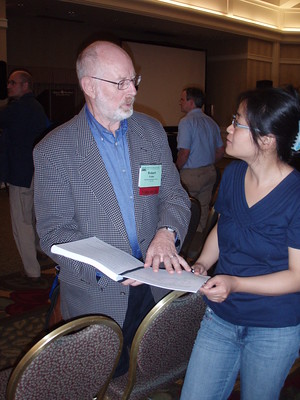
Instead of OSCON, I was invited to AAPT this year, the semi-annual meeting of the American Association of Physics Teachers (all levels). They're meeting at the Hilton downtown, taking over the conference rooms, including two across the street in the executive tower.
I've been bouncing around with Dr. Bob Fuller, made it a few minutes late to his talk this morning, where he yakked about First Person Physics some, even had my name on a slide (woo hoo!). Yesterday, he made a special point of asking to see student project six in a lecture, a Youtube about the Geodesic Dome. This was from Dr. Milner-Bolotin's project, University of British Columbia, wherein students get to make Youtubes about their projects.
Yes, physics teachers are on top of the new tools, way more tools than I'd heard of. Not all of them use Youtube or Facebook, but a lot of them do, and are encouraging their peers to craft an ePortfolio, not just for themselves, but for their courses. I was impressed by the gung ho attitude. Future shock is to be taken in stride.
When one high school physics teacher was asked about the frequent practice of blocking Youtube at the district level, even for teachers, the panelist pulled no punches: start a revolt, she said. Schools can't claim to be institutions of learning if they censor to that degree, are day care centers at best.
Dr. Fuller thinks it's important to tell more compelling stories when setting up some iconic physics situations that are going to yield up a wealth of insights into principles. He is also very supportive of using physics to support life sciences majors. This was a theme of First Person Physics in the form of Dr. Urone's work as well. He was there, showing off the new electronic textbook software behind his latest work.
I know Tara would have enjoyed some of these talks, maybe the one on microscopy especially. The woman delivering that talk, Jennifer L. Ross, University of Massachusetts, came across as one truly brilliant geek. I also watched Duane L. Deardorff, at University of North Carolina at Chapel Hill, juggle five balls (with some fine physics to go with). The talk on bridge failures, which Dr. Fuller was keen to see (Tacoma Narrows is one of his foci), was likewise engaging. Physicists / physics teachers, are an eclectic and dedicated group.
In terms of state standards, there's already some chafing at being normalized as a Physical Science (like chemistry) as opposed to a Life Science. That's an opposition the AAPT seems eager to deny, as Physics and the Life Sciences are closer than hand-in-glove these days. The human heart kept being a focus. EEGs, MRIs... physicists want to help with the practice of medicine. So having the state standards draw a line in the sand... oh well, there's still room for individual schools to best the standards (they set a floor, not a ceiling).
On the way back (I walked home), I stopped into Lucky Lab and had a meeting with a community college software guy. Their shop rolled its own administrative software, starting with a mainframe running FORTRAN, all home grown. Just as he was leaving, a vendor product raised its ugly head, some political wheeling and dealing forced it down their throats. The old guard was still seeing ways to work around it though, as this product was truly lame. They'd stuff it with data at the end of the day, but from more authoritative in-house sources.
Forgive the shop talk, this was a theme on edu-sig this month.
Friday, July 16, 2010
Finish Line
We concluded our Programming in Python today, with students connecting over the web to fill out their evaluations. Each had a student ID number, specific to Saturday Academy (I also have my instructor number and filled out my own evaluation for later mailing, along with the attendance sheet).
Student achievements were considerable. In just five 2.5 hour meetings, they were able to produce some serious computer graphics while wrapping their minds around an industrial strength, state of the art programming language.

 1, 12, 42, 92, 162...

At one point, I was in the odd situation of having sound through the speakers, until I'd engage video as well, in which case sound would cut out. I rebooted and ventured to get some staff support. Within a few minutes, we had it working and I was able to show Warriors of the Net, per usual, which, contrary to reader impressions, is not about cyber-warfare, though you could say it's about cyber-crime to some extent.
Toward the end of the class, I also screened Macro Spitoni's Codeguardian (something I've done in this class previously, as well as at OSCON as a cartoon feature before my talk). What did that have to do with Python?
My usual spiel is to use Python as a means to an end, with the goal being a better understanding of computer animation in two senses: (a) real time game engine renderings and (b) render farm renderings. VPython models the former, POV-Ray the latter.
However, we didn't have POV-Ray going this time, so my reliance on "ray tracing" as an excuse for showing this movie may have seemed a little thin. They seemed to enjoy it in any case.
Spitoni's craft is exquisite in that his camera angles and motions pay homage to the best of that war time genre. The attention to detail is likewise impeccable. I enjoy sharing good work.
A large chunk of the class was spent on the notion of a "generator" in Python, often written as an infinite loop, as these are benign once there's a pause-with-result feature (the purpose of the new yield key word -- not all that new actually, as we've had generators for awhile now, along with "generator expressions" (similar to "list comprehensions" but just-in-time iterables, not pre-computed lists)).
I've shared some of my doings, including source code, on ye old edu-sig at the Python official site. Tim Peters himself reminded me of Pythonic virtues. We'd been doing import this as an easter egg, so having him nudge me back from some stupid blunderings was most apropos.
 1, 12, 42, 92, 162...
I talked about Linus Pauling a lot, as the context for our generator was the number series 1, 12, 42, 92, 162..., looking it up in the On-Line Encyclopedia of Integer Sequences. We also did Fibonacci numbers.
I had a chunk of Flextegrity in my bag again, a 12-around-1, plus another model of the same concept (from my considerable collection). We watching the animated GIF on my crystallography page, plus followed the link for the OEIS entry back to my page on the morphology of the virus (icosahedral numbers == cuboctahedral numbers).
Pauling fits in by bringing a strong sense of spatial geometry to his chemistry, discovering many concepts familiar from Euclidean geometry yet made directly from the atoms of Democritus. I mentioned about his boyhood home on Hawthorne (some of these students were about that same age). I also talked about Ava Helen, OSU having her papers as well as his.
It was through the Pauling House that I became involved with Saturday Academy in the first place, I explained, as that's how I came to meet up with Joyce Cresswell, the SA: director who took this school forward from some house at OGI, through basement status at PSU, to its own agency, currently across from the venerable Multnomah County Library downtown (great location).
Gordon Hoffman was also my contemporary. I was happy to see him at David Feinstein's recent talk (at the Pauling House).
I also spent a goodly portion of the time giving my perspective on the development of the Internet, with special attention to http or hypertext transfer protocol. I suggested Computer Lib / Dream Machines by Ted Nelson was by this time a collectible (watch for 'em at Powell's). The birth of the World Wide Web at CERN was a dream come true for many of us, even though smtp, nntp and ftp were already pretty cool.
Thursday, July 15, 2010
Teaching Again (and Learning)
I'm back in my teaching clothes, PSU facility, small windowless computer lab with fan, about ten students.

os.urandom(n)
Today was a blast. I showed off Virtualbox, so one student promptly installed it, burned a Linux iso to CD, and hosted this other operating system. Another student brought her Apple laptop and wanted to get VPython working. She was expertly assisted by another student, who even knew where site-packages was hiding (I'd never have guessed it, under "frameworks" somewhere).
That's not to say it's always easy.
Some students get bored when everyone else is looking so busy. I had some geometry toyz strewn about, such as Mag-Blocs and a Yoshimoto necklace of Bites (as in Sytes).
One of my students seems obsessed with the difference between securely random and pseudo-random, knows there needs to be a seed, promptly zeroed in on os.urandom( ) -- which takes a hit off the computer clock or something -- and random.seed. This guy has done some reading.
Return a string of n random bytes suitable for cryptographic use.
This function returns random bytes from an OS-specific randomness source. The returned data should be unpredictable enough for cryptographic applications, though its exact quality depends on the OS implementation. On a UNIX-like system this will query /dev/urandom, and on Windows it will use CryptGenRandom. If a randomness source is not found, NotImplementedError will be raised.
There's no serious need for cryptography in this course, which is geared for beginners, despite some advanced students taking it. However, knowing something about the subject and its history is relevant to many walks of life. We also talked about The Turk (as an "apparent chess playing automaton" -- brave staff), as well as Ada Byron and her role in the advent of contemporary computing. Grace Hopper (USN): also moved us along big time.
Mostly I let them work at their own pace today on self-chosen projects. We've done a long slog through data structures, elementary functions, class/object syntax.
More than a couple turned to Pygame as a possible source of interest. I should find something runnable for the next class. Others have already spent many hours in Pygame. A mixed bag, to say the least.
My thanks to the friendly staff.
Mom got off early this morning, via PDX. Light traffic. Tara has been sharing philosophical observations by text messages:
You know, after reading 1984 I can see connections with Nietzsche. The people in 1984 are like Zarathustra's "last man".Pretty nifty. I think that 1984 is a portail of what happens if we never become overmen. That's the right plural right? Yeah... Have fun!
She's 15 (about the same age as these students), with Friends in Montana.
Sunday, July 11, 2010
Coffee Shop Capitalism

More doodling today, even while paying close attention in Oversight Committee meeting, a potluck. I'll upload to Photostream. I got a bank loan for this project, but there's been no press about my projects since those two Peter Carlin articles in the 1980s. That's OK, we don't have to rely on The Oregonian for everything.
The idea of charitable giving as a character building exercise is not news to Foundations, but many kids of no privilege don't get to serve as "benefactors" to anyone. They're institutionally defined as being on the receiving end of programs.
This Coffee Shops Network plan puts you, the player, in the driver's seat.
Play a wicked game of Tetris and benefit some Save the Whales group big time, with the blessings of your sponsor. The payload at point of sale originated in the vendor's charitable giving slice in the first place, so you're basically using your skills to funnel funding as you see fit, with the proceeds of future profits or some portion thereof.
You might object this is no more than "Church Bingo" and you'd be correct. That's not an objection though, and our games range through many levels, some serving a didactic purpose (you learn stuff by playin' 'em). If you really just wanna play Bingo... I'm sure there'd be options.
Thursday, July 08, 2010
Einstein @ OMSI

This exhibit is largely biographical, although it does make a sincere attempt to explain the science.
What was Einstein's relationship to the Manhattan Project? He wrote that famous letter to FDR, but had no direct involvement in the development of the atomic bomb. He likely wouldn't have gotten a security clearance in the first place. The FBI was tracking his every move, looking for Commie connections. The McCarthyites were on his case. Intellectuals in general were against the wall in those days, as Nazism and hatred of Jews was hardly confined to Germany.
He hated the fact that the bombs were used ("Woe is me" said the poster). He was thinking in terms of deterrence, hoping humans would get their affairs in order with this threat hanging over their heads. Nationalism was a disease, a mental illness. Yes, he wanted Jews to have a safe haven, supported the formation of a Jewish state. He was even offered the presidency thereof, which he wisely turned down. He didn't trust nationalism though, nor the United Nations really, as its components were nation-states. One poster used the word "supranational" (versus "inter" or "trans") for the kind of cybernetics he thought might work.
Einstein suffered from being so intelligent, endured being aboard a Ship of Fools. He wasn't arrogant about his intellect though. On the contrary, he was forever humbled, given his inability to crack nature's most secret codes. He lived modestly in Princeton, used his fame to speak out on the issues. He had a lot in common with Linus Pauling, and indeed the two men show up together on one of the posters, as co-supporters of a peace group. He was a big fan of Mahatma Gandhi, Einstein was.

I don't suppose the exhibit was designed with Oregon in mind specifically, but it was good to see Pauling's name, and to see McCarthy pointing at our state. I permit myself some pride in Oregon, as a way of expressing my own values, in Princeton too.

Earlier, on the Wanderers list, I was continuing to spell out the view that only organized criminals harbor nuclear weapons these days, using nation-state decals as camouflage, a way of dodging the glare. Non-proliferation means aggressively rounding up and dismantling these abominations, with the full support of our fearless leaders.
The USA flag is like an art supply: anyone can wrap themselves up in it. Racists, classists, bigots-- all the usual suspects pose as patriots. It's a masquerade ball. "Takes all kinds" as they say.
Note: a lot of good people take the position that nuclear weapons are a crime against humanity, so anyone harboring them is ipso facto a part of a terrorist organization. Such organizations often hide behind nation-state iconography, like those drug smugglers in Central America, really just mercenaries, but quick to say "working for the government" if caught red handed (not that drugs should be illegal -- it's those hypocritical Puritans who are destroying the planet with their phony self-righteousness, but that's for another thread...).
Friday, July 02, 2010
Partial Recovery
The laptop takes forever to boot (not sure how long, as I was out walking both times). Pathological.
I've added back a Sun VirtualBox containing Ubuntu, got Eclipse Helios going, Pythons 2.6 and 3.1... VFP9.
Too many happenings to catch myself up. More when I get the time, or check Facebook.
I've added back a Sun VirtualBox containing Ubuntu, got Eclipse Helios going, Pythons 2.6 and 3.1... VFP9.
Too many happenings to catch myself up. More when I get the time, or check Facebook.
Recent polemics:
The fact is, few if any public schools are lifting a finger to get any concentric hierarchy on the map, whereas it's pretty simple to teach and comprehend. This thinking is also a gateway to grand quasi-utopian visions, a strong strand in American literature up to (but not including) the present day. What's pumped out there now is mostly pessimistic "endless war on terror" Orwellian poopka, with a constant drum beat to start a new war (with Iran they hope)Sounds like NCLB or something. "Concentric hierarchy" includes that Pentagon Math stuff.
Koski has been doing good work on the Archimedean dual honeycombs, conversing about it with Guy Inchbald on the Poly list. Scotts reply to DK was also to Synergeo. This was a high point in this esoteric thread.
My thanks to Trevor Blake for the Youtube below. Thanks also to Joyce Creswell who just phone from her last day at work with Saturday Academy (she's retiring). I encouraged her to visit Wanderers to give us the benefit of some of her insights.
Sunday, June 27, 2010
Conspiracies
 I've helped go through some of the Laughing Horse inventory recently, getting into the Esozone type DVDs and VHS tapes. By that I mean, one gets the perspectives wherein this or that subculture or ethnicity is secretly (or not so secretly) controlling everything.
The Freeman Perspective is a good example. Freeman's dad was a Mason, and by the time you've watched a few episodes, the Masonic cults are running everything, and not just in Texas. In other tapes, by other editor-narrators, it's the Vatican that's in control.
Actually, given the badly managed state of the world, no one really wants to be seen as "in control"; there's always a "them" that's messing it up. One needs to project power elsewhere. I take this up in my Tower of Babel essay of long ago.
Funny true story: I was having a conversation in the living room with my house mate about farm life in Florida when the heating element in the oven decided to self-destruct, in a burst of flame, coating the corn bread with unspecified metals, perhaps toxic.
Rather than waste the corn bread, she tried washing it in the sink and drying it on the stove top. We went back to the Freeman Perspective on population culling by chem trail, in which heavy metals are rained upon the earth from mystery airplanes. Alluding to the corn bread experiment, she asked "Why do we bother?"
That chem trails episode seemed especially likely to scare people, as it offered a ready explanation for feeling weaker, less healthy. Blame the government, not the fast food and lack of exercise maybe? As a metaphor, the chem trails meme is about an unhealthy environment and insufficient protection, a well-founded lack of trust.
Brian (a Wanderer and ecologist) avoids coming into Portland for example, because of all the benzene we're breathing. LA is just that much worse.
Anyway, I'm not above working some of these stories myself, hoping to come up with new twists that might actually be beneficial for a change. I've been using Synergeo as a doodle pad some more. Wanderers also provides me with a sounding board. One can't write in a vacuum.
For the first time in several months, I was out on Tomahawk Island again. Internet connectivity was serviceable. I've been committing some source code, working with clients in both Python and FoxPro.
The captain of our water craft had taken some pictures of a black swan, not usually seen in this area. He's been getting emails, including from faraway Japan, speculating as to the significance of this sighting.
Tuesday, June 22, 2010
Wanderers 2010.6.22

The elders have assembled. Some exotic piece of electronic equipment is being dissected on the table. These denizens of machine world speak knowledgeably of the guts within. I blog, sip some red wine.
Next up: pictures of Antarctica, projected large. Allen Taylor is here, has visited that continent, classified as a desert. It's also quite high (quite mountainous). Don had chosen this topic. Would the global U site any domed-over campuses in this area?
Lynne Taylor (not related to Allen) is explaining each of her pictures (applause). She sold the one on the meeting room wall during the retreat and is replacing it, having asked us to vote on the discussion list, which one to bring. She picked one I like, displayed above.
Concern about the BP bleed runs high, on the list also.
Earlier today:
The Synergeo board has been lit up with activity, as I test the waters regarding my new counter to the Bucky Embargo (aka the Bucky Boycott).
Taking a page from Phil Zimmerman of PGP fame, who exported early public key utilities from New Zealand (messing up the NSA's tentative plan to keep that GHCQ thing classified) I'm thinking maybe Cuba, as a base for exporting Mites, Sytes and Kites as geometrical / educational toyz, not unlike Yoshimoto's and Huntar Mag-Blocs.
Universities in Canada might serve as intermediaries? The toyz could be rebranded with patriotic themes and used to supply the USA public behind the scenes, over the objections of various "corporate persons" (a native superstition kept alive as if by magic -- cite Voodoo Economics).
Living standards would improve, as students got a better grip and sharper picture on spatial geometry + geography.
The plot thickens when I bring in Ben and Jerry's as a possible test co-operative (vs. corporation). Product might be made locally, for delivery on bike trailer in some cases, to Fast Food Free Zones (the whole island if the health care system stays healthy).
My working hypothesis is that Unilever, being European, is free to join the Vatican in supporting "church bingo". I realize that's pretty abbreviated. More on Synergeo.
On Facebook, I was suggesting that liberal Friends have no problem with the "novus ordo eye" (on the dollar bill) being an Eye of Horus.
We don't insist that the one Biblical God be the only all-seeing, are willing to share among the many ethnicities. Per Dr. Bronner, it's all one in any case.
Anyway, Egyptian Math is pretty cool, and an Eye of Horus matches the pyramid theme.
Friday, June 18, 2010
More Documentaries

Every Child is Born a Poet. The autobiography of Piri Thomas, author of Down These Mean Streets, is well made. If schools were a place to grow by watching films, this would be one to show, for the sake of inspiring discussion and sharing (articulating) one's experiences.
Documentaries are (or can be) a serious art form and watching them should count as study, as much as reading does. Watch them for academic credit (it's like this at PSU). You might need to take a train somewhere to see it. Maybe it's only out in IMAX?
Taking the train: that's for math credit maybe? Navigating the topology of your city's subway system, learning to use GPS... does your school campus and/or base issue GPS devices to members of your unit?
Amandala! is a documentary about the role of protest songs during the struggle against apartheid in South Africa. Like Every Child... there's a retrospective flavor, of the situation improving for some of the protagonists, and yet the backdrop is one of ongoing poverty. The ghettos and shanty towns haven't gone away. Perhaps those gallows are less in business? Many heroes in Amandala! were hanged for questioning authority (authoritarians tend to arrogate that right of retaliation, as a prerogative of the nation-state -- or corporation in some cases (we also watched Rollerball)).
I watched both of these documentaries with a Laughing Horse collective member and Portland Free School organizer. Both seemed to be about caving to conventional authority was one view expressed, with both films portraying their respective heroes as role model citizens of their respective Euro-style nation-states.
Like when Native Americans learn to depend on a casino: how is that really a victory? How is wearing a suit and carrying a brief case to work a big win for a free people? Another view: it might be (a big win), if worn as one more costume. When in Rome... or on the set (a period piece perhaps, lots of funky SUVs in the background).
Were consumerism and materialism more existentially meaningless, more individuals might find it an interesting challenge to better balance the world's energies. Alchemy could become full time work. Why should organized religion have all the fun?
If there's a role for geeks in "world domination" then here (on Planet Earth) might be another opportunity to stage a design science decade, more consciously than before. Getting that sponsored shelf of Bucky books at Laughing Horse, mixed with some free software movement tomes, and DVDs such as Revolution OS... How are things going in Africa, with free software these days? Any sponsors out there?
A war on poverty isn't out of altruism, so much as out of having nothing better to do. We've been sentenced to Earth to improve the human condition, which means working on ourselves as well (jihad etc.).
I'm depressed about the response of mathematicians. I expected a little more excitement about those Mites, Sytes and Kites, just because of their streamlining potential. Why aren't we screening about these things in prisons, given that's where so many people get sidelined and warehoused? Piri gets some geometry behind bars, but it's all so rectilinear. The war colleges shouldn't have a monopoly on these newfangled materials, just cuz they're closer to Martians (grays or whatever).
Regarding Every Child... the part about Spanish "blood" mixing with African and American "blood" was annoying. Talking about "blood" is the old racist language, which imagined these racial "essences" floating around in the plasma.
That's faux-science, just like much of Social Darwinism, which couldn't be bothered with any detailed look at real genetics. When it comes to tracing ethnicity, there's not that much interesting going on in the genome. A few skin color bits flip here and there, some nose shaping proteins -- superficial stuff, like what dog breeders care about.
Ethnicity is more about "memes" than "genes" (why all math is ethno-math) but even your average Harvard prof seems reluctant to spell that out in any detail (or is that just my imagination?). The word "meme" just isn't taken seriously enough, is too close to "commercial ditty" (the awesome hypnotic power of which, they'd rather you not think about too critically, any more than filmmakers want you guessing their tricks at every turn (spoils the atmosphere, when you see through the illusion, know what makes it tick (some say))).
Tuesday, June 15, 2010
Asian Scholar Visits

alan @ work
I was best man at Alan's wedding, in my parents' living room in Thimphu, Bhutan. He and Kattie, a scholar of Burmese Buddhist traditions especially, were not sure how seriously to take things going in, given what an ad hoc affair this was, with the connecting airline miss-delivering their belongings elsewhere. Everything came together as if by magic, and the ritual / ceremony proved binding and legally accepted in other nations, France especially (where Kattie is from).
Alan champions the Adobe PDF format as way better than PowerPoint or Word for distributing valuable information of a multimedia nature. I've shared his materials at GIS in Action, where I expected an especially appreciative audience for such artifacts.
One of Alan's projects was to apply projective digital media technology to the task of restoring an ancient temple in Laos. The building was rather worse for the wear, and the more lasting and actually more traditional thing to do would be to tear it down and build a new one in its place. Excavation and archeological exploration of the under-structure was also of neighborhood interest (hidden treasures?).
Perpetuating the graphics on the wall looked like a daunting prospect, with some of the skills lost. The solution: create a high quality archive of the temple interior, the wall art especially, with a goal of later projecting this information on the interior walls of the new structure, for the purpose of guiding painters in recreating the original graphics from the projected information.
The project was a success and is now an accepted way to replicate and perpetuate these traditional depictions, and their accompanying stories.
In other work, Alan made a detailed inventory of ecological features likely to be lost if hydro-electric projects were not well planned. Working with the feng shui of nature is not that difficult and is the mark of any skilled engineer, but many a developer in our developing world have little appreciation for the fine art of earning the respect and admiration of their peers.
Beautiful waterfalls that have anchored a geography and lore for centuries get shut off for a mere megawatt in return, a paltry sum, much of which is squandered on inessentials. Perhaps the shut-offs are a result of land-grabbing by a resort hotel and casino complex, wanting to exploit an "idyllic countryside" by destroying it in the process (not all casinos encourage environmental degradation -- not Avalon's for example (in Catalina)).
Alan's PDFs contain records of some of these lost natural wonders.
The story of Celilo Falls is repeated in Sri Lanka.
The locals often don't realize what they're about to lose, until it's too late. The introduction of hydro-power in Borneo seemed more propitious. I also thought the Japanese engineers in Bhutan were doing a better job, keeping environmental impacts to a minimum, or net positive. Not all hydro-power projects are created equal.
Buddhist thought offers many teachings about letting go, and perhaps the creaky old water wheels of Cambodia, used for irrigation in the dry season, were not going to feed enough people reliably enough.
Preserving these wheels in digital formats, including in movies, would seem a minimum acceptable form of preservation in those cases. Alan specializes in the digital preservation of geographical information. His PDFs tend to be multi-lingual. We all sat around the new monitor (a sponsor donation) and oogled at some of these materials, much of which was written in Laotian.
Alan was expert at getting video cameras into the hands of local witnesses, who knew what was most memorable about the local geography. His work has been pioneering and its relevance has been amplified by the fact that the equipment has only gotten less expensive, more powerful, and easier to use.

Sunday, June 06, 2010
Meetinghouse Benefit
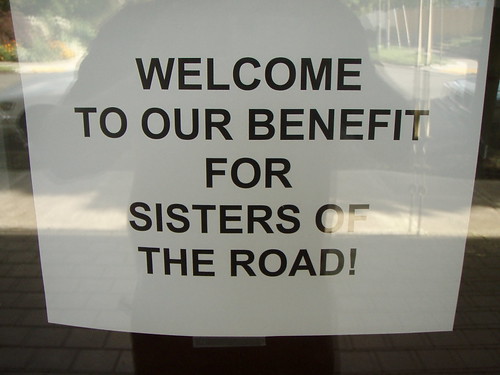
:: multnomah friends benefit concert ::
Elizabeth Fischer's Program Committee worked in the wings on this for several months. Lindsey lined up the bands, orchestrated a meal. Facebook was a primary outlet for news of this benefit, along with the Multnomah Friends newsletter.
Seeing some empty seats, we at first wondered if the event had been promoted sufficiently. The car hitting Lindsey had ripple effects, cut into her schedule. However, the chairs filled. A few more had to be added.
Crystal, our emcee and member of the KBOO community, took a poll as to about how many of us knew one another (about four average), plus passed out paper so we could diagram our interconnections.
With about 45 present, we netted about $450, which was in keeping with the $10 requested donation. Thanks to a matching donation from a benefactor, the total funds raised was $1,422.
After the conversation and a vegan-organic meal (with a robust chicken soup option), some tea, coffee, and cookies (apple cobbler), we adjourned upstairs for the acoustic portion of the program.
One of the best and most effective parts of the evening was when the two speakers from Sisters of the Road traded stories about what's happening in Old Town. The dire straits we're going through have resulted in an overwhelming demand for direct services. People want mail, basic grooming items, as well as food and shelter. These resources are being denied to citizens and non-citizens alike on ideological grounds.
The camping and sidewalk laws are becoming more strict, as fewer people take control of public spaces and their governance.
Those accepting state funds to apply bandaid solutions must as a result somewhat surrender their critical voices as participants in democracy (like NPR). Not being private sector, they don't enjoy the rights of corporate personhood, such as the big businesses do.
Sisters, being privately funded as a restaurant and coffee shop, is closer to having a free voice than most, and so addresses many issues more directly than other agencies feel able to.
Walking Home was doing a last performance at least for awhile, and drew a lot of friends. Their sound was fantastic, even though one girl had a sore throat. She felt safe letting us know, and sang brilliantly anyway. They both used cellos adroitly -- percussively as well as for strings. Their guitar was strong too. You could call these folk songs, at least one from a coal town union worker. Some were original.
Rachael Taylor Brown performed a sweetly macabre set, which the audience truly got and appreciated. She gave some funny insights regarding superheros having grumpy relatives, with a segue back to the saints, who used to more dominate the literature, before Marvel came along. She sang about St. Zoe, treated badly, and warned Fox-watching Americans against returning to the days of public executions. She sang for the deceased Joe.
Rachael played the somewhat out-of-tune piano expertly. Her male accompaniment and instrumentalist was great at harmonizing while her sister, a known figure on the Portland opera scene, joined in on a couple of choruses.
Lindsey Walker took us out with Meal Tickets and Hugs, new for this occasion. She followed with a new love song, then Fear of Flying, ending with Freedom Train. The summer night sky had finally darkened. Sonya, Harriet, Elizabeth and other Friends worked hard as stagehands during setup and teardown.
Lindsey had cooked up a storm at the Blue House earlier, biking her food to the meetinghouse with Trey's trailer. Mom, Tara, Liana and I went to the meetinghouse by 75 bus and came home with Deb, who'd been napping, exhausted from some workshop.
At the very start of the program, Lindsey announced that Tara would be giving a physics lecture. The audience wanted to know more, and the topic was narrowed to Kinematics. A venue was negotiated on the fly for later, where some of us later took in a problem from rocket science, having to do with how much higher a capsule would go against gravity even after the fuel had been spent.
I captured some of this performance with my cigarette-case sized camera (we used the classroom with the Dymaxion Map in it).
Quakers appreciate simplicity and plain speech, both conducive to truth-telling and getting the problems well defined. The Q&A with the audience was most enlightening to all present. No one was wasting anyone else's time, in my experience.
Dr. Nick Consoletti was able to take a few moments out to join us. He's excited by some of the new ferment at PSU (more later).
Hello to John Driscoll etc. (the architect and cross-country cyclist). Thanks to Deb for logging some workshop hours with Tara, who still suffers the after effects of getting hit by that car (in a crosswalk, light in her favor).
I'm not having romantic feelings towards such vehicles. Don't let them fool you with the stereotype: that every North American is car crazy. Only most of them are.
Friday, June 04, 2010
DemocrayLab
:: democracylab party ::
I ended up scripting this as a solo walk, from my neighborhood (Richmond / Sunnyside) to the Pearl District, taking photos along the way. My goal was the DemocracyLab fundraiser, hosted by a company CFO and board member.
DemocracyLab's new Facebook app, Oregon-focused, made a splash at OS Bridge this year. We were featuring it again here. It back ends into a database at OSU. If enough people use the product, a feedback loop useful to self-governance might start up. Trying this on Facebook in no way precludes other channels. Democracy is robust enough to work multiple angles, fragile enough to need creative and visionary champions to keep it alive.
I needed the long walk to check vitals and think about what's next. There's a funereal atmosphere around Wanderers, fed by the disaster in the Gulf, the looming crises of out-of-control nationalism.
Koski and I have both been posting to Synergeo a lot. We do this as unpaid volunteers, which isn't a boast, it's a scary sign of the times. What are philosophers doing for a living these days? Polyhedra anyone? Perhaps geometrical studies seem too much like fiddling while Rome burns.
Thinking about polyhedra is intrinsic to the rational thought process, would be my response. That probably sounds unwelcoming, like too Apollonian when people are in the mood for "all you can eat" and cheap plastic toys, none of them very challenging or geometrical.
LinZ took off with Trey's bike trailer to seek tomato starts somewhere closer to Forest Grove, beyond the urban growth boundary. Using peak oil unnecessarily is an anathema. "Going to work" should not be an excuse. We self ration.
Birthday planning for youngest daughter... in a mad world. We all seem to be aging rather quickly this year.
Subscribe to:
Posts (Atom)


