Pat Barton shared about his science with Wanderers last night, camcorder on, lapel mic on. He works in linear equations describing covariances discovered in focus group data, tying customer attitudes to brand loyalty. This is an expensive high end service for Fortune 100 corporate clients.
An example would be Whirlpool: the company was already heavily involved in Habitat for Humanity, because of its specific history, but the public didn't know that. In the mean time, Pat's company's analysis showed that power nesters, mostly boomer women with bucks and a desire to have the best appliances in all dimensions, cared deeply about corporate social responsibility, and if it turned out Whirlpool actually cared, then more people would replace older Whirlpools with newer Whirlpools. So obviously the answer was to publicize this pre-existing commitment and track record. Everybody wins.
Wednesday, October 05, 2005
Sunday, October 02, 2005
WQM (Fall, 2005)
WQM may not actually meet quarterly, but the Q does refer to a four period cycle. Quakers apex into local Yearly Meetings, which conduct business during their Annual Sessions. Minutes from the Monthly Meetings for Business, such as MMM or BCFM (both in Portland), filter up through the quarterly level (e.g. WQM) enroute to the Yearly level, in our case NPYM (North Pacific Yearly Meeting). The Willamette Valley stretches from Portland south through Salem, Corvallis, and Eugene.
I talked a good bit with Anthony Manousos of Friends Bulletin. He authored the short pamphlet Islam, which documents some kodak moments that characterize the relationship between Islam and Friends (generally good).
Manousos observes Ramadan, which begins this Tuesday. This signature month-long period of fasting at the core of Islam is in part about strengthening and celebrating God's gift of an intuitive mind, attuned to eternal principles, and so frequently our ticket out of these hells of our own making, hells brought on by inappropriate automatism, obsolete and unexamined habits of thought.
Another motivation for the Ramadan fast is to commiserate with the starving. We pray this form of compassion will be of fading relevance, as our global university campus Food Services starts to kick in.
Ibrahim, one of the featured panel members this time, also catered the main meals. He's a pro in the local food biz. His excellent dishes got rave reviews. WQM has been turning to catering more and more (a topic in Business Meeting, along with EMO). Helen's son John catered Thai food a few cycles ago, and that seems to have gotten the ball rolling.
Thanks to my friend Pan, I spent some time thumbing through The Fourth Turning, a cycling-through-archetypes panorama. I got slaughtered at ping pong by a Junior Friend, also a talented piano player (good game). Friend Michener related some of her experiences in leadership with Landmark Education.
The weather wasn't all that bad Saturday night, so star gazing was an option. Mars was very bright overhead around 6 AM the next morning, when I joined the breakfast crew (Pam Avila of MMM directing, fellow BCFMers at work stations).
I shared Stellarium with several Friends in the main lodge while charging up on AC. Later I ran solo on DC in an open field, comparing screen pixels to patterns of starlight. Then I transferred to my tent for the night, where I used up the rest of the battery.
Other abbreviations decoded: MMM = Multnomah Monthly Meeting; BCFM = Bridge City Friends Meeting; AM = Ante Meridiem (i.e. before noon); AC = alternating current; DC = direct current.
I talked a good bit with Anthony Manousos of Friends Bulletin. He authored the short pamphlet Islam, which documents some kodak moments that characterize the relationship between Islam and Friends (generally good).
Manousos observes Ramadan, which begins this Tuesday. This signature month-long period of fasting at the core of Islam is in part about strengthening and celebrating God's gift of an intuitive mind, attuned to eternal principles, and so frequently our ticket out of these hells of our own making, hells brought on by inappropriate automatism, obsolete and unexamined habits of thought.
Another motivation for the Ramadan fast is to commiserate with the starving. We pray this form of compassion will be of fading relevance, as our global university campus Food Services starts to kick in.
Ibrahim, one of the featured panel members this time, also catered the main meals. He's a pro in the local food biz. His excellent dishes got rave reviews. WQM has been turning to catering more and more (a topic in Business Meeting, along with EMO). Helen's son John catered Thai food a few cycles ago, and that seems to have gotten the ball rolling.
Thanks to my friend Pan, I spent some time thumbing through The Fourth Turning, a cycling-through-archetypes panorama. I got slaughtered at ping pong by a Junior Friend, also a talented piano player (good game). Friend Michener related some of her experiences in leadership with Landmark Education.
The weather wasn't all that bad Saturday night, so star gazing was an option. Mars was very bright overhead around 6 AM the next morning, when I joined the breakfast crew (Pam Avila of MMM directing, fellow BCFMers at work stations).
I shared Stellarium with several Friends in the main lodge while charging up on AC. Later I ran solo on DC in an open field, comparing screen pixels to patterns of starlight. Then I transferred to my tent for the night, where I used up the rest of the battery.
Other abbreviations decoded: MMM = Multnomah Monthly Meeting; BCFM = Bridge City Friends Meeting; AM = Ante Meridiem (i.e. before noon); AC = alternating current; DC = direct current.

Friday, September 30, 2005
Another Day in the Rainforest
Jim Buxton gifted our group with some of the best chanterelles ever, and for two days in a row we've been having them on the side next to mushroom & Tillamook cheese omelets. My FitDay food log is having a cow about it, but hey, I'm still under my daily calorie budget, steadily shedding pounds (a British imperial unit).
Quarterly Meeting starts today @ Sky Camp. Given the dismal weather, this'll be largely an indoor affair, more about fellowship and less about banana slugs. I'm packing a tent and may cocoon with a Buffy DVD vs. Stellarium.
I wrote a cool essay on the Urner/Wittgenstein relationship today @ Math Forum.
Great job Nirel! -- she's our new Wanderers Web Wrangler. Whomever holds the Portfolio of Scheduling should report directly to her (we're thinking to rotate the job of booking presentations, so we each get a chance to share some of our favorite people, like I did with Ron i.e. as we've already been doing from the get go).
Quarterly Meeting starts today @ Sky Camp. Given the dismal weather, this'll be largely an indoor affair, more about fellowship and less about banana slugs. I'm packing a tent and may cocoon with a Buffy DVD vs. Stellarium.
I wrote a cool essay on the Urner/Wittgenstein relationship today @ Math Forum.
Great job Nirel! -- she's our new Wanderers Web Wrangler. Whomever holds the Portfolio of Scheduling should report directly to her (we're thinking to rotate the job of booking presentations, so we each get a chance to share some of our favorite people, like I did with Ron i.e. as we've already been doing from the get go).
Wednesday, September 28, 2005
Public Licensing
Obviously a lot of the thinking that's gone on around how to keep software designs public, per the intent of its authors, is starting to inform licensing more generally. Some types of inventor have always wanted their work to benefit humankind. Toys, pharmaceuticals, manufacturing processes -- I expect to see more and more open source licensing protecting these assets from overexploitation by a greedy and undeserving few.
The corporation, having sneakily insinuated itself into our codes as a pseudo-human (see Unequal Protection by Thom Hartmann), has tended to suppress our very human desire to benefit one another. However, the power of this particular institution, in its LAWCAP form at least, is on the wane, in part because much of its core infrastructure is in the hands of philanthropic engineers with an appreciation for general systems theory (i.e. of what it will take for us to succeed macroeconomically).
What does nature herself provide, in terms of common heritage? Should we consider DNA sequences found in nature to be under some kind of BSD type license, or is she more GPL? Such questions will frame the ethical debates of tomorrow, thanks to people like Richard Stallman, one of the great moral philosophers of our day. Unbridled human selfishness, on the other hand, will be seen in retrospect for what it was: a pathology and design flaw that nearly got us wiped out as a species.
The corporation, having sneakily insinuated itself into our codes as a pseudo-human (see Unequal Protection by Thom Hartmann), has tended to suppress our very human desire to benefit one another. However, the power of this particular institution, in its LAWCAP form at least, is on the wane, in part because much of its core infrastructure is in the hands of philanthropic engineers with an appreciation for general systems theory (i.e. of what it will take for us to succeed macroeconomically).
What does nature herself provide, in terms of common heritage? Should we consider DNA sequences found in nature to be under some kind of BSD type license, or is she more GPL? Such questions will frame the ethical debates of tomorrow, thanks to people like Richard Stallman, one of the great moral philosophers of our day. Unbridled human selfishness, on the other hand, will be seen in retrospect for what it was: a pathology and design flaw that nearly got us wiped out as a species.
Sunday, September 25, 2005
More World Game Data
Page A10 of today's Oregonian talks about the rally in Washington, DC on Saturday, next to an ad for Terry's lecture series. My friend Matt was at the rally along with others in his family. He flew all the way from PDX just to be there. I'm looking forward to hearing his personal account.
Wednesday, September 21, 2005
GST Revisited
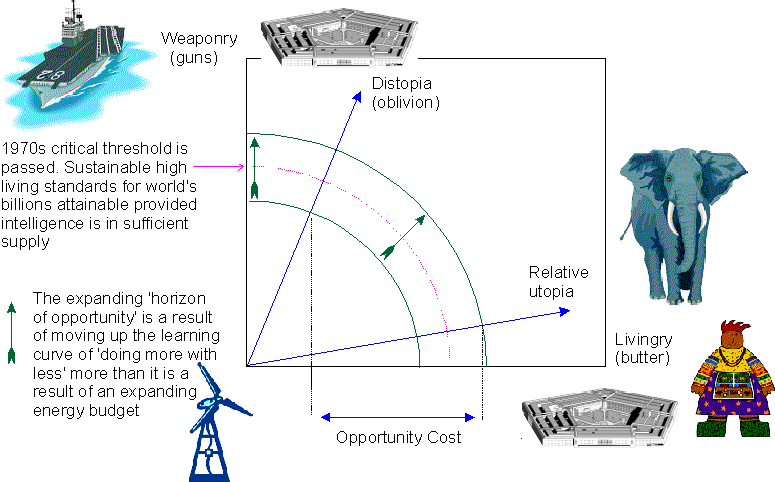
Last night I decided to alter this ancient graphic at my Synergetics on the Web, by sliding a copy of the Pentagon to the lower right (if looking from this side). And I added the paragraph: "The Pentagon is shown in both directions because some in the military have largely freed themselves from LAWCAP's obsolete reflex conditioning and have a more GST-informed outlook."
I think it's important that we acknowledge the progress we've made to date.
And speaking of progress, kudos to Blogger for making picture uploads a snap through the standard interface.
Monday, September 19, 2005
Talk Like a Pirate

Jolly Roger
September 19 is Talk Like a Pirate Day -- another excuse to get in touch with this part of our heritage. According to the algorithm in today's Living section in The Oregonian, my pirate name could be: Squinty Rumpot Broadside (I think I'll pass).
Related Post: Adventures in Radio Land (Part 2), 10 Feb of this year.
Saturday, September 17, 2005
Build It Green
Today we joined other Portlanders on a self-organizing tour of G/Rated homes, featuring various intelligent, energy efficient designs. We visited the tiny one-person house on wheels (visiting from Olympia), the sunlight and rain harvesting "net-zero" Victorian, and the little clay studio with a living roof.
We also left voicemail expressing some interest in a refurbished '84 Ford Econoline camper, a possible bizmo, though hardly G/Rated. The Victorians had a pickup they run on B100 (vegetable oil recycled from restaurants).
We had coffee in one of Dawn's former work places on Foster (she quit shortly after the bomb incident -- the site used to be an abortion clinic, Dawn their bookkeeper). Then we went to a nearby Vietnamese bakery to buy moon cakes.
Across my desk: Bruce LeBel's temporary shelters proposal to Oxfam (forwarded by Dick Fischbeck); a poorly sourced story about US soldiers raping Iraqi infants in Tellaffar; email from Nancy, a would-be Wanderer (I invited her to the 9/20 meeting); a request for a CV update from Nick (changes made); a heads up from Gerald de Jong about N J Wildberger's innovations in trigonometry; other stuff.
We also left voicemail expressing some interest in a refurbished '84 Ford Econoline camper, a possible bizmo, though hardly G/Rated. The Victorians had a pickup they run on B100 (vegetable oil recycled from restaurants).
We had coffee in one of Dawn's former work places on Foster (she quit shortly after the bomb incident -- the site used to be an abortion clinic, Dawn their bookkeeper). Then we went to a nearby Vietnamese bakery to buy moon cakes.
Across my desk: Bruce LeBel's temporary shelters proposal to Oxfam (forwarded by Dick Fischbeck); a poorly sourced story about US soldiers raping Iraqi infants in Tellaffar; email from Nancy, a would-be Wanderer (I invited her to the 9/20 meeting); a request for a CV update from Nick (changes made); a heads up from Gerald de Jong about N J Wildberger's innovations in trigonometry; other stuff.
Thursday, September 15, 2005
Powell's on Hawthorne

Tricycle Magazine cover
Vol. XV No. 1 Fall, 2005
Vol. XV No. 1 Fall, 2005
I snagged a copy of this issue of Tricycle at Powell's this morning, along with Make: (vol. 03) and a copy of The Onion (a satirical newspaper). Coffee with Derek.
Before going out, I worked on some new reports for one of my clients (a coding project, Visual FoxPro). Later today, I finished a first edition of a new web page, in preparation for a course I'm slated to teach.
This afternoon, I watched some Smallville with the family on a borrowed Braithwaite DVD (though not the episode mentioned in the aforementioned web page).
Yesterday was our biweekly Wednesday morning Wanderers meeting. KOREducators Adam Reid and Reese Lord went over their hopes and dreams regarding a new charter school they'd like to start under the umbrella of Portland Public Schools.
Charter schools are public schools, but follow a slightly different rule book, allowing them to experiment with different types of teacher (only 50% must be state certified).
Joyce Cresswell of Saturday Academy joined us as well. Her institution likewise gives students access to teachers from a variety of backgrounds.
Sunday, September 11, 2005
Summer Memories (2005)
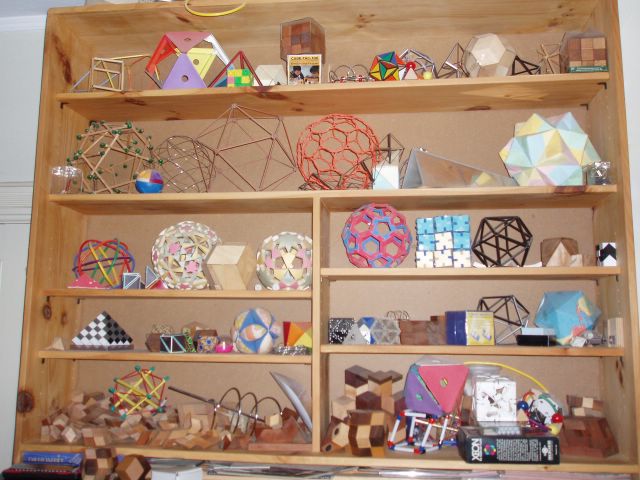
Geometry Toys
Part of the Quimby-Kittner collection in upstate New York. I took this photo during my stay in the tree house this summer, enroute to my 25th Princeton reunion (Class of 1980). For more summer memories, check BizMo Diaries, September 2005.
Thursday, September 08, 2005
Red Eye (movie review)
A salute to lonely pro service workers who take their jobs seriously and fight back when cornered. Modern commercial flight is faithfully rendered (especially coach), but the off shore Russians seem implausibly employed.
The screenwriters provide no backstory about the kingpin with the private jet, who holes up in Miami with his henchmen -- into money laundering perhaps (that'd explain the high caliber enemies).
Saw it with Dave Fabik in the Regal @ Lloyd Center (VP Nixon: "America's answer to communism") . We previewed the new Jodie Foster movie, also airplane-based. She's effective in those suspenseful paranoid films -- I'm looking forward to it (perhaps as inflight entertainment).
The screenwriters provide no backstory about the kingpin with the private jet, who holes up in Miami with his henchmen -- into money laundering perhaps (that'd explain the high caliber enemies).
Saw it with Dave Fabik in the Regal @ Lloyd Center (VP Nixon: "America's answer to communism") . We previewed the new Jodie Foster movie, also airplane-based. She's effective in those suspenseful paranoid films -- I'm looking forward to it (perhaps as inflight entertainment).
Wednesday, September 07, 2005
Wanderers 2005.9.7
Doug Strain kicked off our evening series, alternating Tuesdays. We had the camcorder going, fingers crossed the lapel mike was doing its job (audio is critical for hearing Doug's many excellent stories).
We learned more about how Doug got transitioned from war time nutrition experiments to fighting fires started by Japanese fire balloons.
In the experiments, Doug and other conscientious objector friends were fed various diets to see what'd keep them alive in shivering cold conditions (they spent 8 hrs a day in especially refrigerated rooms -- like on some reality TV show). The high protein diet proved the best, which was disappointing to the experimenters, as it was also the most expensive.
Doug's talents were better used working with the U.S. Forestry radio lab. Maybe 5000 fire balloons were set adrift over the Pacific, timed to crash and burn stateside. Fortunately, the best wind patterns coincided with the wettest forest conditions, so although the fire fighters were kept on their toes, actual fire damage was not that great. Perhaps four lives were lost.
I quizzed Doug most intently on ESI's relationship to its neighbors on the Stark Street property, which was subsequently gifted to Quakers and the AFSC, after the city zoned that neighorhood out of bounds to even light industry (Jantzen had constructed the factory originally, installed lead lined die vats upstairs). Turns out ESI didn't get along with its neighbors that well either. Some long-running karma just goes with that territory I guess.
After ESI moved, over to the Macadam area, the new place burned to the ground the night of some firemen's ball (no one to answer the distress call -- probably couldn't have saved it anyway, given the high temperatures involved). Fortunately, the insurance came through. And later, State Farm (also insurance) helped grow the Silicon Forest with a lot of investments, as did Hewlett-Packard. HP loved Doug's ability to measure resistence in micro-ohms -- about 350 micro-ohms for a house key -- and added Doug's inventions to its product line.
Doug started the meeting with what he called good news: British Petroleum's outlook on remaining proven reserves (40 years worth?), then shared about some promising new city power R&D that Westinghouse is helping fund at Oregon State. Four of these vault-contained helium cooled convection units could sustain Portland. Yeah, we're talking nuclear fission again (means toxic byproducts), but minus any weaponization pathway. Iran might do something similar. Our two Davids discussed the average 24 kW-h per diem energy requirements of the average USAer (takes about a kW to power "the good life"™ they say).
Rick Grote brought a box of golf balls, inviting us to help ourselves. I took seven (six around one). Great seeing Allen Taylor, Dick Pugh, Julian, Steve.
Jim, Don, Barry and I, joined by Derek, celebrated afterwards with beers at the Bagdad. This was after Jim drove Doug home but forgot his thermos bottle, and so came back for it. I'm borrowing Jim's copy of The Astronomical Companion, which I'm cross-checking against Celestia, thanks to Trevor.
Addendum:
I almost forgot to relate Doug's much earlier interesting story about his participation on some panel proposing the switch to cesium-based atomic clock time, and how the Navy was all bellyachy that only astronomical cycles mattered, nothing so measly as an atom should give us the time of day.
Congress got caught up in the soap opera. So the cesium clock people just set it up in Colorado. It's not like they wanted to take anything away from the Navy, just add this new layer. And to this day, atomic clocks take the cake for enabling us to synchronize within tiny slivers of a second -- a kind of synching needed for GPS for example (so ironically, the Navy is now as interested in cesium time as everyone else).
Moral of the story: if you want to get anything done, don't get it bottled up in Congress. Which is too bad really, Doug went on. If only those lawyers understood the science even a little bit better, the whole enterprise might run more smoothly (which is where I think USA OS comes in). The job of educating powerful politicians is enormous, but with modern media, I think it's doable.
We learned more about how Doug got transitioned from war time nutrition experiments to fighting fires started by Japanese fire balloons.
In the experiments, Doug and other conscientious objector friends were fed various diets to see what'd keep them alive in shivering cold conditions (they spent 8 hrs a day in especially refrigerated rooms -- like on some reality TV show). The high protein diet proved the best, which was disappointing to the experimenters, as it was also the most expensive.
Doug's talents were better used working with the U.S. Forestry radio lab. Maybe 5000 fire balloons were set adrift over the Pacific, timed to crash and burn stateside. Fortunately, the best wind patterns coincided with the wettest forest conditions, so although the fire fighters were kept on their toes, actual fire damage was not that great. Perhaps four lives were lost.
I quizzed Doug most intently on ESI's relationship to its neighbors on the Stark Street property, which was subsequently gifted to Quakers and the AFSC, after the city zoned that neighorhood out of bounds to even light industry (Jantzen had constructed the factory originally, installed lead lined die vats upstairs). Turns out ESI didn't get along with its neighbors that well either. Some long-running karma just goes with that territory I guess.
After ESI moved, over to the Macadam area, the new place burned to the ground the night of some firemen's ball (no one to answer the distress call -- probably couldn't have saved it anyway, given the high temperatures involved). Fortunately, the insurance came through. And later, State Farm (also insurance) helped grow the Silicon Forest with a lot of investments, as did Hewlett-Packard. HP loved Doug's ability to measure resistence in micro-ohms -- about 350 micro-ohms for a house key -- and added Doug's inventions to its product line.
Doug started the meeting with what he called good news: British Petroleum's outlook on remaining proven reserves (40 years worth?), then shared about some promising new city power R&D that Westinghouse is helping fund at Oregon State. Four of these vault-contained helium cooled convection units could sustain Portland. Yeah, we're talking nuclear fission again (means toxic byproducts), but minus any weaponization pathway. Iran might do something similar. Our two Davids discussed the average 24 kW-h per diem energy requirements of the average USAer (takes about a kW to power "the good life"™ they say).
Rick Grote brought a box of golf balls, inviting us to help ourselves. I took seven (six around one). Great seeing Allen Taylor, Dick Pugh, Julian, Steve.
Jim, Don, Barry and I, joined by Derek, celebrated afterwards with beers at the Bagdad. This was after Jim drove Doug home but forgot his thermos bottle, and so came back for it. I'm borrowing Jim's copy of The Astronomical Companion, which I'm cross-checking against Celestia, thanks to Trevor.
Addendum:
I almost forgot to relate Doug's much earlier interesting story about his participation on some panel proposing the switch to cesium-based atomic clock time, and how the Navy was all bellyachy that only astronomical cycles mattered, nothing so measly as an atom should give us the time of day.
Congress got caught up in the soap opera. So the cesium clock people just set it up in Colorado. It's not like they wanted to take anything away from the Navy, just add this new layer. And to this day, atomic clocks take the cake for enabling us to synchronize within tiny slivers of a second -- a kind of synching needed for GPS for example (so ironically, the Navy is now as interested in cesium time as everyone else).
Moral of the story: if you want to get anything done, don't get it bottled up in Congress. Which is too bad really, Doug went on. If only those lawyers understood the science even a little bit better, the whole enterprise might run more smoothly (which is where I think USA OS comes in). The job of educating powerful politicians is enormous, but with modern media, I think it's doable.
Tuesday, August 30, 2005
Wanderers 2005.8.30
Bob McGown is giving a thorough overview of our search for ET tech (might not involve any communications). Lots of impromptu discussion. We've found quite a few planets outside our solar system by this time.
We're taping to Hi-8 and I'm hoping a streaming video site will enable us to asynchronously serve excerpts (synchronously too). We could do audio with podcasts (the new iTunes makes it easy).
Given our line up, a growing on-line archive makes some sense. OPB has its eye on doing a Doug Strain interview with broadcast-quality equipment. But given the relatively lower bandwidth of most Internet circuits, consumer camcorder feed is sufficient for our purposes (at least we use a tripod). We've booked Doug for September 6.
Terry thinks the Institute of Noetic Sciences is on a good trajectory. Allen Taylor likes what the Acceleration Studies Foundation is up to. My wwwanderers.org web site is expected to keep morphing c/o wandering web wranglers.
We're taping to Hi-8 and I'm hoping a streaming video site will enable us to asynchronously serve excerpts (synchronously too). We could do audio with podcasts (the new iTunes makes it easy).
Given our line up, a growing on-line archive makes some sense. OPB has its eye on doing a Doug Strain interview with broadcast-quality equipment. But given the relatively lower bandwidth of most Internet circuits, consumer camcorder feed is sufficient for our purposes (at least we use a tripod). We've booked Doug for September 6.
Terry thinks the Institute of Noetic Sciences is on a good trajectory. Allen Taylor likes what the Acceleration Studies Foundation is up to. My wwwanderers.org web site is expected to keep morphing c/o wandering web wranglers.
Monday, August 29, 2005
Bridge Pedal in Rear View Mirror
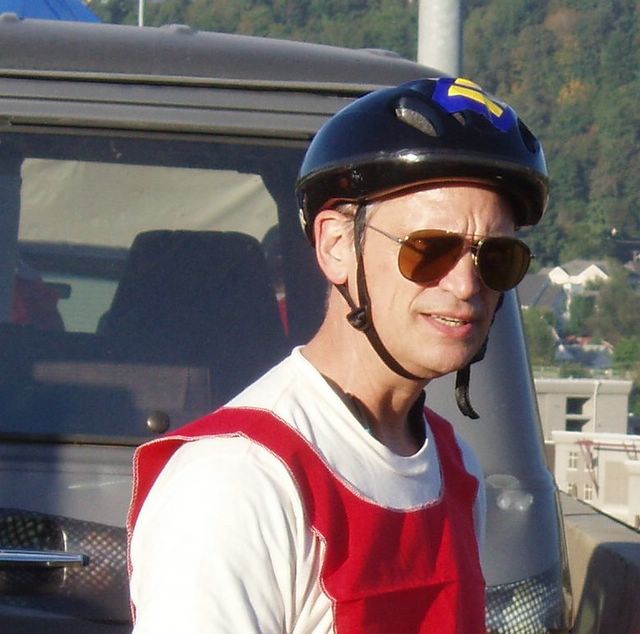
"top of the Marquam"
Congressman Earl Blumenauer
(photo by K. Urner, Olympus Stylus 500)
Congressman Earl Blumenauer
(photo by K. Urner, Olympus Stylus 500)
First year in a long time the Bridge Pedal taversed all 10 bridges -- maybe the first time ever. I was through the chute by 6:30 AM.
This isn't a race, it's a ride. No prize for being first.
Shorter more family-friendly alternatives are provided. It's a city-wide event, on a Sunday, when traffic is minimal anyway.
Sisters of Providence a major sponsor.
Friday, August 26, 2005
Outdoor Project
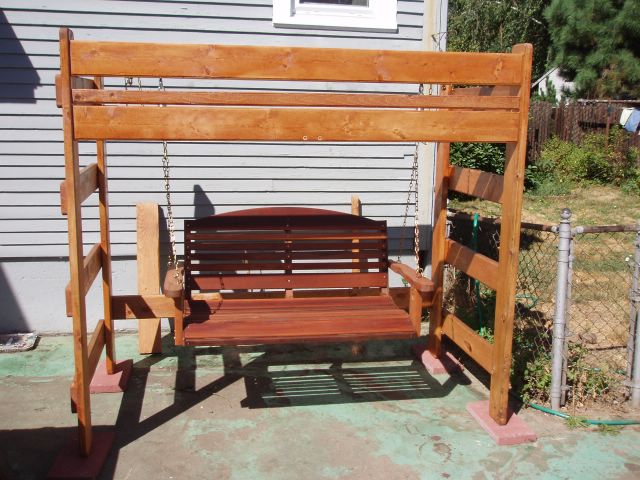
Repurposed Loft
This has been one of my projects over the last few days.
The loft was disassembled and moved to the garage some weeks ago. I prepped and stained it, added a purchased 4' swing and chain Made in Ohio, plus other hardware. I bought the custom cut 82" beam it hangs from at Home Depot on Mall 205 (it fit in the Subaru). My solution to fixing the beam in place: three brass braces at each end, two atop, one under, these purchased from Divison Hardware.
The finished swing now sits in the back yard, facing the Mother Mary statue.
Thursday, August 18, 2005
Tuesday, August 16, 2005
Wanderers 2005.8.16
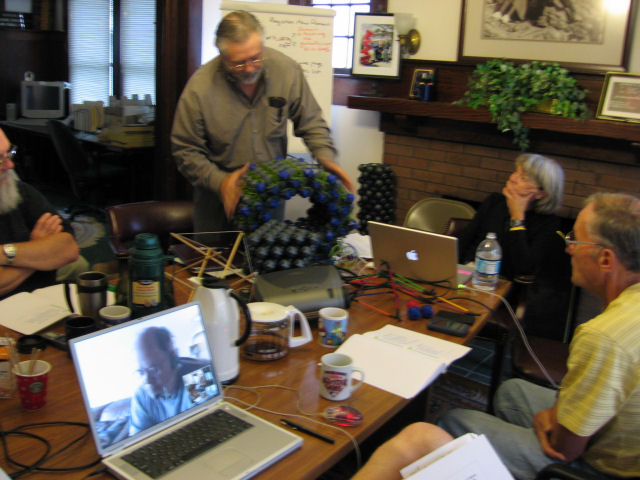
Today's presenters, Sam Lanahan and LaJean, unveiled Sam's so far unnamed invention, a building system based on a meshwork of tensile and compressive elements. The several Made in China plastic prototypes (plus the welded metal one) provided interesting visuals, plus LaJean's slides were distributed as bound color hand-outs. We failed to solve the projector puzzle (the mouse cursor froze every time we connected it to the PowerBook).
We used the occasion to stream video (with audio) to/from Terry, vacationing with family on the Oregon coast. Both ends used Apple laptops running iChat, with vidcams connected by firewire. Down the road we plan to host multiple real time clients, funds permitting. Don and I agree our setup was too obtrusive; we'll try a different arrangement at our next opportunity (maybe shoot from the side office, putting the computer on Terry's desk?).
Does Sam's invention have commercial (.com) or military (.mil) applications? Might NGOs use it in emergency relief situations (.org)? Possibly. David Feinstein's earlier remark, that it's a solution in search of a problem, seems on target. However David Ulmer felt it'd be of immediate relevance as a teaching tool and encouraged Sam to make it available to universities (.edu).
I enjoyed catching up with Julian after so long -- he's been very busy with his hemoglobin sculpture, nearly finished. He's hoping to meet up with Kenneth Snelson this fall. Sam, a long time student of tensegrity, would like to meet Ken as well.
Other threads:
I watched Cinderella Man at the Bagdad last night; Russell Crowe goes back to playing a gladiator, after playing a mathematician in between (link: a spoof with no Netflix listing -- sigh). What's more hypocritical than an adult who decries violent video games and then pays to watch this barbaric sport, wherein the injuries are real? Million Dollar Baby was just as depressing. NBC's The Contender: pure exploitation.
I'm enjoying Agile Web Development with Rails, purchased at OSCON. Powell's sold a ton of 'em, thanks to Ruby's high profile at this conference. Unfortunately, none of my ISPs currently support the Ruby on Rails option.
We used the occasion to stream video (with audio) to/from Terry, vacationing with family on the Oregon coast. Both ends used Apple laptops running iChat, with vidcams connected by firewire. Down the road we plan to host multiple real time clients, funds permitting. Don and I agree our setup was too obtrusive; we'll try a different arrangement at our next opportunity (maybe shoot from the side office, putting the computer on Terry's desk?).
Does Sam's invention have commercial (.com) or military (.mil) applications? Might NGOs use it in emergency relief situations (.org)? Possibly. David Feinstein's earlier remark, that it's a solution in search of a problem, seems on target. However David Ulmer felt it'd be of immediate relevance as a teaching tool and encouraged Sam to make it available to universities (.edu).
I enjoyed catching up with Julian after so long -- he's been very busy with his hemoglobin sculpture, nearly finished. He's hoping to meet up with Kenneth Snelson this fall. Sam, a long time student of tensegrity, would like to meet Ken as well.
Other threads:
I watched Cinderella Man at the Bagdad last night; Russell Crowe goes back to playing a gladiator, after playing a mathematician in between (link: a spoof with no Netflix listing -- sigh). What's more hypocritical than an adult who decries violent video games and then pays to watch this barbaric sport, wherein the injuries are real? Million Dollar Baby was just as depressing. NBC's The Contender: pure exploitation.
I'm enjoying Agile Web Development with Rails, purchased at OSCON. Powell's sold a ton of 'em, thanks to Ruby's high profile at this conference. Unfortunately, none of my ISPs currently support the Ruby on Rails option.
Monday, August 15, 2005
March of the Penguins (movie review)
Conceptually speaking, this movie branches off the earlier Winged Migration, and might have been named Ambulatory Migration. The storyline is more complicated this time, so there's more work for a narrator. Morgan Freeman supplies the voice-over for the USA version and does an excellent job.
The life-cycle:
Small bands of would-be parents waddle and slide about 70 miles to the camp. Like other migratory birds, emperor penguins have built-in GPS, so only a few get lost, though some perish from exhaustion.
Upon arrival at camp, the moms- and dads-to-be pair off. The gals outnumber the guys and sometimes fight for a date -- the guys seem to enjoy this part. There's no rule about finding the same spouse as last year, and some don't find significant others -- better luck next year.
There's not much to do in Antarctica, and relationships are very important. The penguins bond strongly (to call it a marriage would not be out of place), which is fortunate, as the coming ordeal will test both parents severely.
After the egg is laid, mom keeps it safely pinched between her feet and her belly for a little while, but she's starving and so the pair rehearses kicking the egg over to dad. Getting it right is essential: if the egg is exposed to brutal cold for more than a minute or two, it'll freeze solid. Inexperienced teams sometimes flub the hand-off. Either way, mom heads for the ocean, 70 miles distant.
While the mom's are off to fill up (eating for two), the also-hungry dads keep themselves warm against the bitter polar winds by huddling. After some weeks of shuddering cold, junior hatches. Dad and junior bond, but dad is hungry -- he coughs up one meal for junior, but mom better be back soon (she'll be able to cough up a lot more).
When the moms finally get back, the dads turn over custody and head for the ocean, as now it's their turn to feed. The moms do child care for awhile, but take off a little before the dads return, because the chicks need a preview of life on their own -- a sobering experience. Dad gets back shortly before junior totally freaks (unless junior has been eaten by a predator).
This process of parents switching off, with some family time in between, goes on for several months, but with increasing frequency as the ice is melting and the ocean is getting closer. By the time the young penguins are ready for reorientation, the ocean is pretty much adjacent to camp.
Finally, having done some initial training, the parents disperse, having discharged themselves responsibly. The young adult penguins hang out in high school a little longer, then dive in for five years of college in the deep blue sea, only to emerge as full-fledged adults, ready to start their own trek to the camp ground. And so it goes. There's a lot of conformity here, few lifestyle options.
I was glad for the outtakes during the credits, showing the human camera teams at work. I dislike documentaries which pretend camera teams don't exist -- my main beef with that IMAX film Everest, which never shows the camera team at critical moments (even a few stills would have been an improvement).
The life-cycle:
Small bands of would-be parents waddle and slide about 70 miles to the camp. Like other migratory birds, emperor penguins have built-in GPS, so only a few get lost, though some perish from exhaustion.
Upon arrival at camp, the moms- and dads-to-be pair off. The gals outnumber the guys and sometimes fight for a date -- the guys seem to enjoy this part. There's no rule about finding the same spouse as last year, and some don't find significant others -- better luck next year.
There's not much to do in Antarctica, and relationships are very important. The penguins bond strongly (to call it a marriage would not be out of place), which is fortunate, as the coming ordeal will test both parents severely.
After the egg is laid, mom keeps it safely pinched between her feet and her belly for a little while, but she's starving and so the pair rehearses kicking the egg over to dad. Getting it right is essential: if the egg is exposed to brutal cold for more than a minute or two, it'll freeze solid. Inexperienced teams sometimes flub the hand-off. Either way, mom heads for the ocean, 70 miles distant.
While the mom's are off to fill up (eating for two), the also-hungry dads keep themselves warm against the bitter polar winds by huddling. After some weeks of shuddering cold, junior hatches. Dad and junior bond, but dad is hungry -- he coughs up one meal for junior, but mom better be back soon (she'll be able to cough up a lot more).
When the moms finally get back, the dads turn over custody and head for the ocean, as now it's their turn to feed. The moms do child care for awhile, but take off a little before the dads return, because the chicks need a preview of life on their own -- a sobering experience. Dad gets back shortly before junior totally freaks (unless junior has been eaten by a predator).
This process of parents switching off, with some family time in between, goes on for several months, but with increasing frequency as the ice is melting and the ocean is getting closer. By the time the young penguins are ready for reorientation, the ocean is pretty much adjacent to camp.
Finally, having done some initial training, the parents disperse, having discharged themselves responsibly. The young adult penguins hang out in high school a little longer, then dive in for five years of college in the deep blue sea, only to emerge as full-fledged adults, ready to start their own trek to the camp ground. And so it goes. There's a lot of conformity here, few lifestyle options.
I was glad for the outtakes during the credits, showing the human camera teams at work. I dislike documentaries which pretend camera teams don't exist -- my main beef with that IMAX film Everest, which never shows the camera team at critical moments (even a few stills would have been an improvement).
Saturday, August 13, 2005
Kirby @ Free Geek
On invitation through a FreeGeek email list, I attended a presentation by Ying Ki Kowg, PhD, PMP from the Department of Human Services within the State of Oregon. His office is overseeing a large contract between Oregon and various vendors who are adapting a solution already developed for the State of Oklahoma.
My take: Oregon will end up with the resulting source code on its list of assets, and so might in theory open source what it's buying. Another state could start out that much further along. Any federal or state project involving the procurement of source code is logically a contributor to our growing pool of assets, given who ultimately picks up the tab (we the people) -- unless, that is, there's something inherently not open about the process being coded (e.g. it's a weapon, not a voting machine).
If government buys software, and doesn't release the source, the public is entitled to know why (national security improves when many eyes see in, and fewer bugs go undetected -- an important function of journalism if/when the press is really free). Naturally, if contributing source back to the community is built in as a business requirement, then the project will be run a little differently, e.g. state-approved licensing requirements may change.
Speaking of FreeGeek, Ron Braithwaite and family are back in PDX, having failed to gain entry to Canada for the purpose of starting a new life, new school, and work on CareWheels of Canada (Ron's pet project). Their paperwork was not in order. New quarters have been secured, and the 25' U-Haul has been unloaded, the mission aborted.
Tomorrow: 38 miles on my bicycle, over all 10 bridges in Bridge City (aka Portland). Read more on that later in Bizmo Diaries (captain's log).
My take: Oregon will end up with the resulting source code on its list of assets, and so might in theory open source what it's buying. Another state could start out that much further along. Any federal or state project involving the procurement of source code is logically a contributor to our growing pool of assets, given who ultimately picks up the tab (we the people) -- unless, that is, there's something inherently not open about the process being coded (e.g. it's a weapon, not a voting machine).
If government buys software, and doesn't release the source, the public is entitled to know why (national security improves when many eyes see in, and fewer bugs go undetected -- an important function of journalism if/when the press is really free). Naturally, if contributing source back to the community is built in as a business requirement, then the project will be run a little differently, e.g. state-approved licensing requirements may change.
Speaking of FreeGeek, Ron Braithwaite and family are back in PDX, having failed to gain entry to Canada for the purpose of starting a new life, new school, and work on CareWheels of Canada (Ron's pet project). Their paperwork was not in order. New quarters have been secured, and the 25' U-Haul has been unloaded, the mission aborted.
Tomorrow: 38 miles on my bicycle, over all 10 bridges in Bridge City (aka Portland). Read more on that later in Bizmo Diaries (captain's log).
Thursday, August 11, 2005
Wwwanderers
Terry gave me the green light at our meeting this afternoon to launch Wwwanderers.org. I wasted no time registering the domain with Godaddy. Propagation through the DNS system seemed to happen pretty quickly.
I notice Bob Parsons, the CEO of Godaddy, links to his personal blog from the top of the Godaddy home page.
His posting of today is about overcoming the Universal Human Phobia against committing violence against other humans. He's glad firefighters, police, and emergency workers train to overcome this phobia to protect his way of life. Without such warriors, trained in the latest violent techniques, his lifestyle wouldn't last more than a year.
He ends with a link to a music video celebrating the attack on the Iraqi city of Fallujah. "During combat, there is no music" he writes, which isn't always true. Many soldiers wear mini-headphones and/or pipe their tunes through the speaker systems which modern weaponry provides.
I notice Bob Parsons, the CEO of Godaddy, links to his personal blog from the top of the Godaddy home page.
His posting of today is about overcoming the Universal Human Phobia against committing violence against other humans. He's glad firefighters, police, and emergency workers train to overcome this phobia to protect his way of life. Without such warriors, trained in the latest violent techniques, his lifestyle wouldn't last more than a year.
He ends with a link to a music video celebrating the attack on the Iraqi city of Fallujah. "During combat, there is no music" he writes, which isn't always true. Many soldiers wear mini-headphones and/or pipe their tunes through the speaker systems which modern weaponry provides.
Wednesday, August 10, 2005
El-Fish
Tara has been eyeing this El-Fish box on my book shelf for some time, thinking it might be fun to install and run. This software was developed by Russians retired from the Cold War and wanting to wrap their heads around something more genetic. They started with wildflowers and butterflies, but the final commercial version, a game, features an electronic aquarium full of genetically rich electronic fish (hence "El-Fish"). The product was created by Animatek (a Russian company) and published by Maxis.
Unfortunately this product dates back to 1993 and the floppies had gotten corrupted after all these years. Even after finding it archived on an abandonware site, I was unable to run it (so far) on WinXP. Maybe I'll set up an old box to run DOS in a partition, like Simon did. Simon is a 3rd grader I know (4th grader by now); he also got his Thinkpad to work as a Linux-based telnet server, to which he'd connect from his school's Win2000 boxes (he'd install Putty for this purpose).
And speaking of kids I've mentored (through Saturday Academy or Portland Public), Ki Master George accidently wiped out his IM prototype and blog for Father Bob (the latter was a school project). Fortunately, Father Bob wasn't adding new content, and Ki'd already received full credit and glory for his efforts (he'd customized Pybloxsom to run with mod_python on Apache, with algorithms to re-skin the interface based on important dates on the Catholic and US calendars, e.g. the interface'd change color around Easter, plus flag election day). KMG was in 8th grade back then, is now heading into high school.
Related blog post: Twenty Wall Posters
Unfortunately this product dates back to 1993 and the floppies had gotten corrupted after all these years. Even after finding it archived on an abandonware site, I was unable to run it (so far) on WinXP. Maybe I'll set up an old box to run DOS in a partition, like Simon did. Simon is a 3rd grader I know (4th grader by now); he also got his Thinkpad to work as a Linux-based telnet server, to which he'd connect from his school's Win2000 boxes (he'd install Putty for this purpose).
And speaking of kids I've mentored (through Saturday Academy or Portland Public), Ki Master George accidently wiped out his IM prototype and blog for Father Bob (the latter was a school project). Fortunately, Father Bob wasn't adding new content, and Ki'd already received full credit and glory for his efforts (he'd customized Pybloxsom to run with mod_python on Apache, with algorithms to re-skin the interface based on important dates on the Catholic and US calendars, e.g. the interface'd change color around Easter, plus flag election day). KMG was in 8th grade back then, is now heading into high school.
Related blog post: Twenty Wall Posters
Thursday, August 04, 2005
OSCON continued
Additional OSCON coverage is available in the August 2005 section of my neighboring blog, My Bizmo Diaries.
Wednesday, August 03, 2005
More from OSCON
I spaced the fact that Max now goes to Expo (yellow line), and snapped out of it a stop or two north of the Steel Bridge. I was happy to see this part of town: the Gotham Building (complete with coffee shop); those large grain elevators, one with Amazon.com painted on the side. I joined a last trickle of geeks headed into the great hall on the 2nd floor of the Convention Center, bypassing the OSCON/StarBucks coffee bar, missing part of the first keynote.
Summarizing the keynotes:
Speakers: Nathan Torkington, Tim O'Reilly (both O'Reilly Media), Kim Polese (SpikeSource), Andrew Morton (OSDL), Jeremy Zawodny (Yahoo!), Jonathan Schwartz (Sun Microsystems).
Apparently there's considerable ferment as IT moves to support open source in self interest, meaning geek cultures need to adapt to more corporate hookups, usually around more vertically integrated software stacks with a faster release cycle.
The more slowly evolving backbone of free resources (e.g. LAMP, kernels) provides raw material for more malleable, form-fitting services, with much of that malleability stemming from the fact that the source is supplied to the customer (as customers increasingly demand).
Open source is often safer and/or of higher quality than protected source, because the field is so Darwinian i.e. what survives strict public scrutiny usually has some strong advantages. The code ends up more robust, more vetted.
Enthusiasm for open source is spilling over in the realm of hardware per O'Reilly's Make: magazine (shades of Popular Mechanics).
Atop this growing open source stack, bleeding edge innovation occurs out of necessity, oft times in secrecy. Successful closed projects of today provide the new open resources of tomorrow -- a pattern being followed by Sun's Solaris, now OpenSolaris (there's a big booth about that).
Python stock seems to be on the long term increase, although market share is still small, judging from O'Reilly's statistics. Tim keeps close tabs on technical book sales data, as one might expect of a publishing czar. His talk dovetailed with the Yahoo game demonstrated last night, which uses search engine data to track the buzz on specific technology topics, which is graphed alongside game player trading on these same topics (as if topics were companies) within a virtual stock exchange.
Old timer do-it-yourselfers may be suspicious of this new do-it-together work ethic. They worry about communism or some other failure-prone altruism, per Larry's allusions last night: the People's Republic of Perl slide; his cast of cartoon spies, at least one of whom (cute chick) was no doubt Russian (Larry himself identified with the Chinese guy). I think today's keynotes would prove reassuring to these worry warts: this is unbridled capitalism at work, in the ancient sense of "using your head" (Latin root) as a private individual, as free as your peers to collaborate, to partner, to take risks and reap rewards -- and as willing to make it all work.
Across the speakers' lounge, I spy Jim Hugunin (IronPython) chatting with Miguel de Icaza (Mono) -- bright stars in my private sky. Interesting how few from the conventional press report on these doings. Granted, the storylines are somewhat esoteric, yet history is being made nonetheless. I still think we need one or more geek channels on television, along with an open source archive of downloadable, recyclable clips.
I chatted with Alex earlier. He's quite satisfied with the work environment at Google, where he doesn't feel pressured to always be the smartest guy in the room (lots of smart cookies at Google, which company has a popular booth showing off all the global data it serves -- partly as a result of collaborating with the keyhole people).
My presentation:
I had tech support fiddling with sound during the opening, while I browsed my presentation manager's source code for a minute or two -- didn't get into it as deeply as I'd have liked, but hey, it's on the web. The sound problem was soon solved.
Then I launched into the slides, with an interruption at slide 9 to go out on the web and run both Springie and Fluidiom. My general theme: thanks to open source and design science, our school's ability to collaborate has become vastly easier and more effective over the years.
I covered a lot of material using a sort of frenetic pin-ball/scatter- gun approach, using the slides as a guide: the nationless Fuller Projection, Rick's dome program, Kenneth Snelson, tensegrity, elastic interval geometry, Alexander Graham Bell and the octet truss, sphere packing, quadrays, Grunch of Giants, E.J. Applewhite, intellectual property, education reform, making a difference -- a bit too manic for my taste (45 minutes isn't much time). The people who came to the table afterwards seemed seriously into learning more, especially with regard to providing kids with a better education. One guy asked what planet I was from.
At one point in my talk, I predicted we'd soon have open source repositories of downloadable audio/video clips, which kids'd pull down to their computer desktops, mix with new content, and reupload back to the servers (the same process used with software today, but applied to making video). Schools like ours could harness this economy to foment the production of more relevant educational materials.
Summarizing the keynotes:
Speakers: Nathan Torkington, Tim O'Reilly (both O'Reilly Media), Kim Polese (SpikeSource), Andrew Morton (OSDL), Jeremy Zawodny (Yahoo!), Jonathan Schwartz (Sun Microsystems).
Apparently there's considerable ferment as IT moves to support open source in self interest, meaning geek cultures need to adapt to more corporate hookups, usually around more vertically integrated software stacks with a faster release cycle.
The more slowly evolving backbone of free resources (e.g. LAMP, kernels) provides raw material for more malleable, form-fitting services, with much of that malleability stemming from the fact that the source is supplied to the customer (as customers increasingly demand).
Open source is often safer and/or of higher quality than protected source, because the field is so Darwinian i.e. what survives strict public scrutiny usually has some strong advantages. The code ends up more robust, more vetted.
Enthusiasm for open source is spilling over in the realm of hardware per O'Reilly's Make: magazine (shades of Popular Mechanics).
Atop this growing open source stack, bleeding edge innovation occurs out of necessity, oft times in secrecy. Successful closed projects of today provide the new open resources of tomorrow -- a pattern being followed by Sun's Solaris, now OpenSolaris (there's a big booth about that).
Python stock seems to be on the long term increase, although market share is still small, judging from O'Reilly's statistics. Tim keeps close tabs on technical book sales data, as one might expect of a publishing czar. His talk dovetailed with the Yahoo game demonstrated last night, which uses search engine data to track the buzz on specific technology topics, which is graphed alongside game player trading on these same topics (as if topics were companies) within a virtual stock exchange.
Old timer do-it-yourselfers may be suspicious of this new do-it-together work ethic. They worry about communism or some other failure-prone altruism, per Larry's allusions last night: the People's Republic of Perl slide; his cast of cartoon spies, at least one of whom (cute chick) was no doubt Russian (Larry himself identified with the Chinese guy). I think today's keynotes would prove reassuring to these worry warts: this is unbridled capitalism at work, in the ancient sense of "using your head" (Latin root) as a private individual, as free as your peers to collaborate, to partner, to take risks and reap rewards -- and as willing to make it all work.
Across the speakers' lounge, I spy Jim Hugunin (IronPython) chatting with Miguel de Icaza (Mono) -- bright stars in my private sky. Interesting how few from the conventional press report on these doings. Granted, the storylines are somewhat esoteric, yet history is being made nonetheless. I still think we need one or more geek channels on television, along with an open source archive of downloadable, recyclable clips.
I chatted with Alex earlier. He's quite satisfied with the work environment at Google, where he doesn't feel pressured to always be the smartest guy in the room (lots of smart cookies at Google, which company has a popular booth showing off all the global data it serves -- partly as a result of collaborating with the keyhole people).
My presentation:
I had tech support fiddling with sound during the opening, while I browsed my presentation manager's source code for a minute or two -- didn't get into it as deeply as I'd have liked, but hey, it's on the web. The sound problem was soon solved.
Then I launched into the slides, with an interruption at slide 9 to go out on the web and run both Springie and Fluidiom. My general theme: thanks to open source and design science, our school's ability to collaborate has become vastly easier and more effective over the years.
I covered a lot of material using a sort of frenetic pin-ball/scatter- gun approach, using the slides as a guide: the nationless Fuller Projection, Rick's dome program, Kenneth Snelson, tensegrity, elastic interval geometry, Alexander Graham Bell and the octet truss, sphere packing, quadrays, Grunch of Giants, E.J. Applewhite, intellectual property, education reform, making a difference -- a bit too manic for my taste (45 minutes isn't much time). The people who came to the table afterwards seemed seriously into learning more, especially with regard to providing kids with a better education. One guy asked what planet I was from.
At one point in my talk, I predicted we'd soon have open source repositories of downloadable audio/video clips, which kids'd pull down to their computer desktops, mix with new content, and reupload back to the servers (the same process used with software today, but applied to making video). Schools like ours could harness this economy to foment the production of more relevant educational materials.
Tuesday, August 02, 2005
OSCON (Day 2) + Wanderers
I'm listening to Dick Pugh tell the story of our Willamette Meteorite. Dick feels sure this multi-ton lump of metal was pushed by a glacier, then a big flood, from a great distance. The metal itself (a mix of several, some gold even) dates back about 4.5 billion years (mas o meno) and likely came from the asteroid belt.
People have fought over its possession ever since it was discovered. These days, it's in some museum in New York. Dick has a couple little pieces of it. The museum itself broke off some to trade for Martian rock. Native Americans have some ceremonial control.
Now I'm back at the Convention Center, in my Mono Bootcamp venue (room E141). While still at the Pauling House, I downloaded the 40+ meg installer for Windows. Upon rejoining OSCON, I ran the installer and tested the demo of gtk# widgets off the Start menu, which worked well. Mono implements .NET on various operating systems. Of course I'm interested in Mono/.NET mainly because of IronPython.
I had a choice of buses, coming from Hawthorne District: the 75 to Hollywood, transferring to the Max, or the 14 to downtown, transferring likewise to the Max, but going the other direction. I positioned myself strategically to take whichever bus came first. Not surprisingly, it was the 14 (it runs more frequently). Enroute, the middle exit door got stuck, meaning a rider had to make his way to the front. The driver literally rebooted the bus, twice. The second time, he had to get out and do something at the rear. Rebooting the bus solved the door problem.
I handed off a copy of my open source OSCON talk to some guy with a USB stick, after we talked for a few minutes (it's on the web too). This guy turned out to be D. Richard Hipp, creator of SQLite, as I found out later, when he received a $5K Integrator Award from Google.
I'm connected by wireless, which is why I'm able to do real time blogging, check email, news and so on. Yes, I'm concerned about the shuttle, have been at least since reading about NASA seeking replacement parts -- CPUs -- on Ebay. I'm in substantial agreement with the LA Times opinion (The Wrong Stuff, July 28) that "no shuttle should ever fly again" (new technology is needed).
Highly technical talks may be sampled on many levels. I appreciate the freedom to not give my undivided attention to the C# code being discussed on the big screen right now, even though it's really cool.
Larry Wall gave a whimsical State of the Onion based on Spy (a fictional computer language). Damian Conway delivered fun with dead languages (e.g. Latin, Lisp, PostScript, C++...), featuring Lara Croft and Conway's Game of Life which latter was also important in last year's talk, about programming in Klingon. In between, Paul Graham discussed what businesses might learn from open source and blogging (or die).
People have fought over its possession ever since it was discovered. These days, it's in some museum in New York. Dick has a couple little pieces of it. The museum itself broke off some to trade for Martian rock. Native Americans have some ceremonial control.
Now I'm back at the Convention Center, in my Mono Bootcamp venue (room E141). While still at the Pauling House, I downloaded the 40+ meg installer for Windows. Upon rejoining OSCON, I ran the installer and tested the demo of gtk# widgets off the Start menu, which worked well. Mono implements .NET on various operating systems. Of course I'm interested in Mono/.NET mainly because of IronPython.
I had a choice of buses, coming from Hawthorne District: the 75 to Hollywood, transferring to the Max, or the 14 to downtown, transferring likewise to the Max, but going the other direction. I positioned myself strategically to take whichever bus came first. Not surprisingly, it was the 14 (it runs more frequently). Enroute, the middle exit door got stuck, meaning a rider had to make his way to the front. The driver literally rebooted the bus, twice. The second time, he had to get out and do something at the rear. Rebooting the bus solved the door problem.
I handed off a copy of my open source OSCON talk to some guy with a USB stick, after we talked for a few minutes (it's on the web too). This guy turned out to be D. Richard Hipp, creator of SQLite, as I found out later, when he received a $5K Integrator Award from Google.
I'm connected by wireless, which is why I'm able to do real time blogging, check email, news and so on. Yes, I'm concerned about the shuttle, have been at least since reading about NASA seeking replacement parts -- CPUs -- on Ebay. I'm in substantial agreement with the LA Times opinion (The Wrong Stuff, July 28) that "no shuttle should ever fly again" (new technology is needed).
Highly technical talks may be sampled on many levels. I appreciate the freedom to not give my undivided attention to the C# code being discussed on the big screen right now, even though it's really cool.
Larry Wall gave a whimsical State of the Onion based on Spy (a fictional computer language). Damian Conway delivered fun with dead languages (e.g. Latin, Lisp, PostScript, C++...), featuring Lara Croft and Conway's Game of Life which latter was also important in last year's talk, about programming in Klingon. In between, Paul Graham discussed what businesses might learn from open source and blogging (or die).
Monday, August 01, 2005
OSCON 2005 (Tutorial Day One)
So I'm sitting in the Oregon Convention Center listening to Stefan Neufeind from Germany introduce us to XUL. Earlier, at the Starbucks breakfast coffee bar, two geeks discussed the relative merits of Python and Perl (especially Perl 6). I couldn't have scripted it any better; OSCON is off to a great start. I will now give my undivided attention to Stefan...
XUL references Ghostbusters (the movie). The ghost Zuul possesses a certain character (Dana Barrett) and says "There is no Dana, only Zuul," giving rise to a slogan: "there is no data, only XUL." This slogan serves as an engineering guideline: don't incorporate actual data in your XUL documents -- just link to it, and make XUL all about the layout (interface).
Documents of the xul-type (application/vnd.mozilla.xul+xml) talk to the Gecko rendering engine in Mozilla-based browsers (e.g. FireFox) or in whatever clients (other engines may speak xul too). XUL is a DOM-extending XML namespace providing a <window></window> framework within which to lay out widget-containing boxes (variously oriented, directed, packed, flexed and aligned -- bottom-to-top, right-to-left OK too), in order to make a cross-platform front end to back end data sources and runtime objects (e.g. XPCOM gives you hooks to C/C++ library resources). You'll gain control over menus and toolbars as well.
CSS usually plays a role. JavaScript listens for and handles events (Python is a batter up).
Note that mozilla -chrome on the command line will let you substitute your own top window, independently of the default browser, with all its menus, tabs and so on. Chrome is the look-and-feel repository (consulted by Gecko) providing window trim.
A lot of this stuff is similar to my bread and butter Visual FoxPro, in that widgets trigger specific events (oncommand, onmouseover), as does the <window> itself (onload, onunload, onclose). Plus you've got the tabindex attribute with which to control the focus ring.
Try this in FireFox.
I first learned of XUL from Claude Goodman of CareWheels, who mentioned at a Free Geek meeting that he envisioned his interface as XUL-defined. I made a mental note then to find out more about XUL (this meeting was over a year ago by now I believe). I met up with Claude again at Ron Braithwaite's presentation to Wanderers.
Don and I attended Ron's 'Off to Canada' picnic at Creston Park yesterday, before heading over to the Brewer's Festival on the waterfront (stopping enroute to register for OSCON). Lots of motorcycles showed up for the Braithwaite party (plus Jasper's battery- powered bicycle from Taiwan), some ridden by Bavarian Illuminati (Ron is one).
I had lunch with Randal Schwartz and friends, Randal being a heavy lifter in the Perl community (I've studied his Perls of Wisdom in the library). His group of four graciously accepted Kevin Altis and I, both Python people, as table mates at Red Robin. Perlmongers filled us in on some of the community- bending soap operatics surrounding the DBI class, plus offered friendly advice about how we snakecharmers might do something like CPAN, the global Perl repository.
The distinguished Alex Martelli, now with Google, has a new mustache, and joked how European males, upon moving to the US, tend to sprout facial hair to better signify their European origins (Alex is Italian). Guido, you may recall, recently grew a beard.
My afternoon tutorial: Ruby on Rails (a convention-driven framework for website development, based on the Ruby programming language).
XUL references Ghostbusters (the movie). The ghost Zuul possesses a certain character (Dana Barrett) and says "There is no Dana, only Zuul," giving rise to a slogan: "there is no data, only XUL." This slogan serves as an engineering guideline: don't incorporate actual data in your XUL documents -- just link to it, and make XUL all about the layout (interface).
Documents of the xul-type (application/vnd.mozilla.xul+xml) talk to the Gecko rendering engine in Mozilla-based browsers (e.g. FireFox) or in whatever clients (other engines may speak xul too). XUL is a DOM-extending XML namespace providing a <window></window> framework within which to lay out widget-containing boxes (variously oriented, directed, packed, flexed and aligned -- bottom-to-top, right-to-left OK too), in order to make a cross-platform front end to back end data sources and runtime objects (e.g. XPCOM gives you hooks to C/C++ library resources). You'll gain control over menus and toolbars as well.
CSS usually plays a role. JavaScript listens for and handles events (Python is a batter up).
Note that mozilla -chrome on the command line will let you substitute your own top window, independently of the default browser, with all its menus, tabs and so on. Chrome is the look-and-feel repository (consulted by Gecko) providing window trim.
A lot of this stuff is similar to my bread and butter Visual FoxPro, in that widgets trigger specific events (oncommand, onmouseover), as does the <window> itself (onload, onunload, onclose). Plus you've got the tabindex attribute with which to control the focus ring.
Try this in FireFox.
I first learned of XUL from Claude Goodman of CareWheels, who mentioned at a Free Geek meeting that he envisioned his interface as XUL-defined. I made a mental note then to find out more about XUL (this meeting was over a year ago by now I believe). I met up with Claude again at Ron Braithwaite's presentation to Wanderers.
Don and I attended Ron's 'Off to Canada' picnic at Creston Park yesterday, before heading over to the Brewer's Festival on the waterfront (stopping enroute to register for OSCON). Lots of motorcycles showed up for the Braithwaite party (plus Jasper's battery- powered bicycle from Taiwan), some ridden by Bavarian Illuminati (Ron is one).
I had lunch with Randal Schwartz and friends, Randal being a heavy lifter in the Perl community (I've studied his Perls of Wisdom in the library). His group of four graciously accepted Kevin Altis and I, both Python people, as table mates at Red Robin. Perlmongers filled us in on some of the community- bending soap operatics surrounding the DBI class, plus offered friendly advice about how we snakecharmers might do something like CPAN, the global Perl repository.
The distinguished Alex Martelli, now with Google, has a new mustache, and joked how European males, upon moving to the US, tend to sprout facial hair to better signify their European origins (Alex is Italian). Guido, you may recall, recently grew a beard.
My afternoon tutorial: Ruby on Rails (a convention-driven framework for website development, based on the Ruby programming language).
Monday, July 25, 2005
More on Gothenberg
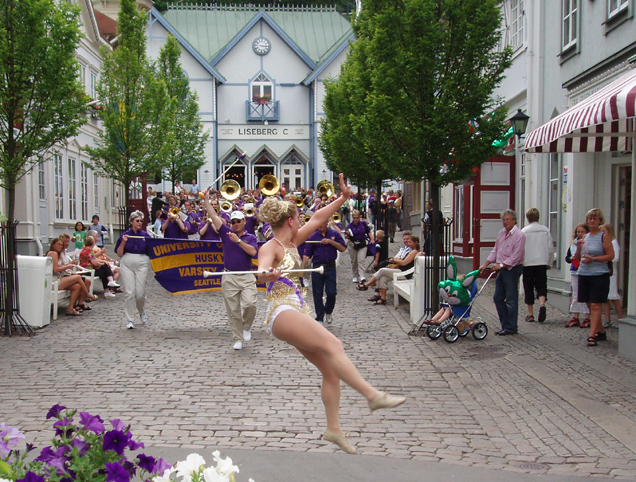
My day in Liseberg, Gothenberg
A thing I did in Gothenburg: buy an all-day rider's pass at Korsvagen, use it even on the ferry boats, and go to Vrango to read Quicksilver and take pictures. At the terminus of tram 11, I found myself in a Thai food kiosk. Guido and family were also present, having previously ordered and waiting to collect the merchandise. Guido had it on good authority that the food here was indeed good. And it was. I got in trouble for eating it in the upstairs cafe enroute to Vrango -- the whole upstairs belongs to the coffee counter (I'd surmised only the closest tier, misjudging the scope of the counter's authority). I was flattered that she lectured me in Swedish. Scandanavians are cool.
Gothenberg has a "Lip Stick Building" similar to our "Candle Building" (KOIN Tower), only theirs is more over the top.
Liseberg was great fun. There I was, all by myself, a 47 year old guy kicking around an amusement park, and who should show up but the University of Washington Varsity and Alumni band! Great baton twirler, enthusiastic musicians. My fellow amusement park goers stood around and clapped, trully impressed in some cases.
I bought an "as many rides as you can stand" pass in Liseberg. I went twice on the roller coaster that parallels the escalators to the tower, once on the others. And that swing thing towards the middle, next to Kannen's 360, wow. I hadn't watched a session before boarding (was just doing my random walk) and wished I'd pocketed my glasses. 47 year old man goes round and round and upside down. In Gothenberg. Fun.
Wednesday, July 20, 2005
Wanderers 2005.7.19
Yesterday's Wanderers was one of the best ever, and yet was unplanned, for the most part, a "do whatever we feel like" kind of event. The result was a kind of round robin, although moving at variable speed, with lots of back and forth between turn-taking.
Big news was more about Lew and his Educational Leave of Absence to dive into the Urban Studies department at PSU -- one of the best in the nation (Carl Abbott is a Friend).
Dick Pugh revealed more mysteries of the meteorites. Brian indulged us with more Condor-talk. Don offered to assist everybody (at the last meeting, Don introduced himself as "Terry's Igor," which brought the house down).
I wedged in a complete OSCON presentation off the laptop (no projector), complete with "Fog of War" battlemap (drawn in green felt on the spot). Jim talked more about the watershed and his plan to view next year's eclipse from a Libyan standpoint, insha Allah.
David left before the round robin got to him (and before I drew my battlemap), but I enjoyed re-explaining Quadrays to him (one slide in my OSCON presentation) -- David being an applied mathematician, with an emphasis on spectral analysis.
Big news was more about Lew and his Educational Leave of Absence to dive into the Urban Studies department at PSU -- one of the best in the nation (Carl Abbott is a Friend).
Dick Pugh revealed more mysteries of the meteorites. Brian indulged us with more Condor-talk. Don offered to assist everybody (at the last meeting, Don introduced himself as "Terry's Igor," which brought the house down).
I wedged in a complete OSCON presentation off the laptop (no projector), complete with "Fog of War" battlemap (drawn in green felt on the spot). Jim talked more about the watershed and his plan to view next year's eclipse from a Libyan standpoint, insha Allah.
David left before the round robin got to him (and before I drew my battlemap), but I enjoyed re-explaining Quadrays to him (one slide in my OSCON presentation) -- David being an applied mathematician, with an emphasis on spectral analysis.
Sunday, July 10, 2005
Bewitched (movie review)
Here Hollywood makes a film about Hollywood remaking a Hollywood TV series. The outermost frame is unspoken (this isn't a documentary about "the making of") but that just heightens the irony of actors making fun of, and celebrating, acting (including bad acting) and its made-for-the-camera cultural milieu.
For Nicole Kidman to frame herself as an actress playing an actress, she almost has to come from another dimension -- which she somewhat manages to do, as a witch who knows her own nothing-to-sneeze-at charms. Ferrell is charming too, and of course more obnoxious as Kidman's male foil.
Shirley Maclaine and Michael Caine play the older parallel couple (as Endora and Nigel), and covertly bewitch one another, likewise to foment romance. So is love authentic if it's so artificially begotten? The movie industry is forever asking itself this question, given the impersonal machinery of love-making is so in-your-face all the time (smile for the camera now).
I don't remember the TV show well enough to recall Uncle Arthur, originally played by Paul Lynde. His appearance in the person of Steve Carrell smashes the illusion: he starts in Wyatt's dream sequence, but is still there when he wakes up -- the layered realities collapse into one (hi Steve). Nor did I recall that Darrin got recast some distance into the original series, a fact Farrell's Wyatt alludes to, when feeling nervous about his career.
The film stays light-hearted throughout, faithful to the spirit of 1960s USA sitcoms and their suburban Pleasantville fluffiness -- is a traditional mid-summer comedy in other words.
For Nicole Kidman to frame herself as an actress playing an actress, she almost has to come from another dimension -- which she somewhat manages to do, as a witch who knows her own nothing-to-sneeze-at charms. Ferrell is charming too, and of course more obnoxious as Kidman's male foil.
Shirley Maclaine and Michael Caine play the older parallel couple (as Endora and Nigel), and covertly bewitch one another, likewise to foment romance. So is love authentic if it's so artificially begotten? The movie industry is forever asking itself this question, given the impersonal machinery of love-making is so in-your-face all the time (smile for the camera now).
I don't remember the TV show well enough to recall Uncle Arthur, originally played by Paul Lynde. His appearance in the person of Steve Carrell smashes the illusion: he starts in Wyatt's dream sequence, but is still there when he wakes up -- the layered realities collapse into one (hi Steve). Nor did I recall that Darrin got recast some distance into the original series, a fact Farrell's Wyatt alludes to, when feeling nervous about his career.
The film stays light-hearted throughout, faithful to the spirit of 1960s USA sitcoms and their suburban Pleasantville fluffiness -- is a traditional mid-summer comedy in other words.
Wednesday, July 06, 2005
Wanderers Meeting 2005.7.5
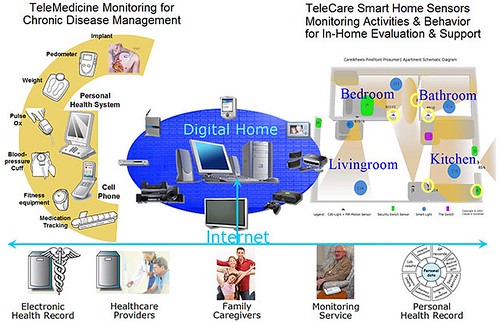
Long time digital activist and alpha geek Ron Braithwaite was our guest speaker at Wanderers yesterday. He's moving to Canada shortly to begin work on a new kind of safety net for elders, staffed in large degree by disabled workers and backed by volunteers.
This net provides elders with human contact by telephone, plus raises exceptions when the installed sensors detect deviations from daily routines, e.g. when a medicine cabinet fails to open, or a stove gets left on. If the telecare provider can't handle the exception, e.g. the phone isn't answered, it gets passed to a higher level, e.g. to an on-scene emergency contact and/or 911.
Disabled workers will staff the call centers, either in offices or at home (some people want to "go to work"). A web browser interface will provide the daily contact list and color-coded warning flags. The software is already being field tested.
Given the average smart home generates a lot of data, the current design puts filtering and summarizing algorithms on a client appliance, thereby shielding the more centralized servers from a flood of routine information. Summary reports will help establish baselines so that long term trends might be monitored as well (e.g. increases or decreases in mobility, number of nightly trips to the bathroom and so on).
Also present to provide supplementary detail and background information, was Claude Goodman, founder of CareWheels and originator of this model. Ron and Claude first met when Ron was spearheading CollabTech for Free Geek. Claude remembered me from that venue.
We had a lot of lively discussion, focusing on possible big brother abuses, and on whether living alone was really the best option. Passions ran high, as personal histories were recounted. Ron and Claude held up well under interrogation and we ended up wishing them well in their adventures.
Given many in the private sector expect to generate future revenue from such On-Star-like home monitoring services, Ron feels it's important to get a working model established using open source software and business models. Otherwise, the more money-hungry will hide behind exclusionary regulations and patent claims, to make sure native human smarts and resourcefulness remain enslaved and controlled by self-serving "know better" elites.
This net provides elders with human contact by telephone, plus raises exceptions when the installed sensors detect deviations from daily routines, e.g. when a medicine cabinet fails to open, or a stove gets left on. If the telecare provider can't handle the exception, e.g. the phone isn't answered, it gets passed to a higher level, e.g. to an on-scene emergency contact and/or 911.
Disabled workers will staff the call centers, either in offices or at home (some people want to "go to work"). A web browser interface will provide the daily contact list and color-coded warning flags. The software is already being field tested.
Given the average smart home generates a lot of data, the current design puts filtering and summarizing algorithms on a client appliance, thereby shielding the more centralized servers from a flood of routine information. Summary reports will help establish baselines so that long term trends might be monitored as well (e.g. increases or decreases in mobility, number of nightly trips to the bathroom and so on).
Also present to provide supplementary detail and background information, was Claude Goodman, founder of CareWheels and originator of this model. Ron and Claude first met when Ron was spearheading CollabTech for Free Geek. Claude remembered me from that venue.
We had a lot of lively discussion, focusing on possible big brother abuses, and on whether living alone was really the best option. Passions ran high, as personal histories were recounted. Ron and Claude held up well under interrogation and we ended up wishing them well in their adventures.
Given many in the private sector expect to generate future revenue from such On-Star-like home monitoring services, Ron feels it's important to get a working model established using open source software and business models. Otherwise, the more money-hungry will hide behind exclusionary regulations and patent claims, to make sure native human smarts and resourcefulness remain enslaved and controlled by self-serving "know better" elites.
Sunday, July 03, 2005
Roller Coaster
We don't have a firm diagnosis yet, but there's some likelihood that Dawn's long-running dry cough and CT scan results mean the cancer has moved to her lungs. This news hit home by email while I was still in Sweden, amusing myself for a couple days after the 3-day conference (given how late the bookings were made on my behalf, no immediate return was available -- a prospect I'd welcomed).
Or maybe it's pneumonia, or a lesion left behind by the radiation. We'd be happy with either.
Life is a roller coaster -- symbolism I was conscious of at the time, in Liseburg.
This wasn't the first time I'd endured a long flight with my guts knotted in grief and sorrow (the MD-11 was packed -- the cabin crew did a good job). I escaped into the pages of Quicksilver, while on inflight TV, Homer put on more weight to qualify as disabled, so he could work from home (I need to lose more weight).
Dawn and Tara came to fetch me from the airport (but the suitcase stayed in Vancouver -- ground crew couldn't fit it on the tightly packed Air Canada Dash-8). Dawn has all her hair back, is so strong and clear in mind and body these days.
We joined a backyard picnic in honor of some moved-away neighbors, back in Portland for a visit. Their daughter Alana and Tara are friends. Jimmy played his guitar, with others joining in. Mom took some time from her peace work to partake of the festivities. Tara and Llysa sang most of an old Dylan ballad they'd learned off a Joan Baez album.
I was glad to be home, experiencing the life of a civilian.
Sweden hasn't sent its young to war for some hundreds of years -- a model. Life is sorrowful enough without we humans doing the killing. What do our computers say, our simulations? Is war a mathematical inevitability? Yesterday's Herald Tribune editorialized that fighting malaria and other such killers should be our priority. I agree. Health care and food services, education, entertainment -- a global university, a city-campus network, all interconnected by airlines, telecommunications, shipping, that's my vision.
Followup (July 13, 2005): The anti-matter scan (PET) indicates anomolies in Dawn's lung are from the radiation field used earlier. Nor were other cancerous hot spots detected, per the preliminary study, which we obtained yesterday. I'm very happy about this news.
Followup (July 21, 2005): The MRI gods, on the other hand, were less kind.
Or maybe it's pneumonia, or a lesion left behind by the radiation. We'd be happy with either.
Life is a roller coaster -- symbolism I was conscious of at the time, in Liseburg.
This wasn't the first time I'd endured a long flight with my guts knotted in grief and sorrow (the MD-11 was packed -- the cabin crew did a good job). I escaped into the pages of Quicksilver, while on inflight TV, Homer put on more weight to qualify as disabled, so he could work from home (I need to lose more weight).
Dawn and Tara came to fetch me from the airport (but the suitcase stayed in Vancouver -- ground crew couldn't fit it on the tightly packed Air Canada Dash-8). Dawn has all her hair back, is so strong and clear in mind and body these days.
We joined a backyard picnic in honor of some moved-away neighbors, back in Portland for a visit. Their daughter Alana and Tara are friends. Jimmy played his guitar, with others joining in. Mom took some time from her peace work to partake of the festivities. Tara and Llysa sang most of an old Dylan ballad they'd learned off a Joan Baez album.
I was glad to be home, experiencing the life of a civilian.
Sweden hasn't sent its young to war for some hundreds of years -- a model. Life is sorrowful enough without we humans doing the killing. What do our computers say, our simulations? Is war a mathematical inevitability? Yesterday's Herald Tribune editorialized that fighting malaria and other such killers should be our priority. I agree. Health care and food services, education, entertainment -- a global university, a city-campus network, all interconnected by airlines, telecommunications, shipping, that's my vision.
Followup (July 13, 2005): The anti-matter scan (PET) indicates anomolies in Dawn's lung are from the radiation field used earlier. Nor were other cancerous hot spots detected, per the preliminary study, which we obtained yesterday. I'm very happy about this news.
Followup (July 21, 2005): The MRI gods, on the other hand, were less kind.
Wednesday, June 29, 2005
Europython 2005
I transitioned from our weekend Wanderers retreat, at the Linus Pauling house on Hawthorne (PDX), to Europython in Göteborg, Sweden (GOT). I'm currently blogging from our venue, the Architecture building at Chalmers using a guest account on the university's Nomad wireless network, with the 3rd and final day of the conference in progress (we're doing a coffee break at the moment).
I got invited to this conference on the basis of my Python in Education initiatives. My talk, entitled Pythonic Mathematics, was about infusing various college and pre-college math curricula with a computer programming component, including doing more with polyhedra (per slides).
The conferees here come from all over Europe, and of course speak a variety of languages. Fortunately for me, English is the medium for presentations.
At the dinner last night I sat next to Mr. Volkmer from the Max Planck Institute of Molecular Cell Biology and Genetics in Dresden. His team uses Python around databases containing the gene sequences of axolotls, frogs and such.
The night before, I had dinner by the student center indoor pool with Guido (Python's creator) and a gent from CERN, the venue for Europython next year.
A lot of these folks are Zope and Plone developers, some of whom I've met in other venues. Oxfam, GB is coordinating tsunami relief and other projects through an elaborate network of interconnected Plone sites.
Laura gave us updates on the political situation regarding the prospect of software patents in the EU, which the programmers here are pretty much uniformly against, even though their work is highly inventive and original.
A large conference on nanotubes (aka buckytubes) is taking place in parallel. Wandering amidst the posters brings back memories of the First International Conference on Fullerenes in Santa Barbara (1993), which I attended as a rep from the BFI, thanks to encourgement from Ed Applewhite.
I got invited to this conference on the basis of my Python in Education initiatives. My talk, entitled Pythonic Mathematics, was about infusing various college and pre-college math curricula with a computer programming component, including doing more with polyhedra (per slides).
The conferees here come from all over Europe, and of course speak a variety of languages. Fortunately for me, English is the medium for presentations.
At the dinner last night I sat next to Mr. Volkmer from the Max Planck Institute of Molecular Cell Biology and Genetics in Dresden. His team uses Python around databases containing the gene sequences of axolotls, frogs and such.
The night before, I had dinner by the student center indoor pool with Guido (Python's creator) and a gent from CERN, the venue for Europython next year.
A lot of these folks are Zope and Plone developers, some of whom I've met in other venues. Oxfam, GB is coordinating tsunami relief and other projects through an elaborate network of interconnected Plone sites.
Laura gave us updates on the political situation regarding the prospect of software patents in the EU, which the programmers here are pretty much uniformly against, even though their work is highly inventive and original.
A large conference on nanotubes (aka buckytubes) is taking place in parallel. Wandering amidst the posters brings back memories of the First International Conference on Fullerenes in Santa Barbara (1993), which I attended as a rep from the BFI, thanks to encourgement from Ed Applewhite.
Monday, June 20, 2005
Father's Day
So yesterday was Father's Day and the dad clowns were out in force on Fox Network cartoons. I came into the middle of The Simpsons episode wherein Homer has found an elusive new friend, a roofer-contractor whom nobody else sees, leading them to conclude Homer needs electroshock therapy. Then, after Homer is "cured" the friend shows up. Explaining the friend's previous invisibility requires Stephen Hawking's presence at one point (Stephen likes being on The Simpsons when he gets a chance -- maybe because of all those mathematicians that write for it).
In the next episode, Marge has this flash that Homer is more mortal than most, and tries to get him insured. When that proves impossible, she starts nickle-and-diming at every turn, saving money in a big jar in the kitchen, a jar which Homer develops a relationship with (he trades it in for an RV, which proves devastating to their marriage -- then I had to answer a phone call).
The dad clown in Family Guy has fantasies of being a genius, but when applying for a grant from the MacArthur Foundation tests out sub-normal, which he has a hard time accepting, until he realizes the privileges that come with rank (including the privilege to really screw up big time).
Then came the dad clown in American Dad, a CIA guy consumed with jealousy over his neighbor's good fortune (which the neighbor loves to rub in). A contest develops as to which dad will become the next deacon in their church. The CIA dad retains Karl Rove, a kind of vampire (lots of bats coming and going), to help him win, and Karl points out the importance of good cooking to church potlucks.
Given the CIA connection, there's this ET living in the house, a family secret (which is way more contact than those people in The X-Files get), and in this episode he/she/it is in some reproductive cycle causing lactation. By happenstance, the family discovers ET breast milk is just the ticket when it comes to making perfect potato salad, an advantage the wife uses to win the deaconship for her man (he later resigns, claiming he's possessed).
Millions of kids were watching spellbound, exercising viewer discretion.
In the next episode, Marge has this flash that Homer is more mortal than most, and tries to get him insured. When that proves impossible, she starts nickle-and-diming at every turn, saving money in a big jar in the kitchen, a jar which Homer develops a relationship with (he trades it in for an RV, which proves devastating to their marriage -- then I had to answer a phone call).
The dad clown in Family Guy has fantasies of being a genius, but when applying for a grant from the MacArthur Foundation tests out sub-normal, which he has a hard time accepting, until he realizes the privileges that come with rank (including the privilege to really screw up big time).
Then came the dad clown in American Dad, a CIA guy consumed with jealousy over his neighbor's good fortune (which the neighbor loves to rub in). A contest develops as to which dad will become the next deacon in their church. The CIA dad retains Karl Rove, a kind of vampire (lots of bats coming and going), to help him win, and Karl points out the importance of good cooking to church potlucks.
Given the CIA connection, there's this ET living in the house, a family secret (which is way more contact than those people in The X-Files get), and in this episode he/she/it is in some reproductive cycle causing lactation. By happenstance, the family discovers ET breast milk is just the ticket when it comes to making perfect potato salad, an advantage the wife uses to win the deaconship for her man (he later resigns, claiming he's possessed).
Millions of kids were watching spellbound, exercising viewer discretion.
Saturday, June 18, 2005
Howl's Moving Castle (movie review)
A tumbling kaleideoscope of smooth transformations, resolving as plot lines, involving true love, and with a girl's age a significant parameter. Yes, there's the moving castle, one of several portals to a subjective world, all of which intersect near a flame (voice by Billy Crystal in the USA version) that contains a loved one's heart.
Overlay that with an ongoing, violent, and stupid war (which all truely powerful wizards are trying to end), and you've got the makings of a fantastically convoluted plot. Some critics have disliked the film for precisely this reason (plot complexity), but I don't regard animation as any less a medium for plot density than say books, with their Tolstoy, i.e. "cartoons for children" remain a sophisticated cultural conveyance for messages of arbitrary depth. Disney was good at it too. Fairy tales have always been deep.
Overlay that with an ongoing, violent, and stupid war (which all truely powerful wizards are trying to end), and you've got the makings of a fantastically convoluted plot. Some critics have disliked the film for precisely this reason (plot complexity), but I don't regard animation as any less a medium for plot density than say books, with their Tolstoy, i.e. "cartoons for children" remain a sophisticated cultural conveyance for messages of arbitrary depth. Disney was good at it too. Fairy tales have always been deep.
Wednesday, June 08, 2005
Wanderers June 8, 2005
Jim Buxton wants Wanderers to know that KOPB is rebroadcasting an interesting episode of This American Life tonight, about religious education. 8 PM (91.5 FM in Portland).
This morning we hosted a meeting with Steve Runion, a high school science teacher with creationist views. He sketched out his beliefs and the kinds of struggles he encounters. The Q&A was animated yet cordial, with many overlapping and divergent views expressed.
For example, how would it be different if highly evolved ETs created the world i.e. what evidence would distinguish between God versus some Alien Nation. Or couldn't the story involve a combination of both?
Afterward, we discussed the role of personal experience in belief systems, open versus closed systems etc. The world of John Nash came up a few times, as exemplary of how personal experiences could lead one to pursue different models of reality.
George Hammond was big on the point that "models" (we hope useful to their holders) is perhaps a better word than "theories," for that which we develop and seek to reality-check in the grand scientific tradition (which tradition may be more efficient at updating its core models than some religious ones -- healthy competition keeps the evolutionary picture interesting).
Another question: so how applicable is the notion of intelligent design from this point foward, i.e. aren't we intelligent and don't we design?
This morning we hosted a meeting with Steve Runion, a high school science teacher with creationist views. He sketched out his beliefs and the kinds of struggles he encounters. The Q&A was animated yet cordial, with many overlapping and divergent views expressed.
For example, how would it be different if highly evolved ETs created the world i.e. what evidence would distinguish between God versus some Alien Nation. Or couldn't the story involve a combination of both?
Afterward, we discussed the role of personal experience in belief systems, open versus closed systems etc. The world of John Nash came up a few times, as exemplary of how personal experiences could lead one to pursue different models of reality.
George Hammond was big on the point that "models" (we hope useful to their holders) is perhaps a better word than "theories," for that which we develop and seek to reality-check in the grand scientific tradition (which tradition may be more efficient at updating its core models than some religious ones -- healthy competition keeps the evolutionary picture interesting).
Another question: so how applicable is the notion of intelligent design from this point foward, i.e. aren't we intelligent and don't we design?
Monday, June 06, 2005
Dot Notation
Not everyone knows what I mean, along with others, by "dot notation." This way of noting states and behaviors was developed around "objects" in computer languages, many of which underwent a revolution in the 1970s and 1980s after the appearance of Smalltalk. The object-oriented way of thinking about programming was a revelation.
I was on the xBase track, i.e. the sequence of languages beginning with dBase II (which had precursors in Cal Tech's JPL) and going in various directions through the Visual FoxPros, of which version 9 is the latest. Our switch to OO in xBase occured around the time Microsoft bought the product, and rewrote it to support an OO GUI (this product has always been something of a skeleton in the closet, as it's more powerful than Access or VB, but marketing always kills its marketing budget).
Anyway, dot notation looks like this:
>>> mydog = Dog("Fido")
>>> mydog.name
"Fido"
>>> mydog.bark(2)
"bark, bark"
>>> mydog.bark(3)
"bark, bark, bark"
Some human user is entering strings after the >>> marks (the prompt) with the interpreter taking over upon a press of the Enter key, and coming back with some response (or not) on the line below. The above looks like Python, but many languages do it similarly, including this use of the dot (period) as a separator between the object (mydog in this example) and its states and behaviors.
Objects come into existence through their class constructors, where the class is the blueprint or generic case of an object. On birth, an object gets a slice of computer memory and private variables, there to individualize. A garbage collector looks for abandoned objects and frees their resources.
During an object's life span, dot notation gives programmers a way to trigger behavior, consult or set state. Typically, the programmer will wire behaviors to events, such as a mouse click on a certain button. Objects listen or subscribe to a kind of Events News (part of a loop or process on the CPU) and react to a subset of them, according to their class definitions. That's the OO model in a nutshell (also sounds a lot like the economy), except I haven't really described how we develop/program within an extensible type system, taking many blueprints for granted, and creating new class definitions by means of inheritance, interfaces and composition, per the Java/C# example.
In my recent proposal to Europython, we develop a curriculum which phases dot notation into K-12, because these design concepts have matured to a point where we can count on kids having recourse to them on the job, at the work place. OO is well-nigh universal as a paradigm (which does not mean other paradigms don't exist or are not valued -- it's just that we understand the OO style, even if we choose to use something else from time to time). I've proposed that we do more of this in math class, by building and then using rational numbers, integers modulo N, vectors, matrices, polyhedra as objects (defined by extension as new classes, types -- and optionally in Python). This CS-infused math/CS hybrid would run parallel to the traditional pre-calc/calc track, criss-crossing it in various ways [sic.], per trig, stats, measurement and the like.
I was on the xBase track, i.e. the sequence of languages beginning with dBase II (which had precursors in Cal Tech's JPL) and going in various directions through the Visual FoxPros, of which version 9 is the latest. Our switch to OO in xBase occured around the time Microsoft bought the product, and rewrote it to support an OO GUI (this product has always been something of a skeleton in the closet, as it's more powerful than Access or VB, but marketing always kills its marketing budget).
Anyway, dot notation looks like this:
>>> mydog = Dog("Fido")
>>> mydog.name
"Fido"
>>> mydog.bark(2)
"bark, bark"
>>> mydog.bark(3)
"bark, bark, bark"
Some human user is entering strings after the >>> marks (the prompt) with the interpreter taking over upon a press of the Enter key, and coming back with some response (or not) on the line below. The above looks like Python, but many languages do it similarly, including this use of the dot (period) as a separator between the object (mydog in this example) and its states and behaviors.
Objects come into existence through their class constructors, where the class is the blueprint or generic case of an object. On birth, an object gets a slice of computer memory and private variables, there to individualize. A garbage collector looks for abandoned objects and frees their resources.
During an object's life span, dot notation gives programmers a way to trigger behavior, consult or set state. Typically, the programmer will wire behaviors to events, such as a mouse click on a certain button. Objects listen or subscribe to a kind of Events News (part of a loop or process on the CPU) and react to a subset of them, according to their class definitions. That's the OO model in a nutshell (also sounds a lot like the economy), except I haven't really described how we develop/program within an extensible type system, taking many blueprints for granted, and creating new class definitions by means of inheritance, interfaces and composition, per the Java/C# example.
In my recent proposal to Europython, we develop a curriculum which phases dot notation into K-12, because these design concepts have matured to a point where we can count on kids having recourse to them on the job, at the work place. OO is well-nigh universal as a paradigm (which does not mean other paradigms don't exist or are not valued -- it's just that we understand the OO style, even if we choose to use something else from time to time). I've proposed that we do more of this in math class, by building and then using rational numbers, integers modulo N, vectors, matrices, polyhedra as objects (defined by extension as new classes, types -- and optionally in Python). This CS-infused math/CS hybrid would run parallel to the traditional pre-calc/calc track, criss-crossing it in various ways [sic.], per trig, stats, measurement and the like.
Saturday, May 28, 2005
Princeton 25th Reunion

2D
So I'm visiting my alma mater, which is bursting at the seams with funds, alumni voting with their dollars to float this UFO, which does some good work in the world.
Professors praised my astute remarks at an event in McCormick (Art Museum), where we discussed the role of religion in campus life. I offered that when it comes to ethics and morality, we shouldn't leave it to the religion department (nor to campus ministries); every walk of life has a code of ethics to offer (potentially). Let's compete and not make religion carry the whole burden. Like, I represent philosophy as a way to go. Psychology contributes as well.
Cindy Lazaroff showed up at the class dinner and regaled me with stories of the Heraclitus, an ocean-going masted vessel, which lost its foremast in a daring crossing of the northern Pacific, registering the most days alone at sea of any vessel. She's devoted to saving coral reefs, and feels betrayed by Crichton's State of Fear, my airplane reading. Cindy and I agreed that better access to global data is what's needed. To that end, her organization is trying to raise money for a satellite, the main mission of which will be to monitor the state of coral reefs around the globe.
Cindy and I were co-residents at 2 Dickinson Street (2D), in our day a new alternative to Princeton's traditional eating club regime. We cooked for each other, and purchased our own food on a university-allotted budget.
I also attended lectures by leading physicists. I learned about how the particulate properties of photons mess with plans to optimally transmit bits per phase-modulated pulse over optical fiber. But clever algorithms let the receiver rectify by anticipation, shifting the subtractive reference pulse to glean maximal data. Dr. Gott discussed esoteric models of early Universe e.g. a time-loop, molded in glass, and begetting forked expansions. I partook of strawberrys and cheese at the reception.
A number of our 2 Dickinson crowd are in evidence this year: Cindy, Kirk, John, Sally, Sarah, Nancy, Kate... and I just encountered dear Selma. The band is too loud to permit talking at the moment. I decided to post to my blog instead. I'm purchasing souvenirs for the family and taking lots of pictures with the Olympus.
Follow-up: Today I crossed paths with Adam Bellow, an old chum with whom I've lost contact over the years. He was on a panel discussing the future of publishing (the university offers a rich program of presentations during reunions). Our class led the P-rade given this is our 25th. I walked and watched it with my ol' buddy Gary Nackenson.
Click here for slides from this reunion, and from my time in the tree house.
Addendum: Ralph Nader '55, a member of our parent class, showed up in church with Patti Smith. I missed it, but some of my friends went.
Saturday, May 21, 2005
Gardening Again
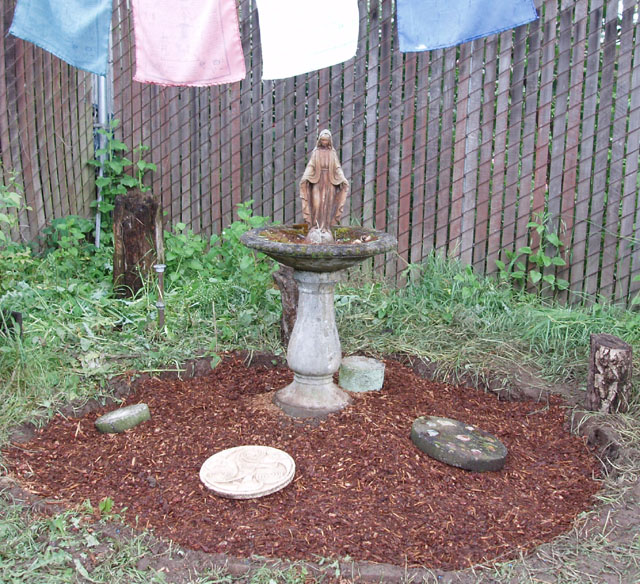
Statue of Mary + Tibetan prayer flags
Today was about buying a bark mixture at Portland Nursery, and spreading it in a circle, with a statue on a pedastal at a focus, having exhumed gross pounds of earth and transported them by wheel barrow to another part of the garden. The bark mixture went over weed barrier (cardboard boxes, unfolded and shaped), and finally an assortment of rock discs of different thickness, some carved or with inlay work (nothing too fancy). I wore boots. The earth was damp and clay-like, given recent rains.
I'm also in the midst of a plumbing job, puzzling over this ancient bathroom sink, with embedded fixtures -- very strange fixtures. I tell people it's like playing Uru.
My birthday is recently behind me. Great day, with friends and family celebrating in various ways. I had some good fish at a Jamaican place near I-405, after some hours on the boat. Michael showed us Giant Steps by Michal Levy on Matt's new Apple computer. I posted a link to that animated art, with sound by John Coltrane, to math-teach, earlier this morning.
On Friday I had lunch with my uncle Lightfoot, a son of Elsie, sister of my father's mother Esther Person. Bill, Bo, Eddy, Howard, and Eve were Elsie's kids. These families lived around Mercer Island early on, in Greater Seattle. I'm doing a web site for Bill. He's done a lot of good research about a little-known chapter in Pacific Northwest history: a period of supplying the world's navies with a lot of submarines, pre and during WWI.
Dawn's slide show about her trip the evening before went very well. We borrowed the ISEPP projector from Terry, and used the edited set, put together to tell some great stories. Dawn and I consulted Cirlot's Dictionary of Symbols to help pull this together, what with Cosmic Fish, Fisher King, and just plain Fishing all so close together like that. Dawn learned a great deal on her trip to the UK and discovered it to be a deeply healing experience.
I projected Levy's Giant Steps from the wireless laptop (which also held the slide show), as "the cartoon before the main feature." And at the end, just before the battery died (fewer cords to contend with), I projected some of my hypertoon (written in Python + VPython).
Wednesday, May 11, 2005
Global Warming
Doug Strain, age 86, and a principal engineer of the Silicon Forest phenomenon here in Oregon, shared his views on global warming at the Linus Pauling House on Hawthorne yesterday.
Doug's view: it's happening, but likely a rising CO2 level is more an effect than a cause of global warming. The original computer model, out of the Colorado-based National Center for Atmospheric Research (NCAR), wasn't sophisticated enough regarding energy transformations. The sun and oceans are the big players, and neither was sufficiently accounted for at the time CO2 was fingered as a main culprit behind a rise in average global temperature.
Doug describes himself as a life-long metrologist, starting around age 5, when a family photo shows him measuring the snow level. His Scottish grandmother emigrated to the USA and pretty much raised him in early childhood, as both parents worked. She detected his early interest in science and measurement and gave him a copy of some book by Lord Kelvin, which he devoured with gusto.
Early on, Doug invented a way of measuring the fat content in butter using its electrical properties. When the family moved to California, he planned to introduce his invention there, but the demo was a disaster, as in CA, the butter was already salted by the time fat content was tested, which fried his device, spattering butter on his pants. Doug went on to invent many more measuring devices, graduated from Caltech, acquired/named Electro Meaurements Inc., later renamed to Electro Scientific Industries.
Bjorn Lomberg's The Skeptical Environmentalist started Doug down a path of questioning, starting from a strongly green position. He's been a supporter of the Rocky Mountain Institute and renewable energy groups. He still considers himself an environmentalist. But Lomberg spoke to his need to see numbers and diagrams, i.e. to gain access to a lot of relevant global data.
Doug's research led him to start questioning the computer models, and consider a back to basics approach. He hasn't become a pie in the sky optimist. For all we know, the climate changes now underway could be disasterous, but he doesn't think rushing to lower CO2 emissions is necessarily a rational, empirically justifiable response, even if global temperatures are in fact rising with CO2.
The structure of our debate (a Wanderers meeting always turns into a debate) followed along the lines suggested by Jon Bunce: is global warming happening, and if so what are the causes? If global warming is happening, is that a bad thing (maybe it'll forestall a next ice age)? If it is a bad thing, what if anything might humans do to stop, slow or reverse it?
As far as Doug is concerned, it's happening, he's not sure how good or bad it will be, and he doesn't know if there's anything humans can do about it. The global climate has never held steady, with or without humans. Change is the norm, not the exception. Life tries to adapt, plus has an important role to play within the many feedback loops (Gaia Hypothesis). But do we really know enough to take smart corrective action at this point? How might we become smarter faster? Accelerating our rate of knowledge acquisition regarding the planetary ecosystem, not sitting on our hands doing nothing, is the way to go.
I learned from this discussion that Michael Crichton has become embroiled in the global warming controversy, having done three years of research leading up to his latest novel, State of Fear. Here's a quote from Quaker-P last night:
Many at the table agreed that measures people advocate to reverse global warming, such as becoming less dependent on fossil fuels and cleaning up polluted city air, should be undertaken regardless of the impact on global warming i.e. we have other reasons for taking many of these recommended actions.
We went around the table both before and after Doug's presentation, to get a read on where each of us stood on the global warming issue. I was willing to accept that the global models could be improved (no real argument there), and that access to good data remains a priority. A TV camera was running, and I said to the camera we should all drink a lot of coffee -- meaning we need to stay awake, burn the midnight oil pondering these important and perplexing issues.
As for the conventional wisdom, that CO2 is a principal cause of global warming, and human activity a principal cause of CO2, I'm still willing to accept that this may be true. However, I'm also quite willing to give skeptics a hearing. I think Doug did an excellent job presenting an alternative perspective. His goal was to spark debate, and in this he most certainly succeeded.
Doug's view: it's happening, but likely a rising CO2 level is more an effect than a cause of global warming. The original computer model, out of the Colorado-based National Center for Atmospheric Research (NCAR), wasn't sophisticated enough regarding energy transformations. The sun and oceans are the big players, and neither was sufficiently accounted for at the time CO2 was fingered as a main culprit behind a rise in average global temperature.
Doug describes himself as a life-long metrologist, starting around age 5, when a family photo shows him measuring the snow level. His Scottish grandmother emigrated to the USA and pretty much raised him in early childhood, as both parents worked. She detected his early interest in science and measurement and gave him a copy of some book by Lord Kelvin, which he devoured with gusto.
Early on, Doug invented a way of measuring the fat content in butter using its electrical properties. When the family moved to California, he planned to introduce his invention there, but the demo was a disaster, as in CA, the butter was already salted by the time fat content was tested, which fried his device, spattering butter on his pants. Doug went on to invent many more measuring devices, graduated from Caltech, acquired/named Electro Meaurements Inc., later renamed to Electro Scientific Industries.
Bjorn Lomberg's The Skeptical Environmentalist started Doug down a path of questioning, starting from a strongly green position. He's been a supporter of the Rocky Mountain Institute and renewable energy groups. He still considers himself an environmentalist. But Lomberg spoke to his need to see numbers and diagrams, i.e. to gain access to a lot of relevant global data.
Doug's research led him to start questioning the computer models, and consider a back to basics approach. He hasn't become a pie in the sky optimist. For all we know, the climate changes now underway could be disasterous, but he doesn't think rushing to lower CO2 emissions is necessarily a rational, empirically justifiable response, even if global temperatures are in fact rising with CO2.
The structure of our debate (a Wanderers meeting always turns into a debate) followed along the lines suggested by Jon Bunce: is global warming happening, and if so what are the causes? If global warming is happening, is that a bad thing (maybe it'll forestall a next ice age)? If it is a bad thing, what if anything might humans do to stop, slow or reverse it?
As far as Doug is concerned, it's happening, he's not sure how good or bad it will be, and he doesn't know if there's anything humans can do about it. The global climate has never held steady, with or without humans. Change is the norm, not the exception. Life tries to adapt, plus has an important role to play within the many feedback loops (Gaia Hypothesis). But do we really know enough to take smart corrective action at this point? How might we become smarter faster? Accelerating our rate of knowledge acquisition regarding the planetary ecosystem, not sitting on our hands doing nothing, is the way to go.
I learned from this discussion that Michael Crichton has become embroiled in the global warming controversy, having done three years of research leading up to his latest novel, State of Fear. Here's a quote from Quaker-P last night:
[Crichton is] very critical of how science is funded, with continued funding basically contingent upon a certain point of view gaining credence. We could probably progress more quickly with double-blind funding -- in politics too (e.g. you see the money show up in your campaign chest, but it's not altogether tracable, i.e. not really clear who exactly your biggest donors might be -- so keep doing what you're doing, if you're getting support, as you must be doing something right).I hope I'm rendering Michael's views accurately (I haven't read the book yet). Both Doug and Michael are members of the Western Behavioral Sciences Institute (WBSI), and Doug is my source here.
Many at the table agreed that measures people advocate to reverse global warming, such as becoming less dependent on fossil fuels and cleaning up polluted city air, should be undertaken regardless of the impact on global warming i.e. we have other reasons for taking many of these recommended actions.
We went around the table both before and after Doug's presentation, to get a read on where each of us stood on the global warming issue. I was willing to accept that the global models could be improved (no real argument there), and that access to good data remains a priority. A TV camera was running, and I said to the camera we should all drink a lot of coffee -- meaning we need to stay awake, burn the midnight oil pondering these important and perplexing issues.
As for the conventional wisdom, that CO2 is a principal cause of global warming, and human activity a principal cause of CO2, I'm still willing to accept that this may be true. However, I'm also quite willing to give skeptics a hearing. I think Doug did an excellent job presenting an alternative perspective. His goal was to spark debate, and in this he most certainly succeeded.
Friday, May 06, 2005
LUNO
Don introduced me to his friend Gene Lehman, a long-time English teacher, now retired and living with his wife in a nursing home in Sandy. We drove out to his place, partly because Gene founded this Learning Unlimited Network of Oregon (LUNO) whereas I have my Oregon Curriculum Network (OCN) -- perhaps we're on parallel/convergent tracks in some dimension, except I'm more into the math end of things.
If you checked this blog yesterday, you might have caught some esoteric essay about a tradition of dissent within Catholicism. Those were Gene's words. While at his place, I helped him find a lost document on his hard disk, fixed his printer, upgraded his browser (which he doesn't yet use) and made progress towards restoring email, which hasn't worked for almost a year (I found a typo in the POP server name, but then at the last minute upgraded to Outlook Express 6, which broke stuff again -- I'll need another visit).
Don and I went to lunch in Sandy (a beer each, cashews and salmon jerky from Trader Joe's) while we did an 11 MB download of Internet Explorer 6 through dial-up (took over an hour). We also stopped at Good Will: I'm looking for a replacement reading lamp for mom, given the Costco one broke, but the one candidate had too many problems.
On my way out to Don's, my wife called from a red phone booth in Glastonbury, England. She wanted me to confirm her return flight with American Airlines, check the bank balance and stuff. She'd just been to Stonehenge that morning and was charged up about it. I'm looking forward to the pictures from her pilgrimmage (the new Olympus went with her).
Also, Nick phoned to check on my schedule for Friday. He wants to introduce me to the Spoon Man, a musician known regionally for his spoon playing technique. This guy is also Nick's ride from Seattle. Spoon Man is enroute to Bandon, Oregon.
After Don and I got back from lunch, the Lehmans had places to go and left a key so we could lock up when done. Don reassembled a busted desk organizer made of wood, then showed me an interesting back route from Boring to Foster Road. He led the way in his white van, with me following in the Subaru, along twisty country roads. Once we reached city congestion, we talked business by cell. We met up with a vehicular funeral procession coming the other way on Foster. Thanks to this short cut, I was only five minutes late meeting Tara, instead of 15-20.
Anyway, I was suggesting to Gene he might want to start a blog, and do his LUNO newsletter in that format. He asked for a demo of ease of use involving this essay I'd just recovered. I cut and pasted from Word to Grain of Sand, and voilá, I think he was impressed. I've since deleted the essay, which wasn't finished in any case. If Gene gets his own blog, I'll link to it from this post.
Follow-up: I completed the planned upgrade, including of Outlook Express, on Tuesday after Doug Strain's presentation to Wanderers (see following post). Don's reassembly of the wooden desk organizer was also much appreciated. Kirby to Don after we accomplished our mission: Meliptus rocks!
If you checked this blog yesterday, you might have caught some esoteric essay about a tradition of dissent within Catholicism. Those were Gene's words. While at his place, I helped him find a lost document on his hard disk, fixed his printer, upgraded his browser (which he doesn't yet use) and made progress towards restoring email, which hasn't worked for almost a year (I found a typo in the POP server name, but then at the last minute upgraded to Outlook Express 6, which broke stuff again -- I'll need another visit).
Don and I went to lunch in Sandy (a beer each, cashews and salmon jerky from Trader Joe's) while we did an 11 MB download of Internet Explorer 6 through dial-up (took over an hour). We also stopped at Good Will: I'm looking for a replacement reading lamp for mom, given the Costco one broke, but the one candidate had too many problems.
On my way out to Don's, my wife called from a red phone booth in Glastonbury, England. She wanted me to confirm her return flight with American Airlines, check the bank balance and stuff. She'd just been to Stonehenge that morning and was charged up about it. I'm looking forward to the pictures from her pilgrimmage (the new Olympus went with her).
Also, Nick phoned to check on my schedule for Friday. He wants to introduce me to the Spoon Man, a musician known regionally for his spoon playing technique. This guy is also Nick's ride from Seattle. Spoon Man is enroute to Bandon, Oregon.
After Don and I got back from lunch, the Lehmans had places to go and left a key so we could lock up when done. Don reassembled a busted desk organizer made of wood, then showed me an interesting back route from Boring to Foster Road. He led the way in his white van, with me following in the Subaru, along twisty country roads. Once we reached city congestion, we talked business by cell. We met up with a vehicular funeral procession coming the other way on Foster. Thanks to this short cut, I was only five minutes late meeting Tara, instead of 15-20.
Anyway, I was suggesting to Gene he might want to start a blog, and do his LUNO newsletter in that format. He asked for a demo of ease of use involving this essay I'd just recovered. I cut and pasted from Word to Grain of Sand, and voilá, I think he was impressed. I've since deleted the essay, which wasn't finished in any case. If Gene gets his own blog, I'll link to it from this post.
Follow-up: I completed the planned upgrade, including of Outlook Express, on Tuesday after Doug Strain's presentation to Wanderers (see following post). Don's reassembly of the wooden desk organizer was also much appreciated. Kirby to Don after we accomplished our mission: Meliptus rocks!
Tuesday, May 03, 2005
Sky Camp
Back from Sky Camp, a Kiwanas, overlooking Eugene's water supply (looks full), and long time site of Willamette Quarterly Meeting (Friends). I assisted as emcee for community night, doing an "ice breaker" five minute math lecture on polyhedra, with Joe Snyder's PowerPoint projector showing my hypertoon in the background (until the laptop power saver kicked in).
Dawn made her connection in Chicago, outbound to the UK, leaving around the same time Laura Bush's bizmo showed up on the PDX tarmac (Boeing?). That was last Thursday. Tara and I drove down to Sky Camp, by way of Fry's Electronics, Friday PM, skirting a jam-up on I-5 by using Barbur Blvd, then discovering a very low pressure front tire situation upon exiting said store. A Les Schwab outlet, adjacent, fixed the problem in no time flat. Glad we caught the problem in a lot, instead of at 65 mph. Tara used a cabin for the two nights. I pitched my tent.
While Dawn is on pilrimmage I'm upgrading her workstation from WinME to XP Pro (purchased at Office Depot, upgrade edition), plus replacing her two obsolete hard drives, with barely 6 gig between them, with a 120 gigger from Maxtor. All her previous files are but a drop in the bucket, somewhere on her E partition. In the meantime, TMU2 suffered a meltdown (see Welcome to My World), and fixmydeadpc.com (local shop) had to work hard on a diagnosis. I thought it was the AGP video card, but turns out the mobo itself had fried, and the CPU, so we upgraded to a newer DDR board, and he swapped the CPU for my old SDRAM (very fair deal). Much better outcome than had it been the video card, which I get to keep and works fine.
Lots of faxing and phoning today to quick certify me with Portland Public to drive Tara and some classmates to OMSI tomorrow, for a school field trip. Signed on to a big meeting at Sisters projected to last up to five hours around the upgrade to GE in the cath labs. I represent Regional Heart and Vascular Institute concerns.
Derek took on Sarah, Moon and the fish (our pets) while we were at Sky Camp, in exchange for Jennifer (just kidding -- dinner), plus I snagged him the requested sale items at Fry's.
I thought of a good poster about our Wanderers CEO: "Don: Better'n OnStar." That's because he sometimes anticipates crises and solves them before they occur. It's hard to find a road service that'll do that, not even AAA.
Dawn made her connection in Chicago, outbound to the UK, leaving around the same time Laura Bush's bizmo showed up on the PDX tarmac (Boeing?). That was last Thursday. Tara and I drove down to Sky Camp, by way of Fry's Electronics, Friday PM, skirting a jam-up on I-5 by using Barbur Blvd, then discovering a very low pressure front tire situation upon exiting said store. A Les Schwab outlet, adjacent, fixed the problem in no time flat. Glad we caught the problem in a lot, instead of at 65 mph. Tara used a cabin for the two nights. I pitched my tent.
While Dawn is on pilrimmage I'm upgrading her workstation from WinME to XP Pro (purchased at Office Depot, upgrade edition), plus replacing her two obsolete hard drives, with barely 6 gig between them, with a 120 gigger from Maxtor. All her previous files are but a drop in the bucket, somewhere on her E partition. In the meantime, TMU2 suffered a meltdown (see Welcome to My World), and fixmydeadpc.com (local shop) had to work hard on a diagnosis. I thought it was the AGP video card, but turns out the mobo itself had fried, and the CPU, so we upgraded to a newer DDR board, and he swapped the CPU for my old SDRAM (very fair deal). Much better outcome than had it been the video card, which I get to keep and works fine.
Lots of faxing and phoning today to quick certify me with Portland Public to drive Tara and some classmates to OMSI tomorrow, for a school field trip. Signed on to a big meeting at Sisters projected to last up to five hours around the upgrade to GE in the cath labs. I represent Regional Heart and Vascular Institute concerns.
Derek took on Sarah, Moon and the fish (our pets) while we were at Sky Camp, in exchange for Jennifer (just kidding -- dinner), plus I snagged him the requested sale items at Fry's.
I thought of a good poster about our Wanderers CEO: "Don: Better'n OnStar." That's because he sometimes anticipates crises and solves them before they occur. It's hard to find a road service that'll do that, not even AAA.
Wednesday, April 27, 2005
Eclipse Chasing
Yesterday came Jim Buxton's turn to enthrall Wanderers at the Pauling House on Hawthorne, and I must say he did a good job. I'm embarrassed to confess that my new Toshiba Satellite wasn't up to showing his 600 MB PowerPoint though, while his much older Win98 laptop managed to plough through it (good thing he lugged it along). I need to get more RAM.
One lesson I took away from Jim's talk is we really do know the future a lot better than we used to, at least when it comes to such cosmic events as total solar eclipses. Not only do we know the dates, but at least some of us know where to draw the narrow tracks along the Earth's surface that demarcate "front row seating" -- which is how Jim and his wife knew to be in a cactus desert in Baja in 1991, and on a cruise ship in the Black Sea in 1999.
Another lesson: we live in a time of contradictory trends. Otherwise literate, informed humans remain ignorant of the night sky, unable to say which are the planets, point out the constellations and so on (I'm one of the dolts in this regard; I can spot the Big Dipper, Orion's Belt, Southern Cross when in Lesotho and that's about it), while on the other hand software and planetariums have made all this information so much more accessible. Light pollution gets some of the blame. If you live in the big city, you forget about the stars (excepting those of the Hollywood variety), i.e. you totally lose perspective.
I see we have a total solar eclipse tracking through Oregon in 2017. Even if I'm lucky enough to still be here, knowing Oregon it'll likely be a rainy day.
Speaking of astronomers and astronomy, it was my privilege to join Wanderers Don and Jon at a surprise 60th birthday party for Doug McCarty over the weekend. Doug teaches a popular college astronomy course -- plus has studied Wittgenstein's philosophy and been to Bhutan, just like me. Also present at this party was Dick Pugh, Oregon's top meteorite specialist, and as a present, he gave Doug a meteorite. Way cool! Doug might be in Libya for the next eclipse in 2006. Jim is eyeing Egypt or Turkey.
One lesson I took away from Jim's talk is we really do know the future a lot better than we used to, at least when it comes to such cosmic events as total solar eclipses. Not only do we know the dates, but at least some of us know where to draw the narrow tracks along the Earth's surface that demarcate "front row seating" -- which is how Jim and his wife knew to be in a cactus desert in Baja in 1991, and on a cruise ship in the Black Sea in 1999.
Another lesson: we live in a time of contradictory trends. Otherwise literate, informed humans remain ignorant of the night sky, unable to say which are the planets, point out the constellations and so on (I'm one of the dolts in this regard; I can spot the Big Dipper, Orion's Belt, Southern Cross when in Lesotho and that's about it), while on the other hand software and planetariums have made all this information so much more accessible. Light pollution gets some of the blame. If you live in the big city, you forget about the stars (excepting those of the Hollywood variety), i.e. you totally lose perspective.
I see we have a total solar eclipse tracking through Oregon in 2017. Even if I'm lucky enough to still be here, knowing Oregon it'll likely be a rainy day.
Speaking of astronomers and astronomy, it was my privilege to join Wanderers Don and Jon at a surprise 60th birthday party for Doug McCarty over the weekend. Doug teaches a popular college astronomy course -- plus has studied Wittgenstein's philosophy and been to Bhutan, just like me. Also present at this party was Dick Pugh, Oregon's top meteorite specialist, and as a present, he gave Doug a meteorite. Way cool! Doug might be in Libya for the next eclipse in 2006. Jim is eyeing Egypt or Turkey.
Sunday, April 24, 2005
Wednesday, April 20, 2005
Bumper Sticker
My karma is my dharma.
I came up with this while floating out on Don's boat. Probably only been thought of like a billion times. Not quite so funny as "a dogma hit my karma" and variants, just a straight tenet of Buddhist thought. And it's a hard teaching when life is hard, which it all too often is. On the other hand, acceptance of what happens, and turning it into a learning opportunity, is a big western idea too, a goal of alchemy (turning shit into roses, as Shakespeare might have put it, but didn't).
Wednesday, April 13, 2005
Morning Mail
This story in New Scientist about some commercial lab carelessly sending out avian flu in test kits is worrisome. I could see shutting down companies that do things like this. Quoting from the article:
In other mail: the Python community is considering me as a candidate to present in Houston, TX next year, at SIGCSE 2006 -- not a sure thing yet. I'm convening a Python Meetup this PM at the usual venue (just sent some mail around about that).
Another surprise development: some family friends yesterday proposed that I be tasked with helping them get the word out about a property they're ready to sell. I've never done much with real estate, but this property is unlikely to stay in my reality for long, given it overlooks the Columbia Gorge, Mount Hood and Hood River (it's on the Washington side). I'll be taking some real estate savvy friends out to lunch, plus investing in a new digital camera, and maybe a GPS device.
Our 2004 taxes are almost finished. Given our very high medical expenses this year (the cancer year), we may be getting a refund for the first time in a long time (unless auditors find a mistake, which I doubt; we used all the right software, and Dawn is a good bookkeeper).
Later today: of course the concept of "morning mail" is somewhat obsolete by now. When we just had USPS, mail tended to show up once a day, often in the morning (depending on the neighborhood and local routes -- businesses downtown expected AM delivery). But with email there's a steady stream, 24/7. Now it's like 4:21 PM and I'm sitting in a local café catching up on my gmail account (Google mail). That's where I monitor Quaker-P and the NSA teacher list. I see Friend Bob Seeley provided a link to a newly revised peace resource site a couple days ago. Cool.
I also just used the gmail account to follow-up on an invitation from the editor of PyZine to write something about hypertoons (maybe with Scott?). He attended my open space talk at Pycon2005.
Generally, when working in cafés like this, it's easier to use an HTTP account, and not bother with an outgoing SMTP server.
"If this incident doesn't cause a major reassessment of the safety of flu research, a lab-sponsored pandemic may well be the only thing that induces sobriety," comments Ed Hammond of the Sunshine Project, a biosafety pressure group.Personally, I don't want incompetent biologists in a position to "induce sobriety" on anyone but themselves.
In other mail: the Python community is considering me as a candidate to present in Houston, TX next year, at SIGCSE 2006 -- not a sure thing yet. I'm convening a Python Meetup this PM at the usual venue (just sent some mail around about that).
Another surprise development: some family friends yesterday proposed that I be tasked with helping them get the word out about a property they're ready to sell. I've never done much with real estate, but this property is unlikely to stay in my reality for long, given it overlooks the Columbia Gorge, Mount Hood and Hood River (it's on the Washington side). I'll be taking some real estate savvy friends out to lunch, plus investing in a new digital camera, and maybe a GPS device.
Our 2004 taxes are almost finished. Given our very high medical expenses this year (the cancer year), we may be getting a refund for the first time in a long time (unless auditors find a mistake, which I doubt; we used all the right software, and Dawn is a good bookkeeper).
Later today: of course the concept of "morning mail" is somewhat obsolete by now. When we just had USPS, mail tended to show up once a day, often in the morning (depending on the neighborhood and local routes -- businesses downtown expected AM delivery). But with email there's a steady stream, 24/7. Now it's like 4:21 PM and I'm sitting in a local café catching up on my gmail account (Google mail). That's where I monitor Quaker-P and the NSA teacher list. I see Friend Bob Seeley provided a link to a newly revised peace resource site a couple days ago. Cool.
I also just used the gmail account to follow-up on an invitation from the editor of PyZine to write something about hypertoons (maybe with Scott?). He attended my open space talk at Pycon2005.
Generally, when working in cafés like this, it's easier to use an HTTP account, and not bother with an outgoing SMTP server.
Saturday, April 09, 2005
Robots (movie review)
A look and feel film: were it just a still canvas, you'd wonder what the reality would be like, and this movie spells it out, with lovable characters being heroic and villainous, per usual. The consistency of the visual motifs is still front and center though, the plot is canned.
Robin Williams shines as Fender and Halle Berry manages to be sexy even as a bucket of bolts (plus Fender's sister ain't bad). Mel Brooks plays the retired CEO tired of fighting for old school values -- until he meets the spark of idealism in the form of our young inventor-hero. Then he's ready to take his company back.
Obviously this is a film for kids, about making your parents proud, plus not having regrets yourself, by fighting hard for your dreams, never giving up etc.. Humor about flatulance is pushed to an extreme. The part about "making a baby" is clever (some assembly required). For the adults, there's a Manchurian Candidate vibe (a twisted mother-son dynamic).
In terms of creating a complete world with fantastic characters, it's not unlike Spirited Away, though not as warm. Interestingly, there's no hint of a parallel human world, i.e. this place is robotic to the core, so even though Fender looks like he's from that circus in AI, we have none of the tension which a human-machine conflict might bring.
Robin Williams shines as Fender and Halle Berry manages to be sexy even as a bucket of bolts (plus Fender's sister ain't bad). Mel Brooks plays the retired CEO tired of fighting for old school values -- until he meets the spark of idealism in the form of our young inventor-hero. Then he's ready to take his company back.
Obviously this is a film for kids, about making your parents proud, plus not having regrets yourself, by fighting hard for your dreams, never giving up etc.. Humor about flatulance is pushed to an extreme. The part about "making a baby" is clever (some assembly required). For the adults, there's a Manchurian Candidate vibe (a twisted mother-son dynamic).
In terms of creating a complete world with fantastic characters, it's not unlike Spirited Away, though not as warm. Interestingly, there's no hint of a parallel human world, i.e. this place is robotic to the core, so even though Fender looks like he's from that circus in AI, we have none of the tension which a human-machine conflict might bring.
Friday, April 08, 2005
Wild World

Gator Meets BuckyBall
I saved this from a free paper they hand you at metro stops in Washington DC -- reminded me of something I'd posted recently.
Monday, April 04, 2005
Getting Back Up to Speed
I spent much of last week wallowing in fever -- too delerious to read much. However, yesterday I was able to wolf down one from mom's collection: Nonviolent Solder of Islam, Badshah Kahn, A Man to Match His Mountains, by Eknath Easwaran (1999 soft cover edition, Nilgiri Press).
I imagine few in the USA today have a clue about this episode: a Gandhian revolution against British imperialism and local custom, which glorified revenge killings, led by a devout Muslim from the north west frontier. Ghaffar blew everyone's stereotypes at the time (a superhero incredible!). The Klingons discover satyagraha. Gandhi considered him a great spiritual leader, as he practiced nonviolence coming from strength, not fear -- always the ideal.
Before I could read, I played comedy channels through the iTunes internet radio. One comic really tore into those RVs. My cybervan idea runs into these same negative PR problems. Matt always signals his disgust when I float this little fantasy.
I'm glad to see Japan is hosting another Expo, complete with signature themes (people movers, corporate pavilions). Maybe Wired'll do a write-up (Gibson likes to visit Japan). Have we seen it on the network news? I might've missed it.
Followup: this article in The Guardian has become something of a classic amidst a growing literature chronicling the rise of a new gulag centered in Afghanistan.
I imagine few in the USA today have a clue about this episode: a Gandhian revolution against British imperialism and local custom, which glorified revenge killings, led by a devout Muslim from the north west frontier. Ghaffar blew everyone's stereotypes at the time (a superhero incredible!). The Klingons discover satyagraha. Gandhi considered him a great spiritual leader, as he practiced nonviolence coming from strength, not fear -- always the ideal.
Before I could read, I played comedy channels through the iTunes internet radio. One comic really tore into those RVs. My cybervan idea runs into these same negative PR problems. Matt always signals his disgust when I float this little fantasy.
I'm glad to see Japan is hosting another Expo, complete with signature themes (people movers, corporate pavilions). Maybe Wired'll do a write-up (Gibson likes to visit Japan). Have we seen it on the network news? I might've missed it.
Followup: this article in The Guardian has become something of a classic amidst a growing literature chronicling the rise of a new gulag centered in Afghanistan.
Subscribe to:
Posts (Atom)
