Sunday, May 29, 2016

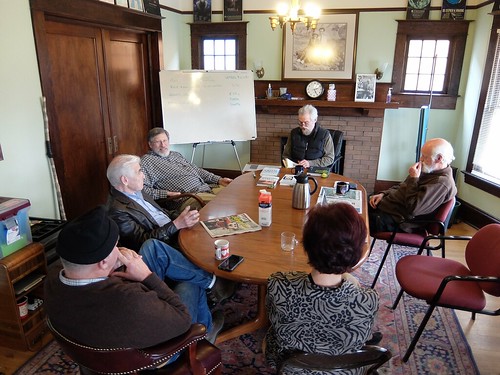
EduSummit / PyCon 2016


AQR Capital and Eventbrite are sponsoring this fourth annual EduSummit, wherein educators from around the world converge to discuss strategies and initiatives around Python in education.  You may have heard of the Raspberry Pi, and Microbit devices.

The UK has been especially on the ball in getting this technology diffused.  One Laptop Per Child (OLPC) was an even more ambitious project, global in scope, wherein Python played a key role.

Nicholas Tollervey, a UK-based Pythonista mentioned edu-sig as a listserv worth jumping into.  He acknowledged me for helping keep it breathing.  S'been rather quiet lately, though with some thoughtful threads.  I've habitually posted to said listserv since its inception.

Pygame Zero is based on PyGame, GPIO, 0MQ.  The target audience is teachers looking for interesting projects for their students, based on some of the most affordable devices available.  One of its jobs is to provide relevant error messages, so that students experience more helpful feedback.

What sort of Manifesto might wrap this up, give a nice summary statement?  Nicholas and others are brainstorming on the question.  I have my own rant.

The teachers coming to Pycon UK are those tasked with teaching "computer stuff" -- as distinct from mathematics -- much like in the US.  Physical Education teachers, business application teachers, want to know what to do with the Microbit.

The US has no institution like the BBC, with a long history of giving out computers.  The BBC has a Royal Charter, is not a for-profit private company per se.  The charter says the BBC should educate, not just entertain and inform.

My impression is the UK is pulling ahead of the US, thanks to the US not having its act together.

MicroPython is Python 3.x for micro-controllers, including the Arm chip on the Microbit.  This solution allowed Microsoft's TouchDevelop to change their approach (TouchDevelop is one of a few ways to flash runnable bytecode to the Micobit chip).

In response to teacher demand, Nicholas and friends are developing Mu, a combination REPL + Editor (i.e. an IDE).

Tollervey's background as a musician is a big plus I'd say.  Microbit comes with a music module, that comes with canned tunes.  They'll be available for sale in the US in a month or two for about fifteen to twenty pounds.  Think of them as a stepping stone to Raspberry Pi programming as a follow-up step.

We have a lot of librarians at the Summit this year.  I wish Multnomah County had taken my job application more seriously, for Diversity Inclusion Fellow.  No interview even.  Because I'm too old? I wrote back to say I'd be happy to work with whomever they end up hiring.

Also frustrating is how Peter Farrell is being excluded because he didn't sign up in time.  We have some empty seats (there's one to my immediate right).  He's at the forefront of the "learning Python to learn math" movement.  He gave me a copy of his softcover book yesterday.

Dr. Craven spoke about his experience as a college intro to programming teacher.  He's the author of Program Arcade Games, a Python and Pygame based curriculum.  Lesson plans should evolve exactly the way software does, with lots and lots of revisions.  Improve the curriculum constantly, it's not a "dead document".  The new kind of teacher will do that.

Watch out for feature bloat.  "Taking away" (paring down) is often as effective or more effective than stuffing with content.  Internationalize.  Self publish, maybe include a Kindle version (forget the Nook).

Other advice from Dr. Craven:  Do video versions.  Take out the "ums".  Do on-screen markups of the code using a tablet.  Use a good microphone.  On-line quizzing gives the curriculum writers useful feedback.  Create lots and lots of free-standing examples.  Don't just stick to developing one super-long application.  Archive to Youtube or Vimeo.  The latter allows more of a paywall.

Skip using Youtube ads. Flipped classroom doesn't work (different from on-line classroom).  Animated code examples not worth the trouble.  PDF downloads lock you into old versions.  Dynamic revising means keeping it fresh on-line.  Use the Arcade Library based on OpenGL and Pyglet, not Pygame which is perhaps going stale?

Actually not, as the next speaker persuasively suggested that Pygame is still alive and kicking.  But does it install to a Mac?  Python using Minecraft is certainly plenty easy, including with Jupyter Notebooks as a front end.

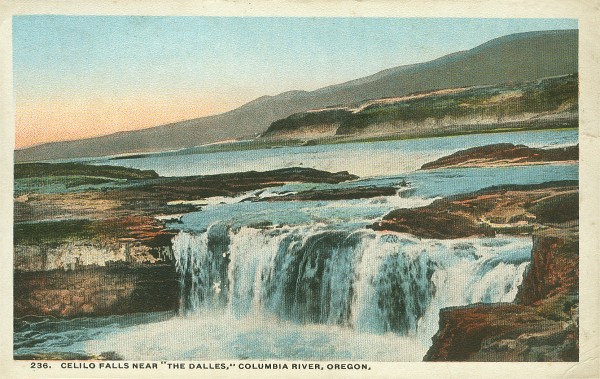
During the Lightning Talks, I talked about my Martian Math class for Saturday Academy.  This was a math class more than a programming class, but using VPython was certainly a big part of it.  I mentioned how thinking about terraforming Mars gets us thinking more about terraforming Earth, showing pictures of Celilo Falls turning the the Dalles Dam, where Google is plugged in.

Perhaps in my allotted five minutes (I used only 4.5) I failed to communicate there's a lot of published literature behind Martian Math, much of which is simply Synergetics in disguise.

Should Grok Learning really be registering an error if a student enters print("Hello World") instead of print("Hello, World").  The English are sticklers for grammar.  The missing comma strikes them as egregious.  A large percentage of students therefore initially fail to get it right.

I was up early wearing my anthropology hat, posting to MathFuture about the various brands (flavors) of mathematics that use the meme "4D".  Given my company name 4Dsolutions.net, this makes some sense.

I've been teasing apart what I call "Coxeter.4D" from "Einstein.4D" using proper names to designate namespaces (per Python).  Unless we understand there's a difference in namespaces (and what a namespace is), it's bloody hard to interject yet another sense of 4D: R. Buckminster Fuller's.

Why we might want to interject the latter has to do with the positive futurism connected thereto.

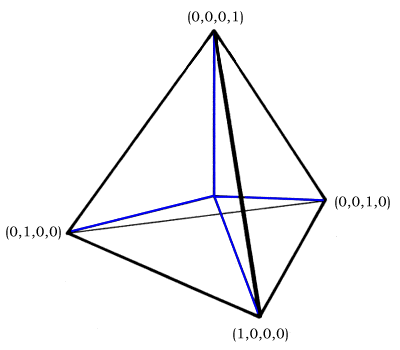
Long time readers of these blogs will know I frequently cite page 119 of Regular Polytopes by H.S.M Coxeter (that's the Dover softcover edition, 1973).  I'm doing that again for Adrius (in Lithuania) and others.


Wednesday, May 25, 2016

The Blockchain and the Global U


Avatars for blockchain and related technologies sometimes focus on anonymity as the core draw, using words like "dark money" and dredging up underworld imagery, on purpose really.  "We're not criminals, we're just dodging the power-hungry who would interfere with our freedoms" is their libertarian tone.

Without raining on that parade, I want to underline what Ethereum and other programmers are pointing out:  you might program the money to reach only a Specific Individual and have it be redeemable from a specific Catalog of Things.  The transaction is both earmarked and tied to a specific party who would need to initiate the chain of events.

The concept is far from new.  It's all about the affordability of the implementation.

Micro-payment systems coupled with "auth" (identity verification) were for the longest time an oxymoron, as the overhead of tracking bazillions of micro-payments outweighs the fees for service collected.

Tracking all those details was just not practical minus serious auditable automation.  The margins were negative, not just thin.  With computers and cryptographic algorithms on the leash, all that changes.

Once digital computers were in the picture, checking and charge card systems expanded financial services to a much larger percentage of humanity, extending credit while reducing the demand for paper money.  Yet in 2016, the majority of humanity is still unbanked.

Going the next step, taking transactions to the next level, using cell phones as devices to both send an receive payments, within specific "games" or "services", is what the new crypto-currencies are all about.  The games may be made more intelligent, and more identity-dependent.

As a work / study student in the Global U, your reward for applying yourself in biology is better access to more equipment, travel opportunities connected with your research, other goodies.  People stand to gain from your work, perhaps on a cure for cancer, and so are eager to reward you with job-relevant tools.

There's social pressure to assist people in getting their jobs done, assuming these jobs redound to our collective social benefit (true, it's not always obvious that's the case).  We compensate bus drivers to have a bus service.

The problem with cold cash is not its anonymity so much as its not having any earmarked function.  In tagging the money with what it's good for, budgeting becomes more self-enforcing through the blockchain and/or other consensus-building workflows.

Work / study students get credits, good towards better access and more privileges, without needing to get cash.  The bookkeeping system sees their choices:  which microscopes they pick, what conferences they attend.  That's not surveillance or a privacy breach, that's a student creating a profile (timeline, chronofile, log, journal).

Again, in stressing how currency may be coupled with identity, I'm not applying the wrecking ball to more anonymous schemes.  The "dark money" business stays a business.  But lets not confuse programming the blockchain in a general sense with just a few of its special case applications.

Tuesday, May 24, 2016

Junkyard Nations

A lot of pundits across the spectrum indulge in the game of "I told you so" when it comes to putting the nations into some train wreck scenario and predicting some "world war N" though with little agreement on what that number N would be.

Were WW1 and WW2 two chapters in the same war?  That's what Sheikh Imran Hosein thinks, as he predicts all manner of woes.  Or was the Cold War actually WW3?  So would it be WW2 or WW4 we're going into?  What if it's entirely cyber and therefore WW0 (inside joke)?

All Syria and Russia and Israel etc. are good for in such trash talk is as radar blips on some End Times crystal ball, playing out some farce, some wimpery "end of the world".  Some Planet of the Apes goofball major fuckup.

If this is all the language of nation-states is good for these days, then I'd say it's been seriously deprecated.  No one had to lift a finger.  Entropy is a physical principle.  Obsolesce is planned, but not necessarily by humans, is another way of saying it.

However I know some UN types still use the lingo for the betterment of humanity, and not through the lens of some apocalyptic "holy book" that one is paid to be right about. These dedicated upholders of the heritage are all that keeps that tired politico-hack language from flying apart at the seams.

A lot of us though, sensing a growing ratio of junkyard crazies wallowing in the tatters of what used to be a functional language, no longer have time to learn it to a high degree.  It's more for pigs than for pearls by this time, legal fiction for the most myopic-minded.

Engineers have real work to do.  Sitting on our butts spinning out reams of End Times PR is not considered "work" on our team (more what a burn bag is for).  Let the pundits have their Youtubes, I'm all for freedom of speech.  I'll view them asynchronously if I get to them i.e. I'm not looking for front row tickets.

Friday, May 20, 2016

Garage Purge

Staged for Transfer
:: staged for transfer ::

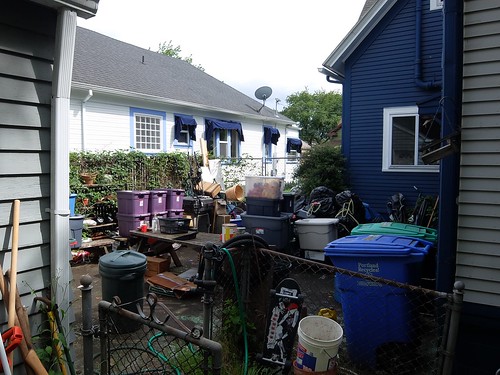
Even as I hunt for gigs, feed my on-line fans with cool content, and monitor the political sphere, my "garage karma" still dogs me.  Lets just say there's not been room for a car in many moons.

I've been thinking of that coffee table book where different lifestyle practitioners bring all their stuff out and array it for public view.  I'm doing that, bringing out big black boulders of trash.

The process is actually more finely tuned as amidst all that trash are the treasures.  Things kept in plastic tubs fared best.  The rest tended to succumb to the relentless attention of a squirrel population.  Lots of nesting and shredding has occurred.

The triage process also involves sorting.  Good Will is getting some electronics and choice clothing, books in the pipeline.  My thanks to Glenn and Deke for helping out, and Patrick.  The local church arranges for a community dumpster once a year.  That's a target.

Tuesday, May 17, 2016

Crypto Currencies


At the code school last night, I pumped Ben for insights regarding crypto-currencies, as I've raised with NPYM Friends the possibility of accepting bitcoin in some contexts.

Ben immediately directed my attention to Ethereum, a Web 3.0 initiative.  I've been immersing myself in that subculture, mostly using YouTube for that purpose.

For those just joining us, Quakerism is a decentralized role playing denomination, a network application based in 1600s innovations within the namespace of Christianity.  Power is not concentrated in any one individual.  Management is by rotation.

The Monthly Meeting, with a monthly business meeting is the Node for this network.  That our Meetings might want to develop internal currencies is no surprise in hindsight.

Perhaps it sounds paradoxical that a practice with a reputation for encouraging honesty is so interested in systems that do not require trust except in mathematical and physical principles.

"Gaming" or "scamming" or "undermining" a blockchain or other well-designed consensus protocol is difficult to impossible in a correctly implemented system, which doesn't mean bitcoin and ether are prohibiting gamification of businesses (those are different meanings of "game").

Cheating in a malicious sense can't be done against physical laws.  Illusionists give the impression it can be.

Why I in particular am researching in this direction is two-fold:

(A) I'm the clerk of the NPYM IT Committee (Oct 1, 2015 to Sept 30, 2017)

and

(B) DWA (the bookkeeping partnership I worked with) was a trusted third party of the kind Ethereum aims to replace, as no longer necessary.

Ethereum contracts are self-policing one might say.  However the trusted third parties of my generation would do well to wrap their minds around these new consensual systems and sign off, warn against, make claims of various types and so on.  Elders get looked to for such feedback, at least in the Quaker experience.

Dawn Wicca was the professional bookkeeper, the DW in DWA, passing the torch to her apprentice (not me), whereas I was an applications developer (mostly xBase / FoxPro) and curriculum designer (lots of Python).  Nonetheless, a lot of Dawn's bookkeeping savvy rubbed off by osmosis, informing my understanding of business, the socially responsible ones especially (DWA worked for idealistic nonprofits by and large).

Good to hear from Judy Smith as I was heading towards code school, stuck at a freight train crossing.  I hope to get over to Terrebonne, Oregon one of these days, in a code school bizmo maybe, provided Oregon State has a fleet ready, or were those to be 100% private sector?

Think of crypto-currency / crypto-law as ACID-compliance on steroids?  The move to distributed databases, distributed version control, led to this concept of an immutable growing code base, signature verified using hash functions to protect against bit flipping.

These crytographer-actuaries have a lot of euphemisms for people dying and losing access to private keys that way.  Instead it's always Bob losing his private key (wallet), not an instance of Bob not taking it with him.  We could say this euphemism is justifiable as whatever the circumstances, Bob is no longer able to use his wallet.  We hope he's made arrangements for this eventuality.

Wishes Upon Death is considered Oversight business in a Monthly Meeting.  I served on that committee numerous times and always encouraged polling Friends regarding how to manage cyber-credentials.  Do you wish us to retire your Facebook account?  What sort of web presence does a Friend wish to maintain?  In many cases these wishes are handled by family, however a Meeting is generally set up to serve in place of family members when appropriate.

Monday, May 09, 2016

Immersion

Routing

I'm continuing my theme of immersion in the Heartland, somewhat like the Holy Land in that both are branded regions.  Likely many Heartlands exist, certainly many Fatherlands and Motherlands.

We joked about the swarm of mothers descending upon Galo's for Mother's Day, May 8.  Galo's is a well-managed Italian restaurant near where Highway 40 intersects I-70 in Richmond, Indiana, very close to the Ohio border.

Coming back across Illinois, I tuned in more NPR, having come the other way on mostly Country and Christian Radio, with oldie Rock & Roll on that Decatur FM station.

We're about to move some works in progress, upholstery projects, from a Mazda to a studio.  Another piece came back from the studio to the apartment where I'm staying.

I have a lot of interesting photos to upload in my camera.  I don't have enough space on the hard drive, nor spare storage devices, and might as well wait for the higher bandwidth.  Optical fiber.

Pictures will include a visit to Hastings, a center for popular culture propagation, and Best Buy, where I updated myself regarding some of the latest consumer electronicsSome Bob Evans.  Many shots of the state of the art at Earlham CollegeThe graduation ceremonyGalo's.

In Springfield
:: in Springfield, IL ::

Sunday, May 01, 2016

May First, 2016

May Day 2016

I started my day by having coffee, showering, and meandering over to Multnomah Monthly Meeting.  I purchased a drawing by a guy in front of New Seasons, camped out on the sidewalk.  Carl Abbott, a Meeting Elder, agreed it could be seen as a horse.

Trevor was turning fifty today, and had arranged for a special event at Mother Foucault's, a bookstore specializing in esoteric tomes.  He has been collaborating with a small press in Baltimore, and another local artist, to bring out another edition of a forgotten early 1900s comic strip:  The Outbursts of Everett True.

Before Trevor's talk, I caught up with Jim Heuer, a stellar programmer and one of the principals with Evos SmartTools.  Jim has featured in this blog before, as a teacher of "truckology".

He knows a lot about the LTL ("less than truckload") shipping business especially, wherein companies make bids on shipper loads, and shippers choose whom to go with.  Optimizing is a difficult problem and humans still play a role, but computers make the job easier.

Jim's software smooths the whole process of working in the LTL business by turning it into a rule-based "computer game", meaning a set of processes and workflows based in computing.

By "game" I don't meant to imply anything simulated or unreal.  We're talking about real tonnage, and paying customers who use these tools every day.  Having a coherent Ux makes the work seem more game-like.  Computers have introduced gamification to the workplace.

We met at Costello's, the travelers' cafe on East Broadway.  I'd been watching a bunch of Youtubes recently, aimed at those involved in startups.  Earlier, I'd lurked in on the Stanford course about not screwing up your startup.

Is pouring old (and valuable) wine into a new startup model (bottle) a recognized way to go?  Could a new company form around Evos and take it to scale?  I wondered aloud if PSU's Business Accelerator might have any advice along these lines.

Jim is a brilliant programmer, and shares my Visual FoxPro heritage.  He uses Microsoft components to serve the web, in cahoots with Apache, but has moved a lot of the business logic over to Python, with which he communicates via Windows COM objects.  That's a diverse and inclusive skill set.  Hacking on Jim's code could be mind-expanding for a whole team. 

A lot of his data resides in the FoxPro DBF format (inherited from dBase), but with CodeBase exposing this format directly to Python.  Now that Jim has discovered MongoDB, he sees that may be his best path forward, for speed reasons in particular.

I like talking shop with Jim because we've used a lot of the same tools, but then he's a transportation engineer and knows a ton about the trucking business, which I do not, though I've been learning.

Trevor has been studying Egoism for quite awhile by now.  That school of thought was founded by Max Stirner and later picked up in the early 1900s by a colorful cast in Chicago and their Hobo College.  One of the faculty was named Sirfesser Willkesbarre.

The publisher, Underworld Amusements from Baltimore, was present for this unveiling, as was one of the artists who helped retouch and restore the Everett True comics.  I got all three collaborators to sign my copy.

Patrick helped lead the BSA troop at the beach and is back in town.  He came over to inspect the odd pooling of water in a mysterious place, far from any obvious source of water.  I called it ectoplasm as a joke.  We actually managed to find the cause, a pin-sized hole in a water jug.

Wednesday, April 27, 2016

Wanderers 2016.4.27

Brainstorming Session

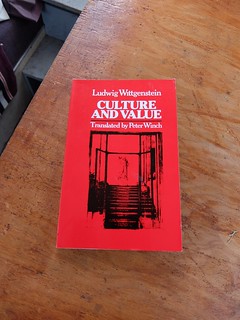
I expressed my frustration with Culture and Value to Jon Bunce.  Wittgenstein, a Vienna Circle vet, alludes in knowing tones to all these musical passages, yes by well-known composers.

It's only my ignorance that's showing through.  Nevertheless, I could use a podcast version (anyone?  Princeton?).

The podcast guides, the voices, would not need to share all of Wittgenstein's opinions, about Mahler's stuff for example.  They'd not be disciples necessarily, but would play some of these missing puzzle piece passages while trying to get at the nuances Wittgenstein was hoping to get across in referencing them.

For Wittgenstein, music had the capability, especially in the hands of some composers, to approach language in its attributes and abilities.  He used language and music as quasi-mirrors of each other, to gain deeper insights into both.

Glenn is talking about his Global Matrix as a useful summarizing tool.  Geoscope.  Macroscope.  The Christian Science folks had their Mapparium.  Yes, we're talking about a globe, which in projections gets flattened out, into a Mercator or whatever.  Glenn's matrix is a data structure.

What distinguishes the Global Matrix from the Mapparium is Glenn is really into the "hexapent" (a word he doesn't like).  Hexagonal tiling is more characteristic of certain game boards, including virtual boards like in Civilization.

We had two newcomers this morning, who've never heard Glenn present, so he had a good opportunity to summarize.  We had some interesting discussion, focusing a lot on the Internet, but ranging to other topics.

Glenn derives a lot of his stuff from scratch, like a cook who invents many great dishes that other restaurants immediately recognize but have other names for.  He builds on his own experience, as a crypt-analyst and project manager.  The flavors he comes up with are subtly different, or even surprisingly different in some cases.  Glenn has his own cuisine.  Maybe he'll succeed where few others have dared to tread.

That reminds me, last night at the dinner party, Alice named my dessert drink, Soylent + Jack Daniels, a "kirbster".  I doubt that'll stick.  We geeks already have "headless chicken" for the Bloody Mary, an allusion to the etymology of "geek".

I expressed to Jon my concern that Wanderers might seem too intimidating from the outside.  Would-be attenders might be concerned they'd be grilled, interrogated, by judgemental know-it-alls.  But that's quite far from our ideal.

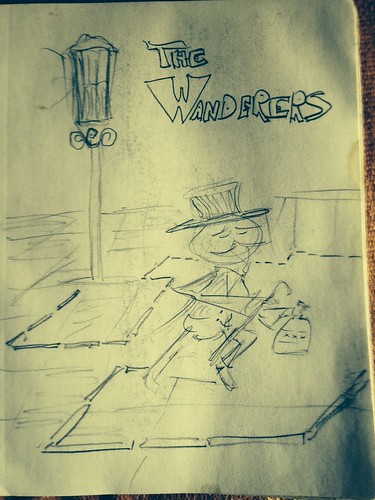
I recalled my suggested logo:  that Monopoly guy wandering on a chess board, a "random walk", with a lamp post marking its beginning, a dotted line showing his path.  Is he holding a bottle?  Is that a triple-x on the label?  He must be drunk right?  And therefore wandering.

IMG_2797

We're called Wanderers for a reason.  We don't have alcohol at our weekly meetings (we do at our Equinox and Solstice celebrations).  The wandering is more Ouija Board like at its best, recalling a Quaker meeting.  We let the spirit move the conversation.

Jon and I got to talking about David Prideaux's No Big Bang in the kitchen, reviewing some of the main memes (elevators, acceleration, gravity...).   Jon agreed that gravity affects wavelength.  Light escaping from a massive body gets redshifted.

We also agreed the Monopoly guy had a much better chance of coming back to the lamp post in a 2D matrix, rather than in a 3D matrix of XYZ cubes, or perhaps rhombic dodecahedra, if using the IVM.

Before that I was out on the porch, phoning Carol Urner (mom), presumably in transit somewhere between Cape Cod and WDC, and Patrick Barton, asking for advice.

"What's a good entry point into what we're calling 'machine learning' these days?" was the gist of my question to Patrick, and "do we have to learn R?".  I'd started reading on the topic in Safari On-Line earlier that morning.

Patrick suggested starting with a large publicly available database.  Although we talked about baseball statistics, I actually don't know if those databases are open.  I completely agree that a hallmark of that sport is its fascination with statistics.

When still with O'Reilly School, I'd suggested writing SQL-related curriculum against just such a stash, but again I have no idea to what extent this stash is available, and/or at what price.

How about a database of faces against which to run facial recognition algorithms?  We could play a game like Memory, wherein every face is twice repeated and the machine's job, after a training period, is to recognize as many pairs as at can.  Patrick suggested using mug shots of the very same baseball players (called "trading cards").

My angle on Machine Learning against Big Data is from the point of view of a code school curriculum writer / instructor, and wanting to lower a ladder to keep the topics accessible.

Where would we start with 8th graders?  I think with success stories. Voice recognition, and OCR (optical character recognition) have come a long way in my day.

"Voice recognition" does not necessarily mean recognizing "who is talking" although that could be an application (biometrics), and would be more like fingerprint or retinal pattern matching (used to authenticate and/or determine identity). This is more Buzz's area.

The customary meaning of "voice recognition" in 2016 is that the computer correctly transcribe into writing what the speaker has said.  Given advances in this area (didn't Tim Peters do work here?), people are talking into their devices a lot more, asking questions, and getting answers.

Great Stuff!

Monday, April 25, 2016

Patterns in Primes


I've been enjoying Dr. Terry Tao's enlightening patter regarding prime numbers and their statistical distribution along the number line.  Important results stretch back thousands of year's, starting with a proof credited to Euclid (as so many are) that no greatest prime number exists.

The Fundamental Theorem of Arithmetic is a next one:  all natural numbers decompose into prime factors except 1, with primes being those with precisely one factor (almost-primes have two).

Terry breaks it down for us into the multiplicative and additive branches of study.  Multiplied primes have received more attention, historically speaking.  In the additive world, we're looking for arithmetic series, and the distribution of intervals.

Do we ever run out of twinned primes, primes only two apart, like 3 and 5, 41 and 43?

As of when these Youtubes were made, we know if we keep twins, cousins, and sexies together in the set, we'll never run out (that set is infinite), but there's still no recognized proof that just twins will occur infinitely often ("i.o.") though Terry suspects that they do.

Primes do get more sparse lets remember i.e. they do tend to spread out.

What if only sexies remain, once we're out far enough i.e. some lower bound exists after which twins will no longer occur?  This result is not much expected, but at this point is hard to rule out.

Many interesting results have been obtained, including that the number of primes between n and 2n approaches n/log(n) as n increases.  That's log to the base e.

This is called the Prime Number Theorem or PNT and was known by the 1800s.

As a programming challenge, why not explore this assertion empirically?  I will make that suggestion on mathfuture, where I'm data warehousing some new curriculum ideas.

I've been developing a so-called "lambda calculus" track for 9-12 grade level topics, shades of Hermann (sp?) on sci.math, way back in the 1990s (he was a huge lambda calculus booster, by which he meant something more hard core and formal in meaning, and to which I am not opposed).

Dr. Tao knows how to continue the history of number theoretic research into primes right up to the last minute, owing to his front row seat as an active contributor to this literature.

Saturday, April 23, 2016

Seder 2016

Seder 2016

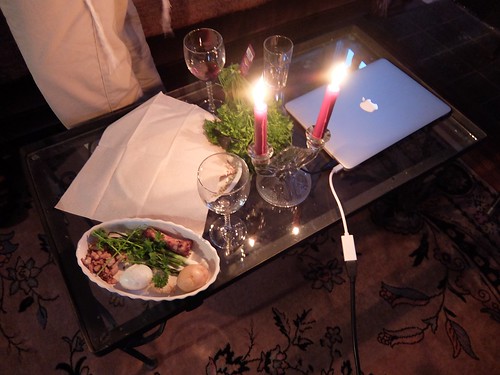
I joined the Potkin brothers for Seder on Friday, the Jewish Passover celebration, which commemorates the escape from tyranny to freedom, both thousands of years ago, as narrated in the Book of Exodus, and in a more eternal sense, every day. 

The ritual has many parts to it, involving especially prepared foods and wine.  Alan presided, in addition to having done a lot of the prep.  I'd been to Seders before, but not many.

Since Alan and his wife have both devoted their careers to curating, often digitally, a lot of Buddhist culture, especially in Southeast Asia (they lived in Laos for many years), why not turn these same skills towards restoring and sharing some aspects of Jewish culture as well?

Illustrated storytelling is at the heart of such anthropology.  Alan had some material ready for sharing on his computer, hooked to an HDTV.

Alan gave the backstory as to how he came to take his Jewish heritage more seriously, thanks to his appointment with destiny in Vietnam.

He'd been drafted out of Bard College, an intellectual Brooklyn Jew who had soured on his own Jewishness, owing to oppressive aspects of his childhood and young adulthood.

As an infantryman in the Army, he got into a firefight, with grenades and all the rest of it.  The shrapnel in his jugular, which no one knew for sure was there, but some suspected, took many hours to to fully express its presence.

His case kept moving to the bottom of the triage list as he spent the day getting shunted from facility to facility in search of a working X-ray machine.  When he finally started losing blood in earnest, he was fortunately in a place that could do something about it and his life was saved.

That's when Alan met Morton Singer, an Army chaplain looking after his fellow Jews, rather few and far between among the enlisted.

Even though Alan had "no preference" on his dog tag, Singer recognized a fellow New York Jew.  He and Alan had some serious soul-searching conversations, and to the delight of Alan's parents, Alan returned to the fold.

As it turned out, Morton's young family lived only block's away from Alan's parents.  Small world.

Later, Alan learned that his new mentor and friend had been killed in a plane crash, owing to a neglectful refueler putting in the wrong type of fuel.  The C-123 pancaked at the end of the runway, killing at least half aboard, including Captain Singer.

Alan's telling contained many more details than shared above, and Jonathan worried Alan might be going overboard with the war story.  What worked to everyone's advantage was about only half those present were Jewish, so no one really knew what to expect.

At least one other Vietnam War vet was in our party.  He later thanked Alan for sharing his story.  We all applauded the Potkin brothers for hosting this special event.

A grand time was had by all.  Passover is a celebration, not a time for mourning especially.  The invited guests were jovial and a source of interesting conversation.

The fact that the next day was Shakespeare's birthday added to the literary and multi-cultural flavor of the event.

Alan drew an analogy between the Jews and the Laotians, forced as slaves to build a certain grand canal in Bangkok by the conquering "Egyptian" Siamese.  Helping people better appreciate history was a big part of what we were up to I'd say.

Tuesday, April 19, 2016

A Wanderers Presentation

HQS

I've written about Alan Potkin before, as a gifted geek but more from the satellite photography side of the business.

Alan used to sell a poster, a satellite picture of the Bay Area from space, which helped finance his grad school days lifestyle.  He shared it in the course of his presentation.

His poster reminded me of Stewart Brand and his "why haven't we seen any pictures of the whole earth yet?" (this was before Google Earth or any of that, in the years leading up to the first Whole Earth Catalog).

Tonight's audience included at least two attenders I've never met.  They asked interesting questions and participated in the discussion of the trade-offs.  Major dams have their consequences, that's just physics, some considered beneficial.

Alan's main focus was hydro-electric projects, existing, planned, postponed, dismantled.  In Burma, Laos,  However he reviewed, in more detail than I'd heard, his role in restoring a famous Lao version of the Ramayana to the newer version of a certain temple.

Detailed photographs from the destroyed temple were projected on the walls of the new temple using techniques Alan pioneered, after some pretty serious processing.  Skilled artists turned the projections back into murals.

These projects are connected, in that both feature Alan's meticulous approach to curating and chronicling findings by means of interlinking PDFs, into which he integrates text and pictures, movies.

Why aren't these techniques standard among those charged with writing environmental impact reports?  Why is just dry text and tabulated data considered sufficient?  Tufte's name came up.

Alan's technique evolved independently of the Internet and its way of doing multimedia, perhaps only locally ("self serve") using 127.0.0.1.

I enjoyed spending time with Alan and his brother Jonathan in downtown Portland earlier, with Glenn Stockton in my company.

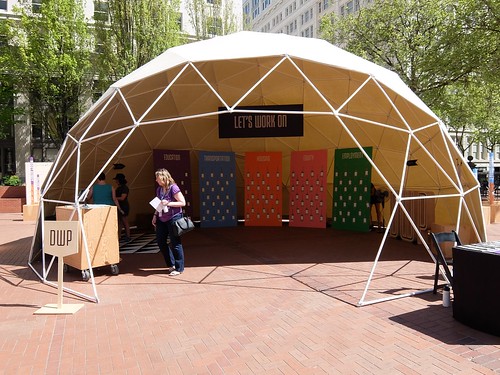
Glenn and I took the bus to the Design Week Portland headquarters in Pioneer Courthouse Square (a geodesic dome) and then met up with the two brothers near the KGW studio entrance (part of the Square).

We ended up at the Yard House for lunch, near the Apple Store.  Alan's presentation was later that evening at the Linus Pauling House.
Presenting at Thirsters
:: Alan presenting at Thirsters two days later ::

Sunday, April 17, 2016

Learnability (continued)


Ashley may be expressing some ambivalence here, about the direction of ES6 / ES7, I find it somewhat hard to tell.

She's loyal to the concept of teaching the language, but worries, rightly, about syntactic sugar obscuring and occluding the more deeply unifying concepts.

The best way to learn is to teach, that she knows.

Some of the new syntax she's clearly excited about, namely "destructuring".

The JavaScript community seems quite comfortable with "transpilers" such as Babel, which re-casts ES7/ES6 semantics in an earlier version.

This developer raves about destructuring too.


Other transpilers go to ES-whatever from TypeScript, CoffeeScript, ClojureScript...


Here's another one by Ashley helping us understand the npm (Node Package Manager) ecosystem.  She's right, the data are pretty sketchy.


Thursday, April 14, 2016

Musings on JavaScript

:: Douglas Crockford ::

I'm sorting through code school videos in the Youtube repository, and others, looking for exemplary recordings.  Today, I'm combing through Douglas Crockford movies.

No, you won't find him in IMDB I don't think (OK, maybe), but he's a star nonetheless.  He invented JSON and JSLint after having an epiphany that JavaScript was really a lot like Scheme under the hood (plus Self, and HyperCard) -- no accident given the history -- and that realization made him really brilliant.

Zooming out, it's the Lessons he teaches we should take to heart:  it's not that what we have today is the way it is because it had to be this way, nor because this way is best.

In the case of JavaScript, the vision of the Web was taking off and Netscape wanted to launch LiveScript at a critical time, when we needed previews.  What would this Web come to be?  Big business was willing to gamble.  Little puppet shows, with some LiveScript pulling the strings, would say a lot about the potential future, and so it shipped, one might say as a part of a much-needed demo.

And that, my children, is what we're calling JavaScript today.  Or ES6 or whatever we're up to.

Crockford is returning to his roots in wanting to dive deep into recursion, with tail optimized calls.  "JS will finally be a real functional programming language", he exclaims.

So lets remember that Lesson:  it's not the best way, it's not the only way, it's just the way, whatever it is.

We're stuck along some axes more than others.

We might define the axes in a negative sense, as precisely those things which cannot happen, leaving what can, constrained, as the allowed space of what's next.  Do we know enough about the rules to preclude... [you name it]?

Let me digress to mention a movie again:  Ten Cloverfield Lane.  How would you ramp it up, given a budget, in the direction of more and more surreal?

In a way I found it compelling how deeply into surrealism our imagination could take us.  Yet my reaction was the same as hers:  "oh gimme a break".

Like, what "miracle" would say to you that "reality is broken"?  Something impossible that is, like the aliens landing.  The thing is:  might not aliens land?

You'd likely not be not surprised to find out many humans believe we've already been invaded, with much disagreement on who by or what the symptoms are.  Most mythologies don't cast the aliens as helping us hold it together, much as the good Angels used to do (the bad ones worked for some Lucy or someone).

Our language leaves that loophole open, for "space invaders" -- one might say.  We're at the twilight of the empirical in entertaining such beliefs, on the fence not so much with what's false as what it makes no sense to say.  What makes us think our language makes us capable of thinking "anything we like"?  I'd say more the opposite is the case.

OK, digression over, sorry.  JavaScript is where I'm focused.

Why?

1.  Because Portland has long had its Admirers of JavaScript (a meetup and listserv I've been a part of).  "I won't need loops anymore, because we'll have tail calls" (Crockford again).

2.  But more than that:  it's a hugely prevalent language that's worth learning from the ground up, perhaps using Crockford's minimalist approach, which allows him to call it "silly" (just a prototype after all) while staying fairly proud of his own use of it (as audited by JSLint).

No code school gets away without teaching JavaScript at some level, and in a hand-wavy way is worse.  I want to get it more thoroughly myself, for a host of reasons, such as looming "boot camps" for math teachers (I use quotes to suggest they're maybe really not as strenuous as the "boot camp" metaphor makes out).

The real question is whether to have it at all levels, client through server, from Angular to Node to MongoDB.

I lean towards wanting to tackle more than one language and SQL, HTML and CSS by themselves don't stand up as Turing Complete if ya know what I mean.

JavaScript and something else, maybe Clojure.

Maybe Java or Python or C# (as a trio?), with an emphasis on whichever one the mentor wants to pick.  We go with the strengths of the mentor, why not, without discouraging cross-training and branching out.

Do we work in .NET or not?  I don't see why not.  I'm not against using free teaser products that hint at more and even better for pay.  I understand money is a medium.  Open Source is often itself the teaser, meaning a company uses it to showcase what must be a vibrant culture, to hatch and sustain such a cool thing.  I'm neither cynical about nor disapproving of this practice, quite the contrary.

Code schools that start small may be tempted to stretch too thin and teach too many subjects, because the materials don't teach themselves and people need mentors, both synchronous and asynchronous (either the adjective and the adverb work here).

A code school without mentors is not so much an oxymoron as one with ghost mentors and/or unsung volunteers, which may be people willing to guinea pig themselves (like "Guinea Pig B", aka Bucky aka RBF).  That's pretty extreme though.  The word "school" has never been synonymous with "robot" and it's a stretch to make it mean that right now.

My theory is the geek etymology, with roots in the carnival business, show business more generally (even stage magic), comes with this idea of "rides" which are indeed "engines" that create experiences, such as roller coasters and Ferris wheels.

Lets remember these are real characteristics of the user experience in cyber-ville:  we do build little rides and theme parks for people (they're called web sites) that treat everyone the same way.  There's lots of automaticity involved, but nevertheless, every pinball game is different.

What I hadn't realized about JavaScript is its deep investment in IEEE 754 floating type as the only type, whereas Douglas is sensitive to the COBOL crowd's need for reliable monetary computations, and true Decimal computations.

We have the Decimal type in Python.  There's an advantage to having several Number types.

DEC64 sounds smart though.

He's entirely open to a next language, star Crockford is.  He's ready to create the space for us to try something new.

Why not something parallel to the Internet to fall back on, made of different parts?  I saw a talk on that topic as well, by someone else stellar.

Call it research.  Call it your company's Diversity policy, in action.  I'm not the one to boss you around, no worries.  I'm just celebrating our liberal openness to new languages and alternatives to what we tend to take for granted.

Having working languages already, dependable, responsible, is a gift as well.  In clinking my glass and toasting the future, I'm not thereby dissing the past, a misunderstanding that's easy to have, sometimes all too hard to let go of.

"We never change the minds... we just have to wait for them to die" (laughter, applause).  "Can we get rid of GOTO now?"  Hah hah.

He's really into lambdas, which is spelled 'function' in JavaScript.  You don't have to name it or remember it, just do it.

What does he think about Go I wonder, Crockford I mean?

That's something I could Google up no doubt, or even Bing.  Is Go not close to the metal enough to qualify as a systems language?

What I wonder, given such as ClojureScript and Brython (a topic in Cuba these days), is:  if JavaScript is to be seen as the Assembler of the Internet, should we maybe just use it like that, to implement mostly other languages?

Stay in Clojure or Python in the client, knowing you've got some V8 or whatever under the hood?

Is JavaScript more like our most refined grade of engine oil in Web 3.0?  Made of only the good parts I mean?

Monday, April 11, 2016

A Code School Evening


I took my time getting to Tillikum Crossing by bus and light rail, having plenty to read, including Southeast Examiner (neighborhood news) and Willamette Week (WW, April 6 "can't believe I ate the whole thing" cover, 2016).

I'd eaten nothing but Soylent all day.  The Flying Elephant Delicatessen was singing a siren's song when I got off the Max and I headed straight to it.

WW was far harder on 10 Cloverfield Lane than I'd be, were I to write my full movie review.

Yes, it turns absurdist, almost dada at the end, but surrealism is the province of science fiction, to which this film lays claim.  It's a genre question.  I saw it in that place where comedy / sitcom meets horror (more Joss Whedon maybe)?

I also saw it as a throwback to stage theater, with high quality close-up performances, most the emphasis on the acting.  Another really good movie like that, also science fiction:  Ex Machina.

I then wandered to Starbucks for an hour of black coffee and WiFi, before ascending the hill behind the tracks, to PDX Code Guild, passing under a maze of freeway overpasses in route.

Many of the regulars were curious about Elm, a new web dev technology, and so were attending its debut meetup tonight.  So attendance at this Monday night Python meetup was initially fairly light... until the tour group showed up.

Greg and Margaux, of workingIT (dot com) arrived soon after I'd set up my second monitor, borrowed from the standing station.  Greg is a professional auditor and expert in risk-based thinking (RBT), with a background in homeland security.

His daughter Margaux was interested in interviewing some of her peers familiar with the code school experience.

Chelsea and Katie practically live at the code school, and were helping orient a newcomer.  Chris (CTO) helped install Python on the newcomer's laptop.  That's pretty much a first step where <guild /> is concerned.

The code schooler across from me wanted to know more about Vagrant, which I at first confused with some Mozilla tool to create random noise for web clients, simulating a VUCA world.

But that's not what Vagrant is at all.  I was confusing Vagrant with Mozilla's Vaurien, used in front of Nginx, by Luciano Ramalho in Fluent Python to deliberately create a choppy Internet experience for browser testing purposes.

Vagrant, in contrast, works with a hypervisor, like VirtualBox or VMware, to smooth the developer experience in mixed OS settings (very common).  I need to learn more.  Good thing I have Safari.

I hooked up a larger monitor so I could show off some of my own projects, for example Peter Farrell's rotating letter F, controlled in Pygame.

I'd needed a gfortran compiler (courtesy of gcc) to get that demo working, and was eager to show off my chops in getting Pygame to actually work on El Capitan.  I was hoping for some applause and approval I suppose, kudos.

I'd also planned to boot up Ted Kosan's MathPiper, a Java-based computer algebra system, but also a study in the generic power of JEdit to run multiple languages, including Clojure.  He'd sent me instructions for getting my tetravolumes demo going.

I also showed off O'Reilly Safari, where I go for a lot of my readings (like tonight's on Vagrant for example).

As I was writing in a memo to Charlie earlier today, I think paywalls like Lydna's and Pluralsight are fantastic for what they have (I've learned plenty from both), however in IT we need to read books a lot too, so paywalls like O'Reilly's need to stay in the game.

I didn't get a picture of the tour group.  Sheri took them off somewhere, and probably out of 2626 to the Business Accelerator building just up the street.  That's where I taught Intro to Programming (accelerated version), which I'd gladly teach again.

Greg and Margaux gave me a ride home, right to my front door.  A productive evening!

Saturday, April 09, 2016

Learnability Versus Complexity


I enjoyed the above presentation by John Allsopp, regarding how we're trading away learnability, in exchange for shorter term convenience, ease.  Are we being lazy in the wrong way?

For those unused to "geek", the word "lazy" may always have negative connotations but it has a positive spin as well:  not too busy in the sense of overwhelmed by urgency (crazed).

Fully mastering the tools that we have, versus frantically trying and throwing away, is what saves us from perpetual infancy.  Complexity is often a function of a lack of mastery.

The vicious circle is: unnecessary complexity detracts from learnability which discourages mastery even more.

Monday, April 04, 2016

Americana


I was chatting with Glenn today, over lunch at Skavone's, about I-5 as an institution, part of the larger I-system, a network of freeways (that sometimes charge a toll).

I'd just driven several hundred miles on I-5 over the weekend:  Portland -> Bellevue -> Tulalip Country -> Stillaguamish Country -> back to Portland.

Freeway means "restricted access"; the only way on or off is via interchange.  They're more restrictive than highways in that way, making higher speeds possible.

Where these exchanges get placed can make or break a local economy.  Congressmen wield power over some of these nuts and bolts.

Glenn knows a lot about the impact of freeways on local highway culture.  The case of Route 66 is famous.  The animated feature Cars (Disney) explores this theme, much as Who Killed Roger Rabbit explored the impact of cars on streetcars.

Glenn filled me on about Harvey Girls, the waitresses who staffed Frank Harvey's chain of track-side restaurants and hotels.  Harvey had an exclusive agreement with Santa Fe railroad.  His restaurants revolutionized the food services industry, setting a new and higher standard for what the general public might expect.

Learning this Americana proved a missing puzzle piece for me.  I'm following up tonight, doing more research.

Sunday, March 27, 2016

Easter 2016


Multnomah Meeting, "Quakers", was close to full today, though we did have some empty chairs, which is good.  I came early for Sunday Morning Adult Discussion (SMAD), an ongoing group with a rotating facilitator.  Today's theme was "respect" as in "what is it, and what would it be like to both receive and give more of it?"

I was able to get my new smartphone on the Wifi easily.  MMM is open to members of the general public, although there's a password, like at a Coffee Shop.

As I was chatting with the Web Keeper a member of Oversight entered the conversation to share about difficulties getting passed the login.  Multnomah Meeting somewhat unfortunately decided it needed to restrict login credentials to the select few able to view the monthly newsletter.

From my angle, that's unnecessary overhead, and a newsletter could be subscriber-based only if not web-published.

Getting would-be recipients of regular publications to join a listserv is easier than trying to maintain website login credentials but then I'm not involved in this Monthly Meeting's IT Committee and had nothing to do with the move to FGC Cloud Services either.

My injuries from the fall on Mt. Tabor must not be too serious as I was able to walk with a fairly normal gait both too and from the meetinghouse.

I shared that code for computing Easter on the mathfuture list, in one of the end notes.

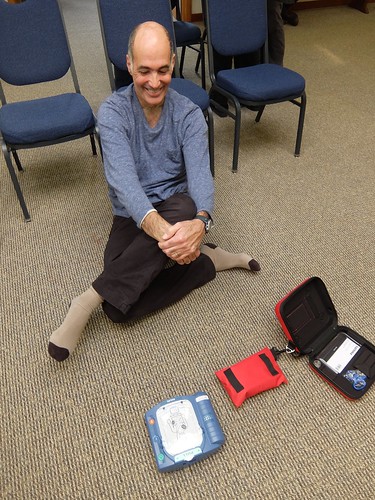
In the spirit of sharing the Easter theme of rejuvenation, even resurrection, one of our medical doctors went over the use of our in-house defibrillator.

DSCF3935

Friday, March 25, 2016

Twists and Turns

Uncle Bill's Visits

 I've been feeling on a longer leash, as no longer a dog's caretaker, and spent an extra long time downtown yesterday, meeting Uncle Bill's train, having lunch at Ringler's and re-depositing him at Union Station, with a quick run through Powell's.

Uncle Bill has a walker and parking is scarce, however that proved the ideal combination.  I used the City Park by the Multnomah County Library and he was able to make it to Ringler's, on Burnside from there, passing by Jake's in route.

The 15 minute spot near the book store proved the ideal pickup point and he was back at the station in time for the 4:05 PM, having arrived, early, from Seattle, on the 1:50 PM Coast Starlight.  He was just out having an adventure, a former mining engineer at ninety-one.

Then I stayed downtown, a luxury, until Patrick could join me, at a Rogue outlet near the Python User Group meetup.  I went back to Powell's and studied their current Python book collection in particular -- I'm talking about the computer language, popular in code schools and one I've taught for a living.

The Portland Python User Group talk was high quality, about civil engineering, the scipy stack, Anaconda and Jupyter Notebooks -- a lot of the same stuff I'm into.  I left feeling confidant the information I've been sharing with Californians (a night school gig) was on the money.

I also reconnected with one of my code school students.  I offered a course in Accelerated Programming as a public service, at PSU's Business Accelerator Center.  Since then, I've been in contact with other brain-stormers in the code school business, an exciting area these days, maybe taking off in Portland, once named Capital of Open Source by Christian Science Monitor.

What happened today was less smooth sailing however.  I hit the micro-gym, then Mt. Tabor, and all was going fine until my routine descent.  The weather was decent, better than decent.

One of the sloping sidewalks near the park entrance is uber-slick with seasonal moss, very ice-like, and down I went all akimbo.  The right ankle got stretched yet again.  Both ankles have taken some abuse of late.  I was hoping to minimize the stress, not set myself back again.

DSCF4004
:: slip zone -- newly exposed moss ::

I hobbled to the Hawthorne bus 14, re-buying the Trimet Ticket app, this being a new phone (HTC running Marshmallow). I was in the role of a grimacing cripple, and only just made it to Townsend Tea on Division, where I met up with Lindsey per our plan.  I used the torture taxi to get there, but then only found parking blocks away.

I'll go for ice and warm packs and take some ibuprofen.

Hey, it coulda been worse.  I didn't hit my head.

At the tea house I pampered myself with an "infantile regression" drink:  bubble tea made from coconut-flavored roiboos with succulent tapioca pearls, sucked through a fat straw stuck through a plastic diaphragm (more packaging than Lindsey could approve).  Yes, it's a silly drink, imbibed mostly for entertainment, but it helped me keep my attention on Lindsey's new plans and off my sore foot.

At the User Group I asked about hexapent tiling, how frequent in his line of work, rubbing shoulders with ESRI and so on.  At the data sampling level, poles in the ground, cell towers, the hexagonal tiling suggests itself, but when modeling the coordinates are always XY (lat / long) or XYZ, so in that sense, the data is not using quadrays or anything like that.

Patrick and I are engaged in discussions of mesh-netting the Everglades, extending cell service to "wastelands" where no Verizon customers are likely to hang out.  But in the Internet of Things era, cell service subscribers may be ownerless devices, too numerous to individually have owners, like chips on a board.  Spread out across an ecosystem, these devices chirp and chat about who is sharing the forest.  Pythons?  In the Everglades, those have been a problem.  Patrick is working on it.

Wednesday, March 23, 2016

A Dog's Life

Sarah the Dog

I've been giving Sarah a long life even though she stopped being able to walk some time ago. '

She's had a healthy appetite, for food, for life more generally. Having a companion at my feet as I kicked back in the big chair, was archetypally satisfying.

However she's gone downhill rather precipitously in the last few days and I think it's time for compassionate end of life care i.e. it's time to take her to the vet to be euthanized.  I have some pain killers but that's a stop gap.  She's clearly become more miserable, not to mention skeletal.

Most people would have put her down months earlier.  A judgement call.

Thank you Sarah, for your long life with our family and all you contributed to our world.

You've been a fantastic dog.

Friday, March 18, 2016

Equinox 2016

Spring Equinox 2016

We all fit around the Pauling House table this time, many of the usual suspects.

Steve Mastin was the first to leave eager to get home while still daylight.  Daylight savings time has only just begun.

Steve's estate is getting pummeled by steady 25 mph winds with gusts up to 60 mph.  We call these the "east winds" and they funnel through the gorge, bringing a cold blast to the East Side especially, as in Gresham (where Steve lives) and Troutdale.

I'd picked Lindsey up at PDX International earlier.  She was coming in by shuttle bus from Corvallis / OSU, bringing impressively heavy bags.

I fought traffic on the Banfield to my exit at 43rd, as we talked about her first semester and pending tour, stopping at Blue House on the way to John's Landing, where we sampled Szechuan Chef and Pier One Imports. I was in chauffeur mode, glad to perform some service for an MVP.

We'd had Szechuan within walking distance of Blue House:  Lucky Strike, in the same building as Hawthorne Theater.  One might think the loud music events within the same building would making fine dining impossible by I never found that to be a problem.  Thick brick.

Lucky Strike closed because the rents went up.  My Chinese food experts circled this place on Macadam as worth a try, along with another place in Sellwood.

Lindsey checked in with a health professional next, also on Macadam, while I took pictures of the handsome river front properties, right across from Ross Island. She loaded up on supplements to help her through a next sojourn in Kathmandu (Patan).

The earthquakes were a year ago.  She was there then too.

She has yet more supplements to pick up in Lake Oswego.

Lindsey's lot as a foreigner is somewhat lonely and difficult in that densely urban environment where she's seen as a "walking ATM" as she puts it.  She has a tight budget to pay her teachers, but to outsiders that looks like deep pockets and an open invitation to further capitalize.

She's learning Newar Charyra Nritya and getting credit towards her BA in so doing, with a PhD to follow most likely.

Barry brought the pork ribs, which Marianne Buchwalter praised, asking for the recipe.  He uses a large grill, which starts open then closes for the tenderizing phase.  He uses only salt and pepper for seasoning.

Nirel and Lindsey -- who showed up on foot after I'd left her cashed out on the couch -- fell into an earnest conversation.  Nirel is well traveled, including in India.  We'd all three been under the weather, starting about two to three weeks ago, when I ferried Lindsey to a mosque, more homework for OSU.

Then the master of ceremonies (not me) suggested we all join in a single conversation, which we did.

Lindsey took the stage given her interesting karma (life path). Dick Pugh suggested she get her degree in cultural anthropology, although switching from religious studies at this point is not really in the cards.  Marianne asked me who Dick was (we don't all know each other).

Marianne had just finished a writing course taught by the author of a novel Zazen, which I added there and then to my Kindle.   By "Kindle" I mean several devices, least of all my actual Kindle which sits unused and discharged, despite its handsome graphite display.

I favor using my Samsung tablet for reading what I buy for Kindle, using the Kindle app.  Otherwise I might read on my phone, until recently a Droid Razr from Motorola.  I just switched to an HTC One M9 which I think will fight me less (it's also from Motorola, but is a much more advanced Droid).

Of course Marianne and I talked about our children and grandchildren, we always do.

Nirel and Marianne then stuck up a conversation in French.  I tried to listen in.  I chatted with Steve Spiegel about Italy.  We'd both toured there in various capacities, me as an elementary then middle schooler, from the late sixties to early seventies.  I was in Manila by the end of ninth grade, with a sojourn in Bradenton, Florida at Southeast High.

I brought the lentils again.  Glenn brought his signature chili.  Good seeing Christine.  S'been awhile.

Remembering Chuck Bolton.