Friday, January 28, 2022

Disambiguation


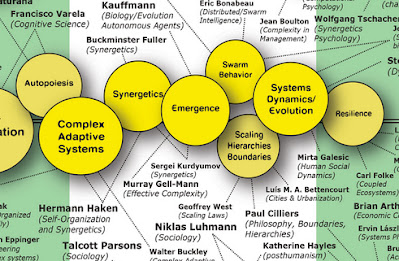
I remarked to the TrimTabbers recently, that when I joined academia.edu, and began surveying the Synergetics literature, I was surprised to find how much the Russians had embraced the Hermann Haken work by that title, while ignoring the all American classic, Bucky Fuller's.

Since that time, I've been doing my part to counter all the confusion occasioned, not only by conflating two very different operational domains, but by the issue of name collisions more generally.  In Python, we know the solution to be namespaces, and that usage has caught on.  

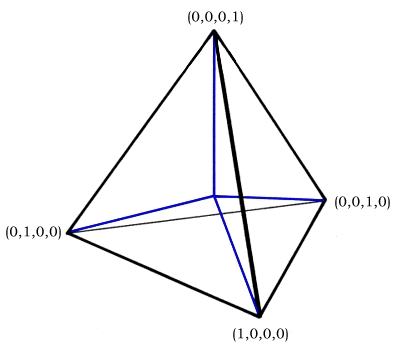
We even have dot notation in our formal (as in machine executable) logic, so we can say Coxeter.4d and understand this refers to extended Euclideanism, whereas Einstein.4d refers to (3d + time), relating to how time/size is rolled into one energy ball in the contemporary physics namespace.  Fuller.4d is yet something else again, having something to do with the simplex, if I may flex my American vocabulary.

In the namespace of Wikipedia, we speak of disambiguation. Vestigial drafts of the page in question may suggest a time when Fuller and Haken philosophies might have been conflated to a single entry. Fortunately, bifurcation happened and the Fuller and Haken works by the same title got separate treatment. That allowed Fuller's to get a direct link from Tetrahedron, tying together memes that need to be emphasized to keep our story coherent.


Saturday, January 01, 2022

Happy New Year 2021 - 2022: School of Tomorrow

My video coincides with a writing blitz, ostensibly in response to Curt's call for content, given a new BFI website going in. I'd started with the opening paragraphs a couple weeks ago, and the piece had mushroomed on Github ever since.

Yes, this is a time of family gatherings and/or family consciously choosing to play it safe in our second year of covid, when variants name delta and omicron were all the buzz.  

However our family has established a pattern of scholarship and learning around Christmas, as you'll find if you consult these blogs going back.  Our default gift giving gathering had become Laurie's Hanukah party.  However these rituals were all disrupted.

The TrimTab Book Club is Curt's project.  I didn't learn of it right away and was invited to join around the time Princeton's architecture program was a main focus, number twelve on CJ's reading list for last year: R. Buckminster Fuller: pattern-thinking by Daniel López-Pérez (Spain, 2020). Bucky had taught at Princeton that time. This time a core focus with the Geoscope, as an idea.

I'm thinking in terms of movie-making in my year end video, by contrasting possibilities for the future as I would movies we might want to make, or see made.  

Some resource hogs are hell bent on continuing to waste.  

My editorial sense tells me we can't spare the time on such pointless detours.  Any wars between Russia and Ukraine for example, have to come across as both avoidable and pointless.  My brand of cold warrior is about keeping it too cold for the hot heads to get their favored fireworks going.  Meaningless fevered dreams needn't gain traction, praise Allah.

Monday, December 20, 2021

Opportunity Cost


I'm ready for a sprawling network of quasi-academic institutions, with more military levels of risk, in terms of the dangers of leaping from helicopters or donning scuba, with the curriculum intelligently redesigned, to include, for example, American philosophy.

However, my fellow chrono-bums (cronies) are more into robot re-enactments of WW2 scenarios, with some "evil communists" in the picture although it's hard to say exactly how that works.  

So many DC roles are defined as "X vis-a-vis the former Soviet Union" i.e. the Russians moved on, but the Americans are still stuck in the 1980s, reliving Reagan and believing their own fantasy TV shows.  

Out to lunch in other words.

So nothing much is getting done, of a materially beneficial nature.  

We can keep hammering on the metaphysics until the cows come home, or is it the chickens that come home to roost?  Something animal related.  Something about a farm.  That would connote basic macro-economics, which is what this is.  

If you're coward who can't face your responsibility to make the world work, then you'll take up arms and hope to die a hero for no good reason other than what your village elders managed to concoct -- something about "communists" or "authoritarians" -- you know, the ones who assume authority to destroy the earth in the name of their stupid and obsolete fantasies?

If you want more self understanding, you will work to provide yourself and others with more opportunities for travel, and not just to resort destinations for conferences.  

My Truckers for Peace was / is a refreshing break from the usual format, involving more heavy equipment, but not degenerating into toting WMDs around (highly unfashionable in my book).

Friday, December 10, 2021

Metropolis (movie review)

I haven't been doing movie reviews, and I doubt readers notice.  Even when I did them quite a bit, they wouldn't always stay on topic and just focus on the movie in question.

Starting with the facts:  I told Glenn I was sure I'd seen Metropolis at some point, hasn't everybody? It's one of those Citizen Kane type films, archetypal.  And so it is.  But I'd never seen it.  Excerpts maybe.  

And this from the guy who went downtown five weekends in a row to watch that fifteen hour odyssey about film making.  I'll have to link to it.

The film is German, released in 1925, and as shared on this Multnomah County Library DVD is to some unavoidable extent a reconstruction.  All the real footage that remains, is used.  Some captions are added to keep the storylines clear, which is important, as the storylines twist around quite a bit, with lots of spying and people outsmarting one another.

A privileged son is turned off by the insipid shallowness of his padded existence and catches a glimpse of his heartthrob from the other side of the tracks, from the Morlockish underworld of the downtrodden proletariat.  

The Morlocks, if you don't recall, were the subsurface technologists who kept civilization going in The Time Machine by H.G. Wells.  I'm borrowing some of that imagery.

The hero starts out Eloi (a privileged child-like surface-dweller) but is determined to discover the depths of his own father's depravity in chasing his heart throb.  

When it comes to exploiting the underclass (his dad is the industrial overlord of this whole Metropolis project, the Tower of Babel in particular).

I should probably go no further without stating the thesis and teaching put forward explicitly by the film: the heart is what mediates between head and hand, meaning if you think of something you want to have happen, it needs to filter through the heart, and be real, in the heartfelt sense, to lead to right action.

The father decides to deceive the son into seeing his heart throb is really a slut (thanks to the stunt double robot he has cast in her place), but the son isn't fooled for long and the ruse backfires, and seemingly plays into the hands of the robotics expert originally charged with the cloning project.  

The slut robot is programmed to run amok, to stir up worker rage, while meanwhile the actual heart throb, good to the bone, sets about rescuing the children, who will surely be impacted when the workers, whipped into a mob frenzy, decide to destroy the machines.

The evil dad (the dark father or "darth vader") has been wanting to provoke the workers all along, so they'll do something he can use as an excuse to use violence against them.  

The whole seething mess of unleashed pathos is ultimately self destructive and both the above ground and below ground aspects of Metropolis are existentially threatened.  

This brings people to their senses, at least a little, and the mob figures out they've been duped, multiple times.  The dad and the workers reconcile, as the hero rescues the heart throb from the robotics guy, who falls to his death (spoiler alert) in the denouement.

That's all me regurgitating much of the plot and calling it a movie review.  Glenn and I were agog at its sophistication, for one of the earliest commercial movies.  Glenn said Hitler saw it and liked it.  That's what they say about The Great Dictator by Charlie Chaplin as well (that Hitler found it funny).  For his part, Chaplin said he wouldn't have made the film had he understood the full scope of the ongoing holocaust.

Carol (92) watched the film with us (Glenn and I).  We paused the film for popcorn and beer. I expect to watch the commentary on another occasion.

Wednesday, November 24, 2021

Tuesday, November 23, 2021

Martian Computing


Colonizing Mars

Thursday, November 18, 2021

Not So Early Adoption

The decision to not share about the concentric hierarchy in public schools, in K-12, came from an authority I so far have not encountered, and nor would I trust it initially if I did, as I disagree with the decision. 

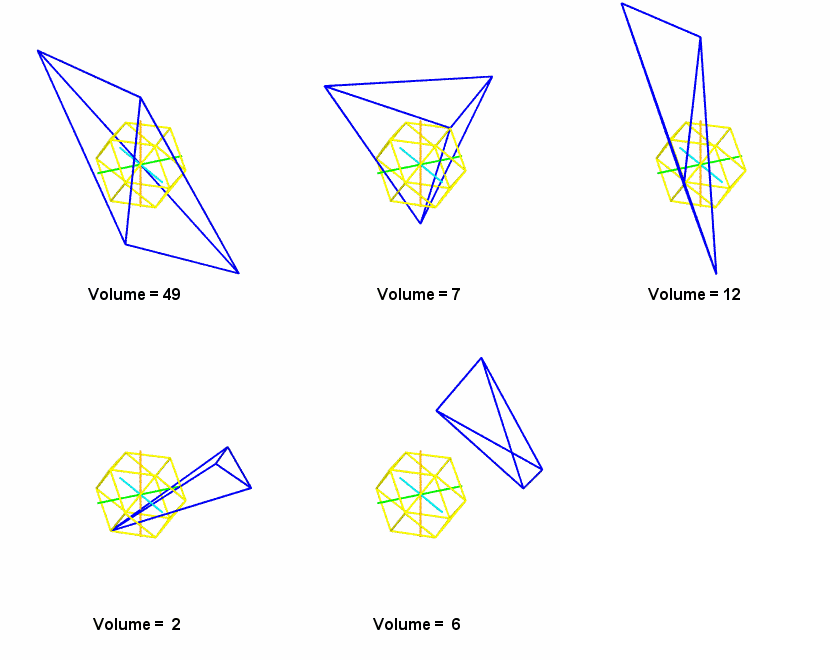
Another possibility is it -- the nested polys with volumes expressed in tetravolumes -- just fell through the cracks.

Perhaps the decision was to not share in K-12, as that ghetto-neighborhood is already packed to the gills with tested content and prereqs, but in higher ed, we have more room to share.  Note to Earlham.

I think maybe the "fell through the cracks" narrative has merit.  There's a chicken-egg issue with booting any new content, like starting a startup.

The decision to share about the concentric hierarchy in some public schools is the one I'm backing.  We're free to start in the literature department, or in history.  We're also free to continue questioning the slow adoption by others, demonstrating a competitive spirit.

If computer science (a) exists and (b) takes an interest (in that school, does it have its own server space?), then we're free to widen the circle.  Look for schools that share Blender (blender.org).

Teachers of mathematics are welcome to keep their distance, as they have been doing.  We'll be drawing on their knowledge base, while trying not to disturb their SAT, AP and ACT preparations.

Thursday, November 11, 2021

Public Schools Embrace Design Science


Not all at once mind you. A blend of computer science + the humanities is ready to roll forward without disturbing the math teaching rank and file, which are boxed in by standards.

Our impact on other STEM subjects is more by osmosis and organic growth than because of any top-down campaign led by think tanks, not that we don't have our own think tanks and ways of advertising.

Some public schools have more freedoms than others, when it comes to sharing American and/or World Literature and History. We do not all share the same notion of "cultural literacy" and the resulting diversity is considered a positive.

School of Tomorrow. Oregon Curriculum Network. 4D Solutions.

Sunday, November 07, 2021

Steering in Cyberia

TrimTabers are plowing through Fuller's Earth these days.  "TrimTabers" is not really an English word, although "trimtab" is, at least according to Collins English Dictionary.  

I find many dictionaries have "trim tab" as two words.  Either way, the meaning traces to maritime origins (but has aeronautical applications as well), as "the rudder that steers the rudder" (or smaller plane that acts on a bigger plane -- with "plane" meaning "piece of the wing" and not short for "airplane"). The trimtab steers the wing or rudder in which it is embedded.

Cybernetics was likewise linked to the verb "to steer" i.e. ""kubernetika" referred to "steering as a skill".

To some extent, Buckminster Fuller (aka RBF) likely helped "trim" and "tab" stick together in a single string, as that was his usage, with "Call Me Trimtab" his famous epitaph.

But even with TrimTab a brewery in Alabama (I have some souvenir empty cans, shared on Youtube), we don't say "TrimTaber" a lot (and should it have two "bs" as in Tabber and Tabby Cat?).

By TrimTabers I mean participants in Curt's TrimTab Book Club.  I'm tempted to write BookClub in camelCase, to allude to TrimTab in camelCase. At least Simple English Wikipedia writes camelCase in camel case (not all sources do).

The other week we had Siobhan Roberts as our guest, author of two biographies connected to our own readings.

John H. Conway was her most recent subject and she had some interesting anecdotes about him.  

Donald Coxeter (also known as "H.S.M. Coxeter"), based at the University of Toronto (Conway was at Princeton in his final days) is the late great geometer to whom Synergetics was dedicated, speaking there of RBF's magnum opus.

These days we're plowing through Fuller's Earth, as I mention in my opening.  That's a book wherein RBF gets together with a few kids, with a tape recorder and a camera going, operated by a small crew.  Their plan was to turn the voice recordings and photographs, along with Fuller's hand drawings into an easy to read book.  The one we're now reading, almost forty years later.

We'll take our time with this book, but it's pretty short and I've been reading ahead.  The kids he's hanging out with know he has a reputation as a futurist, which is akin to a prophet or soothsayer, but with strong grounding in science.  Fuller stresses has faithfulness to science, but in a way that would dismay many teachers: as a source of skepticism versus axiomatically accepted mathematics.

We may be used to pitting science versus religion, but not science versus math.  

He encourages his young proteges to get good grades by pleasing their teachers (what he did ultimately), by giving them the sought for answers ("when in Rome...") but in the mean time, they had the inherent right to exercise freedom of thought, which could mean harboring and cultivating a counter-narrative.

Fuller sets an example by exercising his own freedom to diverge from convention, by converging to something else:  to the tetrahedron, his central construct for conceptuality itself, and his unit of volume.

How esoteric is this history and will it be taught in American high schools?  Not in all of them certainly, but then propagating curriculum ideas is relatively easy these days, so lets expect a few to take it up, perhaps under Lit.  American colleges too, will in some places be picking up the slack.

In the Google Group archives, not public at this time, we intertwine our various threads.  There's a Zoom meetup and a publishing / prototyping aspect.  Some of us are Canadian, as was Coxeter.

Fuller isn't giving spooky Greek metaphysics a free pass, even though it masquerades as beyond questionable.  The infinitely long lines of mono-dimensional thinness come in for some scrutiny. Why don't we reject the Cube World as a world of phoniness and fake news?  Obviously such questioning of the dominant paradigm is enough to perturb the authoritarians, especially given he's passing this torch to kids, in the open.

Saturday, November 06, 2021

Centrum Censorious

I take umbrage that Moderate Rebel Max Blumenthal would diss a Blogspot blog as inherently less professional than whatever else he was pointing to in the linked Youtube.  Blogs started as long ago as mine didn't have this wide range of choices or sport the current vogue look.  So what?

On the other hand, the Rebels are making the good point that NATO is the immature school boy with its hands in the wrong jar again.  Their mockery of Nemo who whomever is appropriately scathing.  The "west" likes to pretend it's above censorship ala some imagined Chinese model (not that there isn't one, just it wouldn't be exactly as you imagine).  On the other hand, "censor" was an appropriate privilege and job title within the Roman-Catholic Empire.  Other euphemisms pertain.

I quit the Mathematics Research Educators group yesterday, public on Facebook.  The admins just couldn't be bothered to include a "pensive cowboy" in the conversations.  That's my Youtube persona:  a guy with a black Stetson a lot of the time (not always).

The education research I'm doing centers around mainstreaming various aspects of a "Bucky math" that's embedded in American literature and that some universities are now starting to grapple with.  They don't like having to play catch up, but in an open source economy that may become their role.  

Remember how GNU / Linux grew from the need to continue practicing one's craft even after enjoying tools covered by license fees unaffordable to individuals.  Everyone needed UNIX but relatively few could afford to pay Bell Labs.  Once ordinary people could use Cyberian power tools, the playing field was leveled like never before and a new kind of democratic meritocracy could begin to experiment with itself.

Our "open source textbook" approach is not new.  I get peer reviewed by my peers even as I pump out the Jupyter notebooks from JupyterLab, while urging my high school students to do the same.  There's no reason to censor my School of Tomorrow content, which extends various entries in Wikipedia and Wikieducator.  We're more delayed than stopped, by the Pearson + NCTM conspiracy.  Given the American literature context, we will continue to "debritify" i.e. escape the tyranny of NATO + English programming.  Does that mean widening the distance twixt NPR and BBC?

Wednesday, October 20, 2021

The Design Way and Dissipation

Back in the day, and even still, I've written of "designer religions".  Wicca comes to mind. A designer religion may be just right for the times, the perfect catalyst, and then, its job completed, it dissipates. That doesn't mean something bad happened to the followers.  They let it go, with a sense of completion.

My attitude somewhat carries over from my skepticism regarding corporate immortality, and whether even that is a worthy goal, in and of itself.  Put it another way:  what's the scandal, what's the controversy, when a big company, such as Kodak, diminishes or goes out of business.  

Kodak performed great service in getting the world of photography popularized.  That it didn't turn into the world's top digital camera maker should have surprised no one.  That wasn't Kodak's area of expertise.

I think of movie companies.  These may come together to provide enough structure for the template called "making a movie" to be pulled off, in one form or another.  Once the movie is made, other dynamics kick in, and the original production company may disband.  Is that a tragedy, and must we go back and analyze all the so-called mistakes?  If the default position is "immortality is the norm and anything short of that is failure" then yes, maybe we must.  But why that default position?

The above ruminations bring me to The Design Way, a book, which has been a convergence topic for several interconnected meetups across Zoom world.  New York and Philadelphia have been doing most of the talking, with Portland, i.e. my backyard group in Oregon, listening in.  

I also catch up on my own, sampling Youtubes on Louis Sullivan, Buckminster Fuller, and some other names most familiar to architects.  Shrikant (52 Thinking Ideas) has found himself drawn to architects, likely thanks to their polymathy.

The Design Way opens a space wherein conspiracies may develop around client desiderata, whereby design teams form, and under the direction of designers, make something (some vision) real, according to ideals (idealism) and in cooperation with useful truths (pragmatism).  The process is according to schemas, which develop over time as a designer gains experience bootstrapping a designer culture within which to strive and perhaps thrive.

That sounds a lot like the movie industry to my ears, likewise steeped in the logistics of special skill sets. In Martian Math we learn the story of Orson Welles, and of the partially overlapping scenario of Agnes Moorehead, in the cast of Mercury Theater company at that time.  

The troupe enacted "Mars attacks!" in the format of a CBS radio news story, but for entertainment, creating an aura of authority and credibility that fooled many.  Hollywood recognized their talent and the rest is history (Citizen Kane etc.).  

Orson Welles gets to be a designer-director in this story, the client being RKO Studios and, more invisibly, the movie-going public and future connoisseurs of film.  

Companies come and go in Design World,  because they're "designer companies" meant to fill a niche and then go on a shelf.  Like a rock band, a company may in some cases jump off the shelf and reform, but if it doesn't, that doesn't negate the work it accomplished.  

Kodak moved mountains in many dimensions.  Don't believe business school teachers, or preachers, who hold up "immortality" as a necessary criterion for success.  Dissipation in a clean designed way, without a lot of loose ends, may be a beautiful part of the overall performance.

Thursday, October 14, 2021

World Game: A Psychodrama

I grew up in a hayday of tourism for Americanos. As a then-resident of Rome, I saw tourists more from outside the bus, as one of the urchins playing on Trevi Fountain.  Got pix?  I'd sometimes go there with my friends from near Trastevere, after school or on weekends. 

My sister claims we tried taking the money at one point (tourists throw coins) and got in trouble -- however I have no recollection of that and don't think we ever did. I had plenty of lira for Mars bars and bus fare.  Rome has a fantastic bus system.

If It's Tuesday It Must Be Belgium typified the American Express debt card whirlwind so many Americans would go on.  They'd shoot oodles of pictures and go home to share slideshows. Kodak was King.  The Japanese middle class couldn't wait to get on board, joining our world of fat families with diabetes.

Then comes another form of "touring" as in "tour of duty". These personnel arrive in camo, live on bases, and tend to expect obedience from the locals, who are in some sense under their authority and jurisdiction.  Those who take orders for a living like to be obeyed when it's their turn to command respect. Sexaholics have a field day if lucky, the whole point for some adventure-seekers.

When tourism gives way to tour of dutyism, as happened in Afghanistan (we went through as tourists, from Peshawar to Kabul on a local bus, out on Aeroflot to Tashkent), the locals get to stirring up trouble, triggering a need for "special forces" and so, another "dirty war" begins.  

The Pentagon encounters insurgencies no matter where it tries to invade, including in Lower48.  Many vets swarm to the police stations, and meet many of the same characters who refuse to do their bidding. "What's wrong with these people?" who came to the New World to escape all types of establishment-arianism, most especially the authoritarian type (tyranny).

One wishes one could turn back the clock, to those confidant days in the 1960s, with Americans offering a freshly optimistic face to the world, after decades of gruesome wartime and some far out futurama ala Montreal 67. 


The American Express generation wanted to "buy the world a coke" and celebrate its freedom and autonomy, vs-a-vis those poor oppressed communists.  But then the Empire stumbled, electively entering various quagmires, to prove itself worthy of the Imperial mantle, starting with war in the Philippines and continuing through the Korean and Vietnamese Peninsulas.

If freedom-loving Americans had really wanted to assert their values and have the world be safe for their kind, then more tourism is what was indicated.  

Putting more boots on the ground is a way to self alienate and self weaken.  That's called putting the wrong foot forward or waking up on the wrong side of the bed.  Americans don't lust for empire the way some generals imagine they must.  Their recalcitrance has more to do with their cognitive powers than with any inherent cowardice or unimaginative view of their destiny.

Americans need to train their young to enjoy the challenge of rugged travel, as work-study students and faculty on a spherical global campus, dotted with superfund sites and other mementos of man's folly. A major role, a calling for many, is that of cleanup or sanitation engineer.  Undoing the damage of previous generations has gotten to be a priority undertaking.  

A janitorial and/or care-taking role is nothing to sneer at.  Course catalogs that offer no such relevant coursework are maybe fair game however, as targets of mockery.

Monday, October 11, 2021

Lunch With a Philosopher

I don't get to have lunch with other philosophers that often.  

By "philosophers" I mean those up on the gossip of Philosophy.  

Take Rorty for example, my prof at Princeton.  Was he unhappy at Princeton because the Anglos always want to be Analytic?  My impression of Haack's critique of Rorty is that it has to do with the latter's lack of appreciation for Peirce.

My take on that front is Rorty took the later Wittgenstein seriously and didn't see a future for Logic in the sense of Fundamentals ala Bertrand Russell.  

So a fourth volume was to take up geometric beginnings, and Whitehead was to write that one?  Whitehead is classified as an American philosopher because of his focus on Process?  I hadn't heard that.  

Peirce's inability to score a lasting position at Harvard wasn't Rorty's fault at least.

Propositional Calculus kept the seat warm for electronic modeling languages to come, in some respects.  Boolean Algebra came into its own during the silicon circuitry revolution.  If the pragmatic task at hand is to model the workflows of a busy airport, then isn't Python way more competent than anything from the age portrayed in Logicomix

To what extent is the formal logic of the 20th Century an art form, on which little of practical value now hinges?  Computer languages, and computer science, have relieved the logicians of their "heavy" burden.

Some detractors say Rorty's skills as a logician were too limiting, which is why his contributions to philosophy were at best mediocre (mean). 

Others say his focus, on Continental authors, and on ethics and aesthetics, areas irreducible to logic, were consistent with his view of philosophy as a branch of literature, less a STEM subject, not a science.

Friday, October 08, 2021

Shades of Invisible Landscapes

Age of Radio

I like this exercise of drawing mind maps.  Our textbooks have well-evolved conventions for both 2D and 3D displays.  Sometimes I like to see Synergetics as encouragement to the biz community (aka buzz community) to get off the plane and do org charts in space.  Use planets for orgs.

Where to draw inspiration:  Little Prince.  Sun Ra.  Star Trek. 

To tune in a system is to pull up alongside a planet, another spaceship, an encounter of a "we-to-a-WTF" kind.  

Newspapers always gave us The Daily Planet.  Thinking in the round about our planet is nothing new, I think I hear Bucky saying, just that we've always had landlubber flat-earther types, and they're not necessarily only the "out" ones you'd think of.  

Like he'd like "tongue-lash" professors at MIT for their obsolete "sun comes up and goes down" jargon, though I think "tongue-in-cheek" is also apt.  His outbursts were cartoonish, as in politically animated.  He did some cannon balls off the diving board into our public swimming pool, making waves at 90 degrees.

One may say one is "apolitical" but on the world stage that just makes one another type of actor.  Earth to Little Prince: "Welcome to PolyTiks Planet".  I'm punning on "poly" as in "polyhedron" and "poli" as in "polis police politics" -- a pseudo-etymology, a form of wordplay.  The Tik sounds like TikTok, suggesting all TikTokkers are political actors. That's what I'd call "spin".

I do enjoy TikTok BTW, as well as Instagram. Lots of design related stuff goes on through these archives, continually sifted-through by mind-guided brains.

The inevitability of our "playing politics" is that same inevitability as of our playing World Game. We want "the right" to get off the boat so to speak ("don't judge me as you would a world game player"), and maybe protest too much about it.

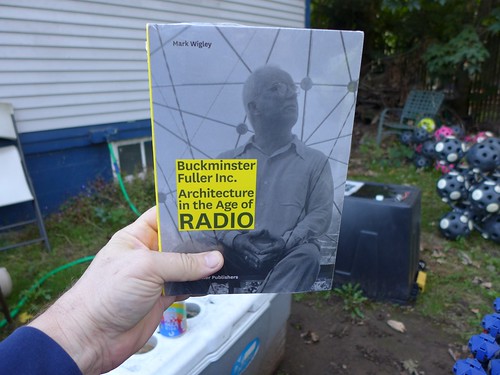
I just got Architecture in the Age of Radio delivered by the Borg (Amazon), and flashed it around, still shrink wrapped, on camera with Shrikant, during the pre-meeting yesterday. 

https://flic.kr/p/2myLcjQ  (picture of the book, still in plastic)

I was in lurk mode during the event, given other Wanderer types were gathered in my backyard, with the iPad like our flickering fire, complete with storytellers. I later moved the show indoors when it got dark. 

The "analog background" versus "digital foreground" theme was hugely front and center last night, as you might hear from the upcoming Youtube.

Still Shrink Wrapped

Monday, September 27, 2021

Sunday, September 26, 2021

Silicon Valley versus Big Bang Theory (movie review)

As my longtime readers may realize, I file TV shows under "movie review" and even Youtubes sometimes, such as when Tiffany shared that interview of herself and her parents.  I bring up Tiffany because Anthropology, the A in STEAM (not Art) is the name of the game.

Silicon Valley is smart and tight, Mike Judge satire.  Judge's resume includes Beavis and Butthead, King of the Hill, and most relevant, Idiocracy.  I regard him as a genius-polymath.  Hey, he makes films, yet he's lived on the inside in engineer world, with "engineer" broadly defined to include such characters as Silicon Valley features. In software engineering world, you're still allowed to be "self taught" as in "self made" although having a CS degree certainly helps.

Big Bang Theory has a different agenda as it's almost exclusively about nerds, not geeks.  Geeks have made it out of their larval stage (as nerds, ugly ducklings -- not physically ugly necessarily, there's always the makeover) and actually have excellent communications skills, even if only with each other.  They ascend through Gamer World, the focus of military recruiters these days.

The range of characters in Silicon Valley is impressive, from billionaires of different breeding, to VC firms, competing companies and teams with incestuous relationships (lots of spying), and yet the nucleus has many traits in common with the Big Bang crew.  The latter core cast is more of a subset of the former, likewise males sharing a common living space, but more confining.  One of the principals, Sheldon, is a physics nerd, not a software engineer.

Software engineering is an attractive vocation in India, conventionally for XYs and awkwardness around XXs gets much attention in both shows.

As a Geek, I much prefer the portrayal of my world through the Mike Judge version.  However I'm in the Silicon Forest, not the Silicon Valley.  An old story about the Oregon Trail recounts a mythical fork in the road whereat some would head for the verdant valleys of the Pacific Northwest, seeking a secure life in real estate and agribusiness, and others would head south to get-rich-quick country, the land of gold diggers and venture capitalism (high stakes gambling).

The way I think of it, my Pacific Northwest tribe was already here, vested in the fish business.  The year I was born was the year agribusiness asserted its upper hand, by drowning Celilo Falls behind the Dalles dam. I find dams fascinating and have them at the center of Martian Math.  My Martian Math science fiction has a lot in common with WestWorld, as I've always used the "tunnels under Disneyland" motif from engineering (akin to the Control Room trope), and more specifically from The Time Machine by H.G. Wells.  We're the Morlocks.

Big Bang Theory had a prime time slot, translating into safe to rebroadcast in rerun slots, so the script has a PG13 flavor, whereas Silicon Valley on HBO was more TV-14, bordering on R for language but without nudity or violence.  Congratulations on the lack of gun play in both of these, the blight of American television, reflecting the "eats their own young" parasitical civilizations that have set up tents here.

I believe Big Bang might've had a live audience as the producer denies using any "sweetening" i.e. a doctored laugh track.  Silicon Valley does not have a laugh track at all, real or artificial, which frees it to be more "adult" given how these days a laugh track more often than not feels manipulatively condescending, and/or in self parody.

Monday, September 06, 2021

Studying the History of New York City

Have I gotten lazy about blogging?  A lot of my autobiographical Quaker journaling type content fed into my Youtube channel, likewise with its autobiographical threads.  Threads add up to a process in NerdSpeak, in Apache.  Has my throughput diminished or simply shifted around on the spectrum, or even increased?  No answer is implied.

Over the last couple days I've watched the Ric Burns PBS documentary on New York, episodes 6 and 7, featuring Mayor La Guardia, and Robert Moses.  

Although the 1939 World's Fair is given significant treatment in Episode 6, Episode 7 made no mention of the 1963-64 World's Fair.  I've studied both from multiple angles, including through Defunctland, with documentaries by Kevin Perjurer.  

I've transferred some of these threads to my Youtube channel, mentioning T.C. Howard, Kenneth Snelson, and again, Robert Moses.  And of course Disney, as EPCOT figures in, with its iconic Spaceship Earth goliath golf ball.  The USA / USSR rivalry, likewise defunct, comes to a head in Critical Path in the mytho-poetics of one Buckminster Fuller.

I just returned those and other videos to Movie Madness on Belmont, by bicycle, stopping for a beer at Glenn's on the way back.  We're both reading Ernst Cassirer and Felix Klein these days.  ISEPP is building a curriculum timeline, with lots of emphasis on the Carnots, Lazare and his son Sadi.  

All of these authors are interested in the grammatical matrix whereby terms such as "energy" "velocity" "work" and "action" arise, in a Newtonian mechanical sense, but in alternative senses as well, perhaps presaging more contemporary uses (meanings) in some cases. Klein is more interested in the pure abstractions of mathematical language, but does not neglect the intersection of same, with physics.

The Ric Burns documentaries make that case the Le Corbusier and Robert Moses were somewhat anti-city in the sense of repulsed by crowded street life and pedestrian friendly organic villages taking up within a metropolis. Greenwich Village for example, which, in the person of Jane Jacobs, successfully repulsed a disfiguring slash from Robert Moses, the plastic surgeon.

Before these, I was watching the full Ken Burns documentary on Prohibition.  The Al Capone story branches to Bucky's.  The first two seasons of Silicon Valley (Mike Judge et al) are now also behind me. On Youtube, I've been going through the Common Sense Skeptic assaults on various favored, contemporary, science fiction flavored, narratives.

Wednesday, September 01, 2021

The Opinion Dispensary Model

When attending high school in Manila, by then adjusted to life in the Philippines more generally, coming from Southeast High, Bradenton (FL), I was caught up in a polarity.  

One the one hand, I liked to talk and participate in conversations. I was not a wallflower.  

On the other hand, I attached little weight to "opinions on the fly" and didn't think a conversation had to be about soliciting or offering opinions all the time, by which I include judgements.

I would push back at my teachers sometimes, especially in journalism class, saying things like "why are you asking me to have an opinion about a topic I barely know anything about?  I'm just a dumb teenager without even a high school level of education yet.  I wouldn't have any respect for my opinions if I hadn't really had time to do a lot of homework first, so why must I have them?"

Now of course it's obvious we judge constantly if not continuously and once in a judgemental mindset, it's hard to get from one moment to the next without rendering judgement on every significant aspect of one's circumstances.  

However I'm circling that mindset as a pitfall, as a sign of an overheated and distracted "thought process" (in quotes because I speak more in metaphor than as if I knew something about how brains work).

What I've since come to is that the caricature of "being an individual" that's often peddled, is that of a know-it-all type with opinions on everything.  

The opinions are allowed to be shallow.  

It's more important to have an opinion on a matter, than to have a malformed one.  The idea of "public debate" is we shape one another's opinions through discourse, but best to have a dog in the fight at least, or there's nothing to shape.  

"Having an opinion on" is considered the opposite of "being apathetic about". 

I would now counter that forming judgements and opinions need not be a high priority, especially during a time when you just want to investigate and not have a bias or prejudice get in the way.  

You find the attitude of open mindedness and "not knowing" to be refreshing and adopt it whenever justified, and it's often justified, because the horizons of one's ignorance may indeed be vast.

Wednesday, August 25, 2021

Critical Race Theory

[ cutting and pasting from Facebook ]

I was just listening to KBOO and the professor who seemingly favors CRT was into debunking that it had anything to do with the Frankfurt School or Herbert Marcuse. But why defend it if that's not what they're committed to calling it. CRT means "cathode ray tube" after all.

I gather the NAACP favors teaching true history, uncensored and unfiltered (like "for adults"), and doesn't claim to want CRT in the schools. We could assign that book Caste for example (good one! I'm reading it now! -- shows similarities of Jim Crow laws to Nazi Germany, which actually studied the American example as exemplary).

NAACP is saying (let me know if I'm wrong): "CRT in the schools is a red herring and those trying to ban it are really just trying to push rotten textbooks purged of anything ugly, which is itself ugly."

The interview mentioned some laughable Texas textbook wherein the word "slavery" was purged. Really? I'd like to add that one to my collection.

I think that old canard that what Texas chooses in the way of textbooks, thereby has to be the choice of many other states, given the economics, is entirely bogus. Not allowing textbooks to be distributed electronically, thereby allowing for far more diversity, is systemic racism in action.

Friday, August 20, 2021

From a Quaker Website

When it comes to the European experience, we already tell the story of the United States as one of east-to-west expansion, complete with the Louisiana Purchase, followed by Lewis & Clark and covered wagons.

Before the Civil War, Quakers moved westward for a reason many did:  to escape the stigma of being anti-slavery, an institution supported by local and federal governments. Those against it were a kind of terrorist in the eyes of their slave-holding neighbors and they fled west to escape persecution.

One Quaker I follow, in this westward migration, from the Carolinas to Minnesota, is Sam Hill.  He later made it all the way out to Seattle and settled on the north side of the Columbia River, hoping other Quakers would follow to build a settlement there. Conditions were bleak however and the vinyards would come later.

So for many years, his palatial Maryhill stood alone in desolate country, followed by his remake (scale model) of Stonehenge.  His passion: to build some world class roads. He had discovered their critical importance in his world travels.

In addition to building a first paved road along the Columbia, a demonstration project, Sam conspired with royalty and celebrities of Europe to turn Maryhill into a cultural museum.  Queen Marie of Romania came all that way out west, by Pullman, to bestow upon Sam a train full of art treasures from old Europe. 

Europeans were interested in the intersection of high culture and democracy.  How would the ethic of egalitarianism play out?  Sam Hill, a self made gentleman, was helping to show the way.

I'm seeing Unitarianism as a later wave of anti-slavery sentiment, reaching its peak after Quakerism did.  With headquarters in Boston, centered around Harvard, the Unitarians gave rise to the Transcendentalists, who formed a literary and philosophical movement that also spread westward. 

Walt Whitman, a poet associated with Transcendentalism, was an early admirer of Elias Hicks. 

The Unitarians, at their apex of power and influence, were well aware of the Quakers who had come before them, and who had already reached their apex of power and influence earlier, in Philadelphia. 

Quakers were against participating in what became the Indian Wars, in addition to disowning any who practiced slavery, thereby proving themselves out of step with their Anglo-European compatriots and their Manifest Destiny ideology.

Among the Transcendentalists, playing a central role, was one Margaret Fuller (1810 - 1850), who would drown with her small family, within sight of land, coming back from her adventure in Italy.  Her grand nephew would be R. Buckminster Fuller (1895 - 1983). 

Margaret, like Thoreau (with his "night in jail" scene), and like Transcendentalists everywhere, was not enamored with the idea of an American Empire, foreshadowing Mark Twain and the Anti-imperialist League.

One of my favorite philosophy professors, Richard Rorty, whom I met at Princeton pre 1980, later went on to write Achieving Our Country, a slim volume outlining his vision of a future American Left without all the Marxism. 

He traces his own leftism back through such figures as Emerson and Whitman in places, right back to Hegel and German Idealism more generally.  Nietzsche admired Emerson, not many people know, and used him as a role model for his Zarathustra character, by his own admission.

Will Quaker institutions of higher learning perhaps capitalize on these intellectual roots going forward? 

My approach is to show what that might look like, in terms of curriculum designs and reading programs. 

In the words of Dr. Steve Brule:  Check it Out!


Original Posting