I transitioned from our weekend Wanderers retreat, at the Linus Pauling house on Hawthorne (PDX), to Europython in Göteborg, Sweden (GOT). I'm currently blogging from our venue, the Architecture building at Chalmers using a guest account on the university's Nomad wireless network, with the 3rd and final day of the conference in progress (we're doing a coffee break at the moment).
I got invited to this conference on the basis of my Python in Education initiatives. My talk, entitled Pythonic Mathematics, was about infusing various college and pre-college math curricula with a computer programming component, including doing more with polyhedra (per slides).
The conferees here come from all over Europe, and of course speak a variety of languages. Fortunately for me, English is the medium for presentations.
At the dinner last night I sat next to Mr. Volkmer from the Max Planck Institute of Molecular Cell Biology and Genetics in Dresden. His team uses Python around databases containing the gene sequences of axolotls, frogs and such.
The night before, I had dinner by the student center indoor pool with Guido (Python's creator) and a gent from CERN, the venue for Europython next year.
A lot of these folks are Zope and Plone developers, some of whom I've met in other venues. Oxfam, GB is coordinating tsunami relief and other projects through an elaborate network of interconnected Plone sites.
Laura gave us updates on the political situation regarding the prospect of software patents in the EU, which the programmers here are pretty much uniformly against, even though their work is highly inventive and original.
A large conference on nanotubes (aka buckytubes) is taking place in parallel. Wandering amidst the posters brings back memories of the First International Conference on Fullerenes in Santa Barbara (1993), which I attended as a rep from the BFI, thanks to encourgement from Ed Applewhite.
Wednesday, June 29, 2005
Monday, June 20, 2005
Father's Day
So yesterday was Father's Day and the dad clowns were out in force on Fox Network cartoons. I came into the middle of The Simpsons episode wherein Homer has found an elusive new friend, a roofer-contractor whom nobody else sees, leading them to conclude Homer needs electroshock therapy. Then, after Homer is "cured" the friend shows up. Explaining the friend's previous invisibility requires Stephen Hawking's presence at one point (Stephen likes being on The Simpsons when he gets a chance -- maybe because of all those mathematicians that write for it).
In the next episode, Marge has this flash that Homer is more mortal than most, and tries to get him insured. When that proves impossible, she starts nickle-and-diming at every turn, saving money in a big jar in the kitchen, a jar which Homer develops a relationship with (he trades it in for an RV, which proves devastating to their marriage -- then I had to answer a phone call).
The dad clown in Family Guy has fantasies of being a genius, but when applying for a grant from the MacArthur Foundation tests out sub-normal, which he has a hard time accepting, until he realizes the privileges that come with rank (including the privilege to really screw up big time).
Then came the dad clown in American Dad, a CIA guy consumed with jealousy over his neighbor's good fortune (which the neighbor loves to rub in). A contest develops as to which dad will become the next deacon in their church. The CIA dad retains Karl Rove, a kind of vampire (lots of bats coming and going), to help him win, and Karl points out the importance of good cooking to church potlucks.
Given the CIA connection, there's this ET living in the house, a family secret (which is way more contact than those people in The X-Files get), and in this episode he/she/it is in some reproductive cycle causing lactation. By happenstance, the family discovers ET breast milk is just the ticket when it comes to making perfect potato salad, an advantage the wife uses to win the deaconship for her man (he later resigns, claiming he's possessed).
Millions of kids were watching spellbound, exercising viewer discretion.

Saturday, June 18, 2005
Howl's Moving Castle (movie review)
A tumbling kaleideoscope of smooth transformations, resolving as plot lines, involving true love, and with a girl's age a significant parameter. Yes, there's the moving castle, one of several portals to a subjective world, all of which intersect near a flame (voice by Billy Crystal in the USA version) that contains a loved one's heart.
Overlay that with an ongoing, violent, and stupid war (which all truely powerful wizards are trying to end), and you've got the makings of a fantastically convoluted plot. Some critics have disliked the film for precisely this reason (plot complexity), but I don't regard animation as any less a medium for plot density than say books, with their Tolstoy, i.e. "cartoons for children" remain a sophisticated cultural conveyance for messages of arbitrary depth. Disney was good at it too. Fairy tales have always been deep.
Overlay that with an ongoing, violent, and stupid war (which all truely powerful wizards are trying to end), and you've got the makings of a fantastically convoluted plot. Some critics have disliked the film for precisely this reason (plot complexity), but I don't regard animation as any less a medium for plot density than say books, with their Tolstoy, i.e. "cartoons for children" remain a sophisticated cultural conveyance for messages of arbitrary depth. Disney was good at it too. Fairy tales have always been deep.
Wednesday, June 08, 2005
Wanderers June 8, 2005
Jim Buxton wants Wanderers to know that KOPB is rebroadcasting an interesting episode of This American Life tonight, about religious education. 8 PM (91.5 FM in Portland).
This morning we hosted a meeting with Steve Runion, a high school science teacher with creationist views. He sketched out his beliefs and the kinds of struggles he encounters. The Q&A was animated yet cordial, with many overlapping and divergent views expressed.
For example, how would it be different if highly evolved ETs created the world i.e. what evidence would distinguish between God versus some Alien Nation. Or couldn't the story involve a combination of both?
Afterward, we discussed the role of personal experience in belief systems, open versus closed systems etc. The world of John Nash came up a few times, as exemplary of how personal experiences could lead one to pursue different models of reality.
George Hammond was big on the point that "models" (we hope useful to their holders) is perhaps a better word than "theories," for that which we develop and seek to reality-check in the grand scientific tradition (which tradition may be more efficient at updating its core models than some religious ones -- healthy competition keeps the evolutionary picture interesting).
Another question: so how applicable is the notion of intelligent design from this point foward, i.e. aren't we intelligent and don't we design?
Monday, June 06, 2005
Dot Notation
Not everyone knows what I mean, along with others, by "dot notation." This way of noting states and behaviors was developed around "objects" in computer languages, many of which underwent a revolution in the 1970s and 1980s after the appearance of Smalltalk. The object-oriented way of thinking about programming was a revelation.
I was on the xBase track, i.e. the sequence of languages beginning with dBase II (which had precursors in Cal Tech's JPL) and going in various directions through the Visual FoxPros, of which version 9 is the latest. Our switch to OO in xBase occured around the time Microsoft bought the product, and rewrote it to support an OO GUI (this product has always been something of a skeleton in the closet, as it's more powerful than Access or VB, but marketing always kills its marketing budget).
Anyway, dot notation looks like this:
>>> mydog = Dog("Fido")
>>> mydog.name
"Fido"
>>> mydog.bark(2)
"bark, bark"
>>> mydog.bark(3)
"bark, bark, bark"
Some human user is entering strings after the >>> marks (the prompt) with the interpreter taking over upon a press of the Enter key, and coming back with some response (or not) on the line below. The above looks like Python, but many languages do it similarly, including this use of the dot (period) as a separator between the object (mydog in this example) and its states and behaviors.
Objects come into existence through their class constructors, where the class is the blueprint or generic case of an object. On birth, an object gets a slice of computer memory and private variables, there to individualize. A garbage collector looks for abandoned objects and frees their resources.
During an object's life span, dot notation gives programmers a way to trigger behavior, consult or set state. Typically, the programmer will wire behaviors to events, such as a mouse click on a certain button. Objects listen or subscribe to a kind of Events News (part of a loop or process on the CPU) and react to a subset of them, according to their class definitions. That's the OO model in a nutshell (also sounds a lot like the economy), except I haven't really described how we develop/program within an extensible type system, taking many blueprints for granted, and creating new class definitions by means of inheritance, interfaces and composition, per the Java/C# example.
In my recent proposal to Europython, we develop a curriculum which phases dot notation into K-12, because these design concepts have matured to a point where we can count on kids having recourse to them on the job, at the work place. OO is well-nigh universal as a paradigm (which does not mean other paradigms don't exist or are not valued -- it's just that we understand the OO style, even if we choose to use something else from time to time). I've proposed that we do more of this in math class, by building and then using rational numbers, integers modulo N, vectors, matrices, polyhedra as objects (defined by extension as new classes, types -- and optionally in Python). This CS-infused math/CS hybrid would run parallel to the traditional pre-calc/calc track, criss-crossing it in various ways [sic.], per trig, stats, measurement and the like.
Saturday, May 28, 2005
Princeton 25th Reunion

2D
So I'm visiting my alma mater, which is bursting at the seams with funds, alumni voting with their dollars to float this UFO, which does some good work in the world.
Professors praised my astute remarks at an event in McCormick (Art Museum), where we discussed the role of religion in campus life. I offered that when it comes to ethics and morality, we shouldn't leave it to the religion department (nor to campus ministries); every walk of life has a code of ethics to offer (potentially). Let's compete and not make religion carry the whole burden. Like, I represent philosophy as a way to go. Psychology contributes as well.
Cindy Lazaroff showed up at the class dinner and regaled me with stories of the Heraclitus, an ocean-going masted vessel, which lost its foremast in a daring crossing of the northern Pacific, registering the most days alone at sea of any vessel. She's devoted to saving coral reefs, and feels betrayed by Crichton's State of Fear, my airplane reading. Cindy and I agreed that better access to global data is what's needed. To that end, her organization is trying to raise money for a satellite, the main mission of which will be to monitor the state of coral reefs around the globe.
Cindy and I were co-residents at 2 Dickinson Street (2D), in our day a new alternative to Princeton's traditional eating club regime. We cooked for each other, and purchased our own food on a university-allotted budget.
I also attended lectures by leading physicists. I learned about how the particulate properties of photons mess with plans to optimally transmit bits per phase-modulated pulse over optical fiber. But clever algorithms let the receiver rectify by anticipation, shifting the subtractive reference pulse to glean maximal data. Dr. Gott discussed esoteric models of early Universe e.g. a time-loop, molded in glass, and begetting forked expansions. I partook of strawberrys and cheese at the reception.
A number of our 2 Dickinson crowd are in evidence this year: Cindy, Kirk, John, Sally, Sarah, Nancy, Kate... and I just encountered dear Selma. The band is too loud to permit talking at the moment. I decided to post to my blog instead. I'm purchasing souvenirs for the family and taking lots of pictures with the Olympus.
Follow-up: Today I crossed paths with Adam Bellow, an old chum with whom I've lost contact over the years. He was on a panel discussing the future of publishing (the university offers a rich program of presentations during reunions). Our class led the P-rade given this is our 25th. I walked and watched it with my ol' buddy Gary Nackenson.
Click here for slides from this reunion, and from my time in the tree house.
Addendum: Ralph Nader '55, a member of our parent class, showed up in church with Patti Smith. I missed it, but some of my friends went.
Saturday, May 21, 2005
Gardening Again
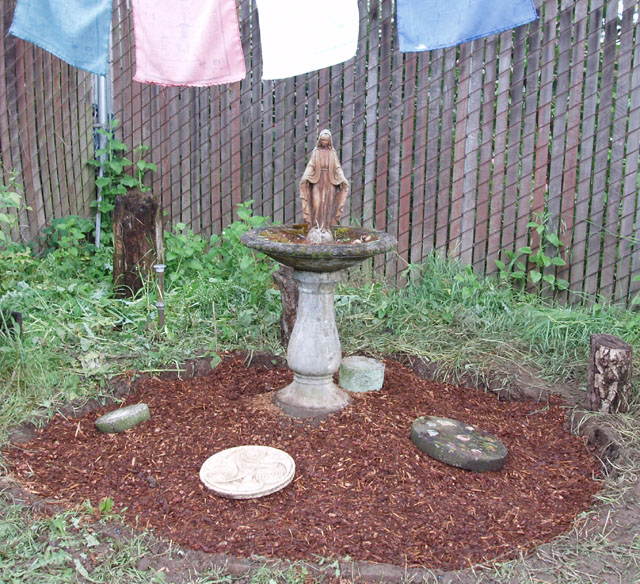
Statue of Mary + Tibetan prayer flags
Today was about buying a bark mixture at Portland Nursery, and spreading it in a circle, with a statue on a pedastal at a focus, having exhumed gross pounds of earth and transported them by wheel barrow to another part of the garden. The bark mixture went over weed barrier (cardboard boxes, unfolded and shaped), and finally an assortment of rock discs of different thickness, some carved or with inlay work (nothing too fancy). I wore boots. The earth was damp and clay-like, given recent rains.
I'm also in the midst of a plumbing job, puzzling over this ancient bathroom sink, with embedded fixtures -- very strange fixtures. I tell people it's like playing Uru.
My birthday is recently behind me. Great day, with friends and family celebrating in various ways. I had some good fish at a Jamaican place near I-405, after some hours on the boat. Michael showed us Giant Steps by Michal Levy on Matt's new Apple computer. I posted a link to that animated art, with sound by John Coltrane, to math-teach, earlier this morning.
On Friday I had lunch with my uncle Lightfoot, a son of Elsie, sister of my father's mother Esther Person. Bill, Bo, Eddy, Howard, and Eve were Elsie's kids. These families lived around Mercer Island early on, in Greater Seattle. I'm doing a web site for Bill. He's done a lot of good research about a little-known chapter in Pacific Northwest history: a period of supplying the world's navies with a lot of submarines, pre and during WWI.
Dawn's slide show about her trip the evening before went very well. We borrowed the ISEPP projector from Terry, and used the edited set, put together to tell some great stories. Dawn and I consulted Cirlot's Dictionary of Symbols to help pull this together, what with Cosmic Fish, Fisher King, and just plain Fishing all so close together like that. Dawn learned a great deal on her trip to the UK and discovered it to be a deeply healing experience.
I projected Levy's Giant Steps from the wireless laptop (which also held the slide show), as "the cartoon before the main feature." And at the end, just before the battery died (fewer cords to contend with), I projected some of my hypertoon (written in Python + VPython).
Wednesday, May 11, 2005
Global Warming
Doug Strain, age 86, and a principal engineer of the Silicon Forest phenomenon here in Oregon, shared his views on global warming at the Linus Pauling House on Hawthorne yesterday.
Doug's view: it's happening, but likely a rising CO2 level is more an effect than a cause of global warming. The original computer model, out of the Colorado-based National Center for Atmospheric Research (NCAR), wasn't sophisticated enough regarding energy transformations. The sun and oceans are the big players, and neither was sufficiently accounted for at the time CO2 was fingered as a main culprit behind a rise in average global temperature.
Doug describes himself as a life-long metrologist, starting around age 5, when a family photo shows him measuring the snow level. His Scottish grandmother emigrated to the USA and pretty much raised him in early childhood, as both parents worked. She detected his early interest in science and measurement and gave him a copy of some book by Lord Kelvin, which he devoured with gusto.
Early on, Doug invented a way of measuring the fat content in butter using its electrical properties. When the family moved to California, he planned to introduce his invention there, but the demo was a disaster, as in CA, the butter was already salted by the time fat content was tested, which fried his device, spattering butter on his pants. Doug went on to invent many more measuring devices, graduated from Caltech, acquired/named Electro Meaurements Inc., later renamed to Electro Scientific Industries.
Bjorn Lomberg's The Skeptical Environmentalist started Doug down a path of questioning, starting from a strongly green position. He's been a supporter of the Rocky Mountain Institute and renewable energy groups. He still considers himself an environmentalist. But Lomberg spoke to his need to see numbers and diagrams, i.e. to gain access to a lot of relevant global data.
Doug's research led him to start questioning the computer models, and consider a back to basics approach. He hasn't become a pie in the sky optimist. For all we know, the climate changes now underway could be disasterous, but he doesn't think rushing to lower CO2 emissions is necessarily a rational, empirically justifiable response, even if global temperatures are in fact rising with CO2.
The structure of our debate (a Wanderers meeting always turns into a debate) followed along the lines suggested by Jon Bunce: is global warming happening, and if so what are the causes? If global warming is happening, is that a bad thing (maybe it'll forestall a next ice age)? If it is a bad thing, what if anything might humans do to stop, slow or reverse it?
As far as Doug is concerned, it's happening, he's not sure how good or bad it will be, and he doesn't know if there's anything humans can do about it. The global climate has never held steady, with or without humans. Change is the norm, not the exception. Life tries to adapt, plus has an important role to play within the many feedback loops (Gaia Hypothesis). But do we really know enough to take smart corrective action at this point? How might we become smarter faster? Accelerating our rate of knowledge acquisition regarding the planetary ecosystem, not sitting on our hands doing nothing, is the way to go.
I learned from this discussion that Michael Crichton has become embroiled in the global warming controversy, having done three years of research leading up to his latest novel, State of Fear. Here's a quote from Quaker-P last night:
Many at the table agreed that measures people advocate to reverse global warming, such as becoming less dependent on fossil fuels and cleaning up polluted city air, should be undertaken regardless of the impact on global warming i.e. we have other reasons for taking many of these recommended actions.
We went around the table both before and after Doug's presentation, to get a read on where each of us stood on the global warming issue. I was willing to accept that the global models could be improved (no real argument there), and that access to good data remains a priority. A TV camera was running, and I said to the camera we should all drink a lot of coffee -- meaning we need to stay awake, burn the midnight oil pondering these important and perplexing issues.
As for the conventional wisdom, that CO2 is a principal cause of global warming, and human activity a principal cause of CO2, I'm still willing to accept that this may be true. However, I'm also quite willing to give skeptics a hearing. I think Doug did an excellent job presenting an alternative perspective. His goal was to spark debate, and in this he most certainly succeeded.
Doug's view: it's happening, but likely a rising CO2 level is more an effect than a cause of global warming. The original computer model, out of the Colorado-based National Center for Atmospheric Research (NCAR), wasn't sophisticated enough regarding energy transformations. The sun and oceans are the big players, and neither was sufficiently accounted for at the time CO2 was fingered as a main culprit behind a rise in average global temperature.
Doug describes himself as a life-long metrologist, starting around age 5, when a family photo shows him measuring the snow level. His Scottish grandmother emigrated to the USA and pretty much raised him in early childhood, as both parents worked. She detected his early interest in science and measurement and gave him a copy of some book by Lord Kelvin, which he devoured with gusto.
Early on, Doug invented a way of measuring the fat content in butter using its electrical properties. When the family moved to California, he planned to introduce his invention there, but the demo was a disaster, as in CA, the butter was already salted by the time fat content was tested, which fried his device, spattering butter on his pants. Doug went on to invent many more measuring devices, graduated from Caltech, acquired/named Electro Meaurements Inc., later renamed to Electro Scientific Industries.
Bjorn Lomberg's The Skeptical Environmentalist started Doug down a path of questioning, starting from a strongly green position. He's been a supporter of the Rocky Mountain Institute and renewable energy groups. He still considers himself an environmentalist. But Lomberg spoke to his need to see numbers and diagrams, i.e. to gain access to a lot of relevant global data.
Doug's research led him to start questioning the computer models, and consider a back to basics approach. He hasn't become a pie in the sky optimist. For all we know, the climate changes now underway could be disasterous, but he doesn't think rushing to lower CO2 emissions is necessarily a rational, empirically justifiable response, even if global temperatures are in fact rising with CO2.
The structure of our debate (a Wanderers meeting always turns into a debate) followed along the lines suggested by Jon Bunce: is global warming happening, and if so what are the causes? If global warming is happening, is that a bad thing (maybe it'll forestall a next ice age)? If it is a bad thing, what if anything might humans do to stop, slow or reverse it?
As far as Doug is concerned, it's happening, he's not sure how good or bad it will be, and he doesn't know if there's anything humans can do about it. The global climate has never held steady, with or without humans. Change is the norm, not the exception. Life tries to adapt, plus has an important role to play within the many feedback loops (Gaia Hypothesis). But do we really know enough to take smart corrective action at this point? How might we become smarter faster? Accelerating our rate of knowledge acquisition regarding the planetary ecosystem, not sitting on our hands doing nothing, is the way to go.
I learned from this discussion that Michael Crichton has become embroiled in the global warming controversy, having done three years of research leading up to his latest novel, State of Fear. Here's a quote from Quaker-P last night:
[Crichton is] very critical of how science is funded, with continued funding basically contingent upon a certain point of view gaining credence. We could probably progress more quickly with double-blind funding -- in politics too (e.g. you see the money show up in your campaign chest, but it's not altogether tracable, i.e. not really clear who exactly your biggest donors might be -- so keep doing what you're doing, if you're getting support, as you must be doing something right).I hope I'm rendering Michael's views accurately (I haven't read the book yet). Both Doug and Michael are members of the Western Behavioral Sciences Institute (WBSI), and Doug is my source here.
Many at the table agreed that measures people advocate to reverse global warming, such as becoming less dependent on fossil fuels and cleaning up polluted city air, should be undertaken regardless of the impact on global warming i.e. we have other reasons for taking many of these recommended actions.
We went around the table both before and after Doug's presentation, to get a read on where each of us stood on the global warming issue. I was willing to accept that the global models could be improved (no real argument there), and that access to good data remains a priority. A TV camera was running, and I said to the camera we should all drink a lot of coffee -- meaning we need to stay awake, burn the midnight oil pondering these important and perplexing issues.
As for the conventional wisdom, that CO2 is a principal cause of global warming, and human activity a principal cause of CO2, I'm still willing to accept that this may be true. However, I'm also quite willing to give skeptics a hearing. I think Doug did an excellent job presenting an alternative perspective. His goal was to spark debate, and in this he most certainly succeeded.
Friday, May 06, 2005
LUNO
Don introduced me to his friend Gene Lehman, a long-time English teacher, now retired and living with his wife in a nursing home in Sandy. We drove out to his place, partly because Gene founded this Learning Unlimited Network of Oregon (LUNO) whereas I have my Oregon Curriculum Network (OCN) -- perhaps we're on parallel/convergent tracks in some dimension, except I'm more into the math end of things.
If you checked this blog yesterday, you might have caught some esoteric essay about a tradition of dissent within Catholicism. Those were Gene's words. While at his place, I helped him find a lost document on his hard disk, fixed his printer, upgraded his browser (which he doesn't yet use) and made progress towards restoring email, which hasn't worked for almost a year (I found a typo in the POP server name, but then at the last minute upgraded to Outlook Express 6, which broke stuff again -- I'll need another visit).
Don and I went to lunch in Sandy (a beer each, cashews and salmon jerky from Trader Joe's) while we did an 11 MB download of Internet Explorer 6 through dial-up (took over an hour). We also stopped at Good Will: I'm looking for a replacement reading lamp for mom, given the Costco one broke, but the one candidate had too many problems.
On my way out to Don's, my wife called from a red phone booth in Glastonbury, England. She wanted me to confirm her return flight with American Airlines, check the bank balance and stuff. She'd just been to Stonehenge that morning and was charged up about it. I'm looking forward to the pictures from her pilgrimmage (the new Olympus went with her).
Also, Nick phoned to check on my schedule for Friday. He wants to introduce me to the Spoon Man, a musician known regionally for his spoon playing technique. This guy is also Nick's ride from Seattle. Spoon Man is enroute to Bandon, Oregon.
After Don and I got back from lunch, the Lehmans had places to go and left a key so we could lock up when done. Don reassembled a busted desk organizer made of wood, then showed me an interesting back route from Boring to Foster Road. He led the way in his white van, with me following in the Subaru, along twisty country roads. Once we reached city congestion, we talked business by cell. We met up with a vehicular funeral procession coming the other way on Foster. Thanks to this short cut, I was only five minutes late meeting Tara, instead of 15-20.
Anyway, I was suggesting to Gene he might want to start a blog, and do his LUNO newsletter in that format. He asked for a demo of ease of use involving this essay I'd just recovered. I cut and pasted from Word to Grain of Sand, and voilá, I think he was impressed. I've since deleted the essay, which wasn't finished in any case. If Gene gets his own blog, I'll link to it from this post.
Follow-up: I completed the planned upgrade, including of Outlook Express, on Tuesday after Doug Strain's presentation to Wanderers (see following post). Don's reassembly of the wooden desk organizer was also much appreciated. Kirby to Don after we accomplished our mission: Meliptus rocks!
Tuesday, May 03, 2005
Sky Camp
Back from Sky Camp, a Kiwanas, overlooking Eugene's water supply (looks full), and long time site of Willamette Quarterly Meeting (Friends). I assisted as emcee for community night, doing an "ice breaker" five minute math lecture on polyhedra, with Joe Snyder's PowerPoint projector showing my hypertoon in the background (until the laptop power saver kicked in).
Dawn made her connection in Chicago, outbound to the UK, leaving around the same time Laura Bush's bizmo showed up on the PDX tarmac (Boeing?). That was last Thursday. Tara and I drove down to Sky Camp, by way of Fry's Electronics, Friday PM, skirting a jam-up on I-5 by using Barbur Blvd, then discovering a very low pressure front tire situation upon exiting said store. A Les Schwab outlet, adjacent, fixed the problem in no time flat. Glad we caught the problem in a lot, instead of at 65 mph. Tara used a cabin for the two nights. I pitched my tent.
While Dawn is on pilrimmage I'm upgrading her workstation from WinME to XP Pro (purchased at Office Depot, upgrade edition), plus replacing her two obsolete hard drives, with barely 6 gig between them, with a 120 gigger from Maxtor. All her previous files are but a drop in the bucket, somewhere on her E partition. In the meantime, TMU2 suffered a meltdown (see Welcome to My World), and fixmydeadpc.com (local shop) had to work hard on a diagnosis. I thought it was the AGP video card, but turns out the mobo itself had fried, and the CPU, so we upgraded to a newer DDR board, and he swapped the CPU for my old SDRAM (very fair deal). Much better outcome than had it been the video card, which I get to keep and works fine.
Lots of faxing and phoning today to quick certify me with Portland Public to drive Tara and some classmates to OMSI tomorrow, for a school field trip. Signed on to a big meeting at Sisters projected to last up to five hours around the upgrade to GE in the cath labs. I represent Regional Heart and Vascular Institute concerns.
Derek took on Sarah, Moon and the fish (our pets) while we were at Sky Camp, in exchange for Jennifer (just kidding -- dinner), plus I snagged him the requested sale items at Fry's.
I thought of a good poster about our Wanderers CEO: "Don: Better'n OnStar." That's because he sometimes anticipates crises and solves them before they occur. It's hard to find a road service that'll do that, not even AAA.
Wednesday, April 27, 2005
Eclipse Chasing
Yesterday came Jim Buxton's turn to enthrall Wanderers at the Pauling House on Hawthorne, and I must say he did a good job. I'm embarrassed to confess that my new Toshiba Satellite wasn't up to showing his 600 MB PowerPoint though, while his much older Win98 laptop managed to plough through it (good thing he lugged it along). I need to get more RAM.
One lesson I took away from Jim's talk is we really do know the future a lot better than we used to, at least when it comes to such cosmic events as total solar eclipses. Not only do we know the dates, but at least some of us know where to draw the narrow tracks along the Earth's surface that demarcate "front row seating" -- which is how Jim and his wife knew to be in a cactus desert in Baja in 1991, and on a cruise ship in the Black Sea in 1999.
Another lesson: we live in a time of contradictory trends. Otherwise literate, informed humans remain ignorant of the night sky, unable to say which are the planets, point out the constellations and so on (I'm one of the dolts in this regard; I can spot the Big Dipper, Orion's Belt, Southern Cross when in Lesotho and that's about it), while on the other hand software and planetariums have made all this information so much more accessible. Light pollution gets some of the blame. If you live in the big city, you forget about the stars (excepting those of the Hollywood variety), i.e. you totally lose perspective.
I see we have a total solar eclipse tracking through Oregon in 2017. Even if I'm lucky enough to still be here, knowing Oregon it'll likely be a rainy day.
Speaking of astronomers and astronomy, it was my privilege to join Wanderers Don and Jon at a surprise 60th birthday party for Doug McCarty over the weekend. Doug teaches a popular college astronomy course -- plus has studied Wittgenstein's philosophy and been to Bhutan, just like me. Also present at this party was Dick Pugh, Oregon's top meteorite specialist, and as a present, he gave Doug a meteorite. Way cool! Doug might be in Libya for the next eclipse in 2006. Jim is eyeing Egypt or Turkey.
Sunday, April 24, 2005
Wednesday, April 20, 2005
Bumper Sticker
My karma is my dharma.
I came up with this while floating out on Don's boat. Probably only been thought of like a billion times. Not quite so funny as "a dogma hit my karma" and variants, just a straight tenet of Buddhist thought. And it's a hard teaching when life is hard, which it all too often is. On the other hand, acceptance of what happens, and turning it into a learning opportunity, is a big western idea too, a goal of alchemy (turning shit into roses, as Shakespeare might have put it, but didn't).
Wednesday, April 13, 2005
Morning Mail
This story in New Scientist about some commercial lab carelessly sending out avian flu in test kits is worrisome. I could see shutting down companies that do things like this. Quoting from the article:
In other mail: the Python community is considering me as a candidate to present in Houston, TX next year, at SIGCSE 2006 -- not a sure thing yet. I'm convening a Python Meetup this PM at the usual venue (just sent some mail around about that).
Another surprise development: some family friends yesterday proposed that I be tasked with helping them get the word out about a property they're ready to sell. I've never done much with real estate, but this property is unlikely to stay in my reality for long, given it overlooks the Columbia Gorge, Mount Hood and Hood River (it's on the Washington side). I'll be taking some real estate savvy friends out to lunch, plus investing in a new digital camera, and maybe a GPS device.
Our 2004 taxes are almost finished. Given our very high medical expenses this year (the cancer year), we may be getting a refund for the first time in a long time (unless auditors find a mistake, which I doubt; we used all the right software, and Dawn is a good bookkeeper).
Later today: of course the concept of "morning mail" is somewhat obsolete by now. When we just had USPS, mail tended to show up once a day, often in the morning (depending on the neighborhood and local routes -- businesses downtown expected AM delivery). But with email there's a steady stream, 24/7. Now it's like 4:21 PM and I'm sitting in a local café catching up on my gmail account (Google mail). That's where I monitor Quaker-P and the NSA teacher list. I see Friend Bob Seeley provided a link to a newly revised peace resource site a couple days ago. Cool.
I also just used the gmail account to follow-up on an invitation from the editor of PyZine to write something about hypertoons (maybe with Scott?). He attended my open space talk at Pycon2005.
Generally, when working in cafés like this, it's easier to use an HTTP account, and not bother with an outgoing SMTP server.
"If this incident doesn't cause a major reassessment of the safety of flu research, a lab-sponsored pandemic may well be the only thing that induces sobriety," comments Ed Hammond of the Sunshine Project, a biosafety pressure group.Personally, I don't want incompetent biologists in a position to "induce sobriety" on anyone but themselves.
In other mail: the Python community is considering me as a candidate to present in Houston, TX next year, at SIGCSE 2006 -- not a sure thing yet. I'm convening a Python Meetup this PM at the usual venue (just sent some mail around about that).
Another surprise development: some family friends yesterday proposed that I be tasked with helping them get the word out about a property they're ready to sell. I've never done much with real estate, but this property is unlikely to stay in my reality for long, given it overlooks the Columbia Gorge, Mount Hood and Hood River (it's on the Washington side). I'll be taking some real estate savvy friends out to lunch, plus investing in a new digital camera, and maybe a GPS device.
Our 2004 taxes are almost finished. Given our very high medical expenses this year (the cancer year), we may be getting a refund for the first time in a long time (unless auditors find a mistake, which I doubt; we used all the right software, and Dawn is a good bookkeeper).
Later today: of course the concept of "morning mail" is somewhat obsolete by now. When we just had USPS, mail tended to show up once a day, often in the morning (depending on the neighborhood and local routes -- businesses downtown expected AM delivery). But with email there's a steady stream, 24/7. Now it's like 4:21 PM and I'm sitting in a local café catching up on my gmail account (Google mail). That's where I monitor Quaker-P and the NSA teacher list. I see Friend Bob Seeley provided a link to a newly revised peace resource site a couple days ago. Cool.
I also just used the gmail account to follow-up on an invitation from the editor of PyZine to write something about hypertoons (maybe with Scott?). He attended my open space talk at Pycon2005.
Generally, when working in cafés like this, it's easier to use an HTTP account, and not bother with an outgoing SMTP server.
Saturday, April 09, 2005
Robots (movie review)
A look and feel film: were it just a still canvas, you'd wonder what the reality would be like, and this movie spells it out, with lovable characters being heroic and villainous, per usual. The consistency of the visual motifs is still front and center though, the plot is canned.
Robin Williams shines as Fender and Halle Berry manages to be sexy even as a bucket of bolts (plus Fender's sister ain't bad). Mel Brooks plays the retired CEO tired of fighting for old school values -- until he meets the spark of idealism in the form of our young inventor-hero. Then he's ready to take his company back.
Obviously this is a film for kids, about making your parents proud, plus not having regrets yourself, by fighting hard for your dreams, never giving up etc.. Humor about flatulance is pushed to an extreme. The part about "making a baby" is clever (some assembly required). For the adults, there's a Manchurian Candidate vibe (a twisted mother-son dynamic).
In terms of creating a complete world with fantastic characters, it's not unlike Spirited Away, though not as warm. Interestingly, there's no hint of a parallel human world, i.e. this place is robotic to the core, so even though Fender looks like he's from that circus in AI, we have none of the tension which a human-machine conflict might bring.
Friday, April 08, 2005
Wild World

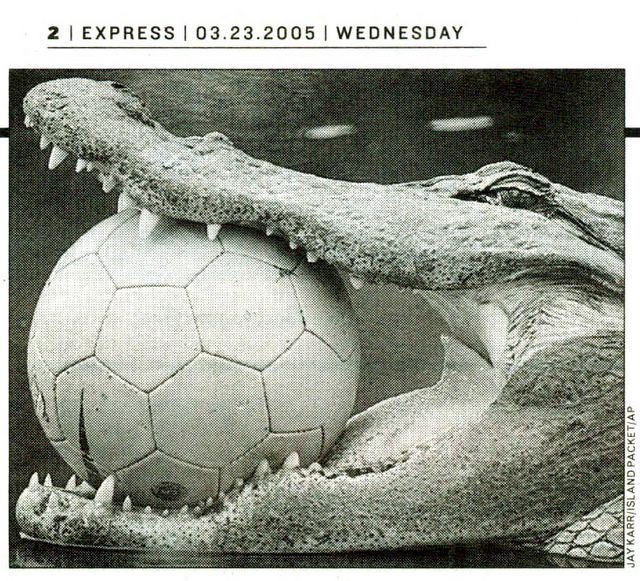
Gator Meets BuckyBall
I saved this from a free paper they hand you at metro stops in Washington DC -- reminded me of something I'd posted recently.
Monday, April 04, 2005
Getting Back Up to Speed
I spent much of last week wallowing in fever -- too delerious to read much. However, yesterday I was able to wolf down one from mom's collection: Nonviolent Solder of Islam, Badshah Kahn, A Man to Match His Mountains, by Eknath Easwaran (1999 soft cover edition, Nilgiri Press).
I imagine few in the USA today have a clue about this episode: a Gandhian revolution against British imperialism and local custom, which glorified revenge killings, led by a devout Muslim from the north west frontier. Ghaffar blew everyone's stereotypes at the time (a superhero incredible!). The Klingons discover satyagraha. Gandhi considered him a great spiritual leader, as he practiced nonviolence coming from strength, not fear -- always the ideal.
Before I could read, I played comedy channels through the iTunes internet radio. One comic really tore into those RVs. My cybervan idea runs into these same negative PR problems. Matt always signals his disgust when I float this little fantasy.
I'm glad to see Japan is hosting another Expo, complete with signature themes (people movers, corporate pavilions). Maybe Wired'll do a write-up (Gibson likes to visit Japan). Have we seen it on the network news? I might've missed it.
Followup: this article in The Guardian has become something of a classic amidst a growing literature chronicling the rise of a new gulag centered in Afghanistan.
Thursday, March 31, 2005
Thought for the Day
Computers ended up giving us a whole new cast of bread and butter metaphysicians, people making their living in realms of abstraction with concrete consequences in code. When philosophers cranked up their propositional calculus and modal logic in the golden age of Principia Mathematica, they maybe expected such lines of work would be their legacy. But academic philosophy seems relatively stuck with old tools right now. Computer science is doing more of the heavy lifting. And what would mathematics be today, without Mathematica? Computers have changed the dialog among the disciplines.
Sunday, March 20, 2005
Social Security for Condors?
So there's some planning afoot to reintroduce condors (the giant birds) to the Pacific Northwest, as well as to the southwest USA. This plan is unlikely to be successful however. Hunters don't want to upgrade their lead shot to titanium or some such, meaning wounded game that gets away and dies alone only serves to poison these carrion feeders.
Another killer is the poison used against coyotes and such (assurances to the contrary notwithstanding). The mortality rate for reintroduced condors is still way too high, thanks to people not taking significant steps to reduce the factors leading to their near total extinction in the first place.
One of the worst things to happen to condors was Sandy Wilbur, author of a self-congratulatory book about his days overseeing their welfare. On Wilbur's watch, the condor population plummeted, in large degree because he thought their reproductivity was the problem, not their morbidity (two factors account for die-offs: failure to breed; failure to survive).
Finally, Wilbur was given the boot, and his successor, a far more competent field biologist, established the true causes of the condor die-off. Low reproductivity had nothing to do with it.
On another front, government bureaucrats overseeing the salmon runs are hell bent on relocating the Caspian tern population at the mouth of the Columbia River, which picks off a percentage of the salmon.
Field biologists have data indicating that this policy doesn't address the real threats to salmon, but it's much easier to scapegoat the terns, to make their relocation the centerpiece of a bogus "solution," than it is to take more serious measures. Or, if the U.S. Army Corps of Engineers does have a credible model of how tern relocation is the answer, then let's see their data.
Intelligent public policymaking depends on making relevant data freely accessible. Science thrives on data. Politics all too often thrives on a lack of data.
When science is safely disposed of, the playing field gets monopolized by self-interested opinion-makers and the winning strategy is to grease the wheels and make the right friends. The public suffers and democracy becomes shallow and farcical. Propagandists have a field day cranking out a shoddy product. The real work of designing a sustainable ecosystem for the longer term doesn't get done.
Science, which harvests and feeds on data, and democracy, which channels data to a concerned and informed public, are natural allies. Politics-as-usual, on the other hand, often works to snuff out democracy whenever possible.
As a political system, democracy is inevitably subversive. We defend democracy by undermining the positions of those who would make policy in a vacuum, in willful ignorance of the relevant data.
Friday, March 11, 2005
Some Political Analysis
I appreciate that putting a focus on social security is giving politicos, especially senatorials, an opportunity to zoom out and talk about the big picture for a change. The president is using a multi- generational time line like a big stick in an alligator's mouth, to hold the jaws open.
Leadership opportunities abound, to mix realism and futurism in interesting new ways; just stick your head down the alligator's throat and tell us what's down there, easy. Obviously big changes are afoot, and technology is racing on ahead, so the American people could use some substantive national dialog.
But the senatorials choose to stick with a strictly literalist or fundamentalist interpretation of "social security" and choose to keep the debate "by the book" i.e. as narrow as possible. For example, they argue about the long term solvency of the program internally, but fail to address the larger issue of a ballooning national debt. They duck, thereby failing to earn their high salaries.
When it comes to bombing campaigns and military action, politicos like to sound bold and full of bluster. But when the debate turns to civilian matters and the long term well-being of ordinary Americans in a peace-time economy, the boldness evaporates and everyone goes for playing it safe. Like, there's always plenty of money for war, but not much else. Funny how that is.
However, this is not a new pattern. We all know that politicos tend to follow more than lead. Another engine for change is the university, where young people with their whole lives ahead of them get some time to brainstorm about the big picture, before becoming submerged in the day-to-day.
Professors stereotypically inspire their youthful idealism, by feeding them a lot of grist for the mill. This is how professors get their reputation for being "liberals" (as in "liberal arts") -- a criminal mindset as some would have it, but historically a big part of what's helped us innovate and adapt.
But I'm not seeing a lot of interesting futurism coming from the professors these days either. They've mostly let this social security opportunity go by, aping the politicos, throwing a lot of numbers around. The deeper issues don't get discussed. A climate of caution prevails.
That leaves Hollywood and the media, including the Internet and the blogosphere (which is where you are now). I see more movement in this sector, plus a way of networking with those student idealists still able to think big picture and outside the box. Unfortunately, a huge amount of energy in the blogosphere goes towards playing petty politics.
I think it's a good thing that Bill Clinton has been out playing golf with the elder George Bush on behalf of tsunami survivors. That helps depolarize a mindset, making it harder for people to pour energy down their favorite political drains, squandering opportunities for personal growth and big picture thinking. Both these guys are showing some real leadership, while the younger Bush goes around stirring up the alligators.
Subscribe to:
Posts (Atom)
