Thursday, November 10, 2005

Google Gets Video

So I've been uploading since like 4 AM, even while sleeping, this 712MB vidclip of me presenting to Wanderers @ Linus Pauling House some years back, on the subject of Geodesic Domes.

At this point in history, open source video is still somewhat new. However, my general systems theory papers suggest this model: humans in scenario Universe = PWSs = personal workspaces = edit/recombine studios.

Of course "recombine" evokes "recombinant DNA" and all the nightmare possibilities early 21st century humans needed to grapple with (right up there with extraterrestrials and dolphin intel).

But it also has more benign meanings, e.g. individual humans becoming very adept at mixing multimedia, expressing themselves and their worlds, making use of studio quality equipment 24/7 (with breaks), and in the freedom of their own homes.

This is in addition to performing in popular day jobs: baggage handler at megajet and microjet airports (including UPS, DHL and FedEx), outdoor security and park ranger (including at zoos), web wrangler (e.g. like for Wanderers), computer technology trainer, health care pro, architect & construction engineer, heavy equipment operator (some airline pilots), and those doing Hilton-Sheraton-Marriott type services (includes a multi-ethnicity cast of career diplomats and spies).

All these lines of work harness many energy slaves, in the sense of robotic time on the CPUs and SQL engines -- a true mass labor force even in 2005 -- with software and circuits etched in silicon (the possibility of machine intel another one of those "must grapple withs" -- and well played by the then Governor of California).

Followup: I'll link to said vidclip lecture here when the uploading process is complete.

Followup: Google kicked us all off Google Video in 2011, so I moved the clip to Youtube (which is also Google's).

Tuesday, November 08, 2005

Math Forum

I posted more futuristic mathematics today, invoking a lot of VBNs in the math teacher community (Gibbs, Heaviside, Hamilton). The general topic is Math/CS, this hybridized numeracy curriculum my colleagues and I think makes a lot of sense in this age of Google Earth and XML. We want formal operations applied in business and commerce, like before, but with more attention to the global Internet, how it works, who administers it.

Washed Razz (the Subaru) in a local U-Wash (insert coins, operate a cycle waving giant wands, Harry Potter style, with stuff spurting out all over your car, sometimes under high pressure -- worth a couple bucks, plus you get this shiny waxy vehicle to drive off in (a happier camper for sure)). Swapped a couple items at Trader Joe's. Having better luck with DVD-Rs for some reason, the DVD+Rs keep wiping out. Burned a complete set of Don's Guatemala pix to a JVC yesterday afternoon. Loved the final Extras with Patrick Stewart on HBO!

More open source curriculum writing from 4D Solutions: [1][2]

Thursday, November 03, 2005

Acting Locally

Some days ago I used the wget tool at my Cygwin command line, a *nix in a *doze, on Joe Moore's site. He's spent half a lifetime compiling bibliography & connecting ideas around Bucky (Bucky being a veritable switchboard of the 20th century), all in rough and ready wild west HTML (no rules, or almost none -- however consistently tabular, a big help).

So this morning I subclassed HTMLParser in Python and wrote a quick hack, aiming at filtering HTML noise and republishing in a strict XML. From there, it'd be easier to head for mature formatting, via XSLT. We wouldn't lose touch with Joe's primary audience, either: souls on the web (so-called "eyeballs" in market research parlance). My Python code globbed through "books By"*.htm and spit back some reasonable XML for a minority of pages (those in a strict 3-column id, chapter title, page number format). I pasted one success story to GEODESIC c/o SUNY at Buffalo. Here, lemme link to my code.

That was this morning.

This afternoon, I left Dawn with some veteran/alumni of some enlightenment training (Portland has a lot of good schools), while I picked up Tara, who needs something faxed to her teacher (due homework, completed per spec, but left in the printer this morning), and then drove out to Marine Drive to welcome Don back from Guatemala. He spoke with great awe and respect of the Guatemalen experience/people (pueblo). I'll be rejoining him later for the kickoff of the 2005-2006 ISEPP lecture series, our latest in a series of presentations delivered by some Very Big Names (VBNs) -- sometimes with repeat visits (e.g. Roger Penrose is returning in March).

Portland has felt very privileged to be on the receiving end of Terry's circus. I've enjoyed so many of these lectures so very very much. You VBN people are simply amazing and wonderful creatures. Love!

But some of that hasn't finished happening yet. Gotta get back to work.

PS: Lotsa VBN-hoods out there, and you're welcome to be a Big Name in several of them. The Universe is not stingy about letting us be celebrities in cool circles we respect, if that's our goal (which doesn't mean individual humans can't be miserly). Join the club, beat your drum (metaphor), and sometimes hold it down (Quaker voice: ssshhh, keep it quiet), and you'll dimly hear many more drum beats, from far far away (something drums are good for).

Followup (Nov 4): my write-up of last night's lecture (link).

Tuesday, November 01, 2005

Wanderers Meeting 2005.11.1

The Gaia Hypothesis holds that complex chemistries known as "the living" may play a homeostatic role on a planetary scale, maintaining atmospheric conditions far from an "equilibrium of the dead." Our oxygen-rich Earthian cocktail could never have arisen, nor would be sustained, minus cell-based metabolism.

We humans play a role in the local cybernetics and have evolved new powers to anticipate and counter death threats the dinos never had (e.g. Apophis).

Gus Frederick of Silverton, Oregon shared his hopeful hypothesis that our self-destructive tendencies were symptomatic of species adolescence, a passing phase we'd survive and outgrow. Our long term destiny, thinks Gus, is to spread life extraterrestrially, starting with our moon and Mars.

Only time will tell.

Followup: link to Gus's slides

Saturday, October 29, 2005

Capote (movie review)

Truman helps prolong the lives of two murderers, giving them false hope of reprieve within a barren prison existence, in order to better understand their crime, and turn his understanding into a non-fiction novel.

He makes good on his promise to portray Perry as more human than monster. The other killer gets far less empathetic treatment. The victims of the crime appear only in horrific flashbacks and crime scene photographs.

Truman is aware of the exploitative aspect of his work. First he needs to keep the prisoners alive, so he can get their story, then he needs them dead, so he can conclude and sell it (his friend Nell sees this dynamic even more clearly). He also sees a lot of himself reflected in Perry. His empathy is real, if tainted. And besides, it's not just Truman who stands to gain by exploiting suffering and violence, but his community of literati, generations of English professors, the makers of this film.

Coincidentally, just a few hours before seeing this film with Dave, I read Lawrence Weshler's essay Valkyries Over Iraq (Harper's, Nov 2005), which looks at how violence and art sometimes feed off one another within the war movie genre. Obviously art is part of life, not outside it, just as language is within the world -- it's not really a matter of one imitating the other. As a Buddhist might put it: parts reflect other parts but the whole is unreflected, because it has no mirror.

Sunday, October 23, 2005

Legal Affairs

Some news and views regarding legal matters:
  1. President G.W. Bush's defense of Harriet Miers reminds me of my own defense of Ada Byron: "It's a casting decision, and in my judgement this Ada Byron character has done a creditable job, and should keep developing in this role. It's her niche and she's earned it. Others may (and do) disagree, but I'm unmoved to alter my aesthetic judgement at this time."

  2. The big crime tangential to special prosecutor Fitzgerald's investigation would be the forging of documents aimed at implicating Niger, a sovereign nation, in secretly circumventing the IAEA by supplying a nuclear weapons program with uranium. Ambassador Wilson's trip to Niger was a part of that larger CIA and FBI investigation. I hope the dangerous criminals behind this ruse eventually get caught, so we can all feel safer.

  3. This morning, I wrote an essay discussing my views regarding the practice of law, which is partly what got me onto this topic. Software engineering is inevitably replacing a lot of legal boilerplate with self-executing code -- the only way to keep up with the increasing volume and speed of global commerce. Philosophy helps communicate our ethics and aesthetics to these engineers, as their soulless machines are intrinsically ignorant of our human values (note: PI = Philosophical Investigations, a book by Ludwig Wittgenstein).
Addendum: link to news item re #2, by Martin Walker, UPI Editor.

Wednesday, October 19, 2005

Wanderers 2005.10.18

Rick Grote took us through an overview of classical thermodynamics and statistical mechanics, in preparation for his review of Into the Cool, a new book by Eric D. Schneider and Dorion Sagan (and which mentions some Wanderers in the acknowledgments).

A core thesis of the book is that life capitalizes on thermal gradients, gets work out of them, is itself work (or organized play, as the case may be). Of course the 2nd law prevents 100% efficiency i.e. there's always leakage in the form of heat such that no standalone machine ever wins immortality for itself.

Another thesis: just noting our Earth is an open system, and therefore not currently bogging down under the 2nd law, doesn't "explain" life's amazingly inventive gradient- exploiting ways, any more than the brute fact of ocean waves "explains" the phenomenon of surf boarding in California.

Grote, a chemist and engineer, found Into The Cool persuasively written and full of interesting info, such as the graph relating successive generations of ground cover to thermal efficiency: small, short-lived, energy-inefficient ecosystems give way to slower, bigger, more thermally efficient ones (e.g Oregon's old growth forests).

He also found insightful the focus on metabolism (eating) over sexual activity, as a signature of primitive life. However when it comes to sheer complexity and pattern formation out of chaotic conditions, non-life is pretty good at that too (the book is pregnant with examples). Life seems destined to explore at the edge of chaos, is always taking risks, flirting with disaster, in terms of becoming overly-complex and experiencing a break down.

On the down side, Rick doesn't much like the aphorism "nature abhors a gradient" as she seems to create and depend on them just as surely as she erodes them away. He also didn't find the tie-ins to preferred social policies scientifically persuasive, even though he shares many of the same policy goals.

Temperature differentials are what separate living ecosystems from an entropic desert, and life seems intent on keeping it that way (an uphill battle), by creating new gradients, new possibilities for interesting work, even as she/we/it burns through existing ones. Even if we're all headed for an ultimately entropic state, as many writers suppose, life has a way of drawing things out, postponing the inevitable for as long as physically possible.

Addendum:

After the end of Rick's talk (2 Hi-8 tapes, recorded using my Sony TRV240), I projected Gerald de Jong's Fluidiom project (Java app). Apparently the digital life people come in for some withering criticism in Into the Cool (which I haven't myself read yet), especially in connection with Stephen Wolfram style cellular automaton studies. Gerald's approach is more like Roger Gilbertson's (muscle-wire robotics), and uses tensegrity-inspired elastic interval geometry (Kenneth Snelson, R.B. Fuller, Cary Kittner, Sam Lanahan, Karl Erickson, Russ Chu, John Braley et al).

Thursday, October 13, 2005

A Candle for Dad

Today we remember the October 13, 2000 car accident, and the wonderful life of Jack Urner. My uncle Lightfoot came by for some coffee. We talked about his adventures in publishing, now that his new book is available. Dad and Bill both worked in Alaska for a spell, had similar adventures. Dad's side of the family really digs Alaska.

Carol, my mom, born in Chico, California, grew up in the midwest and Seattle, her dad a union linotype operator for newspapers. She met my dad at the University of Washington. Dad's lineage traces to Swedish settlers on Mercer Island on his mom's side, and to Urners emigrating to North America in the 1700s on his dad's side. He studied urban/regional planning with Dr. Richard Meier at the University of Chicago, after a stint at Johns Hopkins in international affairs. He then moved his family to Portland, where he joined the Planning Bureau.

Dad's dream all along was to see the world and do planning abroad (a civilian lifestyle -- he'd become a convinced Quaker by this time) and his first overseas client was Libya. He always worked closely with counterparts in the client country, which were then the Philippines, Egypt, Bangladesh, Bhutan and Lesotho.

The car crash happened between Maseru, Lesotho and Bloemfontaine, South Africa, on a dangerous section of road. I flew out to tend to mom in the hospital, arrange the memorial service, settle accounts, and sell or ship our family possessions. My sister Julie spelled me after about a month, and got mom back to the States once she could be moved.

The US Embassy in Maseru, and the one in Johannesburg, were helpful in our time of grief, as were many engineer and diplomat families of many nationalities, the funeral director in Bloem, the police, many Southern African Friends, the Bleekes of Multnomah Meeting. My profound thanks also to the professional staff at the hospital, including the rescue team, who saved mom's life. Thank you to my parents' friends in Lesotho for making their years there so enjoyable, and to Emily for all her good work.

I am also lighting a candle for the driver of the other vehicle, who also died as a result of the crash.

Wednesday, October 12, 2005

Saturday Academy

Terry is chattering about "E equals emcee-squared" (apparently the topic of last night's Nova on OPB). In synergetics, we don't think "squared" so automatically -- "triangled" could be cooler i.e. the important thing is just to imagine some/any surface area (a topology). "Cubed" is volume, and closely associates with "tetrahedron" in synergetics (i.e. the minimal sharp-edged volume). Volume is related to energy, frequency, information and experience (see Synergetics Dictionary).

A few minutes ago, we were exploring Caitlin's (Terry's daughter's) blog. She's enroute around the world.

Joyce Cresswell (SA CEO) kindly appeared to deliver her presentation. Also present: Allen Taylor, Terry Bristol (ISEPP CEO), Jon Bunce, Jim Buxton, Rick Grote and myself. Don (Wanderers CEO) is enroute to Guatemala today, hurricane Stan (now past) notwithstanding. The earthquake in Pakistan was a focus of CBS News last night.

SA was founded around 1982 by 2 PPS TAG teachers. Computers were invading the business world but not yet the home. HP, Tektronix, bright kids = dynamite combo. The companies said yes, let's do it @ Oregon Graduate Institute (OGI). Taught 185 kids the first year, enrollment now up to around 4K+, including Corvallis.

Transitioning to a knowledge-based economy (KBE), is what SA is all about, because that's where creativity is heading in this state: design, invention, not so much manufacturing (although we do some of that). Average income for Oregonians is pretty low by USA standards (75% < $40K). KBEs center around engineers. Degree stats: US 5%, Oregon 9% and China 46% graduate in engineering (source credited on slide: Institute for Engineering Education). Employers have little choice but to import leadership talent. Problem-solving, critical thinking, work ethic -- all in short supply, on top of missing engineering savvy. Allen, citing a recent meeting of IEEE, chatted about the lack of training in cross- disciplinary teamwork.

SA offers courses in: robotics, programming, forensics, web design, genetics etc. It offers apprenticeships in industry, research labs, agencies. Community-based professionals comprise the faculty (I, Kirby, am one of them -- e.g. Joyce placed me with the Hillsboro Police Department that time, teaching open source). A benefit to engineers: SA provides participating firms with a sneak peak at native talent, relationships form, which may lead to later recruitment.

Bottom line: Oregon is moving to address its obvious weaknesses. The elements of a new pipeline are in place, but it's still relatively low volume. The older pipeline, which loses most would-be scientists and engineers through the cracks, still handles most of the load. Too much native talent is needlessly squandered.

SA is working to double enrollment, triple scholarships, and consistently reflect the locally complex demographics (in both students and faculty). Oregonians of whatever hue tend to be multi-ethnic, yet have a common interest in continuing to build a dynamic, world class, Pacific Rim KBE.

We finished with lengthy discussions and Q&A. Wanderers and Saturday Academy have a lot to talk about. Terry sampled a lot of his pro-design, pro-engineering soap box rhetoric. I mentioned Trevor Blake as a possible future Wanderer/presenter regarding such topics as the Technocracy movement and systematic ideology.

Saturday, October 08, 2005

Flightplan (movie review)

Took some fancy footwork (Trimet assissting) but I got there in time, with a preview to spare. This was at the end of the hall in the multiplex out in the infamous parking lot (across from the LC mall), where those crooks stole my Dawn's Suburu during Troy that one time.

She's in top form, dear Jodie as Kyle, sprinting the length of a very long jet, a few times, adrenalin pumping, every emotion in gear, single minded, to find and rescue her missing child.

Hints of Red Eye, sure, but also, for me, a strong hit of Sigourney Weaver as Ellen Ripley, what with her nakedly aggressive bias (pro-human), which audiences know and recognize. We love our children. We fight for them.

The difference being: in this film, the heroine is not up against space aliens, but immigration aliens, i.e. us, the human types. And we're scary enough. We're all those other people on that plane, with our own private losses and dramas. We secretly admire Jodie's character, because she's strong, willful, even right, i.e. a goddess protectress, an incredible.

My insider take is that the movie blatantly lied about aircraft architecture outside the double- deck cabin, territory Jodie's character supposedly knows well. Like that Cray- like supercomputer beneath the cockpit? A pure archetype. Or hey, maybe she really was crazy and wakes up later in bed in some Arnold Schwarzenegger scifi -- or in eXistenZ (caught David Cronenberg's interview with Terry Gross the other day, wherein parent-child separation anxiety was also a theme).

Wednesday, October 05, 2005

Market Research

Pat Barton shared about his science with Wanderers last night, camcorder on, lapel mic on. He works in linear equations describing covariances discovered in focus group data, tying customer attitudes to brand loyalty. This is an expensive high end service for Fortune 100 corporate clients.

An example would be Whirlpool: the company was already heavily involved in Habitat for Humanity, because of its specific history, but the public didn't know that. In the mean time, Pat's company's analysis showed that power nesters, mostly boomer women with bucks and a desire to have the best appliances in all dimensions, cared deeply about corporate social responsibility, and if it turned out Whirlpool actually cared, then more people would replace older Whirlpools with newer Whirlpools. So obviously the answer was to publicize this pre-existing commitment and track record. Everybody wins.

Sunday, October 02, 2005

WQM (Fall, 2005)

WQM may not actually meet quarterly, but the Q does refer to a four period cycle. Quakers apex into local Yearly Meetings, which conduct business during their Annual Sessions. Minutes from the Monthly Meetings for Business, such as MMM or BCFM (both in Portland), filter up through the quarterly level (e.g. WQM) enroute to the Yearly level, in our case NPYM (North Pacific Yearly Meeting). The Willamette Valley stretches from Portland south through Salem, Corvallis, and Eugene.

I talked a good bit with Anthony Manousos of Friends Bulletin. He authored the short pamphlet Islam, which documents some kodak moments that characterize the relationship between Islam and Friends (generally good).

Manousos observes Ramadan, which begins this Tuesday. This signature month-long period of fasting at the core of Islam is in part about strengthening and celebrating God's gift of an intuitive mind, attuned to eternal principles, and so frequently our ticket out of these hells of our own making, hells brought on by inappropriate automatism, obsolete and unexamined habits of thought.

Another motivation for the Ramadan fast is to commiserate with the starving. We pray this form of compassion will be of fading relevance, as our global university campus Food Services starts to kick in.

Ibrahim, one of the featured panel members this time, also catered the main meals. He's a pro in the local food biz. His excellent dishes got rave reviews. WQM has been turning to catering more and more (a topic in Business Meeting, along with EMO). Helen's son John catered Thai food a few cycles ago, and that seems to have gotten the ball rolling.

Thanks to my friend Pan, I spent some time thumbing through The Fourth Turning, a cycling-through-archetypes panorama. I got slaughtered at ping pong by a Junior Friend, also a talented piano player (good game). Friend Michener related some of her experiences in leadership with Landmark Education.

The weather wasn't all that bad Saturday night, so star gazing was an option. Mars was very bright overhead around 6 AM the next morning, when I joined the breakfast crew (Pam Avila of MMM directing, fellow BCFMers at work stations).

I shared Stellarium with several Friends in the main lodge while charging up on AC. Later I ran solo on DC in an open field, comparing screen pixels to patterns of starlight. Then I transferred to my tent for the night, where I used up the rest of the battery.

Other abbreviations decoded: MMM = Multnomah Monthly Meeting; BCFM = Bridge City Friends Meeting; AM = Ante Meridiem (i.e. before noon); AC = alternating current; DC = direct current.

Friday, September 30, 2005

Another Day in the Rainforest

Jim Buxton gifted our group with some of the best chanterelles ever, and for two days in a row we've been having them on the side next to mushroom & Tillamook cheese omelets. My FitDay food log is having a cow about it, but hey, I'm still under my daily calorie budget, steadily shedding pounds (a British imperial unit).

Quarterly Meeting starts today @ Sky Camp. Given the dismal weather, this'll be largely an indoor affair, more about fellowship and less about banana slugs. I'm packing a tent and may cocoon with a Buffy DVD vs. Stellarium.

I wrote a cool essay on the Urner/Wittgenstein relationship today @ Math Forum.

Great job Nirel! -- she's our new Wanderers Web Wrangler. Whomever holds the Portfolio of Scheduling should report directly to her (we're thinking to rotate the job of booking presentations, so we each get a chance to share some of our favorite people, like I did with Ron i.e. as we've already been doing from the get go).

Wednesday, September 28, 2005

Public Licensing

Obviously a lot of the thinking that's gone on around how to keep software designs public, per the intent of its authors, is starting to inform licensing more generally. Some types of inventor have always wanted their work to benefit humankind. Toys, pharmaceuticals, manufacturing processes -- I expect to see more and more open source licensing protecting these assets from overexploitation by a greedy and undeserving few.

The corporation, having sneakily insinuated itself into our codes as a pseudo-human (see Unequal Protection by Thom Hartmann), has tended to suppress our very human desire to benefit one another. However, the power of this particular institution, in its LAWCAP form at least, is on the wane, in part because much of its core infrastructure is in the hands of philanthropic engineers with an appreciation for general systems theory (i.e. of what it will take for us to succeed macroeconomically).

What does nature herself provide, in terms of common heritage? Should we consider DNA sequences found in nature to be under some kind of BSD type license, or is she more GPL? Such questions will frame the ethical debates of tomorrow, thanks to people like Richard Stallman, one of the great moral philosophers of our day. Unbridled human selfishness, on the other hand, will be seen in retrospect for what it was: a pathology and design flaw that nearly got us wiped out as a species.

Sunday, September 25, 2005

More World Game Data

Page A10 of today's Oregonian talks about the rally in Washington, DC on Saturday, next to an ad for Terry's lecture series. My friend Matt was at the rally along with others in his family. He flew all the way from PDX just to be there. I'm looking forward to hearing his personal account.

Wednesday, September 21, 2005

GST Revisited


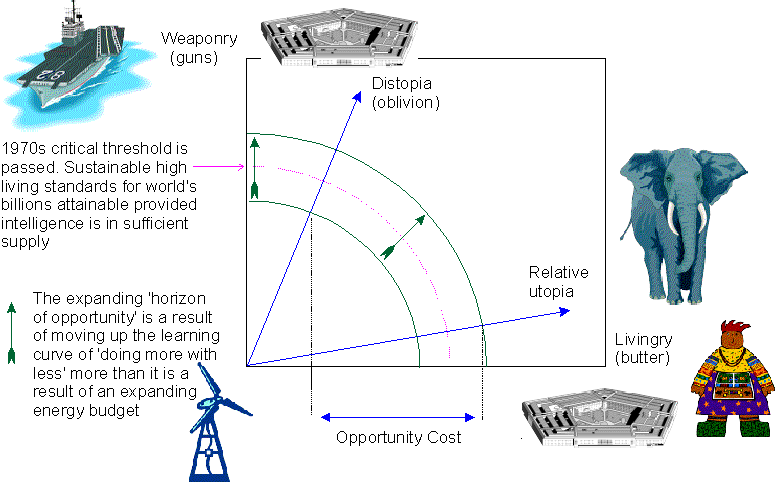
Last night I decided to alter this ancient graphic at my Synergetics on the Web, by sliding a copy of the Pentagon to the lower right (if looking from this side). And I added the paragraph: "The Pentagon is shown in both directions because some in the military have largely freed themselves from LAWCAP's obsolete reflex conditioning and have a more GST-informed outlook."

I think it's important that we acknowledge the progress we've made to date.

And speaking of progress, kudos to Blogger for making picture uploads a snap through the standard interface.

Monday, September 19, 2005

Talk Like a Pirate


Jolly Roger

September 19 is Talk Like a Pirate Day -- another excuse to get in touch with this part of our heritage. According to the algorithm in today's Living section in The Oregonian, my pirate name could be: Squinty Rumpot Broadside (I think I'll pass).

Related Post: Adventures in Radio Land (Part 2), 10 Feb of this year.

Saturday, September 17, 2005

Build It Green

Today we joined other Portlanders on a self-organizing tour of G/Rated homes, featuring various intelligent, energy efficient designs. We visited the tiny one-person house on wheels (visiting from Olympia), the sunlight and rain harvesting "net-zero" Victorian, and the little clay studio with a living roof.

We also left voicemail expressing some interest in a refurbished '84 Ford Econoline camper, a possible bizmo, though hardly G/Rated. The Victorians had a pickup they run on B100 (vegetable oil recycled from restaurants).

We had coffee in one of Dawn's former work places on Foster (she quit shortly after the bomb incident -- the site used to be an abortion clinic, Dawn their bookkeeper). Then we went to a nearby Vietnamese bakery to buy moon cakes.

Across my desk: Bruce LeBel's temporary shelters proposal to Oxfam (forwarded by Dick Fischbeck); a poorly sourced story about US soldiers raping Iraqi infants in Tellaffar; email from Nancy, a would-be Wanderer (I invited her to the 9/20 meeting); a request for a CV update from Nick (changes made); a heads up from Gerald de Jong about N J Wildberger's innovations in trigonometry; other stuff.

Thursday, September 15, 2005

Powell's on Hawthorne


Tricycle Magazine cover
Vol. XV No. 1 Fall, 2005


I snagged a copy of this issue of Tricycle at Powell's this morning, along with Make: (vol. 03) and a copy of The Onion (a satirical newspaper). Coffee with Derek.

Before going out, I worked on some new reports for one of my clients (a coding project, Visual FoxPro). Later today, I finished a first edition of a new web page, in preparation for a course I'm slated to teach.

This afternoon, I watched some Smallville with the family on a borrowed Braithwaite DVD (though not the episode mentioned in the aforementioned web page).

Yesterday was our biweekly Wednesday morning Wanderers meeting. KOREducators Adam Reid and Reese Lord went over their hopes and dreams regarding a new charter school they'd like to start under the umbrella of Portland Public Schools.

Charter schools are public schools, but follow a slightly different rule book, allowing them to experiment with different types of teacher (only 50% must be state certified).

Joyce Cresswell of Saturday Academy joined us as well. Her institution likewise gives students access to teachers from a variety of backgrounds.

Sunday, September 11, 2005

Summer Memories (2005)


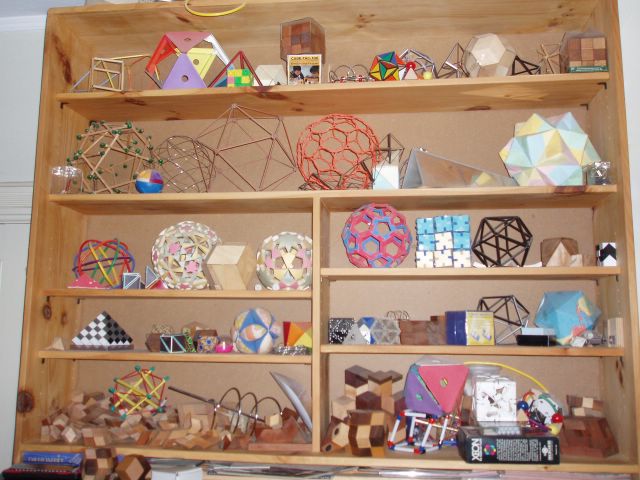
Geometry Toys

Part of the Quimby-Kittner collection in upstate New York. I took this photo during my stay in the tree house this summer, enroute to my 25th Princeton reunion (Class of 1980). For more summer memories, check BizMo Diaries, September 2005.